Connect with us

Published

on

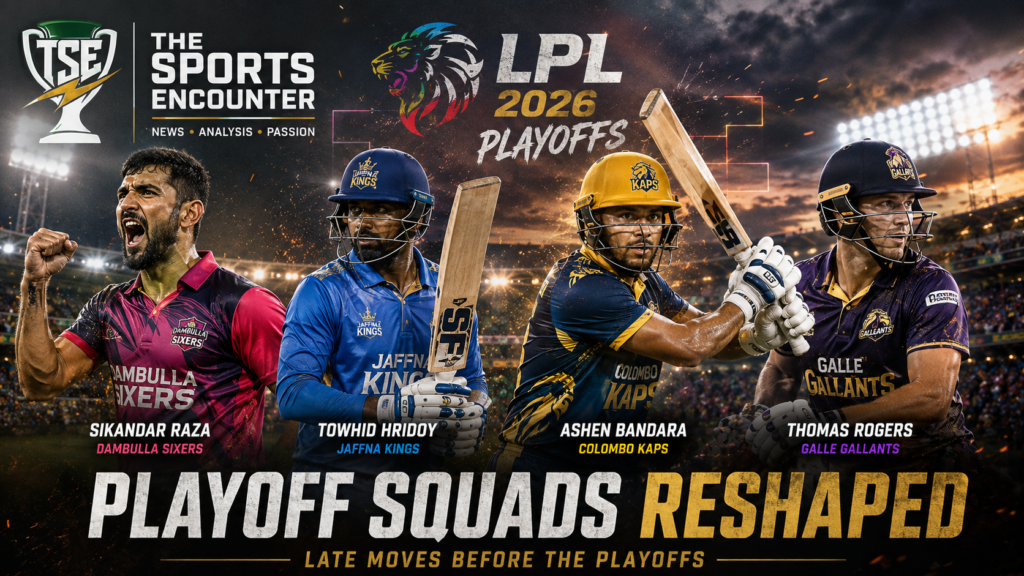
The Lanka Premier League 2026 playoff race has entered its decisive phase, but the teams still standing have not treated qualification as the end of their squad-building work.

Dambulla Sixers, Colombo Kaps, Jaffna Kings, and Galle Gallants have all made late personnel adjustments as injuries, international call-ups, scheduling conflicts, and form concerns reshape their options before the knockout stage.

The changes range from experienced international reinforcements to less-heralded domestic replacements who may suddenly be asked to influence the most important matches of the season.

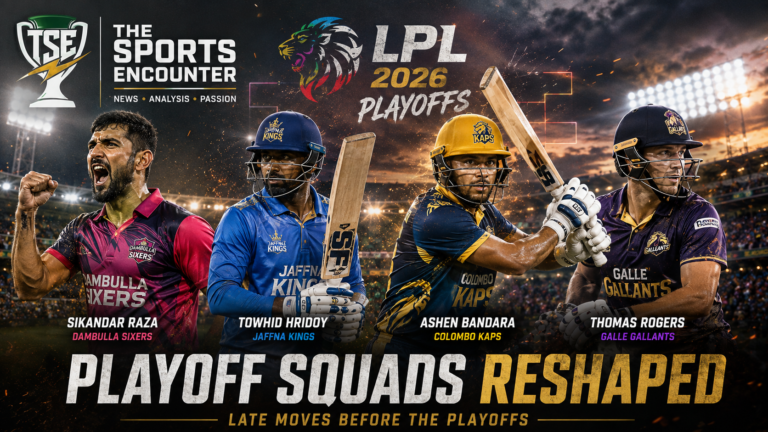
Sikandar Raza has joined Dambulla in place of the injured Marques Ackerman. Sonal Dinusha has also entered the Sixers squad, while Afghanistan fast bowler Fazalhaq Farooqi has departed for national duty.

Colombo have retained Crishan Kalugamage after Kushal Bhurtel was ruled out of his expected arrival. Ashen Bandara replaced the injured Kusal Mendis, while Bangladesh seamer Ripon Mondol came in for Hasan Mahmud.

Galle lost Chris Lynn and Mehidy Hasan Miraz but added Australia’s Thomas Rogers, while Kavija Gamage had already replaced the injured Vishen Halambage.

Jaffna’s most successful late move has been the arrival of Towhid Hridoy after Taskin Ahmed withdrew following an international call-up. Hridoy responded with two aggressive innings that helped lift the Kings from the bottom of the table into a guaranteed playoff place.

These are not cosmetic squad updates. Each one changes a team’s balance, overseas combination, tactical options, and ability to survive the compressed pressure of the playoffs.

Readers can follow every result, squad development, and knockout-stage storyline through The Sports Encounter’s Lanka Premier League coverage.

LPL 2026 Late Squad Changes at a Glance

Team Player in Player out or unavailable Reason or impact
Dambulla Sixers Sikandar Raza Marques Ackerman Raza joined as an injury replacement
Dambulla Sixers Sonal Dinusha Squad reinforcement Adds local all-round depth
Dambulla Sixers No direct replacement confirmed in the update Fazalhaq Farooqi Left for Afghanistan duty
Colombo Kaps Crishan Kalugamage retained Kushal Bhurtel unavailable Temporary squad member now stays for the tournament
Colombo Kaps Ashen Bandara Kusal Mendis Mendis ruled out through injury
Colombo Kaps Ripon Mondol Hasan Mahmud Mahmud returned for Bangladesh duty
Galle Gallants Thomas Rogers Mehidy Hasan Miraz Mehidy’s early departure had been scheduled
Galle Gallants Squad adjusted internally Chris Lynn Lynn failed to recover fully from injury
Galle Gallants Kavija Gamage Vishen Halambage Halambage ruled out through injury
Jaffna Kings Towhid Hridoy Taskin Ahmed Taskin withdrew after a national-team call-up

Dambulla Turn to Sikandar Raza in Must-Win Territory

Dambulla’s decision to bring in Sikandar Raza carried the greatest urgency.

The Sixers had lost three consecutive matches and five of their first six by the time the Zimbabwe all-rounder entered the squad on July 29. Their qualification hopes were no longer entirely under their control, and the final league match against Jaffna had become a must-win contest.

Raza replaced Marques Ackerman, but his first appearance did not produce the immediate impact Dambulla needed.

Against Colombo, he scored 23 from 25 balls and failed to take a wicket from four overs. Dambulla lost again, leaving the experienced all-rounder with the possibility of an extremely short LPL campaign.

Those figures should not obscure the logic behind the signing.

Raza offers three qualities that become particularly valuable in knockout cricket: experience under pressure, middle-order flexibility, and a second spin option. He can enter during a collapse, accelerate against slower bowling, or provide four overs of off-spin and variation when conditions favor grip.

Dambulla’s problem has rarely been a complete lack of talent. Their season has been shaped by inconsistency, disrupted combinations, and an inability to sustain control across both innings.

They began strongly with a high-scoring victory over Kandy, driven by Reeza Hendricks. The Sports Encounter examined that opening statement in its report on how Hendricks and Gulbadin Naib punished Kandy in Match 2.

Dambulla later defeated Galle through another commanding Hendricks performance, showing that their best batting could trouble the strongest sides. That victory is covered in our analysis of how Dambulla handed Galle a major league-stage setback.

The subsequent decline forced management to search for immediate solutions.

What Sonal Dinusha Adds to Dambulla

Sonal Dinusha’s inclusion attracted less attention than Raza’s arrival, but it may offer important structural value.

Dinusha gives Dambulla another Sri Lankan all-round option and greater flexibility when balancing overseas selections. In franchise cricket, local players capable of contributing in more than one discipline can determine whether a team is able to carry an additional overseas batter or specialist bowler.

His value may come through matchup use rather than star billing.

If Dambulla require another left-handed batter, an extra spin option, or a player capable of filling a lower-order role without disturbing the top six, Dinusha provides cover.

The timing also matters because Farooqi’s departure removed one of the squad’s most dangerous overseas pace options.

The Afghanistan left-armer left after Dambulla’s defeat to Colombo to join his national side. His absence reduces the Sixers’ ability to attack with left-arm pace during the powerplay and at the death.

Raza and Dinusha cannot replicate Farooqi’s bowling profile. Their inclusion instead shifts Dambulla toward greater spin and batting depth.

That makes selection more dependent on venue conditions. A slow surface may reward the new balance. A pitch offering pace and carry could expose the loss of Farooqi.

Colombo Lose Kusal Mendis but Gain Middle-Order Cover

Colombo’s most damaging squad change was the loss of Kusal Mendis.

Mendis provides more than top-order runs. He is an experienced wicketkeeper, a strong player of spin, and a batter capable of controlling an innings without losing boundary-scoring intent.

Ashen Bandara was drafted in as his replacement.

Bandara does not offer the same attacking ceiling, but he strengthens Colombo’s middle order and adds a batter familiar with Sri Lankan conditions. His role is likely to involve rebuilding after early wickets, targeting spin through placement, and giving the lineup another dependable domestic option.

That became particularly relevant after Colombo repeatedly required middle-order recoveries during the league stage.

Janith Liyanage and James Neesham rescued one difficult chase against Kandy after the Kaps slipped to 67 for four. Their unbeaten partnership demonstrated Colombo’s depth and is revisited in our report on how Liyanage and Neesham completed a composed recovery.

The playoffs will make similar collapses far more dangerous.

Bandara’s presence gives Colombo another batter capable of occupying the middle overs, but the team must ensure that stability does not become stagnation. Their loss to Galle exposed what happens when wickets and dot balls arrive together.

That 13-run defeat is analyzed in The Sports Encounter’s report on how Mohammad Nawaz dismantled Colombo after a flying powerplay.

Bhurtel’s Absence Keeps Kalugamage in the Squad

Kushal Bhurtel had been expected to join Colombo, but the Nepal international is no longer scheduled to link up with the franchise.

That change means Crishan Kalugamage, initially included on a temporary basis, will remain with the Kaps until the end of the tournament.

Bhurtel would have offered aggressive top-order batting and international T20 experience. His absence reduces the number of options available if Colombo want to alter their opening combination during the playoffs.

Kalugamage’s retention brings continuity.

Late replacements often arrive with little time to understand team roles, training routines, and tactical plans. A player already embedded in the squad may be easier to use, even when he carries less international recognition.

The decision also shows that playoff squad management is not always about finding the biggest available name. Teams must consider availability, role clarity, overseas limits, familiarity, and the time required to settle into a new environment.

Ripon Mondol Replaces Hasan Mahmud

Bangladesh fast bowler Hasan Mahmud returned home for national duty and was replaced by compatriot Ripon Mondol.

The exchange preserves a Bangladeshi pace option but changes Colombo’s risk profile.

Hasan brings greater senior international experience and a clearer record under high-level pressure. Mondol arrives with pace and potential but less exposure to major franchise matches.

His debut against Galle was difficult. Mondol conceded 34 runs from two overs and was involved in the chaotic run-out that ended Colombo’s chase.

A poor first appearance does not settle his value, but playoff cricket offers little patience.

Colombo must decide whether to back his pace, protect him through favorable matchups, or rely more heavily on their established seamers and slower bowlers.

The Galle match also showed that attacking pace can become vulnerable when a bowler misses length at Pallekele. Mondol may be more effective if used in short, clearly defined bursts rather than being expected to solve multiple phases of an innings.

Galle Move On From Chris Lynn

Galle’s squad changes carried less desperation because the Gallants had already built one of the competition’s strongest combinations.

Chris Lynn left Sri Lanka after failing to recover fully from an injury that had caused him to miss matches earlier in the tournament.

On reputation, losing Lynn would appear significant. At his best, he can dominate a powerplay and change the scoring ceiling of an innings within a few overs.

In practical terms, Galle had already learned to operate without him.

Sam Harper, Charith Asalanka, Sahan Arachchige, and Dasun Shanaka had given the batting order several methods of building totals and completing chases.

Harper played a central role when Galle defeated Colombo earlier in the season, scoring 65 during a successful pursuit. That performance is covered in our report on how Harper and Arachchige guided the Gallants home.

Asalanka and Eshan Malinga had already set the tone in the tournament opener against Jaffna. Their influence is detailed in The Sports Encounter’s analysis of how Galle launched its campaign with a 36-run victory.

Lynn’s departure therefore removes a high-impact option without forcing Galle to redesign its entire batting structure.

Thomas Rogers Replaces Mehidy Hasan Miraz

Mehidy Hasan Miraz also left the Galle squad, although his early departure had been expected.

Australia’s Thomas Rogers came in as his replacement.

This was not a like-for-like change.

Mehidy offered off-spin, lower-order batting, and experience in subcontinental conditions. Rogers is primarily a top-order batter who changes the shape of the lineup rather than replacing Mehidy’s bowling contribution.

The move suggests Galle believed its existing slow-bowling resources were sufficient.

Mohammad Nawaz, Sahan Arachchige, Sachindu Colombage, and other local options give the Gallants several ways to cover spin overs. That allowed management to prioritize another specialist batter.

Rogers immediately entered the lineup and contributed during Galle’s win over Colombo, while Asalanka and Nawaz produced the decisive performances.

The signing gives the Gallants an alternative opening or top-order option as they prepare for Qualifier 1. It also creates competition for places, something strong teams can use to protect standards before knockout matches.

Kavija Gamage Adds Local Cover

Kavija Gamage had already entered the Galle squad as a replacement for the injured Vishen Halambage.

The change attracted little attention compared with the overseas movements, but local depth is especially important during a tournament compressed into a few weeks.

Injuries, workload, form, and impact-player combinations can force teams to move beyond their preferred eleven.

Galle’s advantage is that replacements are joining a settled structure rather than being asked to rescue a broken one.

The Gallants finished the league stage at the top after defeating Colombo. Asalanka’s 58 and Nawaz’s three-wicket spell confirmed their Qualifier 1 place and demonstrated why their current balance remains difficult to disrupt.

Towhid Hridoy Transforms Jaffna’s Season

No late replacement has influenced the playoff race more dramatically than Towhid Hridoy.

Jaffna brought in the Bangladesh batter after Taskin Ahmed withdrew following a national-team call-up.

Losing Taskin removed an experienced fast bowler. Adding Hridoy did not replace that skill set, but it solved another urgent problem: Jaffna needed more power and intent in the batting order.

Hridoy scored 35 from 21 balls and followed it with 31 from only eight deliveries.

Those innings helped lift Jaffna from the bottom of the standings into a guaranteed playoff position.

His impact came from tempo rather than volume alone.

A short innings can change a T20 match when it arrives at the right moment. Hridoy’s ability to attack spin and pace immediately gave Jaffna more freedom around him and reduced the burden on Bhanuka Rajapaksa, Kamil Mishara, Ibrahim Zadran, and Chamindu Wickramasinghe.

Wickramasinghe had already delivered one of Jaffna’s most important late assaults against Colombo, helping the Kings defend 179 in a five-run victory. That contest is revisited in our report on how Jaffna survived a dramatic final-over finish.

Jaffna later crushed Kandy by 93 runs as Mishara led a far more complete batting performance. The result confirmed that the Kings had moved beyond their difficult start.

Why Taskin’s Departure Still Matters

Hridoy’s success does not erase the loss of Taskin.

Taskin would have strengthened Jaffna’s powerplay and death bowling, two phases that become increasingly important when playoff matches narrow into a few decisive overs.

Jaffna have effectively traded bowling experience for batting aggression.

That can work if their remaining pace attack controls the new ball and avoids expensive closing overs. It becomes dangerous if opponents survive the early phase and force the Kings to defend under pressure.

The adjustment places greater responsibility on Jaffna’s local bowlers and overseas combination.

It also makes team selection dependent on conditions. On a batting surface, Hridoy’s power may provide more value than the pace option lost through Taskin’s withdrawal. On a pitch offering movement, Jaffna may feel the absence more strongly.

Late Replacements Can Change Playoff Roles

Squad changes made near the end of a tournament differ from preseason recruitment.

There is little time for experimentation.

A replacement must understand the expected role quickly, fit within overseas-player limits, adapt to local conditions, and contribute without disrupting established relationships.

The four teams have approached that challenge differently.

  • Dambulla: Added experience and all-round flexibility because their season was in danger.
  • Colombo: Replaced injured and unavailable players while trying to preserve depth.
  • Galle: Adjusted a successful squad without changing its core structure.
  • Jaffna: Turned an international withdrawal into a batting upgrade that immediately changed results.

The quality of the player matters, but so does the accuracy of the role.

Raza may be the biggest name among the additions, yet Hridoy has produced the clearest immediate return. Rogers entered a strong side with a defined top-order function. Mondol arrived in a pressured situation and endured a difficult debut.

That contrast shows why recruitment cannot be judged through reputation alone.

How the Changes Affect the Playoff Picture

Galle and Jaffna secured the most valuable positions by reaching Qualifier 1.

The winner will advance directly to the final, while the loser receives another opportunity in Qualifier 2.

Colombo entered the Eliminator route, where one defeat ends the campaign.

Dambulla’s position remained more fragile when the late changes were announced. Their final league match against Jaffna carried must-win significance, while other results and net run rate also shaped the qualification equation.

The official schedule, team information, fixtures, and tournament updates are available through the official Lanka Premier League website.

The playoff structure rewards the teams that built consistency across the league stage, but late squad changes can still reshape the final week.

Galle enter with the strongest balance. Jaffna carry renewed batting confidence. Colombo retain enough depth to survive knockout pressure. Dambulla have added experience but must prove the changes arrived in time.

Which Team Benefited Most?

Jaffna have received the clearest immediate benefit.

Hridoy did not require a long adjustment period. He attacked from his first appearances and helped change the rhythm of a side that had been struggling near the bottom.

Galle may have managed the changes most effectively.

Losing Lynn and Mehidy could have disrupted another franchise. The Gallants had enough depth and role clarity to replace them without losing their position at the top.

Colombo’s moves are more defensive.

Bandara, Kalugamage, and Mondol help maintain squad numbers and tactical options, but the Kaps have lost significant experience in Mendis and Hasan Mahmud.

Dambulla’s changes carry the greatest uncertainty.

Raza can still transform a decisive match, but his first outing showed that late arrivals cannot automatically reverse a team’s form. Farooqi’s departure also leaves a clear bowling gap.

Conclusion

The final days before the LPL 2026 playoffs have revealed how quickly franchise squads can change.

International duty removed Taskin Ahmed, Hasan Mahmud, and Fazalhaq Farooqi. Injuries ended or disrupted the campaigns of Kusal Mendis, Chris Lynn, Marques Ackerman, and Vishen Halambage. Scheduled departures created further movement.

The replacements have produced different outcomes.

Hridoy immediately changed Jaffna’s batting. Rogers entered a settled Galle lineup. Bandara and Kalugamage gave Colombo domestic cover. Raza arrived with Dambulla’s season already close to the edge.

The playoffs will determine whether these were administrative adjustments or championship-shaping decisions.

Galle and Jaffna have earned the protection of Qualifier 1. Colombo face the sharper pressure of an Eliminator. Dambulla’s late reinforcements must help turn uncertainty into survival.

At this stage of the season, a replacement does not need to dominate an entire tournament.

A single innings, spell, catch, or tactical matchup may be enough to decide who reaches the final.


Serina Ramgopallan is a Sri Lanka-based sports writer and physical education graduate from the University of Colombo. She has reported on cricket and other major sporting events for Sri Lankan media outlets, bringing regional insight, local context, and a strong understanding of athletic performance to her coverage. Her work focuses on match reporting, player development, tournament analysis, and the emerging stories shaping cricket and other sports across Sri Lanka, India, Bangladesh, and the wider international stage.

Breaking News

Pakistan Leave Trinidad With Relief, West Indies With Regret After a Series That Exposed Both

Hamad Hussain | The Sports Encounter

Published

on

Pakistan Leave Trinidad With Relief, West Indies With Regret After a Series That Exposed Both

Pakistan needed 75 runs to prevent Babar Azam’s return as Test captain from beginning with another overseas series defeat. West Indies needed early wickets to protect a home summer that had finally restored some belief in their red-ball cricket.

By the time Babar launched Jomel Warrican for consecutive sixes at Queen’s Park Oval, the pressure had found its answer. Pakistan had won the second Test by eight wickets, ended their longest away losing streak and leveled a closely contested series 1-1.

The scoreline suited the cricket. West Indies handled the seam-friendly conditions better in Tarouba. Pakistan read the turning surface more accurately in Port of Spain. Both teams found players capable of changing Tests, yet neither produced enough consistency to claim the series.

Readers can revisit the original expectations in our West Indies vs Pakistan series preview and follow further international coverage through The Sports Encounter’s Cricket Hub.

TL;DR

  • West Indies won the first Test at Tarouba by 90 runs before Pakistan answered with an eight-wicket victory in Port of Spain.
  • Justin Greaves produced a historic five-wicket spell and shared Player of the Series honors with Babar Azam.
  • Abdullah Shafique marked his unexpected recall with an unbeaten 160 and earned Player of the Match in the second Test.
  • Babar and head coach Sarfaraz Ahmed made four changes, including the surprising omission of Mohammad Abbas.
  • Roston Chase admitted West Indies underestimated how early the second-Test pitch would turn and should have selected another spinner.
  • Babar sustained a bruised finger during Pakistan’s final chase, but there is currently no indication that he will miss the first Test against England.

West Indies vs Pakistan 2026 Test Series Results

DetailFirst TestSecond Test
VenueBrian Lara Cricket Academy, TaroubaQueen’s Park Oval, Port of Spain
DatesJuly 25-28, 2026August 2-5, 2026
West Indies totals311 and 181344 and 117
Pakistan totals282 and 120387 and 77/2
ResultWest Indies won by 90 runsPakistan won by eight wickets
Player of the MatchJustin GreavesAbdullah Shafique
Defining performanceGreaves took 5/27 and 2/12Shafique scored 160 not out
Series resultDrawn 1-1Drawn 1-1
Players of the SeriesBabar Azam and Justin GreavesBabar Azam and Justin Greaves

Tarouba: Pakistan Created Chances, West Indies Took Them

The opening Test gave Pakistan several opportunities to control the match. That made the eventual 90-run defeat more troubling than the margin alone suggested.

West Indies made 311 after Kavem Hodge scored 84 and Shai Hope contributed 92. Pakistan’s seamers kept the innings within reach, with Mohammad Ali taking 4/50 and Mohammad Abbas collecting 3/63.

Shan Masood answered with 109, the first Test century recorded at Brian Lara Cricket Academy. His 155-run partnership with Imam-ul-Haq, who made 63, brought Pakistan back into the contest after an early setback.

Masood’s innings carried added meaning because he had recently lost the captaincy. He responded as an experienced batter should, focusing on the match rather than turning his hundred into a public statement about the leadership change.

Pakistan reached a position from which they could have secured a first-innings advantage. Greaves changed the direction of the match with one of the most productive spells seen in recent Test cricket.

Justin Greaves Finds the Length That Pakistan Could Not Handle

Greaves took five wickets during five consecutive wicket-maiden overs, becoming the first bowler in Test history to achieve that sequence. His 5/27 restricted Pakistan to 282 and protected a 29-run West Indies lead.

The all-rounder later revealed that he had watched Abbas and copied the Pakistan seamer’s fuller length. That small technical adjustment delivered a historic spell.

Greaves added two wickets in the second innings to finish with match figures of 7/39. Our first-Test report from Tarouba explains how his control and Jayden Seales’ pace turned Pakistan’s promising positions into another painful defeat.

West Indies’ Tail Changes the Chase

Pakistan regained control through Abbas in West Indies’ second innings. He took 5/22, repeatedly challenging the stumps and making scoring difficult. Mohammad Ali supported him with two wickets as the hosts slipped to 93/7.

Shamar Joseph then attacked his way to 38 from 27 balls. Kemar Roach and the remaining lower order provided enough support to push West Indies to 181, leaving Pakistan 211 to win.

Those lower-order runs became one of the series’ major turning points. A chase closer to 160 would have felt manageable. Passing 200 increased the pressure on a batting side with a damaging recent record in second innings.

Seales exploited that vulnerability by taking 5/20. Pakistan collapsed for 120 while Babar remained stranded on 58 not out. The captain showed patience and resilience, but no partnership survived long enough to support him.

West Indies deserved the victory because they controlled the final exchanges of each innings. Pakistan played good cricket in long stretches, yet their inability to remove the tail and protect Babar in the chase proved decisive.

Four Changes Reveal the Intent Behind Babar 2.0

The defeat left Babar and head coach Sarfaraz Ahmed with a difficult decision. They could retain the same combination and demand better execution, or reshape the team for a Queen’s Park Oval surface expected to offer more assistance to spin.

They chose change.

Shan’s fractured left index finger ruled him out, creating an opening for Abdullah Shafique. Pakistan also brought in Awais Zafar, Sajid Khan and Ubaid Shah. Awais and Ubaid received their Test debuts.

Aamer Jamal, Khurram Shahzad, Mohammad Abbas and the injured Shan made way. Abbas’ omission attracted the most attention because he had taken eight wickets in Tarouba and almost rescued the opening match.

The selection made sense once the surface began to turn. Pakistan strengthened the batting order, added an experienced off-spinner and retained Ali Usman as the left-arm option.

Those who followed our earlier analysis of Babar Azam’s return as Test captain will recognize why the decision mattered. His second tenure needed a visible tactical identity. Port of Spain provided the first convincing evidence of one.

Sajid Khan Prevents West Indies From Escaping

West Indies still reached a respectable 344 after winning the toss. Greaves made 73, Chase scored 70 and Brandon King contributed 46.

Sajid prevented a larger total with 4/85. He bowled long spells, changed pace intelligently and gave Babar enough control to rotate Mohammad Ali, Ubaid and Ali Usman around him.

The decision to select two specialist spinners had already started working. West Indies would later regret failing to make the same adjustment.

Abdullah Shafique Turns an Unexpected Recall Into a Series-Saving Innings

Shafique had not entered the tour as an automatic selection. Shan’s injury created the opening, and the recalled batter treated it like a fresh start.

“This comeback match felt like a debut for me,” Shafique said. “I had been working hard for the last one year.”

His unbeaten 160 came from 323 balls and included 15 fours and three sixes. The innings carried patience, technical discipline and a clear understanding of the match situation. Shafique became the first Pakistan batter since 1977 to score more than 150 in a Test innings in the West Indies.

Azan Awais also justified Pakistan’s faith with 55. The young opener handled the new ball carefully and helped establish a platform before Shafique and Babar took command.

Babar’s 88 Restores Authority but Extends His Century Drought

Babar joined Shafique with Pakistan still needing a substantial stand. Their 183-run third-wicket partnership became the central passage of the match.

The captain scored 88 from 147 balls, striking 10 fours and a six. He appeared set for his first Test hundred since making 161 against New Zealand in December 2022 before a mix-up with Shafique ended in King’s direct-hit run-out.

That dismissal extended Babar’s Test century drought beyond three and a half years. His wider contribution still carried significant weight. He finished the series with 193 runs, more than any other batter, and earned a share of the Player of the Series award.

Pakistan reached 387, with Sajid’s 30 helping secure a 43-run lead. The advantage looked modest, but it forced West Indies to bat against two spinners on a deteriorating surface.

Roston Chase Admits West Indies Got Their Balance Wrong

West Indies retained an unchanged XI despite moving from a seam-dominated Tarouba pitch to a surface offering increasing turn at Queen’s Park Oval.

That decision became one of the defining mistakes of the series.

Warrican remained the only specialist spinner in the team. Chase could normally have provided another off-spin option, but his finger injury prevented him from bowling a meaningful number of overs. Greaves then sustained a leg injury and could not bowl at all.

In his post-match interview, Chase admitted that West Indies had underestimated the conditions.

“I don’t want to say we misread the pitch, but we didn’t think that it was going to spin as much from so early,” he said.

The captain also accepted that West Indies should have found room for another spinner.

“We probably would have gone with an extra spinner,” Chase said while reconsidering the team combination.

Joshua Bishop had earned his first Test call-up after taking 119 wickets in 25 first-class matches, but West Indies left him out. His inclusion would have given the team another specialist spin option as the pitch deteriorated.

Chase also felt his fast bowlers took too long to adapt. They continued searching aggressively for wickets when the surface required patience, changes of pace and control of one side of the field.

Pakistan selected for the conditions before the match. West Indies started adjusting after Shafique and Babar had already taken control.

Sajid Khan and Ali Usman Finish the Job

Pakistan’s 43-run lead became decisive when Sajid and Ali Usman attacked together in West Indies’ second innings.

Sajid varied his pace and challenged the right-handed batters around the front pad. Ali Usman created a different angle from the opposite end and kept the stumps involved.

West Indies fell to 103/6 by stumps on Day 3 and lasted less than half an hour the following morning. Sajid took 4/32, Ali Usman returned 4/39, and the hosts were dismissed for 117.

Mohammad Ali added another wicket and ended the series as its leading bowler with nine dismissals.

King could not bat after sustaining a lower-back injury while completing the run-out of Babar. His absence hurt, although the remaining batters still failed to negotiate Pakistan’s spin pair with enough clarity.

The collapse left Pakistan requiring only 75. For a complete account of the series-leveling victory, read our Pakistan vs West Indies second-Test report.

Babar’s Injury Creates a Question Before England

Pakistan’s victory came with one late concern. Babar hurt his finger during the final chase and required treatment before continuing his innings.

The injury did not prevent him from batting. He remained unbeaten on 24 and finished the match with consecutive sixes off Warrican. Babar later described the problem as soreness and bruising.

“Right now it’s a bit sore, but I think it’s fine. It’s a little bit bruised,” he said during the presentation ceremony.

Based on that assessment, the injury currently appears minor. Pakistan have not reported a fracture, announced further medical tests or listed Babar as doubtful for the opening Test against England at Headingley on August 19.

Almost two weeks separate the Trinidad Test from the start of the England series. That recovery window should be sufficient for a minor bruise, although Pakistan’s medical staff will monitor his grip, pain level and ability to train.

English conditions make complete recovery important. Movement and bounce can expose a sore bottom hand or finger, particularly when fast bowlers attack the body.

Babar’s availability appears safe at this stage. His case also looks far less serious than Shan’s fractured finger, which could affect the former captain’s participation at Headingley.

The Seven Turning Points of the Series

Turning pointWhy it mattered
Shan Masood and Imam-ul-Haq added 155Pakistan recovered from an early wicket and threatened to take control in Tarouba
Greaves took five wickets in five consecutive maidensWest Indies protected a valuable 29-run first-innings lead
Shamar Joseph scored 38 from 27 ballsThe West Indies tail pushed Pakistan’s target to 211
Seales took 5/20Pakistan collapsed for 120 and lost the opening Test
Pakistan made four changesBabar and Sarfaraz rebuilt the team for Port of Spain’s spin-friendly conditions
Shafique and Babar added 183Pakistan moved past West Indies and created a decisive first-innings lead
Sajid and Ali Usman took four wickets eachWest Indies fell for 117, leaving Pakistan only 75 to win

What West Indies Learned From Their Home Summer

West Indies finished their 2026 home Test season with a 1-0 series victory over Sri Lanka and a 1-1 draw against Pakistan. After years of frequent red-ball disappointment, that represents progress.

Amir Jangoo’s 233 against Sri Lanka gave the team a potential long-term middle-order anchor. His 401-run sixth-wicket partnership with Chase set a Test record and showed that West Indies can build matches through sustained batting.

Hope supplied stability and led West Indies’ run-scoring against Pakistan with 146. Greaves established himself as a valuable all-round option. Seales reached 100 Test wickets during the Sri Lanka series before collecting eight against Pakistan. Shamar Joseph continued to provide express pace and fearless lower-order hitting.

Chase also enhanced his standing as captain. He scored important runs, communicated a clear ambition to improve West Indies at home and guided the team through an unbeaten Test summer.

His selection in Port of Spain deserves scrutiny, but his honest post-match assessment showed accountability. West Indies now need to turn those lessons into greater adaptability.

The emotional significance of the summer also connected with the passing of a Caribbean icon. Our tribute to Sir Garfield Sobers and his unmatched all-round legacy provides the wider historical context behind West Indies’ dedication in Tarouba.

What Pakistan Found and What Still Needs Repair

Pakistan leave Trinidad with several useful answers. Shafique has reopened the selection conversation. Azan showed the temperament required of a Test opener. Mohammad Ali produced nine wickets through persistence and control. Sajid and Ali Usman proved they can operate as an effective pairing when conditions suit spin.

Babar’s captaincy also gained credibility. Leaving Abbas out after an eight-wicket match carried risk, but Pakistan selected for the new surface rather than rewarding the previous scorecard.

Serious questions remain. Pakistan were bowled out for 120 while chasing 211 in Tarouba. Their management of opposition tailenders remains inconsistent. Babar’s century drought continues, while Mohammad Rizwan and Salman Agha did not make the sustained contributions expected from senior middle-order batters.

Pakistan’s broader fast-bowling direction also remains unsettled. The omission of Shaheen Afridi and the decision to rest Abbas in Port of Spain show how quickly the hierarchy has changed, an issue examined in our analysis of Shaheen Afridi’s red-ball career crossroads.

England Will Give Babar 2.0 a Harder Examination

Pakistan begin a three-Test series against England at Headingley on August 19. Lord’s hosts the second Test from August 27, with the final match scheduled at Edgbaston from September 9.

England are also entering a leadership transition. Joe Root has returned as Test captain, while Marcus Trescothick will oversee the Pakistan series before Stephen Fleming takes permanent charge. Our report on Joe Root’s captaincy return and England’s red-ball reset explains the challenge awaiting Pakistan.

English conditions will require a different balance. Abbas could return immediately, while Sajid’s place may depend on the Headingley surface. Shan’s recovery will affect whether Shafique retains his position, although dropping the Player of the Match after an unbeaten 160 would create another difficult selection debate.

The series forms part of the ICC World Test Championship 2025-27. Pakistan remain well outside the leading qualification positions, making the search for a reliable Test identity more realistic than talk of reaching the final.

Final Takeaway: A Fair Draw With Unequal Emotions

West Indies can feel encouraged by an unbeaten home Test summer, the growth of Chase’s captaincy and the emergence of several dependable performers. They can also regret allowing a 1-0 lead to disappear through an inflexible selection and a second-innings collapse.

Pakistan leave with greater relief. Their eight-match away losing streak has ended, Babar’s leadership has its first meaningful result, and Shafique has returned with an innings that could revive his career.

The 1-1 scoreline reflected an evenly fought series. It also left both teams with work ahead. West Indies need a batting order and selection strategy that adapt more quickly to changing conditions. Pakistan must prove that Port of Spain represented the beginning of better decision-making rather than another brief recovery between crises.

England will provide the next answer. Until then, Trinidad belongs equally to Greaves’ historic spell, Shan’s landmark hundred, Shafique’s comeback and Babar’s two winning sixes.

Visit The Sports Encounter for more match reports, series reviews and international cricket analysis.

West Indies vs Pakistan Test Series FAQs

Who won the West Indies vs Pakistan Test series in 2026?

The two-match series ended 1-1. West Indies won the opening Test by 90 runs, while Pakistan won the second Test by eight wickets.

Who was named Player of the Series?

Pakistan captain Babar Azam and West Indies all-rounder Justin Greaves shared the Player of the Series award.

Who scored the most runs?

Babar led the series with 193 runs. Shai Hope topped the West Indies batting list with 146.

Who took the most wickets?

Pakistan fast bowler Mohammad Ali finished with a series-high nine wickets. Jayden Seales led West Indies with eight.

Will Babar Azam play the first Test against England?

Babar described his finger injury as soreness and bruising. Pakistan have not reported a fracture or listed him as doubtful, so he is currently expected to play at Headingley.

When does the England vs Pakistan Test series begin?

The first Test begins at Headingley on August 19, 2026.

Continue Reading

Breaking News

Raza’s Late Power Carries MI London Through Lord’s Chase

Sikandar Raza supplied the late power after Nicholas Pooran and Sam Curran rebuilt the chase, carrying MI London past London Spirit with six balls remaining at Lord’s.

Published

on

Raza’s Late Power Carries MI London Through Lord’s Chase

London Spirit had 160 runs to defend and the Lord’s crowd behind them, but their room for error had disappeared long before the final six balls. When Sikandar Raza began finding the boundary, a competitive contest turned into another damaging defeat for a team whose qualification hopes were already fading.

Raza struck four sixes in a rapid 32 from 16 balls after Nicholas Pooran and captain Sam Curran had repaired MI London’s chase. Their combined work carried the visitors to 164 for six from 94 balls, completing a four-wicket victory on Thursday, August 6.

The result moved MI London onto 16 points and strengthened their control of a top-three place. Spirit remained on four points and, with only two matches left, were mathematically eliminated from the knockout race.

TL;DR

  • MI London chased 161 in 94 balls to win by four wickets.
  • Sikandar Raza’s 32 from 16 balls, featuring four sixes, provided the decisive acceleration.
  • Nicholas Pooran made 39, while Sam Curran added a measured 33.
  • Lhuan-dre Pretorius led London Spirit with an explosive 52 from 28 balls.
  • Nathan Sowter and Trent Boult took two wickets each to restrict Spirit to 160 for five.
  • MI London strengthened their qualification position, while Spirit’s top-three hopes ended.

MI London vs London Spirit Scorecard

DetailInformation
MatchLondon Spirit vs MI London
CompetitionThe Hundred Men’s Competition 2026
DateAugust 6, 2026
VenueLord’s, London
TossMI London won the toss and bowled
London Spirit160/5 from 100 balls
MI London164/6 from 94 balls
ResultMI London won by four wickets with six balls remaining
Top PerformerSikandar Raza, 32 from 16 balls
Leading Spirit BatterLhuan-dre Pretorius, 52 from 28 balls
Best MI London BowlersTrent Boult 2/35; Nathan Sowter 2/29
Turning PointCurran and Raza added 41 from 18 balls
Tournament ImpactMI London climbed to 16 points; Spirit were eliminated

Pretorius Gives Spirit an Aggressive Start

MI London chose to bowl and quickly removed Jonny Bairstow, but Pretorius refused to let the early wicket dictate the innings. The South African prospect attacked pace and spin with clean swings, reaching 52 from only 28 balls with five fours and three sixes.

His willingness to hit through the line gave Spirit momentum, although the innings became increasingly dependent on him. Liam Livingstone struggled to six from nine balls, while Dewald Brevis managed four from nine.

Nathan Sowter changed the shape of the innings by removing Livingstone and Pretorius. Spirit slipped from 61 for one to 79 for three, losing their most dangerous batter before he could launch a sustained assault through the final quarter.

David Willey responded with 31 from 18 balls, but another cluster of wickets left Spirit at 118 for five after 80 balls. James Coles and Jamie Overton then rescued the finish, adding 42 from the last 20 deliveries. Coles remained unbeaten on 30 from 23, while Overton struck 13 from six.

A total of 160 offered Spirit something to defend. It also felt short of what Pretorius’ innings had briefly promised.

Boult finished with two for 35, while Sowter’s two for 29 gave MI London control during the middle phase. Their work continued a campaign in which the franchise’s power hitters have frequently received a useful platform from the bowling unit, as seen in MI London’s victory over Manchester Super Giants.

Pooran and Curran Rebuild the Chase

MI London lost Will Jacks and James Vince inside the first 31 balls, leaving the chase delicately placed at 48 for two. Spirit had created pressure, and Lord’s began to sense that 160 might be enough.

Pooran settled the situation without abandoning his natural aggression. He scored 39 from 25 balls, hitting two fours and three sixes, and shared a 43-run partnership with Curran.

Their approach mattered as much as the runs. Pooran forced Spirit to protect the boundary, while Curran worked the spaces and kept the required rate under control. Pooran’s dismissal at 91 for three gave the hosts another opening, but Raza immediately refused to let the pressure settle.

Curran and Raza added 41 from 18 balls, the partnership that decided the match. Raza targeted the short boundary and punished anything delivered in his hitting arc. His four sixes transformed a manageable chase into one MI London could finish without needing the final set.

Curran departed for 33 from 23, and Spirit removed Sherfane Rutherford before Raza fell with six runs still required. Tom Curran and Ollie Pope completed the job, with Pope’s boundary taking MI London to 164 for six.

Jamie Overton led Spirit’s attack with two for 23, but the bowlers could not contain all three of Pooran, Sam Curran and Raza. That middle-order depth also proved decisive in MI London’s earlier win over Southern Brave.

Updated Hundred 2026 Points Table

Standings immediately after this match. Net run rate is omitted because the official table had not yet refreshed it.

PositionTeamPlayedWonLostPoints
1Trent Rockets65120
2MI London64216
3Welsh Fire64216
4Manchester Super Giants63312
5SunRisers Leeds53212
6Southern Brave6248
7London Spirit6154
8Birmingham Phoenix5144

The top team advances directly to the final, while second and third contest the Eliminator. MI London now have four wins from six and hold a strong position with two league matches remaining.

Their next game against Trent Rockets on August 8 could influence both the direct-final race and the battle for home advantage in the Eliminator. The wider qualification picture remains available through The Sports Encounter’s cricket coverage hub, including analysis of Trent Rockets’ campaign against Birmingham Phoenix.

Spirit can reach only 12 points by winning their remaining matches. With the third-placed side already on 16, their elimination is confirmed. That outcome completes a difficult stretch that included Jofra Archer’s destructive spell against Spirit and the record-breaking batting assault they suffered at Headingley.

MI London Find the Depth Spirit Lack

Pretorius gave London Spirit the most exciting individual innings of the night, but MI London produced contributions across both disciplines. Sowter and Boult controlled the first innings before Pooran, Curran and Raza divided the responsibility of the chase.

Spirit found another promising player in Pretorius, yet their inability to build around his innings exposed the problem that has followed them through the tournament. MI London, by contrast, found an answer each time the match tightened.

That difference left one side looking toward the knockout stage and the other facing two remaining fixtures with pride, development and selection planning as its principal rewards.https://chatgpt.com/backend-api/sentinel/frame.html?sv=20260423af3c

Continue Reading

Cricket

Jos Buttler Becomes T20 Cricket’s Highest Run-Scorer: How England’s Game-Changer Reached the Summit

Jos Buttler moved past Kieron Pollard to become the highest run-scorer in T20 cricket history after an unbeaten 51 for Manchester Super Giants. This article traces his rise, major teams, titles, tactical impact and place among the format’s top 20 run-getters.

Published

on

Jos Buttler launches a powerful shot under stadium lights beside a graphic showing his record 14,833 T20 runs and his rise to No. 1 on the all-time run-scoring list.

Jos Buttler has spent much of his career making the extraordinary appear inevitable. At Emirates Old Trafford on Wednesday night, another violent burst of clean hitting carried him beyond every batter in the history of T20 cricket.

Buttler struck an unbeaten 51 from only 20 balls as Manchester Super Giants defeated Welsh Fire by nine wickets in Match 22 of The Hundred Men’s Competition 2026.

The innings contained two fours and six sixes. More importantly, it lifted Buttler past Kieron Pollard’s career aggregate of 14,803 runs and made the England wicketkeeper-batter the leading run-scorer in all recognized T20 cricket.

Buttler reached the landmark with the first of three consecutive sixes off Marco Jansen. The ball disappeared towards the hotel beyond deep square leg, and one of modern cricket’s most adaptable careers reached its statistical summit in appropriately forceful fashion.

He finished the night with 14,833 T20 runs from 492 innings, having recorded nine hundreds and 106 half-centuries.

The record may change hands again. Pollard is due to play for Trinbago Knight Riders in the Caribbean Premier League, while Alex Hales also remains active. Buttler himself acknowledged that the summit may eventually belong to a younger generation.

For now, it belongs to him.

That matters because Buttler’s rise was never built around one league, one batting position or one version of himself. He has opened, finished, kept wicket, captained, rebuilt chases and destroyed attacks during the powerplay. He has represented England and franchises across several continents, winning titles while helping redefine what elite T20 batting can look like.

Jos Buttler’s T20 Run Record at a Glance

Record Detail Figure
Career T20 runs 14,833
Previous record-holder Kieron Pollard, 14,803
Career T20 matches 522
Career T20 innings 492
Career T20 average 35.49
Career T20 hundreds 9
Career T20 half-centuries 106
Career-best T20 score 131
Record-breaking innings 51 not out from 20 balls
Sixes in record-breaking innings 6
Match result Manchester Super Giants won by nine wickets

TL;DR

  • Jos Buttler became the highest run-scorer in the history of recognized T20 cricket.
  • His unbeaten 51 from 20 balls took him to 14,833 career runs.
  • He moved ahead of Kieron Pollard, who currently has 14,803.
  • Buttler reached the landmark by hitting Marco Jansen for the first of three consecutive sixes.
  • Manchester Super Giants chased Welsh Fire’s 155 for four in only 69 balls.
  • Buttler has represented England and major franchises in the IPL, Big Bash League, The Hundred and South African competitions.
  • He captained England to the 2022 T20 World Cup title.
  • His franchise honors include two IPL titles with Rajasthan Royals and multiple influential campaigns across global leagues.
  • His impact extends beyond runs because he helped normalize wicketkeepers as elite attacking batters.
  • Pollard can reclaim the record when he returns for the Caribbean Premier League.

How Buttler Broke the Record at Emirates Old Trafford

Manchester Super Giants entered the match under pressure after three consecutive defeats.

Aiden Markram had returned to South Africa for personal reasons, placing Buttler in charge of the side. Welsh Fire then posted 155 for four after Phil Salt and Matthew Short added 125 from 83 balls for the opening wicket.

Short scored 71, while Salt contributed 48. The partnership appeared substantial, but the innings never fully escaped Manchester’s control.

Gus Atkinson took two wickets for 12 runs during the closing phase, while Josh Tongue helped restrict the scoring rate. Welsh Fire’s late order could not transform the platform into a total beyond 170.

Manchester attacked immediately.

Tim Seifert and Paul Walter raced to 53 without loss from the 25-ball powerplay. Walter scored 37 before falling, but the home side had already removed most of the pressure from the chase.

Buttler began relatively quietly. The target allowed him to assess the bowling rather than force the pace from his first delivery.

Then Jansen missed his length.

Buttler deposited the ball towards the hotel beyond deep square leg, moving past Pollard’s record. He repeated the shot from the next two deliveries, turning a personal milestone into a rapid demolition of the chase.

Further consecutive sixes carried him to a 20-ball fifty. Manchester reached 161 for one from 69 balls, winning with 31 deliveries unused.

The margin also delivered a major net run-rate improvement and moved the Super Giants into third place.

“It’s Really Cool”: Buttler Reflects on Reaching the Top

Buttler admitted that the record carried genuine emotional weight.

“It’s really cool, actually, to think you’ve got the most T20 runs out of anyone.”

He accepted that the mark will not remain untouched forever and jokingly identified India’s teenage sensation Vaibhav Sooryavanshi as a possible future successor.

The Sports Encounter has previously examined the unusual circumstances surrounding Sooryavanshi’s rapid rise despite being too young to share a senior dressing room.

Buttler also mentioned that he had hoped to pass Pollard during Manchester’s previous meeting with MI London, when the West Indian was present in the opposing dugout.

“There are some great names on there, some special players, so I’m really proud of that.”

The respect was appropriate.

Pollard, Gayle, Hales and Warner helped build the commercial and tactical foundations of global T20 cricket. Buttler has now moved above them by combining their strongest qualities: Gayle’s destructive opening, Pollard’s finishing power, Hales’ longevity and Warner’s cross-league consistency.

Top 20 Run-Scorers in T20 Cricket History

Statistics reflect the career records available after Manchester Super Giants versus Welsh Fire on August 5, 2026. Active players’ totals may change with each match. The Hundred is included in recognized T20 career statistics because its 100-ball innings is recorded as the equivalent of 20 five-ball overs.

Rank Player Career T20 Runs Highest Score Hundreds Fifties
1 Jos Buttler 14,833 131 9 106
2 Kieron Pollard 14,803 104 2 70
3 Chris Gayle 14,562 175* 22 88
4 Alex Hales 14,449 119* 7 92
5 David Warner 14,284 135* 10 118
6 Virat Kohli 14,218 122* 10 110
7 James Vince 13,777 129* 8 89
8 Shoaib Malik 13,571 95* 0 83
9 Quinton de Kock 12,654 140* 9 84
10 Rohit Sharma 12,531 121* 8 84
11 Babar Azam Approximately 12,493 122 13 101
12 Faf du Plessis Approximately 12,333 120* 9 83
13 David Miller More than 12,000 120* 4 52
14 Colin Munro More than 11,800 120* 6 72
15 Aaron Finch 11,458 172 8 77
16 Glenn Maxwell More than 11,000 154* 8 58
17 Dawid Malan 10,801 117 5 75
18 Jason Roy 10,733 145* 6 70
19 Nicholas Pooran More than 10,450 108* 4 63
20 Martin Guptill 9,997 120* 6 59

The Five Highest Run-Scorers in T20 History

1. Jos Buttler: The Most Complete T20 Batter of His Generation

Buttler reached the top through reinvention rather than repetition.

He began his senior career as a lower-middle-order innovator for Somerset. His early reputation was built on scoops, reverse strokes, extreme hand speed and an ability to manufacture boundaries from deliveries that other batters could only defend.

England initially treated him as a specialist finisher.

That role suited his creativity but limited the number of deliveries available to him. Over time, England and his franchise teams recognized that a batter this destructive should not routinely wait until the final quarter of an innings.

Opening transformed his career.

Against the hard new ball and with only two fielders outside the circle, Buttler became more than a finisher. He became an innings-defining force capable of scoring hundreds, controlling chases and batting through an entire contest.

His record now reflects several versions of the same player:

  • The inventive Somerset finisher
  • The Lancashire match-winner
  • The Rajasthan Royals opener
  • The England captain and World Cup winner
  • The Manchester Hundred leader
  • The global franchise specialist

His 14,833 runs were accumulated at an average above 35 while maintaining an elite scoring rate. That combination separates him from many volume accumulators.

Buttler did not reach the summit by protecting his wicket or steadily collecting low-risk runs. He remained one of the format’s most aggressive batters while surviving long enough to build the largest aggregate in its history.

2. Kieron Pollard: The Finisher Who Built a Global Career

Pollard’s total may be the most remarkable on the list because of where he batted.

Openers receive the maximum number of deliveries. Pollard spent much of his career entering during the middle or closing phases, where one mistake can end an innings after only a few balls.

He still accumulated 14,803 runs across more than 700 matches.

Pollard became synonymous with Mumbai Indians, winning five IPL titles as a player and repeatedly deciding close matches through power-hitting, boundary fielding and occasional medium pace.

He also became a central figure for Trinbago Knight Riders, Barbados and the West Indies.

His record is not only a monument to longevity. It reflects two decades of solving the most unforgiving role in T20 cricket.

Pollard remains active and can reclaim the lead during the Caribbean Premier League. The contest at the top may therefore continue across the remaining months of 2026.

3. Chris Gayle: The Man Who Defined T20 Batting

Buttler owns the career-runs record. Gayle still owns much of the format’s mythology.

His unbeaten 175 for Royal Challengers Bengaluru remains the highest individual score in recognized T20 cricket. He also scored 22 hundreds, twice as many as any of the other leading players in the top five.

Gayle changed expectations around opening batting.

He demonstrated that a batter could take relatively few risks during the opening deliveries and still destroy a contest through sustained six-hitting. Once set, he did not merely increase the scoring rate. He made conventional field settings irrelevant.

His influence spread across the IPL, Big Bash League, Bangladesh Premier League, Pakistan Super League, Caribbean Premier League and numerous other competitions.

Every modern franchise opener is judged, consciously or otherwise, against the standards Gayle established.

4. Alex Hales: The Franchise Survivor Who Kept Scoring

Hales built his place near the top through a combination of early powerplay aggression and remarkable global availability.

After his England career became uncertain, franchise cricket gave him a second professional world. He played across England, Australia, Pakistan, the Caribbean, the UAE and several emerging competitions.

His 14,449 runs place him only 384 behind Buttler.

That gap is small enough to keep the race active, particularly because Hales continues to play significant franchise schedules.

He has represented Nottinghamshire, Sydney Thunder, Islamabad United, Karachi Kings, Trent Rockets, Sunrisers Hyderabad and numerous other sides.

His career demonstrates how T20 cricket created a new kind of specialist: a player capable of building an international reputation without depending entirely on bilateral international selection.

5. David Warner: Elite Output Across Every Major Stage

Warner combined international success with unusually sustained franchise productivity.

He scored 14,284 T20 runs, recorded 10 hundreds and passed fifty on another 118 occasions. No player in the top five has registered more half-centuries.

Warner’s greatest franchise achievement came with Sunrisers Hyderabad, whom he captained to the 2016 IPL title.

He was both their tactical leader and primary run-scorer, making his championship impact stronger than a simple trophy count suggests.

Warner also represented Delhi, Sydney Thunder and several global franchises while remaining one of Australia’s defining white-ball players.

His continued presence around the top five reflects extraordinary consistency across almost two decades.

How Buttler Earned the Record Over 17 Years

Buttler’s first senior T20 appearances came for Somerset in 2009.

English cricket already possessed established white-ball competitions, but the global franchise landscape remained relatively young. The IPL had completed only two seasons. The Big Bash League had not yet adopted its franchise model. The Hundred did not exist.

Buttler’s career therefore developed alongside the format itself.

His earliest value came from improvisation. He possessed the balance to move around the crease without losing access to the ball and the bat speed to clear boundaries from unstable positions.

As bowlers adapted, he expanded.

He developed a more stable base, improved his game against high pace and became increasingly destructive against spin. He learned to wait for favorable matchups without allowing the innings to become static.

Opening gave those improvements greater statistical weight.

Instead of producing 30 from 12 balls near the end, Buttler could now score 80 from 45 and determine the entire shape of a chase.

Every Major Team Jos Buttler Has Represented in T20 Cricket

Team Competition or Country Buttler’s Role and Impact
England T20 Internationals Wicketkeeper-batter, opener and captain; led England to the 2022 T20 World Cup title.
Somerset English domestic cricket Developed his reputation as one of England’s most inventive finishers.
Lancashire English domestic cricket Became a senior white-ball figure and helped strengthen Lancashire’s short-format identity.
Mumbai Indians Indian Premier League Played in the 2016 and 2017 seasons and was part of Mumbai’s 2017 title-winning squad.
Rajasthan Royals Indian Premier League Transformed into an elite franchise opener and became one of the team’s defining modern batters.
Gujarat Titans Indian Premier League Extended his IPL career in a new franchise environment.
Manchester Originals The Hundred Long-term captain and central batter before the franchise’s rebranding.
Manchester Super Giants The Hundred Current batter and stand-in captain; broke the global T20 runs record for the franchise.
Melbourne Renegades Big Bash League Added Australian franchise experience early in his global career.
Sydney Thunder Big Bash League Produced aggressive opening contributions in Australian conditions.
Comilla Victorians Bangladesh Premier League Strengthened his experience across Asian franchise conditions.
Paarl Royals SA20 Served as a senior opener and tactical leader in South Africa.
Durban’s Super Giants SA20 Continued his connection with the Super Giants ownership group.

The Titles and Teams Buttler Helped Shape

England’s 2022 T20 World Cup Triumph

Buttler’s most important T20 title came as England captain in Australia.

He took over from Eoin Morgan and inherited a team expected to remain at the front of the white-ball game. England’s tournament was not flawless, but Buttler guided them through pressure and produced one of the defining innings of the event in the semifinal against India.

He and Alex Hales chased 169 without losing a wicket, turning a World Cup knockout match into a ten-wicket rout.

England then defeated Pakistan in the final at the Melbourne Cricket Ground.

The title made England the first men’s team to hold the ODI and T20 World Cups simultaneously.

Mumbai Indians’ 2017 IPL Title

Buttler played for Mumbai Indians during their 2017 championship campaign.

He did not feature in the final because he had returned for England duty, but his contributions during the league phase helped Mumbai reach the playoffs and eventually secure the trophy.

The experience also placed him alongside Pollard, Rohit Sharma and other elite T20 specialists during an important stage of his development.

Rajasthan Royals and the 2022 IPL Final

Rajasthan did not win the 2022 IPL, but Buttler produced one of the greatest individual seasons in the tournament’s history.

He scored 863 runs, struck four hundreds and won the Orange Cap as Rajasthan reached the final for the first time since their 2008 title.

His batting carried the franchise through several difficult phases and reinforced his status as the world’s leading T20 opener at the time.

The campaign is essential to understanding his legacy. Titles matter, but a player’s impact can also be measured by how far he moves a team beyond its expected level.

Why Buttler’s Impact Cannot Be Reduced to 14,833 Runs

He Changed Expectations for Wicketkeeper-Batters

Wicketkeepers were once expected to provide competent lower-order runs around their primary skill.

Adam Gilchrist had already challenged that model. Buttler carried the evolution into the franchise era.

He proved that a wicketkeeper could be the best pure batter in a T20 side, open the innings, captain the team and still complete the technical demands behind the stumps.

Players such as Quinton de Kock, Nicholas Pooran, Phil Salt and Heinrich Klaasen have strengthened the same trend.

The Sports Encounter recently examined Pooran’s 22-ball assault for MI London, another illustration of how wicketkeeper-batters now sit at the center of T20 team construction.

He Made Unorthodox Batting Repeatable

Buttler’s scoops and ramps were initially treated as moments of improvisational genius.

Over time, they became part of a repeatable method.

He did not use innovation merely to entertain. He used it to attack field placements. A fine leg inside the circle invited the scoop. A deep square boundary created access behind the wicket. Yorkers could be redirected before bowlers completed their follow-through.

Modern batters now train these strokes as standard options.

He Adapted Between Finishing and Opening

Many batters master one role.

Buttler became elite in two of the most different jobs in the format.

As a finisher, he entered against set fields, older balls and specialist death bowlers. As an opener, he learned to manage swing, maximize the powerplay and construct longer innings.

The record reflects that tactical range.

The Winter Collapse That Makes the Record More Meaningful

Buttler’s achievement arrived only months after serious doubts about his future.

He scored 87 runs across eight innings during the 2026 T20 World Cup and appeared unable to find his usual timing.

The tournament followed a difficult wider period in which form, leadership and workload became increasingly connected.

Buttler could have treated the decline as evidence that age and mileage were beginning to win.

Instead, he continued working.

“You’ve only ever got two options: you either give up, or you’ve got the energy to keep going and try to rediscover your form.”

He said he had found the determination required to rebuild and now feels he may be batting as well as at any point in his career.

The recent evidence supports him.

Before his record-breaking 51, Buttler had produced scores of 90, 63 not out and 55 not out during The Hundred season.

The achievement was therefore not created by longevity alone. It arrived during a genuine return to elite form.

Why The Hundred Runs Count as T20 Runs

The Hundred uses 100 balls per innings rather than the conventional 120 legal deliveries of a standard T20 match.

For official statistical purposes, however, the format is classified within players’ T20 career records. Each innings is effectively treated as 20 sets of five deliveries.

That is why Buttler’s runs for Manchester Super Giants moved his recognized T20 career aggregate.

The official Hundred website provides fixtures, results and competition information for the 2026 season.

The competition has already produced several major individual performances. Phil Salt’s controlled chase against Southern Brave demonstrated how conditions can force even elite attackers to change tempo, as explored in The Sports Encounter’s Match 2 analysis.

Manchester’s campaign also began with a narrow victory over London Spirit, when Tim Seifert and Sonny Baker survived Liam Livingstone’s all-round assault. The full story is available in our report on the Super Giants’ seven-run win at Lord’s.

Buttler Versus Pollard: Why the Record Could Change Again

Buttler leads Pollard by only 30 runs.

That is not a meaningful cushion in modern T20 cricket.

Pollard could move back above him during his next innings for Trinbago Knight Riders. Hales is also fewer than 400 runs behind and remains active across franchise competitions.

The record may therefore pass between several players before one of them creates a lasting gap.

Buttler’s advantage lies in his current form and his position near the top of the order. Pollard may play fewer matches as he moves increasingly towards coaching, while Hales’ schedule will determine how quickly he can close the distance.

Virat Kohli and Warner remain close enough to stay relevant, although their future franchise commitments will shape their chances.

Can Buttler Become the First Batter to Reach 15,000 T20 Runs?

Buttler requires only 167 more runs to reach 15,000.

At his current Hundred scoring rate, the landmark could arrive before the end of 2026, depending on Manchester’s remaining fixtures and his later franchise schedule.

Reaching 15,000 would not guarantee permanent ownership of the record, but it would establish another symbolic boundary in the format’s statistical development.

Gayle was the first great T20 run mountain. Pollard passed him through unmatched longevity. Buttler now has the opportunity to move the benchmark into new territory.

What the Record Says About T20 Cricket’s Evolution

The top 20 contains several distinct eras.

Gayle, Pollard, Shoaib Malik, Rohit Sharma and Warner helped establish T20 cricket as a viable global career.

Buttler, Hales, de Kock, Maxwell and Miller expanded the specialist franchise model.

Pooran, Salt and the next generation are entering a landscape in which leagues operate almost throughout the calendar.

Raw career totals will therefore continue rising.

Future players may play more matches, encounter shorter boundaries, use more advanced equipment and benefit from data-led matchup planning.

That does not weaken Buttler’s achievement.

It places him at the point where multiple eras meet.

He began before the franchise calendar became fully global and reached the top after adapting to every tactical change the format placed in front of him.

Jos Buttler’s T20 Legacy Scorecard

Legacy Category Assessment Score
Career run production Highest aggregate in T20 history 10/10
Powerplay batting One of the most destructive openers the format has produced 10/10
Finishing ability Built his early career as an elite lower-order finisher 9/10
Innovation Helped normalize scoops, ramps and 360-degree boundary access 10/10
International leadership Captained England to the 2022 T20 World Cup title 9/10
Franchise impact Major influence in England, India, Australia and South Africa 9/10
Adaptability Excelled as opener, middle-order batter, finisher and captain 10/10
Longevity Elite T20 production from 2009 through 2026 10/10
Overall T20 legacy A defining batter of the global franchise era 10/10

Final Verdict

Jos Buttler did not become T20 cricket’s highest run-scorer by preserving one successful version of himself.

He changed repeatedly.

He moved from finisher to opener, from improvised stroke-maker to complete innings-builder, and from explosive individual talent to World Cup-winning captain.

He scored for Somerset and Lancashire before becoming one of England’s first truly global franchise stars. He won with Mumbai Indians, transformed Rajasthan Royals, carried England through World Cups and now leads Manchester’s latest Hundred identity.

The record-breaking shot captured his career perfectly.

Buttler did not edge past Pollard with a cautious single.

He launched Jansen for six, repeated the blow twice and finished the chase before Welsh Fire could recover from the violence of the moment.

The summit may be temporary. Pollard can return. Hales remains close. A younger player will eventually pass them all.

Buttler’s wider legacy will survive any future statistical change.

He helped turn wicketkeeping into an attacking advantage, made unorthodox strokes teachable and proved that one batter could master every phase of a T20 innings.

For the first time in the format’s history, no one has scored more.

Frequently Asked Questions

Who has scored the most runs in T20 cricket history?

Jos Buttler became the leading run-scorer in recognized T20 cricket on August 5, 2026. His unbeaten 51 for Manchester Super Giants took him to 14,833 career runs.

Who held the T20 runs record before Jos Buttler?

Kieron Pollard held the record with 14,803 runs after passing Chris Gayle earlier in 2026.

How did Buttler break Pollard’s record?

Buttler passed Pollard by hitting the first of three consecutive sixes off Marco Jansen during Manchester Super Giants’ chase against Welsh Fire.

How many T20 hundreds has Jos Buttler scored?

Buttler had scored nine career T20 hundreds after his record-breaking innings at Emirates Old Trafford.

Which team did Buttler captain to a T20 World Cup title?

He captained England to the 2022 ICC Men’s T20 World Cup title in Australia.

Which IPL teams has Jos Buttler represented?

Buttler has represented Mumbai Indians, Rajasthan Royals and Gujarat Titans in the IPL.

Did Jos Buttler win the IPL?

He was part of Mumbai Indians’ 2017 title-winning campaign. He also led Rajasthan Royals’ batting during their run to the 2022 final.

Why do Hundred runs count in T20 statistics?

The 100-ball format is statistically classified within recognized T20 cricket, with the innings treated as 20 five-ball sets.

Who are the five highest run-scorers in T20 cricket?

The current top five are Jos Buttler, Kieron Pollard, Chris Gayle, Alex Hales and David Warner.

Can Kieron Pollard regain the record?

Yes. Pollard trails Buttler by only 30 runs and is expected to play for Trinbago Knight Riders in the Caribbean Premier League.

Continue Reading

FIFA World Cup 2026 Hub

Cinematic FIFA governance graphic showing a somber football executive at a FIFA Congress podium, a glowing FA letter stamped “Support Withdrawn,” the headline “FA Turns Against Infantino,” international flags, a connected globe, and The Sports Encounter logo. Cinematic FIFA governance graphic showing a somber football executive at a FIFA Congress podium, a glowing FA letter stamped “Support Withdrawn,” the headline “FA Turns Against Infantino,” international flags, a connected globe, and The Sports Encounter logo.
Breaking News22 hours ago

English FA Turns Its Back on Gianni Infantino, Withdraws Support for Re-Election

The English FA has formally withdrawn its support for Gianni Infantino’s bid for another term as FIFA president, adding major...

A suited FIFA official bows at a crisis meeting beneath a fractured world football graphic, surrounded by delegates, torn $4.2 billion deal papers and the headline “World Cup Not for Sale.” A suited FIFA official bows at a crisis meeting beneath a fractured world football graphic, surrounded by delegates, torn $4.2 billion deal papers and the headline “World Cup Not for Sale.”
Editor's Choice1 day ago

FIFA President Apologizes to Member Nations After FIFA World Cup Selloff Plan Fails to Inspire

FIFA has apologized to its member associations after abandoning a controversial plan to sell a 20% stake in a new...

Gianni Infantino stands under pressure as FIFA officials hold crisis talks in Morocco following the rejected World Cup commercial stake sale proposal. Gianni Infantino stands under pressure as FIFA officials hold crisis talks in Morocco following the rejected World Cup commercial stake sale proposal.
Breaking News2 days ago

Infantino in Survival Mode After World Cup Stake Sale Idea Results in Global Revolt

Gianni Infantino’s abandoned World Cup commercial rights proposal has triggered an internal FIFA revolt, lost European support, and drawn a...

Gianni Infantino stands isolated at a FIFA podium as Arsène Wenger, Mattias Grafstrom, Prince Ali and divided football officials surround him, with fractured blue-and-red VFX imagery, The Sports Encounter logo, and the headline “Allies Break Ranks.” Gianni Infantino stands isolated at a FIFA podium as Arsène Wenger, Mattias Grafstrom, Prince Ali and divided football officials surround him, with fractured blue-and-red VFX imagery, The Sports Encounter logo, and the headline “Allies Break Ranks.”
Editor's Choice2 days ago

Crisis Plagues FIFA as Wenger, Grafstrom and Federations Break Ranks

Gianni Infantino’s grip on FIFA is under growing pressure after senior officials, European federations and former allies distanced themselves from...

Gianni Infantino stands between representatives of smaller football nations and the rejected UEFA and CONCACAF blocs, with a glowing world map, voting imagery, and the headline “Small Nations, Big Power” beneath The Sports Encounter logo. Gianni Infantino stands between representatives of smaller football nations and the rejected UEFA and CONCACAF blocs, with a glowing world map, voting imagery, and the headline “Small Nations, Big Power” beneath The Sports Encounter logo.
Editor's Choice4 days ago

Infantino Looks to Smaller Nations After UEFA, CONCACAF Snub

Gianni Infantino’s FIFA future may depend on smaller and emerging nations after UEFA and CONCACAF lost confidence in his leadership....

Gianni Infantino appears under a fractured World Cup trophy as UEFA, AFC, and other football stakeholders reject FIFA’s failed private investment stake plan. Gianni Infantino appears under a fractured World Cup trophy as UEFA, AFC, and other football stakeholders reject FIFA’s failed private investment stake plan.
Editor's Choice4 days ago

FIFA’s World Cup Stake Plan Failed in Three Days. The Damage to Gianni Infantino May Last Much Longer

FIFA’s attempt to sell a 20% stake in a new World Cup commercial entity collapsed within days after a global...

Cinematic tribute to Cristiano Ronaldo’s World Cup career, showing his rise, record-breaking goals and six-tournament journey on one side, and his emotional final farewell with Portugal on the other, under the headline “Goals. Records. Farewell.” with The Sports Encounter logo. Cinematic tribute to Cristiano Ronaldo’s World Cup career, showing his rise, record-breaking goals and six-tournament journey on one side, and his emotional final farewell with Portugal on the other, under the headline “Goals. Records. Farewell.” with The Sports Encounter logo.
Editor's Choice5 days ago

Cristiano Ronaldo’s World Cup Career: Goals, Records and Final Farewell

Cristiano Ronaldo became the first man to score in six FIFA World Cups, but football’s greatest tournament never gave him...

Cinematic VFX featured image showing fictionalized World Cup legend silhouettes walking toward a glowing stadium tunnel, with farewell confetti, The Sports Encounter logo, and the headline “The Last Dance: World Cup Legends Say Goodbye.” Cinematic VFX featured image showing fictionalized World Cup legend silhouettes walking toward a glowing stadium tunnel, with farewell confetti, The Sports Encounter logo, and the headline “The Last Dance: World Cup Legends Say Goodbye.”
Editor's Choice5 days ago

The Golden Generation Saying Goodbye After the FIFA World Cup 2026

The 2026 World Cup did more than crown a champion. It marked the emotional farewell of a generation that shaped...

Cinematic tribute to Neymar Jr.’s World Cup journey, showing his Brazilian flair and rainbow-flick skill on one side and his pain, injuries and emotional heartbreak on the other, with the headline “Skill. Pain. Legacy.” and The Sports Encounter logo. Cinematic tribute to Neymar Jr.’s World Cup journey, showing his Brazilian flair and rainbow-flick skill on one side and his pain, injuries and emotional heartbreak on the other, with the headline “Skill. Pain. Legacy.” and The Sports Encounter logo.
Editor's Choice7 days ago

Neymar’s World Cup Career: Skill, Pain, and the Rainbow Flick Legacy

Neymar carried Brazil’s World Cup hopes across four tournaments, producing unforgettable goals while enduring injuries, criticism and elimination heartbreak. His...

Cinematic FIFA World Cup 2030 graphic showing the golden trophy at the center of a global football revolt, with protesting delegates, distressed executives, collapsing financial charts, torn investment documents, and the headline “World Cup 2030: Not for Sale?” alongside The Sports Encounter logo. Cinematic FIFA World Cup 2030 graphic showing the golden trophy at the center of a global football revolt, with protesting delegates, distressed executives, collapsing financial charts, torn investment documents, and the headline “World Cup 2030: Not for Sale?” alongside The Sports Encounter logo.
Editor's Choice7 days ago

Is the FIFA World Cup 2030 Not for Sale Anymore?

FIFA’s proposal to sell a minority stake in a $20 billion World Cup commercial company appears to have collapsed after...

A cinematic World Cup 2030 graphic compares a 48-team format with a proposed 64-team expansion, surrounded by national teams, global flags, the trophy, and contrasting calls to grow or protect the tournament. A cinematic World Cup 2030 graphic compares a 48-team format with a proposed 64-team expansion, surrounded by national teams, global flags, the trophy, and contrasting calls to grow or protect the tournament.
Editor's Choice7 days ago

FIFA Explores 64-Nation World Cup for 2030: Is Another Expansion Worth It?

FIFA is examining whether the 2030 World Cup should expand from 48 to 64 teams. The proposal could increase global...

Gianni Infantino faces mounting internal opposition at FIFA as Carlos Cordeiro resigns and Kevin Lamour publicly challenges the proposed World Cup stake sale. Gianni Infantino faces mounting internal opposition at FIFA as Carlos Cordeiro resigns and Kevin Lamour publicly challenges the proposed World Cup stake sale.
Editor's Choice7 days ago

FIFA Revolt Moves Inside Infantino’s Office as Cordeiro Quits and Kevin Lamour Condemns World Cup Selloff

FIFA’s World Cup stake crisis has moved inside the organization. Carlos Cordeiro has resigned in protest, while chief operating officer...

Gianni Infantino faces mounting opposition to FIFA’s proposed World Cup stake sale as UEFA officials threaten a boycott and private investors circle the tournament’s commercial future. Gianni Infantino faces mounting opposition to FIFA’s proposed World Cup stake sale as UEFA officials threaten a boycott and private investors circle the tournament’s commercial future.
Editor's Choice7 days ago

Infantino’s World Cup Selloff Crisis Deepens as Adviser Quits and UEFA Backs FIFA Boycott

Gianni Infantino’s plan to bring private investors into a $20 billion FIFA commercial company has triggered a global soccer revolt....

Cinematic VFX-style featured image showing a cracked FIFA World Cup trophy chained at the center beneath a fractured globe as CONCACAF rejects FIFA’s World Cup stake sale proposal. A CONCACAF flag with a red “Rejected” stamp faces a FIFA flag in a storm-lit stadium, with the headline “CONCACAF Rejects FIFA Stake Plan” and the official The Sports Encounter logo in the top-left. Cinematic VFX-style featured image showing a cracked FIFA World Cup trophy chained at the center beneath a fractured globe as CONCACAF rejects FIFA’s World Cup stake sale proposal. A CONCACAF flag with a red “Rejected” stamp faces a FIFA flag in a storm-lit stadium, with the headline “CONCACAF Rejects FIFA Stake Plan” and the official The Sports Encounter logo in the top-left.
Editor's Choice1 week ago

CONCACAF Rejects FIFA’s World Cup Stake Plan as Infantino Faces a Global Governance Revolt

CONCACAF has unanimously rejected FIFA’s proposal to bring private investors into a new company controlling the commercial business of the...

Cinematic graphic showing a cracked World Cup trophy between UEFA and FIFA, symbolizing Europe’s boycott threat and the possibility of a rival international tournament. Cinematic graphic showing a cracked World Cup trophy between UEFA and FIFA, symbolizing Europe’s boycott threat and the possibility of a rival international tournament.
Breaking News1 week ago

Could UEFA Create Its Own World Cup? Kaveh Solhekol’s Warning Shows How Far the FIFA Crisis Could Go

UEFA’s threat to boycott FIFA competitions has opened a much bigger question for world soccer: if Europe walks away from...

European football representatives confront FIFA’s World Cup investment proposal across a fractured stadium pitch, with the headline “Europe Draws the Line.” European football representatives confront FIFA’s World Cup investment proposal across a fractured stadium pitch, with the headline “Europe Draws the Line.”
Breaking News1 week ago

UEFA Votes 55-0 for FIFA Boycott as Infantino’s World Cup Plan Sparks Open Revolt

UEFA’s 55 member associations have unanimously threatened to withdraw their national teams from FIFA competitions unless Gianni Infantino abandons plans...

Cinematic illustration of a global football trophy caught between passionate fans and private investors, symbolizing FIFA’s proposed $20 billion World Cup commercial stake sale. Cinematic illustration of a global football trophy caught between passionate fans and private investors, symbolizing FIFA’s proposed $20 billion World Cup commercial stake sale.
Editor's Choice1 week ago

Why FIFA Selling Stakes in the World Cup Isn’t a Good Idea

FIFA plans to raise up to $4.2 billion by selling minority stakes in a new commercial company valued at $20...

Cinematic FIFA vs UEFA confrontation with rival soccer executives facing off across a fractured pitch as global federation delegates gather around the World Cup trophy. Cinematic FIFA vs UEFA confrontation with rival soccer executives facing off across a fractured pitch as global federation delegates gather around the World Cup trophy.
Breaking News1 week ago

FIFA and UEFA at Loggerheads: Could the $20 Billion World Cup Plan Trigger a Global Soccer Revolt?

UEFA has opened a direct confrontation with FIFA over its proposed $20 billion World Cup company. The decisive battle will...

VFX cinematic featured image showing Cape Verde’s Sidny Lopes Cabral-inspired footballer celebrating a dramatic long-range goal against Argentina, with The Sports Encounter logo and the headline “Goal of a Nation.” VFX cinematic featured image showing Cape Verde’s Sidny Lopes Cabral-inspired footballer celebrating a dramatic long-range goal against Argentina, with The Sports Encounter logo and the headline “Goal of a Nation.”
Breaking News2 weeks ago

Sidny Lopes Cabral’s World Cup Wonder Goal Gave Cape Verde a Moment No One Can Take Away

Sidny Lopes Cabral’s stunning 25-yard strike against Argentina gave Cape Verde its defining World Cup 2026 moment. The 23-year-old left-back...

Gianni Infantino angrily addresses reporters at a tense press conference as cameras flash, alongside The Sports Encounter logo and the headline “FIFA Fires Back.” Gianni Infantino angrily addresses reporters at a tense press conference as cameras flash, alongside The Sports Encounter logo and the headline “FIFA Fires Back.”
Editor's Choice2 weeks ago

Gianni Infantino Defends FIFA World Cup 2026 Decisions in an Open Letter

Gianni Infantino says critics allowed hate to obscure the joy of FIFA World Cup 2026. Fans, players, officials, and national...

ASEAN Championship 2026

English Premier League 2026

NHL 2026

The Hundred 2026

Wimbledon 2026

French Open 2026

Lanka Premier League 2026

Global Super League 2026

The World of LeBron James

NFL 2026-27

Boxing Gloves On

US Open 2026

Breaking News