Connect with us

Published

on

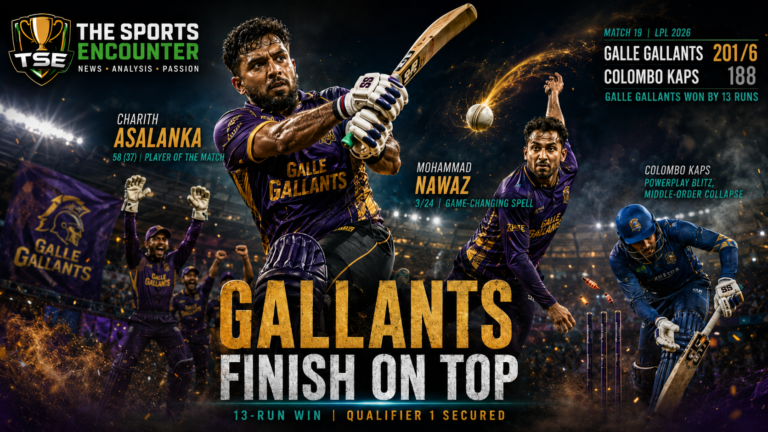
Galle Gallants finished the Lanka Premier League 2026 league stage exactly where every team wanted to be: at the top of the table, with a second chance built into their playoff route.

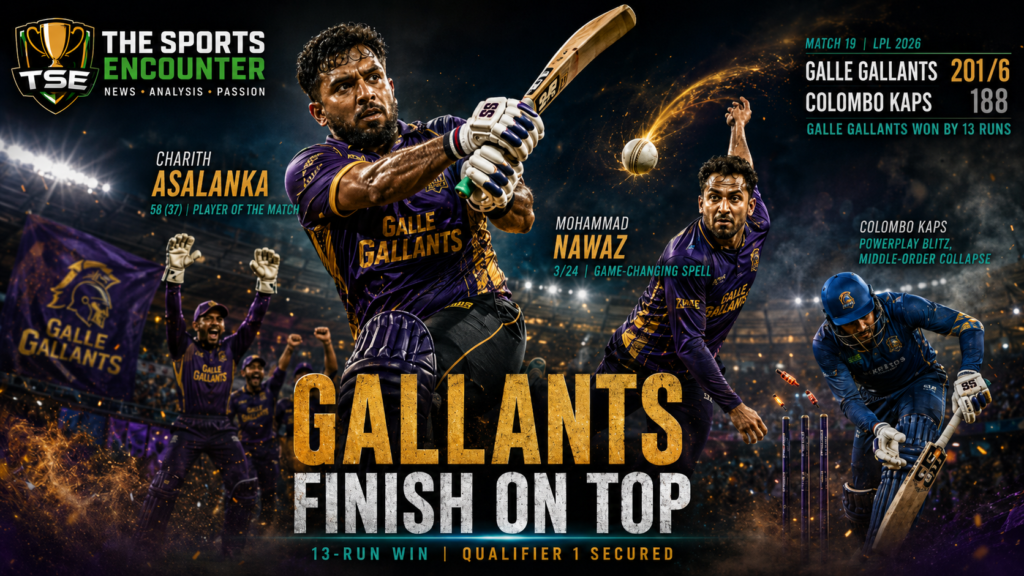
Their 13-run victory over Colombo Kaps in Match 19 at Pallekele was built on Charith Asalanka’s authority with the bat, Mohammad Nawaz’s control through the middle overs, and a tactical contrast that became more obvious as the night unfolded.

Galle posted 201 for six after being asked to bat first, then dismissed Colombo for 188 in 19.4 overs. The result moved the Gallants to first place and confirmed a Qualifier 1 meeting with Jaffna Kings, while Colombo were pushed into the Eliminator.

Asalanka earned Player of the Match honors for his 58 from 37 balls, but Nawaz produced the most decisive bowling performance. His four overs cost only 24 runs and brought three wickets, including Sadeera Samarawickrama, Kamindu Mendis, and Ashen Bandara.

Colombo had raced to 62 for one in the powerplay. Once the field spread and Nawaz entered the contest, the chase changed completely.

Readers can follow every result, playoff development, team update, and tactical storyline through The Sports Encounter’s Lanka Premier League coverage hub.

Galle Gallants vs Colombo Kaps: Match Summary

Match detail Information
Competition Lanka Premier League 2026
Match Match 19
Venue Pallekele International Cricket Stadium
Date August 1, 2026
Galle Gallants 201/6 in 20 overs
Colombo Kaps 188 all out in 19.4 overs
Result Galle Gallants won by 13 runs
Player of the Match Charith Asalanka, 58 from 37 balls
Best bowling Mohammad Nawaz, 3/24
Top Colombo scorer Ben McDermott, 38 from 28 balls
Playoff impact Galle advanced to Qualifier 1 against Jaffna Kings
Colombo’s route Colombo moved into the Eliminator

Galle Attack Early Despite Losing Rogers

Colombo captain Kamindu Mendis chose to bowl first because of the weather conditions, a decision he continued to defend after the match.

The call was understandable. Night matches at Pallekele can create uncertainty around moisture, dew, and chasing conditions. Mendis believed bowling first offered the safer route and insisted afterward that he would make the same choice again.

Galle immediately challenged that plan.

Thomas Rogers struck his first ball for four before Mujeeb Ur Rahman trapped him leg before for four from two deliveries. The early wicket did not slow the innings.

Sam Harper attacked from the other end, scoring 28 from 16 balls with four fours and one six. His approach forced Colombo’s bowlers to defend rather than settle into disciplined new-ball lengths.

Galle reached 49 for two by the end of the fourth over after Wanuja Sahan removed Harper, but the innings had already gained its desired tempo.

The powerplay ended at 71 for two.

That rate gave Galle room to absorb quieter overs later without losing control of the innings.

Harper had already played a major role in Galle’s earlier victory over Colombo, when he scored 65 during a successful pursuit of 190. That match is revisited in our report on how Harper and Sahan Arachchige completed Galle’s first win over the Kaps.

Asalanka Reads the Surface Better Than Colombo

Asalanka’s innings was the central batting performance because it matched aggression with awareness.

He made 58 from 37 balls at a strike rate of 156.75, hitting seven fours and two sixes. His half-century came from 31 deliveries.

The Galle batter admitted afterward that the pitch did not behave like a typical Kandy surface. Despite reaching 201, he occasionally wondered whether the total would be enough.

“We were really happy about the score because we saw that this is not a typical Kandy pitch. But still, sometimes I thought that 200 was not enough.”

The comment reflected the uncertainty of the conditions.

The ball traveled well during the powerplay, yet the pitch later offered grip, turn, drift, and extra bounce. The challenge was identifying when to attack and when to preserve wickets.

Asalanka managed that balance better than anyone else in the top order.

Dinura Kalupahana required 21 balls for his 20, while Chamika Karunaratne fell for two. Galle were 103 for four after 10.4 overs, with the innings at risk of losing the advantage created during the powerplay.

Asalanka did not allow the slowdown to become a collapse.

He found a valuable partner in Sahan Arachchige, who scored 43 from 29 balls. Their fifth-wicket stand added 66 runs and restored control through the middle and closing phases.

Asalanka had also shaped Galle’s opening victory over Jaffna Kings with 65 before Eshan Malinga took four wickets. That performance can be revisited in our report on how Asalanka and Malinga launched Galle’s LPL campaign.

Arachchige and Shanaka Turn a Strong Total Into 201

Arachchige’s innings carried considerable tactical value.

He struck four fours and two sixes, rotated the strike effectively, and ensured Asalanka did not have to manufacture every scoring opportunity.

Their 50-run partnership came from 32 balls.

Colombo eventually removed Arachchige at 169, followed by Asalanka two runs later. At 171 for six after 18.1 overs, the Kaps had an opportunity to keep Galle below 190.

Dasun Shanaka closed that door.

The Galle captain struck 21 not out from eight balls, including one four and two sixes. Nawaz added an unbeaten seven from four, and the Gallants reached 200 with one ball remaining.

They collected 48 runs from the final four overs.

That finish was especially damaging because Colombo had not used its slow-bowling resources as effectively as the conditions demanded.

Ripon Mondol endured a difficult LPL debut, conceding 34 runs from two overs. Mujeeb gave away 37 from four, while Kamindu’s three overs cost 27.

Milan Rathnayaka was Colombo’s most economical bowler, conceding 14 runs from two overs and removing Asalanka.

Arachchige has repeatedly provided Galle with middle-order stability during the tournament. He also led their recovery during the 60-run victory over Jaffna, covered in our analysis of how Galle overwhelmed the Kings after an uncertain start.

Colombo’s Bowling Plan Misses the Surface Clues

The first innings exposed a tactical problem that became even clearer during Galle’s defense.

The surface increasingly rewarded slower pace and spin, yet Colombo relied heavily on pace and did not maximize the overs available from its slower bowlers.

Malsha Tharupathi bowled only two overs and claimed one for 16. Wanuja Sahan took two for 28 from three. Kamindu delivered three overs without taking a wicket.

Colombo’s spinners and slower options had eight overs remaining in their combined allocations.

Galle later demonstrated what a more spin-focused plan could achieve.

Kamindu defended the toss decision after the match, pointing to the weather and insisting he would make the same choice again. The bigger concern was not the toss. It was the deployment of the attack after the pitch began revealing its character.

“Considering the weather, we felt bowling first was the right decision. I don’t take it back. We made the choice and backed it.”

Galle adapted. Colombo stayed closer to its original script.

That difference helped produce a target above 200.

Samarawickrama Gives Colombo a Flying Start

Colombo’s chase began with the required urgency.

Rubin Hermann fell for five in the second over, caught off Akif Javed, but Samarawickrama immediately transformed the powerplay.

He struck 37 from 19 deliveries, hitting five fours and two sixes. His strike rate of 194.73 brought Colombo back ahead of the required pace.

With Ben McDermott supporting him, the Kaps reached 50 in 5.4 overs and completed the powerplay at 62 for one.

At that stage, the chase was alive.

Colombo required 140 from 14 overs with nine wickets available. The scoring rate was demanding but manageable, particularly with McDermott settled and Kamindu, Bandara, James Neesham, and Janith Liyanage still to come.

Then Nawaz took the ball.

Nawaz’s First Over Breaks the Chase

The seventh over decided the match.

Samarawickrama attempted a reverse sweep and chipped Nawaz directly to short third. The shot had delivered runs earlier, but the field placement and surface made it a high-risk option immediately after the powerplay.

He departed for 37.

Three balls later, Nawaz trapped Kamindu leg before for one.

Colombo had moved from 62 for one to 65 for three.

The psychological damage was as important as the wickets. Their most aggressive batter was gone, the captain had failed, and the momentum built during the powerplay disappeared before the middle overs had properly begun.

Nawaz struck again in the ninth over.

He drew Bandara forward with a beautifully flighted delivery, beat him in the air and off the pitch, and allowed Harper to complete the stumping.

Colombo were 74 for four.

Nawaz’s opening spell had removed three batters for almost no cost and forced the Kaps to rebuild when they needed to keep attacking.

McDermott Cannot Carry the Middle Order

McDermott tried to stabilize the chase while keeping the required rate within reach.

He scored 38 from 28 balls with four fours and one six, but his innings never fully escaped the pressure created by the wickets around him.

Sachindu Colombage removed him in the 11th over, with Rogers completing the catch.

The dismissal left Colombo at 93 for five.

Janith Liyanage briefly attacked with a boundary but fell leg before for five. Neesham made 20 from 15 before Malinga dismissed him at 121 for seven.

The chase had lost six wickets for 59 runs after the powerplay.

That phase captured the tactical difference between the teams.

Galle’s spinners varied their pace, challenged both edges, and forced the batters to hit against turn. Colombo’s middle order responded with hurried strokes rather than calculated partnerships.

Nawaz completed his four overs with figures of three for 24 and 12 dot balls.

In a match where both sides scored quickly overall, his economy rate of six was exceptional.

Colombo’s middle order had previously demonstrated its ability to rescue difficult chases. Liyanage and Neesham added an unbeaten 115 against Kandy, as detailed in our report on how Colombo recovered from 67 for four to punish Kandy.

No comparable partnership emerged against Galle.

Tharupathi Gives Colombo One Final Chance

Malsha Tharupathi nearly dragged Colombo back into the match.

He attacked immediately, scoring 36 from 15 balls with three fours and three sixes. His strike rate of 240 gave the Kaps their first serious momentum since Samarawickrama’s dismissal.

Milan Rathnayaka supported him with 21 from 19 deliveries.

Their eighth-wicket partnership added 52 runs from 28 balls and took Colombo from 121 for seven to 173 for eight.

The stand briefly changed the equation.

With 29 needed from 13 balls and Tharupathi striking cleanly, Galle could not relax.

Malinga ended the threat by dismissing Tharupathi for 36. Akif then removed Rathnayaka in the following over.

Colombo entered the final over needing 21.

The innings ended chaotically at 188 when Ripon Mondol failed to respond to Wanuja Sahan’s call for a second run. Both batters finished at the same end, completing a difficult debut for Mondol and a frustrating night for the Kaps.

Sahan had already produced a dramatic lower-order assault against Jaffna earlier in the season, although Colombo fell five runs short. That match is covered in our report on how Jaffna survived Sahan’s late charge.

Eshan Malinga Takes the Purple Cap

Malinga finished with two for 43 from 3.4 overs.

His spell was expensive, particularly during Tharupathi’s assault, but the wickets of Neesham and Tharupathi carried major value.

The second dismissal moved Malinga to the top of the LPL 2026 wicket-taking list, earning him the Purple Cap at the end of Match 19.

His rise continues a strong tournament for the young Sri Lankan fast bowler. Malinga has provided pace, wicket-taking threat, and the willingness to return during the most demanding stages of an innings.

His ability to remove Tharupathi after being attacked showed why Galle continue to trust him in high-pressure overs.

Galle’s bowling figures also demonstrated the importance of shared responsibility.

Akif took two for 42, Colombage claimed one for 34, and Tharindu Ratnayake conceded 37 while removing Liyanage.

The collective attack survived the late hitting because Nawaz had created such a large advantage earlier.

Why Galle Gallants Won

Three tactical areas separated the teams.

First, Galle maximized the powerplay. Their 71 for two gave the innings a strong base even when the scoring rate slowed.

Second, Asalanka and Arachchige rebuilt without surrendering intent. Their partnership prevented the middle overs from becoming a period of control for Colombo.

Third, Galle used spin more intelligently.

Nawaz’s spell was the clearest example, but Colombage also benefited from the surface. The Gallants understood that the pitch offered more once the ball aged and the field spread.

Colombo missed the same opportunity during the first innings.

Kamindu acknowledged that his side had areas to refine in both batting and bowling. His decision to bowl first was defensible. The greater concern was the failure to adjust quickly enough once the pitch began favoring spin.

“The boys have been doing really well, but there are areas we need to refine in both batting and bowling. Mistakes are bound to happen. The important thing is that we learn from them and come back stronger in the next round.”

Galle Finish First and Earn Two Chances

The victory lifted Galle to the top of the standings and confirmed their place in Qualifier 1.

They will face Jaffna Kings, with the winner advancing directly to the final.

The loser will receive another opportunity in Qualifier 2 against the winner of the Eliminator.

That safety net explains why Asalanka emphasized the importance of finishing in the top two.

“That’s what we were aiming for, to take one of the first two spots, because then we get two chances to qualify for the final.”

Galle have earned two possible routes to the championship match rather than facing immediate elimination.

Schedules, match information, standings, and official tournament updates are available through the official Lanka Premier League website.

Galle’s Qualifier 1 opponent will arrive with confidence from several close victories, including Jaffna’s recovery against Dambulla. That match is covered in our analysis of how Bhanuka Rajapaksa rescued the Kings from 35 for three.

Colombo Head Into the Eliminator

Colombo’s defeat leaves them facing a more dangerous path.

They will meet either Kandy Royals or Dambulla Sixers in the Eliminator, depending on the outcome of the final league match.

One poor evening will now end their season.

Kamindu struck the right tone after the defeat. He defended the toss decision, accepted that mistakes had been made, and focused on learning before the playoffs.

Colombo have played several close matches during the tournament. That experience may help in the Eliminator, but their middle-order collapses and bowling adjustments remain serious concerns.

The Kaps cannot afford to rely on repeated recoveries from Tharupathi, Rathnayaka, or the lower order.

Their top six must carry more of the chase.

Kandy and Dambulla have both produced dangerous performances during the league stage. Kandy’s first victory came through Wanindu Hasaranga and Nuwan Thushara, as covered in our report on how Kandy defeated Dambulla by 43 runs.

Asalanka Demands More Despite Finishing First

Asalanka’s post-match comments showed why Galle remain dangerous.

He praised the fielding and welcomed the top-two finish, but he also identified death bowling and fielding as areas requiring continued improvement.

“We are playing good cricket at the moment, but I still think there are certain areas we can really improve, like our death bowling and especially our fielding. But today, I think our fielding was fantastic.”

That may sound overly critical after a win, yet Galle did allow Colombo to recover from 121 for seven to 173 for eight.

A stronger opponent could punish those late overs more severely.

The Gallants have reached the playoffs with momentum, balance, and a batting order capable of scoring 200. Nawaz gives them control through the middle, while Malinga offers wicket-taking pace at the death.

They are leading the table because they have solved more match situations than their rivals.

Qualifier 1 will demand another level.

Galle’s Campaign Has Combined Power With Recovery

Galle have rarely depended on a single batting formula.

Asalanka and Shanaka powered them beyond 200 in the tournament opener. Harper and Arachchige then completed a chase against Colombo. Arachchige and Nawaz rebuilt the innings during the 60-run victory over Jaffna.

The Gallants also experienced setbacks, including a defeat to Dambulla Sixers when Reeza Hendricks punished their attack. That performance is examined in our report on how Hendricks drove Dambulla past Galle.

The defeat did not derail Galle because their lineup retained several methods of winning.

They can attack inside the powerplay, recover through Asalanka and Arachchige, finish through Shanaka and Nawaz, and use spin to control the middle overs.

That adaptability has placed them at the top of the standings.

Key Statistics From Galle Gallants vs Colombo Kaps

  • Galle Gallants scored 201 for six at a run rate of 10.05 per over.
  • Charith Asalanka made 58 from 37 balls with seven fours and two sixes.
  • Sahan Arachchige scored 43 from 29 deliveries.
  • Dasun Shanaka finished unbeaten on 21 from eight balls.
  • Galle scored 71 runs during the six-over powerplay.
  • Sadeera Samarawickrama struck 37 from 19 balls for Colombo.
  • Mohammad Nawaz took three wickets for 24 runs from four overs.
  • Nawaz dismissed Samarawickrama and Kamindu Mendis in the same over.
  • Ben McDermott top-scored for Colombo with 38 from 28 deliveries.
  • Malsha Tharupathi made 36 from only 15 balls.
  • Tharupathi and Milan Rathnayaka added 52 runs for the eighth wicket.
  • Eshan Malinga claimed two wickets and finished the match as the tournament’s leading wicket-taker.
  • Colombo were bowled out for 188 with two balls remaining.

Conclusion

Galle Gallants won because they understood the conditions faster and used them more intelligently.

Asalanka’s 58 gave the innings control. Arachchige ensured the middle overs remained productive. Shanaka turned a strong score into 201.

Colombo then started brilliantly but lost the chase in one devastating phase.

Nawaz removed Samarawickrama and Kamindu in the same over, dismissed Bandara shortly afterward, and left the Kaps rebuilding against a required rate that kept climbing.

Tharupathi’s 15-ball 36 restored drama, but the repair job was too large.

Galle finished the league stage on top and secured the protection of Qualifier 1. Colombo remain alive, although their next mistake could end the campaign.

The Gallants did more than win by 13 runs at Pallekele.

They earned the most valuable advantage available before an LPL final: a second chance.

Serina Ramgopallan is a Sri Lanka-based sports writer and physical education graduate from the University of Colombo. She has reported on cricket and other major sporting events for Sri Lankan media outlets, bringing regional insight, local context, and a strong understanding of athletic performance to her coverage. Her work focuses on match reporting, player development, tournament analysis, and the emerging stories shaping cricket and other sports across Sri Lanka, India, Bangladesh, and the wider international stage.

Breaking News

Archer Destroys London Spirit as Southern Brave Survive Nervous Chase

Jofra Archer claimed 4/9 before David Miller steadied a difficult chase as Southern Brave defeated London Spirit by five wickets at Lord’s.

Published

on

Archer Destroys London Spirit as Southern Brave Survive Nervous Chase

London Spirit had reached 103 for five with Jonny Bairstow still at the crease and enough deliveries left to build a competitive total. Twenty balls later, their innings was over.

Jofra Archer triggered a collapse that transformed the match at Lord’s. His pace, control, and late accuracy carried him to remarkable figures of 4 for 9 from 20 balls, leaving Southern Brave with a target of only 106.

The chase became uncomfortable when Brave slipped to 60 for five, but David Miller absorbed the pressure and finished unbeaten on 39. Southern Brave reached 111 for five from 97 balls to secure a five-wicket victory and move back into serious contention for the knockout stage of The Hundred 2026.

TL;DR

  • Southern Brave beat London Spirit by five wickets at Lord’s.
  • London Spirit collapsed from 103 for five to 105 all out in 92 balls.
  • Jofra Archer claimed 4 for 9 and received the Match Hero award.
  • Jonny Bairstow scored 56 from 43 balls, more than half of Spirit’s total.
  • Jamie Smith struck 36 from 22 before David Miller finished the chase with an unbeaten 39.
  • Brave moved to eight points, while Spirit’s qualification prospects suffered another major setback.

London Spirit vs Southern Brave Scorecard

DetailInformation
CompetitionThe Hundred Men’s Competition 2026
MatchMatch 16
DateAugust 1, 2026
VenueLord’s Cricket Ground, London
TossSouthern Brave elected to bowl
London Spirit105 all out from 92 balls
Southern Brave111/5 from 97 balls
ResultSouthern Brave won by five wickets
Top Spirit BatterJonny Bairstow, 56 from 43 balls
Top Brave BattersDavid Miller 39*, Jamie Smith 36
Top BowlerJofra Archer, 4/9 from 20 balls
Match HeroJofra Archer
Turning PointLondon Spirit collapsed from 103/5 to 105 all out
Tournament ImpactBrave moved to eight points; Spirit remained on four

Archer Turns a Recoverable Innings Into a Collapse

London Spirit’s innings depended almost entirely on Bairstow. The opener scored 56 from 43 deliveries, hitting five fours and two sixes while wickets disappeared around him.

Lhuan-dre Pretorius gave Spirit an aggressive start with 11 from eight balls, but Marcus Stoinis removed him with the score on 14. James Rew added 11, while Liam Livingstone managed only five before Adil Rashid dismissed both batters.

Spirit’s middle order then failed to support Bairstow. Dewald Brevis scored one, James Coles made two, and Jamie Overton’s 10 represented the only other double-figure contribution.

At 68 for five, Bairstow and Overton began a necessary recovery. Their partnership carried the total to 103 and gave Spirit a chance of reaching something close to 125, a score that could have tested Brave on a surface offering help to pace and spin.

Archer closed that route immediately.

He removed Bairstow for 56, caught by Chris Jordan, before dismissing David Willey and trapping Andrew Tye leg before on consecutive deliveries. Stoinis then claimed the final two wickets as Spirit lost five wickets for two runs.

Archer finished with four wickets while conceding only nine runs from his full allocation. Stoinis collected 3 for 17 from 17 balls, and Rashid added 2 for 17. The performance strengthened a Brave attack that had already shown its ability to control difficult games when Marcus Stoinis inspired the record defense against Birmingham Phoenix.

Jamie Smith Attacks Before Spirit Fight Back

A target of 106 appeared modest, but Southern Brave quickly discovered that the Lord’s surface still demanded careful batting.

David Willey bowled Ben McKinney for a duck and later removed Nikhil Chaudhary for five. Jamie Smith prevented Spirit from taking complete control by scoring 36 from 22 balls, including four fours and two sixes.

Smith’s aggression gave Brave 38 runs from the 25-ball powerplay. His approach mattered because the rest of the top order struggled to rotate the strike or find boundaries.

James Coles dismissed Smith with the score on 55. Adam Zampa then removed Moeen Ali for nine before a run-out ended Stoinis’ innings on three. Brave had fallen to 60 for five, and Spirit suddenly had a realistic chance of defending one of the lowest totals in the competition.

That pressure exposed a familiar weakness in Brave’s batting. Their earlier last-ball defeat to MI London showed how quickly control could disappear during a tight chase.

Miller refused to allow another collapse.

David Miller Brings Calm to a Nervous Chase

Miller combined calculation with selective aggression. He scored an unbeaten 39 from 28 balls, striking four fours and two sixes while Tristan Stubbs concentrated on survival at the other end.

Stubbs made only 12 from 20 deliveries, but his role carried considerable value. He protected his wicket, helped build an unbroken 51-run partnership, and allowed Miller to target favorable matchups.

The pair required 45 balls to complete their stand, reflecting the difficulty of the pitch and the tension created by Spirit’s bowlers. Miller supplied 38 of those partnership runs from 25 balls.

Willey finished with 2 for 28, while Zampa conceded only 14 from 20 deliveries. Coles also produced a controlled spell of 1 for 13 from 20 balls. Spirit’s bowlers gave the team a chance, but their batters had left them with almost no margin.

Readers can follow further English and franchise coverage through The Sports Encounter’s cricket hub and its wider collection of breaking sports stories.

What the Result Means for Qualification

Southern Brave entered the match with four points from four games after one win and three defeats. Their second consecutive victory lifted them to eight points from five matches, placing them firmly inside the group competing for the three knockout positions.

Brave still have work ahead. Trent Rockets and Welsh Fire occupied the leading positions before this result, while Manchester Super Giants, SunRisers Leeds, and MI London were also clustered around the qualification race. With three league matches remaining, Brave can now influence their own future rather than relying entirely on other results.

Their next match against Welsh Fire on August 3 carries immediate importance. Victory would move Brave to 12 points and strengthen their challenge for the Eliminator. The improved bowling form of Archer, Stoinis, and Rashid gives them a reliable foundation even while the batting remains inconsistent.

London Spirit’s position looks far more dangerous. They remain on four points after one win and three defeats, with five matches still available. Qualification remains mathematically possible, but Spirit will probably need at least four victories and a significant improvement in net run rate.

Their batting must become less dependent on individual rescue efforts. Livingstone had previously produced a major all-round performance, while Bairstow carried this innings almost alone. The repeated lack of middle-order support has become a structural problem rather than an isolated bad night.

The result also arrives during a broader discussion over The Hundred’s connection with English cricket fans. At Lord’s, Archer supplied the kind of high-quality individual performance the competition needs, while the fluctuating chase kept the contest alive until its closing stages.

Final Verdict

Southern Brave won because Archer destroyed London Spirit’s chance of building a defendable total and Miller managed the chase when five wickets created genuine pressure.

Bairstow’s 56 and Spirit’s disciplined bowling deserved more support. A collapse from 103 for five to 105 all out proved too damaging to overcome.

Brave now have consecutive victories and a clear route back into the qualification race. Spirit still have time, but their margin for another batting failure has almost disappeared.

Continue Reading

Cricket

Tim Robinson Explodes as Unicorns Thump Vipers to Enter the Global Super League Final

Tim Robinson struck an unbeaten 68 as San Francisco Unicorns defeated Desert Vipers by eight wickets in the Global Super League Qualifier, setting up a final against Guyana Amazon Warriors.

Marcos Wetherfield | The Sports Encounter

Published

on

San Francisco Unicorns turned one of their most painful defeats of the Global Super League into the performance that saved their tournament.

Four days after Desert Vipers dismantled them by nine wickets at Providence, the Unicorns returned to the same ground, controlled the Qualifier from the opening overs, and completed a commanding eight-wicket victory with 23 balls remaining.

Tim Robinson anchored the chase with an unbeaten 68 from 54 deliveries as San Francisco reached 126 for two in 16.1 overs, comfortably overhauling the Vipers’ modest 122 for seven.

The result sends the Unicorns into the Global Super League final against defending champions Guyana Amazon Warriors, giving the Major League Cricket representatives an immediate opportunity to avenge another earlier defeat.

Robinson was named Player of the Match after combining his composed half-century with two catches in the field. His innings contained eight fours and one six, but its real value came from the calm he brought after San Francisco lost two wickets in three balls.

Oliver Peake finished unbeaten on 33 from 31 deliveries and shared an unbroken 97-run third-wicket partnership with Robinson. Together, they turned what could have become a nervous chase into a controlled procession.

Readers can follow the tournament, franchise cricket, and international match coverage through The Sports Encounter’s Cricket Hub.

Global Super League Qualifier Match Summary

Match detail Information
Competition Global Super League 2026, Qualifier
Match Desert Vipers vs San Francisco Unicorns
Venue Providence Stadium, Guyana
Date July 31, 2026
Desert Vipers 122/7 in 20 overs
San Francisco Unicorns 126/2 in 16.1 overs
Result San Francisco Unicorns won by eight wickets
Balls remaining 23
Player of the Match Tim Robinson, 68 not out from 54 balls and two catches
Best bowling Fabian Allen, 3/20
Key partnership Tim Robinson and Oliver Peake, unbeaten 97
Next match Global Super League final against Guyana Amazon Warriors

Unicorns Respond to Their Earlier Humiliation

This was more than a routine knockout victory.

When the teams met during the league stage, Desert Vipers restricted San Francisco to 151 for seven before chasing the target in only 16.1 overs for the loss of one wicket.

Shadab Khan dominated that match with four wickets for 13 runs, while 19-year-old Zachary Carter struck 55 from 29 deliveries during a nine-wicket victory that revived the Vipers’ tournament.

The Sports Encounter documented how Shadab and Carter rescued the Desert Vipers’ GSL campaign through one of the most complete performances of the league stage.

The Qualifier produced an almost complete reversal.

San Francisco won the toss, chose to field, squeezed the Vipers through the middle overs, and completed their chase in exactly 16.1 overs, the same point at which the Vipers had finished their earlier pursuit.

That symmetry told the story of a team that had learned quickly.

Hassan Khan’s side did not allow the previous defeat to dictate the rematch. The Unicorns changed the pace of the contest, attacked with spin, held their catches, and forced the Vipers into a style of batting that never suited the pressure of a knockout match.

Vipers Lose Momentum Before They Can Build It

Desert Vipers never found a stable tempo after being asked to bat first.

Andries Gous fell for eight in the third over, caught by Peter Siddle off Fabian Allen. Rilee Rossouw briefly threatened to increase the scoring rate with 11 from seven balls, including a four and a six, but Anirudh Immanuel removed him with the total on 29.

The innings then became trapped between survival and acceleration.

Zachary Carter made 15 from 23 deliveries, while captain Shadab Khan required 24 balls for his 14. Their partnership occupied valuable time without creating the platform required for a strong finish.

Carter’s strike rate of 65.21 and Shadab’s 58.33 left the middle and lower order with too much repair work. By the time Kyle Mayers was dismissed for 15 in the 13th over, the Vipers were only 61 for four.

San Francisco understood that wickets were more valuable than chasing dot-ball perfection. The bowlers offered few easy boundary deliveries and kept inviting the batters to force shots against a Providence surface that rewarded patience and changes of pace.

The Vipers reached only 81 for six after Bevon Jacobs fell in the 17th over.

At that point, a total near 110 appeared possible.

Vriitya Aravind prevented a complete collapse with an unbeaten 29 from 20 balls. His five boundaries gave the innings some late life, while Khary Pierre contributed eight from six and Sanjay Pahal struck five from two deliveries.

The Vipers scored 41 runs from their final 23 balls, but the late recovery could not disguise the damage caused earlier.

A total of 122 left almost no room for defensive mistakes.

Fabian Allen Changes the Match

Fabian Allen delivered the most influential bowling performance of the night.

The left-arm spinner finished with three for 20 from four overs, dismissing Gous, Shadab, and Jacobs. Those wickets came at three different stages of the innings and prevented the Vipers from developing any meaningful continuity.

Allen removed Gous before the opener could settle, returned to dismiss Shadab when the captain was attempting to rebuild, and then ended Jacobs’ effort just as the batter threatened to accelerate.

His economy rate of five runs per over was impressive, but the timing of his wickets mattered more.

Hassan Khan also produced an outstanding spell, conceding only 14 runs from four overs and removing Mayers. Immanuel matched those figures with one for 14, while Karima Gore needed only one over to claim Carter’s wicket for four runs.

Together, Allen, Hassan, Immanuel, and Gore bowled 13 overs for 52 runs and took all six wickets credited to bowlers.

That collective return decided the match.

Peter Siddle and Callum Stow conceded 70 runs between them from seven overs without taking a wicket, yet the pressure created by the slower bowlers ensured those expensive overs never became part of a sustained Vipers surge.

San Francisco’s attack demonstrated an important T20 principle: every bowler does not need to dominate when the team’s strongest matchup is used correctly and for long enough.

Early Wickets Give the Vipers Brief Hope

A target of 123 should have been comfortable, but the Vipers briefly created an opening.

Connor Esterhuizen began aggressively, striking 17 from 10 balls with two fours and a six. His intent helped San Francisco move quickly to 29, reducing the pressure on Robinson.

Khary Pierre then changed the atmosphere.

The spinner bowled Esterhuizen for 17 and dismissed captain Hassan Khan for a two-ball duck later in the same over. San Francisco had lost two wickets without adding a run.

At 29 for two after 4.4 overs, the Vipers had their only genuine chance to make the chase uncomfortable.

Another wicket could have exposed a middle order that had experienced collapses earlier in the tournament.

Robinson and Peake refused to offer it.

Robinson Chooses Control Over Drama

Robinson’s innings was built for the situation rather than the highlight reel.

He had already scored 48 against the Vipers in the league-stage defeat, making him San Francisco’s leading batter in both meetings between the teams. This time, he converted his start and remained at the crease until the match was finished.

His half-century came from 48 balls, reflecting the measured nature of the chase. With the required rate barely above six runs per over, there was no reason to manufacture risks against Pierre or attack every delivery from the other spinners.

Robinson waited for errors, rotated the strike, and punished width when it appeared.

Thirty-eight of his 68 runs came in boundaries. The remaining 30 were accumulated through running and strike management, an important detail on a night when the chase required discipline more than explosive power.

Peake played the supporting role intelligently.

The young Australian scored 33 from 31 balls, hitting two fours and two sixes. He did not attempt to match Robinson shot for shot. Instead, he absorbed pressure, targeted selected bowlers, and ensured the Vipers could not create another opening.

Their unbeaten partnership added 97 runs after the double strike at 29.

San Francisco passed 50 in 7.1 overs, reached 78 for two at the halfway stage, and crossed 100 at the end of the 14th over. By then, the outcome had become a matter of timing rather than uncertainty.

Robinson completed the chase in the 17th over, delivering the controlled finish his team had lacked in several earlier passages of the tournament.

Shadab’s Difficult Night Captures the Vipers’ Decline

Shadab Khan had been the central figure in the Vipers’ league-stage victory over San Francisco.

In the Qualifier, his influence disappeared.

He scored 14 from 24 balls, failed to hit a boundary, and conceded 41 runs from four wicketless overs. The Unicorns targeted his bowling more successfully than any other part of the Vipers’ attack.

Shadab’s economy rate of 10.25 was the most expensive among the specialist bowlers who completed four overs.

The contrast with his earlier four-wicket performance was striking.

San Francisco appeared better prepared for his variations, avoided giving him easy dismissals, and forced him to bowl under the pressure of defending a small total. Robinson and Peake were content to wait when the delivery was difficult and attack whenever the length became hittable.

Pierre offered the Vipers some resistance with two for 22, but he could not bowl from both ends.

Vitel Lawes conceded 27 from four overs, Carter gave away 25 from 3.1, and the Unicorns never allowed the required rate to become a factor.

Desert Vipers’ Tournament Ends After a Dramatic Recovery

The Vipers’ elimination will feel particularly painful because they had fought their way back into contention after a difficult start.

They lost their first two matches before Shadab and Carter inspired the nine-wicket victory over San Francisco.

Rilee Rossouw then scored a vital half-century as the Vipers survived Akeal Hosein’s four-wicket spell to defeat Perth Scorchers XI by one wicket. That final-over thriller kept their qualification hopes alive and demonstrated the resilience of a side that had appeared close to elimination.

The full story of that escape can be revisited in The Sports Encounter’s report on how the Vipers survived Akeal Hosein and Perth in a one-wicket GSL thriller.

The Qualifier presented a different challenge.

San Francisco’s slower bowlers denied Rossouw and Shadab the influence they had enjoyed earlier in the tournament. Aravind’s late effort offered hope, but the Vipers had already conceded too much control during the first 16 overs.

San Francisco’s Tournament Has Been Built on Recovery

The Unicorns’ path to the final has rarely been comfortable.

They lost their opening encounter against Guyana Amazon Warriors by three wickets under the DLS method after making 156 for six.

The hosts recovered from 107 for seven to complete the chase, with Rovman Powell remaining unbeaten on 29 and Matthew Forde striking the winning boundary.

That dramatic opening meeting is covered in The Sports Encounter’s report on how Rovman Powell carried Guyana past San Francisco in a rain-shortened chase.

The Unicorns then survived a five-run thriller against Perth Scorchers.

Hammad Azam rescued the innings with an unbeaten 64 after San Francisco slipped to 46 for four, while Ghulam Mudassar took four wickets to defend 152.

Their nine-wicket league-stage defeat to the Vipers exposed major weaknesses, particularly against Shadab and during the middle overs. The Qualifier showed how effectively the team responded.

This has become a campaign defined by repair.

Different players have carried the side at different moments. Hammad rescued them against Perth. Mudassar defended a modest total. Robinson then controlled the most important chase of their GSL campaign.

That variety gives San Francisco a credible chance in the final.

Guyana Amazon Warriors Await in the Final

The Unicorns will now face the tournament’s strongest and most settled team.

Guyana Amazon Warriors entered the competition as defending champions and secured direct qualification for the final by finishing at the top of the league standings.

The competition format awarded the leading team automatic entry into the championship match, while the second- and third-placed sides contested the Qualifier to determine the other finalist.

Schedules, results, tournament information, and official updates are available through the official Global Super League website.

The Warriors have already beaten San Francisco once, but that earlier meeting also showed that the hosts can be placed under severe pressure.

The Unicorns reduced Guyana to 107 for seven before allowing the chase to escape. Their challenge in the final will be to finish the moments they created in the league game.

Providence will bring another layer of difficulty.

Guyana will have the local crowd, greater familiarity with the conditions, and the confidence of defending champions. San Francisco, however, enter the final with fresh evidence that earlier results do not have to define knockout matches.

They have already reversed a nine-wicket defeat against the Vipers.

Now they must attempt the same transformation against the Warriors.

Guyana’s Final League Match Exposed a Possible Weakness

Guyana may have finished at the top of the table, but their passage into the final was not flawless.

Perth Scorchers XI defeated the Warriors by 14 runs after recovering from 78 for eight to score 135. Brody Couch made 43 from 29 balls before Perth’s spinners bowled Guyana out for 121 in 16.1 overs.

The Sports Encounter’s report on how Perth’s spin attack silenced Guyana at Providence provides San Francisco with a useful tactical reference before the final.

Guyana’s top order can be dangerous, particularly when Rahmanullah Gurbaz establishes an early tempo. However, the Perth defeat showed that their batting can unravel when several spin options operate accurately through the middle overs.

San Francisco’s performance against the Vipers suggests they possess the resources to test that vulnerability.

Allen, Hassan, Immanuel, and Gore combined for six wickets and conceded only 52 runs from 13 overs in the Qualifier. Repeating that level of control against Guyana would give the Unicorns a genuine route to the title.

What San Francisco Must Do Differently in the Final

The league-stage meeting with Guyana offered San Francisco both encouragement and warning.

Robinson attacked early, Hammad Azam built an unbeaten 61, and the Unicorns reached 156 for six. Their bowlers then reduced the Warriors to seven wickets down.

The decisive problem was their inability to close the match.

Powell remained calm while wickets fell around him, and San Francisco conceded enough boundaries during the final phase to lose with three deliveries remaining.

The Unicorns must improve in four areas:

  • Protect wickets during the powerplay: Losing two or three early wickets would allow Guyana’s experienced spinners to dictate the middle overs.
  • Attack the middle overs selectively: Robinson and Peake showed against the Vipers that controlled batting can be more valuable than constant aggression.
  • Use spin as the primary pressure weapon: Guyana’s defeat to Perth and the Qualifier both showed how effective slower bowling can be at Providence.
  • Finish the chase or defense: Creating pressure will not be enough if Powell or another experienced Guyana batter remains at the crease.

Providence Continues to Reward Adaptability

The 2026 Global Super League has repeatedly shown that Providence cannot be approached with a single batting formula.

Lahore Qalandars began the tournament by scoring 171 for seven before defeating Perth by 16 runs. The Sports Encounter covered how Farhan Yousaf announced his arrival in the GSL opener with an explosive half-century.

A day later, Michael Bracewell and Usama Mir helped Lahore defeat the Vipers by 38 runs. That performance, detailed in our report on how Bracewell led Lahore from the front at Providence, demonstrated how quickly an innings can collapse once spin gains control.

Later matches produced totals of 112, 122, 135, and 152, reinforcing the importance of reading the pitch rather than relying on a fixed target.

San Francisco handled that challenge correctly in the Qualifier. They recognized that 123 did not require reckless acceleration, absorbed Pierre’s double strike, and allowed Robinson to pace the chase around the required rate.

The final may demand a different approach.

San Francisco Carry Major League Cricket Experience

The Unicorns also bring experience from a highly competitive American franchise system.

Major League Cricket’s recent season produced several close finishes, including a one-run championship match won by Los Angeles Knight Riders.

The Sports Encounter’s report on the Los Angeles Knight Riders’ dramatic MLC final victory highlighted how small tactical decisions can determine a title match.

San Francisco will need the same awareness at Providence.

One loose over, a missed catch, or an unnecessary middle-over dismissal could separate the champion from the runner-up. The Unicorns’ Qualifier performance showed they can execute under pressure, but Guyana will present a deeper batting order and a more experienced bowling attack.

Key Statistics From the Qualifier

  • San Francisco Unicorns won by eight wickets with 23 balls remaining.
  • Tim Robinson scored an unbeaten 68 from 54 balls, including eight fours and one six.
  • Oliver Peake made 33 not out from 31 deliveries.
  • Robinson and Peake shared an unbeaten 97-run third-wicket partnership.
  • Fabian Allen took three wickets for 20 runs from four overs.
  • Hassan Khan and Anirudh Immanuel each conceded only 14 runs from four overs.
  • Vriitya Aravind top-scored for the Vipers with an unbeaten 29 from 20 balls.
  • Shadab Khan scored 14 from 24 balls and conceded 41 runs from four wicketless overs.
  • Khary Pierre claimed both San Francisco wickets and finished with two for 22.
  • The Unicorns reached their target at a run rate of 7.79 per over.

Final Verdict

The scorecard will show an eight-wicket victory completed with 23 balls remaining.

The deeper story is how thoroughly San Francisco corrected the failures of their previous meeting with Desert Vipers.

Their spinners controlled the innings. Allen delivered wickets at crucial stages. Robinson absorbed the pressure created by Pierre’s double strike. Peake stayed with him, and the chase never drifted into panic.

Desert Vipers will regret the 70 deliveries consumed by Carter, Shadab, and Mayers for only 44 runs. Aravind’s late assault gave the total some respectability, but knockout cricket rarely forgives an innings that spends too long searching for momentum.

The Unicorns were sharper, calmer, and more adaptable.

They arrived at Providence carrying the memory of a heavy defeat and left with a place in the Global Super League final.

Guyana Amazon Warriors are next, and San Francisco have already learned the most valuable lesson of their campaign: in a knockout match, the first result does not get a vote.

Frequently Asked Questions

Who won the Global Super League Qualifier between Desert Vipers and San Francisco Unicorns?

San Francisco Unicorns defeated Desert Vipers by eight wickets in the Global Super League Qualifier at Providence Stadium. The Unicorns chased 123 in 16.1 overs with 23 balls remaining.

Who was Player of the Match in the Vipers vs Unicorns Qualifier?

Tim Robinson was named Player of the Match after scoring an unbeaten 68 from 54 balls and taking two catches during the Desert Vipers innings.

How many runs did Tim Robinson score against Desert Vipers?

Tim Robinson scored 68 not out from 54 deliveries, including eight fours and one six. He also shared an unbeaten 97-run partnership with Oliver Peake.

What was the key partnership in San Francisco Unicorns’ chase?

Tim Robinson and Oliver Peake added an unbeaten 97 runs for the third wicket after San Francisco had slipped to 29 for two.

Who was the best bowler for San Francisco Unicorns?

Fabian Allen was the leading bowler for the Unicorns, taking three wickets for 20 runs from four overs. Hassan Khan and Anirudh Immanuel also conceded only 14 runs each from their four-over spells.

Why did Desert Vipers score only 122?

The Vipers struggled to build momentum through the middle overs. Zachary Carter, Shadab Khan, and Kyle Mayers consumed 70 balls for only 44 runs combined, leaving the lower order with too much work to do late in the innings.

Who top-scored for Desert Vipers?

Vriitya Aravind top-scored with an unbeaten 29 from 20 balls. His late boundaries helped the Vipers recover from 81 for six to 122 for seven.

How did Khary Pierre perform in the Qualifier?

Khary Pierre took both San Francisco wickets and finished with figures of two for 22 from four overs. He dismissed Connor Esterhuizen and Hassan Khan in the same over.

Why was Shadab Khan unable to influence the Qualifier?

Shadab struggled with both bat and ball. He scored 14 from 24 deliveries without a boundary and conceded 41 runs from four wicketless overs.

Who will San Francisco Unicorns face in the Global Super League final?

San Francisco Unicorns will face Guyana Amazon Warriors in the Global Super League final.

Why did Guyana Amazon Warriors qualify directly for the final?

Guyana Amazon Warriors finished at the top of the league standings. Under the tournament format, the first-placed team advanced directly to the final, while the second- and third-placed teams contested the Qualifier.

Where will the Global Super League final be played?

The final will be played at Providence Stadium in Guyana, the main venue for the 2026 Global Super League.

When is the Global Super League final?

The final is scheduled for Sunday, with San Francisco Unicorns facing defending champions Guyana Amazon Warriors.

Did Desert Vipers beat San Francisco Unicorns earlier in the tournament?

Yes. Desert Vipers defeated San Francisco Unicorns by nine wickets during the league stage before the Unicorns reversed the result in the Qualifier.

Has San Francisco Unicorns already played Guyana Amazon Warriors in GSL 2026?

Yes. Guyana Amazon Warriors defeated San Francisco by three wickets under the DLS method during the league stage.

What must San Francisco Unicorns improve before the final?

The Unicorns must protect early wickets, use their spin attack effectively, and finish decisive moments more clinically than they did in their earlier defeat to Guyana.

Continue Reading

Cricket

Marcus Stoinis Turns 128 Into History as Southern Brave Finally Break Through Against Birmingham Phoenix

Southern Brave finally broke their losing run as Marcus Stoinis and a disciplined bowling attack defended 128 against Birmingham Phoenix at the Utilita Bowl.

Published

on

Marcus Stoinis celebrates Southern Brave’s 12-run victory over Birmingham Phoenix after scoring 34 and taking 2 for 16 in The Hundred 2026 at Southampton.

Southern Brave had spent the opening phase of The Hundred 2026 discovering increasingly painful ways to lose.

They had been beaten on the same Southampton ground by Welsh Fire, then carried MI London to the final ball without finding the finish. Their batting remained uncertain, their points column stayed empty, and another modest total against Birmingham Phoenix appeared to have left them exposed once again.

This time, Brave refused to let the game slip.

Marcus Stoinis scored 34 from 26 balls before producing a remarkably controlled spell of 2 for 16 as Southern Brave defended 128 for eight to defeat Birmingham Phoenix by 12 runs in Match 13 of The Hundred 2026 at the Utilita Bowl.

Phoenix needed only 129 from 100 balls, a required rate of 1.29 runs per delivery. They never truly controlled the chase. Regular wickets, poor tempo through the middle, and 60 dot balls across the innings left them stranded on 116 for nine.

The result gave Southern Brave their first men’s victory of the season and created a piece of tournament history. Their total of 128 became the lowest successfully defended score in the men’s competition.

For a side that had repeatedly fought without reward, the relief around Southampton was understandable.

TL;DR

  • Southern Brave defeated Birmingham Phoenix by 12 runs at the Utilita Bowl.
  • Brave scored 128 for eight from their 100 balls.
  • Phoenix finished on 116 for nine despite needing fewer than 1.3 runs per ball.
  • Marcus Stoinis was named Match Hero after scoring 34 and taking 2 for 16.
  • Luke Wood claimed 3 for 24, including two wickets in the final five balls.
  • Jofra Archer conceded only 21 runs and delivered 12 dot balls.
  • Rehan Ahmed took 3 for 25 during Brave’s innings.
  • Will Smeed top-scored for Phoenix with 35 from 28 balls.
  • Brave’s 128 was the lowest successful defense in the history of the men’s Hundred.
  • Southern Brave collected four points, while Birmingham Phoenix received none.

Southern Brave vs Birmingham Phoenix Match Summary

Match DetailInformation
CompetitionThe Hundred Men’s Competition 2026
MatchMatch 13
DateJuly 30, 2026
VenueUtilita Bowl, Southampton
TossBirmingham Phoenix elected to field
Southern Brave128/8 from 100 balls
Birmingham Phoenix116/9 from 100 balls
ResultSouthern Brave won by 12 runs
Match HeroMarcus Stoinis, 34 and 2/16
Attendance11,181
PointsSouthern Brave 4, Birmingham Phoenix 0

Brave’s Batting Never Looked Comfortable

Birmingham Phoenix captain Donovan Ferreira chose to field first, a decision that appeared sensible almost immediately.

The Southampton surface looked fresh, but it did not reward free-flowing stroke play. The ball gripped, held in the pitch, and occasionally arrived more slowly than the batters expected. Southern Brave had already learned how demanding the Utilita Bowl could be during their earlier defeat to Welsh Fire, when Phil Salt adapted better than anyone else to another awkward chase.

Jamie Smith began positively with a boundary but fell after five balls, caught by Mitchell Owen off Ben Dwarshuis for six.

Ben McKinney offered a brief burst of aggression. His 18 from nine balls included two fours and a six, and he helped Brave reach 38 for one at the end of the 25-ball powerplay.

The innings did not accelerate from there.

McKinney fell to Owen at 40, while Tom Abell struggled to turn a start into momentum. Abell made 22 from 19 balls before Rehan Ahmed had him stumped by Joe Clarke.

Brave were 55 for three after 44 deliveries. Their scoring rate remained manageable, but there was no clear path toward a total that looked safe.

Stoinis Builds the Only Substantial Innings

Stoinis entered with Brave needing control and enough power to prevent the innings from drifting.

He provided both, although the conditions never allowed him to dominate completely.

The Australian all-rounder scored 34 from 26 balls, striking two fours and two sixes. His innings was the highest score of the match for Brave and represented the closest thing either side produced to a complete batting performance.

Stoinis did not simply swing at every ball. He accepted the difficulty of the surface, waited for hittable lengths, and tried to preserve enough wickets for the final phase.

He added 32 with Abell before joining David Miller in another useful partnership. Brave reached 87 for three after 64 balls, which placed them in position to push toward 145 if one batter could stay until the end.

Rehan Ahmed prevented that possibility.

Stoinis attempted to attack the leg-spinner and was caught by Ferreira for 34. Rehan then removed Tristan Stubbs for five, completing a highly effective middle-overs spell.

His 3 for 25 from 20 balls was the best bowling return of the first innings. The performance continued Rehan’s growing influence as an all-rounder, although his later dismissal during the chase would become one of several moments when Phoenix lost control.

Miller Cannot Find a Final Surge

David Miller occupied the crease for 21 balls but never fully escaped the pressure created by Phoenix’s slower bowlers and boundary protection.

He made 24 without hitting a four, with his only six providing a rare release. His strike rate of 114.28 was understandable in the conditions, yet Brave needed someone to find 15 or 20 more runs during the closing phase.

Instead, the innings stalled badly.

Chris Jordan fell for three, Miller was dismissed at 116, and Jofra Archer was run out two balls later without scoring. Brave had slipped from 104 for four to 116 for eight.

Luke Wood’s late 10 from five balls, including a six, lifted the total to 128. Those runs appeared minor at the time. By the end of the evening, they looked invaluable.

Brave finished with only 11 boundaries across the innings: seven fours and four sixes. Phoenix produced an excellent collective bowling display, with Dwarshuis taking 2 for 18 and conceding only 0.90 runs per ball.

Usman Tariq also impressed without taking a wicket, allowing only 17 runs from 20 balls. Owen conceded four from his five, while Ferreira gave up seven from five.

The contrast with Birmingham’s explosive opening win over Trent Rockets could hardly have been sharper. In that match, Phoenix produced one of the season’s most entertaining batting displays, a performance explored in The Sports Encounter’s report on their early Hundred campaign.

At Southampton, they were asked to win through patience instead.

A Target That Should Have Been Manageable

A chase of 129 from 100 balls should offer a team several routes to victory.

Phoenix did not need one batter to score 70. They did not require constant six-hitting or a reckless powerplay. A controlled sequence of partnerships, with the required rate held close to one run per ball, should have been enough.

The match instead became a lesson in how dot balls and regular wickets can distort even a modest chase.

Jofra Archer and Luke Wood immediately established the tone. Archer’s pace and hard lengths made scoring uncomfortable, while Wood attacked the stumps and used changes of pace effectively.

Joe Clarke managed only seven from 10 balls before Stoinis removed him, caught by Stubbs. Phoenix completed the powerplay on 28 for one, exactly 10 runs behind Brave’s powerplay score.

The difference was not decisive. The lack of rhythm was more concerning.

Smeed Starts, Then Leaves Too Soon

Will Smeed played the most substantial Phoenix innings, scoring 35 from 28 balls with three fours and a six.

He looked capable of controlling the chase once he settled, but his dismissal arrived before Phoenix had established a secure platform.

Wood removed him at 52 after 47 balls, with Miller taking the catch. Phoenix still needed 77 from 53 deliveries, an entirely achievable equation with nine wickets initially available.

Rehan Ahmed joined Smeed in a 24-run partnership but scored only 16 from 16 balls. His innings included one six but no four, an indication of how difficult it was to rotate the strike cleanly.

Chris Jordan dismissed Rehan at 64, and three balls later the chase suffered its sharpest blow.

Ferreira was bowled by Archer for one.

Phoenix had lost two wickets for one run and slipped to 65 for four after 61 balls.

The game had not escaped them yet. They needed 64 from 39 balls. The required rate remained below 1.65 runs per ball, but every new batter now had to begin against a bowling attack that fully understood the pitch.

Stoinis Uses His Batting Knowledge With the Ball

Stoinis later explained that batting first had helped him understand which areas were hardest to score from.

That knowledge shaped his bowling.

Rather than searching for dramatic movement or excessive variation, he relied on consistency and subtle changes of pace. He targeted difficult lengths, denied the batters room, and forced Phoenix to manufacture shots.

His dismissal of Laurie Evans was especially important.

Evans had accelerated with 18 from 11 balls, including three fours. He appeared capable of giving the chase the momentum it had lacked. Stoinis removed him at 83 after 70 balls, with Jamie Smith taking the catch.

That wicket left Phoenix needing 46 from 30.

Stoinis completed his full 20-ball allocation with 13 dot balls, two wickets, and only 16 runs conceded. His economy of 0.80 runs per ball was extraordinary in a match where Phoenix’s target should have allowed them to attack selectively.

His all-round contribution also continued the form he had shown in Southern Brave’s last-ball defeat to MI London, when he took 3 for 17 and nearly rescued another low total. The Sports Encounter analyzed that earlier performance in its report on Will Jacks holding MI London together against Brave.

This time, Stoinis had enough support to finish the job.

Rashid Tightens the Middle Overs

Adil Rashid’s figures were almost as influential as Stoinis’.

The experienced leg-spinner conceded only 18 from 20 balls, delivered 10 dots, and dismissed Mitchell Owen for seven.

Owen tried to break the pressure with a six but was bowled soon afterward. Phoenix were 89 for six after 77 balls, leaving them 40 runs short with 23 balls remaining.

Sean Dickson remained, and his unbeaten 20 from 13 gave Birmingham a faint route back into the game. His innings included one four and two sixes, providing the late power that had been missing earlier.

Dickson found little support.

Dwarshuis made four from eight balls. The lower order could not rotate the strike, while Wood continued attacking the stumps and forcing mistakes.

The Final Five Balls Confirm Brave’s Breakthrough

Phoenix reached 115 for six after 95 balls, requiring 14 from the final five.

The equation remained difficult but not impossible, particularly with Dickson at the crease.

Wood removed Dwarshuis on ball 96, caught by Miller. Scott Currie was then caught behind from the next delivery without scoring.

Saqib Mahmood was run out on ball 98, with Rashid completing the fielding play.

Three wickets had fallen without the score moving.

Phoenix managed only one run from the last two balls and closed on 116 for nine.

Wood finished with 3 for 24 from 20 balls. His final set turned a tense defense into a decisive 12-run victory.

Why Phoenix Lost a Chase They Should Have Controlled

Birmingham’s failure cannot be explained by one dismissal.

The larger problem was tempo.

Phoenix faced 60 dot balls across the innings. That meant three-fifths of their chase produced no run. In a pursuit of 129, the target should have allowed them to avoid desperate hitting, but the accumulation of dots kept transferring pressure to the next delivery and the next batter.

Only Evans and Dickson scored at better than 1.5 runs per ball. Clarke, Rehan, Ferreira, Owen, Dwarshuis, Currie, and Mahmood combined for 35 runs from 49 balls.

Phoenix also failed to build one defining partnership.

Their best stand was 24 between Smeed and Rehan. Southern Brave did not allow any pair to settle long enough to take ownership of the chase.

The contrast with other successful chases in the tournament is significant. Nicholas Pooran and Sam Curran added an unbeaten 93 from 40 balls when MI London recovered from early trouble against Sunrisers Leeds. Phil Salt stayed to the end against Brave, while Will Jacks anchored MI London’s tense chase in Southampton.

Phoenix had starts. They lacked a batter willing and able to remain until the target was almost finished.

Brave’s Bowlers Win Through Collective Control

BowlerBallsRunsWicketsDot Balls
Luke Wood202437
Jofra Archer2021112
Marcus Stoinis2016213
Adil Rashid2018110
Chris Jordan203515

The figures show how completely Brave controlled the game.

Archer, Stoinis, and Rashid conceded a combined 55 runs from 60 balls while delivering 35 dots. Wood supplied the wickets at the end. Jordan was the only bowler to concede more than 1.2 runs per delivery, but he still removed Rehan at an important stage.

Brave’s attack understood that the pitch rewarded patience. They did not chase magic balls or allow the frustration of defending 128 to affect their plans.

That composure was missing in earlier defeats. It was the central reason they finally reached the points column.

Marcus Stoinis Deserved the Match Hero Award

Stoinis’ score of 34 may not appear spectacular beside the usual standards of modern franchise cricket.

Context made it invaluable.

He scored more than a quarter of Brave’s total, struck two of their four sixes, and helped prevent the innings from collapsing before the final phase.

His bowling then changed the match. Clarke and Evans represented different threats: Clarke was an opener who could have settled into the chase, while Evans had already started accelerating. Stoinis removed both and conceded fewer runs than any bowler who completed 20 balls.

After the match, he admitted Brave were relieved to finally close out a tight contest.

“We’re pumped, we needed that,” Stoinis said. “We’ve had close games but got over the line.”

He also explained the difficulty of setting a target on a fresh surface.

“It’s hard batting first, fresh wicket today, hard to know what a good score is,” he said. “An extra 10 runs might have made that a lot easier.”

His most revealing comments concerned the advantage gained from batting before bowling.

“You know how to bowl on it,” Stoinis said. “As an allrounder you know what felt hard to hit. On a wicket like this, it was just consistency and subtle changes.”

The performance was not based on one dramatic over. It came from reading the conditions better than the opposition and repeating a simple plan without losing nerve.

What the Result Means for Southern Brave

Southern Brave collected four points and finally gave themselves a route back into the men’s competition.

The victory does not solve every problem.

Their batting remains fragile. Brave have repeatedly failed to turn reasonable positions into strong totals, while too much responsibility has fallen on Stoinis, Miller, Smith, and Stubbs.

Still, this defense can change the mood around the squad.

Previous close matches ended with Brave regretting missed opportunities. Against MI London, they defended 129 until the final ball but lost. Against Phoenix, they improved their control at the most important moments and protected an even smaller score.

That difference matters psychologically.

A team sitting near the bottom can quickly lose belief when tight games repeatedly go the other way. Brave now have evidence that their bowling attack can win matches even when the batting leaves almost no margin.

They face London Spirit next at Lord’s on August 1, according to the official Southern Brave fixture schedule. Another victory would turn a poor start into a genuine recovery.

What the Defeat Means for Birmingham Phoenix

Phoenix will view this as a missed opportunity.

Their bowlers restricted Brave to 128, took eight wickets, and created a chase that should have suited a deep batting order.

Instead, their batters allowed the surface and scoreboard pressure to dictate the game.

Phoenix now need to recover quickly before facing Welsh Fire at Edgbaston on August 1. Their opening victory over Trent Rockets showed how dangerous the batting can be when Clarke, Smeed, and the middle order attack with freedom.

This defeat exposed the other side of that approach.

When boundaries became harder to find, Birmingham lacked enough strike rotation and failed to identify one batter who could manage the chase from beginning to end.

The same issue has appeared in several matches during the opening phase of the tournament. The wider concern over the competition’s crowds and changing identity was recently explored in The Sports Encounter’s analysis of whether The Hundred is losing popularity among English cricket fans. Matches like this still show the format’s sporting value. A target that looked routine became tense because every ball carried tactical importance.

Helix Trophy Boost for Southern Brave

The victory also carried value beyond the men’s table.

Southern Brave Women had already continued their excellent start by moving to four wins from four. The combined results placed the franchise at the top of the joint Helix Trophy standings.

The Helix Trophy rewards the combined performance of the men’s and women’s teams, giving every double-header additional meaning.

Brave’s women have provided consistency. The men finally added the result their performances had threatened without delivering.

That balance gives the Southampton franchise one of the strongest combined positions in the tournament, even though the men still have significant work ahead.

Key Turning Points

MomentWhy It Mattered
Stoinis reaches 34 from 26 ballsHis innings gave Brave enough substance to reach a defendable total.
Rehan Ahmed removes Abell, Stoinis, and StubbsPhoenix prevented Brave from building toward 145 or more.
Luke Wood scores 10 from five ballsHis late runs lifted Brave from 116 to 128 and ultimately widened the winning margin.
Smeed falls for 35Phoenix lost the only top-order batter who had begun to settle.
Rehan and Ferreira fall within three ballsPhoenix slipped from a controlled chase into a rebuilding situation.
Stoinis dismisses EvansThe fastest-scoring Phoenix batter was removed before he could take over the chase.
Wood takes two wickets in two ballsThe final threat disappeared as Phoenix lost three wickets without adding a run.

Final Verdict: Brave Finally Learn How to Finish

Southern Brave did not suddenly solve their batting problems.

They won because their bowlers refused to let a poor total define the result.

Stoinis read the pitch as a batter, then used that information to control the chase. Archer removed Ferreira and delivered 12 dot balls. Rashid squeezed the middle overs. Wood finished the match with three wickets.

Phoenix never needed a heroic chase. They needed calm partnerships, regular rotation, and one batter to remain deep into the innings. Instead, they allowed dots to accumulate, lost wickets whenever momentum appeared, and finished 12 runs short of a target that had initially looked modest.

For Brave, the importance of the victory extends beyond four points.

They had fought hard in earlier matches. They had threatened comebacks. They had taken one chase to the final delivery. None of it had produced a win.

At the Utilita Bowl, 128 was finally enough.

The lowest successful defense in the men’s Hundred became Southern Brave’s first victory of 2026, and the man who had nearly rescued them three nights earlier finished the job this time.

Marcus Stoinis gave Brave the runs, the wickets, and the control they had been missing.

Continue Reading

FIFA World Cup 2026 Hub

Cinematic VFX featured image showing fictionalized World Cup legend silhouettes walking toward a glowing stadium tunnel, with farewell confetti, The Sports Encounter logo, and the headline “The Last Dance: World Cup Legends Say Goodbye.” Cinematic VFX featured image showing fictionalized World Cup legend silhouettes walking toward a glowing stadium tunnel, with farewell confetti, The Sports Encounter logo, and the headline “The Last Dance: World Cup Legends Say Goodbye.”
Editor's Choice2 hours ago

The Golden Generation Saying Goodbye After the FIFA World Cup 2026

The 2026 World Cup did more than crown a champion. It marked the emotional farewell of a generation that shaped...

Cinematic tribute to Neymar Jr.’s World Cup journey, showing his Brazilian flair and rainbow-flick skill on one side and his pain, injuries and emotional heartbreak on the other, with the headline “Skill. Pain. Legacy.” and The Sports Encounter logo. Cinematic tribute to Neymar Jr.’s World Cup journey, showing his Brazilian flair and rainbow-flick skill on one side and his pain, injuries and emotional heartbreak on the other, with the headline “Skill. Pain. Legacy.” and The Sports Encounter logo.
Editor's Choice1 day ago

Neymar’s World Cup Career: Skill, Pain, and the Rainbow Flick Legacy

Neymar carried Brazil’s World Cup hopes across four tournaments, producing unforgettable goals while enduring injuries, criticism and elimination heartbreak. His...

Cinematic FIFA World Cup 2030 graphic showing the golden trophy at the center of a global football revolt, with protesting delegates, distressed executives, collapsing financial charts, torn investment documents, and the headline “World Cup 2030: Not for Sale?” alongside The Sports Encounter logo. Cinematic FIFA World Cup 2030 graphic showing the golden trophy at the center of a global football revolt, with protesting delegates, distressed executives, collapsing financial charts, torn investment documents, and the headline “World Cup 2030: Not for Sale?” alongside The Sports Encounter logo.
Editor's Choice1 day ago

Is the FIFA World Cup 2030 Not for Sale Anymore?

FIFA’s proposal to sell a minority stake in a $20 billion World Cup commercial company appears to have collapsed after...

A cinematic World Cup 2030 graphic compares a 48-team format with a proposed 64-team expansion, surrounded by national teams, global flags, the trophy, and contrasting calls to grow or protect the tournament. A cinematic World Cup 2030 graphic compares a 48-team format with a proposed 64-team expansion, surrounded by national teams, global flags, the trophy, and contrasting calls to grow or protect the tournament.
Editor's Choice2 days ago

FIFA Explores 64-Nation World Cup for 2030: Is Another Expansion Worth It?

FIFA is examining whether the 2030 World Cup should expand from 48 to 64 teams. The proposal could increase global...

Gianni Infantino faces mounting internal opposition at FIFA as Carlos Cordeiro resigns and Kevin Lamour publicly challenges the proposed World Cup stake sale. Gianni Infantino faces mounting internal opposition at FIFA as Carlos Cordeiro resigns and Kevin Lamour publicly challenges the proposed World Cup stake sale.
Editor's Choice2 days ago

FIFA Revolt Moves Inside Infantino’s Office as Cordeiro Quits and Kevin Lamour Condemns World Cup Selloff

FIFA’s World Cup stake crisis has moved inside the organization. Carlos Cordeiro has resigned in protest, while chief operating officer...

Gianni Infantino faces mounting opposition to FIFA’s proposed World Cup stake sale as UEFA officials threaten a boycott and private investors circle the tournament’s commercial future. Gianni Infantino faces mounting opposition to FIFA’s proposed World Cup stake sale as UEFA officials threaten a boycott and private investors circle the tournament’s commercial future.
Editor's Choice2 days ago

Infantino’s World Cup Selloff Crisis Deepens as Adviser Quits and UEFA Backs FIFA Boycott

Gianni Infantino’s plan to bring private investors into a $20 billion FIFA commercial company has triggered a global soccer revolt....

Cinematic VFX-style featured image showing a cracked FIFA World Cup trophy chained at the center beneath a fractured globe as CONCACAF rejects FIFA’s World Cup stake sale proposal. A CONCACAF flag with a red “Rejected” stamp faces a FIFA flag in a storm-lit stadium, with the headline “CONCACAF Rejects FIFA Stake Plan” and the official The Sports Encounter logo in the top-left. Cinematic VFX-style featured image showing a cracked FIFA World Cup trophy chained at the center beneath a fractured globe as CONCACAF rejects FIFA’s World Cup stake sale proposal. A CONCACAF flag with a red “Rejected” stamp faces a FIFA flag in a storm-lit stadium, with the headline “CONCACAF Rejects FIFA Stake Plan” and the official The Sports Encounter logo in the top-left.
Editor's Choice2 days ago

CONCACAF Rejects FIFA’s World Cup Stake Plan as Infantino Faces a Global Governance Revolt

CONCACAF has unanimously rejected FIFA’s proposal to bring private investors into a new company controlling the commercial business of the...

Cinematic graphic showing a cracked World Cup trophy between UEFA and FIFA, symbolizing Europe’s boycott threat and the possibility of a rival international tournament. Cinematic graphic showing a cracked World Cup trophy between UEFA and FIFA, symbolizing Europe’s boycott threat and the possibility of a rival international tournament.
Breaking News3 days ago

Could UEFA Create Its Own World Cup? Kaveh Solhekol’s Warning Shows How Far the FIFA Crisis Could Go

UEFA’s threat to boycott FIFA competitions has opened a much bigger question for world soccer: if Europe walks away from...

European football representatives confront FIFA’s World Cup investment proposal across a fractured stadium pitch, with the headline “Europe Draws the Line.” European football representatives confront FIFA’s World Cup investment proposal across a fractured stadium pitch, with the headline “Europe Draws the Line.”
Breaking News3 days ago

UEFA Votes 55-0 for FIFA Boycott as Infantino’s World Cup Plan Sparks Open Revolt

UEFA’s 55 member associations have unanimously threatened to withdraw their national teams from FIFA competitions unless Gianni Infantino abandons plans...

Cinematic illustration of a global football trophy caught between passionate fans and private investors, symbolizing FIFA’s proposed $20 billion World Cup commercial stake sale. Cinematic illustration of a global football trophy caught between passionate fans and private investors, symbolizing FIFA’s proposed $20 billion World Cup commercial stake sale.
Editor's Choice4 days ago

Why FIFA Selling Stakes in the World Cup Isn’t a Good Idea

FIFA plans to raise up to $4.2 billion by selling minority stakes in a new commercial company valued at $20...

Cinematic FIFA vs UEFA confrontation with rival soccer executives facing off across a fractured pitch as global federation delegates gather around the World Cup trophy. Cinematic FIFA vs UEFA confrontation with rival soccer executives facing off across a fractured pitch as global federation delegates gather around the World Cup trophy.
Breaking News4 days ago

FIFA and UEFA at Loggerheads: Could the $20 Billion World Cup Plan Trigger a Global Soccer Revolt?

UEFA has opened a direct confrontation with FIFA over its proposed $20 billion World Cup company. The decisive battle will...

VFX cinematic featured image showing Cape Verde’s Sidny Lopes Cabral-inspired footballer celebrating a dramatic long-range goal against Argentina, with The Sports Encounter logo and the headline “Goal of a Nation.” VFX cinematic featured image showing Cape Verde’s Sidny Lopes Cabral-inspired footballer celebrating a dramatic long-range goal against Argentina, with The Sports Encounter logo and the headline “Goal of a Nation.”
Breaking News5 days ago

Sidny Lopes Cabral’s World Cup Wonder Goal Gave Cape Verde a Moment No One Can Take Away

Sidny Lopes Cabral’s stunning 25-yard strike against Argentina gave Cape Verde its defining World Cup 2026 moment. The 23-year-old left-back...

Gianni Infantino angrily addresses reporters at a tense press conference as cameras flash, alongside The Sports Encounter logo and the headline “FIFA Fires Back.” Gianni Infantino angrily addresses reporters at a tense press conference as cameras flash, alongside The Sports Encounter logo and the headline “FIFA Fires Back.”
Editor's Choice6 days ago

Gianni Infantino Defends FIFA World Cup 2026 Decisions in an Open Letter

Gianni Infantino says critics allowed hate to obscure the joy of FIFA World Cup 2026. Fans, players, officials, and national...

FIFA World Cup 2026 Final Viewership Confirms Soccer’s Rise in the US FIFA World Cup 2026 Final Viewership Confirms Soccer’s Rise in the US
Editor's Choice1 week ago

FIFA World Cup 2026 Final Viewership Confirms Soccer’s Rise in the US

The FIFA World Cup 2026 final drew nearly 63 million U.S. viewers across Fox, Telemundo, and Peacock. The record audience,...

Back view of the 11 players selected in the fan-voted FIFA World Cup 2026 Dream Team walking toward the trophy under stadium lights. Back view of the 11 players selected in the fan-voted FIFA World Cup 2026 Dream Team walking toward the trophy under stadium lights.
Editor's Choice1 week ago

Who Made It to the Fan-Voted Dream Team of the FIFA World Cup 2026?

The fan-voted FIFA World Cup 2026 Dream Team features standout performers from Spain, France, Argentina, England, Norway, and Cape Verde,...

Lamine Yamal kisses the FIFA World Cup trophy as his Spain teammates celebrate behind him under gold confetti and bright stadium lights. Lamine Yamal kisses the FIFA World Cup trophy as his Spain teammates celebrate behind him under gold confetti and bright stadium lights.
Editor's Choice2 weeks ago

How Youngster Lamine Yamal Came of Age in the FIFA World Cup 2026

Lamine Yamal arrived at the FIFA World Cup 2026 as football’s most celebrated teenager. He left as a world champion...

Kylian Mbappé celebrates a FIFA World Cup 2026 goal in his signature crossed-arms pose as France teammates and fans react inside a packed stadium. Kylian Mbappé celebrates a FIFA World Cup 2026 goal in his signature crossed-arms pose as France teammates and fans react inside a packed stadium.
Editor's Choice2 weeks ago

Meet the Top 10 Goal Scorers of the FIFA World Cup 2026

Kylian Mbappé’s speed, movement, and ruthless finishing produced 10 goals and another Golden Boot, but the FIFA World Cup 2026...

Rodri lifts the FIFA World Cup 2026 trophy as Spain’s players celebrate on the winners’ podium beneath gold confetti and stadium lights. Rodri lifts the FIFA World Cup 2026 trophy as Spain’s players celebrate on the winners’ podium beneath gold confetti and stadium lights.
Editor's Choice2 weeks ago

Why FIFA Picked Rodri as the Best Player of the FIFA World Cup 2026

Rodri did not lead the FIFA World Cup 2026 scoring charts, but Spain’s captain controlled the spaces, passing lanes, defensive...

Breaking News2 weeks ago

From Johannesburg to New Jersey: Spain’s Two World Cup Heroes

Separated by sixteen years and two different generations, Andrés Iniesta and Ferran Torres delivered the goals that defined Spain's two...

Ferran Torres Ends Argentina’s Resistance as Spain Rule the World Again Ferran Torres Ends Argentina’s Resistance as Spain Rule the World Again
Breaking News2 weeks ago

Ferran Torres Ends Argentina’s Resistance as Spain Rule the World Again

Ferran Torres struck in extra time as Spain’s relentless control overwhelmed Argentina, ended Lionel Messi’s title defense, and delivered La...

ASEAN Championship 2026

English Premier League 2026

NHL 2026

The Hundred 2026

Wimbledon 2026

French Open 2026

Lanka Premier League 2026

Global Super League 2026

The World of LeBron James

NFL 2026-27

Boxing Gloves On

US Open 2026

Breaking News