Jannik Sinner’s Wimbledon Defense Against Novak Djokovic and Alexander Zverev
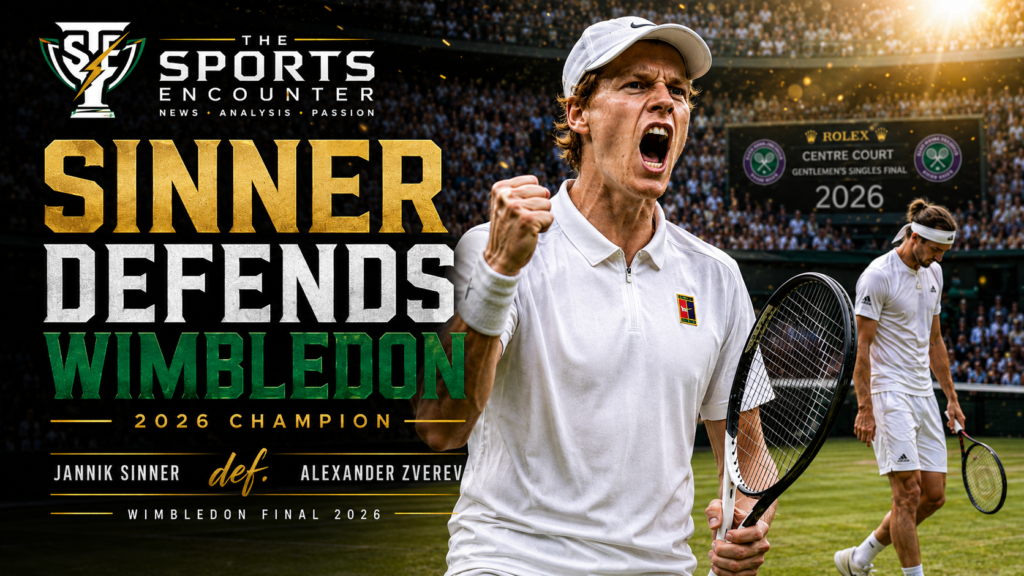
Jannik Sinner’s Wimbledon 2026 defense began with a five-set escape and ended with victories over Novak Djokovic and Alexander Zverev. Explore his complete campaign, career rise, key quotes, and road to a fifth Grand Slam title.
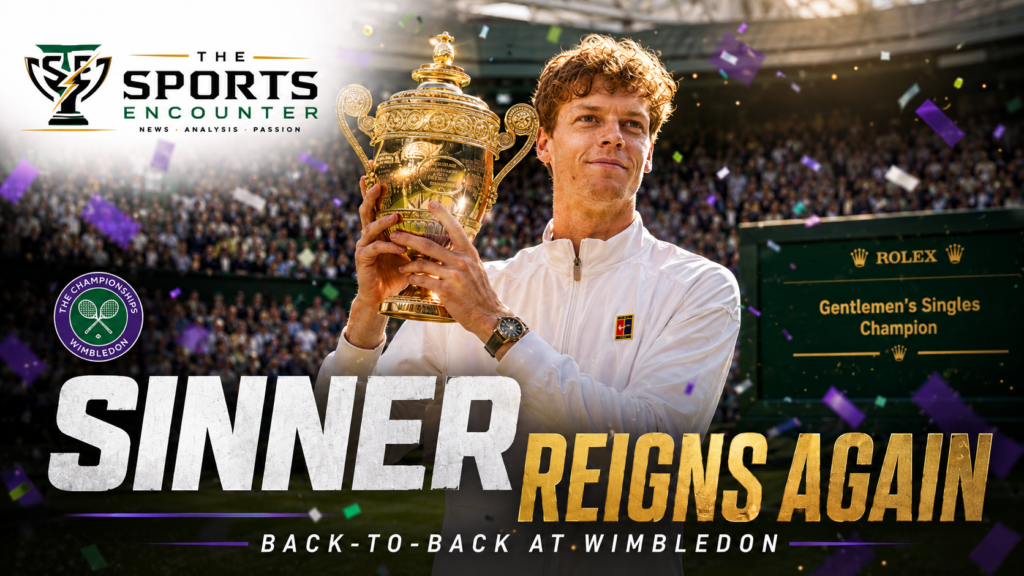
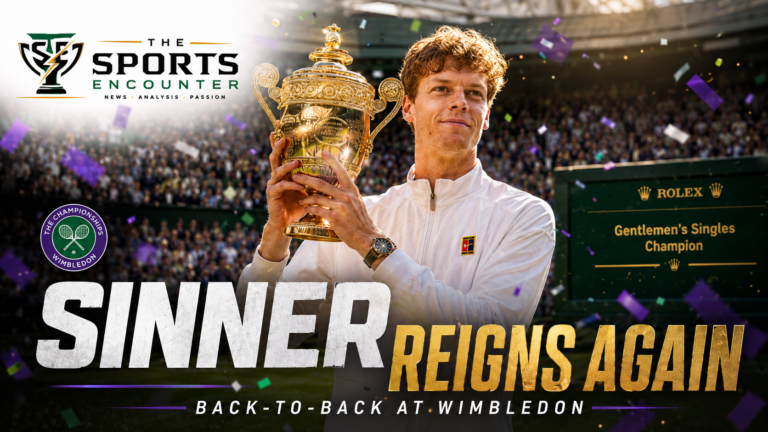
Jannik Sinner’s second Wimbledon title began with uncertainty and ended with authority.
The defending champion arrived at the All England Club after a damaging second-round exit at the French Open, no competitive grass-court warm-up event, and a first-round draw that pushed him to five sets. By the end of the fortnight, he had defeated Novak Djokovic in straight sets, outlasted French Open champion Alexander Zverev in a thunderous final, and secured the fifth Grand Slam title of his career.
Sinner beat Zverev 6-7(7), 7-6(2), 6-3, 6-4 on Centre Court, completing the victory after three hours and 46 minutes. The result made him the first Italian man to win two Wimbledon singles titles and one of only 10 men in the professional era to defend the championship successfully.
The final also delivered Sinner’s 100th Grand Slam match win.
His Wimbledon 2026 campaign demanded more than clean ball-striking. Sinner had to manage physical uncertainty, rebuild his confidence after Paris, resist Zverev’s best serving performance of the tournament, and remain composed when the final stayed balanced deep into the third set.
By the time he lifted the pineapple-topped Challenge Cup, Sinner had shown why he remains the world’s top-ranked player.
TL;DR
Jannik Sinner successfully defended his Wimbledon men’s singles title by beating Alexander Zverev in four sets.
The 24-year-old Italian:
- Won his fifth Grand Slam title
- Claimed his second consecutive Wimbledon crown
- Recorded his 100th Grand Slam match victory
- Beat Novak Djokovic in straight sets in the semifinal
- Extended his winning run against Zverev to 10 matches
- Became the 10th man in the professional era to retain the Wimbledon title
- Recovered from a five-set struggle in the opening round
- Finished the semifinal and final without losing a service game
Jannik Sinner at a Glance
| Category | Detail |
|---|---|
| Age | 24 |
| Nation | Italy |
| ATP ranking | No. 1 |
| Wimbledon seeding | No. 1 |
| Wimbledon titles | 2025, 2026 |
| Grand Slam titles | Five |
| Australian Open titles | 2024, 2025 |
| US Open titles | 2024 |
| Wimbledon titles | 2025, 2026 |
| Final opponent | Alexander Zverev |
| Final score | 6-7(7), 7-6(2), 6-3, 6-4 |
| Grand Slam match wins | 100 |
| Consecutive wins over Zverev | 10 |
The Road to the Wimbledon 2026 Title
| Round | Opponent | Result |
|---|---|---|
| First round | Miomir Kecmanovic | 4-6, 6-3, 6-7, 6-2, 6-3 |
| Second round | Nuno Borges | 7-6, 7-6, 6-4 |
| Third round | Jenson Brooksby | 6-4, 6-3, 6-4 |
| Fourth round | Shintaro Mochizuki | 6-3, 7-6, 6-3 |
| Quarterfinal | Jan-Lennard Struff | 7-5, 7-6, 6-3 |
| Semifinal | Novak Djokovic | 6-4, 6-4, 6-4 |
| Final | Alexander Zverev | 6-7(7), 7-6(2), 6-3, 6-4 |
Sinner dropped two sets in the opening round and one in the final. Every other opponent fell in straight sets.
That progression became the story of his championship. The tournament began with survival, moved into control, and ended with Sinner producing his most complete tennis when the title demanded it.
Paris Created the Doubt That Followed Him to London
Sinner entered Wimbledon with an unusual level of pressure for a player who had dominated most of the 2026 season.
He had won all five Masters 1000 tournaments he contested, becoming the first man to claim five consecutive Masters titles. Yet his Grand Slam results told a different story.
Two of his three defeats during the season came at the first two majors. His Australian Open campaign ended before the title match, while the French Open produced a far more surprising result.
Juan Manuel Cerundolo defeated Sinner in the second round in Paris, ending the Italian’s tournament far earlier than expected. The loss came in punishing heat and raised questions about his physical condition, preparation, and ability to reset quickly before Wimbledon.
Sinner responded by skipping the traditional grass-court warm-up tournaments.
Instead, he returned to Monaco for a demanding training block. Some sessions took place on hard courts as his team focused on preparing his body rather than chasing match practice.
“We put in a lot of workdays in Monaco, very, very long,” Sinner said after winning the Wimbledon title.
“Definitely sacrificing a lot of my time and everything to be in this position. Having this achievement, it means a lot to me. Yeah, it was an amazing day today.”
The decision appeared risky at the beginning of Wimbledon. Grass demands precise footwork, sharp reactions, and confidence in movement. Competitive preparation usually helps players adjust to the lower bounce and faster points.
Sinner accepted that risk because he believed physical preparation mattered more than tournament rhythm.
“Every Grand Slam is different,” he said. “Different story, different environment, different feelings before the tournament.”
“For me, this one means a lot, because it was tough after Paris. Last year was also tough. But coming here, I tried to put myself in the best position to be as competitive as possible.”
The first round tested that preparation immediately.
Miomir Kecmanovic Nearly Ended the Title Defense Before It Began
Sinner’s opening match became his greatest scare before the final.
Miomir Kecmanovic took the first set and then won a third-set tiebreak, leaving the defending champion two sets to one down. Sinner struggled to control the rallies with his usual precision and briefly appeared concerned after slipping near the baseline.
Kecmanovic played with confidence and forced Sinner into a physical, uncomfortable contest.
The Italian eventually recovered to win 4-6, 6-3, 6-7, 6-2, 6-3.
The match showed that Sinner had arrived without his best rhythm. It also revealed the mental quality that later shaped the final.
He remained patient.
Sinner stopped forcing points, improved his return position, and gradually reduced his unforced errors. Once the fifth set began, he looked more secure than he had earlier in the match.
The defending champion escaped, but the performance gave his rivals reason to believe he remained vulnerable.
That impression did not last long.
Borges and Brooksby Help Sinner Find His Rhythm
Sinner’s second-round victory over Nuno Borges marked the beginning of a more controlled phase.
He won 7-6, 7-6, 6-4, handling two tight sets before closing the match without allowing it to develop into another long physical battle.
The match sharpened his serve and return patterns. Sinner began taking the ball earlier, protecting the baseline, and creating pressure without overhitting.
Jenson Brooksby presented a different challenge in the third round. The American’s movement, court craft, and ability to disrupt rhythm can frustrate aggressive baseliners.
Sinner stayed composed and won 6-4, 6-3, 6-4.
By this stage, the opening-round instability had begun to disappear. His movement looked cleaner, his first serve became more reliable, and he started controlling rallies with depth rather than chasing quick winners.
The tournament was beginning to move at his pace.

Mochizuki Tests Sinner’s Patience
Shintaro Mochizuki entered the fourth round with freedom and confidence.
His varied game, low ball trajectory, and willingness to change direction gave Sinner a different kind of problem. The Japanese player competed well during the second set and forced a tiebreak.
Sinner dominated that breaker without losing a point.
He won 6-3, 7-6, 6-3 and reached the quarterfinals without wasting energy.
The performance reflected his growing comfort on the surface. Sinner attacked when the opportunity appeared, but he did not become impatient when Mochizuki extended rallies or changed the pace.
The world No. 1 had moved beyond survival. He was now managing matches.
Struff Brings Power, but Sinner Controls the Important Points
Jan-Lennard Struff entered the quarterfinal as an experienced and dangerous grass-court opponent.
At 36, the German had reached his first Grand Slam quarterfinal. His serve, forehand, and aggressive court positioning offered the kind of direct tennis that can shorten points and remove rhythm from a favorite.
Sinner won 7-5, 7-6, 6-3.
The match remained competitive across the first two sets, but Sinner controlled the closing stages of each.
He broke late to take the opening set, then held his nerve during another tiebreak. Once he established a two-set lead, Struff could no longer sustain the pressure required to reverse the match.
Sinner’s return game did not overwhelm Struff from the first ball. It worked through accumulation.
He forced the German to play extra volleys, made him hit difficult first shots after serve, and waited for the small drop in accuracy that eventually arrived.
The victory sent Sinner into a semifinal against Novak Djokovic.
Sinner Solves Djokovic in Straight Sets
The semifinal carried more history than any other match in Sinner’s campaign.
Djokovic entered Wimbledon chasing an eighth men’s singles title and a 25th Grand Slam crown. His Centre Court record, experience, and ability to survive difficult matches made him the greatest threat remaining in the draw.
Sinner gave him almost no opportunity to change the contest.
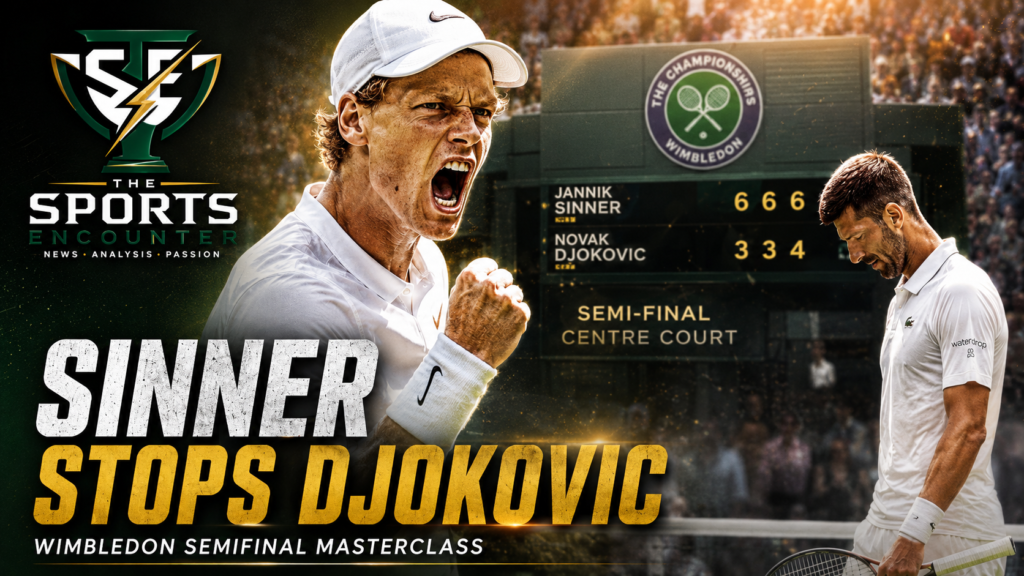
He won 6-4, 6-4, 6-4.
The Italian served with exceptional control and did not lose a service game. His return position allowed him to attack Djokovic’s second serve, while his depth prevented the Serbian from controlling rallies through changes of direction.
Sinner also refused to allow the match to become emotionally complicated.
Djokovic often turns major matches by extending points, changing tempo, and creating doubt. Sinner stayed close to the baseline and kept striking through the court.
Each set followed a similar pattern. The rallies remained competitive, but Sinner produced the cleaner tennis when the decisive moment arrived.
The straight-set result placed him back in the Wimbledon final and reinforced the sense that the world No. 1 had found his highest level at the right time.
The Sports Encounter has followed the wider debate around whether Novak Djokovic can still win another Wimbledon title, and Sinner’s semifinal performance offered a clear answer about the current balance of power.
Djokovic remains capable of reaching the final stages. Sinner currently gives him almost no room for error.
Zverev Arrives With Momentum and Belief
Alexander Zverev reached the final in the strongest stretch of his career.
The German had finally won his first Grand Slam title at the French Open and arrived at Wimbledon with renewed confidence. Before 2026, he had never progressed beyond the fourth round at the All England Club.
Now he stood one win away from completing the French Open-Wimbledon double.
Zverev’s game had also changed.
He played closer to the baseline, trusted his forehand under pressure, and attacked rather than waiting for Sinner to dictate. His first serve became the central weapon of the final.
For much of the match, Zverev’s first-serve percentage remained close to 80 percent.
The quality of his serving allowed him to shorten points and protect his weaker second serve. His forehand, often vulnerable during the biggest moments of his career, became a weapon.
“That’s the tennis I want to play,” Zverev said after the final.
“That’s the game style I want to play. The more I do it, the better I’ll become hopefully.”
His level gave Sinner the most difficult test of the tournament.
A First Set Decided by Tiny Margins
The opening set lasted 65 minutes and featured intense, heavy ball-striking from both players.
Only one break point appeared across the first 12 games.
Sinner created it at 4-3 but framed a forehand wide. The miss became costly because Zverev continued moving through his service games with remarkable efficiency.
The German dropped only eight points on serve during the set.
The tiebreak remained just as tight.
Zverev reached set point but lost it when Sinner passed him after a drop-shot exchange. He then saved a set point with an ace before earning another opportunity.
This time, he attacked with his forehand and closed the breaker 9-7.
The set ended Sinner’s run of 14 consecutive sets won against Zverev.
It also placed the defending champion behind for the first time since his opening match.
Sinner Levels the Match Without Losing Control
Sinner’s frustration became visible early in the second set.
He struggled to make an impact on Zverev’s service games, while the German continued moving around the court with confidence.
The Italian could have tried to force the issue. Instead, he protected his own serve and waited.
The set reached another tiebreak.
Zverev’s level dropped for the first time, and Sinner responded immediately. He increased his return pressure, took control of the baseline, and won the breaker 7-2.
The final was level.
That outcome mattered psychologically. Zverev had played close to his highest level for two sets and still held only half the match.
Sinner had survived the strongest phase of his opponent’s performance without losing serve.
Zverev’s Fall Changes the Third Set
The third set remained balanced at 3-3.
After two hours and 42 minutes, Zverev earned his first break point of the match.
Sinner answered with a delicate drop shot. Zverev chased it, slipped behind the dusty baseline, and fell awkwardly.
The Italian walked around the net to check on him.
Zverev said he was fine, but his movement looked less comfortable afterward. Sinner held serve and then broke in the following game.
The German threw his racket across the grass in frustration.
Sinner closed the set 6-3.
The fall became an important moment, but it did not fully explain the shift. Zverev still had a break opportunity before the slip. Sinner saved it through skill, held his nerve, and then converted the first clear opening on the other side.
The contrast came down to execution.
Sinner Completes the Title Defense
Zverev recovered enough to compete strongly in the fourth set.
Sinner had already reached another level.
His serve remained secure, his movement became more assertive, and his groundstrokes pushed Zverev farther behind the baseline. At 3-3, Sinner broke again.
The final still needed a memorable finish.
Sinner produced one.
During a 23-shot rally, both players defended, attacked, changed direction, and tested every part of the court. Sinner ended it with a sharp angled touch that brought up match point.
A forehand winner completed the victory.
The final point became Sinner’s 100th win in Grand Slam competition.
He had also completed the semifinal and final without dropping serve.
“There’s No Better Place”
Sinner’s reaction after the match reflected how deeply he valued the moment.
“There’s no better place, honestly, to play tennis,” he said while holding the trophy.
“I’m standing here. You can feel the nerves in a Sunday morning when you wake up, that this is a very special day, and you never know how many times you can come back. So I never take things for granted.”
The quote captured the emotional weight of his title defense.
Sinner entered the tournament carrying the disappointment of Paris. He survived a five-set opening match, rebuilt his level across the middle rounds, defeated Djokovic, and then faced Zverev at his most aggressive.
The trophy had never felt inevitable.
“It always takes two players,” Sinner said.
“We try to give everything we have. I’m very happy about the win but mostly very happy also about the level we played.”
Why Sinner Rejected the Language of Failure
Sinner had gone 12 months without winning another Grand Slam, despite controlling the Masters circuit.
Wimbledon could have been described as relief.
He rejected that interpretation.
“Sometimes you have a tournament with a good outcome, and sometimes you just don’t,” Sinner said.
“There is no failure if you don’t win a Grand Slam.”
“Now I have five in my whole life. But it’s five days of so many other days. You just want to enjoy it. Today was a very tough day. If I lose, it’s still a great day.”
“I never take things for granted.”
That perspective helps explain his emotional stability.
Sinner did not treat defeat as a collapse of identity. The French Open result hurt, but it became part of the preparation for Wimbledon rather than a verdict on his season.
His words also reflected the discipline behind his success. The five Grand Slam title days represent only a small part of the work, training, travel, recovery, and sacrifice that built them.
Sinner Welcomes the Growing Competition
Zverev’s performance confirmed that the German has become a more dangerous major opponent.
Sinner welcomed that development.
“That’s exactly what’s good, because you have always someone who’s pushing you to the limit,” he said.
“We hope that Carlos Alcaraz is coming back from injury, as well, because tennis needs him. Having Novak Djokovic still around, having all the young players coming, it’s really nice.”
“At the same time, you always need to work hard and have moments like this.”
The men’s game now contains several overlapping eras.
Djokovic still competes for history. Zverev has finally become a Grand Slam champion. Alcaraz remains central to the future of the sport. A younger group continues to rise.
Sinner currently stands above them as world No. 1 and back-to-back Wimbledon champion.
From Skiing and Soccer to the Top of Tennis
Sinner’s path to Wimbledon greatness began in Innichen, a small town in northern Italy.
He started playing tennis at the age of seven, but the sport did not immediately become his main focus. Skiing and soccer interested him more during his childhood.
At 13, he committed fully to tennis.
That decision changed Italian sporting history.
Sinner began his professional career on the ITF circuit in 2018. His rise accelerated in 2019 when he won the Next Gen ATP Finals by defeating Alex de Minaur.
He finished that year ranked No. 78 and received the ATP Newcomer of the Year award.
In 2020, Sinner won the Sofia Open, becoming the youngest Italian man to claim a tour-level title during the Open Era. He ended the season ranked 37th.
His progress continued in 2021 with titles at the Great Ocean Road Open, Washington Open, Sofia Open, and European Open. By the end of the year, he had entered the world’s top 10.
Wimbledon 2023 Signals the Next Stage
Sinner reached his first Grand Slam semifinal at Wimbledon in 2023.
That run confirmed his potential on grass and marked the beginning of his development into a genuine major contender.
Later that year, he won his first Masters 1000 title at the Canadian Open and rose to world No. 4, becoming only the second Italian man to enter the ATP top five.
His impact extended beyond individual tournaments.
In November 2023, Sinner helped Italy win the Davis Cup for the first time in 47 years. His performances under national pressure strengthened his reputation as a player capable of delivering in emotionally demanding environments.
The following season brought the breakthrough.
The 2024 Season Changes Sinner’s Career
Sinner won his first Grand Slam title at the 2024 Australian Open, defeating Daniil Medvedev in the final.
He later reached the French Open semifinal and became the world No. 1 in June.
At the US Open, Sinner defeated Taylor Fritz to claim his second major title. He also won the Shanghai Masters and completed the year by capturing his first ATP Finals crown.
His 2024 season also included a complicated anti-doping case.
Sinner tested positive for clostebol in two samples taken in March. The International Tennis Integrity Agency accepted that the substance entered his system through contamination linked to treatment by a member of his support team and initially imposed no suspension.
The World Anti-Doping Agency later challenged that outcome. A settlement followed in 2025.
The case remained part of the public discussion around Sinner, but his competitive rise continued.
Australian Open Defense and the Alcaraz Rivalry
Sinner retained the Australian Open title in 2025, confirming that his first major victory had begun a sustained period of dominance.
The French Open that year brought disappointment when Carlos Alcaraz defeated him in the final.
Sinner answered weeks later at Wimbledon.
He beat Alcaraz in the 2025 final to win his first title at the All England Club, becoming the first Italian man to claim the Wimbledon singles championship.
That victory added another dimension to his rivalry with Alcaraz.
The Sports Encounter’s wider Wimbledon coverage has followed how Sinner, Alcaraz, Djokovic, and Zverev are reshaping the men’s game across different surfaces and major tournaments.
One year after beating Alcaraz, Sinner returned to Centre Court and defeated Zverev to retain the crown.
Five Grand Slam Titles by Age 24
Sinner’s major record now includes:
- Australian Open 2024
- US Open 2024
- Australian Open 2025
- Wimbledon 2025
- Wimbledon 2026
The balance of those titles matters.
Sinner has won on hard courts and grass, defended two major championships, and defeated several of the strongest players of his generation in Grand Slam finals.
His Wimbledon defense also strengthened his case as the most complete active player across conditions.
He can overpower opponents from the baseline, serve with precision, defend with balance, and adjust his position when the match changes.
The 2026 final showed all of those qualities.
What Made Sinner’s Wimbledon Campaign Special
The defining feature of Sinner’s campaign was his ability to adapt without losing his identity.
Against Kecmanovic, he survived.
Facing Borges and Brooksby, he restored rhythm.
Mochizuki required patience.
Struff demanded precision against power.
Djokovic tested his ability to dominate an experienced champion.
Zverev forced him to absorb a first-set assault, manage two tiebreaks, and wait nearly three hours for the first break of serve.
Sinner answered every challenge.
He did not need the same version of his tennis in every round. His base level remained strong enough to survive the difficult days, while his highest level arrived for the semifinal and final.
That is the pattern of a mature champion.
Final Verdict
Jannik Sinner’s Wimbledon 2026 title defense strengthened his position at the top of men’s tennis.
The campaign began with a five-set escape and ended with a four-set victory over the reigning French Open champion.
Between those matches, Sinner won five consecutive contests in straight sets, including a controlled semifinal against Djokovic.
His fifth Grand Slam title carried the weight of his entire journey.
The child who preferred skiing and soccer became Italy’s first Wimbledon men’s singles champion. One year later, he returned and defended the title.
The player who left Paris disappointed committed to long training days in Monaco and arrived in London without a warm-up tournament.
The world No. 1 then survived the uncertainty, trusted his preparation, and produced his best tennis when Centre Court demanded it.
“There’s no better place,” Sinner said.
For the second consecutive year, there was no better player there either.
Jannik Sinner’s Wimbledon 2026 Campaign Scorecard
| Category | Rating | Assessment |
|---|---|---|
| Mental resilience | 10/10 | Recovered from a five-set opening match and losing the first set of the final |
| Serving | 9.5/10 | Went unbroken across the semifinal and final |
| Return game | 9/10 | Increased pressure as matches developed |
| Baseline control | 9.5/10 | Dictated without forcing unnecessary risks |
| Tactical adjustment | 10/10 | Solved different styles across all seven rounds |
| Physical management | 9/10 | Recovered from a difficult opening match and sustained his level |
| Semifinal performance | 10/10 | Defeated Djokovic in straight sets |
| Final performance | 9.5/10 | Outlasted an inspired Zverev in four sets |
| Overall campaign | 9.8/10 | A complete title defense built through resilience, patience, and elite execution |
FAQs
Who did Jannik Sinner beat in the Wimbledon 2026 final?
Sinner defeated Alexander Zverev 6-7(7), 7-6(2), 6-3, 6-4.
How many Wimbledon titles has Jannik Sinner won?
He has won two Wimbledon men’s singles titles, in 2025 and 2026.
How many Grand Slam titles does Sinner have?
The 2026 Wimbledon title gave him five Grand Slam singles championships.
Which Grand Slam titles has Jannik Sinner won?
Sinner won the Australian Open in 2024 and 2025, the US Open in 2024, and Wimbledon in 2025 and 2026.
Who did Sinner beat in the semifinal?
He defeated Novak Djokovic 6-4, 6-4, 6-4.
Did Sinner lose serve in the semifinal or final?
No. Djokovic and Zverev failed to break his serve across both matches.
How old was Sinner when he defended Wimbledon?
He was 24.
Where was Jannik Sinner born?
He was born in Innichen, a small town in northern Italy.
Which sports did Sinner prefer as a child?
He initially preferred skiing and soccer before committing fully to tennis at age 13.
What was Sinner’s first ATP title?
He won the Sofia Open in 2020.
When did Sinner become world No. 1?
He became the top-ranked men’s player after reaching the French Open semifinal in June 2024.
Why did the 2026 Wimbledon title mean so much to him?
Sinner said it carried extra meaning because of his early French Open defeat, the demanding preparation that followed, and his awareness that opportunities to play Wimbledon finals cannot be taken for granted.

Editor's Choice
How Youngster Lamine Yamal Came of Age in the FIFA World Cup 2026
Lamine Yamal arrived at the FIFA World Cup 2026 as football’s most celebrated teenager. He left as a world champion whose creativity, composure, identity, and global appeal helped define a new generation.
Lamine Yamal arrived at the FIFA World Cup 2026 as the most famous teenager in soccer. He left North America as a world champion, a symbol of modern Spain, and the young player who connected the tournament with a new generation of fans.
His campaign did not unfold through a simple collection of goals or a procession of spectacular individual performances. Spain asked Yamal to occupy defenders, create space, carry the ball through pressure, and provide the unpredictability that a possession-heavy team still needed.
At 19 years and six days, he became one of the youngest players ever to win the men’s World Cup. He also became the first teenager to appear in both a European Championship final and a FIFA World Cup final, having already helped Spain win Euro 2024 as a 17-year-old.
By the time Spain defeated Argentina 1-0 after extra time in the final, Yamal had completed a journey that stretched far beyond one tournament. The fearless boy who broke records at Barcelona had learned how to influence games when opponents designed entire defensive plans around stopping him.
Lamine Yamal at the FIFA World Cup 2026
- Age during the final: 19 years and six days
- Country: Spain
- Position: Right winger
- Tournament finish: FIFA World Cup champion
- World Cup appearance: Tournament debut
- Major role: Wide creator, dribbler, chance-maker, and attacking outlet
- Historic achievement: First teenager to play in both a European Championship final and a World Cup final
How Did Lamine Yamal Perform at the FIFA World Cup 2026?
Yamal scored once during Spain’s title run, but his value could not be reduced to his goal total.
He remained one of Spain’s primary sources of width and creativity from the right. Opposing left backs rarely defended him alone. Midfielders moved across to close the inside channel, while center backs prepared for the moment he cut toward goal on his stronger left foot.
That attention changed Spain’s attacking geometry.
When two defenders moved toward Yamal, teammates gained room elsewhere. Pedri and Dani Olmo could receive between the lines. Fullbacks found wider passing lanes. Mikel Oyarzabal, Ferran Torres, and Nico Williams benefited from defensive units leaning toward Spain’s right side.
Yamal’s influence appeared in passes that opened attacks, dribbles that forced fouls, and moments when a defender had to abandon his position to confront him. His tournament became a study in how an elite young player can affect matches even when the scoring numbers remain modest.
FIFA consistently included him among the leading candidates for the tournament’s Young Player Award, although the honor eventually went to his Spain teammate Pau Cubarsí. Yamal’s fellow teenager earned the award through outstanding defensive performances, while Yamal supplied much of Spain’s attacking imagination.
The World Cup Tested Yamal Differently
Yamal had already won major trophies before arriving in North America. He had become Spain’s youngest international and goalscorer, played a central role in the Euro 2024 triumph, and established himself as one of Barcelona’s most important players.
The World Cup brought a different level of attention.
Every match carried global scrutiny. Every quiet spell became a debate. Defenders understood his preferred movements, while coaches built compact structures to prevent him from receiving the ball near the penalty area.
Spain’s opening draw against Cape Verde provided an early warning. Yamal found limited room against a disciplined defensive block, and Spain struggled to turn possession into clear chances. The result became one of the tournament’s early surprises and forced Luis de la Fuente’s team to become more varied in attack.
Rather than chasing the game on his own, Yamal adapted. He released the ball earlier, combined more frequently with midfield runners, and learned when to hold his width instead of constantly moving inside.
That tactical growth mattered as Spain progressed through the competition. Their route included victories over Austria, Portugal, Belgium, France, and Argentina, opponents with very different defensive approaches.
Lamine Yamal’s Best World Cup 2026 Performances
Yamal’s attacking importance became clearer during the knockout rounds.
Against Austria in the Round of 32, his movement stretched a defense that struggled to contain Spain’s wide threats. Portugal then presented a more physical and experienced challenge, forcing the teenager to work through tighter spaces during Spain’s 1-0 victory.
The quarterfinal against Belgium offered another stage for his creativity. Belgium attempted to crowd central areas and break quickly through its own attacking talent, but Yamal continued to carry Spain forward from the right as the champions won 2-1.
His composure before the semifinal also revealed how comfortable he had become under the brightest lights. Yamal turned 19 on July 13, one day before facing France. Asked about pressure, he treated the occasion with the relaxed confidence of someone playing a familiar neighborhood game rather than a World Cup semifinal. He had already scored against France at ages 16 and 17, and he entered the match focused on another Spanish victory rather than personal recognition.
Spain won 2-0, controlling a French side led by Kylian Mbappé and Ousmane Dembélé. Rodri and Spain’s midfield dictated the match, but Yamal’s presence continued to influence where France placed its defensive protection.
That victory sent Spain into the FIFA World Cup 2026 final against Argentina, where Yamal faced the player who had shaped so much of his own football imagination.
Lamine Yamal vs Lionel Messi Became the Story of Generations
The final carried an irresistible narrative.
In 2007, a young Lionel Messi held six-month-old Yamal during a charity calendar photo shoot organized by Barcelona, UNICEF, and the Spanish newspaper Sport. Nearly two decades later, they met on opposite sides of a World Cup final.
The image returned throughout the tournament because it captured the passage of football time with remarkable clarity. Messi represented the most influential playing career of the modern era. Yamal stood as one of the clearest candidates to lead the sport’s next generation.
That storyline could easily have overwhelmed a teenager. Yamal handled it with maturity.
He spoke respectfully about Messi without treating the final as a ceremonial handover. Spain’s goal was to win, and Yamal played with the aggression of a competitor rather than the hesitation of an admirer.
During the final, he repeatedly attempted to isolate Argentina’s defenders and thought he had scored the opening goal before the effort was ruled out. Argentina contained him for long stretches, yet his movement kept their defensive line occupied while Spain maintained territorial control.
Ferran Torres eventually scored in the 106th minute, ending Argentina’s resistance and securing Spain’s second World Cup title.
After the match, Yamal approached Messi and embraced him. The moment carried respect rather than theatrical symbolism. One Barcelona generation had met another on the largest stage, and the younger player left with the trophy.
Why Lamine Yamal Inspired Young Soccer Fans
Yamal’s influence extended well beyond Spain’s tactical structure.
Young fans saw a 19-year-old playing decisive World Cup matches with visible joy. His game included the qualities that attract children to soccer in the first place: dribbling, invention, quick changes of direction, daring passes, and the willingness to challenge defenders.
His background added another layer to that appeal.
Yamal grew up in Rocafonda, a working-class and culturally diverse neighborhood near Barcelona. He represents that community with his “304” celebration, a reference to the final digits of the local postal code. Born to a Moroccan father and an Equatorial Guinean mother, he has spoken through his career and public image to a Spain shaped by migration, mixed identities, and neighborhood pride.
During the World Cup, residents of Rocafonda gathered around the story of a local child reaching the final against Messi. His success carried social meaning because he remained connected to the place that formed him.
For young players in Barcelona, Madrid, Casablanca, Malabo, Karachi, Lagos, New York, and countless other cities, Yamal made elite soccer appear closer. His journey showed that global fame does not require abandoning local identity.
His popularity across social media also helped the tournament reach audiences who experience soccer through clips, short videos, player-led content, and mobile-first storytelling. By the end of the World Cup, his Instagram audience had grown beyond 50 million followers, reflecting a global appeal that already stretched beyond traditional club loyalties.
Yamal Led a Remarkable Generation of Young Players
The FIFA World Cup 2026 featured several young players who looked ready to shape the next decade.
Pau Cubarsí won the Young Player Award after anchoring Spain’s defense. Désiré Doué impressed for France. Nico O’Reilly strengthened England’s midfield options, while Ayyoub Bouaddi emerged as another high-level prospect.
Yamal remained the most visible figure among them.
His fame, playing style, championship pedigree, and ability to connect with younger audiences gave him a different kind of influence. Cubarsí earned the official youth award, but Yamal became the tournament’s clearest generational symbol.
He was also central to a Spain side that blended teenage talent with experienced leaders such as Rodri. The balance allowed young players to express themselves within a disciplined structure rather than carrying the team alone.
That framework helps explain why Spain won. Yamal offered freedom and improvisation. Rodri supplied control. Cubarsí brought defensive composure, while the wider squad contributed goals from several positions.
How Old Was Lamine Yamal When Spain Won the World Cup?
Yamal was 19 years and six days old when Spain defeated Argentina in the final on July 19, 2026.
FIFA’s tournament statistics placed him among the youngest World Cup winners in history. Only a small group, including Pelé and Giuseppe Bergomi, lifted the trophy at a younger age.
The achievement became even more remarkable because Yamal was already a European champion. He had won Euro 2024 shortly after turning 17, then added the World Cup two years later.
Few players in soccer history have accumulated that level of international experience before their 20th birthday.
Did Lamine Yamal Win the World Cup Young Player Award?
No. Spain center back Pau Cubarsí received the FIFA World Cup 2026 Young Player Award.
That result did not diminish Yamal’s tournament. The two young Spaniards influenced different parts of the game, and Cubarsí’s defensive consistency helped Spain concede only one goal across eight matches.
Yamal’s contribution appeared through creativity, width, defensive attention, and attacking progression. He entered the tournament as a global star and left as a world champion who had learned to contribute even when opponents prevented him from dominating individually.
What the 2026 World Cup Changed for Lamine Yamal
Before the tournament, Yamal was already viewed as football’s leading young talent.
After it, he had become part of World Cup history.
The distinction matters. Club brilliance creates fame, while World Cups create memories shared across countries and generations. Yamal’s tournament now belongs to children who watched him challenge defenders, lift the trophy, embrace his younger brother on the field, and share a respectful moment with Messi after the final.
That family celebration softened the scale of the occasion. His three-year-old brother, Keyne, ran onto the field wearing Yamal’s shirt and became one of the tournament’s most widely shared post-final images. The scene reminded millions of viewers that the new world champion was still a young man surrounded by family.
Yamal did not need to win the Golden Ball, Golden Boot, or Young Player Award to define the youth story of the World Cup.
His broader achievement was making elite football feel adventurous again. Every touch carried possibility. Every one-on-one duel invited anticipation. Young fans watched him play and saw someone close enough to their own age to make ambition feel immediate.
Frequently Asked Questions
How many goals did Lamine Yamal score at the FIFA World Cup 2026?
Yamal scored once during Spain’s championship campaign, while contributing through chance creation, dribbling, width, and attacking combinations.
Did Lamine Yamal play in the 2026 World Cup final?
Yes. Yamal started for Spain against Argentina and became the first teenager to appear in both a European Championship final and a World Cup final.
How old was Lamine Yamal in the World Cup final?
He was 19 years and six days old when Spain won the final on July 19, 2026.
Did Lamine Yamal win the Best Young Player award?
No. His Spain teammate Pau Cubarsí won the FIFA Young Player Award.
Is Lamine Yamal the youngest World Cup winner?
No. Pelé remains the youngest men’s World Cup winner. Yamal nevertheless became one of the youngest players ever to lift the trophy.
Why is Lamine Yamal so popular with young soccer fans?
His expressive playing style, age, multicultural background, neighborhood identity, social media presence, and success at Barcelona and with Spain make him highly relatable to younger audiences worldwide.
A World Champion Before His 20th Birthday
The FIFA World Cup 2026 did not represent Yamal’s arrival. That had already happened at Barcelona and Euro 2024.
It marked his maturation.
He learned to influence matches when space disappeared, remained composed under global pressure, helped Spain navigate the knockout rounds, and started a World Cup final against his childhood idol.
By the end, Yamal stood with a winner’s medal, a trophy, and a place inside the next chapter of soccer history.
The generation inspired by Messi now has a champion of its own age to follow.
The Sports Encounter’s World Cup 2026 coverage focuses on fixtures, team news, match analysis, fan stories, tournament trends, and the biggest talking points from football’s global stage.
Editor's Choice
Meet the Top 10 Goal Scorers of the FIFA World Cup 2026
Kylian Mbappé’s speed, movement, and ruthless finishing produced 10 goals and another Golden Boot, but the FIFA World Cup 2026 scoring race also delivered historic campaigns from Lionel Messi, Jude Bellingham, Erling Haaland, and Spain’s title-winning attack.
Kylian Mbappé finished as the top scorer at the FIFA World Cup 2026, winning the Golden Boot with 10 goals as his pace, agility, movement, and ruthless finishing carried France to fourth place.
The tournament ended with Spain lifting the trophy, Argentina finishing second, and England claiming third place. Yet the individual scoring race belonged to Mbappé. France’s captain scored in the group stage, the Round of 32, the Round of 16, the quarterfinal, and the third-place playoff.
His two goals against England took him into double figures and moved him clear of Lionel Messi, who finished with eight. Mbappé also reached 22 career World Cup goals, strengthening his claim as the most productive tournament scorer of his generation.
The final list of the top goal scorers at the FIFA World Cup 2026 featured established superstars, a breakout World Cup debutant, two England players, and one member of Spain’s championship team.
FIFA World Cup 2026 Top Scorers at a Glance
| Rank | Player | Country | Goals |
|---|---|---|---|
| 1 | Kylian Mbappé | France | 10 |
| 2 | Lionel Messi | Argentina | 8 |
| 3 | Jude Bellingham | England | 7 |
| 4 | Erling Haaland | Norway | 7 |
| 5 | Ousmane Dembélé | France | 6 |
| 6 | Harry Kane | England | 6 |
| 7 | Mikel Oyarzabal | Spain | 5 |
| 8 | Ismaïla Sarr | Senegal | 4 |
| 9 | Julián Quiñones | Mexico | 4 |
| 10 | Vinícius Júnior | Brazil | 4 |
1. Kylian Mbappé, France: 10 Goals
Mbappé began the World Cup as one of the favorites for the Golden Boot and quickly turned expectation into production. He scored twice against Senegal, added another brace against Iraq, and struck twice more as France defeated Sweden in the Round of 32.
His movement made him almost impossible to contain. Mbappé could begin on the left, drift centrally, attack the gap between defenders, or accelerate behind the back line before opponents had time to reorganize. His goals came through speed, sharp positioning, controlled finishing, and an ability to recognize danger a second earlier than everyone around him.
Further goals against Paraguay and Morocco helped France reach the semifinals. Spain denied him space during its disciplined 2-0 victory, but Mbappé responded with two goals in the extraordinary 6-4 third-place playoff defeat against England.
France finished fourth, below its pre-tournament target, but Mbappé remained the tournament’s most devastating scorer. He became the first man to win two FIFA World Cup Golden Boots after also leading the scoring table in 2022.
2. Lionel Messi, Argentina: 8 Goals
At 39, Messi produced another World Cup campaign filled with records and moments of individual brilliance.
He opened with a hat trick against Algeria, scored twice against Austria, and added a free kick against Jordan. Further goals against Cape Verde and Egypt took him to eight for the tournament.
Messi’s influence stretched beyond scoring. He supplied decisive passes during Argentina’s path through the knockout rounds and helped the defending champions reach another final. Spain eventually won 1-0 after extra time, but Messi remained Argentina’s main creative reference throughout the competition.
His eight goals earned second place in the scoring chart and the Silver Ball behind Spain captain Rodri.
3. Jude Bellingham, England: 7 Goals
Bellingham delivered one of the strongest tournament performances ever produced by an England midfielder.
He scored against Croatia and Panama, struck twice during England’s comeback victory over Mexico, and added another double in the quarterfinal against Norway. His extra-time winner in that match carried England into the semifinals.
A final goal against France in the third-place playoff brought his total to seven. That made Bellingham the first England player to score seven times at a single World Cup.
His goals reflected his complete attacking range. Some came from late runs into the penalty area. Others required physical strength, timing, or calm finishing under pressure.
4. Erling Haaland, Norway: 7 Goals
Haaland’s first World Cup produced exactly the kind of impact Norway had hoped for.
The striker scored twice against Iraq and twice against Senegal before finding the winner against Ivory Coast in the Round of 32. He then delivered two more goals as Norway stunned Brazil in the Round of 16.
Norway’s run ended against England in the quarterfinals, but Haaland left with seven goals and proof that his club-level scoring power could transfer to international football’s biggest stage.
His finishing was direct and unforgiving. Norway rarely needed to create several chances for him. One loose ball, mistimed defensive step, or accurate cross was often enough.
5. Ousmane Dembélé, France: 6 Goals
Dembélé gave France a second player among the tournament’s leading scorers.
His campaign gathered momentum after he scored against Iraq. A hat trick against Norway pushed him into the Golden Boot conversation, while another goal against Morocco helped France reach the semifinals.
Dembélé completed his tournament by scoring against England in the third-place playoff. His six goals, combined with his creative contribution, made him one of the most productive attackers at the competition.
France’s attack often depended on Mbappé’s directness, but Dembélé provided unpredictability from different positions. His ability to use either foot made defenders reluctant to force him in one direction.
6. Harry Kane, England: 6 Goals
Kane remained England’s reliable penalty-area finisher even as Bellingham and Bukayo Saka produced major attacking moments around him.
He scored twice against Croatia and added another goal against Panama. A brace against DR Congo moved England through the Round of 32, while his penalty against Mexico helped complete a difficult comeback.
Kane’s six-goal campaign also carried historical weight. He moved beyond Gary Lineker to become England’s leading scorer in World Cup finals.
England missed the final after losing to Argentina, but its victory over France secured third place and completed another productive tournament for its captain.
7. Mikel Oyarzabal, Spain: 5 Goals
Spain won the World Cup through collective control, defensive discipline, and attacking variety. Oyarzabal emerged as their leading scorer.
He struck twice against Saudi Arabia and scored another double against Austria in the Round of 32. His penalty against France in the semifinal took him to five goals.
Oyarzabal did not score in the final, where Ferran Torres produced the decisive extra-time finish against Argentina. His earlier goals, however, gave Spain a dependable central threat during its journey to the title.
His presence also prevented opponents from focusing entirely on Lamine Yamal, Nico Williams, and Spain’s midfield runners.
8. Ismaïla Sarr, Senegal: 4 Goals
Sarr was Senegal’s most dangerous attacker during a tournament that ended in the Round of 32.
He scored twice against Norway, found the net against Iraq, and struck again as Senegal built a lead against Belgium. The African side could not protect that advantage, but Sarr’s four goals underlined his importance.
His acceleration and direct running repeatedly stretched defensive lines. Senegal’s elimination arrived earlier than supporters hoped, although Sarr left as one of the tournament’s leading African scorers.
9. Julián Quiñones, Mexico: 4 Goals
Quiñones became one of the central figures in Mexico’s home World Cup campaign.
He scored during the group stage against South Africa and Czechia, then struck against Ecuador in the Round of 32. His fourth goal came in Mexico’s 3-2 defeat against England.
Mexico did not reach the quarterfinals, but Quiñones gave the co-hosts power, athleticism, and a reliable finishing presence. His performances also made him one of the tournament’s standout scorers from the CONCACAF region.
10. Vinícius Júnior, Brazil: 4 Goals
Vinícius opened his tournament with an outstanding strike against Morocco and followed it with a goal against Haiti. Two more against Scotland brought him to four before the knockout stage.
Brazil then defeated Japan but suffered a surprise Round of 16 loss to Norway. Vinícius could not add to his total during those matches, leaving his World Cup with a sharp divide between an explosive group stage and a frustrating knockout campaign.
His four goals still earned him a place among the competition’s 10 leading scorers.
Why Mbappé Won the FIFA World Cup 2026 Golden Boot
Mbappé separated himself through consistency across the tournament. He scored against different opponents, in different rounds, and through different types of finishes.
His agility allowed him to change direction without losing momentum. Elite acceleration made defensive recovery difficult, while improved movement through central areas gave him more routes to goal than in previous tournaments.
France fell short of the final after losing to Spain, but Mbappé kept producing until the last match. His brace against England became the difference between sharing the scoring lead and winning the Golden Boot outright.
The World Cup ultimately belonged to Spain. Its scoring crown belonged to Mbappé.
Frequently Asked Questions
Who was the top scorer at the FIFA World Cup 2026?
Kylian Mbappé finished as the tournament’s top scorer with 10 goals and won the FIFA World Cup 2026 Golden Boot.
How many goals did Mbappé score at World Cup 2026?
Mbappé scored 10 goals in eight matches for France.
Who finished second in the 2026 World Cup scoring chart?
Lionel Messi finished second with eight goals for Argentina.
How many goals did Jude Bellingham score?
Bellingham scored seven goals and became the first England player to reach that total in a single World Cup.
Who was Spain’s leading scorer at World Cup 2026?
Mikel Oyarzabal led the champions with five goals.
Did Mbappé win consecutive World Cup Golden Boots?
Yes. Mbappé won the Golden Boot in 2022 and again in 2026, becoming the first male player to win the award twice.
The Sports Encounter’s World Cup 2026 coverage focuses on fixtures, team news, match analysis, fan stories, tournament trends, and the biggest talking points from football’s global stage.
Editor's Choice
Why FIFA Picked Rodri as the Best Player of the FIFA World Cup 2026
Rodri did not lead the FIFA World Cup 2026 scoring charts, but Spain’s captain controlled the spaces, passing lanes, defensive transitions, and match tempo that carried La Roja to the title.
Rodri won the FIFA World Cup 2026 Golden Ball because he controlled the part of the game that decided Spain’s championship: the space between defending and attacking.
Kylian Mbappé scored 10 goals. Lionel Messi led Argentina back to the final. Lamine Yamal provided Spain with imagination, width, and youthful nerve. Yet when FIFA selected the Player of the Tournament, the award went to the man who gave every part of Spain’s football its balance.
Rodri, Spain’s captain and midfield anchor, received the adidas Golden Ball after La Roja defeated Argentina 1-0 following extra time in the final at New York New Jersey Stadium. His tournament was built on control rather than highlight-reel production. He moved the ball, protected the defense, managed transitions, organized teammates, and repeatedly made difficult matches feel comfortable for Spain.
For supporters asking why Rodri won the 2026 World Cup Golden Ball, the clearest answer lies in his total influence. He was Spain’s tactical reference point across all eight matches.
Why Did Rodri Win the FIFA World Cup 2026 Golden Ball?
FIFA highlighted Rodri’s ability to connect defense with attack, intervene at the right moments, and pass with exceptional accuracy. Those qualities shaped Spain’s entire campaign.
Rodri completed more passes than any other player at the tournament. He finished with 655 accurate passes from 705 attempts, giving him a completion rate of almost 93 percent. His distribution remained accurate even when he advanced the ball into crowded attacking areas.
The numbers describe only part of his value. Spain trusted Rodri to receive possession under pressure, turn away from opponents, and decide whether the next action required patience or speed. He rarely forced the game. His decisions allowed Pedri, Fabián Ruiz, Dani Olmo, Nico Williams, and Yamal to operate with greater freedom.
During Spain’s World Cup final victory over Argentina, Rodri completed 101 of his 105 passes. He also won 80 percent of his duels and created two scoring chances. Those figures came in the highest-pressure match of the tournament, against a team built to punish mistakes and disrupt central midfield rhythm.
Rodri Controlled the World Cup Final Against Argentina
The final offered the strongest explanation for FIFA’s decision.
Argentina entered the match with Messi operating between midfield and attack, Enzo Fernández attempting to progress the ball, and Lautaro Martínez looking for opportunities behind Spain’s defense. Rodri’s positioning reduced the space available to all three.
He rarely chased Messi recklessly. Instead, Rodri stayed connected to Spain’s center backs, blocked forward passing lanes, and moved across the field as Argentina changed the point of attack. When Messi dropped deeper, Rodri helped prevent him from turning into open space.
One of his most important interventions came late in the contest when he dispossessed Messi during a dangerous Argentine transition. It was the kind of moment that defined Rodri’s tournament. The action did not produce a goal or assist, but it stopped Argentina from creating the moment that could have changed the final.
Spain eventually broke through when Ferran Torres scored in the 106th minute. The goal earned the headlines. Rodri had spent the previous 105 minutes ensuring Spain remained in control long enough for the breakthrough to arrive.
Spain’s Defensive Record Strengthened Rodri’s Case
Spain conceded only one goal across eight World Cup matches. That record belonged to the entire team, including Golden Glove winner Unai Simón and a disciplined defense led by Pau Cubarsí and Aymeric Laporte.
Rodri provided the protection in front of them.
He led the tournament with 26 tackles and won 63.3 percent of his ground duels. Spain’s opponents produced only 2.37 expected goals across the competition, a remarkably low figure for an eight-match run through an expanded World Cup.
His defensive intelligence was especially valuable because Spain committed numbers forward. Fullbacks advanced, wide attackers stayed high, and midfielders moved between the lines. Rodri monitored the spaces they left behind and slowed counterattacks before they developed into clear chances.
That structure helped Spain eliminate Austria, Portugal, Belgium, France, and Argentina during the knockout stage. The 2-0 semifinal victory over France offered another example. Mbappé and Ousmane Dembélé entered as major attacking threats, but Spain controlled the center and denied France the transitions they needed.
Rodri Gave Spain More Than Passing Accuracy
Defensive midfielders are often judged through pass-completion percentages, but safe passing alone does not explain Rodri’s importance.
His value came from choosing the right pass at the right moment.
Rodri could recycle possession when Spain needed stability, break the first defensive line with a vertical pass, switch play toward Yamal or Williams, or draw an opponent forward before releasing a teammate into the space behind him.
He completed more final-third passes than any other player and maintained an accuracy rate above 90 percent in advanced areas. That distinction matters. Passing accurately near one’s own defense is far easier than finding teammates around a compact penalty area.
Spain experienced the difficulty of breaking down deep defenses during their opening goalless draw with Cape Verde. As the competition progressed, Rodri helped Spain improve the speed and direction of their possession. La Roja became more purposeful without losing control.
Was Rodri Better Than Messi and Mbappé at World Cup 2026?
That question depends on how tournament excellence is measured.
Mbappé was the outstanding goalscorer and deserved the Golden Boot after scoring 10 times. Messi remained Argentina’s attacking leader and received the Silver Ball after guiding the defending champions to another final.
Rodri influenced more phases of the game.
He contributed to Spain’s buildup, defensive organization, pressing structure, game management, and leadership. While Mbappé decided matches near the penalty area and Messi created Argentina’s most dangerous moments, Rodri shaped how Spain played from the opening pass to the final defensive action.
Before the final, The Sports Encounter’s ranking of the top players at the FIFA World Cup 2026 reflected how difficult it was to compare goalscorers with midfield controllers. The final strengthened Rodri’s argument because he delivered his most complete performance on the tournament’s biggest night.
Rodri’s Leadership Mattered During Spain’s Title Run
Rodri also carried the captaincy during a campaign that required Spain to manage different kinds of pressure.
The team began with questions after drawing against Cape Verde. It responded by beating Saudi Arabia 4-0 and Uruguay 1-0 before finding a stronger rhythm in the knockout rounds.
Spain then defeated Austria 3-0, eliminated Portugal 1-0, overcame Belgium 2-1, shut out France 2-0, and finally defeated Argentina.
Rodri gave the side emotional stability throughout those changes. He communicated constantly, slowed matches when opponents gained momentum, and helped younger players remain connected to Spain’s structure.
Yamal, Cubarsí, and several other members of the squad experienced their first World Cup under intense expectations. Rodri’s calm authority gave Luis de la Fuente an experienced leader in the most important area of the pitch.
Why Rodri Was the Right FIFA World Cup 2026 Player of the Tournament
Golden Ball debates often favor goals, assists, and individual attacking moments. Rodri’s victory recognized a broader form of football influence.
He completed the most passes, maintained elite accuracy, won tackles and duels, protected the tournament’s best defense, controlled the final, and captained Spain to its second world championship.
FIFA’s choice reflected the story of the tournament. Spain won through collective intelligence, positional discipline, technical quality, and patience. Rodri embodied every one of those qualities.
Ferran Torres scored the goal that won the final. Unai Simón protected Spain’s net. Yamal supplied invention, while Cubarsí represented the team’s emerging generation.
Rodri made the entire system function.
Frequently Asked Questions
Who won the FIFA World Cup 2026 Golden Ball?
Spain captain Rodri won the adidas Golden Ball as the best player of the FIFA World Cup 2026.
Why did Rodri win Player of the Tournament?
Rodri won because of his passing accuracy, defensive work, midfield control, leadership, consistency, and major influence during Spain’s championship campaign.
What were Rodri’s statistics in the 2026 World Cup final?
Rodri completed 101 of 105 passes, won 80 percent of his duels, and created two chances against Argentina.
Who finished behind Rodri in the Golden Ball voting?
Lionel Messi received the Silver Ball, while Kylian Mbappé received the Bronze Ball and also won the Golden Boot.
How many goals did Spain concede at the 2026 World Cup?
Spain conceded only one goal across eight matches, with Rodri playing a central role in protecting the defense.
The Sports Encounter’s World Cup 2026 coverage focuses on fixtures, team news, match analysis, fan stories, tournament trends, and the biggest talking points from football’s global stage.