Connect with us
Marcos Wetherfield | The Sports Encounter

Published

on

Egypt left the World Cup with a scoreline, a grievance, and a gesture that instantly became part of the tournament’s biggest refereeing debate.

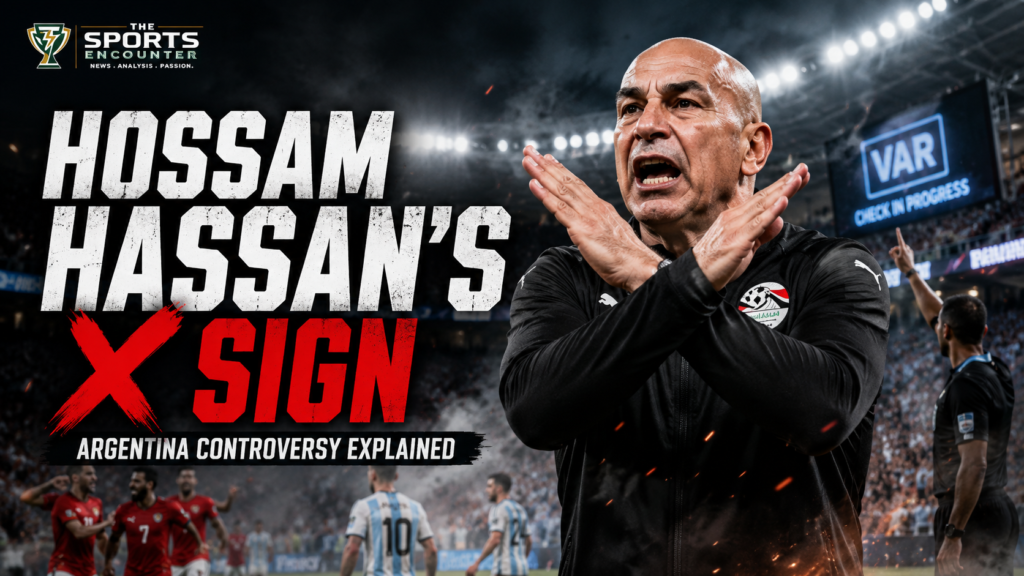
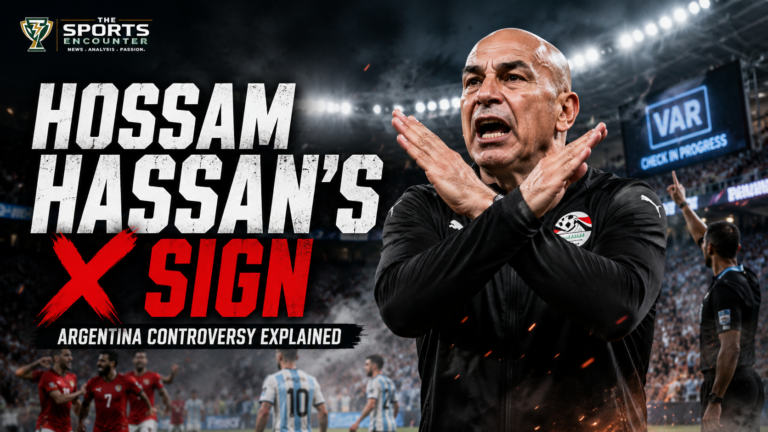
Hossam Hassan’s crossed-arm “X” sign during and after Egypt’s 3-2 defeat to Argentina in the FIFA World Cup 2026 Round of 16 did more than express anger. It pulled FIFA’s anti-racism protocol into the center of a match already boiling with VAR controversy, disputed calls, emotional reactions, and questions about whether officials handled one of the tournament’s most intense knockout games with enough control.

Argentina advanced to face Switzerland in the quarterfinals, but the post-match conversation did not move cleanly toward the next round. Egypt had led 2-0, saw a goal ruled out after VAR intervention, appealed for penalties, and then conceded late as Argentina completed a dramatic comeback. Sky Sports reported that Egypt coach Hossam Hassan called the officiating “unfair”, while Egypt also lodged a formal complaint with FIFA over the refereeing in the defeat.

The X sign added a different layer.

It raised a simple question with a complicated answer: was Hassan protesting refereeing, signaling discrimination, or attempting to activate FIFA’s anti-racism process?

Key Facts

DetailInformation
MatchArgentina 3-2 Egypt
CompetitionFIFA World Cup 2026 Round of 16
Main controversyEgypt’s disallowed goal, penalty appeals, VAR use, late Argentina winner
Coach involvedHossam Hassan
GestureCrossed-arm “X” sign
FIFA meaning“No Racism Gesture” linked to anti-discrimination protocol
FIFA/IFAB referee principleReferee makes the final decision
Egypt’s responseFormal complaint to FIFA reported after the defeat
Next matchArgentina vs Switzerland in the quarterfinals

What Does the X Sign Mean Under FIFA Rules?

The crossed-arm X is not a normal protest gesture in FIFA competitions anymore. It has a specific meaning inside FIFA’s anti-discrimination framework.

FIFA’s “No Racism Gesture” allows players, team officials, and referees to signal alleged racist abuse by crossing their hands at the wrists. FIFA says the gesture is designed to empower players, officials, and referees to take a stand against racism.

The system sits inside FIFA’s wider Global Stand Against Racism initiative. FIFA says tournament officials and security staff receive training on the No Racism Gesture and the three-step anti-discrimination procedure.

That matters because Hassan’s gesture cannot be treated as a random touchline signal if he clearly crossed his arms in the official X shape. In FIFA’s current framework, that action points toward an allegation of racist or discriminatory conduct, or at least a demand that officials treat something as such.

The New Arab reported that Hassan’s use of the crossed-arm signal drew attention because the gesture was introduced by FIFA in 2024 as part of the Global Stand Against Racism initiative, approved by all 211 member associations at FIFA’s Congress in Bangkok.

What Happens When the Gesture Is Made?

FIFA’s anti-racism process follows a three-step model.
First, the referee can stop the match. A stadium announcement can warn supporters or relevant parties that racist abuse has been reported and must stop.

Second, if abuse continues, the referee can suspend the match and send players toward the dressing rooms.

Third, if the situation still does not stop, the referee can abandon the match.

Reports after the Argentina-Egypt match noted that the crossed-arm X can trigger FIFA’s three-step anti-racism protocol once recognized by the referee.

This is why Hassan’s gesture created such a large reaction. The sign carries a heavier meaning than normal frustration with a referee. A coach waving his arms after a decision is common. A coach using FIFA’s No Racism Gesture during a World Cup knockout match is very different.

Why Did Hossam Hassan Make the X Sign?

The safest reading is this: Hassan appeared to use the gesture because Egypt felt wronged during the match and believed the treatment crossed beyond normal refereeing frustration.

Several outlets reported that Hassan was furious after the match, especially over VAR decisions, the disallowed Egypt goal, and penalty appeals that did not lead to intervention. Reuters reported that the Egyptian Football Association criticized VAR after the 3-2 defeat and submitted a formal complaint to FIFA against referee François Letexier.

The exact target of Hassan’s gesture remains unclear. Some reports connected the moment to a heated exchange involving Lionel Messi, while others framed it more broadly as part of Egypt’s protest over perceived unfair treatment. The Business Standard reported that there was no confirmed audio or official transcript of what Messi said, and that neither Hassan nor FIFA had publicly clarified whether the gesture was directed at Messi, Argentina’s bench, the officials, or the broader situation.

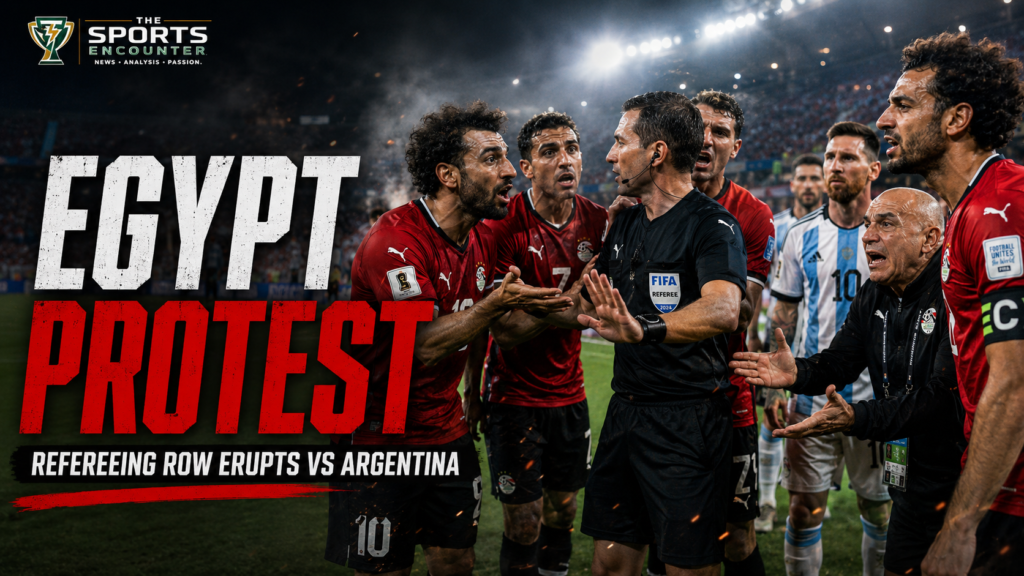
Egyptian players and coaching staff protest to the referee during the Argentina World Cup match after disputed calls and VAR controversy.

That distinction matters.

If Hassan intended the gesture as a formal racism complaint, FIFA may need to examine what he reported, who he reported it against, and whether officials followed the correct process.

If he used it mainly as an emotional symbol of unfair treatment, FIFA could still view the moment through a disciplinary lens, especially if the gesture created confusion or escalated tension near the officials.

Was It a VAR Signal?

No. The X sign should not be confused with the VAR “TV signal.”

Under the IFAB VAR protocol, the referee uses a TV-shaped signal before an on-field review or before announcing a VAR-related final decision. The protocol says the referee stops play in a neutral situation and shows the TV signal when initiating a review. It also states that the referee remains the only person who can make the final decision, while the VAR can only assist.

Coaches cannot formally demand a VAR review by making their own hand sign. They can protest, ask questions, or complain to the fourth official, but the laws do not give them a coach’s challenge system.

So Hassan’s crossed-arm X was not a valid VAR request. It either carried anti-racism meaning under FIFA’s protocol, or it functioned as a protest gesture that drew attention because it resembled FIFA’s official No Racism signal.

What Does FIFA Say About Refereeing Decisions?

FIFA’s disciplinary code gives referees very strong protection over match decisions.

Article 9 of the FIFA Disciplinary Code says decisions taken by the referee on the field of play are final and may not be reviewed by FIFA judicial bodies. It adds that disciplinary consequences can be reviewed only in limited cases, such as obvious mistaken identity.

This means Egypt’s complaint may force FIFA to review conduct, procedure, reporting, and disciplinary questions, but it is unlikely to change the result of the match based only on disagreement with referee decisions.

The IFAB VAR protocol also limits when VAR can intervene. VAR can recommend a review for a potential “clear and obvious error” or “serious missed incident,” but the referee decides whether to initiate a review and makes the final call.

That framework leaves room for frustration. A decision can feel inconsistent to fans and still survive within the technical limits of VAR.

Why Egypt Felt the Refereeing Was Below Standard

Egypt’s anger came from the pattern of decisions, not one isolated whistle.

The biggest flashpoint was the disallowed Egypt goal. Al Jazeera reported that Egypt felt injustice after a VAR decision ruled out a Mostafa Ziko goal while Egypt were leading 1-0. The same report noted that the match also included a string of yellow cards for Egypt and strong contrasting emotions after the final whistle.

Another major complaint focused on consistency. Al Jazeera reported that analysts questioned why VAR intervened on the buildup to Egypt’s disallowed goal but did not intervene over a later incident involving Mohamed Salah before Argentina’s third goal. One analyst said the foul before the disallowed Egyptian goal was “indisputable,” but questioned how far VAR should go back in the attacking phase.

That is the heart of the controversy.

A referee can defend one decision by pointing to the laws. Fans can still question why similar levels of contact receive different treatment in the same match.

In a knockout game with Argentina, Egypt, Messi, Salah, late goals, and huge emotional pressure, consistency becomes more important than usual. Players can accept strict officiating if it remains strict for both sides. They struggle when one team feels VAR has a microscope on its attacks and a softer lens on the opponent’s.

For readers tracking the wider knockout picture, Egypt’s anger also mattered because Argentina’s win set up a quarterfinal against Switzerland, who advanced after a tense penalty shootout in the Switzerland vs Colombia Round of 16 report.

Was the Standard of Refereeing Good Enough?

The standard of refereeing did not match the emotional and competitive weight of the game.

That does not mean every controversial decision was automatically wrong. Some calls may have had technical support. The disallowed goal, for example, appears to have involved contact in the buildup that VAR considered relevant. Under the laws, VAR can intervene when officials believe there has been a clear and obvious error in a match-changing attacking phase.

But elite refereeing is not only about finding a legal explanation afterward. It is also about control, consistency, communication, and trust.

On those measures, the match looked damaged.

The referee and VAR team allowed too many moments to become interpretive battles. Egypt left the field believing the same standard did not apply both ways. Hassan’s X gesture then turned a refereeing dispute into a wider governance issue. Once that happens, the officials have already lost the room.

The debate sits alongside other high-pressure knockout flashpoints in this World Cup, including Spain’s late win in the Portugal vs Spain Round of 16 report and Belgium’s dominant performance in the USA vs Belgium Round of 16 report.

Could Hassan Face Action?

Possibly, depending on what FIFA finds.

If Hassan made a genuine anti-racism complaint, FIFA must assess the allegation and whether the protocol should have been activated. If the gesture was used without a clear basis or in a confrontational way toward opponents or officials, FIFA could review it as misconduct by a team official.

IFAB’s Laws of the Game allow referees to discipline team officials who fail to act responsibly. IFAB specifically states that a coach acting provocatively during penalties can be cautioned or sent off depending on the circumstances.

FIFA will likely care about context. That matters because AP reported that FIFA recently cleared an official over a separate gesture controversy after concluding there was no evidence of a disciplinary breach.

So the gesture alone may not decide the issue. FIFA will need context, footage, reports from match officials, any audio available, and any complaint submitted by Egypt.

The Bigger Issue: FIFA’s New Gesture Faces a Real Stress Test

FIFA created the No Racism Gesture to give players and officials a clear way to report racist abuse in real time. That is valuable. Football needed a visible process that did not leave abused players waiting for post-match statements.

But the Argentina-Egypt controversy shows the challenge.

If the gesture appears during a furious refereeing dispute, FIFA must separate three things quickly:

  • Was there an allegation of racist abuse?
  • Was the gesture aimed at a person, an official, a crowd, or the general situation?
  • Did the referee and match officials follow the anti-discrimination procedure correctly?

Without clarity, the sign can become another source of confusion instead of protection.

Final Take

Hossam Hassan’s X sign should not be dismissed as ordinary frustration. Under FIFA’s current framework, crossed wrists carry anti-racism meaning. That gives the moment serious weight.

At the same time, the gesture came inside a match already overwhelmed by VAR anger, late drama, and Egypt’s belief that key decisions went against them. FIFA now faces two separate questions. It must examine whether the X sign raised a valid discrimination issue, and it must also assess why the refereeing performance left one team feeling the process had failed.

Argentina survived and moved on.

Egypt left with one of the tournament’s strongest complaints.

The X sign ensured this match will be remembered for more than the comeback.

For more tournament analysis, follow The Sports Encounter’s complete FIFA World Cup 2026 coverage.


Marcos Wetherfield is a Boca Raton-based fitness expert covering WWE, soccer, baseball, NHL, NBA, and major American sports for The Sports Encounter. His work focuses on athletic conditioning, strength, mobility, recovery, injury prevention, performance habits, and the physical demands behind elite competition. Coverage areas: fitness, sports performance, WWE, soccer, baseball, NHL, NBA, athlete conditioning, recovery, and American sports culture.

Editor's Choice

Know All About Erling Haaland: Records, Goals, Career, and Norway’s World Cup Hope

Erling Haaland has turned Norway’s World Cup 2026 run into one of football’s biggest stories. Here is everything fans need to know about his goals, records, career, playing style, Manchester City rise, and why England now face one of the world’s most dangerous strikers.

Miley Rumer | The Sports Encounter

Published

on

Erling Haaland-inspired Norway striker celebrates with teammates after a World Cup 2026 victory as Norway flags wave across a packed stadium with The Sports Encounter logo.

Erling Haaland had already conquered club football before he ever kicked a ball at the FIFA World Cup 2026.

That is what makes this tournament feel different.

For years, football fans watched him turn league seasons into shooting drills. Manchester City gave him the platform, and Haaland gave them goals with ridiculous regularity. Yet the biggest international stage had remained the missing chapter in his story.

Now Norway are in the FIFA World Cup 2026 quarterfinals, Haaland is chasing the Golden Boot, and England are next. This is no longer only a player profile. It is the story of a striker who arrived at his first World Cup under heavy expectation and made the tournament bend toward him.

Norway’s 2-1 win over Brazil in the Round of 16 gave the world the clearest version of Haaland’s international value. He scored twice late, first with a header and then with a low finish, while goalkeeper Ørjan Nyland’s performance gave Norway the platform to survive Brazil’s pressure. The Sports Encounter covered that wider Norway story in detail in Ørjan Nyland: Norway’s Last Man Standing vs Brazil.

Haaland finished the job. Norway believed the job was possible.

That combination is why England’s quarterfinal against Norway now feels like one of the most fascinating matches of the tournament. For wider tournament coverage, visit The Sports Encounter’s FIFA World Cup 2026 section.

Quick Answer: Why Is Erling Haaland Trending?

Erling Haaland is trending because Norway have reached the FIFA World Cup 2026 quarterfinals, he is among the Golden Boot contenders, and his goals have turned Norway into one of the tournament’s most dangerous knockout teams. Fans are also searching for his records, Manchester City career, playing style, height, and role before Norway’s quarterfinal against England.

Erling Haaland Key Facts

CategoryDetails
Full nameErling Braut Haaland
Date of birthJuly 21, 2000
NationalityNorwegian
PositionStriker
Height1.94 meters, around 6 feet 4 inches
ClubManchester City
National teamNorway
Senior clubsBryne, Molde, Red Bull Salzburg, Borussia Dortmund, Manchester City
Playing stylePowerful penalty-box striker, elite finisher, explosive runner, aerial threat
World Cup 2026 storylineNorway’s first World Cup run since 1998, Haaland’s debut tournament, Golden Boot chase

Who Is Erling Haaland?

Erling Haaland is a Norwegian striker who plays for Manchester City and the Norway national team. He is known for his pace, strength, movement, aerial power, and almost machine-like ability to turn half-chances into goals.

He was born in Leeds, England, while his father, Alfie Haaland, was playing professionally in the Premier League. Raised in Norway, Haaland came through Bryne before moving to Molde, where his scoring talent became impossible to ignore. From there, his career accelerated quickly through Red Bull Salzburg, Borussia Dortmund, and Manchester City.

FIFA’s profile on Erling Haaland frames him as one of Norway’s biggest World Cup hopes and highlights his scoring records, club achievements, and long-awaited arrival on the tournament stage.

The simple version is this: Haaland is the striker modern football built toward.

He is fast enough to run behind high defensive lines, strong enough to hold off center-backs, tall enough to dominate aerial duels, and clinical enough to make defenders pay for one bad step.

Why Erling Haaland Matters to Norway

Norway had waited 28 years to return to the World Cup. That wait carried history, frustration, and a quiet question: could a country with Haaland and Martin Ødegaard finally turn promise into a tournament run?

International football is not club football. Manchester City can dominate possession, pin opponents back, and feed Haaland through rehearsed patterns. Norway have to survive longer spells without the ball. They need structure, discipline, goalkeeping, and moments.

Haaland gives them the moments.

The Sports Encounter saw this coming before the knockout rounds. In our preview of Norway’s Round of 32 clash, we asked whether Haaland could carry Norway past Côte d’Ivoire’s power test. That match was about whether Norway had more than one star. The Brazil match answered a bigger question: could Norway survive elite pressure long enough for Haaland to decide it?

They could.

Norway’s World Cup 2026 Path So Far

StageOpponentResultHaaland storyline
Group stageSenegalNorway advanced with Haaland among the scorersHaaland pushed himself into the Golden Boot race
Round of 32Côte d’IvoireNorway 2-1 Côte d’IvoireNorway proved they could survive a physical knockout test
Round of 16BrazilNorway 2-1 BrazilHaaland scored twice late to send Norway into the quarterfinals
QuarterfinalEnglandScheduledHaaland faces defenders who know him from Premier League football

Visual Chart: World Cup 2026 Golden Boot Race

By the quarterfinal stage, Haaland was firmly inside the World Cup Golden Boot race. Al Jazeera’s Golden Boot tracker listed Lionel Messi ahead after reaching eight goals, with Haaland and Kylian Mbappé close behind.

Golden Boot Race Before Quarterfinals

Goals scored at the FIFA World Cup 2026 before the quarterfinal stage.

Messi 8 goals
Haaland 7 goals
Mbappé 7 goals
Kane 6 goals

Source: Al Jazeera and Reuters tournament reporting. Figures should be updated after each knockout match.

Erling Haaland’s World Cup 2026 Run

Haaland’s first World Cup has not been a gentle introduction. It has been a test of expectation from the first match.

He scored early in the tournament and helped Norway move through the knockout picture. Then came the deeper pressure. Norway’s rotation against France raised questions. The knockout draw brought Côte d’Ivoire, then Brazil. Against Brazil, Haaland delivered the kind of late-match brutality that separates elite strikers from highlight players.

He did not need ten chances. He needed the match to stay alive.

That is Haaland’s danger. A quiet 75 minutes does not protect the opponent. It only delays the problem.

Reuters reported before the England quarterfinal that Haaland had seven goals and was competing for the Golden Boot, while Norway prepared for one of the biggest matches in the country’s World Cup history.

The number matters, but the timing matters more. Haaland’s goals have not arrived only in comfortable group-stage situations. He has scored when Norway’s tournament has needed a finishing blow.

Why England vs Norway Is Now a Haaland Test

England’s quarterfinal against Norway is not only about England managing possession or Norway defending deep. It is about whether England can control the one striker who changes a tactical plan with one run.

England reached the quarterfinal after a wild 3-2 win over Mexico, with Jude Bellingham scoring twice, Harry Kane converting from the spot, and Jordan Pickford helping ten-man England survive. The Sports Encounter covered that match in England Outlast Mexico in Azteca Battle to Set Up Norway Quarterfinal.

Now England must prepare for a different kind of danger.

Mexico tested England’s nerve. Norway will test England’s concentration.

Haaland does not need to dominate every minute. He needs one cross, one transition, one loose touch, one defender caught square, or one set-piece mismatch. That is why he is such a brutal knockout opponent.

Norway coach Ståle Solbakken has also played down the idea that Premier League familiarity gives either side a simple advantage. Reuters reported that Solbakken pointed out that England’s top scorers in the tournament, Harry Kane and Jude Bellingham, play outside the Premier League. His larger point was clear: familiarity is not the same as control.

Erling Haaland’s Club Career: From Norway to Manchester City

Haaland’s career has followed a rare pattern: every move looked like a step up, and every step became a scoring platform.

At Bryne, he was a teenage prospect. At Molde, he became a serious name. At Red Bull Salzburg, he turned into a European phenomenon, especially through his Champions League scoring burst. Borussia Dortmund then gave him the perfect bridge: a bigger league, elite development, huge pressure, and enough attacking space to sharpen his finishing.

Manchester City turned him from a terrifying talent into a record-breaking centerpiece.

At City, Haaland joined a team already built to dominate the ball. The question was whether he would disrupt their flow or complete it. The answer came quickly. His movement inside the box, near-post timing, back-post hunger, and penalty-area calm turned City’s possession into even more punishment.

The Premier League confirmed that Haaland became the fastest player to reach 100 Premier League goals, doing it in 111 matches. That is not just a record. It is a statement about rate.

Visual Chart: Fastest to 100 Premier League Goals

Fastest Players to 100 Premier League Goals

Fewer matches means a faster scoring pace.

Erling Haaland 111 matches
Alan Shearer 124 matches

Source: Premier League. Haaland reached 100 Premier League goals in 111 matches, beating Alan Shearer’s previous pace of 124 matches.

Haaland’s Biggest Records

Haaland’s record list is already long, and he is still in his mid-20s.

RecordAchievementWhy it matters
Premier LeagueFastest player to 100 Premier League goalsShows his scoring pace across one of football’s most competitive leagues
Premier League36 goals in a single Premier League seasonSet a new single-season benchmark for the competition
Champions LeagueFastest player to 50 Champions League goalsConfirms his scoring rate against Europe’s strongest clubs
Champions LeagueQuickest player to 40 Champions League goalsUEFA lists him among the competition’s great scoring milestone leaders
World Cup 2026Seven goals before the quarterfinal stagePlaced him firmly in the Golden Boot race during his debut World Cup

UEFA’s Champions League milestone tracker lists Haaland as the quickest player to reach 50 Champions League goals. FIFA’s own World Cup profile also highlights his Premier League scoring record, Champions League speed, and status as one of football’s defining modern forwards.

What Makes Haaland So Difficult to Defend?

Haaland is often described as a goal machine, but that phrase can make his game sound simpler than it is.

His scoring comes from several layers.

First, his movement is ruthless. He does not wander for touches when the ball is not in dangerous areas. He saves energy for the sprint that matters.

Second, his body shape is elite inside the box. He opens his hips quickly, adjusts to low crosses, and finishes with both feet. A defender may block the obvious lane, but Haaland often scores from the second lane.

Third, his aerial power changes how teams defend crosses. Fullbacks cannot relax at the back post. Center-backs cannot lose contact. Goalkeepers have to read crosses earlier because Haaland attacks space before the ball arrives.

Fourth, his transition threat stretches the pitch. If a team presses too high, Haaland can run behind. If it drops too deep, he becomes a penalty-box target.

That is why he changes the geometry of a match. He does not simply score within a system. He forces opponents to adjust their system around him.

Is Haaland Only a Scorer?

The easy criticism is that Haaland does not touch the ball as much as other elite forwards.

That is partly true. He is not Lionel Messi. He is not Kylian Mbappé drifting wide to beat three defenders. He is not Harry Kane dropping deep to pass like a No. 10.

That comparison misses the point.

Haaland’s value is not measured by how often he joins the game. It is measured by how brutally he ends it.

In a possession-heavy team, he gives the final action. In a lower-possession national team, he gives belief that one clean attack can be enough. That is especially valuable in World Cup knockout football, where matches often become tense, narrow, and emotionally heavy.

Norway do not need Haaland to look elegant for 90 minutes.

They need him to be awake when the chance arrives.

Haaland vs Messi, Mbappé, and Kane in the Golden Boot Race

The 2026 World Cup Golden Boot race has become one of the tournament’s biggest storylines.

Messi’s goals are tied to Argentina’s last-dance energy. Mbappé’s goals are tied to France’s modern dominance. Kane’s goals are tied to England’s hunt for the trophy. Haaland’s goals feel different because Norway are not a traditional World Cup superpower.

Erling Haaland-inspired Norway striker smiles calmly in a cinematic World Cup 2026 stadium scene with Norway colors and The Sports Encounter logo.

If Haaland wins the Golden Boot, it will not only be a personal award. It will be a sign that Norway’s tournament was more than a surprise run.

How Haaland Changed Norway’s Ceiling

Before Haaland, Norway could be organized, disciplined, and competitive.

With Haaland, Norway can be feared.

That is the difference.

Tournament football is often decided by the player opponents spend the week worrying about. Norway now have that player. Brazil felt it. England know it. Every defender left in the competition understands that Haaland is not a normal striker.

He gives Norway margin.

They can be under pressure and still have a way back. They can be outshot and still have the most dangerous finisher on the field. They can defend for long stretches and still make opponents nervous about one transition.

That is what elite strikers do for national teams. They do not solve every problem, but they change the opponent’s emotional state.

What Fans Should Watch Next

The quarterfinal against England will reveal more about Haaland’s World Cup legacy than any group-stage scoring burst.

  • Can England deny service into him?
  • Can Norway release him early enough?
  • Can Haaland beat England’s center-backs in the air?
  • Can he drag defenders away and create space for Ødegaard?
  • Can he handle a match where England may dominate the ball?

Those are the questions that will shape the night.

For readers following Norway’s full knockout journey, The Sports Encounter’s earlier coverage of Vini Jr vs Haaland before Brazil vs Norway and Haaland turning Brazil’s missed penalty into a World Cup nightmare gives the clearest path into this quarterfinal story.

The bigger picture is simple.

Haaland came to the World Cup with club records. He may leave it with international mythology.

Final Take

Erling Haaland is already one of the most feared strikers in world football. His club numbers at Manchester City, his Champions League records, and his Premier League scoring pace have already placed him in rare company.

The 2026 World Cup is giving him something different.

It is giving him a national story.

Norway are not only watching a superstar score goals. They are watching him pull their football identity into a new place. The country that waited 28 years to return to the World Cup now stands one win from a semifinal, with England in the way and Haaland carrying the danger every opponent fears.

Club football made Haaland famous.

This tournament could make him historic.

FAQs About Erling Haaland

Who is Erling Haaland?

Erling Haaland is a Norwegian striker who plays for Manchester City and the Norway national team. He is known for his pace, strength, movement, aerial power, and elite finishing inside the penalty area.

How old is Erling Haaland?

Erling Haaland was born on July 21, 2000. He is 25 during the FIFA World Cup 2026.

How tall is Erling Haaland?

Erling Haaland is 1.94 meters tall, or about 6 feet 4 inches. His height, strength, and timing make him one of the most dangerous aerial forwards in world football.

Which club does Erling Haaland play for?

Erling Haaland plays for Manchester City in the English Premier League.

What country does Erling Haaland represent?

Erling Haaland represents Norway at international level.

How many goals has Haaland scored at the 2026 World Cup?

By the quarterfinal stage of the FIFA World Cup 2026, Haaland had scored seven goals and was competing for the Golden Boot.

Why is Haaland important to Norway?

Haaland gives Norway one of the best finishers in world football. His goals, movement, and physical presence allow Norway to compete with stronger teams, especially in knockout matches where one chance can decide the result.

What are Haaland’s biggest records?

Haaland became the fastest player to reach 100 Premier League goals and the fastest player to reach 50 Champions League goals. He also set the Premier League single-season scoring record with 36 goals.

Has Haaland won the World Cup?

No. Haaland has not won the World Cup. The 2026 tournament is his first World Cup appearance with Norway.

Who will Norway play next in the World Cup?

Norway will face England in the FIFA World Cup 2026 quarterfinal after beating Brazil 2-1 in the Round of 16.

Can Haaland win the 2026 Golden Boot?

Yes. Haaland is firmly in the Golden Boot race after scoring seven goals by the quarterfinal stage, putting him among the tournament’s leading scorers.

Continue Reading

Cricket

Kapil Dev: The All-Rounder Who Made India Believe in Itself

Kapil Dev was more than India’s 1983 World Cup-winning captain. He was the fast-bowling all-rounder who changed Indian cricket’s confidence, records, ambition, and global identity, leaving behind a legacy built on courage, wickets, runs, leadership, and belief.

Jawad Hussain | The Sports Encounter

Published

on

Kapil Dev bats in India’s blue 1992 World Cup kit in a cinematic action scene, with The Sports Encounter logo and “1992 World Cup Era” text.

Indian cricket had great players before Kapil Dev. It had stylish batters, gifted spinners, proud captains, and men who carried the game through difficult decades.

Kapil Dev gave it something different.

He gave Indian cricket a new physical language. He ran in hard. He swung the ball at pace. He hit the ball cleanly. He fielded like a natural athlete. He carried himself with the directness of a cricketer who did not wait for permission to compete with the strongest teams in the world.

That may be the simplest way to understand his place in Indian cricket. Before India became a global cricket power, before the IPL, before packed white-ball calendars, before fast-bowling depth became normal, Kapil Dev made India believe it could attack.

His record still explains the size of the cricketer. According to ESPNcricinfo’s Kapil Dev profile, he played 131 Tests, scored 5,248 runs, took 434 wickets, held 64 catches, and became one of the most complete cricketers India has produced. In ODIs, he played 225 matches, scored 3,783 runs, took 253 wickets, and held 71 catches.

The numbers matter. The meaning goes further.

Kapil Dev did not inherit an Indian team used to winning World Cups. He captained one that had won only one match across the first two editions of the tournament before 1983. He then led India to the title at Lord’s, beating the West Indies, the most dominant cricket force of that era, by 43 runs in the final. The full India vs West Indies 1983 World Cup final scorecard still reads like one of cricket’s greatest upsets.

That victory changed Indian cricket’s self-image. It also changed how the world saw Indian cricket. For more stories around major cricket moments and current match coverage, follow The Sports Encounter’s complete Cricket coverage.

Key Facts: Kapil Dev Career Snapshot

CategoryRecord
Full nameKapil Dev Ramlal Nikhanj
BornJanuary 6, 1959
RoleFast-bowling all-rounder
Test matches131
Test runs5,248
Test wickets434
Test centuries8
Test five-wicket hauls23
Best Test bowling9 for 83
ODI matches225
ODI runs3,783
ODI wickets253
Best ODI bowling5 for 43
Biggest captaincy achievement1983 Cricket World Cup title
Major individual World Cup innings175 not out vs Zimbabwe in 1983
Major honorsICC Cricket Hall of Fame, Wisden Indian Cricketer of the Century, CK Nayudu Lifetime Achievement Award

The Cricketer India Did Not Know It Needed

Kapil Dev arrived in Indian cricket at a time when India was known more for spin, patience, and batting craft than pace and athletic aggression. The country had produced some of the finest spin bowlers in the world, but genuine fast-bowling all-rounders were rare. Kapil gave India a player who could take the new ball, bat in the middle order, rescue an innings, change the tempo, and inspire a dressing room through visible energy.

The ICC Hall of Fame profile for Kapil Dev describes him as India’s finest fast-bowling all-rounder and places him alongside Imran Khan, Ian Botham, and Richard Hadlee among the great all-rounders of his time. It also notes that he was India’s strike bowler for nearly 15 years and finished with 434 Test wickets, a world record at the time.

That comparison is important. The 1980s were an all-rounder’s era. Imran had command and reverse swing. Botham had charisma and match-winning instinct. Hadlee had precision and control. Kapil had a different blend. He brought pace, stamina, natural hitting, attacking fields, and a stubborn refusal to treat Indian cricket as smaller than anyone else’s.

He was called the Haryana Hurricane for a reason. The name matched his cricket. He played with movement, force, and a certain rural athleticism that felt different from India’s earlier cricketing image.

Kapil was never only a bowler who could bat. He was a cricketer who gave India balance. That balance mattered because India’s teams of that period often needed one player to cover two roles. Kapil opened the bowling, batted with the lower middle order, fielded with energy, and captained without looking overwhelmed by bigger reputations.

The Test Record That Still Stands Apart

Kapil Dev’s Test career remains one of the most extraordinary statistical achievements by any Indian cricketer. He scored 5,248 runs at an average a little above 31 and took 434 wickets at an average under 30. His batting brought eight Test centuries, while his bowling brought 23 five-wicket hauls and two 10-wicket match hauls, as listed in his ESPNcricinfo career record.

The defining all-round number is simple: 5,000 runs and 400 wickets.

Kapil remains the only cricketer in Test history to complete that exact double of more than 5,000 runs and more than 400 wickets. Others have built elite all-round combinations in different ways, but Kapil’s combination of volume batting and strike-bowling workload remains rare.

His 434 Test wickets made him the highest wicket-taker in Test history when he passed Richard Hadlee’s record in 1994. Courtney Walsh later broke Kapil’s record, but Kapil’s achievement carried special weight because he came from a cricket system that did not have the fast-bowling culture, pitches, or support structure enjoyed by many pace greats of his era.

Kapil bowled long spells on Indian pitches that often rewarded spin more than pace. He played years without the kind of pace-bowling depth that allows a lead fast bowler to rotate workload easily. He often had to be the first threat, the holding option, the reverse-swing hope, and the lower-order batting insurance in the same match.

That is why his Test numbers cannot be read in isolation. They are also a record of endurance.

The ODI Record and the Shape of a Modern All-Rounder

Kapil Dev’s ODI career came from a period when the format was still learning what it wanted to become. The game was slower than today’s ODI cricket. Strike rates were lower. Batting power was used differently. Fielding standards were still evolving.

Inside that era, Kapil looked ahead of his time.

He scored 3,783 ODI runs and took 253 wickets in 225 matches. He was the first player to take 200 wickets in ODIs, and his best ODI bowling figures were 5 for 43. His combination of wickets, late-order runs, and fielding made him one of the format’s early complete players.

His batting strike rate in ODIs stood out for his time. In the 1983 World Cup, he made 303 runs at an average of 60.60 and a strike rate above 100, while also taking 12 wickets and holding seven catches. That tournament showed his value across every discipline.

That is the heart of Kapil’s ODI value. He did not only contribute. He changed the speed of a match.

India had many players who could occupy the crease. Kapil could shift pressure. He could turn 180 into 230, or 230 into 270. He gave bowlers a target to defend and batters a model of courage. When India later built its white-ball identity around aggression, athleticism, and all-round balance, Kapil’s influence sat quietly beneath that evolution.

The 175 Not Out That Became Indian Cricket Folklore

No Kapil Dev tribute can move far without returning to June 18, 1983.

India were playing Zimbabwe at Tunbridge Wells in a World Cup group match. The situation was desperate. India collapsed to 17 for 5. Kapil, the captain, walked into a match that was sliding toward humiliation and produced one of the most important innings in cricket history.

He made 175 not out from 138 balls. India reached 266 for 8 and won by 31 runs. The India vs Zimbabwe 1983 World Cup scorecard records Kapil’s 175 not out with 16 fours and six sixes, an innings that remains part of cricket folklore.

Its place in cricket history grew partly because there was no live television footage of the innings due to a BBC strike. That absence made the innings feel almost mythical. Fans heard about it, read about it, repeated it, imagined it, and passed it down as a story. In a strange way, the missing footage made the innings larger.

The scorecard still gives the basic structure. The captain came in with India broken. He refused to let the match end there. He hit with force, protected the lower order, and transformed the tournament.

In World Cup context, that innings saved India. Without it, India likely would not have reached the semifinal. Without the semifinal, there is no Lord’s final. Without the Lord’s final, there is no 1983 moment that changed Indian cricket.

Kapil’s 175 was more than a rescue. It was the innings that kept the possibility of Indian cricket’s biggest psychological breakthrough alive.

Lord’s 1983: The Catch, the Cup, and the Shock

India’s 1983 World Cup final against West Indies remains the central chapter of Kapil Dev’s career.

India were bowled out for 183 at Lord’s. Against the West Indies batting lineup, that total looked light. The West Indies had won the first two World Cups and were seeking a third straight title. They had elite fast bowlers, powerful batters, and the aura of a team that expected to win.

Then came the defining moment.

Viv Richards was batting freely. He had moved to 33 from 28 balls. Madan Lal bowled, Richards pulled, and the ball went high into the London sky. Kapil ran back from mid-wicket and completed one of Indian cricket’s most famous catches. The official 1983 World Cup final scorecard records Richards as caught by Kapil Dev off Madan Lal.

The catch became a symbol because of who hit the shot and who caught it. Richards was the most intimidating batter in the world. Kapil was India’s captain. The moment did not win the final by itself, but it punctured the sense that West Indies were untouchable.

India went on to bowl West Indies out for 140 and win by 43 runs. Mohinder Amarnath was player of the match for his all-round performance, but Kapil’s captaincy, fielding, energy, and tournament-wide contribution turned him into the face of the triumph.

The image of Kapil lifting the World Cup at Lord’s became one of Indian sport’s foundation photographs. Later generations would have their own moments: Sachin Tendulkar carried around Wankhede in 2011, MS Dhoni’s six, Virat Kohli’s global dominance, Rohit Sharma’s white-ball era, Jasprit Bumrah’s fast-bowling excellence. Yet 1983 came first.

Kapil’s team made all of that feel possible.

What Kapil Dev Brought to Indian Cricket

Kapil Dev brought five major things to Indian cricket.

The first was fast-bowling belief. India did not suddenly become a pace factory because of him, but he changed what young players could imagine. A boy in India could watch Kapil and think pace bowling was not only for Australians, West Indians, Pakistanis, or Englishmen.

The second was all-round ambition. Before Kapil, India had great specialists. Kapil showed the value of a cricketer who could influence the game in three ways. He made Indian cricket think harder about balance, depth, and utility.

The third was World Cup confidence. India’s 1983 win gave the country its first major global cricket title. That victory helped cricket grow into a mass emotional force in India. It also made future World Cup dreams feel realistic rather than decorative.

The fourth was physical courage. Kapil was athletic in a way that felt visible. His running catch in the 1983 final, his bowling workloads, and his lower-order hitting all carried the same message: India could match anyone in intensity.

The fifth was leadership without fear. Kapil’s captaincy was not perfect, and his record as a leader had ups and downs. But the image of him leading India past West Indies gave Indian cricket a new kind of captaincy memory. He was not managing decline. He was inviting risk.

That is his deepest legacy. Kapil made Indian cricket bolder.

Records and Major Achievements

Kapil Dev’s career is full of headline records and honors.

He finished with 434 Test wickets, which was a world record at the time. He became the first player to reach the 5,000-run and 400-wicket double in Test cricket. He led India to the 1983 World Cup. He scored the famous 175 not out against Zimbabwe. He finished his ODI career with 253 wickets, becoming one of the format’s early great wicket-takers.

He was named one of Wisden’s Cricketers of the Year in 1983, a recognition tied to the scale of his influence during that period. In 2002, Rediff reported that Kapil Dev was chosen as Wisden Indian Cricketer of the Century by a jury of 35 cricketers, journalists, and thinkers at Wembley.

Kapil was inducted into the ICC Cricket Hall of Fame in 2010. ESPNcricinfo reported that he played 131 Tests and 225 ODIs across a 16-year international career, while the ICC profile presents him as India’s greatest fast-bowling all-rounder.

In 2013, the BCCI honored him with the Col. C.K. Nayudu Lifetime Achievement Award, the board’s highest lifetime honor for a former Indian cricketer.

Those honors matter because they came from different directions. Wisden recognized his century-scale place in Indian cricket. ICC recognized his global status. BCCI recognized his lifetime contribution to Indian cricket.

The Difficult Moments and the Human Side of the Legend

Kapil Dev’s career was glorious, but it was not untouched by pain.

The first difficult layer was expectation. After 1983, Kapil became more than a captain. He became a national symbol. Every defeat, every selection debate, every captaincy decision, and every personal slump carried extra scrutiny.

India did not become a consistently dominant world team immediately after 1983. The World Cup win changed belief, but it did not instantly fix infrastructure, overseas performance, or team depth. Kapil remained a central figure through that gap between inspiration and sustained power.

The second difficult moment came at the 1987 World Cup. India entered as co-hosts and defending champions but lost to England in the semifinal. Kapil was criticized for his dismissal in that match after attempting a big shot at a crucial stage. For a player who had built his reputation on brave, attacking cricket, the same instinct became a source of criticism when it failed.

The third difficult chapter was his coaching period. Kapil coached India from 1999 to 2000 during one of the most turbulent periods in world cricket. His tenure coincided with Indian cricket’s match-fixing storm and ended with his resignation. ABC reported in September 2000 that Kapil Dev resigned as Indian coach after months of pressure while defending his reputation.

The most painful public moment involved match-fixing allegations made by Manoj Prabhakar. The Central Bureau of Investigation later found no evidence of Kapil Dev’s role in match-fixing and related malpractice. ESPNcricinfo’s publication of the CBI report section states that the inquiry had not disclosed evidence of Kapil’s role. That finding is central to any fair account of the episode, and the relevant section is available in ESPNcricinfo’s archive of the CBI report on cricket match-fixing.

That chapter matters in any honest tribute. It was a brutal personal and public ordeal. It placed one of India’s greatest cricket heroes in the middle of a national trust crisis. The CBI finding cleared him of the allegation, but the experience left a scar on how that period is remembered.

The fourth difficult layer was post-retirement comparison. As Indian cricket grew richer and more powerful, later generations sometimes reduced Kapil to one image: the 1983 captain. That is unfair. He was not only a World Cup symbol. He was also India’s greatest fast-bowling all-rounder, a long-serving Test match-winner, an ODI pioneer, and a cricketer who carried enormous workloads before modern sports science, rotation, and recovery systems became normal.

Kapil Dev the Batter: Better Than the Average Suggests

Kapil’s Test batting average of just over 31 can make his batting look useful rather than elite. That misses context.

He often batted in difficult situations. He played attacking cricket before lower-order counterpunching was celebrated in the modern way. He was capable of centuries, rescue acts, and momentum-shifting cameos. His highest Test score was 163, and his eight Test centuries confirmed that he was more than a tail-end hitter.

Kapil’s batting had a particular value for India. He could change the mood of a dressing room. A collapse did not always feel terminal when he was still to come. Bowlers could be attacked. Fields could be moved. A match could breathe again.

The 175 against Zimbabwe is the greatest example, but it was not the only proof. Kapil’s batting gave India a rare form of lower-order intimidation. He made opponents think about him. In an era when India did not regularly bat deep with power, that mattered.

He was not a textbook stylist in the Sunil Gavaskar tradition. He was not a long-form technician in the Rahul Dravid tradition. He did not have the modern white-ball finishing templates of Dhoni or Hardik Pandya. Kapil’s batting lived through instinct, timing, hand speed, and courage.

That courage often gave India runs it had no right to expect.

Kapil Dev the Bowler: India’s First Great Pace-Bowling Standard

Kapil’s bowling legacy may be even more important than his batting.

India has now produced fast bowlers who win Test matches overseas. Jasprit Bumrah, Mohammed Shami, Mohammed Siraj, Ishant Sharma, Zaheer Khan, and others have given Indian cricket a pace tradition that looks normal today. It was not normal when Kapil began.

Kapil had to carry the idea of Indian pace before the system fully supported it.

His numbers show range and longevity. In Tests, he took 434 wickets with 23 five-wicket hauls. In ODIs, he took 253 wickets. He bowled with stamina across formats and conditions.

He was not express pace throughout his career, but he had rhythm, outswing, control, and a natural ability to make things happen. His best Test innings figures, 9 for 83, remain one of the great Indian bowling performances.

Kapil gave Indian fast bowling a target. He showed that an Indian pacer could lead an attack, survive workloads, and earn global respect. Later Indian fast bowlers did not follow his exact style, but they inherited the permission he created.

That is a rare kind of influence.

Kapil Dev the Captain: Imperfect, Instinctive, Historic

Kapil Dev’s captaincy cannot be judged only through win-loss numbers.

His Test captaincy record was mixed, and India in the 1980s faced strong teams with structural limitations. But captaincy is also about moments, and Kapil owns the biggest captaincy moment in Indian cricket before the 21st century.

Kapil Dev receives the 1983 Cricket World Cup trophy at Lord’s as officials and spectators applaud, with The Sports Encounter branding and “1983 World Cup Glory” text.

The 1983 World Cup title remains his defining leadership achievement. He was 24 when India won the tournament, making him one of the youngest World Cup-winning captains in cricket history. More importantly, he was the first Indian captain to win a Cricket World Cup.

Kapil’s leadership style was built on instinct and example. He was not a distant strategist. He led through action. He bowled, batted, fielded, smiled, attacked, and kept moving. His team reflected that in 1983. India were not the most powerful side in the tournament. They became the side that refused to leave.

There were also tactical criticisms across his captaincy years, as there are with most captains. Yet history is sometimes decided by whether a leader opens a door others later walk through. Kapil opened one of Indian cricket’s largest doors.

Why 1983 Changed India Beyond Cricket

The 1983 World Cup victory did more than give India a trophy.

It changed cricket’s emotional market in India. It helped create a generation of children who saw cricket as a field of possibility. It strengthened the idea that India could beat the best in a global final. It became a reference point for future teams, sponsors, broadcasters, administrators, and fans.

Kapil’s image with the trophy at Lord’s became a national sporting memory. Before that, Indian cricket had pride, but not the same global event identity. After 1983, World Cups became part of India’s cricketing imagination.

That imagination produced long-term consequences. Sachin Tendulkar’s generation grew up in the shadow of 1983. India’s 2011 World Cup win carried emotional echoes of 1983. The expansion of cricket as a national obsession also drew strength from that moment.

Kapil did not create modern Indian cricket alone. No player does that. But he gave it one of its first great global proofs.

Comparing Kapil Dev With Other Great All-Rounders

Kapil Dev belongs in the elite all-rounder conversation because his career combines volume, durability, and historical impact.

Imran Khan had a stronger bowling average and a commanding leadership arc. Ian Botham had spectacular peaks and match-winning charisma. Richard Hadlee was one of the most precise fast bowlers the game has seen. Kapil’s case is different.

He carried a less pace-friendly system. He played for a team that was not as consistently strong overseas. He shouldered huge bowling responsibility. He scored more than 5,000 Test runs while taking more than 400 wickets. He captained a World Cup-winning team from outside the favorites.

That combination gives him a unique place.

The ICC groups him with Imran, Botham, and Hadlee as one of the great all-rounders of his time. That framing is accurate, but India’s context makes Kapil’s career even more remarkable.

Kapil was not simply India’s version of those players. He was India’s original fast-bowling all-rounder template.

The Worst Moments Did Not Shrink the Legacy

Every great career has shadows. Kapil’s had a few.

The 1987 World Cup semifinal exit hurt. His coaching tenure ended badly. The match-fixing allegation period was deeply painful, even though the CBI report found no evidence against him. His later public image sometimes became complicated by outspoken comments and the natural friction that follows legends who remain visible after retirement.

Yet those moments do not reduce the scale of his contribution. They make the story fuller.

Greatness in sport is rarely clean. It includes risk, criticism, failure, recovery, and reputation battles. Kapil’s career had all of that. The reason he remains so large in Indian cricket is that the achievements outweigh the wounds by a distance.

He gave India records. He gave India a World Cup. He gave India a fast-bowling dream. He gave India an all-rounder’s model. He gave India a fearless sporting memory.

Kapil Dev’s Place in Indian Cricket Today

Kapil Dev’s legacy has changed shape over time.

For older fans, he is the captain who lifted the 1983 World Cup. For cricket historians, he is the all-rounder who completed one of Test cricket’s rarest doubles. For fast bowlers, he is a pioneer. For Indian cricket’s commercial history, he is part of the moment that helped cricket become a national emotional economy.

For younger fans, Kapil may sometimes feel like a figure from archive clips and anniversary specials. That is why his numbers and context need repeating.

He played 131 Tests and 225 ODIs. He took 687 international wickets across Tests and ODIs. He scored more than 9,000 international runs across the two formats available to him. He held a Test wicket world record. He was India’s first World Cup-winning captain. He played one of the greatest ODI innings ever.

Those are not nostalgic claims. They are hard cricket facts.

The greater point is this: Kapil Dev helped Indian cricket walk differently.

Before him, India could win. After him, India could dream bigger.

Final Take

Kapil Dev’s tribute cannot be contained by one innings, one catch, or one trophy.

The 175 not out against Zimbabwe saved India’s 1983 World Cup campaign. The catch of Viv Richards helped turn the final. The Lord’s trophy lift gave Indian cricket one of its defining images. The 434 Test wickets gave him a world record. The 5,248 Test runs and 400-plus wickets gave him a statistical identity no other Test cricketer has matched in the same way.

His worst moments were real. The 1987 disappointment, the difficult coaching exit, and the match-fixing allegation period all belong in the record. The CBI’s finding of no evidence against him is just as important to that record.

Kapil Dev remains one of Indian cricket’s most important lives because he changed what the country thought was possible.

He was not polished into greatness by a perfect system.

He ran in anyway.

He swung the ball anyway.

He hit back anyway.

And in 1983, he made Indian cricket believe the world could be beaten.

For more cricket stories, records, match reports, and long-form features, visit The Sports Encounter’s Cricket section.

FAQs About Kapil Dev

Who is Kapil Dev?

Kapil Dev is a former Indian cricket captain and fast-bowling all-rounder. He is best known for leading India to its first Cricket World Cup title in 1983 and for becoming one of the greatest all-rounders in cricket history.

What are Kapil Dev’s major cricket records?

Kapil Dev scored 5,248 runs and took 434 wickets in Test cricket. In ODIs, he scored 3,783 runs and took 253 wickets. He was the first cricketer to complete the Test double of more than 5,000 runs and 400 wickets.

Why is Kapil Dev’s 175 not out against Zimbabwe famous?

Kapil Dev’s 175 not out against Zimbabwe in the 1983 World Cup is famous because India were struggling at 17 for 5 before he rescued the innings. India won the match by 31 runs, and the victory helped keep their World Cup campaign alive.

What was Kapil Dev’s role in India’s 1983 World Cup win?

Kapil Dev captained India during the 1983 World Cup. He played a key role with bat, ball, fielding, and leadership. His catch to dismiss Viv Richards in the final against West Indies became one of Indian cricket’s most iconic moments.

How many Test wickets did Kapil Dev take?

Kapil Dev took 434 wickets in Test cricket. At the time of his retirement, he held the world record for the most Test wickets.

How many runs did Kapil Dev score in Test cricket?

Kapil Dev scored 5,248 runs in Test cricket, including eight centuries. His batting was especially valuable because he often played aggressive innings from the lower middle order.

Was Kapil Dev only important because of the 1983 World Cup?

No. The 1983 World Cup is his most famous achievement, but Kapil Dev’s legacy is much larger. He was India’s greatest fast-bowling all-rounder, a former Test wicket world-record holder, a major ODI performer, and a pioneer who changed how India viewed pace bowling and all-round cricket.

Did Kapil Dev face difficult moments in his career?

Yes. Kapil Dev faced criticism after India’s 1987 World Cup semifinal exit, had a difficult coaching stint from 1999 to 2000, and was affected by match-fixing allegations during that period. The CBI later found no evidence of his role in match-fixing and related malpractice.

What honors has Kapil Dev received?

Kapil Dev was inducted into the ICC Cricket Hall of Fame, named Wisden Indian Cricketer of the Century in 2002, and received the BCCI’s C.K. Nayudu Lifetime Achievement Award.

What did Kapil Dev bring to Indian cricket?

Kapil Dev brought fast-bowling belief, all-round balance, attacking confidence, athletic fielding, and fearless leadership to Indian cricket. His 1983 World Cup triumph gave India a new sense of possibility on the global stage.

Continue Reading

Breaking News

WNBA’s Obama Center All-Star Move: Bigger Than Basketball?

The WNBA’s decision to host All-Star Weekend events at the Obama Presidential Center turns Chicago’s showcase into something larger than a game: a statement about community, leadership, women’s sports, and the South Side’s place in basketball culture.

Marcos Wetherfield | The Sports Encounter

Published

on

Fans cheer around a WNBA All-Star court at the Obama Presidential Center in Chicago, with event lights, community signs, city skyline, and The Sports Encounter logo.

The WNBA will host several AT&T WNBA All-Star 2026 events at the newly opened Obama Presidential Center in Chicago, making it the first professional sports league to use the campus for official programming.

The move matters because it turns All-Star Weekend into more than a celebrity showcase. It connects women’s basketball with youth development, civic identity, South Side visibility, and the league’s broader cultural growth. The All-Star Game remains scheduled for July 25 at United Center, while other major fan and skills events will take place across Chicago.

The WNBA Just Made Its All-Star Weekend Feel Bigger Than the Court

The WNBA could have treated its 2026 All-Star Weekend like a normal sports showcase.

Bring the stars. Sell the tickets. Fill the arena. Crown the MVP. Move on.

Instead, the league has chosen a sharper and more meaningful stage.

Several marquee AT&T WNBA All-Star 2026 events will take place at the newly opened Obama Presidential Center on Chicago’s South Side, placing basketball inside a space built around public life, leadership, culture, and community. The WNBA said the Obama Center will host events including All-Star Media Day, All-Star Game practice, WNBA Day, Changemaker Day, and Jr. WNBA Day.

That makes this more than a venue announcement.

It is a statement about what the WNBA believes its All-Star Weekend can become.

The league is not only bringing players to Chicago. It is bringing its biggest midseason platform into a civic campus connected to youth, history, education, and one of America’s most politically and culturally important neighborhoods.

For a league growing in audience, commercial weight, and cultural influence, that choice feels deliberate.

The WNBA is not hiding from the larger meaning of its rise. It is leaning into it.

Key Facts

ItemDetail
EventAT&T WNBA All-Star 2026
Main cityChicago
Obama Center locationJackson Park, Chicago’s South Side
Obama Center openingPublic grand opening weekend held June 19-21, 2026
WNBA milestoneFirst professional sports league to host official events at the Obama Presidential Center
Obama Center eventsMedia Day, practice, WNBA Day, Changemaker Day, Jr. WNBA Day
Main All-Star GameJuly 25, 2026, United Center
Skills eventsJuly 24, 2026, Wintrust Arena
Bigger themeBasketball, leadership, community, women’s sports, and South Side visibility

Why the Obama Center Changes the Meaning of All-Star Weekend

All-Star games can sometimes feel like sports industry pageantry.

There are red carpets, sponsor activations, celebrity appearances, media scrums, highlight plays, and carefully packaged fan moments. That is part of the business, and it works.

But the Obama Center gives this weekend a different emotional center.

The campus opened to the public in June 2026 with programming framed around community, creativity, and public participation. The Obama Foundation described the opening as a free, open-house style milestone designed to bring people together on the campus.

That matters because the WNBA has always operated with a different relationship to community than many leagues.

Its players have often been visible in public conversations about equity, health, education, voting, labor, identity, and representation. Its fans do not only watch the league for scores. Many follow it because it feels tied to something larger: visibility for women, investment in athletes who were long under-promoted, and a league that has had to earn attention the hard way.

Holding All-Star events at the Obama Center fits that history.

It tells fans that the league sees basketball as a bridge, not only a product.

That is why this story belongs alongside The Sports Encounter’s broader basketball business and culture coverage. The WNBA’s Chicago plan is not only about where players will practice. It is about how a league uses location to tell the public what it stands for.

The South Side Is Not Just a Backdrop

Chicago’s South Side carries deep basketball meaning.

It has produced players, coaches, playground legends, school gyms, community mentors, and a culture where basketball has often been more than recreation. It has been social space, escape, discipline, pride, and possibility.

That is why staging WNBA All-Star events at the Obama Center cannot be reduced to symbolism alone.

The league is putting some of its most visible athletes and events in a place that speaks directly to young people, families, local organizations, and communities that understand basketball as part of daily life.

The Obama Center’s Home Court gives the WNBA a natural setting for that message. The facility includes a WNBA-regulation basketball court, which will be used during All-Star programming.

That detail matters.

This is not a museum room temporarily dressed up for sports. It is a real basketball space inside a civic campus. That allows the league to make a stronger point: girls and young athletes should see elite women’s basketball not as something distant, but as something physically present in spaces built for them.

That is the type of visibility that can stay with a child long after the final buzzer.

Changemaker Day May Be the Real Heart of the Weekend

The All-Star Game will draw the biggest crowd. The skills events will generate the highlights. The media day will create the clips.

But Changemaker Day may be the most important part of the WNBA’s Obama Center plan.

The WNBA’s Changemaker platform is built around partners who support the league’s growth, visibility, fan engagement, and wider social impact. Bringing that programming to the Obama Center gives the weekend a structure that connects corporate power, sports access, youth development, and community outreach.

That is where this move becomes commercially smart as well as socially meaningful.

Women’s sports are no longer asking brands to support them as a goodwill exercise. The WNBA is showing that its platform can deliver cultural relevance, community trust, youth engagement, and high-value sports attention at the same time.

That combination is powerful.

It also explains why the league’s All-Star Weekend is becoming more layered. The United Center can stage the spectacle. Wintrust Arena can host the skills-night energy. The Obama Center can carry the community and leadership story.

Together, those venues create a city-wide All-Star footprint instead of one isolated event.

Chicago Gets a Bigger Sports Moment

Chicago has hosted the WNBA All-Star Game before. The 2026 edition marks the city’s second time welcoming the league’s premier midseason event, with the main game scheduled for July 25 at United Center.

But this version feels broader.

The weekend now spreads across Chicago in a way that gives the city multiple layers of exposure. Wintrust Arena will host Friday’s major All-Star events. United Center will carry the main game. The Obama Center brings the South Side into the center of the league’s official programming. WNBA Live presented by AWS is also scheduled at McCormick Place from July 23-25.

That is a strong footprint.

For the WNBA, it means All-Star Weekend can touch different audiences: hardcore fans, families, young players, sponsors, community partners, media, and casual viewers who may be experiencing the league through culture before competition.

For Chicago, it reinforces the city’s standing as a major basketball stage.

That matters at a time when women’s basketball is pushing deeper into mainstream sports conversation and cities are increasingly judged by how well they host events that combine sport, culture, tourism, and local impact.

Why the Chicago Sky Angle Is So Unusual

There is also a strange wrinkle.

The host city may not have a Chicago Sky player in the All-Star Game unless a late injury replacement changes the roster picture.

That creates an odd contrast.

Top WNBA stars stand and move across a dramatic basketball court in team-colored jerseys under arena lights, with an All-Star atmosphere and The Sports Encounter logo.

Chicago gets the league’s spotlight. The South Side gets the Obama Center programming. United Center gets the main event. Wintrust Arena gets the skills-night stage.

Yet the host franchise may not be represented on the court.

From a pure sports angle, that is disappointing for local fans. Host-city supporters naturally want one of their own to be part of the show. All-Star weekends work best when the building has a local emotional hook.

But from a larger WNBA angle, the absence may also sharpen the point.

The weekend is bigger than one team.

Chicago is not only hosting because of the Sky. It is hosting because the city itself, and especially the South Side, gives the WNBA a stronger story about community, history, and the future of women’s basketball.

That does not erase the Sky disappointment. It simply shows how large the weekend has become.

The WNBA Is Building a Different Kind of Sports Property

The best leagues do more than stage games.

They build rituals.

The NBA has done it with All-Star Weekend, draft night, summer league, Christmas Day, and the Finals. The NFL has done it with the Draft, Thanksgiving, Super Bowl week, and the schedule release. Soccer does it through transfer windows, knockout draws, derbies, and international tournaments.

The WNBA is now building its own calendar with more confidence.

All-Star Weekend is becoming one of the league’s most important cultural assets. It gives the WNBA a midseason moment when stars, sponsors, media, fans, and cities all gather around one concentrated product.

That makes venue selection important.

Choosing the Obama Center helps the league define the event as more than entertainment. It becomes leadership programming, youth access, sponsor activation, local storytelling, and women’s basketball celebration all in one package.

This is exactly the kind of institutional growth The Sports Encounter has tracked across modern basketball, from the NBA’s shifting power structure to how teams are managing future talent and roster depth. The WNBA’s move belongs to the same conversation: sports organizations are no longer selling only games. They are selling identity, access, and meaning.

Why This Matters for Young Girls

The most important audience may not be sitting courtside at United Center.

It may be the young girl who attends Jr. WNBA Day, watches players practice, steps onto the Obama Center campus, and sees women’s basketball treated as something worthy of major civic space.

That kind of moment can change what ambition looks like.

Representation is sometimes discussed too loosely in sports, but here it has a concrete form. A regulation court. A major league event. Public programming. Young athletes. Professional players. A historic campus. A city that understands basketball.

That is real.

The WNBA’s rise has often been measured through ratings, attendance, expansion chatter, merchandise, social engagement, and star power. Those metrics matter. They prove commercial growth.

But the league’s deeper value is also measured by how many young people see basketball as a path to confidence, leadership, education, and public voice.

The Obama Center setting strengthens that message.

Why Is the WNBA Hosting Events at the Obama Center?

The WNBA is hosting All-Star Weekend events at the Obama Presidential Center because the campus gives the league a unique venue that connects basketball with community engagement, youth leadership, civic identity, and Chicago’s South Side. The Center’s Home Court includes a WNBA-regulation court, making it suitable for official All-Star programming such as practice, media day, WNBA Day, Changemaker Day, and Jr. WNBA Day.

Verdict: This Is the WNBA Turning Growth Into Purpose

The WNBA’s Obama Center decision works because it meets the moment.

Women’s basketball is growing. The league has more attention, more stars, more sponsors, and more pressure to turn momentum into durable power.

A normal All-Star Weekend would have been fine.

This is smarter.

By bringing major programming to the Obama Presidential Center, the WNBA is making a clear statement: its growth is not only about bigger arenas and louder highlights. It is also about who gets access, which communities are included, and what young people see when the league arrives in their city.

That is the difference between a weekend and a legacy play.

The United Center will host the game. Wintrust Arena will host the skills-night spectacle. But the Obama Center may give the 2026 WNBA All-Star Weekend its soul.

For a league that has spent decades fighting to be seen, that matters.

Now it is not only being seen.

It is choosing where to stand.

FAQs

Why is the WNBA hosting All-Star events at the Obama Presidential Center?

The WNBA is hosting events at the Obama Presidential Center to connect All-Star Weekend with basketball, community engagement, youth development, leadership programming, and Chicago’s South Side.

Which WNBA All-Star events will be held at the Obama Center?

The Obama Center will host several All-Star Weekend events, including All-Star Media Day, All-Star Game practice, WNBA Day, Changemaker Day, and Jr. WNBA Day.

Where is the 2026 WNBA All-Star Game being played?

The 2026 WNBA All-Star Game is scheduled for Saturday, July 25, at United Center in Chicago.

Where are the 2026 WNBA skills events being held?

The State Farm WNBA 3-Point Contest and Kia WNBA Shooting Stars are scheduled for Friday, July 24, at Wintrust Arena in Chicago.

Why does the Obama Center venue matter?

The venue matters because it turns part of WNBA All-Star Weekend into a community-facing event tied to leadership, youth access, civic culture, and South Side visibility.

Does the Obama Center have a basketball court?

Yes. The Obama Presidential Center includes Home Court, a facility with a WNBA-regulation basketball court that will be used for All-Star programming.

Will the Chicago Sky have a player in the 2026 WNBA All-Star Game?

The Chicago Sky are not expected to have a player in the All-Star Game unless a late injury replacement changes the roster situation.

Why is this important for women’s basketball?

This is important because it shows the WNBA using its growing platform to create community impact, expand youth access, and position women’s basketball as a cultural and civic force, not only a sports product.

Continue Reading

Breaking News