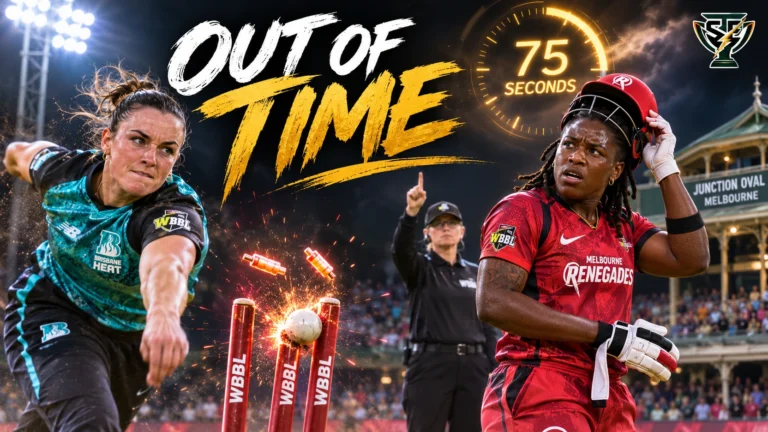
MELBOURNE, Australia, November 25, 2026: Deandra Dottin was forbidden from playing the delivery that ended her innings at Junction Oval on Wednesday. Brisbane Heat leg-spinner Sarah Glenn bowled the West Indies all-rounder after she exceeded the Women’s Big Bash League’s 75-second readiness limit. The Melbourne Renegades still won by three wickets off the final ball, but the dismissal exposed an unusual feature of cricket’s attempts to eliminate wasted time.
For the first time in either Big Bash competition, umpires enforced a penalty that turns an ordinary delivery into an uncontested attempt to take a wicket. The scorecard records a duck from one ball, even though the batter was denied the opportunity to defend her stumps.
Key Takeaways
- Deandra Dottin was forbidden from playing the delivery that ended her innings at Junction Oval on Wednesday.
- The incident occurred in the 15th over of Melbourne’s pursuit of 138.
- At the 2023 Men’s ODI World Cup, Sri Lanka’s Angelo Mathews lost his wicket against Bangladesh without a delivery being bowled.
- In 2010, Deandra Dottin became the first woman to score a T20 international century, reaching three figures from 38 balls against South Africa.
Why Deandra Dottin was bowled rather than recorded as timed out
The incident occurred in the 15th over of Melbourne’s pursuit of 138. Glenn had removed Georgia Wareham, and the incoming batter took too long to complete her preparations. Cricket Australia’s account of the dismissal identifies the incident as a Big Bash first.
Under the competition’s modified timed-out procedure, the next batter must be ready within 75 seconds of a dismissal or retirement unless the umpires have called Time. Merely arriving at the crease does not satisfy the requirement. The batter must be prepared to receive the delivery, or the other batter must be ready to receive it where applicable.
When Deandra Dottin exceeded that deadline, the umpires instructed her to move aside. Glenn had a legal delivery at the exposed wicket and hit the target. The opportunity was particularly valuable to Brisbane because it gave Glenn successive wickets without another run being added.
What the scorecard tells us about Deandra Dottin
The recorded dismissal is bowled, not timed out, and the delivery counts toward the batter’s innings. A golden duck is therefore the appropriate statistical description, although the conventional image of a batter losing her wicket to the first delivery she attempts to play does not fit this case.
The distinction is similar to other circumstances in which cricket’s laws attach consequences to a batter’s actions or omissions. TSE’s explanation of Marnus Labuschagne’s no-shot LBW dismissal examines a different example of how an apparently familiar mode of dismissal can depend on a specific playing condition.
The Big Bash had already encountered this problem
The rule was introduced for the 2021-22 season, as administrators sought to shorten matches that were regularly exceeding three hours. It almost entered the record books on December 31, 2022, when Adelaide Strikers questioned Marcus Stoinis’ readiness during a men’s BBL match.
In its report on the Stoinis dispute, Cricket Australia calculated that 102 seconds elapsed before the Melbourne Stars batter faced up. Stoinis argued that Adelaide’s field was still being rearranged. The umpires declined to grant the free delivery, and he went on to score 74 from 35 balls in an eight-run victory.
The dismissal of Deandra Dottin establishes a precedent for enforcement that the Stoinis episode did not. As the men’s competition approaches its next season, covered in TSE’s Big Bash squad and season preview, teams have a concrete illustration of the cost of an extended changeover.
How the penalty differs from Angelo Mathews’ World Cup dismissal
At the 2023 Men’s ODI World Cup, Sri Lanka’s Angelo Mathews lost his wicket against Bangladesh without a delivery being bowled. The ICC’s explanation of the ruling confirmed that the tournament allowed two minutes for readiness. Bangladesh appealed, and the umpires upheld the appeal. Mathews experienced a helmet problem, but the fourth official said the permitted time had already expired before the equipment failure.
| Feature | Mathews, 2023 World Cup | Deandra Dottin, WBBL |
|---|---|---|
| Readiness limit | 120 seconds | 75 seconds |
| Delivery required for dismissal | No | Yes, under the free-ball procedure |
| Recorded dismissal | Timed out | Bowled |
| Bowler credited with wicket | No | Yes |
The Big Bash deadline is 45 seconds shorter, a reduction of 37.5 percent compared with that World Cup condition. Its penalty nevertheless leaves an element of execution with the bowler. Glenn had to hit the wicket; a miss on a legal delivery would have left the batter in the contest. That makes the consequence different from the championship-point deductions discussed in TSE’s analysis of slow over-rate penalties.
Continue the Big Bash League Story



ONE OF THE RARE DISMISSAL IN CRICKET HISTORY 🤯Deandra Dottin was late to arrive in the middle so Sarah Glenn got a free delivery to dismiss her by hitting the stumps as per rule & Dottin is gone. ❌ https://t.co/LYEoAj1jnp
— Johns. (@CricCrazyJohns) November 25, 2026
Melbourne survives the loss of its power hitter
In 2010, Deandra Dottin became the first woman to score a T20 international century, reaching three figures from 38 balls against South Africa. Her unbeaten 112 demonstrated how rapidly she could change a game. At Junction Oval, Melbourne lost that potential source of acceleration with the score at 97 for five.
The Renegades required another 41 runs from 34 balls with five wickets available, a required rate of 7.24 runs per over. Tess Flintoff and Wareham had contributed 30 and 29 respectively before Glenn struck. The lower order still had to finish the chase. Annie Wikman supplied the decisive single off Lucy Hamilton to seal victory.
Captain Sophie Molineux earned Player of the Match after taking four for 20, restricting Brisbane to 137 for eight. The performance came in a campaign preceded by changes to the Big Bash and WBBL playing rosters. Molineux’s contribution also illustrates the depth of the Australian women’s game seen in the recent Rose Bowl series against New Zealand.
For teams, the lesson from Deandra Dottin is that preparation for an innings now has competitive value before the batter takes guard. The batting order, equipment checks and readiness of the next player all deserve attention during an innings. Melbourne recovered this time, but a lost wicket and delivery can be decisive in a tighter chase.