ZURICH, Switzerland, November 25, 2026: The International Ice Hockey Federation (IIHF) has decided to challenge the decision overturning the Russia hockey ban at the Swiss Federal Tribunal, opening a new legal front in a dispute that has already disrupted preparations for five international championships.
The federation’s latest challenge concerns the independence of two members of the three-person arbitration panel that ruled in Russia’s favor. Even if that ruling survives judicial scrutiny, governments retain control over who enters their countries, while national associations must decide whether their teams will take the ice against Russian opponents.
Key Takeaways
- In its announcement, reported by Daily Faceoff, the federation cited concerns about the arbitrators’ “independence and impartiality” following information concerning possible connections to Russia.
- The Court of Arbitration for Sport (CAS) had unanimously ruled on October 30 that the federation had failed to establish an adequate evidentiary basis for continuing its exclusion of Russian teams under its own rules.
- In the Russia hockey ban case, the federation had already faced an internal setback: its disciplinary board annulled the January exclusion in May.
- The Russia hockey ban began after the full-scale invasion of Ukraine in 2022, when the IIHF suspended Russian and Belarusian teams.
Russia hockey ban: Why the IIHF is challenging the arbitration process
In its announcement, reported by Daily Faceoff, the federation cited concerns about the arbitrators’ “independence and impartiality” following information concerning possible connections to Russia. These are allegations underlying the planned challenge, not findings of misconduct by a court.
The Court of Arbitration for Sport (CAS) had unanimously ruled on October 30 that the federation had failed to establish an adequate evidentiary basis for continuing its exclusion of Russian teams under its own rules. TSE’s original report on the reinstatement decision examined the immediate implications.
In the Russia hockey ban case, the federation had already faced an internal setback: its disciplinary board annulled the January exclusion in May. The Council subsequently maintained the exclusion, making the evidentiary basis of its renewed decision central to the October arbitration.
What Swiss judges can review in the Russia hockey ban dispute
Under Swiss international arbitration law, grounds for challenging awards are limited. Questions about the proper constitution of a panel or subsequently discovered grounds for disqualifying an arbitrator can be relevant, subject to procedural conditions. A challenge does not ordinarily suspend an award automatically. The court can grant suspensive effect, but no such order was established in the material reviewed.
A successful challenge could therefore lead to another arbitration rather than an immediate judicial determination of whether Russia should play hockey. The federation’s objection must be assessed under the relevant legal procedure; its disagreement with the sporting outcome alone is insufficient.
Five championships are caught in the dispute
The October CAS media release identified the following competitions. The countdown illustrates how differently the Russia hockey ban dispute affects organizers, depending on their event’s proximity.
| Championship | Host | Scheduled start | Days from November 25 |
|---|---|---|---|
| World Junior Championship | Canada | Dec. 26, 2026 | 31 |
| Women’s U18 | Czechia | Jan. 8, 2027 | 44 |
| Men’s U18 | United States | Apr. 22, 2027 | 148 |
| Men’s World Championship | Germany | May 14, 2027 | 170 |
| Women’s World Championship | Canada | November 2027 | Exact date not specified in release |
Source: October 30 CAS release. Calendar-day intervals calculated by TSE. The table identifies the scope of the original decision, not confirmed Russian entries.
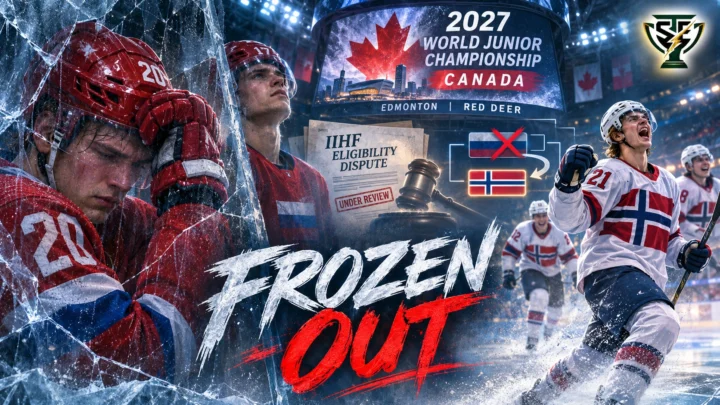
Canada has already demonstrated the gap between eligibility and participation. The IIHF confirmed that Russia would miss the junior tournament because of Canadian entry restrictions, preserving the event in Edmonton and Red Deer. TSE’s coverage of the World Juniors decision also explains the uncertainty that surrounded Norway’s place in the competition.
The men’s championship in Düsseldorf and Mannheim begins 139 days after the junior event opens. That gives organizers more preparation time, but it does not guarantee agreement over Russian participation. Norway has announced its refusal to face Russia, and other federations have expressed opposition.
Continue the Hockey Story

Who controls Russia’s return to the ice?
The Russia hockey ban began after the full-scale invasion of Ukraine in 2022, when the IIHF suspended Russian and Belarusian teams. The Russian Ice Hockey Federation’s legal victory concerns Russia’s eligibility, and should not be interpreted as an automatic reinstatement of Belarus.
| Authority | Decision within its remit |
|---|---|
| CAS and Swiss judiciary | Validity of sporting decisions and arbitral awards under applicable rules |
| Host governments | Entry permissions and public security measures |
| IIHF and member associations | Tournament formats, participation and consequences of refusals under applicable regulations |
As TSE reported when the CAS defended its decision, the tribunal did not impose neutral participation conditions or settle the organizational consequences of reintegration. Those omissions matter because even an award that remains in effect cannot itself issue visas or resolve a boycott.
The governing body’s earlier opposition to immediate reintegration preceded its current focus on arbitrator impartiality. Whether the new objections meet the Swiss court’s legal threshold remains unresolved.
What happens next?
| Development | Implication |
|---|---|
| Court grants a stay | Implementation may be temporarily suspended within the order’s scope. |
| Award survives the challenge | IIHF must address participation under the award, subject to lawful host restrictions. |
| Award is set aside | Further arbitration or other proceedings may be needed. |
The next meaningful developments will be confirmation of the court filing, any interim order and published participation decisions for the January women’s U18 tournament. The Russia hockey ban dispute will ultimately test whether sporting eligibility can be translated into actual fixtures when organizers, governments and member federations disagree.