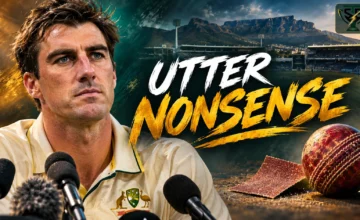
LONDON, England, November 19, 2026: Former England captain Nasser Hussain has questioned why Australian cricket allowed the divisions caused by Sandpapergate to endure long after Steve Smith, David Warner and Cameron Bancroft completed their suspensions. Speaking in a Sky Sports Cricket video published on November 18, Hussain argued that the treatment of the three punished players and their reintegration into the national side deserve greater scrutiny as Usman Khawaja’s autobiography reignites the controversy.
The latest Nasser Hussain Sandpapergate intervention introduces a question that goes beyond the original ball-tampering offense: if Australia believed three players had accepted responsibility for the scandal, why did the returning players and their teammates fail to establish a shared understanding of what happened? With Sky hoping to interview Khawaja the following week, that unresolved issue could become central to the next stage of a dispute that has already drawn Cricket Australia’s leadership into another public confrontation.
Key Takeaways
- Former England captain Nasser Hussain has questioned why Australian cricket allowed the divisions caused by Sandpapergate to endure long after Steve Smith, David Warner and Cameron Bancroft completed their suspensions.
- Referring to Khawaja’s emerging account, Hussain described Smith and Warner as having taken the blame for the side.
- Hussain also said Sky hoped to have Khawaja on its podcast the following week, while acknowledging that the former Australian batter appeared determined to explain his reasons for speaking publicly.
- The controversy began during the third Test between South Africa and Australia at Newlands in March 2018.
Nasser Hussain Sandpapergate Remarks Challenge Australia’s Handling of the Aftermath
Hussain’s argument was striking because it concentrated less on the technical offense of altering a cricket ball and more on the consequences of the original investigation for relationships within the Australian team.
Story at a glance

Nasser Hussain Sandpapergate Remarks Challenge Australia’s Handling of the Aftermath
Hussain’s argument was striking because it concentrated less on the technical offense of altering a cricket ball and more on the consequences of the original investigation for relationships within the Australian team.
What Usman Khawaja Can Explain That Others Cannot
Khawaja occupies an unusual position in the renewed controversy.
The Questions Khawaja’s Podcast Appearance Should Resolve
Hussain’s expectation of speaking with Khawaja creates an opportunity for a more focused discussion than the exchanges of accusations and denials that have dominated recent coverage.
What the Original Sandpapergate Investigation Actually Established
The controversy began during the third Test between South Africa and Australia at Newlands in March 2018.
Pat Cummins’ Denial Creates a Difficult Test for Khawaja’s Account
The strongest public disagreement concerns Australia captain Pat Cummins.
Referring to Khawaja’s emerging account, Hussain described Smith and Warner as having taken the blame for the side. He questioned how three teammates could be left carrying responsibility for such a serious incident while others continued their international careers.
His observation reflected the importance placed on solidarity in Australian cricket, where the national team’s identity has long been associated with loyalty, competitiveness and pride in representing the country.
Hussain also said Sky hoped to have Khawaja on its podcast the following week, while acknowledging that the former Australian batter appeared determined to explain his reasons for speaking publicly.
The Sky Sports Cricket video featuring Hussain’s remarks provides the immediate context for his comments.
There is an important limitation to the argument. Describing the three sanctioned players as having accepted responsibility for the team does not establish that every Australian cricketer knew about the sandpaper plan or participated in it.
That distinction remains central to the controversy. A team can share the consequences of misconduct without every member bearing the same individual responsibility for the offense.
Why the Nasser Hussain Sandpapergate Argument Matters
Hussain’s contribution is significant because it identifies two different failures that could have occurred in 2018.
The first was a failure to prevent deliberate ball tampering. The second, which requires separate examination, was a potential failure to rebuild trust between players after the disciplinary process ended.
Those failures should not be confused.
An investigation can establish responsibility for a specific offense without necessarily repairing relationships within a team. Equally, difficult relationships after an investigation do not prove that its findings were wrong.
Nasser Hussain reacts to Cameron Bancroft’s ‘sandpapergate’ statement 🗣️ https://t.co/RDpNiZOQox
— Sky Sports Cricket (@SkyCricket) November 18, 2026
Hussain’s remarks invite scrutiny of how Australia handled both responsibilities.
That issue was already visible in The Sports Encounter’s examination of the confrontation between Warner and Pat Cummins, which documented how former teammates have publicly challenged one another’s accounts and loyalties.
The new dimension is whether those disagreements developed because the original inquiry left important questions unresolved, because subsequent reconciliation was inadequate, or because former players now interpret the same events differently.
What Usman Khawaja Can Explain That Others Cannot
Khawaja occupies an unusual position in the renewed controversy.
He was part of the Australian squad during the 2018 South Africa tour, giving him firsthand experience of the team’s environment before and after the Cape Town incident.
His autobiography, Sabr: Finding My Way in Cricket and Life, challenges the accepted understanding that knowledge of the sandpaper plot was confined to the three sanctioned players.
He has also described discussions and alleged conduct preceding the incident that became public at Newlands.
These allegations are serious, but they remain contested.
What makes a substantive interview valuable is the opportunity to distinguish Khawaja’s direct observations from conversations he recalls, conclusions he subsequently reached and information he may have learned from other people.
That distinction determines how much his account can establish independently.
If Khawaja personally witnessed a particular discussion, his testimony could be compared with the recollections of other participants. If he learned about an alleged incident afterward, the identity and reliability of the original source would become relevant.
Similarly, an assertion that teammates generally understood that the ball was being manipulated would need to be distinguished from evidence that specific individuals knew sandpaper would be used.
TSE’s earlier analysis of the case for reopening the investigation examined those differences and the importance of independent corroboration.
A podcast cannot replace an investigative process. It can, however, clarify precisely what a witness claims, how the witness reached those conclusions and which details may be independently checked.
The Questions Khawaja’s Podcast Appearance Should Resolve
Hussain’s expectation of speaking with Khawaja creates an opportunity for a more focused discussion than the exchanges of accusations and denials that have dominated recent coverage.
Five areas deserve particular attention.
What Did Khawaja Personally Witness?
There is a material difference between being present during a conversation about reverse swing and witnessing an explicit plan to use an illegal abrasive substance.
An account that identifies the participants, timing and precise subject of discussions would be more informative than a general claim about collective awareness.
Was There Evidence of Ball Tampering Before Cape Town?
Khawaja’s account raises questions about whether misconduct occurred before the third Test against South Africa.
Those allegations would require independent evidence, including contemporaneous testimony or other reliable records. The original Cape Town incident cannot automatically establish that similar offenses occurred in previous matches.
Why Did Khawaja Decide to Speak Publicly?
Hussain suggested that Khawaja believes the time has arrived to explain his position.
A useful interview would explore whether his decision followed new evidence, conversations with former teammates, long-standing dissatisfaction with the investigation or a desire to defend those who were punished.
Khawaja has said he understands the personal consequences of speaking out. The reason for his intervention matters, but it cannot independently determine whether his claims are accurate.
What Happened When the Three Players Returned?
This question goes directly to Hussain’s concern.
Smith and Warner eventually returned to the Australian side after their suspensions, while Bancroft also resumed competitive cricket.
Did the national team’s leadership make a deliberate effort to reconcile differing understandings of the scandal? Were players able to discuss the events openly? Did disagreement remain beneath the surface?
The answers could help explain why relationships that appeared manageable for years have now become publicly strained.
What Would Khawaja Accept as a Fair Resolution?
Khawaja has supported greater acknowledgment of what happened. But acknowledgment can take several forms.
It could involve a fuller public account, additional witness testimony, institutional recognition of investigative shortcomings or a formal finding based on new evidence.
Establishing precisely what outcome he seeks would help determine whether the present dispute has a realistic path toward resolution.
What the Original Sandpapergate Investigation Actually Established
The controversy began during the third Test between South Africa and Australia at Newlands in March 2018.
Television cameras captured Cameron Bancroft attempting to alter the condition of the ball using sandpaper.
The subsequent Cricket Australia investigation identified three players as responsible for the plan.
Warner was found to have played a leading role in developing the scheme, Smith was held accountable for his knowledge and leadership failures, and Bancroft was punished for carrying out the attempted alteration.
The ICC’s contemporary account of Cricket Australia’s sanctions documented the disciplinary findings and the penalties imposed.
| Player | 2018 sanction | Relevance to the renewed dispute |
|---|---|---|
| Steve Smith | 12-month suspension | Captain during the Cape Town incident; leadership responsibility formed part of the original findings |
| David Warner | 12-month suspension | Identified as a principal organizer; now supports Khawaja’s challenge to the accepted account |
| Cameron Bancroft | Nine-month suspension | Player filmed attempting to alter the ball; his conduct established the original offense |
The findings identified responsibility for the particular scheme investigated. They should not be represented as a definitive explanation of every conversation, team relationship or possible ball-management practice throughout the tour.
However, the opposite conclusion is equally important. The existence of unanswered questions does not establish that other players committed misconduct.
Hussain’s concern about the three players carrying the consequences is an argument about fairness and team responsibility. It should not be transformed into a factual accusation against teammates whose involvement has not been proved.
Pat Cummins’ Denial Creates a Difficult Test for Khawaja’s Account
The strongest public disagreement concerns Australia captain Pat Cummins.
Cummins has categorically rejected suggestions that he knew of or helped devise the use of sandpaper during the Cape Town Test.
His response was explored in TSE’s detailed report on the captain’s rejection of Khawaja’s allegations.
The disagreement is not something an independent publication should settle by deciding which cricketer sounds more convincing.
Personal recollections, even when sincerely expressed, can differ after many years. That does not mean every conflicting account is equally credible, but credibility should be assessed through corroboration, specificity and consistency with other evidence.
Where claims involve identifiable individuals and possible professional misconduct, the standard should be particularly demanding.
Hussain’s comments are most useful when understood as a challenge to the completeness of Australia’s response, rather than a judgment that Cummins or other previously cleared players must have been involved.
Cricket Australia’s New Forum Faces a Fundamental Limitation
The governing body’s latest response adds another dimension to the controversy.
On November 18, Cricket Australia announced plans for an independent forum intended to give members of the 2018 touring squad an opportunity to present their accounts.
The initiative followed renewed public disagreement after Khawaja’s autobiography, but it is not being presented as a formal reopening of the original disciplinary investigation.
That distinction could determine its effectiveness.
According to reporting on Cricket Australia’s proposed forum, the governing body intends to provide a process for players to discuss their experiences. Reuters also reported that Khawaja questioned whether such an initiative would establish the full truth.
A confidential process may encourage former teammates to speak more openly, particularly if they are reluctant to make further public accusations.
However, a forum designed primarily for reconciliation has different powers and purposes from an investigation examining disputed evidence.
An investigative process would normally require defined questions, standards of proof, access to relevant records and procedures for responding to allegations.
A reconciliation forum may instead prioritize dialogue, relationships and acknowledgment of the harm caused by earlier events.
Neither objective is inherently illegitimate. The problem arises if one process is expected to accomplish both without clearly explaining its authority.
If Cricket Australia wants to repair relationships, it must create conditions in which participants can speak without unnecessary personal confrontation.
If it wants to resolve disputed allegations, it must provide a credible means of examining evidence.
Without that distinction, the forum risks producing an appearance of progress while leaving the central factual disagreements unresolved.
Continue the Cricket Story



Why Hussain’s Question About Team Unity Deserves Attention
Hussain’s perspective carries additional weight because he captained England against Australian sides whose competitive strength was often reinforced by a powerful collective identity.
The Australian dressing room has traditionally presented itself as an environment in which teammates support one another and share responsibility for success or failure.
That image is not unique to Australian cricket, but it has been a prominent feature of the national team’s public identity.
Sandpapergate exposed the consequences of misconduct within a tightly connected sporting organization. The renewed argument shows how difficult it can be to restore relationships when individuals disagree about what accountability should involve.
Hussain’s concern is understandable: three players received substantial punishments, eventually returned to the game and now remain associated with a scandal that other former teammates continue to discuss publicly.
But successful reintegration does not require pretending that everyone shared identical responsibility.
Instead, it requires a clear understanding of the established facts, fair treatment of those disciplined and appropriate protection for individuals against unsubstantiated accusations.
The present disagreements suggest Australian cricket has not achieved a durable consensus around those matters.
The issue also connects with Australia’s wider cricketing transition. Several senior players associated with the 2018 era have continued to influence the national side as it prepares the next generation.
That generational challenge was examined in The Sports Encounter’s analysis of Australia’s aging squad.
Unresolved divisions involving senior players do not automatically damage younger cricketers. But they can complicate the values and expectations that future leaders inherit.
Why the Scandal Still Matters Beyond Australia’s Dressing Room
Ball tampering is not solely an Australian problem. Cricket’s history includes controversies over changing the condition of the ball, disagreements over the interpretation of rules and accusations of gaining an unfair advantage.
What made the 2018 incident distinctive was the combination of visible evidence, admissions by senior players, significant disciplinary penalties and a subsequent examination of Australian cricket’s culture.
The consequences reached far beyond the outcome of one Test match.
Australia’s subsequent return to South Africa carried that historical background, as discussed in TSE’s examination of the rivalry eight years after Sandpapergate.
Other cricketing misconduct cases also demonstrate why proportionality matters. A disciplinary sanction should reflect what can be proved about an individual’s conduct rather than the intensity of public anger surrounding an incident.
The case of amateur cricketer Clicky Ponting, examined in TSE’s reporting on his two-year suspension, offers a separate example of how rule violations can create consequences extending beyond the immediate contest.
The cases differ in circumstances and governing rules, but they share a broader principle: sporting authorities must make disciplinary decisions through transparent and proportionate procedures.
In Australia’s case, the continuing disagreement is now testing not only the original punishment but the institution’s ability to explain and defend its decisions years afterward.
The Next Podcast Must Produce More Than Another Round of Accusations
Sky’s proposed conversation with Khawaja could become one of the more informative interviews in the renewed debate, provided it examines precise claims rather than merely asking him to respond to the latest criticism.
There are questions about what he witnessed, when he acquired particular knowledge, why his interpretation differs from Cricket Australia’s findings and what evidence could support further scrutiny.
There are also questions about what happened after Smith, Warner and Bancroft returned to competitive cricket.
Those questions directly reflect Hussain’s concern about the team’s inability to move beyond the scandal.
Yet an interview, however detailed, cannot determine disputed responsibility through testimony alone. Its greatest contribution would be to make the competing claims sufficiently specific that they can be examined fairly.
For Cricket Australia, the next challenge is deciding whether its proposed forum can genuinely address both the relationships damaged by Sandpapergate and the unresolved allegations that continue to divide former teammates.
The latest Nasser Hussain Sandpapergate remarks point toward a question that deserves an answer: how did a team associated with such strong collective loyalty emerge from one of cricket’s greatest integrity scandals without achieving a lasting understanding of responsibility?
Until Australian cricket can distinguish what was established, what remains disputed and how relationships were affected, the controversy is unlikely to be resolved by another interview or another statement of denial.
Sandpapergate
- Nasser Hussain Sandpapergate Remarks Raise Questions Ahead of Usman Khawaja Podcast
- Sandpapergate 2026: Cameron Bancroft’s Revelations Reopen Australian Cricket’s Deepest Trust Crisis
- Sandpapergate Tears Australian Cricket Apart as Warner and Cummins Turn on Each Other After Khawaja Unveils ‘Sabr’
- Sandpapergate Allegations: Cummins Calls Khawaja’s Claims Nonsense
- Sandpapergate: Why Cricket Australia Must Reopen the Investigation