Breaking News
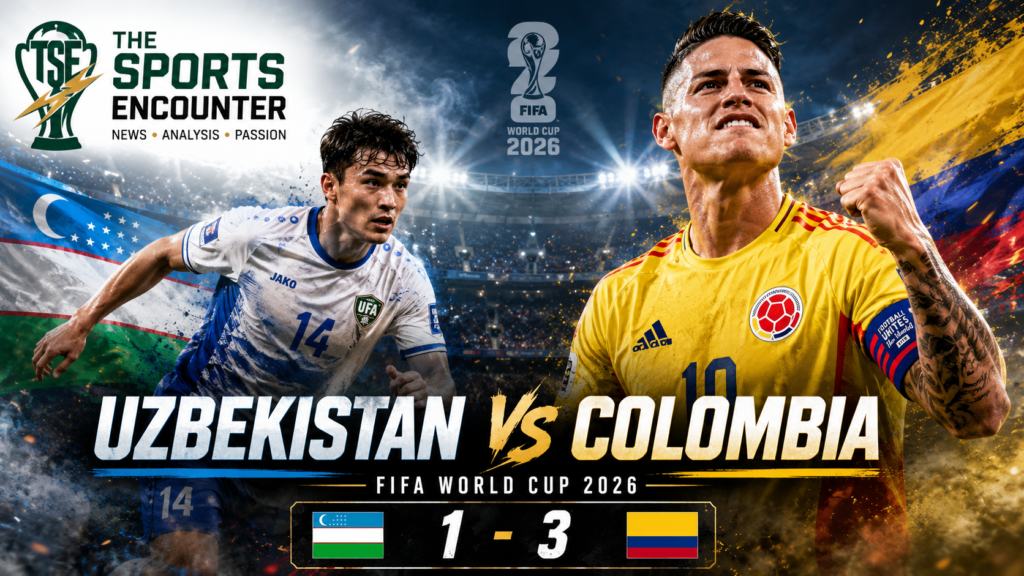
Uzbekistan Make History, Colombia Take Control in Group K Thriller
Colombia returned to the FIFA World Cup with three points, but Uzbekistan made sure their first appearance on football’s biggest stage did not pass quietly.
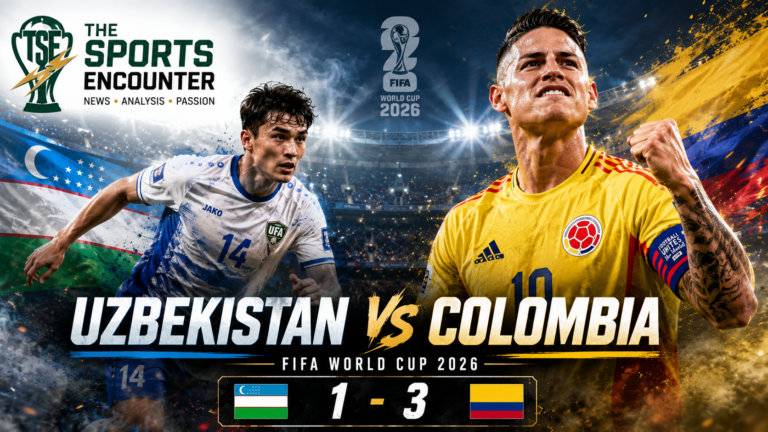
In a Group K opener that looked routine on paper but carried long spells of tension, Colombia beat Uzbekistan 3-1 at Estadio Azteca after goals from Daniel Muñoz, Luis Díaz, and Jhon Arias. Uzbekistan, making their World Cup debut, had briefly threatened to turn the match into one of the early tournament stories when Abbosbek Fayzullaev equalized in the second half.
Colombia did not always look fluent. They did not always look comfortable. Yet they had enough individual quality, enough patience, and enough final-third sharpness to survive Uzbekistan’s best spell and leave Mexico City with a result that immediately changes the pressure inside Group K.
For more World Cup coverage, follow The Sports Encounter’s FIFA World Cup 2026 coverage as the group stage begins to take shape.
Colombia Start Slowly but Strike Before Half-Time
Colombia entered the match with greater tournament experience, stronger individual names, and the weight of expectation that comes with a side returning to the World Cup after missing the 2022 edition.
James Rodríguez started in midfield, giving Colombia a familiar creative reference point. Luis Díaz carried the direct threat from wide areas, while Colombia’s structure looked built around control rather than chaos.
That control, however, did not turn into early domination.
Uzbekistan defended with discipline, kept their shape compact, and refused to give Colombia easy access through central areas. Their game plan was clear. Stay organized, protect the box, and look for moments through Eldor Shomurodov and Fayzullaev when Colombia lost rhythm.
For much of the first half, that plan worked.
Colombia had more of the ball, but their tempo stayed cautious. They moved possession from side to side without always forcing Uzbekistan’s back line into uncomfortable decisions. The South Americans looked technically cleaner, but Uzbekistan looked emotionally switched on.
The breakthrough finally arrived in the 41st minute.
Daniel Muñoz gave Colombia the lead with a sharp finish that settled nerves before the interval. It was the kind of goal Colombia needed badly, not because they had been under constant threat, but because the longer the match stayed goalless, the more Uzbekistan’s belief would grow.
Half-time score: Uzbekistan 0-1 Colombia
Uzbekistan’s Historic Moment Arrives Through Fayzullaev
Uzbekistan came out after the break with more courage.
Their passing became quicker. Their midfield line pushed higher. Their attacking players began to take up braver positions between Colombia’s defense and midfield.
That improvement brought its reward in the 60th minute.
Fayzullaev reacted sharply after Shomurodov’s effort created danger inside the Colombia box, finishing the move to make it 1-1. For Uzbekistan, it was more than an equalizer. It was the country’s first World Cup goal, scored on a night that already carried historic weight for Central Asian football.
The goal briefly changed the emotional temperature of the game.
Colombia, who had tried to manage the match through patience, suddenly had to respond with urgency. Uzbekistan’s players looked energized. Their supporters had something real to hold on to. The match no longer felt like a debutant trying to survive against a stronger opponent. It felt like a contest.
That was the point where Colombia’s individual quality became decisive.
Luis Díaz Answers Five Minutes Later
Colombia did not allow Uzbekistan’s equalizer to breathe for long.
Five minutes later, Luis Díaz restored Colombia’s lead with a curling effort that put the South Americans back in control. The finish may invite questions about whether the goalkeeper could have done better, but Díaz still created the moment Colombia needed when the match began slipping toward uncertainty.
Big players matter in these moments.
Díaz had entered the tournament with his own emotional World Cup storyline. His first appearance on this stage came after difficult years personally and professionally, and his goal gave Colombia more than a lead. It gave them emotional control again.
At 2-1, Uzbekistan faced a different challenge. Their equalizer had required energy, timing, and belief. Now they had to chase the match again against a Colombia side that could slow the game down, draw fouls, and use possession to drain the clock.
The final phase showed the gap between promise and tournament maturity.
Uzbekistan still pushed forward, but Colombia managed the danger better. They did not produce a spectacular closing stretch, yet they found enough stability to deny Uzbekistan another clean look at a comeback.
Jhon Arias Seals It in Stoppage Time
Colombia made the result safe in stoppage time.
Jhonder Cádiz worked the chance from the right side and delivered for Jhon Arias, who headed in Colombia’s third goal to make it 3-1. The goal gave the scoreline a more comfortable shape than the match itself had suggested for long stretches.
Uzbekistan will feel the final margin was harsh.
They were not outclassed for 90 minutes. They did not freeze on the occasion. They showed organization, courage, and enough attacking structure to trouble a Colombia team with serious knockout-round ambition.
Still, World Cup football punishes small mistakes quickly. Colombia had more cutting edge in decisive moments, and that became the difference.
What the Result Means for Group K
This result gives Colombia a strong early position in Group K, especially after Portugal’s 1-1 draw with DR Congo earlier in the group.
That draw already changed the mood around the section. Portugal entered as the headline favorite, but DR Congo’s resistance showed that Group K may not follow the expected script. The Sports Encounter covered that result in detail here: DR Congo stun Portugal as Ronaldo’s World Cup question grows louder.
Colombia now have three points while Portugal and DR Congo sit on one each. Uzbekistan remain on zero, but their performance gives them enough reason to believe they can still compete in their remaining fixtures.
Colombia next face DR Congo on June 23, a match that could decide whether they take control of the group early. Uzbekistan face Portugal on the same day, and that game now carries serious pressure for both sides.
Portugal cannot afford another slow performance. Uzbekistan cannot afford another defeat.
Colombia Still Have Questions Despite the Win
A 3-1 win looks convincing on the scoreboard, but Colombia will know this was not a perfect performance.
Their possession often lacked speed. Their attacking movements became predictable during long spells. They had to rely on moments rather than sustained pressure to break Uzbekistan’s resistance.
That may be enough in an opening group match. It may not be enough later in the tournament.
James Rodríguez gave Colombia calmness and personality in midfield, but Colombia still need more vertical movement around him. Díaz remains their clearest direct weapon, yet the team cannot depend only on his ability to break games open.
The positive side is obvious. Colombia won without playing at their highest level. Tournament teams often grow into World Cups. Three points give them room to breathe, adjust, and sharpen.
For wider tournament context, read The Sports Encounter’s coverage of another major contender here: Mbappé leads France as Senegal learn how ruthless World Cup football can be.
Uzbekistan Leave With Pain but Also Proof
Uzbekistan’s defeat will sting because they had Colombia worried.
Their first World Cup match could easily have become a one-sided lesson. Instead, they produced a serious second-half response and scored a goal that will live in the country’s football memory.
Fayzullaev’s equalizer gave Uzbekistan their first World Cup moment. Shomurodov’s presence gave them a focal point. Their midfield showed enough discipline to frustrate Colombia for long periods.
The next step is harder.
Debutant teams often earn praise for spirit, but points decide survival. Uzbekistan now need to turn brave passages into complete performances. Against Portugal, they will likely need the same discipline, better defensive concentration, and more confidence in transition.
This tournament has already shown that underdogs can disturb bigger names. Argentina, France, Portugal, and other headline sides have all faced different kinds of early pressure. You can follow more tournament match reports and fan-focused analysis through The Sports Encounter’s football coverage.
Breaking News
Ghana Leave It Late as Yirenkyi Breaks Panama Hearts in World Cup Opener
Ghana opened their FIFA World Cup 2026 campaign with the kind of win that can shape a team’s tournament far beyond the scoreboard.
For most of the night, Panama looked disciplined, organized, and brave enough to believe they could take something from their Group L opener. They frustrated Ghana, moved the ball with patience in the first half, and forced the Black Stars to work harder than expected for control.
Then came the moment that changed everything.
Caleb Yirenkyi struck in stoppage time to give Ghana a dramatic 1-0 win, turning a tense opening match into a huge psychological lift for Carlos Queiroz’s side. It was not Ghana’s cleanest performance, but World Cups rarely reward style alone. They reward survival, timing, and players who stay alive when the match looks ready to drift away.
Yirenkyi became Ghana’s hero with a late finish after Brandon Thomas-Asante helped launch the decisive counter-attack. Panama had defended with commitment for almost the entire match, but one late transition broke their resistance and left them with nothing from a game they had fought hard to control.
For more tournament coverage, follow The Sports Encounter’s latest World Cup 2026 stories and match reports.
Panama Made Ghana Uncomfortable Early
Panama did not approach this match like a team waiting to be overpowered.
They started with confidence, passed with purpose, and made Ghana chase the rhythm in midfield. Ghana had attacking quality on paper, with Antoine Semenyo, Jordan Ayew, Kamaldeen Sulemana, and Ernest Nuamah giving them speed and directness. Yet Panama’s structure denied them easy routes into dangerous areas.
Cecilio Waterman, Jose Luis Rodriguez, Cristian Martinez, and Edgar Yoel Barcenas helped Panama stretch the pitch whenever they could. The Central American side looked especially useful when they moved quickly into wide areas and forced Ghana’s back line to turn.
Ghana goalkeeper Lawrence Ati Zigi had to stay alert during a difficult first half. Panama did not turn their pressure into a goal, but they did enough to make Ghana uncomfortable and keep the contest tense.
That first-half spell mattered because it showed Panama were not just trying to survive. They were trying to compete.
That same competitive edge has already shaped several early World Cup stories, including DR Congo’s fearless performance in their statement result against Portugal.
Ghana’s Attack Took Time to Settle
Ghana carried more individual threat, but their attacking rhythm did not arrive early enough.
Semenyo gave Panama problems with his physical presence and movement, while Jordan Ayew tried to connect midfield and attack. Still, Ghana’s final ball lacked sharpness for long stretches. Sulemana and Nuamah had moments where they looked ready to open the match, but Panama’s defensive line stayed compact and refused to panic.
The game became a test of patience.
For Ghana, the danger was obvious. The longer the match stayed goalless, the more Panama believed. The Black Stars needed someone to raise the tempo, run beyond the first line, or force a mistake.
That shift came after Ghana refreshed the attack and started finding more direct routes forward. Brandon Thomas-Asante’s introduction gave Ghana another runner, and his role in the decisive move proved crucial.
The match followed a pattern already seen in this tournament: even technically stronger teams have needed patience, tactical discipline, and late-match focus to separate themselves. France showed that balance in their World Cup 2026 campaign coverage, while Ghana found their answer much later.
Yirenkyi’s Winner Changes the Mood Around Ghana
Caleb Yirenkyi’s goal was not just a late winner. It was a release.
Ghana had spent much of the match fighting frustration. Panama had closed spaces well, disrupted Ghana’s flow, and made the Black Stars work for every yard. By the time stoppage time arrived, the game looked set for a draw that would have suited Panama far more than Ghana.
Then Ghana found the transition they had been waiting for.
Thomas-Asante helped create the break, Yirenkyi arrived with composure, and Ghana finally punished Panama’s stretched defensive shape. The finish gave Ghana three points, but it also gave them breathing room in a group that still includes England and Croatia.
That matters.
A draw would have left Ghana under immediate pressure before facing England. A win changes the tone. It gives Queiroz’s side margin, belief, and a stronger platform before the group gets tougher.
Panama Deserved More, But Football Punished One Late Moment
Panama will feel this one deeply.
They were organized for long periods. They limited Ghana’s clean chances. They competed physically and tactically. They also had moments where they looked capable of hurting Ghana, especially when Cristian Martinez and Barcenas found space between the lines.
But World Cup matches often turn on small margins.
Panama did almost everything required to earn a point, then lost concentration in the one phase that mattered most. Their disappointment will come from knowing they were not outclassed. They were beaten by timing.
That makes the defeat more painful.
Still, Panama can take something from the performance. If they show the same discipline and intensity against Croatia, they will not be easy to break down. The problem is that performances alone do not move teams through World Cup groups. Points do.
The emotional weight of World Cup moments has always been part of football’s deepest appeal, something The Sports Encounter recently explored through the story of Andrés Escobar and Colombia’s 1994 heartbreak.
What This Means for Group L
Ghana now move into a stronger position after winning their opener. In a group featuring England, Croatia, Ghana, and Panama, early points are priceless.
The Black Stars will face England next, and that match will test their defensive discipline, midfield structure, and ability to create chances against elite opposition. Ghana cannot rely only on late drama again. They will need a cleaner build-up, better final-third decisions, and more control in midfield.
Panama, meanwhile, must regroup quickly before facing Croatia. Their performance against Ghana showed fight, but the table will not care about effort. They need a result in their next match to stay alive in the group.
For readers following the broader tournament picture, The Sports Encounter’s football coverage also tracks how different nations are handling pressure, momentum, and expectation across the FIFA World Cup 2026.
Final Verdict
Ghana did not dominate Panama, but they showed the one quality every World Cup team needs: the ability to stay alive until the final whistle.
Panama played with courage and deserved respect for the way they competed. Yet Ghana found the decisive moment when the match was almost gone.
Caleb Yirenkyi’s stoppage-time winner may become one of those goals that looks even bigger later in the tournament. For now, it gives Ghana a winning start, three crucial points, and a much stronger position in Group L.
Panama leave with regret. Ghana leave with belief.
Breaking News
England Beat Croatia 4-2 as Kane and Bellingham Turn Chaos Into a World Cup Statement
England opened their FIFA World Cup 2026 campaign with a 4-2 win over Croatia in Group L, but this was not the calm, controlled statement Thomas Tuchel would have wanted.
It was louder than that.
It had goals, defensive alarms, Croatian resistance, Harry Kane history, Jude Bellingham authority, and enough first-match chaos to remind England that talent alone will not carry a team through this tournament.
Croatia hurt England twice. They found space, punished loose moments, and refused to let the match become an English procession. But England had too much firepower in the decisive phases. Kane scored twice, Bellingham changed the rhythm after halftime, and Marcus Rashford finished the job late to give England the start they needed.
For more tournament coverage, follow The Sports Encounter’s FIFA World Cup 2026 hub.
Match Summary: England Win, But Croatia Make Them Work
England started the match with the pressure of a favorite and the scars of history.
Croatia have been more than just another opponent for England over the last decade. Their 2018 World Cup semifinal win still sits inside English football memory. That night in Russia turned a dream into pain. This Group L opener in Dallas gave England a chance to set a different tone.
They did.
But they had to survive uncomfortable spells first.
Kane gave England the attacking foundation they needed, scoring twice in a performance that mixed penalty-box instinct with deeper link-up play. His second goal carried extra meaning because it brought him level with Gary Lineker’s England World Cup goalscoring record.
That kind of milestone matters, but the match itself was bigger than one number.
England repeatedly found attacking quality when Croatia looked ready to tilt the contest. Bellingham’s second-half goal gave England the emotional break they needed. Rashford’s late finish then removed Croatia’s last hope of turning pressure into a comeback.
Still, the 4-2 scoreline should not hide the warning signs.
Croatia equalized twice through Martin Baturina and Petar Musa, exposing gaps in England’s defensive spacing and transition control. England won because they had sharper finishers. They did not win because everything worked perfectly.
Kane Shows Why England Still Revolve Around Him
Harry Kane’s value to England is no longer only about goals.
He still scores them, of course. Against Croatia, he scored two more on the World Cup stage and moved into rare England territory. But what made his display important was how often he connected England’s attack when the match became stretched.
Kane dropped into pockets, drew Croatia’s center backs into awkward decisions, and gave England a reference point when the ball needed to stick. That mattered because Croatia tried to drag England into a frantic rhythm.
Some strikers disappear when a match becomes messy. Kane usually becomes more useful.
His penalty-box timing gave England control in the moments that mattered. His movement also opened lanes for runners around him. Bellingham, Rashford, and England’s wide players all benefited from the space Croatia had to protect because Kane remained the constant central threat.
This is why England cannot treat Kane as only a finisher. He is still the player who slows the game when England need calm and sharpens it when they need a final action.
That balance could define England’s tournament.
Was England’s First Goal a Fair Penalty Retake?
England’s opening goal came with controversy attached.
Harry Kane initially saw his penalty saved by Dominik Livakovic, giving Croatia a brief escape from early pressure. But VAR intervened and ruled that the Croatia goalkeeper had stepped off his line before Kane struck the ball. The penalty was retaken, and Kane made no mistake with his second attempt.
For Croatia, it felt like a harsh emotional swing. They had survived the first shot, only to be pulled back into danger by a technical infringement. For England, it was a clear application of the law. Goalkeepers must remain on or above the goal line until the penalty is taken, and VAR judged that Livakovic moved early.
That makes the decision controversial, but not automatically unfair.
The bigger issue for Croatia was psychological. Instead of gaining momentum from a major save, they conceded moments later and had to chase the match from the 12th minute. England benefited from the retake, but Croatia paid for a goalkeeper movement that VAR considered illegal. In a match decided by sharp margins, that early decision gave England the first emotional break of the night.
Bellingham Changed the Temperature After Halftime
Jude Bellingham’s goal was not only a scoring moment.
It was the moment England began to look like a team with control rather than a team trading punches.
The first half carried too much emotional noise for England. Croatia kept finding ways back. England’s defensive line looked uneasy. The midfield did not always protect the back four cleanly. Tuchel’s side had quality, but the match felt too open.
After halftime, Bellingham gave England a different presence.
He carried the ball with purpose, attacked space with authority, and forced Croatia to defend while moving backward. That is where Bellingham is most dangerous. He does not need to touch the ball 100 times to change a match. He needs the right pockets, the right timing, and the courage to drive at a defense when others choose safety.
His goal gave England breathing room.
It also showed why this England team has a different ceiling when Bellingham plays with forward aggression. Kane gives England structure. Bellingham gives them surge.
Together, they made the difference.
Croatia Were Beaten, Not Broken
Croatia lost the match, but this was not a soft defeat.
They showed enough quality to trouble England and enough resilience to suggest Group L is far from settled. Baturina and Musa gave Croatia two important goals, and both finishes reflected a team that still knows how to punish elite opponents when space appears.
Croatia’s problem was not belief.
It was defensive control.
They gave England too many second chances, too much room around the box, and too many chances to reset attacks after pressure should have been cleared. Against Kane and Bellingham, those margins become dangerous quickly.
Luka Modric still offered moments of composure, but Croatia could not fully slow England’s attacking waves after halftime. Their experience kept them alive. Their defending eventually let them down.
That will worry Zlatko Dalic because Croatia now move into their next fixtures against Panama and Ghana with pressure already attached.
For a wider look at how emotional storylines are shaping this tournament, read The Sports Encounter’s feature on the sibling stories giving World Cup 2026 a deeper emotional edge.
England’s Attack Looks Ready, But the Defense Still Needs Work
England scored four goals in an opening World Cup match against Croatia. That is a serious attacking statement.
The problem is that they also conceded twice.
Tournament football does not always punish defensive flaws immediately. Sometimes strong attacking teams survive early errors because their forwards carry them. That happened here. England’s attack gave them enough margin to escape the uncomfortable parts of the match.
But stronger knockout-stage opponents will not be so forgiving.
England’s back line had issues with spacing, recovery runs, and second balls. Croatia found dangerous moments by moving quickly through the middle and using width when England’s shape became uneven. The two goals conceded were not random accidents. They came from patterns that Tuchel will need to address quickly.
That does not make England fragile.
It does make them unfinished.
The best version of England can press, control possession, and score through several routes. The dangerous version of England can also leave gaps when the game becomes emotional. Against Croatia, both versions appeared.
Tuchel will take the result. He will not ignore the warning.
Group L Opens With England in Control
England now have the platform every favorite wants from an opening match: three points, four goals, and attacking rhythm.
Their next Group L match against Ghana now becomes a chance to strengthen their hold on the group. Ghana opened with a 1-0 win over Panama, which means England cannot treat the second match as a soft step. Ghana already have points and will arrive with confidence.
Croatia, meanwhile, face Panama next in a match they cannot afford to waste. A win would pull them back into the qualification picture. Anything less would leave them chasing too much before the final group game against Ghana.
This is why England’s win matters beyond the scoreline.
They have already forced Croatia to play under pressure. They have already put themselves in position to manage the group instead of chase it. In a World Cup with expanded groups and fast-moving qualification pressure, that is valuable.
For another early tournament shock from a European heavyweight’s group-stage test, read our report on DR Congo stunning Portugal as Ronaldo’s World Cup question grows louder.
What England Must Fix Before Ghana
England’s attacking quality is not in doubt.
Their control still needs work.
Before facing Ghana, Tuchel will want sharper defensive distances between midfield and defense. England cannot allow opponents to keep finding central pockets after turnovers. Ghana’s pace and physicality could make those moments even more dangerous.
England also need cleaner game management when they go ahead. Croatia twice found a way back emotionally. That cannot become a habit.
The best teams at the World Cup know when to attack and when to suffocate a match. England attacked well. They did not always suffocate well.
That is the next step.
What Croatia Must Take From the Defeat
Croatia will feel frustrated because they did enough to make England uncomfortable.
But frustration alone will not help them.
They need to fix the defensive mistakes quickly. Their attack showed life. Their midfield still has technical intelligence. Their tournament experience remains useful. But if they defend set pieces, transitions, and box entries this loosely, their World Cup will become difficult fast.
The encouraging part is that Croatia did not disappear after conceding. They fought back twice and showed they can still hurt strong opponents.
The concern is that they needed too much effort to stay close.
That cannot continue.
Final Word: England Win the Opener, But the Real Test Starts Now
England got the result they needed.
A 4-2 win over Croatia gives Tuchel’s team a strong start, gives Kane another historic World Cup night, and gives Bellingham another reminder of how much influence he can carry when England need a match to bend their way.
But this was not a perfect opening performance.
It was thrilling. It was powerful. It was messy. It was also revealing.
England look dangerous enough to hurt anyone in this tournament. They also look open enough to be hurt by teams with courage, speed, and patience.
That makes their World Cup story interesting from the first match.
The talent is real.
The warning signs are real too.
England have started with a win. Now they need to turn a chaotic statement into a controlled campaign.
Breaking News
DR Congo Stun Portugal as Ronaldo’s World Cup Question Grows Louder
Portugal started fast but finished frustrated as DR Congo earned a brave 1-1 draw in Group K. João Neves gave Portugal an early lead, but Yoane Wissa’s historic equalizer turned the match into another strong African statement against European opposition at the FIFA World Cup 2026.
Portugal arrived with pedigree, star power, and one of the most recognizable players in football history.
DR Congo arrived with belief.
By full time, that belief had turned into one of the most meaningful results of the early FIFA World Cup 2026 group stage. Portugal were held to a 1-1 draw by DR Congo in Group K, and the result said plenty about both teams.
For Portugal, this was a missed chance to open the tournament with control. They scored early, moved the ball with confidence, and looked ready to turn the match into a routine win.
For DR Congo, this was not only a point. It was a statement of identity.
The Leopards refused to shrink under the pressure of facing Portugal and Cristiano Ronaldo on the World Cup stage. They defended with discipline, attacked with purpose, and found a deserved equalizer through Yoane Wissa before halftime.
This was another reminder that the gap between established European names and ambitious African teams is not as comfortable as it once looked.
Match Summary: Early Portugal Lead, Historic DR Congo Reply
Portugal made the perfect start.
João Neves put them ahead in the sixth minute after Pedro Neto delivered a dangerous cross into the box. Neves timed his run well and guided his header into the net, giving Portugal exactly the kind of early goal that should settle a favorite.
At that point, the match looked ready to follow a familiar script. Portugal would dominate the ball, stretch DR Congo across the pitch, and wait for the second goal to arrive.
It never did.
DR Congo absorbed pressure, stayed compact, and slowly grew into the match. They did not panic after conceding early. Instead, they kept their shape and waited for the right moment to hurt Portugal.
That moment came just before halftime.
Arthur Masuaku delivered from a corner, and Yoane Wissa attacked the ball with conviction. His header beat the Portuguese defense and changed the mood of the match completely.
Portugal had started like a favorite. DR Congo went into the break like a team that knew it belonged.
For more early tournament context, read our France vs Senegal World Cup 2026 match report, where Kylian Mbappe’s performance showed how elite sides can still punish African teams when given space.
DR Congo Played With Nerve, Not Fear
The best part of DR Congo’s performance was not only the goal.
It was the attitude.
Many underdogs defend deep, clear the ball, and wait for the final whistle against elite European opposition. DR Congo showed more courage than that. They were organized without becoming passive. They respected Portugal without looking intimidated.
Their defenders stayed tight in central areas, forcing Portugal to look wide and slowing the rhythm around Cristiano Ronaldo. When Portugal tried to overload the box, DR Congo bodies were there. When the ball dropped loose, they fought for second balls.
That structure gave them a platform.
Axel Tuanzebe and Chancel Mbemba provided the kind of defensive authority DR Congo needed. Their reading of crosses, physical duels, and late blocks kept Portugal from turning possession into real punishment.
Goalkeeper Lionel Mpasi also gave the team calmness. He managed pressure well, claimed what he could, and helped DR Congo reset during difficult spells.
The wider story was even more powerful. DR Congo were playing their first World Cup match in more than five decades, and Wissa’s goal carried historic weight. This was a country returning to the biggest stage and refusing to play like a guest.
Wissa’s Equalizer Was More Than a Goal
Yoane Wissa’s header gave DR Congo a result to chase.
It also gave their fans a moment to keep.
The timing mattered. Scoring before halftime meant Portugal could not go into the dressing room with control of the match narrative. The equalizer forced Roberto Martinez’s team to restart emotionally and tactically after the break.
The method also mattered.
DR Congo did not need a lucky deflection or a defensive mistake. They created pressure from a set piece, delivered the ball with quality, and finished with authority. That kind of goal travels well in tournament football because it gives a team something repeatable.
Set pieces can change group-stage math. DR Congo proved they have that tool.
For an African side facing one of Europe’s biggest teams, the goal carried another message. DR Congo were not there to survive. They were there to compete.
That same competitive edge has already shaped several stories in this tournament, including the sibling stories giving FIFA World Cup 2026 a deeper emotional layer.
Were Portugal Too Dependent on Ronaldo?
This match will raise a difficult question for Portugal.
Are they still too emotionally and tactically dependent on Cristiano Ronaldo?
Ronaldo remains a giant figure. His presence changes stadium energy, media focus, defensive attention, and Portugal’s attacking psychology. Even at 41, he still carries a magnetism very few players in football history have ever had.
The problem is that Portugal sometimes seemed to wait for the Ronaldo moment instead of building enough collective threat around him.
Their early goal came from movement, width, and a cross into a dangerous area. After that, Portugal had plenty of possession but did not create enough high-quality chances. The ball moved, but the attack lacked sharp final actions.
Bruno Fernandes tried to influence the tempo. Bernardo Silva and Pedro Neto offered technical control and width. Rafael Leão and Gonçalo Ramos gave Portugal different options from the bench.
Still, the longer the match went on, the more Portugal’s attack looked caught between two ideas.
They wanted to serve Ronaldo.
They also needed to play faster around him.
That balance never fully arrived.
Ronaldo’s presence remains valuable, but Portugal cannot afford to let every tight match become a search for one iconic finish. Tournament football rewards teams that can win through different routes. Against DR Congo, Portugal looked short of those routes.
The issue felt even clearer when compared with Argentina’s sharper use of Lionel Messi in Argentina’s win over Algeria, where the superstar influence translated into clear attacking output rather than hesitation around one focal point.
Portugal Had Control, But Not Enough Danger
The most worrying part for Portugal was the lack of cutting edge.
They had territory. They had the stronger names on paper. They had the early goal. Yet DR Congo were not pulled apart often enough.
That matters because Portugal are not judged only by whether they dominate the ball. They are judged by whether they turn that control into chances, pressure, and goals.
Against DR Congo, the rhythm became too predictable.
Portugal circulated possession but did not consistently break defensive lines. Their crosses became easier to read. Their central combinations slowed down. DR Congo’s defenders were asked to work hard, but they were not constantly dragged into panic.
That is where Portugal must improve before facing Uzbekistan and Colombia.
In a group stage, one draw does not destroy a campaign. It does, however, remove comfort. Portugal now have less margin for error, and the Ronaldo question will only grow louder if their attack remains this dependent on moments rather than patterns.
Another African Team Stands Up to Europe
This result also fits a bigger pattern from the opening stage of the tournament.
African teams are making European opponents uncomfortable.
Cape Verde held Spain to a goalless draw. Egypt drew 1-1 with Belgium. Morocco earned a 1-1 draw against Brazil, a South American giant with European-level quality across the squad. Now DR Congo have held Portugal.
These results do not all tell the same story tactically, but they point toward the same football reality.
African teams are no longer arriving at the World Cup only with athleticism and emotion. They are arriving with structure, experience, and players shaped by major European leagues. They know how to defend space, manage pressure, and punish teams that take too long to finish matches.
DR Congo’s draw with Portugal will feel especially important because of the opponent and the stage. Portugal are not a fading side with one superstar. They have elite talent across midfield, attack, and defense. Holding them required more than passion.
It required a plan.
DR Congo had one.
This wider African resilience also connects with how Jordan, Algeria, and Senegal have been forcing stronger opponents to work harder than expected, as seen in our coverage of Austria’s win over Jordan and France’s battle with Senegal.
Why This Result Matters for Group K
Group K now looks far more open than Portugal wanted.
A win would have allowed Portugal to control the group early and manage the next two fixtures with more flexibility. A draw means every remaining match carries pressure.
Portugal still have the talent to top the group, but they now need sharper performances against Uzbekistan and Colombia. They cannot rely on reputation, Ronaldo’s aura, or late pressure alone.
For DR Congo, the point is huge.
They did not just avoid defeat. They showed they can compete physically, tactically, and emotionally at this level. That gives them real belief before facing Colombia and Uzbekistan.
The draw also changes how opponents will view them. DR Congo will not be treated as a soft fixture. That brings respect, but it also brings new pressure. Their next challenge is to prove this was not a one-night surge.
For fans tracking how the wider tournament picture is developing, our FIFA World Cup 2026 coverage will continue following every major group-stage shift.
Final Word: DR Congo Earned Respect, Portugal Earned Questions
Portugal did not lose, but this felt like a warning.
Their attack still has elite names, yet the team must become more fluid, more ruthless, and less centered around the hope that Ronaldo will solve every difficult moment.
DR Congo, meanwhile, earned the kind of result that can reshape a group-stage campaign. They were brave without being reckless, disciplined without being negative, and emotional without losing control.
That is tournament football at its best.
One team came in expecting to win.
The other came in ready to prove it belonged.
By the final whistle, DR Congo had done far more than take a point from Portugal. They had added another African statement to a World Cup that is already refusing to follow old assumptions.
The Sports Encounter’s World Cup 2026 coverage focuses on fixtures, team news, match analysis, fan stories, tournament trends, and the biggest talking points from football’s global stage.
FAQs
What was the final score between Portugal and DR Congo?
Portugal and DR Congo drew 1-1 in their FIFA World Cup 2026 Group K match.
Who scored for Portugal against DR Congo?
João Neves scored for Portugal in the sixth minute after meeting Pedro Neto’s cross.
Who scored DR Congo’s equalizer?
Yoane Wissa scored DR Congo’s equalizer with a header from Arthur Masuaku’s delivery just before halftime.
Was Portugal too dependent on Cristiano Ronaldo?
Portugal looked too reliant on Ronaldo as a focal point at times. They had possession and attacking talent, but their play often lacked speed and variety around him.
Why was DR Congo’s performance important?
DR Congo showed discipline, courage, and tactical maturity against a major European side. Their draw also continued a wider World Cup pattern of African teams troubling established opponents.
Tags: Portugal vs DR Congo, FIFA World Cup 2026, Cristiano Ronaldo, DR Congo football, Yoane Wissa, João Neves, Group K, African football, World Cup match report