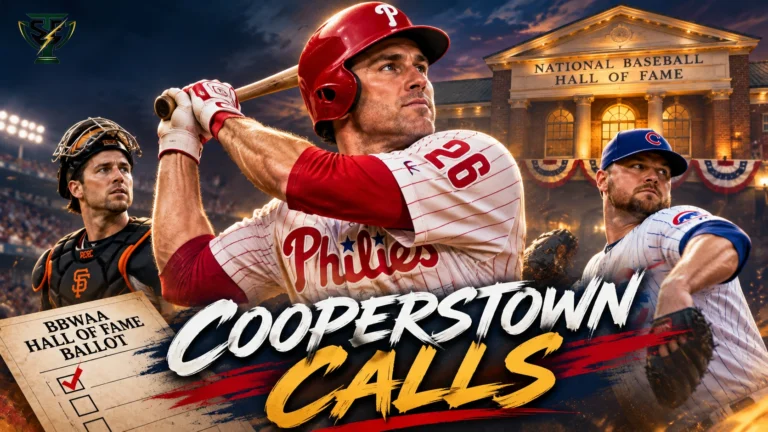
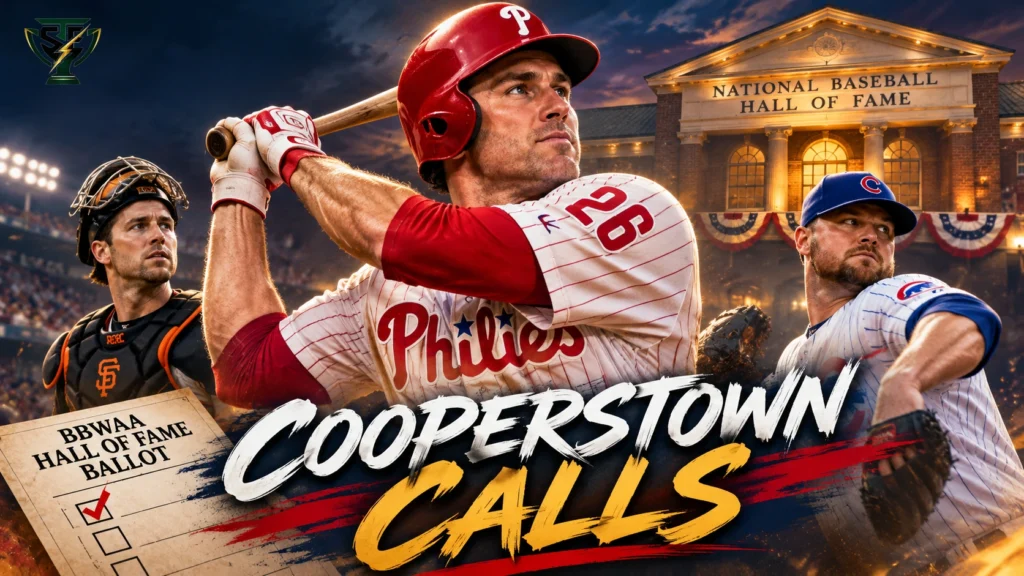
Cooperstown, United States, November 16, 2026: Chase Utley leads the 27-player Baseball Hall of Fame ballot after receiving 59.1% support in the previous election, putting the former Philadelphia Phillies second baseman closer to Cooperstown than any other returning candidate. The field includes 14 newcomers, led by three-time World Series champion Buster Posey, veteran pitcher Jon Lester and former Cy Young Award winner Jake Arrieta.
Utley enters his fourth year of eligibility needing another 15.9 percentage points to reach the required 75% threshold. Andy Pettitte, Félix Hernández and Alex Rodriguez are among 13 returning candidates, while Omar Vizquel faces his final opportunity through the writers’ ballot. Voting closes December 31, with the results scheduled for January 19, 2027. The election presents voters with sharply different cases involving sustained excellence, postseason achievements, positional value and the limited time remaining for several established candidates.
Key Takeaways
- The National Baseball Hall of Fame’s official announcement confirms 14 first-time candidates and 13 returning players.
- Lester enters the ballot with 200 career victories and three World Series championships.
- The Baseball Writers’ Association of America conducts the annual election for eligible recently retired players.
- BBWAA members must return their ballots by December 31, 2026.
Baseball Hall of Fame Ballot: All 27 Candidates
The National Baseball Hall of Fame’s official announcement confirms 14 first-time candidates and 13 returning players.
Story at a glance
Baseball Hall of Fame Ballot: All 27 Candidates
The National Baseball Hall of Fame’s official announcement confirms 14 first-time candidates and 13 returning players.
Why Chase Utley Is the Leading Returning Candidate
Utley’s candidacy has strengthened substantially since he first appeared on the ballot.
Can Buster Posey Become a First-Ballot Hall of Famer?
Posey may present the strongest immediate challenge to Utley’s prominence.
Jon Lester, Jake Arrieta and the Challenge of Evaluating Pitchers
Lester enters the ballot with 200 career victories and three World Series championships.
Why Relief Pitchers Face a Different Hall of Fame Test
Andrew Miller’s inclusion introduces another difficult evaluation.
Several newcomers were central figures in championship-winning teams, while others built their reputations through long careers, individual awards and specialized contributions.
| First-Time Candidate | Position | Career Distinction |
|---|---|---|
| Buster Posey | Catcher | Three World Series titles, NL MVP |
| Jon Lester | Pitcher | 200 wins, three World Series titles |
| Jake Arrieta | Pitcher | NL Cy Young Award winner |
| Andrew Miller | Pitcher | Dominant postseason relief specialist |
| Pablo Sandoval | Third baseman | Three World Series titles, World Series MVP |
| Ryan Zimmerman | Third baseman | Longtime Washington Nationals cornerstone |
| Brett Gardner | Outfielder | Yankees World Series champion, Gold Glove winner |
| Kyle Seager | Third baseman | Gold Glove winner, 242 career home runs |
| Jay Bruce | Outfielder | 319 career home runs |
| Asdrúbal Cabrera | Infielder | Two-time All-Star, World Series champion |
| Starlin Castro | Infielder | Four-time All-Star |
| Wade Davis | Pitcher | World Series champion and elite postseason reliever |
| Ervin Santana | Pitcher | 151 career victories |
| Joakim Soria | Pitcher | 229 career saves |
Posey and Lester enter with particularly recognizable championship credentials. Arrieta offers a peak-performance argument, while Miller and Davis present cases that require voters to consider the changing importance of specialized relief pitching.
The 13 returning players bring established voting histories, making it possible to identify who is closest to election and whose candidacy faces a more difficult path.
Returning Baseball Hall of Fame Ballot Candidates and Previous Votes
| Player | 2026 Vote Share | Year on Ballot | Percentage Points Needed |
|---|---|---|---|
| Chase Utley | 59.1% | 4th | 15.9 |
| Andy Pettitte | 48.5% | 9th | 26.5 |
| Félix Hernández | 46.1% | 3rd | 28.9 |
| Alex Rodriguez | 40.0% | 6th | 35.0 |
| Bobby Abreu | 30.8% | 8th | 44.2 |
| Jimmy Rollins | 25.4% | 6th | 49.6 |
| Cole Hamels | 23.8% | 2nd | 51.2 |
| Dustin Pedroia | 20.7% | 3rd | 54.3 |
| Mark Buehrle | 20.0% | 7th | 55.0 |
| Omar Vizquel | 18.4% | 10th | 56.6 |
| David Wright | 14.8% | 4th | 60.2 |
| Francisco Rodríguez | 11.8% | 5th | 63.2 |
| Torii Hunter | 8.7% | 7th | 66.3 |
Source: Baseball Writers’ Association of America, published 2026 election percentages. TSE calculations subtract each candidate’s previous support from the 75% election threshold. These are percentage-point gaps, not forecasts of the next election.
The BBWAA’s official ballot listing provides the candidate breakdown and previous voting percentages.
The figures establish an important distinction: Utley leads the returning field, but leadership does not guarantee election. The next electorate must independently decide whether his record merits Cooperstown.
Why Chase Utley Is the Leading Returning Candidate
Utley’s candidacy has strengthened substantially since he first appeared on the ballot.
His support rose from 39.8% in 2025 to 59.1% in 2026, an increase of 19.3 percentage points.
If he gains another 15.9 points in the coming election, he will reach the Hall’s required threshold. Such an increase is possible given his recent trajectory, but previous voting growth cannot establish how the next group of voters will respond.
Utley spent 16 major league seasons with Philadelphia and the Los Angeles Dodgers, compiling a .275 batting average, 1,885 hits, 259 home runs and 1,025 RBIs.
He earned six All-Star selections and four Silver Slugger awards, while helping the Phillies win the 2008 World Series.
His value extended beyond offensive totals. At his best, Utley combined power production uncommon among second basemen with strong defensive positioning, effective baserunning and consistent contributions to winning teams.
Those qualities create a broader Hall of Fame argument than his counting statistics alone might suggest.
He also demonstrated substantial postseason power, matching the record for most home runs in a single World Series with five against the New York Yankees in 2009.
Philadelphia ultimately lost that championship, but the performance remains an important example of Utley’s ability to deliver against elite postseason opposition.
His candidacy also carries particular historical significance for the Phillies.
The franchise’s championship history includes influential players from different generations, among them catcher Bob Boone, whose role in Philadelphia’s first World Series triumph was examined in The Sports Encounter’s tribute to Boone’s career and legacy.
Utley belongs to another defining Phillies generation, alongside Jimmy Rollins and Cole Hamels, who are also seeking election.
Can Buster Posey Become a First-Ballot Hall of Famer?
Posey may present the strongest immediate challenge to Utley’s prominence.
The former San Francisco Giants catcher enters the ballot with three World Series championships, seven All-Star selections and the 2012 National League MVP award.
He also won the National League Rookie of the Year award in 2010, establishing himself early as one of baseball’s leading catchers.
Posey’s case combines offensive production with the demanding defensive responsibilities of his position.
Catchers must manage pitching staffs, control the running game, handle opposing hitters and withstand considerable physical wear over a season.
Those responsibilities complicate comparisons with players at less physically demanding positions.
Posey’s career was shorter than those of several established Hall of Fame catchers, but his peak performance and central role in three championships provide a substantial argument for election.
He played his entire major league career with the Giants, giving his candidacy a strong association with one franchise’s championship era.
Whether voters prioritize his exceptional peak and postseason accomplishments or place greater weight on career longevity will be one of the election’s defining questions.
Jon Lester, Jake Arrieta and the Challenge of Evaluating Pitchers
Lester enters the ballot with 200 career victories and three World Series championships.
He helped Boston win titles in 2007 and 2013 before becoming a central figure in the Chicago Cubs’ historic 2016 championship campaign.
His candidacy rests on longevity, dependable starting pitching and repeated success in high-pressure postseason situations.
Arrieta presents a different case.
His most compelling evidence is concentrated around an extraordinary peak, particularly his Cy Young-winning 2015 season with the Cubs.
That contrast creates a familiar Hall of Fame dilemma: how should voters weigh sustained above-average performance against a shorter period of exceptional dominance?
The question also affects contemporary discussions about pitching excellence.
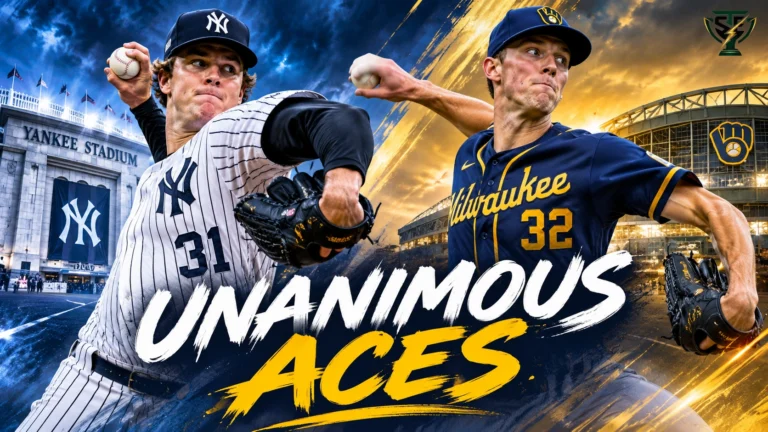
Recent achievements by elite starters continue to shape how baseball evaluates performance, including the unanimous Cy Young victories examined in TSE’s analysis of Cam Schlittler and Jacob Misiorowski.
Regular-season awards are valuable evidence of excellence, but Hall of Fame voters must consider entire careers rather than isolated seasons.
Why Relief Pitchers Face a Different Hall of Fame Test
Andrew Miller’s inclusion introduces another difficult evaluation.
Miller became one of baseball’s most effective high-leverage relievers, capable of handling important situations before the ninth inning.
His postseason performances demonstrated the value of a pitcher who could enter games at their most consequential moments rather than following a conventional closer’s role.
Yet relief pitchers often accumulate fewer innings and different statistical totals than starters, making direct career comparisons difficult.
Wade Davis also built a substantial postseason reputation, particularly during Kansas City’s championship period.
The evaluation of specialized bullpen talent remains relevant to modern baseball, where teams increasingly invest in pitchers capable of delivering important outs late in games.
That strategic and financial importance is explored in TSE’s analysis of Evan Phillips’ $35 million agreement with Atlanta.
However, commercial value and Hall of Fame merit are different considerations. A player’s contract reflects market conditions and projected future performance, while Cooperstown voting concerns an entire completed career.
Andy Pettitte and Omar Vizquel Face Different Deadlines
Pettitte enters his ninth ballot with 48.5% support from the previous election.
The former Yankees pitcher won five World Series championships and built a reputation for postseason reliability.
His voting share increased sharply in 2026, but he still needs 26.5 percentage points to reach induction.
With only two years of eligibility remaining, including the current ballot, his candidacy has limited time to develop further.
Vizquel faces greater immediate pressure.
The former shortstop is entering his 10th and final year on the BBWAA ballot after receiving 18.4% support.
His defensive reputation remains a major part of his baseball legacy, but his voting support is far below the election threshold.
The difference between the two candidates illustrates how the ballot’s time limits influence the stakes.
Pettitte has another opportunity after this election if he remains eligible. Vizquel does not have an 11th year available through the standard writers’ process.
Failure to win election through the BBWAA does not permanently eliminate every potential route to the Hall of Fame, because separate Era Committee procedures exist for eligible candidates.
Alex Rodriguez and the Debate Over Career Achievements
Alex Rodriguez remains one of the ballot’s most statistically accomplished players.
The former Yankees and Texas Rangers star hit 696 home runs and won three American League MVP awards.
Those achievements would ordinarily make a player a major Hall of Fame contender.
However, Rodriguez’s documented involvement in performance-enhancing drug controversies remains a significant factor in how his candidacy is discussed.
He received 40% support in the previous election, leaving him 35 percentage points short of induction.
His candidacy illustrates the difference between statistical accomplishment and the broader judgments voters make about a player’s career.
The Yankees’ championship legacy remains central to those discussions. The franchise’s more recent struggle to return to the top was examined in TSE’s analysis of Brian Cashman’s continued leadership after a lengthy World Series drought.
Rodriguez’s Hall of Fame prospects must ultimately be assessed through the voting process, rather than assumed from his records or predicted from controversy alone.
How the Baseball Hall of Fame Voting Process Works
The Baseball Writers’ Association of America conducts the annual election for eligible recently retired players.
Continue the MLB Story
 MLBCrow-Armstrong Challenges Ohtani’s MVP Reign as Alvarez Leads American League Race
 MLBCam Schlittler and Jacob Misiorowski Sweep Cy Young Awards in Historic MLB First Full-Season Triumphs
 MLBBob Boone Dies at 78: The Catcher Behind Philadelphia’s First World Series Crown and Baseball’s Three-Generation Dynasty
Only qualified voting members participate, and candidates must appear on at least 75% of submitted ballots to secure election.
Voters may select up to 10 candidates.
Players who do not reach the threshold can return in subsequent elections, provided they receive at least 5% support and have not exhausted their 10-year eligibility period.
The process is explained in MLB’s official Hall of Fame voting guide.
The 2027 election follows a 2026 vote in which Carlos Beltrán and Andruw Jones secured induction.
Utley’s growing support makes him the leading returning candidate, but the addition of Posey and 13 other newcomers could change how voters allocate their limited selections.
That possibility matters because voters cannot simply endorse every deserving player without restriction.
Different interpretations of peak performance, defensive value, postseason results, longevity and career conduct can produce substantially different ballots.
What the Previous Vote Reveals About Cooperstown’s Next Class
The most useful way to evaluate the returning candidates is to consider both their distance from election and the time remaining on the ballot.
Utley has the strongest starting position and considerable eligibility remaining.
Pettitte is closer to the threshold than most other holdovers, but his ninth-year status creates urgency.
Hernández, entering his third year, has time for his candidacy to develop after reaching 46.1% support.
Meanwhile, Posey’s first appearance introduces a candidate with no established voting trend but substantial championship and individual-award credentials.
The next election will therefore test several competing arguments rather than produce a straightforward ranking of career statistics.
The wider baseball context reinforces why voters must distinguish accomplishments carefully. Recent individual awards, including the MLB MVP race analyzed by The Sports Encounter, evaluate particular seasons. Hall of Fame selection requires a much broader judgment about a player’s entire career.
Likewise, championship achievements such as Milwaukee’s historic World Series victory can become defining career moments without automatically establishing that every member of a winning team deserves induction.
Individual excellence and team success are related, but they are not interchangeable.
When Will the Hall of Fame Results Be Announced?
BBWAA members must return their ballots by December 31, 2026.
The results will be announced on January 19, 2027, at 6 p.m. Eastern Time, with the announcement carried live on MLB Network.
Players who meet the 75% threshold will join the next Hall of Fame class, with the induction ceremony scheduled for July 25 in Cooperstown.
For Utley, the central question is whether his rapidly improving support translates into another substantial gain.
For Posey, the issue is whether his catching excellence and three championships earn immediate recognition.
For Pettitte and Vizquel, the clock is an increasingly important part of their respective candidacies.
The Baseball Hall of Fame ballot ultimately presents voters with 27 different career records and competing definitions of greatness. Utley enters as the strongest returning candidate, but the final decision will depend on how writers assess his complete contribution alongside Posey’s championship pedigree, Lester’s longevity and the achievements of the other 24 contenders.