
Key Takeaways
- TL;DR: Pegula enters the WTA Finals after winning 50 of 64 singles matches in 2026.
- Jessica Pegula was born in Buffalo, New York, on February 24, 1994.
- Her parents are Terry and Kim Pegula, whose business interests include ownership of the Buffalo Bills in the NFL and the Buffalo Sabres in the NHL.
- The official draw has placed Pegula in Group 1 alongside Elena Rybakina, Coco Gauff and Linda Nosková.
INDIAN WELLS, United States, November 4, 2026: Jessica Pegula has spent much of her career making consistency look ordinary. In 2026, it became her most formidable weapon. The 32-year-old American won 50 matches, reached five singles finals across three surfaces, claimed championships in Dubai and Charleston, and advanced to the Australian Open and US Open semifinals. Those numbers would represent a breakthrough for most players. For Pegula, they brought another question: after five consecutive qualifications for the WTA Finals and a runner-up finish in 2023, can the player who keeps reaching the biggest stages finally win the season-ending championship?
The challenge awaiting her at Indian Wells is unusually personal. Pegula has been drawn alongside world No. 1 Elena Rybakina, fellow American Coco Gauff and Wimbledon champion Linda Nosková. All three have helped shape her 2026 season. She lost to Gauff in the Cincinnati final and at Wimbledon, fell to Nosková in Berlin, and watched Rybakina end her Australian Open semifinal run. Yet Pegula’s year also included a remarkable victory over Aryna Sabalenka in Berlin and a comeback against Iga Świątek in Cincinnati. She arrives with a 50–14 singles record, a career-best 78.1% season winning percentage, and the memory of how close she came to the WTA Finals crown in Cancún three years ago.
Jessica Pegula in 2026: Biography, Ranking and Career Statistics
| Category | Verified information |
|---|---|
| Full name | Jessica Pegula |
| Date of birth | February 24, 1994 |
| Age | 32 |
| Birthplace | Buffalo, New York, United States |
| Nationality | American |
| Height | 170 cm (5 feet, 7 inches) |
| Playing hand | Right-handed |
| Career-high singles ranking | World No. 3 |
| Singles ranking entering WTA Finals 2026 | World No. 5 |
| 2026 Race points, November 4 snapshot | 5,760 |
| 2026 singles record | 50 wins, 14 losses |
| 2026 winning percentage | 78.1% |
| 2026 singles championships | Dubai and Charleston |
| 2026 singles finals reached | Five |
| Career WTA singles championships | 11 |
| Best Grand Slam singles result | US Open finalist, 2024 |
| Best WTA Finals result | Runner-up, 2023 |
| 2026 WTA Finals appearance | Fifth consecutive |
| Coaching team | Mark Knowles and Mark Merklein |
| Parents | Terry and Kim Pegula |
| Husband | Taylor Gahagen |
| WTA Finals 2026 group | Group 1 |
TL;DR: Pegula enters the WTA Finals after winning 50 of 64 singles matches in 2026. She won Dubai and Charleston, reached three additional finals, made two Grand Slam semifinals and produced memorable comebacks against Aryna Sabalenka and Iga Świątek. Her 2023 WTA Finals runner-up finish gives her valuable experience, but a difficult round-robin group featuring Elena Rybakina, Coco Gauff and Linda Nosková will test whether consistency can finally deliver the championship.
Story at a glance

Jessica Pegula in 2026: Biography, Ranking and Career Statistics
TL;DR: Pegula enters the WTA Finals after winning 50 of 64 singles matches in 2026. She won Dubai and Charleston, reached three additional finals, made two Grand Slam semifinals and produced memorable comebacks against Aryna Sabalenka and Iga Świątek. Her 2023 WTA Finals runner-up finish gives her valuable experience, but a difficult round-robin group featuring Elena Rybakina, Coco Gauff and Linda Nosková will test whether consistency can finally deliver the championship.
Who Is Jessica Pegula? Her Parents, Childhood and Tennis Background
Jessica Pegula was born in Buffalo, New York, on February 24, 1994. She grew up in a family associated with business and professional sports, but her path into elite tennis was considerably less straightforward than her family’s public profile might suggest.
From Injury Setbacks to the World’s Top Three
Pegula did not follow the conventional path of a teenage superstar who immediately established herself among the game’s elite.
Jessica Pegula’s 2026 Season: Five Finals Across Three Surfaces
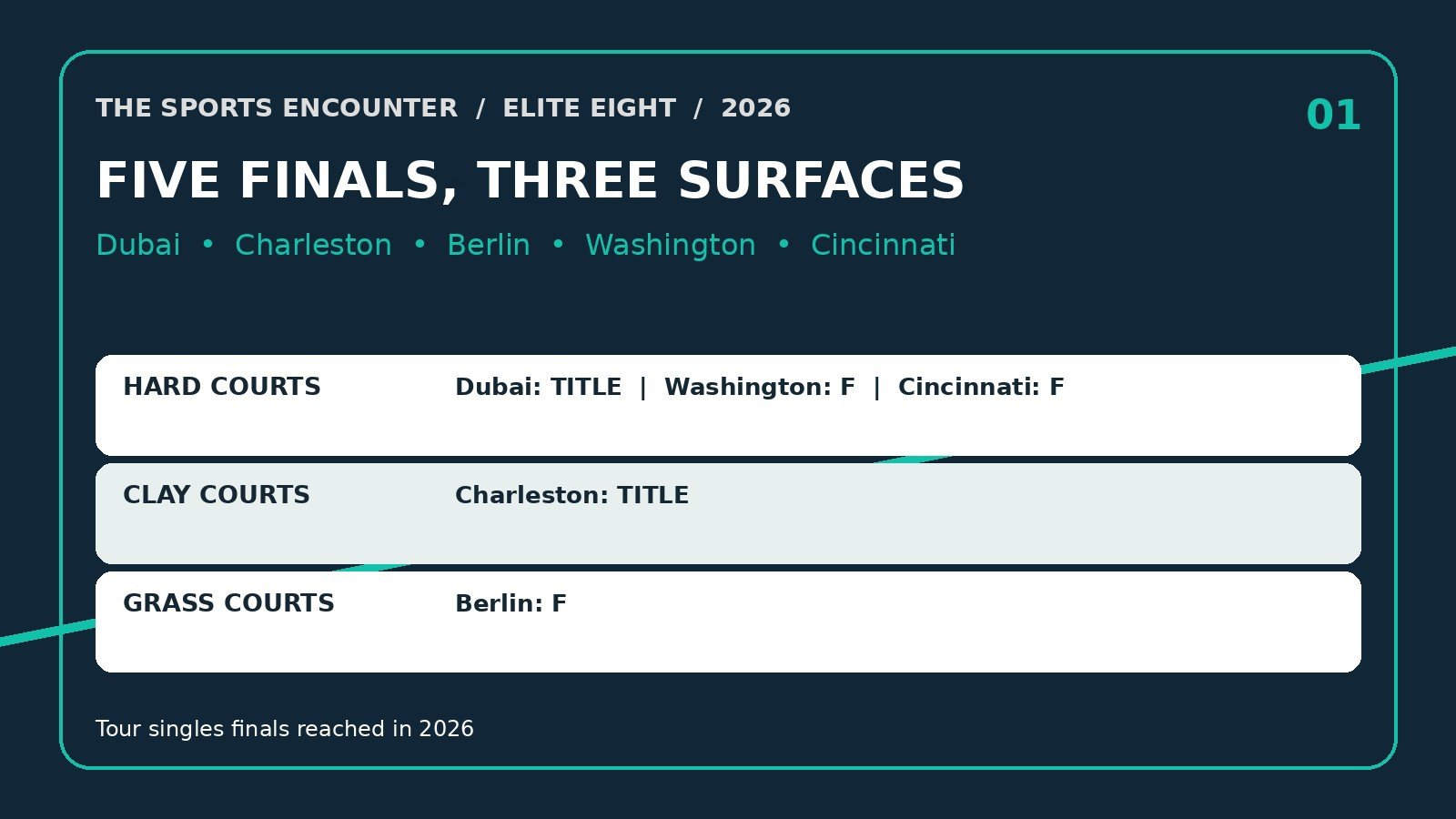
The most revealing statistic of Pegula’s year is not her two titles. It is the five finals she reached.
Dubai 2026: The Championship That Established Her Season
Dubai provided Pegula with her first title of 2026.
Who Is Jessica Pegula? Her Parents, Childhood and Tennis Background
Jessica Pegula was born in Buffalo, New York, on February 24, 1994. She grew up in a family associated with business and professional sports, but her path into elite tennis was considerably less straightforward than her family’s public profile might suggest.
Her parents are Terry and Kim Pegula, whose business interests include ownership of the Buffalo Bills in the NFL and the Buffalo Sabres in the NHL.
Jessica has four siblings: Michael, Matthew, Laura and Kelly. Her sister Laura played Division I college tennis at the University of Pittsburgh.
Jessica began playing tennis at approximately seven years old. Martina Hingis was among the players she admired, and the Swiss champion’s intelligent shot selection offered an example of how technical precision could overcome physically stronger opponents.
Pegula eventually developed into a professional player whose greatest strengths were clean ball-striking, court positioning and an ability to redirect an opponent’s power.
Did Her Family’s Wealth Make Her Tennis Career Easy?
Pegula’s family background has frequently attracted attention, particularly because her father owns major American professional sports franchises.
It would be inaccurate, however, to treat her financial circumstances as an explanation for her competitive achievements.
Professional tennis requires results. A player’s ranking depends on matches won against opponents who are attempting to defeat her.
Pegula’s career included serious injury interruptions and years spent outside the sport’s highest rankings before she became a regular Top 10 contender.
Her eventual rise was built on persistence, technical development and the ability to remain competitive over an increasingly demanding calendar.
Jessica Pegula’s Husband, Taylor Gahagen, and Their Charity Work
Pegula married Taylor Gahagen in October 2021.
The couple have supported animal welfare initiatives, including A Lending Paw, which connects people with rescued and trained service animals.
Pegula has also been involved in business activities beyond tennis, including the skincare brand Ready 24.
These interests form part of her public identity, but her standing in professional tennis rests on more than business or family connections.
From Injury Setbacks to the World’s Top Three
Pegula did not follow the conventional path of a teenage superstar who immediately established herself among the game’s elite.
Injuries disrupted her early development and delayed her rise through the rankings.
She underwent knee surgery in 2014 and subsequently dealt with a hip injury that required surgery in 2017.
Those interruptions were significant because they prevented her from building the uninterrupted match experience that many successful young professionals depend on.
Her first WTA singles championship came in Washington in 2019, when she was already 25.
That achievement established an important foundation, but her sustained breakthrough came later.
She climbed into the Top 10, reached a career-high singles ranking of No. 3 and became one of the tour’s most reliable competitors.
Pegula reached her first Grand Slam singles final at the US Open in 2024, losing to Aryna Sabalenka.
She had already reached the 2023 WTA Finals championship match, where Iga Świątek defeated her.
By 2026, Pegula’s central challenge was no longer proving she belonged among the best. It was turning repeated opportunities into the biggest championships of her career.
Jessica Pegula’s 2026 Season: Five Finals Across Three Surfaces
The most revealing statistic of Pegula’s year is not her two titles. It is the five finals she reached.
Those championship appearances came on hard courts, clay and grass, demonstrating an ability to adjust her game across contrasting playing conditions.
| Tournament | Surface | Final opponent | Result | Competitive significance |
|---|---|---|---|---|
| Dubai | Hard | Elina Svitolina | Won 6-2, 6-4 | Fourth career WTA 1000 singles championship |
| Charleston | Clay | Yuliia Starodubtseva | Won 6-2, 6-2 | Successfully defended her title |
| Berlin | Grass | Linda Nosková | Lost 4-6, 6-4, 3-6 | Reached final after defeating Aryna Sabalenka |
| Washington | Hard | Alexandra Eala | Lost 6-4, 4-6, 0-6 | Another championship opportunity slipped away |
| Cincinnati | Hard | Coco Gauff | Lost 2-6, 4-6 | Fifth singles final of the season |
What the Five Finals Reveal
The first conclusion is straightforward: Pegula remained competitive on every major surface.
Three finals came on hard courts, her most productive surface historically. One came on clay, and another on grass.
Her two championships represent a 40% conversion rate across five finals.
That figure requires context. Three defeats came against opponents who either became major champions or established themselves among the year’s leading players.
The Berlin loss to Nosková was followed by the Czech player’s Wimbledon championship. Gauff, meanwhile, entered the WTA Finals as a former champion with another successful season behind her.
The important question is therefore not whether Pegula can reach finals. Her 2026 record has already answered that.
The question is whether she can sustain her most effective tennis through the final match of another high-pressure tournament.
Dubai 2026: The Championship That Established Her Season
Dubai provided Pegula with her first title of 2026.
Her route to the championship was impressive, particularly because she had to recover from difficult positions against strong opponents.
In the semifinals, Amanda Anisimova won the opening set 6-1 and led 3-1 in the second.
Pegula was facing elimination against an opponent capable of dominating rallies with powerful baseline shots.
Instead of attempting to overpower Anisimova, Pegula gradually regained control of the court.
She won the second set 6-4 and the deciding set 6-3.
The comeback sent her into a final against Elina Svitolina, another experienced player who had begun the season strongly.
Pegula won the championship match 6-2, 6-4.
It was her fourth WTA 1000 singles title and the tenth singles championship of her career.
Dubai’s Competitive Consequences
Winning a WTA 1000 championship early in the year did more than improve Pegula’s ranking position.
It demonstrated that her match management remained effective against elite opponents.
The semifinal victory over Anisimova was particularly important because it required a tactical recovery rather than an uninterrupted display of dominant tennis.
That quality would become a recurring feature of Pegula’s season.
Charleston 2026: Four Three-Set Battles Before a Straight-Sets Final
If Dubai established Pegula’s championship form, Charleston revealed how much work she was prepared to do to retain it.
She successfully defended her title in April, becoming the tournament’s first repeat champion since Serena Williams in 2013.
The achievement was not straightforward.
Pegula came from a set down in each of her first three matches and won four consecutive three-set contests before reaching the final.
By the championship match, she had accumulated considerable time on court.
Yet against Yuliia Starodubtseva, Pegula produced her most convincing performance of the week.
She won 6-2, 6-2 in one hour and 22 minutes.
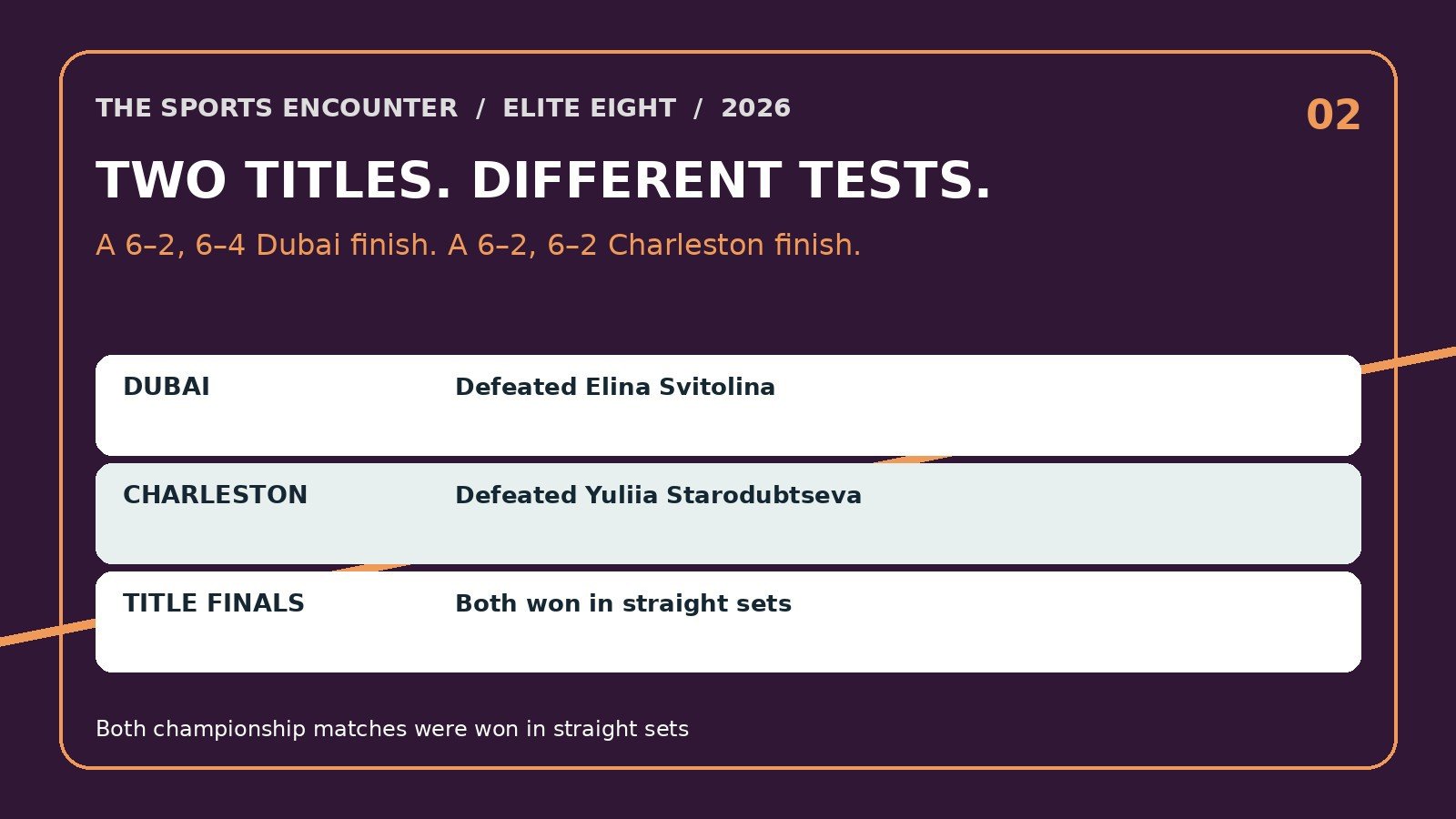
| Championship measure | Dubai | Charleston |
|---|---|---|
| Final opponent | Elina Svitolina | Yuliia Starodubtseva |
| Final score | 6-2, 6-4 | 6-2, 6-2 |
| Sets lost in final | 0 | 0 |
| Games won in final | 12 | 12 |
| Games lost in final | 6 | 4 |
| Career singles title milestone | 10th | 11th |
| Distinctive achievement | Fourth WTA 1000 title | Consecutive Charleston championships |
A useful distinction emerges from the two finals.
In Dubai, Pegula won 12 of 18 completed games, approximately 66.7%.
In Charleston, she won 12 of 16, or 75%.
These figures describe only the championship matches, not overall tournament dominance. They nevertheless illustrate how decisively Pegula performed when she reached the final stage of both title-winning campaigns.
Berlin 2026: The Sabalenka Victory That Exposed Pegula’s Mental Strength
Pegula’s grass-court season featured one of the most revealing matches of her career.
In the Berlin semifinals, she faced Aryna Sabalenka, the world No. 1 and one of the most powerful players in women’s tennis.
Pegula won the opening set 6-4.
She then led 3-1 in the second-set tiebreak when rain interrupted the match for more than two hours.
When play resumed, Sabalenka recovered and won the tiebreak 7-4.
For many players, losing momentum after such a long interruption would have been difficult to overcome.
Pegula responded by winning all six games of the deciding set.
Her 6-4, 6-7(4), 6-0 victory demonstrated the competitive resilience that had become a defining feature of her season.
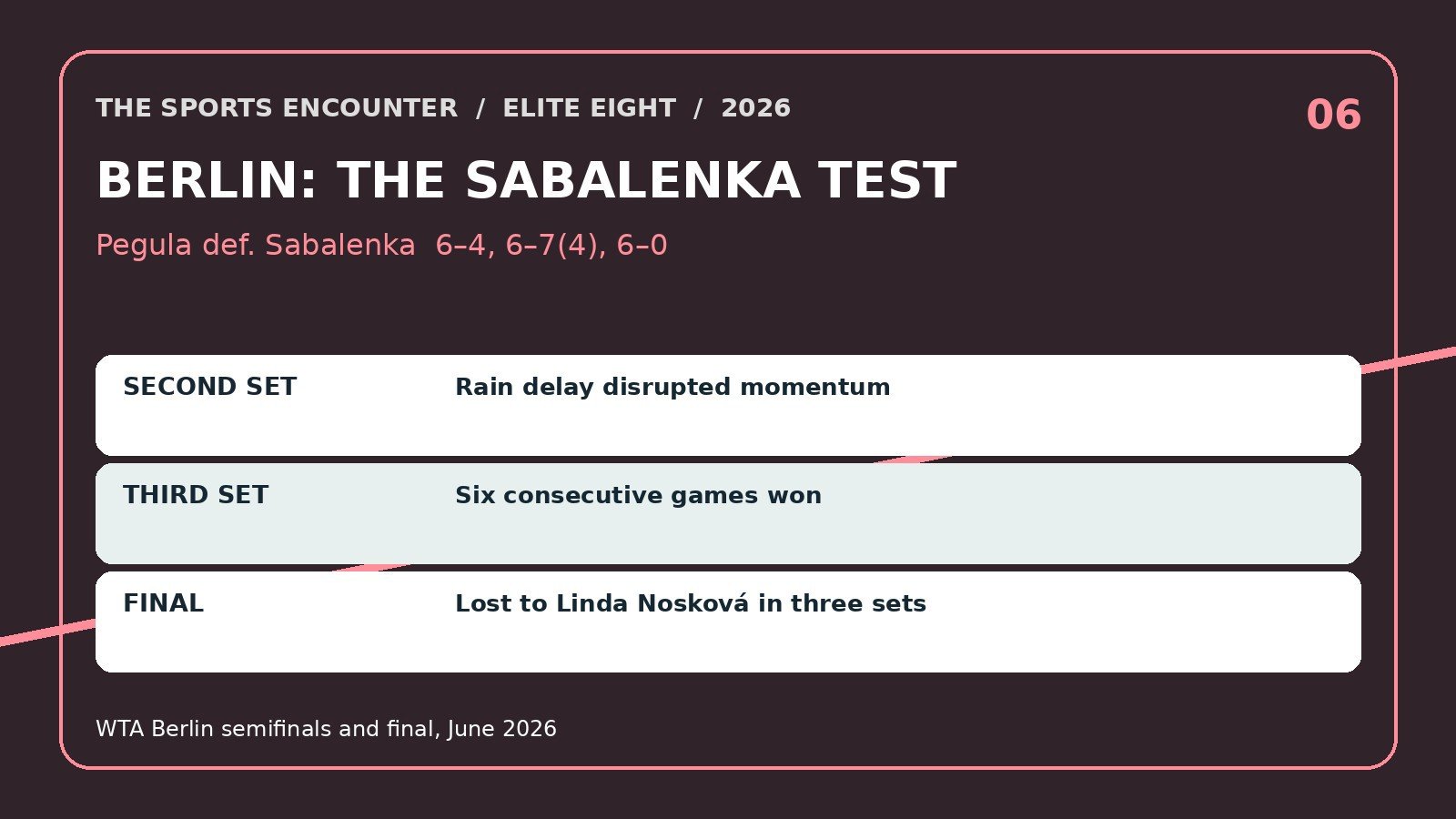
| Match phase | What happened | Why it mattered |
|---|---|---|
| First set | Pegula won 6-4 | Established control over the world No. 1 |
| Second-set tiebreak | Pegula led 3-1 | Positioned herself to close the match |
| Rain interruption | Play stopped for more than two hours | Disrupted Pegula’s momentum |
| Second-set conclusion | Sabalenka won the tiebreak 7-4 | Forced a deciding set |
| Third set | Pegula won 6-0 | Delivered six unanswered games |
| Match result | Pegula won in three sets | Advanced to the Berlin final |
Why the Berlin Final Still Ended in Defeat
Pegula faced Linda Nosková in the championship match.
The Czech player won the opening set 6-4, Pegula responded by taking the second 6-4, and Nosková secured the title with a 6-3 deciding set.
The result became a significant moment in Nosková’s development.
She entered the world’s Top 10 and subsequently won Wimbledon.
Pegula’s defeat therefore carries particular relevance ahead of their possible rematch at the WTA Finals.
The Sports Encounter’s Linda Nosková profile examines her rise, Berlin victory and Wimbledon triumph.
Washington 2026: Alexandra Eala’s Comeback Denies Pegula Another Title
The Washington final offered Pegula another opportunity to add a hard-court championship.
She faced Alexandra Eala, whose developing game had already attracted attention across the tour.
Pegula won the opening set 6-4.
Eala responded by winning the second 6-4 before sweeping the deciding set 6-0.
The result was significant because Pegula had appeared to be in a strong position to claim another championship.
Instead, the match exposed the difficulty of halting an opponent who is gaining confidence and controlling increasingly frequent rallies.
The Sports Encounter covered Eala’s dramatic Washington championship victory over Pegula, including the decisive shift in momentum.
Cincinnati 2026: Pegula’s Extraordinary Comeback Against Iga Świątek
Cincinnati provided one of Pegula’s most compelling performances of 2026.
In the semifinals, she faced defending champion Iga Świątek, whose ten-match winning streak made her a formidable opponent.
Pegula won the opening set 7-5 before Świątek took the second 6-4.
The deciding set appeared to be moving in Świątek’s favor when she established a 3-1 lead.
But Pegula refused to surrender control.
She won five of the final six games to complete a 7-5, 4-6, 6-4 victory.
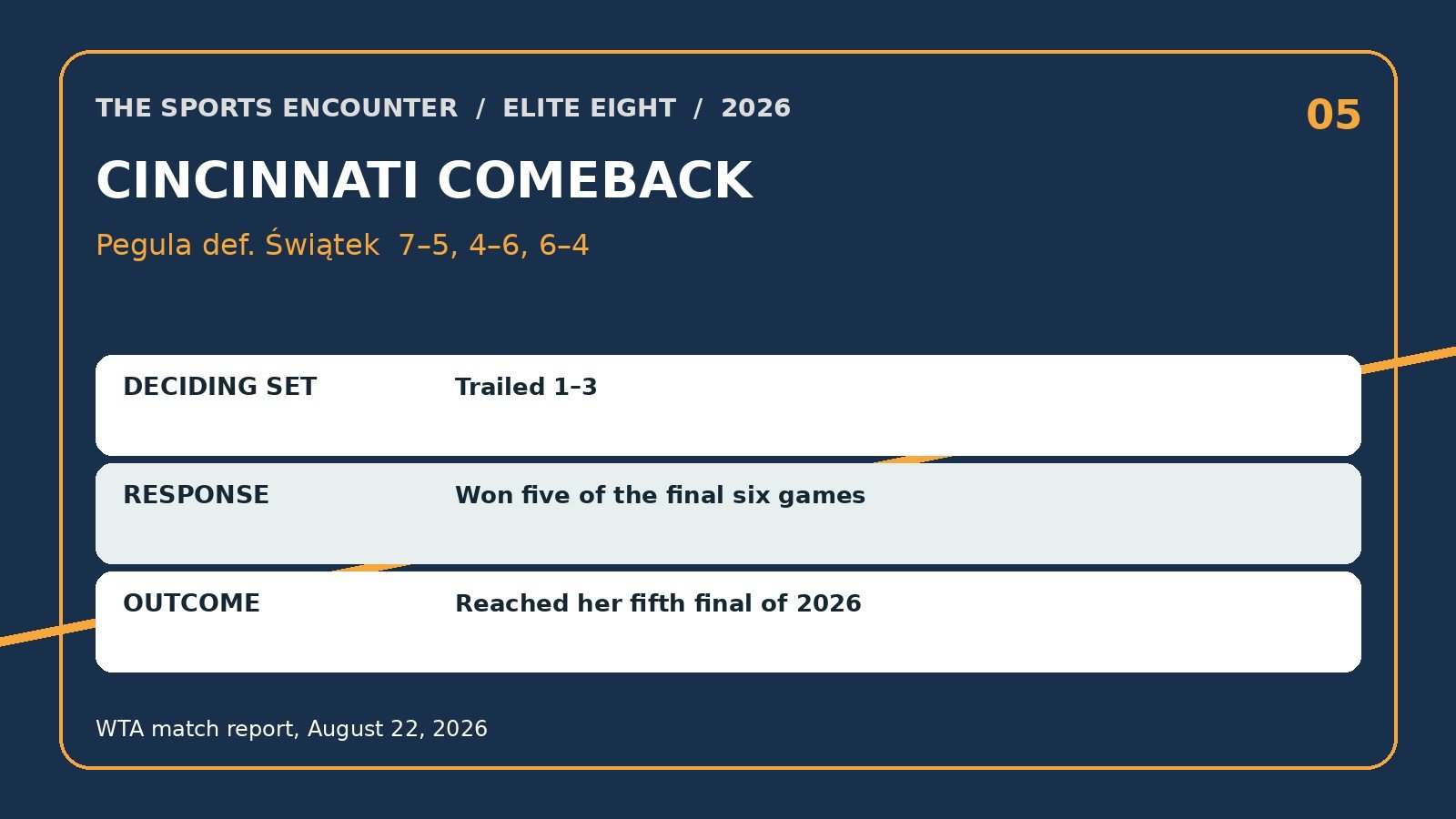
| Measure | Verified match detail | Competitive consequence |
|---|---|---|
| Opponent | Iga Świątek | Defending Cincinnati champion |
| First set | Pegula won 7-5 | Took early advantage |
| Second set | Świątek won 6-4 | Forced a decider |
| Third-set deficit | Pegula trailed 1-3 | Risked semifinal elimination |
| Closing sequence | Won five of the last six games | Completed the comeback |
| Final score | 7-5, 4-6, 6-4 | Advanced to Cincinnati final |
| Streak ended | Świątek’s ten-match winning streak | Stopped the defending champion |
How Pegula Took Time Away From Świątek
Pegula’s explanation of the match emphasized her intention to stand close to the baseline and reduce the time available to her opponent.
This is a central feature of her game.
She does not always generate the heaviest individual shots, but her early ball contact can make even physically powerful opponents feel rushed.
Against Świątek, that approach allowed Pegula to control court position and attack before the Polish player’s defensive movement could become fully effective.
The match also featured a remarkable rally that the WTA subsequently recognized with its August Shot of the Month award.
Pegula survived repeated changes of direction before producing a forehand winner down the line.
The shot was a vivid example of her ability to turn defense into attack without abandoning her tactical discipline.
Why Coco Gauff Won the Cincinnati Final
Pegula’s reward was a championship meeting with Coco Gauff.
The final was the first all-American women’s singles championship match at Cincinnati since 1970.
Gauff controlled the contest and won 6-2, 6-4.
The loss prevented Pegula from claiming a third singles title in 2026, but the tournament strengthened her position in the WTA Finals qualification race.
Gauff and Pegula will now meet again in Group 1 at Indian Wells.
For Gauff’s broader campaign, read Coco Gauff’s 2026 season profile.
Jessica Pegula’s 2026 Grand Slam Results: Two Semifinals and a Paris Shock
Pegula’s Grand Slam campaign was far less uniform than her overall season record.
She reached the semifinals at the Australian Open and US Open, advanced to the Wimbledon quarterfinals and suffered a first-round defeat at Roland-Garros.
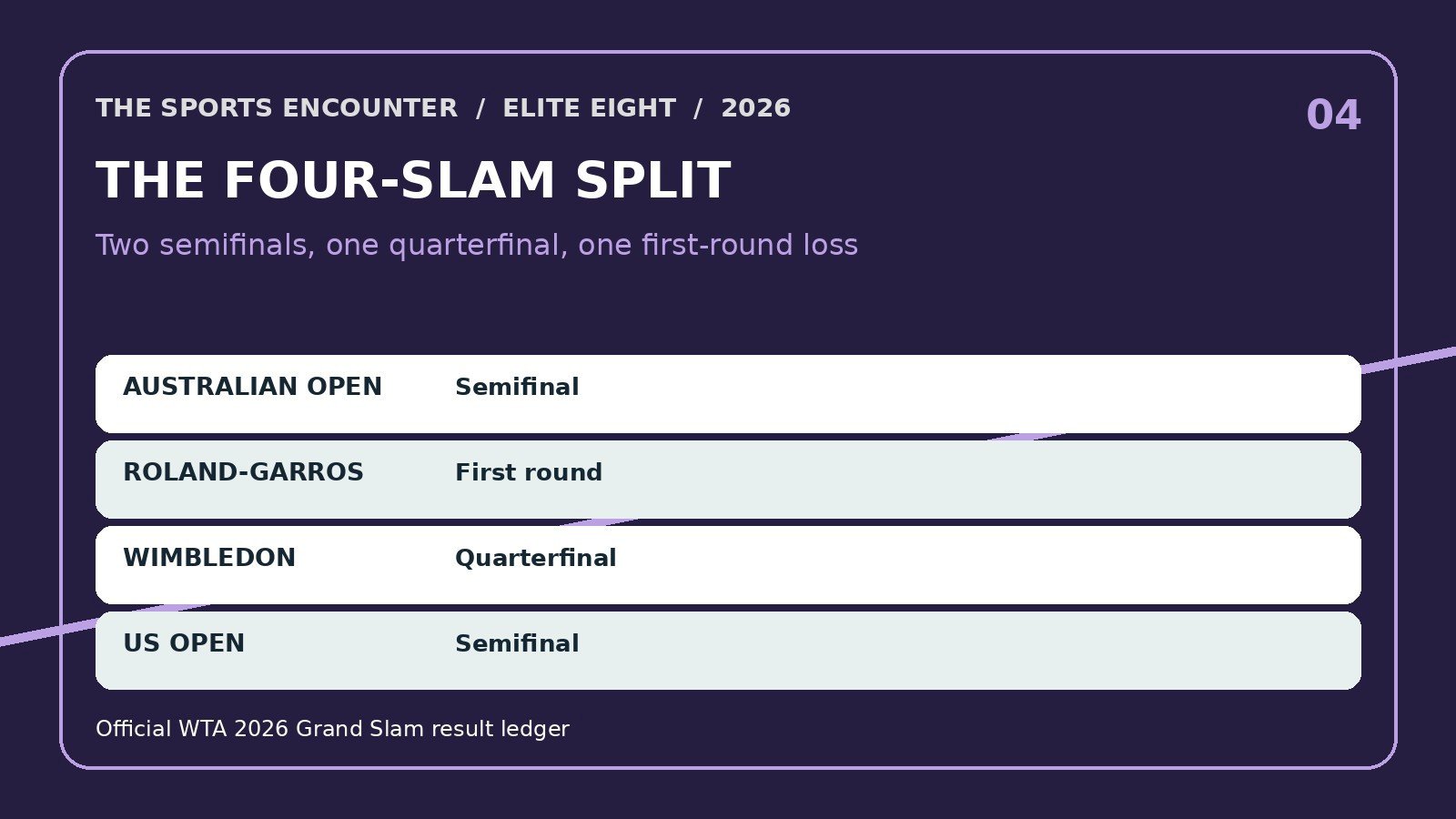
| Grand Slam | Finish | Match wins | Eliminating opponent | Significance |
|---|---|---|---|---|
| Australian Open | Semifinal | 5 | Elena Rybakina | First Australian Open semifinal |
| Roland-Garros | First round | 0 | Kimberly Birrell | Unexpected early exit |
| Wimbledon | Quarterfinal | 4 | Coco Gauff | Second career Wimbledon quarterfinal |
| US Open | Semifinal | 5 | Aryna Sabalenka | Another deep run in New York |
| Total | Four events | 14 | Four losses | 77.8% Grand Slam match-winning rate |
Pegula won 14 of her 18 singles matches across the four majors.
That represents a 77.8% winning percentage.
Her Australian Open and US Open performances accounted for ten of the 14 victories, approximately 71.4%.
This concentration helps explain the strength of her hard-court credentials entering Indian Wells.
Australian Open: A Long-Awaited Semifinal
Pegula reached her first Australian Open semifinal after defeating Amanda Anisimova 6-2, 7-6(1) in the quarterfinals.
Her victory also followed an earlier win over Madison Keys, giving her multiple Top 10 victories at the same Grand Slam tournament for the first time.
Elena Rybakina ended her campaign in the semifinals.
The result demonstrated that Pegula could again reach the closing stages of a major but also highlighted the challenge of overcoming an elite first-strike player.
Roland-Garros: The First-Round Defeat That Contradicted Her Clay-Court Form
After winning Charleston, Pegula had legitimate reasons for confidence on clay.
Nevertheless, Kimberly Birrell defeated her 1-6, 6-3, 6-3 in the opening round at Roland-Garros.
The result was especially surprising because Pegula dominated the first set.
It demonstrated how quickly a match can change when a player fails to maintain control against an opponent adjusting effectively.
Wimbledon: Coco Gauff Wins the American Quarterfinal
Pegula reached the quarterfinals after defeating Iva Jović in the fourth round.
She then faced Coco Gauff, one of the strongest defensive players on the tour.
Pegula took the first set 6-4, but Gauff recovered to win 3-6, 6-3, 6-3 from her perspective.
The defeat ended Pegula’s grass-court campaign but provided another example of her competitiveness against elite opposition.
US Open: Sabalenka Stops Another New York Run
Pegula returned to the US Open semifinals after defeating fellow American Emma Navarro in the quarterfinals.
Her opponent was again Aryna Sabalenka, who had beaten her in the 2024 US Open final.
Sabalenka won 7-5, 6-2.
One of the most revealing statistics was Pegula’s limited success on second-serve points.
She won only four of 17 such points, a 23.5% success rate, according to the official match statistics.
That weakness created repeated opportunities for Sabalenka to attack.
The Sports Encounter covered Sabalenka’s US Open semifinal victory over Pegula and the significance of the result.
Readers can also revisit Pegula’s quarterfinal comeback against Emma Navarro.
What Makes Pegula So Difficult to Beat?
Pegula’s game is often described as efficient, but efficiency alone does not explain her success.
Her ability to take the ball early reduces an opponent’s preparation time.
Her compact strokes make it easier to redirect pace and create sharp angles without taking excessive risks.
She is particularly effective when she controls the middle of the court and prevents opponents from establishing long, comfortable attacking sequences.
The Backhand Down the Line
Pegula identifies her backhand down the line as a favorite shot.
That stroke is effective because it changes the direction of rallies and punishes opponents who become too comfortable trading crosscourt.
It is especially useful against players whose forehands rely on generating heavy topspin from predictable positions.
Her Ability to Win Deciding Sets
Pegula’s 2026 three-set record became a defining statistical feature of her season.
By the Cincinnati semifinals, she had recorded 17 three-set victories.
Her win over Świątek was another example of a player who can maintain tactical clarity after losing momentum.
The ability to recover is particularly important at the WTA Finals, where every match carries consequences for semifinal qualification.
Where Her Game Remains Vulnerable
Pegula can struggle when powerful opponents establish a dominant service rhythm.
Players such as Rybakina and Sabalenka can force her into defensive positions before she has an opportunity to redirect the rally.
Second-serve vulnerability can also become significant.
The US Open semifinal against Sabalenka showed how damaging an ineffective second serve can be against an aggressive returner.
Jessica Pegula’s 2026 Record: The Numbers Behind Her Consistency
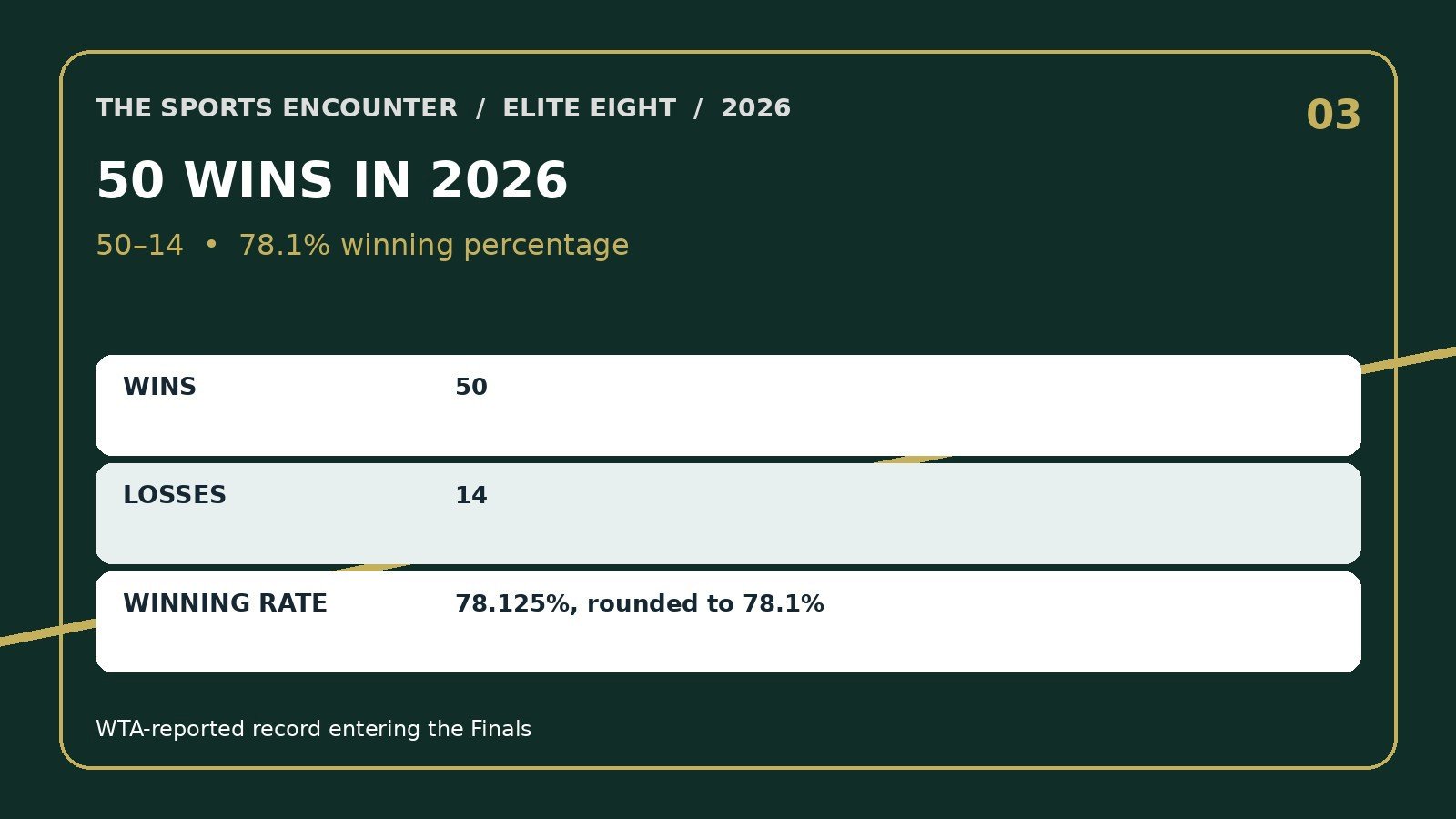
| Performance indicator | 2026 figure | Interpretation |
|---|---|---|
| Singles wins | 50 | Among the highest totals on tour |
| Singles defeats | 14 | Relatively few losses across a full season |
| Matches played | 64 | Substantial competitive workload |
| Winning percentage | 78.1% | Career-best season rate |
| Finals reached | 5 | Consistent tournament progression |
| Titles won | 2 | Dubai and Charleston |
| Finals conversion | 40% | Two championships from five finals |
| Grand Slam match wins | 14 | Two major semifinal appearances |
| Grand Slam winning percentage | 77.8% | 14 victories from 18 matches |
The WTA has identified Pegula’s consistency as an increasingly important strength.
From the 2025 US Open through her Dubai championship in February, she reached seven consecutive semifinals.
Her subsequent tournament results extended an impressive run of reaching at least the quarterfinals.
This consistency is important because the WTA ranking system rewards performance throughout the season, not just the number of trophies collected.
WTA Finals 2026: Pegula Drawn Into a Dangerous Group
The official draw has placed Pegula in Group 1 alongside Elena Rybakina, Coco Gauff and Linda Nosková.
It is a demanding assignment.
Rybakina arrives as the world No. 1 and US Open champion.
Gauff defeated Pegula in the Cincinnati final and Wimbledon quarterfinals.
Nosková beat her in the Berlin final before winning Wimbledon.
Those results establish genuine reasons for concern, but they also provide Pegula with information about the tactical adjustments she must make.
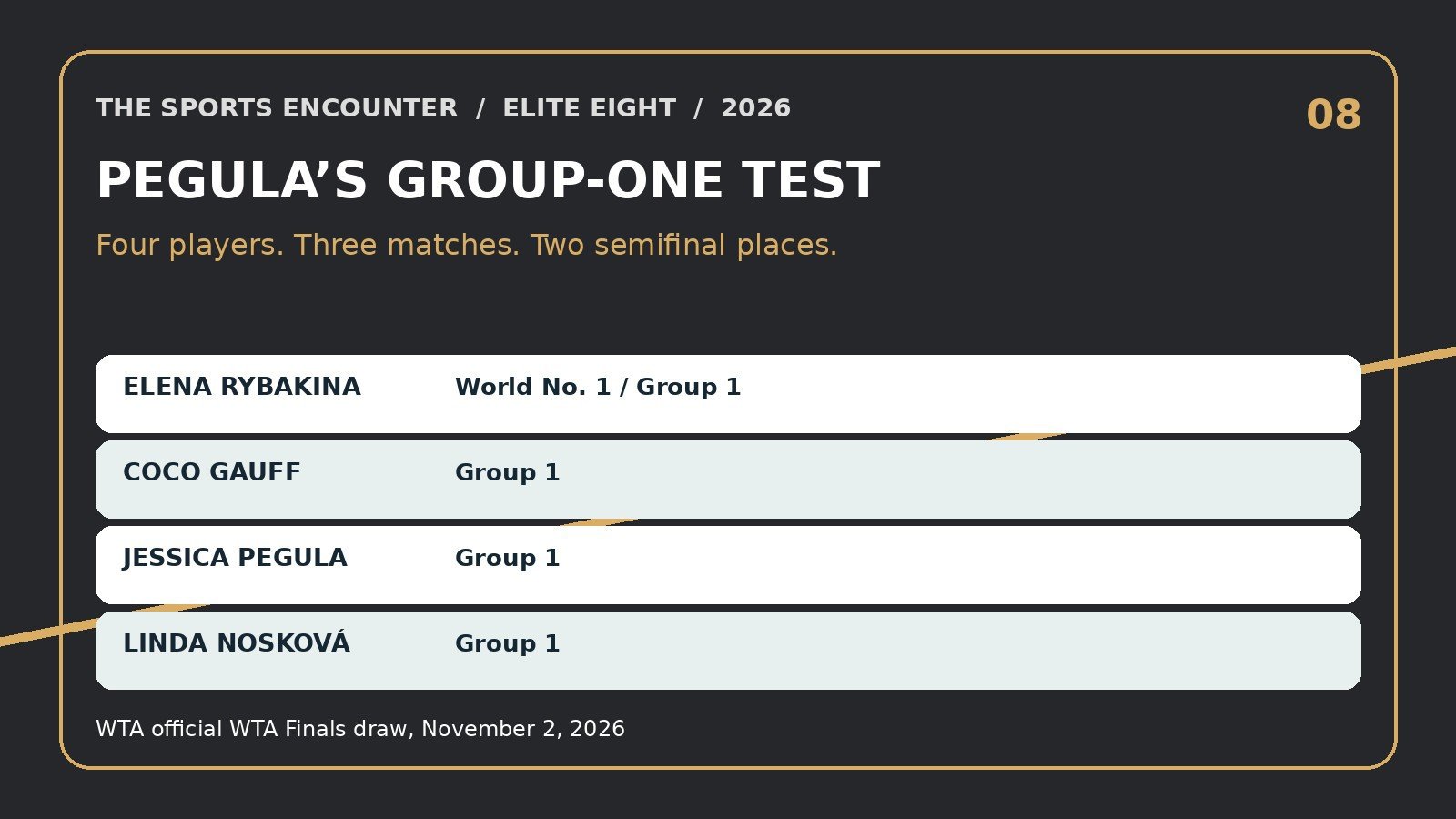
| Opponent | Principal strength | Relevant 2026 history | Pegula’s tactical priority |
|---|---|---|---|
| Elena Rybakina | Powerful serve and first-strike tennis | Beat Pegula at Australian Open | Attack second serves and protect court position |
| Coco Gauff | Movement, defensive range and backhand | Beat Pegula at Wimbledon and Cincinnati | Avoid predictable patterns and control rally tempo |
| Linda Nosková | Early attacking contact and aggressive baseline play | Beat Pegula in Berlin final | Force longer exchanges and vary ball direction |
Elena Rybakina: The First-Strike Challenge
Rybakina’s serve allows her to establish immediate control of points.
Pegula will need to reduce the number of short balls available to the world No. 1 and make her return games competitive.
Her success will depend partly on whether she can neutralize the first serve and force Rybakina into extended rallies.
Our previous analysis of Elena Rybakina’s rise to world No. 1 provides further background on the challenge.
Coco Gauff: A Familiar Opponent With Different Weapons
Gauff can turn apparently lost points into defensive recoveries.
Pegula’s early ball-striking may limit Gauff’s preparation time, but she must avoid rushing attacks when the younger American is still well positioned.
The Cincinnati defeat suggests that Pegula needs greater control of the opening exchanges.
Linda Nosková: The Rematch Pegula Cannot Overlook
Nosková’s Berlin victory demonstrated her ability to maintain attacking pressure against Pegula on grass.
Indian Wells will present different conditions, but the tactical problem remains relevant.
Pegula must prevent Nosková from consistently attacking short balls and taking time away from her groundstrokes.
The Three-Point Race That Separated Pegula and Coco Gauff
One of the most unusual details in the final WTA Finals qualification standings is the tiny gap between the two American players.
Gauff occupied fourth place in the Race with 5,763 points.
Pegula was fifth with 5,760.
The difference was just three points after an entire season of international competition.
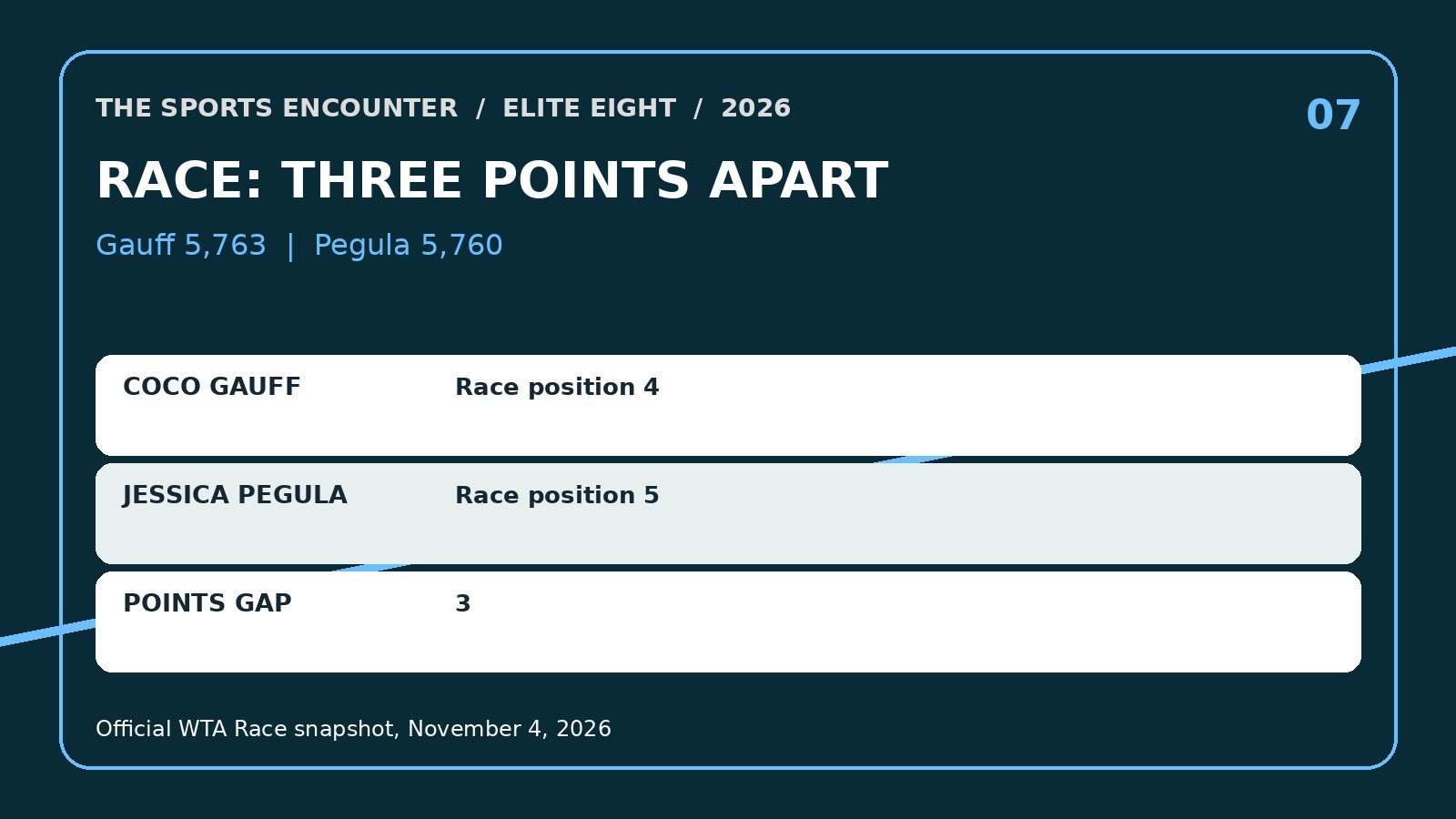
| Player | Race position | Points | Difference |
|---|---|---|---|
| Coco Gauff | 4 | 5,763 | Three points ahead |
| Jessica Pegula | 5 | 5,760 | Three points behind |
This comparison illustrates the competitiveness of the women’s tour.
Across dozens of matches and many tournaments, two experienced Americans remained almost inseparable in the year-end qualification race.
Now they must compete directly in the same WTA Finals group.
The Sports Encounter has published the confirmed WTA Finals draw and group assignments, including the implications for all eight players.
How Can Jessica Pegula Reach the WTA Finals Semifinals?
Each competitor plays three round-robin matches.
The top two players from each four-player group advance to the semifinals.
Pegula cannot afford to treat any match as unimportant, particularly because her group includes opponents who have already defeated her in major events during 2026.
| Round-robin record | Semifinal outlook | Important qualification detail |
|---|---|---|
| 3–0 | Qualification guaranteed | Would finish with the strongest possible group record |
| 2–1 | Strong opportunity | Tiebreak procedures may determine the final order |
| 1–2 | Possible only in specific circumstances | Depends on other results and official tiebreak rules |
| 0–3 | Eliminated | Cannot finish among the top two |
A particularly important tactical consideration is recovery.
Pegula has demonstrated the ability to win difficult three-set matches, but the round-robin format creates a demanding schedule with limited opportunities to recover from physical and emotional fatigue.
Winning in straight sets would help preserve energy, although a demanding three-set victory can also provide the confidence needed for the next match.
Could Jessica Pegula Win Her First WTA Finals Championship?
Pegula has already demonstrated that she can compete against most of the leading players in the field.
Her Berlin victory over Sabalenka and Cincinnati success against Świątek are particularly persuasive examples.
She also has experience of reaching the WTA Finals championship match.
In 2023, Pegula advanced to the final in Cancún before losing to Świątek.
Her 2026 challenge is to combine that experience with the adaptability and composure she has shown throughout the season.
The Case for Pegula
Her strengths are substantial.
She has one of the most repeatable baseline games on tour, exceptional experience in deciding sets and the ability to compete on hard courts against almost any opponent.
The slower Indian Wells conditions may also reward her clean ball-striking and court positioning.
The Case Against Pegula
Her group contains three opponents who defeated her in major 2026 matches.
She has also struggled in championship matches against powerful opponents capable of establishing control early.
Her second serve can become vulnerable under heavy return pressure.
These are not minor issues in a competition where every opponent is already among the world’s elite.
The Sports Encounter Verdict: Fifty Wins Have Earned Pegula One More Opportunity
Jessica Pegula’s 2026 season deserves to be judged by its full body of work.
She won two championships, reached five finals, recorded 50 victories and returned to the semifinals of two Grand Slam tournaments.
She recovered from difficult positions against powerful opponents and established one of the highest winning percentages on the tour.
Yet her strongest season performances have repeatedly ended just short of the sport’s biggest rewards.
That tension gives her WTA Finals campaign its significance.
Pegula is not seeking evidence that she belongs among the game’s best. She has accumulated that evidence over several seasons.
She is seeking the championship that would convert her exceptional consistency into another defining career achievement.
Our assessment: Pegula has the experience and tactical discipline to compete for a semifinal position, but Group 1 gives her little room for error. Her chances will improve considerably if she protects her second serve, maintains aggressive court positioning and avoids allowing powerful opponents to control the opening exchanges. Reaching the final would be an achievement. Winning it would provide one of the most significant victories of her career.
For ongoing tournament coverage, including the confirmed draw, match schedule, results and standings, visit The Sports Encounter’s WTA Finals 2026 hub.
Readers can also explore how Pegula and Gauff secured their fifth consecutive WTA Finals qualifications and our eight-player championship preview.
Continue the WTA Finals Story
 WTA FinalsCoco Gauff’s Turbulent 2026: A Rebuilt Serve, Cincinnati Glory, and the Fight for WTA Finals Redemption
 WTA FinalsMirra Andreeva’s Historic 2026: Roland-Garros Glory, 50 Wins, and the Battle to Become Tennis’ Next Queen
 WTA FinalsWTA Finals 2026 Draw: Rybakina Faces Gauff, Pegula and Nosková as Sabalenka Gets Andreeva, Svitolina and Muchová
Frequently Asked Questions About Jessica Pegula
How Old Is Jessica Pegula?
Jessica Pegula was born on February 24, 1994. She is 32 years old as of November 2026.
Where Was Jessica Pegula Born?
She was born in Buffalo, New York, United States.
Who Are Jessica Pegula’s Parents?
Her parents are Terry and Kim Pegula, whose business interests include ownership of the Buffalo Bills and Buffalo Sabres.
Who Is Jessica Pegula’s Husband?
Pegula married Taylor Gahagen in October 2021.
Who Coaches Jessica Pegula?
Her coaching team includes Mark Knowles and Mark Merklein.
How Many WTA Singles Titles Has Pegula Won?
She has won 11 career WTA singles championships, including Dubai and Charleston in 2026.
How Many Matches Did Jessica Pegula Win in 2026?
She recorded 50 singles victories and 14 defeats before the WTA Finals, giving her a 78.1% winning percentage.
Which Tournaments Did Pegula Win in 2026?
She won the Dubai Duty Free Tennis Championships and Charleston Open.
How Many Finals Did Jessica Pegula Reach in 2026?
She reached five WTA singles finals, winning two and finishing runner-up at Berlin, Washington and Cincinnati.
Has Jessica Pegula Won a Grand Slam Singles Title?
No. Her best Grand Slam singles result remains her runner-up finish at the 2024 US Open.
Has Pegula Won the WTA Finals?
No. Her best result was reaching the 2023 championship match in Cancún, where she lost to Iga Świątek.
Who Is in Jessica Pegula’s WTA Finals Group?
She is in Group 1 alongside Elena Rybakina, Coco Gauff and Linda Nosková.
When Are the WTA Finals 2026?
The WTA Finals are scheduled for November 8–15, 2026, at the Indian Wells Tennis Garden in California.
Official Sources
The official WTA player profile provides Pegula’s biographical details, coaching team, career results and season statistics. The WTA’s 2026 season review documents her 50-win campaign and championship achievements. The official WTA Finals group announcement confirms her round-robin opponents.
This is Article 5 of The Elite Eight: Road to the WTA Finals 2026, The Sports Encounter’s eight-part series exploring the careers, 2026 results and championship prospects of the players competing at Indian Wells.
Jessica Pegula
- Jessica Pegula’s Relentless 2026: 50 Wins, Five Finals, and the Crown That Still Eludes Her
- Pegula and Gauff Book Fifth Straight WTA Finals as Świątek’s Escape Route Narrows
- Grand Slam Player Council Opens New Phase in Tennis Pay and Power Battle
- Sabalenka Punishes Pegula’s Second Serve to Keep US Open Three-Peat Alive
- Pegula Rallies Past Navarro to Set Up Sabalenka US Open Semifinal Rematch