Key Takeaways
- On paper, Group 1 combines the defending champion with two established American contenders and one of the season’s biggest breakthrough performers.
- Sabalenka has avoided an immediate rematch with Rybakina, but Group 2 presents its own demanding combination.
- The 2026 championship begins Sunday, November 8, and concludes Sunday, November 15.
- Elena Rybakina has earned the right to enter the 2026 WTA Finals as the leading contender.
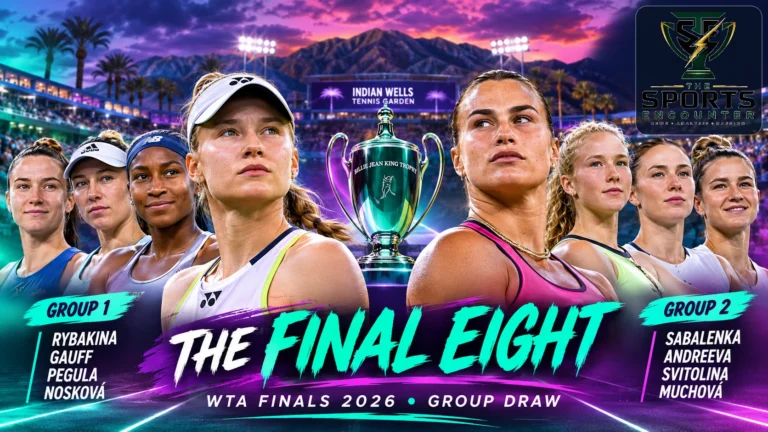
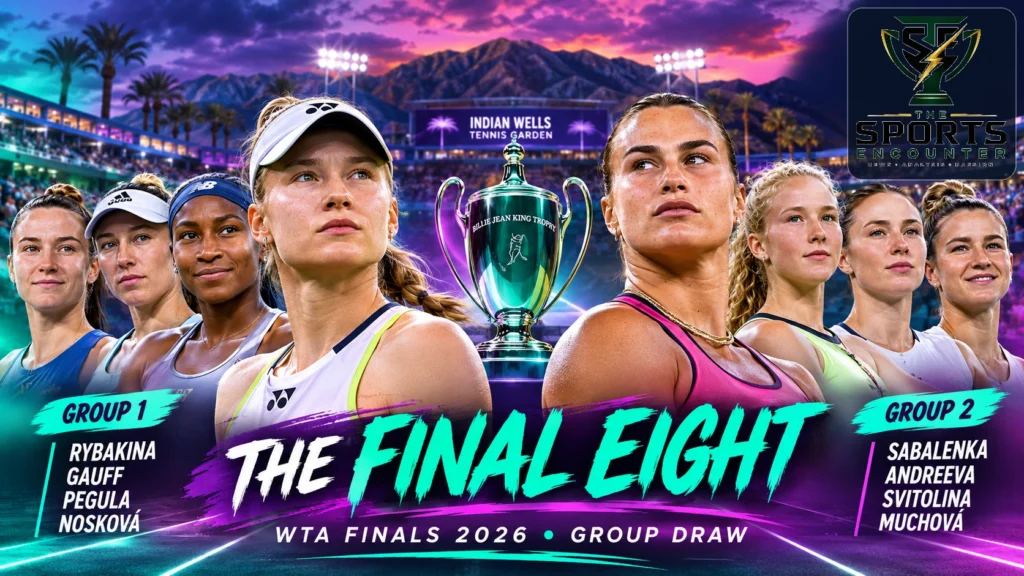
INDIAN WELLS, United States, November 4, 2026: Elena Rybakina’s defense of the WTA Finals title will begin against two American contenders and the reigning Wimbledon champion, while Aryna Sabalenka must navigate a group containing the French Open champion, a former WTA Finals winner and one of tennis’s most unpredictable shot-makers. The Women’s Tennis Association confirmed the 2026 FAGE WTA Finals groups following Tuesday’s draw at the Indian Wells Tennis Garden. World No. 1 Rybakina will face Coco Gauff, Jessica Pegula and Linda Nosková in Group 1. World No. 2 Sabalenka leads Group 2 alongside Mirra Andreeva, Elina Svitolina and Karolína Muchová. The championship runs from November 8 to 15 in California.
The draw immediately creates several compelling rivalries while postponing another. Rybakina and Sabalenka, who contested both the Australian Open and US Open finals in 2026, cannot meet during the round-robin stage. Instead, Rybakina must face 2024 WTA Finals champion Gauff, 2023 runner-up Pegula and Wimbledon winner Nosková. Sabalenka’s route includes Roland-Garros champion Andreeva, 2018 Finals champion Svitolina and Muchová, whose variety makes her particularly dangerous against powerful baseline players. Each woman will play three group matches, with the top two from each group advancing to the November 14 semifinals before the Billie Jean King Trophy is awarded on November 15.
WTA Finals 2026 Draw: Complete Singles Groups
The November 3 draw divided the eight qualified singles players into two groups of four.
Story at a glance
WTA Finals 2026 Draw: Complete Singles Groups
The November 3 draw divided the eight qualified singles players into two groups of four.
Group 1 Analysis: Rybakina Must Overcome American Experience and Nosková’s Power
On paper, Group 1 combines the defending champion with two established American contenders and one of the season’s biggest breakthrough performers.
Group 1: All Six Confirmed Round-Robin Pairings
Every player must face the other three members of the group once.
Group 2 Analysis: Sabalenka Faces Three Different Tactical Problems
Sabalenka has avoided an immediate rematch with Rybakina, but Group 2 presents its own demanding combination.
Group 2: All Six Confirmed Round-Robin Pairings
On balance: Sabalenka has the strongest championship credentials in Group 2, but Muchová’s tactical variety makes her a dangerous opponent. Andreeva has the potential to finish in the top two, while Svitolina’s experience means she should not be discounted.
The number beside each player in the official group announcement represents her tournament seeding. It should not automatically be treated as her position in every separately published WTA Race standings snapshot.
| Group | Seed | Player | Country | 2026 Season Highlight |
|---|---|---|---|---|
| Group 1 | 1 | Elena Rybakina | Kazakhstan | Australian Open and US Open champion |
| Group 1 | 4 | Coco Gauff | United States | Cincinnati champion; 2024 Finals winner |
| Group 1 | 5 | Jessica Pegula | United States | Dubai and Charleston champion |
| Group 1 | 8 | Linda Nosková | Czechia | Wimbledon champion |
| Group 2 | 2 | Aryna Sabalenka | Competing as a neutral athlete | Indian Wells and Miami champion |
| Group 2 | 3 | Mirra Andreeva | Competing as a neutral athlete | Roland-Garros champion |
| Group 2 | 6 | Elina Svitolina | Ukraine | Former WTA Finals champion |
| Group 2 | 7 | Karolína Muchová | Czechia | Doha and Bad Homburg champion |
The official WTA draw announcement confirms both groups and the corresponding doubles draw.
The result adds a new chapter to the championship preview already published by The Sports Encounter. Our complete 2026 WTA Finals preview examines the eight qualifiers, their championship credentials and the tournament’s return to Indian Wells.
Group 1 Analysis: Rybakina Must Overcome American Experience and Nosková’s Power
On paper, Group 1 combines the defending champion with two established American contenders and one of the season’s biggest breakthrough performers.
Rybakina is the strongest individual candidate based on her 2026 achievements.
She has won two Grand Slam titles, reached world No. 1 and already demonstrated that she can win the season-ending championship without losing a match.
Yet the group is not straightforward.
Gauff possesses exceptional defensive movement and has previously won the Finals.
Pegula brings sustained consistency and the ability to redirect powerful groundstrokes.
Nosková can produce aggressive serving and baseline tennis capable of disrupting more established opponents.
There is no guaranteed easy match for Rybakina.
Elena Rybakina: Can the Defending Champion Survive Three Contrasting Opponents?
Rybakina arrives as the defending champion after completing an unbeaten campaign at the 2025 WTA Finals.
Her 2026 Grand Slam season has been equally significant.
She defeated Sabalenka in the Australian Open final and repeated that achievement in New York, winning her first US Open title and strengthening her position at the top of women’s tennis.
The Sports Encounter documented that second major triumph in its report on Rybakina’s US Open victory over Sabalenka.
Her biggest weapon remains the combination of a powerful first serve and an ability to attack early in rallies.
When Rybakina serves accurately, opponents often struggle to establish neutral exchanges.
But Gauff, Pegula and Nosková present three different problems.
Gauff can force her to play additional shots. Pegula can redirect pace and expose open court. Nosková can challenge her through a similar first-strike approach.
The group therefore tests Rybakina’s tactical adaptability as much as her power.
The WTA’s qualification announcement also confirms that Rybakina is attempting to become the first woman since Serena Williams to defend the WTA Finals singles championship.
Coco Gauff: Could Home Support Help the 2024 Champion?
Gauff has already established that she can win this competition.
She lifted the title in 2024 and is making her fifth consecutive appearance in the season-ending championship.
Her movement and defensive range are particularly valuable against opponents who prefer to dictate play through power.
Against Rybakina, that could involve extending rallies and forcing the world No. 1 to hit several high-quality attacking shots rather than one immediate winner.
Against Nosková, Gauff may seek to exploit moments when the Czech’s aggression produces errors.
Her meeting with Pegula presents a different challenge because both players know each other’s patterns and strengths.
Gauff’s serve will remain an important factor. Strong opponents can punish short second serves, and her group contains several players capable of taking control through early returns.
Jessica Pegula: The Consistent Contender With a Difficult Draw
Pegula has reached five tournament finals in 2026 and qualified for the WTA Finals for the fifth consecutive year.
She was runner-up in 2023 and understands the demands of playing multiple elite opponents within one week.
Her compact groundstrokes and early ball contact can be particularly effective against players who generate heavy pace.
The challenge is producing enough attacking pressure against opponents whose serving and movement can prevent her from controlling the baseline.
Pegula will also face fellow American Gauff, who defeated her in the Cincinnati final earlier this season.
The Sports Encounter’s report on Gauff and Pegula securing their fifth consecutive WTA Finals qualifications examines how their different seasons brought them to the same championship.
Linda Nosková: Why the Wimbledon Champion Could Disrupt Group 1
Nosková arrives at Indian Wells as a Grand Slam champion making her WTA Finals singles debut.
She defeated fellow Czech Karolína Muchová in the Wimbledon final and became one of the season’s most compelling young champions.
Her powerful serve and aggressive groundstrokes make her dangerous in a short group-stage format.
Nosková does not necessarily need to dominate an opponent across a prolonged tournament run to create an upset. A strong individual serving performance can place considerable pressure on even the best returners.
However, she has also experienced inconsistent results and physical concerns during the later months of 2026.
The Sports Encounter’s detailed profile of Nosková’s breakthrough 2026 season examines her Wimbledon victory, ranking development, injury setbacks and prospects at Indian Wells.
Her debut will provide an important test of whether she can reproduce her Grand Slam-winning level against three elite opponents in quick succession.
Group 1: All Six Confirmed Round-Robin Pairings
Every player must face the other three members of the group once.
The six pairings are therefore known, although this list does not establish their playing order or specific session times.
| Matchup | Main Tactical Battle | Why It Matters |
|---|---|---|
| Rybakina vs. Gauff | First-strike power against defensive movement | Defending champion meets 2024 champion |
| Rybakina vs. Pegula | Serve dominance against early ball redirection | Tests Pegula’s ability to absorb and redirect pace |
| Rybakina vs. Nosková | Two powerful servers and aggressive baseliners | Potentially important match with narrow margins on serve |
| Gauff vs. Pegula | Movement against timing and directional control | All-American meeting between two experienced contenders |
| Gauff vs. Nosková | Defense against aggressive baseline hitting | Tests Nosková’s consistency against elite movement |
| Pegula vs. Nosková | Controlled redirection against first-strike aggression | Could influence the second semifinal position |
On balance: Rybakina is the leading candidate to finish first, but Gauff and Pegula have the experience to challenge her. Nosková is the most unpredictable competitor, capable of upsetting the group without necessarily sustaining the same level across all three matches.
That is an editorial assessment based on playing styles and recent achievements, not an official ranking of qualification probability.
Group 2 Analysis: Sabalenka Faces Three Different Tactical Problems
Sabalenka has avoided an immediate rematch with Rybakina, but Group 2 presents its own demanding combination.
Andreeva brings creativity and a major title-winning season.
Svitolina has extensive experience managing high-pressure matches and previously won the WTA Finals.
Muchová possesses one of the most varied games in the field.
Sabalenka’s serving and baseline power can overwhelm opponents when she finds her best rhythm.
The problem is that her three rivals possess different ways of interrupting that rhythm.
Aryna Sabalenka: Can She Win the Major Season-Ending Title Still Missing?
Sabalenka returns to a championship where she has twice finished runner-up.
She reached the final in 2022 and again in 2025 but has not yet won the singles title.
Her 2026 campaign featured the Indian Wells and Miami championships, completing the prestigious Sunshine Double.
That success is especially relevant because the WTA Finals will take place at Indian Wells.
However, the November conditions and tournament structure will differ from the March event.
Sabalenka’s strongest weapon is her capacity to control points through powerful serving and aggressive baseline tennis.
When her first serve and return work together, opponents can struggle to establish any sustained attacking rhythm.
But Andreeva, Svitolina and Muchová all offer tactical challenges that require patience and decision-making.
Mirra Andreeva: Can the French Open Champion Win on Her Singles Finals Debut?
Andreeva enters the championship after winning Roland-Garros and securing one of the leading qualification positions.
Her ability to change pace, defend and construct points has become increasingly important as she has developed against elite opponents.
Unlike players who rely primarily on first-strike aggression, Andreeva can build points through a combination of depth, movement and tactical variation.
Those qualities could be especially useful against Sabalenka.
Yet the round-robin format introduces another test.
Andreeva must adapt to three different opponents within a short period, rather than preparing for a conventional knockout draw with only one possible opponent at each stage.
Her recent rise was already a major part of the qualification picture examined in The Sports Encounter’s October investigation into the WTA Finals qualification race.
Elina Svitolina: The 2018 Champion Who Cannot Be Overlooked
Svitolina brings championship experience that neither Andreeva nor Muchová has yet gained in the singles event.
She won the WTA Finals in 2018 and has subsequently rebuilt her career following maternity leave.
Her movement, discipline and ability to absorb attacking pressure remain valuable qualities.
Against Sabalenka, Svitolina will need to prevent rallies from becoming a succession of comfortable attacking shots.
Against Muchová, the tactical question changes. Both players can vary pace, and long exchanges may become contests of court positioning and patience.
Against Andreeva, the match could depend on which player controls the balance between defense and attack.
Svitolina’s return also provides an important generational contrast within the tournament.
She is a former champion competing against younger players already established as Grand Slam winners.
Karolína Muchová: The Player Who Could Make Sabalenka Uncomfortable
Muchová’s strength lies in refusing to play every point at the same pace.
Her combination of slices, drop shots, changes in trajectory and net approaches can prevent power hitters from settling into their preferred patterns.
That makes her particularly interesting against Sabalenka.
If Muchová can vary the height and speed of the ball without surrendering court position, she may create opportunities to disrupt Sabalenka’s powerful baseline game.
Muchová earned the final place in the singles field after Marta Kostyuk’s withdrawal from the Ningbo Open ended the remaining qualifying challenge.
The Sports Encounter covered that conclusion in its report on Muchová securing the last WTA Finals place.
She also reached the Wimbledon final after surviving a dramatic semifinal against Gauff.
That performance was examined in our account of the all-Czech Wimbledon final taking shape.
Muchová is capable of challenging every player in the group, but her physical condition and ability to sustain her level across consecutive matches remain important considerations.
Group 2: All Six Confirmed Round-Robin Pairings
| Matchup | Main Tactical Battle | Why It Matters |
|---|---|---|
| Sabalenka vs. Andreeva | Power against creative point construction | World No. 2 faces Roland-Garros champion |
| Sabalenka vs. Svitolina | Attacking pace against movement and consistency | Former Finals champion tests Sabalenka’s patience |
| Sabalenka vs. Muchová | First-strike aggression against all-court variety | Potentially difficult stylistic matchup |
| Andreeva vs. Svitolina | Two disciplined movers with contrasting experience | Could be important for the second qualifying place |
| Andreeva vs. Muchová | Creative shot-making and court positioning | Two versatile players seeking their first singles Finals title |
| Svitolina vs. Muchová | Defensive consistency against tactical variation | Could become a crucial qualification contest |
On balance: Sabalenka has the strongest championship credentials in Group 2, but Muchová’s tactical variety makes her a dangerous opponent. Andreeva has the potential to finish in the top two, while Svitolina’s experience means she should not be discounted.
No player has an automatic qualification advantage beyond the actual matches and applicable standings rules.
Which Group Is Tougher: Rybakina’s or Sabalenka’s?
The draw has created two groups that are difficult for different reasons.
Group 1 contains three players who have previously reached a WTA Finals championship match: Rybakina, Gauff and Pegula.
Group 2 contains two former singles champions or finalists with extensive Finals experience, Sabalenka and Svitolina, alongside two players capable of producing major upsets through tactical variation.
The comparison becomes more revealing when measured by championship history.
| Measure | Group 1 | Group 2 |
|---|---|---|
| Players | Rybakina, Gauff, Pegula, Nosková | Sabalenka, Andreeva, Svitolina, Muchová |
| Previous WTA Finals singles champions | 2: Rybakina, Gauff | 1: Svitolina |
| Previous WTA Finals singles finalists, excluding champions | 1: Pegula | 1: Sabalenka |
| 2026 Grand Slam singles champions | 2: Rybakina, Nosková | 1: Andreeva |
| 2026 Grand Slam titles represented | 3: Australian Open, Wimbledon, US Open | 1: Roland-Garros |
| Singles Finals debutants | 1: Nosková | 2: Andreeva, Muchová |
| Official seeds | 1, 4, 5, 8 | 2, 3, 6, 7 |
| Sum of seed numbers | 18 | 18 |
The draw reveals: Group 1 accounts for three of the four Grand Slam singles titles won by the eight finalists in 2026. Rybakina holds two, while Nosková holds Wimbledon. Group 2 contains the remaining major winner, Andreeva.
Group 1 also includes two previous WTA Finals champions and another former finalist.
That gives it the stronger championship-history profile.
However, the two groups have identical seed-number totals of 18. That equality is a consequence of the seed distribution, not proof that the competitive difficulty is identical.
Group 2’s contrasting playing styles may prove just as demanding as Group 1’s concentration of major champions.
The leading contenders are: Group 1 is marginally more formidable on championship credentials, while Group 2 may present greater tactical uncertainty.
Why Rybakina and Sabalenka Cannot Meet Before the Semifinals
The draw has separated the two leading seeds.
That means Rybakina and Sabalenka cannot play one another during the three-match round-robin phase.
Their first possible meeting is in the semifinals if one wins her group and the other finishes second in the opposite group.
They could also meet in the final if both win their groups and then win their semifinals, or if both finish runners-up and advance.
This distinction matters because another meeting between the pair would carry considerable historical weight.
Rybakina defeated Sabalenka in the 2025 WTA Finals final and twice in Grand Slam finals during 2026.
Sabalenka has demonstrated the ability to defeat Rybakina on hard courts, including at Indian Wells earlier this year.
A potential knockout meeting would therefore offer another chapter in one of the season’s most important rivalries.
How Do the WTA Finals Round-Robin Standings Work?
The eight players are divided into two groups of four.
Every player faces each of the other three women in her group once.
The two leading players from each group advance to the semifinals.
A player does not need to win all three group matches to qualify.
Two victories are often enough, although the outcome can depend on the remaining results and the applicable tiebreak procedures.
A player may even finish with a 2-1 record and fail to progress if three players finish level and the relevant tiebreaks go against her.
WTA Finals Qualification Scenarios After Three Matches
| Group Record | Possible Outcome | Explanation |
|---|---|---|
| 3 wins, 0 losses | Advances | Finishes unbeaten and takes first place |
| 2 wins, 1 loss | Usually advances, but not guaranteed | A three-way tie on two wins is possible |
| 1 win, 2 losses | Can advance in certain scenarios | Three players can finish 1-2 behind a 3-0 leader |
| 0 wins, 3 losses | Eliminated | Cannot finish in the top two |
Where players are tied, the official event rules govern the comparison using applicable results, participation and set or game percentages.
Readers should not assume that a two-win player has qualified before the remaining group results are known.
The tournament’s official WTA Finals tournament center provides the event schedule, results and standings as they become available.
How Many Matches Will Be Played at the 2026 WTA Finals?
Each group contains six distinct singles matchups.
With two groups, that produces 12 round-robin singles matches.
The semifinals add two matches, followed by the championship final.
The singles competition therefore contains 15 scheduled matches, assuming all are completed.
The same structure applies to doubles, with another 15 scheduled matches.
| Stage | Singles Matches | Doubles Matches |
|---|---|---|
| Group 1 | 6 | 6 |
| Group 2 | 6 | 6 |
| Semifinals | 2 | 2 |
| Final | 1 | 1 |
| Total scheduled | 15 | 15 |
The format means a singles champion can win five matches during the tournament, including three round-robin matches, a semifinal and the final.
It also creates the possibility of becoming champion despite losing one group match.
WTA Finals 2026 Doubles Draw: Complete Groups
The WTA also confirmed the doubles groups on November 3.
Eight qualified partnerships are competing for the Martina Navratilova Trophy.
Each doubles team will face the other three partnerships in its group, with the top two advancing to the semifinals.
| Group | Seed | Doubles Team |
|---|---|---|
| Group 1 | 1 | Gabriela Dabrowski / Luisa Stefani |
| Group 1 | 3 | Guo Hanyu / Kristina Mladenovic |
| Group 1 | 5 | Hsieh Su-wei / Jelena Ostapenko |
| Group 1 | 7 | Elise Mertens / Zhang Shuai |
| Group 2 | 2 | Katerina Siniaková / Taylor Townsend |
| Group 2 | 4 | Cristina Bucsa / Nicole Melichar-Martinez |
| Group 2 | 6 | Ellen Perez / Demi Schuurs |
| Group 2 | 8 | Sara Errani / Jasmine Paolini |
Dabrowski and Stefani lead the first group, while Siniaková and Townsend head the second.
Errani and Paolini secured the final qualifying place on October 31, completing the eight-team field.
The doubles competition will reward different skills from singles, particularly positioning at the net, communication, return placement and coordinated movement.
The presence of several accomplished doubles specialists ensures that the title race will remain significant alongside the singles championship.
WTA Finals 2026 Schedule: November 8-15 at Indian Wells
The 2026 championship begins Sunday, November 8, and concludes Sunday, November 15.
The tournament will take place on outdoor hard courts at the Indian Wells Tennis Garden.
The published event format places the group matches before the semifinal and final weekend.
| Date | Tournament Stage | Status |
|---|---|---|
| November 3 | Official group draw | Completed |
| November 8 | Competition begins | Scheduled |
| November 8-13 | Round-robin competition | Individual order of play governs exact matches |
| November 14 | Semifinals | Scheduled |
| November 15 | Championship finals | Scheduled |
The groups establish which players must meet, but not their complete daily playing order.
Exact match times should be taken from the organizers’ official order of play rather than inferred from the draw.
Why Iga Świątek’s Absence Changes the 2026 Championship
The tournament will take place without six-time Grand Slam champion Iga Świątek.
The former world No. 1 withdrew from Ningbo because of a left thigh problem and subsequently ended her 2026 season.
Her withdrawal also brought her attempt to reach another WTA Finals to an end.
The Sports Encounter’s report on Świątek’s injury and the collapse of her Finals qualification hopes examined the consequences for the final singles position.
Her absence removes one of the sport’s most accomplished players from the eight-woman field.
Nevertheless, the championship retains four Grand Slam singles title winners from the 2026 season across Rybakina, Andreeva and Nosková.
Rybakina holds two of those titles, while Andreeva and Nosková hold one each.
The field also includes several previous WTA Finals champions and finalists, ensuring that the competition remains exceptionally demanding.
The Czech Connection: Nosková and Muchová Could Meet Again
Nosková and Muchová produced one of the season’s defining Grand Slam storylines.
Both reached the Wimbledon final, creating a historic all-Czech championship match.
Nosková won the title 6-2, 5-7, 6-3, while Muchová finished runner-up.
Their contrasting playing styles remain compelling.
Nosková prefers aggressive baseline tennis and powerful serving.
Muchová uses greater variation in pace, movement and shot selection.
They have been drawn into different WTA Finals groups, so they cannot meet during the round robin.
A reunion would require both to qualify for the semifinals and then be paired in the knockout stage, or to progress to the championship final.
TSE’s complete historical record of Wimbledon women’s singles champions places Nosková’s 2026 victory in the wider history of the sport.
Which Players Are Most Likely to Reach the WTA Finals Semifinals?
Rybakina and Sabalenka remain the strongest pre-tournament candidates to win their respective groups.
Rybakina has been the season’s leading Grand Slam performer and is defending the WTA Finals championship.
Sabalenka has dominated important hard-court events and returns to a venue where she won earlier this year.
The second qualifying positions are more difficult to predict.
Gauff’s previous title and outstanding movement make her a strong Group 1 contender, but Pegula and Nosková have enough ability to challenge her.
In Group 2, Andreeva’s Grand Slam-winning season makes her a leading candidate, although Svitolina’s experience and Muchová’s tactical flexibility complicate the race.
| Group | TSE Projected First | TSE Projected Second | Strongest Alternative |
|---|---|---|---|
| Group 1 | Elena Rybakina | Coco Gauff | Jessica Pegula, with Linda Nosková a serious upset threat |
| Group 2 | Aryna Sabalenka | Mirra Andreeva | Karolína Muchová, with Elina Svitolina also capable of advancing |
These are editorial predictions rather than probability estimates or official qualification projections.
They assume the players remain available and compete without a material fitness setback.
The actual semifinals will be determined by the round-robin results and applicable tiebreak rules.
Could the WTA Finals Produce Another Rybakina vs. Sabalenka Final?
Yes.
The draw makes a championship rematch possible because the two leading players are in separate groups.
If both win their groups, they will face the opposite group’s runner-up in the semifinals.
Winning those matches would create another Rybakina-Sabalenka final.
That outcome would carry significance beyond the trophy.
Rybakina defeated Sabalenka in two Grand Slam finals this season and previously overcame her in the 2025 WTA Finals championship match.
Sabalenka, meanwhile, has already demonstrated she can beat Rybakina at Indian Wells.
A final meeting would therefore represent another opportunity for both players to test their standing in one of tennis’s defining rivalries.
However, neither can look beyond the group stage.
Rybakina must face Gauff, Pegula and Nosková.
Sabalenka must overcome Andreeva, Svitolina and Muchová.
The championship format provides no guarantee that the two leading seeds will eventually meet.
Why This Draw Matters for the Future of Women’s Tennis
The 2026 WTA Finals field reflects an increasingly competitive generational balance.
Rybakina and Sabalenka remain established forces at the highest level.
Gauff combines an existing WTA Finals title with another season of strong results.
Pegula and Svitolina bring experience and consistency.
Muchová contributes a creative style capable of challenging the leading power hitters.
Andreeva and Nosková are young Grand Slam champions who have already demonstrated that they can perform under the greatest pressure.
The group draw brings those different strengths together.
It also ensures that experienced champions and emerging contenders will face one another before the knockout rounds.
The result is an opportunity to assess which skills prove most valuable in a tournament requiring repeated high-level performances across a short period.
Where Can Fans Follow the WTA Finals Draw, Results and Standings?
The official WTA tournament center provides the governing schedule, results and standings.
For ongoing editorial coverage, readers can follow The Sports Encounter’s dedicated WTA Finals 2026 hub, which brings together the championship’s principal developments, match reports, standings and analysis.
That page should remain the central reference as the event progresses from the group stage to the semifinals and championship final.
Continue the WTA Finals Story
 WTA FinalsWTA Finals 2026: 8 Women, One Crown, and the Rivalries That Define Tennis’s Biggest Season Finale
 WTA FinalsCoco Gauff’s Turbulent 2026: A Rebuilt Serve, Cincinnati Glory, and the Fight for WTA Finals Redemption
 WTA FinalsElina Svitolina’s Defiant 2026: 20 Titles, a Wimbledon Collapse and One More Shot at WTA Finals Glory
Frequently Asked Questions About the WTA Finals 2026 Draw
Who Is in Group 1 at the WTA Finals 2026?
Elena Rybakina, Coco Gauff, Jessica Pegula and Linda Nosková.
Who Is in Group 2?
Aryna Sabalenka, Mirra Andreeva, Elina Svitolina and Karolína Muchová.
When Do the 2026 WTA Finals Start?
The competition begins on November 8, 2026, at the Indian Wells Tennis Garden.
When Is the 2026 WTA Finals Final?
The singles and doubles championships are scheduled to conclude on November 15, 2026.
Can Elena Rybakina Play Aryna Sabalenka in the Group Stage?
No. They are in separate groups and can only meet in the knockout rounds.
Will Coco Gauff Play Jessica Pegula?
Yes. Both Americans are in Group 1 and are scheduled to meet during the round-robin phase.
How Many Group Matches Does Each Player Have?
Each player is scheduled for three group matches, one against each of the other members of her group.
How Many Players Advance to the Semifinals?
Two players from each group advance, producing four singles semifinalists.
Can Someone Lose a Match and Still Win the WTA Finals?
Yes. A player may qualify despite a group defeat and go on to win the semifinals and final.
Who Is the Defending WTA Finals Champion?
Elena Rybakina won the singles title in 2025 and is defending her championship in Indian Wells.
Which Trophy Does the Singles Champion Win?
The Billie Jean King Trophy. The doubles champions receive the Martina Navratilova Trophy.
Who Are the Favorites to Reach the Semifinals?
Rybakina and Sabalenka are the strongest projected group winners, with Gauff, Pegula, Andreeva, Svitolina, Muchová and Nosková all capable of influencing qualification.
The Sports Encounter Verdict: The Draw Has Made an Already Difficult Championship Even More Intriguing
Elena Rybakina has earned the right to enter the 2026 WTA Finals as the leading contender.
She is the defending champion, the world No. 1 and the winner of two Grand Slam titles this season.
But the draw has placed three dangerous opponents directly in her path.
Gauff has previously won the championship. Pegula has reached the final. Nosková arrives with a Wimbledon title and the confidence of a player capable of defeating established opponents.
Sabalenka’s assignment is no less complicated.
Andreeva is already a Grand Slam champion. Svitolina has won the WTA Finals. Muchová possesses the variety to make even the strongest hitters uncomfortable.
The most important implication is that no player can assume she will qualify simply because of her seeding or earlier results.
The opening round-robin matches will determine which contenders establish an advantage.
The final group encounters may produce complicated qualification scenarios involving head-to-head results, sets and games.
And the semifinals could reunite rivalries that have defined the season.
Rybakina and Sabalenka remain the strongest pre-tournament title candidates. Gauff and Andreeva look well placed to challenge for semifinal places, but Pegula, Muchová, Svitolina and Nosková have compelling reasons to believe they can disrupt those expectations.
The draw has now answered who must face whom.
From November 8, the eight finalists will decide which four deserve to remain in the championship race, and which two will contest the Billie Jean King Trophy on November 15.
WTA Finals 2026
- WTA Finals 2026 Draw: Rybakina Faces Gauff, Pegula and Nosková as Sabalenka Gets Andreeva, Svitolina and Muchová
- Coco Gauff’s Turbulent 2026: A Rebuilt Serve, Cincinnati Glory, and the Fight for WTA Finals Redemption
- Elina Svitolina’s Defiant 2026: 20 Titles, a Wimbledon Collapse and One More Shot at WTA Finals Glory
- Karolína Muchová’s 2026 Revival: 2 Titles, Wimbledon Heartbreak and the Long Road to the WTA Finals
- Linda Nosková’s Remarkable 2026: Wimbledon Glory, Personal Loss and a WTA Finals Dream