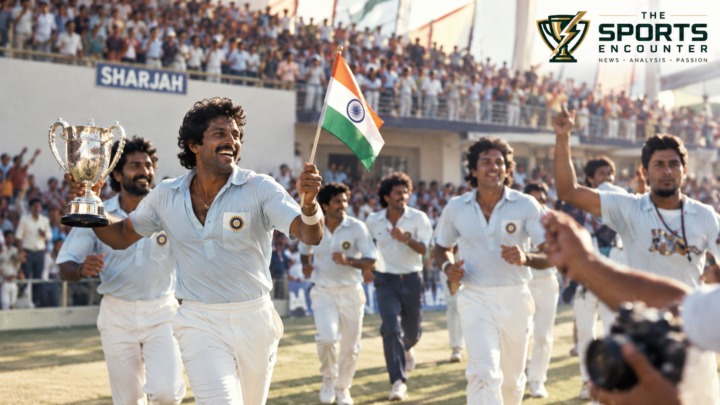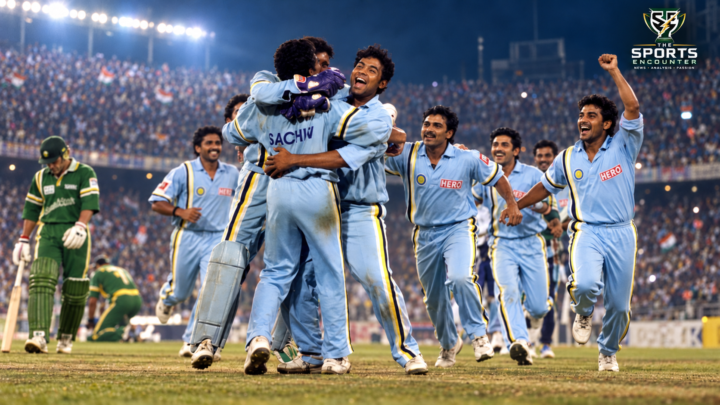
SHARJAH, United Arab Emirates, May 4, 1990: Australia were still chasing Pakistan’s 266 in the Austral-Asia Cup final when Wasim Akram returned to deliver a devastating conclusion. Merv Hughes, Carl Rackemann and Terry Alderman fell bowled from consecutive deliveries, giving the left-arm fast bowler an unforgettable hat-trick as Australia collapsed to 230 all out in 46.5 overs. Pakistan won by 36 runs at Sharjah Cricket Stadium, claiming the tournament title through a performance that combined powerful lower-order batting, disciplined spin bowling and exceptional fast-bowling execution.
Wasim’s final three deliveries became the defining images of the match, but Pakistan’s victory had taken shape much earlier. Saleem Malik anchored the innings with 87, Wasim blasted an unbeaten 49 from 35 balls, Waqar Younis removed two Australian batters in the same over, and Mushtaq Ahmed claimed three middle-order wickets. Steve Waugh’s 64 had given Australia hope, but his dismissal at 207/6 left the chase increasingly dependent on the lower order. Wasim subsequently completed the hat-trick despite experiencing groin pain, earning the Player of the Match award for an outstanding all-round performance.
This historic encounter is Match 67 in The Sports Encounter’s A Celebration of 5000 ODIs, a special series revisiting 100 remarkable One-Day Internationals.
Its inclusion recognizes an extraordinary hat-trick in a tournament final, the outstanding contributions of Pakistan’s younger bowlers and a contest that remained competitive deep into Australia’s pursuit.
Story at a glance

Pakistan vs Australia 1990 Austral-Asia Cup Final: Match Summary
Pakistan’s 266 represented a challenging target in 1990, although Australia’s batting lineup contained sufficient quality to complete the chase.
Saleem Malik’s 87 Gives Pakistan a Competitive Total Despite Repeated Setbacks
Saleem Malik played the innings around which Pakistan built its eventual total.
Wasim Akram’s Unbeaten 49 Turns 207/7 Into 266/7
Wasim Akram’s batting contribution was almost as important as his famous bowling performance.
Saeed Anwar’s 40 Provides Pakistan With an Aggressive Start
Saeed Anwar scored 40 from just 36 deliveries.
Carl Rackemann’s 3/49 Keeps Australia Competitive
Carl Rackemann was Australia’s most successful bowler.
The final also revealed something important about Pakistan’s emerging cricketing strength in 1990. The team possessed the experience of Imran Khan and Javed Miandad, supported by a generation of bowlers capable of deciding major international matches.
Pakistan vs Australia 1990 Austral-Asia Cup Final: Match Summary
| Match detail | Information |
|---|---|
| Tournament | Austral-Asia Cup 1989-90 |
| Stage | Final |
| Date | May 4, 1990 |
| Venue | Sharjah Cricket Stadium, UAE |
| Toss | Pakistan won and elected to bat |
| Pakistan | 266/7 in 50 overs |
| Australia | 230 all out in 46.5 overs |
| Result | Pakistan won by 36 runs |
| Player of the Match | Wasim Akram |
| Player of the Series | Waqar Younis |
| Pakistan’s highest scorer | Saleem Malik, 87 |
| Australia’s highest scorer | Steve Waugh, 64 |
| Pakistan’s leading wicket-takers | Wasim Akram and Mushtaq Ahmed, 3 each |
| Australia’s leading wicket-taker | Carl Rackemann, 3/49 |
| Decisive moment | Wasim Akram’s hat-trick |
| Tournament consequence | Pakistan won the Austral-Asia Cup |
Pakistan’s 266 represented a challenging target in 1990, although Australia’s batting lineup contained sufficient quality to complete the chase.
Allan Border captained an experienced side that included David Boon, Mark Taylor, Dean Jones, Steve Waugh, Simon O’Donnell and Ian Healy.
Pakistan’s task was complicated by the presence of several Australian batters comfortable against pace bowling.
The match eventually turned on Pakistan’s ability to take wickets in clusters while preventing established partnerships from becoming match-winning ones.
Saleem Malik’s 87 Gives Pakistan a Competitive Total Despite Repeated Setbacks
Saleem Malik played the innings around which Pakistan built its eventual total.
He scored 87 from 104 deliveries, hitting nine fours and one six.
Pakistan’s innings had started positively through Saeed Anwar, who attacked Australia’s opening bowlers.
However, the early dismissal of Saleem Yousuf and subsequent losses of Anwar and Javed Miandad prevented Pakistan from establishing complete control.
Pakistan slipped to 80/3.
Malik had to balance rebuilding with maintaining a scoring rate that would produce a competitive total.
He succeeded by occupying the crease and allowing other batters to play around him.
Ijaz Ahmed contributed 20, but his dismissal left Pakistan at 109/4.
Imran Khan managed only two.
Pakistan were reduced to 154/5.
Malik remained the central figure.
His ability to rotate the strike and punish loose deliveries prevented Australia’s bowlers from completely restricting the innings.
He continued batting while Mansoor Rana contributed ten.
The score advanced to 179/6.
Malik eventually fell for 87 with Pakistan at 207/7.
Carl Rackemann had earlier taken three wickets, and Australia were positioned to restrict Pakistan below 250.
Wasim Akram changed that calculation.
Saleem Malik’s Innings by the Numbers
| Statistic | Performance |
|---|---|
| Runs | 87 |
| Balls faced | 104 |
| Fours | 9 |
| Sixes | 1 |
| Strike rate | 83.65 |
| Pakistan’s total | 266 |
| Share of team runs | 32.71% |
| Pakistan when dismissed | 207/7 |
Malik contributed nearly one-third of Pakistan’s runs.
His innings was especially valuable because Pakistan repeatedly lost wickets just as partnerships began developing.
Without his 87, the late assault from Wasim would have carried far greater pressure.
Wasim Akram’s Unbeaten 49 Turns 207/7 Into 266/7
Wasim Akram’s batting contribution was almost as important as his famous bowling performance.
He scored an unbeaten 49 from 35 deliveries, striking one four and three sixes.
His strike rate of 140 was exceptional for an ODI played in 1990.
The most decisive period came after Saleem Malik departed.
Pakistan were 207/7.
With only three wickets remaining and limited overs available, Australia had a realistic opportunity to restrict the total.
Wasim instead produced an aggressive finish.
He attacked the bowling and found support from Mushtaq Ahmed, who scored an unbeaten 17 from 15 deliveries.
The pair added 59 runs without losing another wicket.
Pakistan finished on 266/7.
That unbroken eighth-wicket partnership was crucial because it transformed the final target.
Australia would need 267 to win rather than chase a score closer to 230.
The additional runs created room for Pakistan’s bowlers to attack without allowing Australia to control the required scoring rate.
Pakistan’s Late-Innings Acceleration
| Situation | Score | Runs Added |
|---|---|---|
| Pakistan after six wickets | 179/6 | |
| Malik dismissed | 207/7 | 28 |
| Wasim and Mushtaq finish unbeaten | 266/7 | 59 |
| Final partnership | 59* | |
| Wasim’s innings | 49* from 35 balls | |
| Mushtaq’s innings | 17* from 15 balls |
Pakistan’s final partnership contributed 22.18% of the team’s total.
The statistic reveals the importance of lower-order hitting in a match ultimately decided by 36 runs.
Wasim’s attacking contribution helped Pakistan establish the kind of total that allowed its bowlers to remain competitive even when Australia’s batters gained momentum.
Saeed Anwar’s 40 Provides Pakistan With an Aggressive Start
Saeed Anwar scored 40 from just 36 deliveries.
His innings included five fours and arrived at a strike rate of 111.11.
Anwar’s aggressive approach provided Pakistan with early momentum against Australia’s pace attack.
Saleem Yousuf struggled at the other end, making five from 22 balls before Terry Alderman dismissed him.
Pakistan lost their first wicket at 40.
Anwar followed shortly afterward when Rackemann dismissed him.
Pakistan were 54/2.
Although Anwar failed to convert his start into a half-century, his attacking innings reduced the pressure on the middle order.
It also forced Australia to defend scoring opportunities rather than immediately establish complete bowling control.
Anwar’s contribution therefore deserves recognition alongside Malik’s 87 and Wasim’s late acceleration.
Carl Rackemann’s 3/49 Keeps Australia Competitive
Carl Rackemann was Australia’s most successful bowler.
He claimed 3/49 from ten overs, dismissing Saeed Anwar, Ijaz Ahmed and Imran Khan.
His wickets prevented Pakistan from developing substantial partnerships during the middle stages.
Rackemann’s dismissal of Anwar ended a potentially dangerous innings.
Removing Ijaz and Imran then placed additional pressure on Malik.
Pakistan were reduced to 154/5.
Rackemann finished with an economy rate of 4.90.
Peter Taylor also bowled effectively, conceding 39 runs from ten overs and removing Saleem Malik.
Terry Alderman dismissed Saleem Yousuf, while Steve Waugh removed Javed Miandad.
However, Australia’s bowling performance deteriorated during the closing stages.
Simon O’Donnell conceded 66 runs from ten overs.
Merv Hughes went for 55.
Wasim and Mushtaq exploited those opportunities to extend Pakistan’s innings beyond 260.
Australia’s Bowling Performance
| Bowler | Overs | Runs | Wickets | Economy |
|---|---|---|---|---|
| Terry Alderman | 5 | 22 | 1 | 4.40 |
| Merv Hughes | 10 | 55 | 0 | 5.50 |
| Carl Rackemann | 10 | 49 | 3 | 4.90 |
| Simon O’Donnell | 10 | 66 | 0 | 6.60 |
| Steve Waugh | 5 | 22 | 1 | 4.40 |
| Peter Taylor | 10 | 39 | 1 | 3.90 |
Australia took seven wickets but could not prevent Pakistan’s lower order from scoring rapidly.
That failure would become increasingly important as the chase progressed.
David Boon and Mark Taylor Give Australia a Promising Start
Australia began the chase positively.
David Boon scored 37 from 58 deliveries, while Mark Taylor contributed 52 from 81.
The opening pair added 62 runs.
At 62 without loss, Australia had established a promising position while pursuing 267.
Pakistan needed a breakthrough before the partnership grew into something more dangerous.
Boon’s run-out provided that opportunity.
He departed with Australia at 62/1.
The dismissal also brought Dean Jones to the crease.
Jones had produced an outstanding 117 against Sri Lanka in Australia’s semifinal victory.
His form made him one of the batters Pakistan most needed to dismiss early.
Waqar Younis delivered precisely that breakthrough.
Waqar Younis Dismisses Dean Jones and Allan Border to Transform the Chase
Waqar Younis produced one of the match’s most important spells.
He finished with 2/38 from eight overs, but the figures alone do not explain his contribution.
His two wickets arrived almost immediately after Australia’s opening partnership ended.
Dean Jones fell for a two-ball duck.
Captain Allan Border followed for one.
Both were dismissed by Waqar.
Australia had slumped from 62/0 to 64/3.
The dismissals changed the competitive balance.
Australia had lost three wickets for two runs.
More importantly, Pakistan had removed two of the most experienced batters in the Australian lineup.
The loss of Jones was particularly significant because he had scored a century in the semifinal.
Border’s dismissal further weakened Australia’s middle order.
Pakistan had created the opportunity to attack a new batter while continuing to restrict the scoring rate.
Waqar’s spell demonstrated the value of wicket-taking fast bowling during the middle stages of an ODI.
He did not need a large number of wickets to influence the result.
Removing Jones and Border within the same over had already changed the match.
Steve Waugh’s 64 Brings Australia Back Into Contention
Steve Waugh played Australia’s most substantial innings.
He scored 64 from 83 deliveries, hitting six fours.
His performance arrived after Australia had lost three wickets for 64 runs.
Australia needed stability.
Waugh provided it.
He initially rebuilt alongside Mark Taylor, who continued his patient innings.
Their partnership took Australia to 133/4 before Taylor was run out for 52.
Waugh then combined with Simon O’Donnell.
The pair added 54 runs for the fifth wicket.
Australia advanced to 187/4.
At that stage, another substantial partnership could have placed Pakistan under significant pressure.
Australia needed 80 additional runs with six wickets remaining.
Waugh was well established.
O’Donnell was attacking aggressively.
Pakistan required a wicket.
Mushtaq Ahmed supplied it.
Simon O’Donnell’s 33 Keeps Australia in the Fight Before Mushtaq Strikes
Simon O’Donnell contributed 33 from 28 deliveries, including four fours.
His aggressive batting gave Australia momentum after the earlier setbacks.
He supported Waugh during a crucial fifth-wicket partnership.
Together, they added 54 runs.
Their stand reduced the target to 80 runs.
However, Mushtaq Ahmed dismissed O’Donnell for 33.
Australia were 187/5.
Waugh remained at the crease, but Pakistan had interrupted the partnership before Australia could move decisively toward victory.
Mushtaq subsequently dismissed Waugh for 64.
Australia slipped to 207/6.
He also removed Peter Taylor for nine without another run being added.
Australia were 207/7.
Those two wickets were decisive.
Pakistan had removed the remaining established batter and exposed Australia’s tail.
The final 60 runs required for victory now appeared increasingly difficult.
Mushtaq Ahmed’s 3/48 Breaks Australia’s Middle-Order Resistance
Mushtaq Ahmed played a critical role in Pakistan’s victory.
He claimed 3/48 from ten overs, including one maiden.
His victims were Simon O’Donnell, Steve Waugh and Peter Taylor.
All three wickets arrived after Australia had begun recovering from Waqar’s earlier breakthroughs.
O’Donnell’s dismissal at 187/5 ended a threatening partnership.
Waugh’s wicket at 207/6 removed Australia’s highest scorer.
Taylor fell immediately afterward, leaving Australia 207/7.
Mushtaq’s spell therefore transformed an achievable chase into a difficult lower-order assignment.
Australia’s Chase: Where the Momentum Changed
| Match Situation | Australia Score | Runs Needed | Wickets Left |
|---|---|---|---|
| Opening partnership ends | 62/1 | 205 | 9 |
| Jones and Border dismissed | 64/3 | 203 | 7 |
| Mark Taylor dismissed | 133/4 | 134 | 6 |
| O’Donnell dismissed | 187/5 | 80 | 5 |
| Steve Waugh dismissed | 207/6 | 60 | 4 |
| Peter Taylor dismissed | 207/7 | 60 | 3 |
| Wasim begins hat-trick | 230/7 | 37 | 3 |
| Australia all out | 230 | Pakistan win by 36 | 0 |
Runs required are calculated from Australia’s winning target of 267. The progression illustrates how Pakistan repeatedly stopped Australia’s recoveries through timely wickets.
Australia’s most damaging setback came when the score remained on 207 for two successive wickets.
Mushtaq had removed the batters most capable of completing the chase.
That allowed Wasim to return against the lower order with Pakistan in a commanding position.
Wasim Akram’s Hat-Trick Dismisses Hughes, Rackemann and Alderman
Wasim Akram’s decisive spell came late in Australia’s innings.
Pakistan had already reduced Australia to 230/7.
The visitors still required 37 runs to win.
Wasim returned for the ninth over of his spell.
He dismissed Merv Hughes, Carl Rackemann and Terry Alderman from consecutive deliveries.
All three were bowled.
Australia collapsed from 230/7 to 230 all out.
The hat-trick ended the match in spectacular fashion.
It was Wasim’s second ODI hat-trick, following his achievement against the West Indies in Sharjah in 1989.
The 1990 final made him the first bowler to take two ODI hat-tricks.
The significance of the achievement extended beyond the wickets themselves.
Wasim was already developing into one of international cricket’s most dangerous left-arm fast bowlers.
His combination of pace, swing and accuracy made him capable of dismissing established batters and tailenders alike.
The three consecutive bowled dismissals provided an unforgettable demonstration of those qualities.
Wasim Akram’s Hat-Trick
| Delivery | Batter | Dismissal | Australia Score |
|---|---|---|---|
| 46.3 | Merv Hughes | Bowled | 230/8 |
| 46.4 | Carl Rackemann | Bowled | 230/9 |
| 46.5 | Terry Alderman | Bowled | 230 all out |
The sequence ended the match with 19 deliveries remaining in Australia’s allotted 50 overs.
Wasim finished with 3/45 from 8.5 overs.
However, the most remarkable aspect of his performance became clear after the match.
Wasim Akram Bowled His Hat-Trick Despite Groin Pain
The ICC’s historical account records that Wasim was struggling with groin pain during the decisive spell.
After completing the hat-trick, he acknowledged the discomfort he had experienced while bowling.
The physical difficulty adds another dimension to the performance.
Wasim was already responsible for Pakistan’s rapid late-innings scoring.
His unbeaten 49 had helped establish a competitive total.
He then returned to bowl against Australia’s lower order despite discomfort.
The precise medical nature and severity of the problem cannot be established from the historical record alone, and no later diagnosis should be inferred.
What is documented is that Wasim completed the spell and secured the hat-trick.
His contribution remains one of the most memorable all-round performances in a major ODI final.
Why Wasim Akram Was Player of the Match
Wasim Akram received the official Player of the Match award for his extraordinary all-round contribution.
His unbeaten 49 from 35 deliveries helped Pakistan reach 266/7.
His hat-trick then completed Australia’s dismissal for 230.
Several other Pakistan players made major contributions.
Saleem Malik scored 87.
Saeed Anwar provided an aggressive 40.
Waqar Younis dismissed Jones and Border.
Mushtaq Ahmed removed three important middle-order batters.
However, Wasim’s contribution was exceptional because he influenced both innings at decisive moments.
His batting changed the size of Australia’s target.
His bowling provided the unforgettable conclusion.
The award was thoroughly justified.
Five Turning Points That Defined Pakistan’s Sharjah Victory
1. Saleem Malik Stabilizes Pakistan After Early Wickets
Pakistan lost three wickets for 80 runs before Malik built the innings around his 87.
His contribution prevented Australia from gaining complete control.
2. Wasim and Mushtaq Add 59 Unbeaten Runs
Pakistan were 207/7 when Malik departed.
Wasim and Mushtaq added 59 without losing another wicket, lifting the total to 266.
3. Waqar Dismisses Jones and Border
Australia collapsed from 62/1 to 64/3.
The dismissals removed two of Australia’s most experienced batters and allowed Pakistan to attack the middle order.
4. Mushtaq Removes Waugh and Peter Taylor at 207
Waugh’s 64 had kept Australia competitive.
His dismissal, followed immediately by Taylor’s, exposed the lower order.
5. Wasim Completes the Hat-Trick
With Australia at 230/7, Wasim bowled Hughes, Rackemann and Alderman from consecutive deliveries.
Pakistan won by 36 runs.
Why Match 67 Belongs in A Celebration of 5000 ODIs
The 1990 Austral-Asia Cup final deserves its inclusion because it combined several elements that make ODI cricket unforgettable.
Pakistan produced a competitive total through contrasting batting contributions.
Saeed Anwar attacked early.
Saleem Malik provided stability.
Wasim Akram and Mushtaq Ahmed accelerated late.
Australia then began the chase confidently through Boon and Taylor.
Waqar’s wickets changed the match.
Waugh and O’Donnell rebuilt.
Mushtaq interrupted the recovery.
Finally, Wasim completed the hat-trick.
The result demonstrated the depth of Pakistan’s bowling resources during an important period in the team’s development.
It also offered a compelling contrast with the previous installment of this series.
In Match 66, Imran Khan took 6/14 against India in the 1985 Rothmans Cup semifinal, yet Pakistan lost after being dismissed for just 87.
Five years later, Imran captained Pakistan to another Sharjah tournament final, this time with a bowling attack capable of securing victory after a competitive batting performance.
The two matches provide a fascinating comparison between individual brilliance and collective execution.
Imran’s six-wicket haul in 1985 could not prevent defeat.
Wasim’s hat-trick in 1990 completed a victory that Malik, Waqar and Mushtaq had helped construct.
That combination of individual brilliance and collective performance makes this match an essential chapter in The Sports Encounter’s celebration of 5,000 ODIs.
Pakistan vs Australia 1990 Austral-Asia Cup Final: Complete Match Scorecard
Pakistan Innings: 266/7 in 50 Overs
| Batter | Dismissal | R | B | 4s | 6s | SR |
|---|---|---|---|---|---|---|
| Saeed Anwar | c Healy b Rackemann | 40 | 36 | 5 | 0 | 111.11 |
| Saleem Yousuf (wk) | lbw b Alderman | 5 | 22 | 0 | 0 | 22.73 |
| Javed Miandad | c Healy b Steve Waugh | 14 | 31 | 1 | 0 | 45.16 |
| Saleem Malik | c Border b Peter Taylor | 87 | 104 | 9 | 1 | 83.65 |
| Ijaz Ahmed | c Healy b Rackemann | 20 | 30 | 1 | 0 | 66.67 |
| Imran Khan (c) | c Healy b Rackemann | 2 | 8 | 0 | 0 | 25.00 |
| Mansoor Rana | Run out | 10 | 21 | 0 | 0 | 47.62 |
| Wasim Akram | Not out | 49 | 35 | 1 | 3 | 140.00 |
| Mushtaq Ahmed | Not out | 17 | 15 | 2 | 0 | 113.33 |
| Waqar Younis | Did not bat | |||||
| Aaqib Javed | Did not bat | |||||
| Extras | 3 byes, 10 leg-byes, 9 wides | 22 | ||||
| Total | 7 wickets, 50 overs | 266 |
Fall of wickets: 1-40 (Saleem Yousuf), 2-54 (Saeed Anwar), 3-80 (Javed Miandad), 4-109 (Ijaz Ahmed), 5-154 (Imran Khan), 6-179 (Mansoor Rana), 7-207 (Saleem Malik).
Australia Bowling
| Bowler | Overs | Maidens | Runs | Wickets | Economy |
|---|---|---|---|---|---|
| Terry Alderman | 5 | 1 | 22 | 1 | 4.40 |
| Merv Hughes | 10 | 0 | 55 | 0 | 5.50 |
| Carl Rackemann | 10 | 0 | 49 | 3 | 4.90 |
| Simon O’Donnell | 10 | 0 | 66 | 0 | 6.60 |
| Steve Waugh | 5 | 0 | 22 | 1 | 4.40 |
| Peter Taylor | 10 | 0 | 39 | 1 | 3.90 |
Australia Innings: 230 All Out in 46.5 Overs
| Batter | Dismissal | R | B | 4s | 6s | SR |
|---|---|---|---|---|---|---|
| David Boon | Run out | 37 | 58 | 3 | 0 | 63.79 |
| Mark Taylor | Run out | 52 | 81 | 1 | 0 | 64.20 |
| Dean Jones | b Waqar Younis | 0 | 2 | 0 | 0 | 0.00 |
| Allan Border (c) | lbw b Waqar Younis | 1 | 5 | 0 | 0 | 20.00 |
| Steve Waugh | c Aaqib Javed b Mushtaq Ahmed | 64 | 83 | 6 | 0 | 77.11 |
| Simon O’Donnell | c Ijaz Ahmed b Mushtaq Ahmed | 33 | 28 | 4 | 0 | 117.86 |
| Peter Taylor | c Saeed Anwar b Mushtaq Ahmed | 9 | 6 | 0 | 0 | 150.00 |
| Ian Healy (wk) | Not out | 12 | 8 | 1 | 0 | 150.00 |
| Merv Hughes | b Wasim Akram | 9 | 9 | 1 | 0 | 100.00 |
| Carl Rackemann | b Wasim Akram | 0 | 1 | 0 | 0 | 0.00 |
| Terry Alderman | b Wasim Akram | 0 | 1 | 0 | 0 | 0.00 |
| Extras | 10 leg-byes, 3 wides | 13 | ||||
| Total | All out, 46.5 overs | 230 |
Fall of wickets: 1-62 (David Boon), 2-62 (Dean Jones), 3-64 (Allan Border), 4-133 (Mark Taylor), 5-187 (Simon O’Donnell), 6-207 (Steve Waugh), 7-207 (Peter Taylor), 8-230 (Merv Hughes), 9-230 (Carl Rackemann), 10-230 (Terry Alderman).
Pakistan Bowling
| Bowler | Overs | Maidens | Runs | Wickets | Economy |
|---|---|---|---|---|---|
| Wasim Akram | 8.5 | 0 | 45 | 3 | 5.09 |
| Aaqib Javed | 7 | 0 | 27 | 0 | 3.86 |
| Waqar Younis | 8 | 0 | 38 | 2 | 4.75 |
| Mushtaq Ahmed | 10 | 1 | 48 | 3 | 4.80 |
| Imran Khan | 7 | 0 | 28 | 0 | 4.00 |
| Saeed Anwar | 6 | 0 | 34 | 0 | 5.67 |
Result: Pakistan won by 36 runs.
Player of the Match: Wasim Akram, 49 not out and 3/45, including a hat-trick.
Player of the Series: Waqar Younis.
Tournament consequence: Pakistan won the 1990 Austral-Asia Cup.
The scorecard figures, dismissals, fall of wickets and bowling performances have been cross-checked against the Pakistan Cricket Board’s official match record and the preserved historical scorecard.

PCB
+1
What Made Wasim Akram’s Hat-Trick Historically Significant?
Wasim Akram’s hat-trick in the 1990 Austral-Asia Cup final was his second in ODI cricket.
He had previously taken an ODI hat-trick against the West Indies in Sharjah in 1989.
His second achievement made him the first bowler in ODI history to complete two hat-tricks.
The 1990 performance was particularly memorable because it occurred in a major tournament final.
The three wickets came from consecutive deliveries, and all three batters were bowled.
The hat-trick also demonstrated Wasim’s ability to combine attacking bowling with precise execution.
Pakistan’s bowling attack had already created a favorable position, but Wasim removed any possibility of a late Australian recovery.
His achievement remains one of the defining performances in the early career of a bowler who would subsequently become one of the most celebrated fast bowlers in cricket history.
The ICC has revisited the spell in its historical account of cricket’s memorable hat-tricks.
What Happened After Pakistan’s Austral-Asia Cup Victory?
Pakistan’s triumph reinforced its position as one of the most competitive limited-overs teams of the period.
The tournament also highlighted the emergence of a fast-bowling combination that would become central to Pakistan’s success.
Wasim Akram and Waqar Younis possessed different strengths but complemented each other effectively.
Wasim’s left-arm angle, swing and variations made him difficult to attack.
Waqar’s pace and ability to threaten the stumps created opportunities for rapid breakthroughs.
Mushtaq Ahmed added a valuable spin option.
Imran Khan provided experience and leadership.
Those resources would become increasingly important as Pakistan approached the 1992 Cricket World Cup.
Two years after the Sharjah final, Pakistan won the World Cup under Imran’s captaincy.
Wasim produced another decisive performance in the final against England, claiming 3/49 after contributing 33 runs.
The connection illustrates how important Pakistan’s emerging bowling depth became during the early 1990s.
The 1990 Austral-Asia Cup final offered an early demonstration of that potential.
Continue A Celebration of 5000 ODIs
 A Celebration of 5000 ODIsA Celebration of 5000 ODIs Match 66: Imran Khan Takes 6/14, Pakistan Collapse for 87 as India Defend the Impossible
 A Celebration of 5000 ODIsA Celebration of 5000 ODIs Match 65: South Africa Need Six, Tendulkar Concedes Three as India Steal the 1993 Hero Cup Semifinal
 A Celebration of 5000 ODIsA Celebration of 5000 ODIs Match 64: Shaheen’s Double Strike Almost Saves Pakistan Before Asalanka Breaks Their Hearts
Frequently Asked Questions
Who won the 1990 Austral-Asia Cup final?
Pakistan defeated Australia by 36 runs at Sharjah Cricket Stadium on May 4, 1990.
What was Pakistan’s total?
Pakistan scored 266/7 in 50 overs, with Saleem Malik contributing 87 and Wasim Akram making an unbeaten 49.
How many runs did Australia score?
Australia were dismissed for 230 in 46.5 overs.
Who took the hat-trick?
Wasim Akram dismissed Merv Hughes, Carl Rackemann and Terry Alderman with consecutive deliveries.
What were Wasim Akram’s bowling figures?
Wasim finished with 3/45 from 8.5 overs.
Who was Player of the Match?
Wasim Akram received the award for scoring an unbeaten 49 and taking three wickets, including the hat-trick.
Who was Player of the Series?
Waqar Younis received the Player of the Series award.
Who scored the most runs in the final?
Saleem Malik was Pakistan’s highest scorer with 87, while Steve Waugh led Australia with 64.
Why was the match included in A Celebration of 5000 ODIs?
The final featured outstanding individual batting, important middle-over wickets, a historic hat-trick and Pakistan’s successful defense of a competitive total to secure a major tournament title.
The Sports Encounter Verdict: Wasim Finished What Pakistan’s Bowling Attack Had Started
Wasim Akram’s three consecutive wickets provided the unforgettable conclusion to the 1990 Austral-Asia Cup final.
However, Pakistan’s victory was built on contributions throughout the match.
Saleem Malik’s 87 stabilized the innings.
Saeed Anwar’s aggressive 40 provided early momentum.
Wasim and Mushtaq’s unbeaten 59-run partnership gave Pakistan a competitive total.
Waqar’s dismissals of Jones and Border disrupted Australia’s top order.
Mushtaq’s three wickets removed the established middle-order batters.
By the time Wasim returned to complete his hat-trick, Australia had lost the players most likely to finish the chase successfully.
The final therefore demonstrated the value of a balanced ODI team.
Pakistan possessed experienced leadership, aggressive batting and several bowlers capable of changing the match.
Wasim’s individual brilliance deserved the Player of the Match award.
The trophy reflected a collective performance that had created the opportunity for his extraordinary finish.
Match 67 belongs in A Celebration of 5000 ODIs because it captured a rare moment when a spectacular individual record became the final act of a championship-winning team effort.
Explore more memorable finishes and historic performances in The Sports Encounter’s A Celebration of 5000 ODIs.