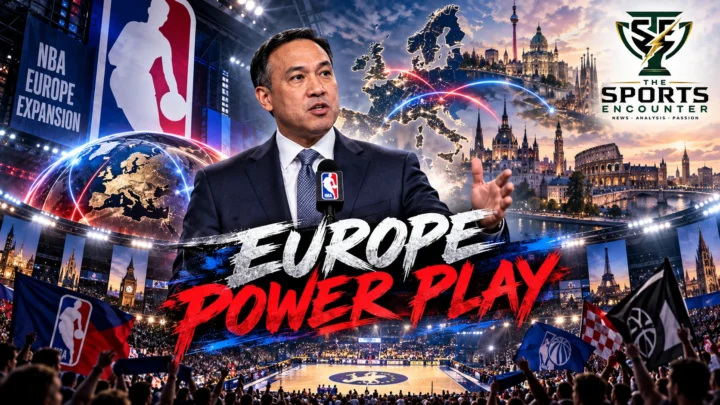
LONDON, England, November 25, 2026: The NBA has announced plans to mobilize at least €10 billion ($10.97 billion) for basketball arenas and entertainment districts across Europe, giving its proposed NBA Europe competition a financial dimension that extends far beyond the court. The league is assembling an investor group to help clubs build new facilities or modernize existing ones as it prepares to launch the league with FIBA in 2027.
The immediate significance lies in the assets that could remain valuable throughout the year. A European basketball club might play only a few dozen home games in a season, but an arena can host concerts, exhibitions and other sporting events on dates when the team is away. Who controls that calendar, and who keeps the proceeds, could become as important to the new competition as the identity of its founding clubs.
Key Takeaways
- NBA Commissioner Adam Silver said the facilities could help “transform basketball teams and their surrounding communities.” The financial question is how clubs and venue operators will divide the benefits of that transformation.
- Consider a hypothetical 16,000-seat venue with 25 home basketball fixtures annually.
- The Sports Consultancy study cited by the NBA projects roughly 70 million spectators and more than €24 billion in economic value added over the first decade, alongside nearly 15,000 annual full-time-equivalent jobs.
What the NBA Europe funding announcement actually means
The NBA’s official announcement identifies eight investment businesses among those supporting the initiative: Apollo Sports Capital, Ares Management, Arctos (part of KKR), Blackstone, HPS Investment Partners (part of BlackRock), J.P. Morgan, Sixth Street and Stonepeak.
The €10 billion figure is a funding target. It should not be confused with money already transferred to clubs, a league valuation or expenditure from the NBA’s own balance sheet. The distribution of financing among projects, its terms and individual investor commitments have not been established in the published material reviewed.
NBA Commissioner Adam Silver said the facilities could help “transform basketball teams and their surrounding communities.” The financial question is how clubs and venue operators will divide the benefits of that transformation.
| Category | Purpose | Current status |
|---|---|---|
| Arena financing | Construction, refurbishment and surrounding developments | At least €10 billion targeted |
| Franchise investment | Acquiring participation and ownership rights | Individual agreements not established in this announcement |
| Club operating budget | Players, staff, travel and competition costs | Final club-level terms undisclosed |
As TSE reported in its October analysis of NBA Europe franchise negotiations, prospective ownership bids had already reached hundreds of millions of dollars. The arena initiative addresses a separate investment requirement: where those teams will play and how the venues will generate income.
Why a sold-out basketball season may still leave an arena underused
Consider a hypothetical 16,000-seat venue with 25 home basketball fixtures annually. Even if every game sells out, basketball accounts for just 400,000 admissions and 25 event dates. The remaining dates are available in principle for other uses, although setup, maintenance and scheduling would limit the actual number.
NBA Europe and the economics of a second event calendar
| Assumption | Basketball only | With additional events |
|---|---|---|
| Basketball games | 25 | 25 |
| Basketball admissions | 400,000 | 400,000 |
| Other event dates | 0 | 40 |
| Other admissions (10,000 per event) | 0 | 400,000 |
| Total admissions | 400,000 | 800,000 |
Under these assumptions, the venue doubles its annual admissions without adding a basketball fixture. That does not double profit: concerts and basketball games have different rental terms, production expenses, staffing requirements and ticket prices. It illustrates why entertainment districts matter to NBA Europe and why a club’s access to non-basketball revenue deserves scrutiny.
The same logic featured in Bill Foley’s Las Vegas expansion bid, where venue readiness and operating experience formed part of the ownership proposition. European clubs, however, may share facilities with other teams or independent operators. A successful venue does not necessarily mean its basketball tenant receives a proportionate financial benefit.
From visiting NBA games to a permanent European competition
The NBA’s relationship with European arenas already has a commercial history. London hosted its first regular-season games in 2011. The league’s three-year international games program subsequently selected Berlin and London for 2026, Manchester and Paris for 2027, and Berlin and Paris for 2028.
Those events can demonstrate local enthusiasm for marquee American teams. A permanent NBA Europe club must establish a different kind of demand: repeat attendance for ordinary league fixtures, local sponsorship and a recognizable identity independent of visiting superstars.
TSE’s coverage of the reported interruption to NBA games in the Middle East also illustrates the fragility of a touring calendar. A permanent league introduces longer-term obligations to employees, supporters and venue partners, even when commercial or operational conditions change.
Can EuroLeague clubs afford to ignore the arena initiative?
EuroLeague shareholders rejected a cooperation proposal in October, although talks have continued. The existing competition has a valuable asset that a new arena cannot manufacture: established rivalries and supporters who return because of their attachment to particular clubs. NBA Europe could offer access to capital, but teams considering a move must evaluate the consequences for existing commercial agreements, domestic schedules and their supporters.
FIBA’s joint competition proposal includes permanent places and an annual qualification route via the Basketball Champions League or another qualifying event. The proposal also seeks to coordinate NBA Europe with domestic leagues and national-team calendars.
That raises an important financing question. A permanent member can plan around continued participation; a club qualifying for a single season may have less certainty over future international gate receipts. Arena loans and leases can run for decades. The rules governing access, revenue distribution and minimum venue requirements will determine whether sporting qualification is financially practical.
The proposed support for development programs is also relevant. As TSE explored in its report on the Futures Basketball League backed by LeBron James and Kevin Durant, investment in young players requires a working development system, not merely a high-profile competition. European clubs need affordable training facilities and coaching resources alongside premium spectator venues.
Continue the NBA Story



What the projected economic impact leaves unanswered
The Sports Consultancy study cited by the NBA projects roughly 70 million spectators and more than €24 billion in economic value added over the first decade, alongside nearly 15,000 annual full-time-equivalent jobs.
That implies approximately seven million spectator admissions and more than €2.4 billion in gross value added per year on a simple ten-year average. These are projections, not annual ticket sales or cash distributions. Gross value added measures economic activity rather than investor profit. Neither figure establishes whether a particular arena can repay its financing.
As TSE’s analysis of global sports media rights illustrates, broadcasting is another important part of the business. Venue earnings and media distributions need to be considered separately when assessing the sustainability of a club.
What must be confirmed before the new league begins
Existing arenas could host early NBA Europe fixtures while longer construction projects proceed. But until specific locations, financing agreements, ownership arrangements and opening schedules are disclosed, the investment target cannot establish which facilities will be ready in 2027.
For fans, the meaningful indicators are affordable ticket options, transport access and continuity of local club identity. For clubs, they are the cost of venue access, security of home dates and their entitlement to commercial income generated outside games.
Ultimately, NBA Europe will need to demonstrate that its arena strategy strengthens the teams playing inside those buildings. A thriving entertainment district could benefit a city and its investors, but European basketball clubs will judge the initiative by whether it leaves them financially stronger and able to serve their supporters.