
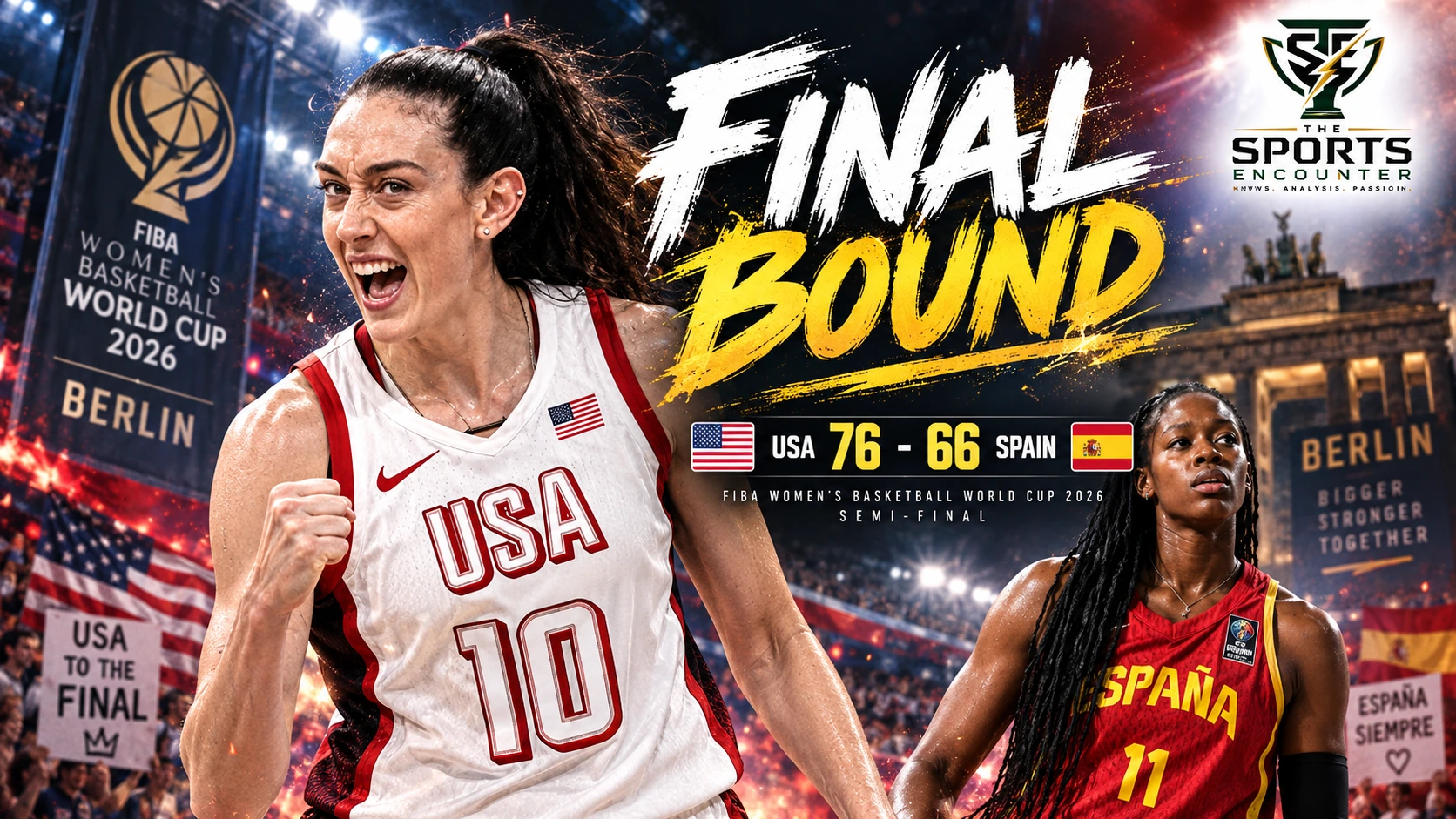
BERLIN, GERMANY, September 12, 2026: The United States is back in the FIBA Women’s Basketball World Cup final, but Spain made the defending champion work for every inch of it.
Team USA beat Spain 76-66 in Berlin after the teams entered the fourth quarter tied 58-58, surviving its most serious knockout-stage test of the tournament and setting up a championship-game rematch with France.
Breanna Stewart provided the steady hand the Americans needed, finishing with 16 points and six rebounds. Spain’s 20-year-old guard Iyana Martín scored 17 points and became the youngest player to score more than 16 points in a Women’s World Cup semifinal.
The 10-point final margin does not tell the story of the game.
Spain led 9-1 early, trailed by only three at halftime, won the third quarter 22-19 and became the first team in Women’s World Cup history to enter the fourth quarter tied with the United States in a semifinal.
Then the defending champions did what dynasties do. They found another gear when the margin for error disappeared.
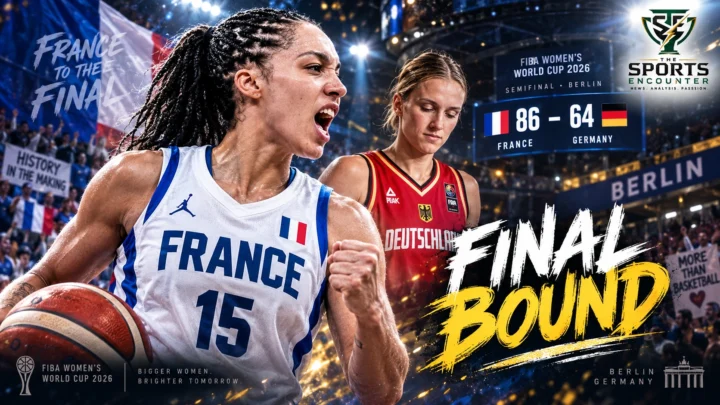
The result sends Team USA into a fifth consecutive World Cup final and gives the Americans a chance to win a fifth straight title and 12th championship overall. France will be waiting after beating Germany 86-64 to reach its first World Cup final.
USA vs Spain: FIBA Women’s World Cup Semifinal at a Glance
| Match Detail | Spain | USA |
|---|---|---|
| Final score | 66 | 76 |
| First quarter | 18 | 21 |
| Halftime | 36 | 39 |
| Third quarter | 22 | 19 |
| Score after three quarters | 58 | 58 |
| Fourth quarter | 8 | 18 |
| Leading scorer | Iyana Martín, 17 | Breanna Stewart, 16 |
| What’s next | Bronze game vs Germany | Final vs France |
The matchup and tournament pathway are confirmed by the official FIBA game page, while FIBA’s postgame analysis highlighted Stewart’s 16 points, six rebounds and late-game leadership.
Spain Opened Like a Team With Nothing to Fear
Spain did not spend the opening minutes trying to survive the United States. It attacked immediately, played with pace and forced Team USA to respond rather than dictate the game from the opening possession.
Awa Fam hit an early three-pointer, Spain jumped ahead 9-1 and the semifinal immediately took on a very different shape from the quarterfinal routs that had sent both teams into the final four.
The Americans eventually settled. Rhyne Howard helped cut into the early deficit, Paige Bueckers gave the offense more control, and Team USA moved ahead for the first time at 17-16 before taking a 21-18 lead into the second quarter.
That response mattered because the United States had entered the semifinal with a recent history of blowing opponents away once its depth started to take over.
The most obvious example came in the quarterfinal, where the Americans crushed Hungary 108-56. Before that, they scored 105 against Czechia, part of the offensive surge covered in our Group D analysis of USA’s 105-point statement.
Spain refused to let this semifinal follow that script.
The Halftime Score Told USA Something It Had Not Wanted to Hear
At halftime, Team USA led only 39-36.
Spain had survived the American response and continued creating good shots through Martín, Fam, María Conde and Raquel Carrera.
The Americans had more size, more individual creation and deeper rotation options, but Spain kept dragging the game back toward half-court execution.
That slower, possession-by-possession game suited Spain because it reduced the impact of Team USA’s depth and made every defensive stand more valuable.
Two days earlier, Spain had overwhelmed Australia 89-66 in the quarterfinals. The Sports Encounter’s breakdown of that quarterfinal win showed how well Spain had balanced youth, pace and defensive discipline.
Against the United States, that same confidence was visible from the start.
The Third Quarter Turned a Competitive Game Into a Historic One
Spain won the third quarter 22-19.
Conde’s outside shooting and Martín’s aggression kept forcing the Americans to defend deep into possessions. Kahleah Copper answered repeatedly for Team USA, but Spain kept finding another response.
Martín tied the game at 58-58 late in the period.
According to FIBA’s official postgame feature, it was the first Women’s World Cup semifinal in which the United States entered the fourth quarter tied.
That single fact gives Spain’s performance its proper scale. This was not a favorite managing a comfortable lead while an underdog hung around. With 10 minutes left, the semifinal was completely open.
Iyana Martín’s 17 Points Became Part of World Cup History
Martín’s 17 points were more than Spain’s leading total.
FIBA confirmed that the 20-year-old became the youngest player to score more than 16 points in a Women’s World Cup semifinal.
Her performance continued a tournament in which she had already emerged as the face of Spain’s next generation.
Before the semifinal, FIBA had highlighted Martín and Awa Fam as two of the tournament’s leading young talents. Martín entered the knockout stage averaging 16.5 points per game and had already produced back-to-back 20-point performances earlier in the event.
Spain’s youth had been one of the reasons the team recovered so well after a shock group-stage defeat to Mali. Our Group A report tracked how Spain responded and still finished first in the group.
Then Came the Fourth Quarter
Dynasties are often judged by what happens when the expected script disappears.
The United States had no cushion entering the final period.
Spain had belief. The crowd understood the possibility of an upset. Team USA was 10 minutes from either another final or its first World Cup defeat since the 2006 semifinals.
The Americans responded by winning the fourth quarter 18-8.
A 12-2 run created the decisive separation, moving the score from a one-possession battle into a 70-60 American lead.
Spain’s foul trouble became increasingly important. Martín and Maite Cazorla were carrying four fouls, and the physical burden of defending the United States for three quarters began to show.
Spain continued competing, but the Americans were finally able to convert stops into controlled possessions rather than rushed exchanges.
That fourth-quarter control was enough to finally separate the teams after three quarters in which Spain had matched the defending champions possession for possession.
Stewart Gave USA Exactly What a Veteran Is Supposed to Give
Stewart’s 16 points and six rebounds do not look overwhelming by superstar standards.
They were precisely what Team USA needed.
FIBA described Stewart as the constant in a game where the Americans struggled for long periods. Her experience mattered because the semifinal had stopped being about talent accumulation and become a test of composure.
Stewart also moved to 266 career Women’s World Cup points, passing Cheryl Miller for fifth on the United States’ all-time scoring list.
She is now the only American player ranked inside the national team’s top five in World Cup points, rebounds and assists.
That historical profile helps explain why Stewart remains central even in a roster containing Caitlin Clark, Paige Bueckers, Napheesa Collier, Angel Reese and other elite players.
When the tournament becomes uncomfortable, experience becomes a skill.
This Was the Test USA Needed Before Facing France
Team USA’s path to the semifinal had included explosive performances, but it had also contained a warning.
Italy held the Americans to their lowest Women’s World Cup scoring total in 42 years during a 55-52 group-stage game, a result we examined in our analysis of the USA-Italy struggle.
That game showed that slowing the pace, crowding driving lanes and forcing Team USA to execute in the half court could create pressure.
Spain took that blueprint much further.
Unlike Italy, Spain also generated enough offense to keep the scoreboard level deep into the game.
The Americans therefore arrive in the final having experienced something they had not faced in the quarterfinals: a genuine late-game elimination threat.
Caitlin Clark’s Tournament Has Become About More Than Numbers
Before the World Cup, much of the attention around Team USA focused on Clark’s first major global championship.
The Sports Encounter framed Berlin as Clark’s biggest international test yet.
She answered part of that question early, producing a strong all-around performance in USA’s 94-61 win over China.
By the semifinals, however, the tournament had become less about one player and more about how the Americans use their depth when different opponents create different problems.
Against Spain, Stewart’s steadiness, Copper’s physical scoring and Bueckers’ control all mattered.
That balance is exactly what a championship roster is supposed to provide.
Spain Lost the Game but Strengthened Its Future
Spain will leave the semifinal disappointed because it was close enough to imagine the final.
That disappointment should not hide what the tournament revealed.
Martín is 20. Fam is one of the most promising young frontcourt players in Europe. The roster blends those rising players with experienced internationals such as Conde, Carrera and Cazorla.
The result against Australia already showed Spain could dominate a major knockout game.
The 76-66 defeat to the United States showed something different: Spain can stand level with the deepest team in international basketball entering the final quarter of a World Cup semifinal.
That is a stronger long-term signal than a comfortable bronze-medal pathway would have been.
The USA-France Final Is a 2024 Olympic Rematch
The championship game now carries obvious history.
France lost the 2024 Paris Olympic final to the United States by one point.
Two years later, France arrives in Berlin unbeaten and playing the best basketball of its World Cup history.
France has won all five games by at least 22 points, including Saturday’s 86-64 semifinal victory over Germany. Our France-Germany semifinal analysis showed how Gabby Williams and the French defense turned 25 German turnovers into a historic first trip to the final.
The United States brings the opposite kind of momentum.
France has dominated its route to the final, while Team USA has now been pushed through the kind of late-game pressure that can expose weaknesses before a championship game.
That contrast gives Sunday’s final far more intrigue than a simple favorite-against-challenger narrative.
USA’s World Cup Dynasty Is One Win From Another Record Chapter
FIBA confirmed before the semifinal that the United States was appearing in the final four for the 13th consecutive time and in an 11th straight semifinal since the semifinal format was introduced in 1986.
The Americans have now reached a fifth consecutive championship game.
A victory over France would deliver a fifth straight world title and a 12th championship overall.
The official FIBA semifinal announcement documented the scale of that sustained dominance before Saturday’s games.
The remarkable part is that Spain came within one quarter of putting all of it at risk.
TSE Analysis: The Final Margin Hid USA’s Most Valuable Lesson
Team USA did not need another 30-point win before playing France.
It needed this.
It needed a game where the opponent led early, where the offense never fully escaped pressure, where the score was tied after three quarters and where reputation could not close the game by itself.
Spain forced the Americans to find out whether the habits behind the dynasty still worked when the scoreboard stopped cooperating.
The answer was yes. Stewart stayed composed, the defense improved, the fourth-quarter execution sharpened and Team USA won the final 10 minutes 18-8.
The lesson is not that Spain exposed a fatal weakness.
It is that the United States can still win when the overwhelming talent advantage does not immediately become an overwhelming score.
That may matter more against France than anything Team USA learned during its blowout victories.
Spain, meanwhile, leaves the semifinal with a different kind of proof. Its next generation did not merely compete at a World Cup. It pushed the reigning champion to the edge of the final quarter.
Team USA moves on to play for another chapter in its extraordinary World Cup history, while Spain leaves Berlin with evidence that its next generation is already capable of challenging the sport’s established order.
Frequently Asked Questions
What was the USA vs Spain score at the 2026 FIBA Women’s World Cup?
The United States defeated Spain 76-66 in the semifinal in Berlin.
Was the USA-Spain semifinal close?
Yes. The game was tied 58-58 after three quarters before Team USA won the fourth quarter 18-8.
Who led Team USA against Spain?
Breanna Stewart scored 16 points and grabbed six rebounds while providing the veteran leadership FIBA highlighted as decisive.
Who led Spain?
Iyana Martín scored 17 points. At 20, she became the youngest player to score more than 16 points in a Women’s World Cup semifinal.
Who will Team USA face in the final?
The United States will face France, which beat Germany 86-64 in the other semifinal.
What happens next for Spain?
Spain will face host Germany in the third-place game, with a World Cup bronze medal at stake.