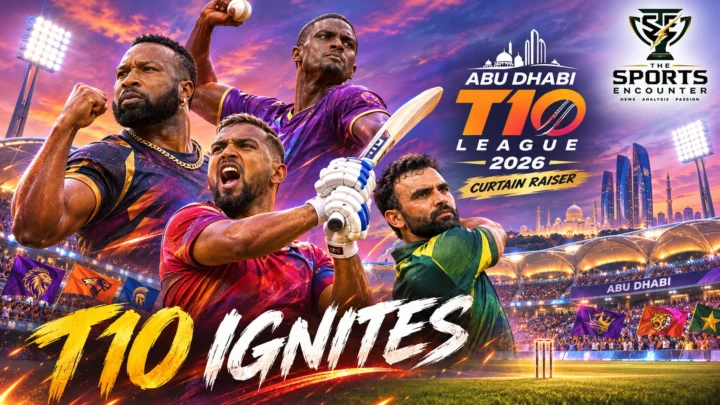
LAHORE, Pakistan, November 6, 2026: Sixteen Pakistani cricketers, including Fakhar Zaman, Shadab Khan, Naseem Shah and Mohammad Amir, have been handed a lifeline just before the Abu Dhabi T10 League begins on November 7. The Pakistan Cricket Board (PCB) has reportedly reached a financial agreement with tournament organizers, clearing the main obstacle that threatened to keep players from five franchises out of the 2026 competition. The breakthrough follows days of uncertainty over the board’s demand for No-Objection Certificate (NOC) fees, although confirmation that every individual certificate has actually been issued remains outstanding.
The settlement is particularly significant because the league opens at Zayed Cricket Stadium on Saturday, with all six participating franchises scheduled to play on the first day. The PCB had reportedly sought $10,000 for each of 16 players, prompting concerns that franchises would have to pay additional charges or arrange replacements. The subsequent agreement, reached on November 5 according to contemporary reports, has eased those concerns. Yet the dispute leaves a larger question unanswered: can Pakistan protect its national cricket interests while giving players and overseas leagues enough certainty to plan their participation?
PCB and Abu Dhabi T10 Reach NOC Agreement: What Has Actually Changed?
The development reverses the increasingly pessimistic outlook surrounding Pakistan’s participation in the tenth edition of the Abu Dhabi T10.
Earlier reports indicated that the PCB had withheld approval while seeking a payment of $10,000 for each No-Objection Certificate. With the tournament approaching, franchises faced the prospect of losing players already included in their squad plans.
Story at a glance

PCB and Abu Dhabi T10 Reach NOC Agreement: What Has Actually Changed?
The development reverses the increasingly pessimistic outlook surrounding Pakistan’s participation in the tenth edition of the Abu Dhabi T10.
Why Were Pakistani Players at Risk of Missing the Abu Dhabi T10?
The uncertainty developed after the September 30 player draft.
Which 16 Pakistani Players Were Selected for Abu Dhabi T10 2026?
Five franchises account for the 16 Pakistani players named in the widely reported draft-related list. The sixth team, Yas Lions, has no player in that particular group.
Why UAE Bulls and United Tigers Had the Most to Lose
Defending champions UAE Bulls begin their title defense with several established names, including Kieron Pollard, Sunil Narine and Romario Shepherd.
What Does the PCB Gain From the Reported Financial Settlement?
The financial dispute deserves close examination because the figures being circulated describe different things.
Reports on November 5 indicated that the board and organizers had reached an agreement. Additional reporting on November 6 described a settlement that would allow the Pakistani contingent to participate.
Some accounts put the package of compensation and facilities at up to $200,000. Others described a lump-sum arrangement worth less than the originally requested cash total. Those descriptions are not necessarily equivalent, and the complete contractual breakdown has not been publicly established in the material reviewed.
The most important practical distinction is between an agreement in principle, approval for participation and an individual NOC actually being issued to a player.
| Key Question | Position as of November 6 | What Remains to Be Confirmed |
|---|---|---|
| Has the PCB reached an agreement? | Yes, according to multiple reports citing sources | Full written terms and official public documentation |
| Can Pakistani players now participate? | The reported agreement opens the way for participation | Individual NOC issuance and player availability |
| How many players were affected? | 16 players in the widely reported draft-related list | Any later additions or changes to final registered squads |
| How many franchises selected those players? | Five of the six participating teams | Final matchday squads |
| Was a fee originally demanded? | Reports cited $10,000 per NOC | Formal wording of the original demand |
| What is the settlement worth? | Reported descriptions differ between cash and broader commercial benefits | Verified cash amount, facilities and other benefits |
| When does the competition begin? | November 7, 2026 | Whether every selected Pakistani player will be available immediately |
The agreement is a substantial improvement in the players’ prospects. However, a credible report of an agreement should not be mistaken for a verified list of 16 completed NOCs.
Why Were Pakistani Players at Risk of Missing the Abu Dhabi T10?
The uncertainty developed after the September 30 player draft.
Abu Dhabi T10 organizers reportedly submitted requests for Pakistani players’ NOCs shortly after the selections were made. The PCB’s financial demand was communicated much closer to the tournament’s opening date, according to reporting on the dispute.
That timing created practical problems. Franchises had selected players for specific roles, prepared combinations around their availability and entered the final stages of tournament planning.
Replacing a specialist fast bowler, spinner or top-order batter immediately before a 10-over competition is not necessarily straightforward. Available alternatives may already have contracts elsewhere, while travel and team-registration requirements can complicate late changes.
Some Pakistani cricketers were reportedly prepared to pay the disputed fee themselves if their franchises refused to cover it.
Such an arrangement could have shifted the commercial cost of participation from tournament organizers onto individual players. Whether that would have been fair depends on their contracts and the rules governing release, neither of which can be assumed from the reports alone.
How the NOC Dispute Developed
| Date | Development | Consequence |
|---|---|---|
| May 2026 | Abu Dhabi T10’s new ownership structure was announced | Tournament entered a new organizational phase |
| September 30 | Player draft held in Abu Dhabi | Sixteen Pakistani players were included in the widely reported selection list across five franchises |
| Early November | PCB reportedly communicated its $10,000-per-player demand | Organizers and franchises faced additional costs and possible replacements |
| November 3 | Reports confirmed players were still awaiting NOCs | Uncertainty intensified before the opening weekend |
| November 4 | Further reporting suggested participation was increasingly doubtful | Franchises faced a shrinking preparation window |
| November 5 | Agreement between the PCB and organizers reported | Main financial disagreement appeared to have been resolved |
| November 6 | Further settlement details emerged | Prospects improved, but individual approvals still required confirmation |
| November 7 | Abu Dhabi T10 scheduled to begin | First test of actual player availability |
The chronology reveals the dispute’s central weakness. The players had been selected more than five weeks before the tournament, yet clarity over their participation arrived only at the end of the preparation period.
That uncertainty can affect players, coaches, franchise owners and organizers even when a financial settlement is eventually reached.
Which 16 Pakistani Players Were Selected for Abu Dhabi T10 2026?
Five franchises account for the 16 Pakistani players named in the widely reported draft-related list. The sixth team, Yas Lions, has no player in that particular group.
Defending champions UAE Bulls have the largest Pakistani contingent, followed by United Tigers.
| Franchise | Pakistani Players | Count |
|---|---|---|
| UAE Bulls | Shadab Khan, Mohammad Amir, Khawaja Nafay, Khushdil Shah, Azam Khan, Mohammad Wasim Jr. | 6 |
| United Tigers | Fakhar Zaman, Iftikhar Ahmed, Faheem Ashraf, Sufyan Muqeem, Abbas Afridi | 5 |
| Emirates Eagles | Akif Javed, Hasan Nawaz, Ali Raza | 3 |
| Royal Desert Champions | Naseem Shah | 1 |
| Arabian Aces | Salman Irshad | 1 |
| Yas Lions | None in the reported 16-player list | 0 |
| Total | Sixteen players across five franchises | 16 |
TSE statistical discovery: UAE Bulls and United Tigers together account for 11 of the 16 Pakistani players in this list, representing 68.75% of the reported contingent.
The concentration matters because those two franchises have built substantial parts of their batting, all-round and bowling options around Pakistani talent.
For UAE Bulls, losing six players immediately before the season would have created a significant squad-management problem. United Tigers faced a comparable challenge with five.
The list describes the reported player group affected by the NOC dispute. It should not be treated as an independently verified, exhaustive count of every Pakistani national appearing on updated official squad pages, which may change after the draft.
Why UAE Bulls and United Tigers Had the Most to Lose
Defending champions UAE Bulls begin their title defense with several established names, including Kieron Pollard, Sunil Narine and Romario Shepherd.
Their Pakistani selections add valuable tactical variety.
Shadab Khan offers leg-spin, batting depth and fielding athleticism. Khushdil Shah provides left-handed hitting and a spin option, while Azam Khan and Khawaja Nafay offer aggressive batting.
Mohammad Amir and Mohammad Wasim Jr. give the team pace-bowling alternatives in a format where a poor over can dramatically change a contest.
Shadab’s recent franchise performances illustrate why such flexibility is valuable. In August, he produced a powerful all-round display for Antigua and Barbuda Falcons, taking one wicket for eight runs before hitting an unbeaten 52 from 20 balls, as documented in The Sports Encounter’s Caribbean Premier League analysis.
He also contributed to the Falcons’ strong finish to the league stage, covered in TSE’s report on their victory over Guyana Amazon Warriors.
Those performances are not predictions of Abu Dhabi T10 form. They demonstrate the range of skills that a franchise can lose when an overseas player becomes unavailable.
United Tigers: Fakhar Zaman’s Role Could Be Particularly Important
United Tigers recruited Fakhar Zaman alongside experienced Pakistani all-rounders Iftikhar Ahmed and Faheem Ashraf. Abbas Afridi and Sufyan Muqeem provide additional bowling variety.
Fakhar’s ability to score quickly at the top of the order makes him an important option in a tournament where every side receives only 60 legal deliveries.
His recent form also makes his participation particularly interesting.
On October 31, Fakhar scored 127 from 99 balls as Pakistan successfully chased 326 against Sri Lanka in the ODI tri-series final. That innings was central to a remarkable result examined in TSE’s detailed report on Pakistan’s historic chase.
A One-Day International innings does not automatically translate into T10 success, but Fakhar’s attacking range offers a useful starting point for the Tigers’ plans.
The five Pakistani players also create the possibility of a balanced combination featuring specialist batting, pace, spin and experienced lower-order hitting.
That combination still depends on their availability, form and final team selection.
What Does the PCB Gain From the Reported Financial Settlement?
The financial dispute deserves close examination because the figures being circulated describe different things.
The reported original demand was $10,000 for each of 16 players, producing a straightforward potential cash total of $160,000.
Subsequent accounts described an arrangement involving compensation and facilities worth up to $200,000. Other reporting indicated that the agreed cash payment was lower than the original total.
These accounts should not be combined into a claim that the PCB received a $200,000 cash payment.
| Financial Item | Amount | Meaning |
|---|---|---|
| Reported original NOC demand | $10,000 per player | Reported proposed charge |
| Players in affected group | 16 | Basis for original calculation |
| Original demand at full participation | $160,000 | 16 multiplied by $10,000 |
| Reported broader settlement package | Up to $200,000 | Some reports combine compensation and facilities |
| Reported final cash component | Not independently established | Other accounts suggest less than the original requested total |
| Verified amount received by PCB | Not established | Payment and delivery require independent confirmation |
The commercial logic presented in reporting is that the PCB wants compensation where it sees limited reciprocal opportunities for Pakistan cricket.
For example, players from certain overseas leagues may not generate equivalent recruitment demand within the Pakistan Super League.
However, whether that rationale justifies a last-minute financial condition is a separate question.
National boards have legitimate interests in player workloads, availability, insurance, contractual obligations and the health of domestic competitions.
Overseas franchises also need reasonable certainty when recruiting players who are expected to join their squads.
A transparent, consistently applied NOC policy could help address both concerns.
Why the Nepal Premier League Dispute Makes This More Than an Isolated Incident
The Abu Dhabi disagreement follows a reported dispute involving the Nepal Premier League in October.
In that case, the PCB reportedly sought $25,000 per player, with several Pakistani cricketers returning home without playing.
Hussain Talat and Jahandad Khan were among the players whose participation continued, according to contemporary reporting.
The comparison raises a governance question: should NOC financial conditions be established well before player recruitment, rather than becoming a matter for negotiation shortly before a tournament starts?
There are arguments on both sides.
Supporters of tighter control may argue that national boards invest heavily in developing players and should not lose access to them without suitable safeguards.
Players and franchise organizers may argue that late uncertainty can damage earning opportunities, contractual confidence and future recruitment prospects.
Both arguments deserve consideration, but neither establishes that a particular fee is automatically justified or unlawful.
The wider problem is predictability. An overseas franchise making a player investment needs to know what approvals are required, who is responsible for securing them and how far in advance a decision can be expected.
Could Late NOC Decisions Hurt Pakistani Players’ Future Franchise Opportunities?
The immediate settlement may prevent disruption to this year’s Abu Dhabi T10, but the longer-term risk is more difficult to measure.
Overseas leagues recruit players for more than their individual batting and bowling abilities. Availability, travel arrangements, contractual certainty and the ability to join pre-tournament preparations also influence recruitment decisions.
If a franchise repeatedly faces unexpected clearance difficulties, it may begin to favor alternatives whose availability appears easier to establish.
That possibility should be understood as a commercial risk, not an established finding that Pakistani players have already lost specific future contracts because of this dispute.
Franchise cricket is becoming increasingly competitive for players, particularly as existing leagues expand and new competitions seek international talent.
The Sports Encounter’s investigation into the PSL’s 2027 scheduling overlap with the IPL examined how calendar congestion already complicates player recruitment and availability.
That problem becomes more difficult if contractual clearance remains uncertain after selections have been made.
There is also a commercial comparison with other cricket boards. TSE’s report on New Zealand Cricket abandoning a proposed Major League Cricket franchise investment examined how governing bodies must weigh domestic priorities against overseas commercial opportunities.
The circumstances differ, but both stories concern how national cricket institutions interact with expanding international franchise businesses.
Abu Dhabi T10 2026: When Do Pakistani Players’ Teams Play on Opening Day?
The first day of the competition will feature three matches, and every participating franchise is scheduled to take the field.
UAE Bulls open against Yas Lions, followed by Royal Desert Champions against Emirates Eagles. United Tigers then face Arabian Aces.
That schedule makes the timing of the NOC agreement especially consequential. All five franchises with players in the affected Pakistani group have matches scheduled for November 7.
November 7 Opening Fixtures and Pakistan Start Times
| Fixture | UAE Time (GST) | Pakistan Time (PKT) | Pakistani Players in Reported List |
|---|---|---|---|
| UAE Bulls vs. Yas Lions | 3:30 PM | 4:30 PM | Six in UAE Bulls |
| Royal Desert Champions vs. Emirates Eagles | 5:45 PM | 6:45 PM | One in Royal Desert Champions, three in Emirates Eagles |
| United Tigers vs. Arabian Aces | 8:00 PM | 9:00 PM | Five in United Tigers, one in Arabian Aces |
All three fixtures are scheduled at Zayed Cricket Stadium, Abu Dhabi. Pakistan is one hour ahead of the United Arab Emirates, which has been reflected in the converted start times.
The opening matches also provide several compelling international matchups.
Kieron Pollard’s defending champions begin against a Yas Lions side led by Jason Holder, with David Willey, James Vince and Dasun Shanaka among the notable names associated with the Lions.
Royal Desert Champions include Nicholas Pooran and Phil Salt, alongside Pakistan fast bowler Naseem Shah.
United Tigers’ overseas group includes Afghanistan all-rounder Azmatullah Omarzai, while Arabian Aces feature Moeen Ali, Andre Russell and Liam Livingstone.
The official Abu Dhabi T10 opening-day schedule confirms the three fixtures and their timings.
The published fixtures do not independently confirm the availability or selection of individual Pakistani players. Final matchday squads will provide that evidence.
How Does the Revamped Abu Dhabi T10 League Work in 2026?
The tournament has undergone an important organizational change ahead of its tenth edition.
Abu Dhabi Cricket & Sports Hub has assumed majority ownership and commercial control, with support from the Abu Dhabi Sports Council and Emirates Cricket Board.
The new structure positions the competition as a long-term Abu Dhabi sporting property.
Six franchises will contest the 2026 season rather than the eight-team format described in some earlier announcements.
All six will play a double round-robin league stage, giving each team ten matches.
That produces 30 league fixtures, followed by a qualifier and final on November 20.
What Must Teams Do to Reach the Abu Dhabi T10 Final?
| Stage | Format | Consequence |
|---|---|---|
| League stage | Six teams, each playing ten matches | Final standings determine the top three |
| First place | Highest-ranked team after league stage | Qualifies directly for the final |
| Second and third | Contest November 20 qualifier | Winner advances to the final |
| Fourth to sixth | Finish outside the top three | Eliminated after league stage |
| Qualifier | November 20, 4:30 PM GST | Determines the second finalist |
| Final | November 20, 6:45 PM GST | Determines the champion |
Finishing first is therefore especially valuable. The league leader bypasses the qualifier, while the teams finishing second and third must contest an additional elimination match.
With only three of six teams advancing, exactly half the franchises will qualify for the final day.
The league phase ends on November 19 with another triple-header, meaning net run rate could become important if teams remain tied near the qualification cutoff.
The official Abu Dhabi T10 player-draft announcement provides the recruitment background, while the league’s ownership announcement explains the changes to the competition’s management.
Why the Tournament’s New Ownership Makes the PCB Agreement More Significant
The timing of the dispute is particularly sensitive because this is the first full Abu Dhabi T10 season under the new management structure.
Organizers have been promoting stronger governance, long-term investment, international stars and an expanded commercial strategy.
Securing the participation of well-known Pakistani players supports that objective, particularly because Pakistan is one of cricket’s largest and most engaged audiences.
Fakhar Zaman, Shadab Khan, Naseem Shah and Mohammad Amir have established followings that can help connect franchise teams with viewers beyond the UAE.
However, a commercial agreement reached shortly before the tournament is a reminder that franchise organizers must coordinate with national boards well before opening day.
The impact also extends to recruitment strategy.
Each franchise needs a sufficiently stable squad to develop team combinations, create promotional material and plan around international-player availability.
The Sports Encounter previously examined the importance of recognizable team identity in its analysis of branding challenges across T20 and T10 franchise cricket.
For a competition undergoing substantial changes in ownership and team identities, stable player recruitment provides another important foundation for building a recognizable sporting product.
Does Pakistan’s International Schedule Justify Tight NOC Restrictions?
National-team availability is a legitimate issue whenever internationally contracted players seek overseas opportunities.
The PCB must consider future international commitments, fitness, workload, domestic obligations and the terms of individual contracts.
Fast bowlers such as Naseem Shah and Mohammad Wasim Jr. require particular attention to workload management, although there is no verified evidence in the reviewed material that a specific medical or fitness concern caused the current dispute.
Similarly, players involved in Pakistan’s recent ODI tri-series may have different recovery and preparation needs depending on their workloads.
Shadab Khan, for example, recently played a remarkable role in Pakistan’s victory over England, scoring an unbeaten century in a one-wicket chase, as documented in TSE’s October 25 match report.
But the NOC dispute has been reported principally as a financial disagreement. Player protection should not be presented as its established cause without supporting evidence.
The distinction matters because financial compensation and physical workload are separate issues requiring different forms of oversight.
What Could a More Predictable PCB NOC Policy Look Like?
The latest dispute suggests several practical areas for improvement.
First, leagues and franchises should know the applicable approval rules before they recruit players.
Second, financial conditions should be disclosed at an appropriate stage rather than introduced shortly before a tournament begins.
Third, the responsibilities of players, franchises, league organizers and national boards should be established through clear contracts and published procedures.
Fourth, there should be a defined process for handling disputes when an NOC is delayed or refused.
These are policy recommendations based on the difficulties illustrated by the dispute. They are not claims about measures the PCB has already approved.
There is also a commercial opportunity for Pakistan cricket in managing its relationship with overseas competitions more effectively.
The PCB has been exploring additional shorter-format cricket opportunities of its own. TSE’s investigation into the proposed PSL Sixes tournament examined how new competitions could broaden participation while generating additional revenue.
That ambition makes reciprocal arrangements with overseas leagues a potentially important policy area.
However, a reciprocal arrangement should be judged by its actual benefits, contractual obligations and effect on players, rather than simply the size of an announced financial package.
What Can Other Cricket Leagues Learn From the Abu Dhabi NOC Dispute?
National-board approval, player recruitment and franchise finances are increasingly connected across the global cricket calendar.
Leagues can spend months assembling competitive squads, but a single unresolved approval requirement may disrupt multiple teams near opening day.
At the same time, cricket authorities have legitimate reasons to preserve control over contracted players and protect domestic competitions.
Different boards have taken different approaches to franchise development and regulation.
The Bangladesh Premier League, for example, has faced a separate governance and commercial reset, examined in TSE’s report on the competition being put on hold.
The Abu Dhabi dispute did not arise from the same circumstances, but both developments show that a successful franchise ecosystem requires dependable governance as well as recognizable players.
Cricket’s growing number of international competitions makes coordination more important.
The Hong Kong Sixes, for example, operates under an entirely different structure from the Abu Dhabi T10. Its Cup, Plate and Bowl system was explained in TSE’s guide to the 2026 tournament’s three championship pathways.
The two competitions should not be confused, but their contrasting structures illustrate how short-format cricket is creating a wider range of professional and commercial opportunities.
Continue the Abu Dhabi T10 Story
 Abu Dhabi T10Abu Dhabi T10 2026 Curtain Raiser: Six Teams, 108 Players and a Ruthless Title Race in the Fastest Format
 CricketPSL Eyes Six-a-Side Tournament to Reach Smaller Cities, but Can Another Cricket League Make Money?
 CPL 2026Identical Cricket Team Kits: Why T20 and T10 Franchises Are Losing Their Unique Identities
Frequently Asked Questions About Pakistan Players and Abu Dhabi T10 2026
Has the PCB allowed Pakistani players to participate in Abu Dhabi T10 2026?
The PCB and tournament organizers have reportedly reached an agreement opening the way for Pakistani participation. Individual NOCs and final player availability still require confirmation.
How many Pakistani players were affected by the dispute?
The widely reported draft-related list contains 16 Pakistani players across five franchises. Updated official squad listings may contain additional or changed registrations.
Why was the PCB delaying NOCs?
Contemporary reporting indicates that the dispute concerned a financial demand of approximately $10,000 per No-Objection Certificate.
How much did Abu Dhabi T10 agree to pay the PCB?
Reports differ. Some describe compensation and facilities worth up to $200,000, while others describe a cash settlement below the original $160,000 demand. The exact financial breakdown has not been independently established.
Which franchise will Fakhar Zaman play for?
Fakhar Zaman is listed with United Tigers. His participation in a specific match depends on final clearance, availability and team selection.
Which team selected Naseem Shah?
Royal Desert Champions selected Naseem Shah for the 2026 competition.
Which Abu Dhabi T10 franchise has the most Pakistani players?
UAE Bulls have six players in the widely reported 16-player group, the most of any participating franchise in that list.
When does Abu Dhabi T10 2026 start?
The tournament begins on Saturday, November 7, 2026, at Zayed Cricket Stadium in Abu Dhabi.
How many teams are competing in Abu Dhabi T10 2026?
Six teams are competing: UAE Bulls, Yas Lions, Royal Desert Champions, Emirates Eagles, United Tigers and Arabian Aces.
How does a team qualify for the Abu Dhabi T10 final?
The team finishing first in the double round-robin league stage qualifies directly for the final. The second- and third-placed teams contest a qualifier, with the winner taking the other final berth.
PCB’s Abu Dhabi T10 U-Turn Solves the Immediate Crisis, but the Bigger Test Lies Ahead
The agreement between the PCB and Abu Dhabi T10 organizers appears to have rescued the participation prospects of 16 Pakistani cricketers after several days of uncertainty.
For franchises, the settlement offers relief after the possibility of replacing key players immediately before the tournament.
For fans, it increases the likelihood of watching some of Pakistan’s most recognizable international and franchise cricketers competing alongside major overseas stars.
For the PCB, however, the outcome raises questions extending beyond the November 7 opening fixtures.
Can financial terms be established earlier? Can players receive approval decisions within predictable deadlines? Can national-team priorities be protected without creating unnecessary contractual uncertainty?
Those questions deserve serious consideration, particularly after similar concerns emerged during the Nepal Premier League.
The next step is practical rather than rhetorical. Confirmed individual NOCs, player arrivals, registered matchday squads and actual participation will establish how effectively the agreement has been implemented.
Abu Dhabi T10 begins with three matches on Saturday and closes on November 20, when its revamped six-team competition will crown a champion.
Pakistan’s players now have a clearer route into that tournament. Whether the PCB’s handling of the dispute produces a more reliable overseas participation policy will be judged over a much longer period.