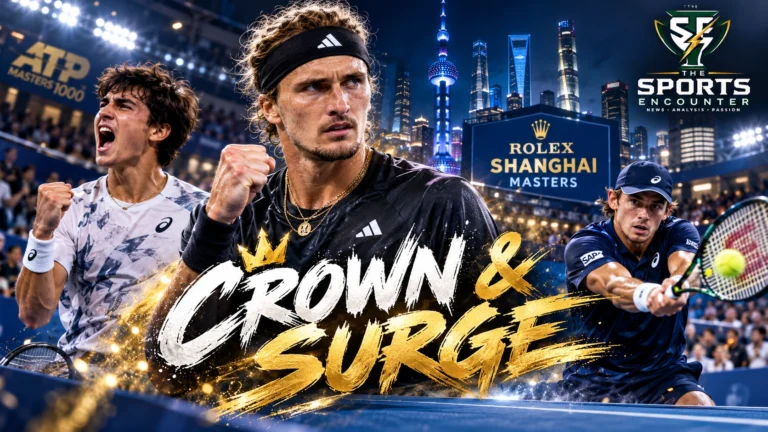
SHANGHAI, China, October 15, 2026: Alexander Zverev finally found a convincing answer to Alex de Minaur’s recent resistance on Thursday, defeating the Australian 6-4, 6-4 in just 78 minutes to reach the Shanghai Masters semifinals. The top-seeded German will face Alejandro Davidovich Fokina on Saturday after the Spaniard advanced when Arthur Gea retired with psoas pain while trailing 4-1 in the opening set at Qizhong Forest Sports City Arena.
Zverev’s 10 aces and two decisive service breaks told only part of the story. He also saved five break points across two crucial games, preventing De Minaur from turning sustained pressure into a comeback. Davidovich Fokina, meanwhile, received a much-needed shorter afternoon after surviving two consecutive deciding-set tiebreaks. Their semifinal now presents an intriguing contest between Zverev’s improving level and the Spaniard’s opportunity to recover from a demanding tournament.
Shanghai Masters 2026: October 15 Quarterfinal Results
| Quarterfinal | Result | Winner |
|---|---|---|
| Alexander Zverev vs Alex de Minaur | 6-4, 6-4 | Alexander Zverev |
| Alejandro Davidovich Fokina vs Arthur Gea | 4-1, Gea retired | Alejandro Davidovich Fokina |
Zverev will meet Davidovich Fokina in the semifinals on Saturday, October 17. The other two quarterfinals, scheduled for Friday, feature Daniil Medvedev against Tommy Paul and Rafael Jodar against Casper Ruud.
How Did Zverev Finally Get the Better of De Minaur?
De Minaur entered Thursday’s match with enough recent success against Zverev to make their quarterfinal particularly interesting.
Story at a glance

Shanghai Masters 2026: October 15 Quarterfinal Results
Zverev will meet Davidovich Fokina in the semifinals on Saturday, October 17. The other two quarterfinals, scheduled for Friday, feature Daniil Medvedev against Tommy Paul and Rafael Jodar against Casper Ruud.
How Did Zverev Finally Get the Better of De Minaur?
De Minaur entered Thursday’s match with enough recent success against Zverev to make their quarterfinal particularly interesting.
What Has Changed for Zverev Since His Recent Defeats?
Zverev has developed a stronger habit of protecting important points during a season in which his accomplishments have extended far beyond Shanghai.
Why Did Arthur Gea Retire Against Davidovich Fokina?
While Zverev and De Minaur contested two completed sets, the day’s other quarterfinal lasted only five games.
Why Davidovich Fokina May Benefit From a Shorter Quarterfinal
For Davidovich Fokina, the circumstances were unfortunate but created welcome recovery time before his fourth career Masters 1000 semifinal.
The Australian had won their previous two meetings, both at the Laver Cup. Most recently, he recovered from a set down in London last month and saved a match point before winning 2-6, 7-6(5), 11-9.
That extraordinary turnaround became one of the most revealing contests of the competition, which eventually ended with Zverev helping Team Europe reclaim the Laver Cup.
Shanghai offered a more conventional best-of-three contest, with normal advantage sets replacing the Laver Cup’s deciding match tiebreak. Zverev made the adjustment count.
He began striking his groundstrokes aggressively enough to stop De Minaur from settling into the extended exchanges that often favor the Australian’s speed and defensive coverage.
According to the official Shanghai Masters quarterfinal report, Zverev won 35 of 44 points behind his first serve, an 80 percent success rate.
That gave him an important advantage. De Minaur still created opportunities, but Zverev repeatedly found his most reliable tennis when the Australian threatened his serve.
The First Set Turned on Three Break Points Zverev Refused to Concede
The opening set was more competitive than the 6-4 scoreline might suggest.
Zverev broke De Minaur in the fifth game, converting his opportunity with a forehand winner. He then faced three break points in the following game.
That was the Australian’s immediate chance to restore equality.
Instead, Zverev saved all three and consolidated the break for 4-2.
The sequence effectively separated the players for the remainder of the set. De Minaur had created the chance to undo the damage but could not convert it, while Zverev protected his advantage and served out the opener.
The distinction is important because De Minaur’s strongest comebacks often begin when opponents fail to consolidate a break. Here, Zverev gave him no such opening.
Another Escape at 2-3 Changed the Second Set
The second set brought a similar test, although the danger arrived slightly later.
Serving at 2-3, Zverev faced two break points. Losing that game would have allowed De Minaur to serve with a break advantage and a chance to push the quarterfinal toward a deciding set.
Zverev saved both opportunities, held for 3-3 and immediately broke the Australian in the next game.
Within two games, the possibility of De Minaur taking control had turned into a 4-3 advantage for Zverev.
Those five saved break points across the two sets explain the victory more effectively than the score alone. De Minaur generated pressure at moments that could have changed the match. Zverev answered each time.
The win improved the German’s career head-to-head record against De Minaur to 9-4.
What Has Changed for Zverev Since His Recent Defeats?
Zverev has developed a stronger habit of protecting important points during a season in which his accomplishments have extended far beyond Shanghai.
He entered the tournament having won Roland Garros and the US Open, with his New York triumph showing how effectively he could regain control after an opponent threatened a comeback.
Against Ben Shelton in September, Zverev surrendered the third set before completing a four-set victory. TSE’s analysis of the US Open final examined the German’s response to that pressure.
His Shanghai quarterfinal provided a different test. He never lost the lead after establishing it, and his first serve repeatedly gave him a route out of danger.
Thursday’s result also represented another step in a fluctuating Asian swing.
At the China Open, Zverev began with an efficient victory over Cameron Norrie, a performance covered in TSE’s Beijing opening-round analysis.
Novak Djokovic subsequently defeated him 4-6, 6-4, 6-4 in the quarterfinals, as documented in TSE’s report on Beijing’s final-four lineup.
In Shanghai, Zverev initially needed three sets to overcome Quentin Halys and Alexander Bublik. Against De Minaur, however, he reached a noticeably higher standard.
With a 62-14 season record after Thursday’s victory, Zverev has reached his third Shanghai semifinal and his first since 2019, when he progressed to the final.
Why Did Arthur Gea Retire Against Davidovich Fokina?
While Zverev and De Minaur contested two completed sets, the day’s other quarterfinal lasted only five games.
Davidovich Fokina led Gea 4-1 when the 21-year-old Frenchman stopped playing because of pain in his psoas, a muscle in the hip region.
The circumstances were explained in the tournament’s official account of Gea’s retirement.
Gea reported experiencing pain earlier that morning. He received treatment before the match and remained uncertain whether he could compete, but chose to try.
Once on court, he concluded that continuing carried too much risk.
The player said he planned to undergo further tests after returning to France. No confirmed recovery timeline was provided.
This was an injury retirement after play had started, rather than a walkover awarded before the match.
Gea’s Shanghai Breakthrough Deserved a Better Ending
The retirement ended an impressive run by a player who had been steadily establishing himself on the ATP Tour.
Gea had defeated Ben Shelton and Jakub Mensik on his way to the Shanghai quarterfinals, continuing the momentum established earlier in the season.
His breakthrough included a maiden tour-level title in Los Cabos, where he defeated defending champion Denis Shapovalov in straight sets.
TSE’s detailed report on Gea’s Los Cabos championship documented how the Frenchman emerged from relative obscurity to defeat an established Top 10-level opponent in a final.
Shanghai represented another important stage in that development. Reaching a Masters 1000 quarterfinal after defeating established opponents offered evidence of his increasing competitiveness.
His withdrawal denied him the opportunity to test that progress over a complete match against Davidovich Fokina.
The immediate priority is establishing the nature of the problem through the planned medical assessment. Any prediction about his return would be premature.
Why Davidovich Fokina May Benefit From a Shorter Quarterfinal
For Davidovich Fokina, the circumstances were unfortunate but created welcome recovery time before his fourth career Masters 1000 semifinal.
The Spaniard had already completed two demanding matches to reach the quarterfinals.
Against Frances Tiafoe, he saved a match point before winning a deciding-set tiebreak.
He then defeated former Shanghai champion Hubert Hurkacz through another third-set tiebreak.
Those escapes carried a physical cost, particularly in a tournament where recovery time between rounds becomes increasingly important.
Davidovich Fokina has also built an encouraging run on Chinese courts, having won the Chengdu title earlier in the Asian swing.
His brief encounter with Gea means he enters Saturday without having endured another lengthy quarterfinal.
However, the benefit should not be exaggerated. Zverev needed only 78 minutes to beat De Minaur, so neither semifinalist endured an especially long Thursday match.
The more meaningful difference is cumulative workload. Davidovich Fokina had survived successive deciding-set tiebreaks, while Zverev arrives with the confidence of producing arguably his cleanest performance of the tournament.
What Will Decide Zverev vs Davidovich Fokina in the Shanghai Semifinal?
The matchup presents several questions that go beyond their quarterfinal results.
Can Davidovich Fokina Put Enough Returns Into Play?
Zverev’s serving against De Minaur was exceptional, particularly on first-serve points.
If that standard continues, Davidovich Fokina may struggle to create sustained pressure in return games.
His opportunities are more likely to come when rallies extend beyond Zverev’s initial attack or when the German’s first-serve percentage falls.
The challenge will be converting those opportunities, something De Minaur failed to do despite creating five break points during the two decisive service games.
Can Zverev Maintain His Aggression Against Another Mobile Opponent?
Davidovich Fokina is capable of extending rallies, retrieving difficult balls and changing direction from uncomfortable positions.
Those qualities could test whether Zverev’s improved baseline aggression against De Minaur is sustainable against a different opponent.
The German’s forehand will be particularly important. When he controls points with it, he reduces the opportunities for opponents to move him into defensive positions.
When he becomes passive, longer rallies can become more complicated.
Will Recovery Change the Balance?
Davidovich Fokina has received a shorter quarterfinal, while Zverev has avoided the physical burden of a three-set battle.
Both developments are favorable for preparation, but neither establishes a guaranteed advantage.
Continue the Tennis Story

The semifinal will provide the stronger evidence of how much their previous matches have affected their movement, consistency and ability to sustain pressure.
Why the Shanghai Title Still Matters to Zverev After Securing Year-End No. 1
Zverev entered the quarterfinal having already secured the year-end No. 1 ranking following Carlos Alcaraz’s defeat to Zizou Bergs earlier in the tournament.
That result completed a remarkable ranking story, with TSE examining the implications in its report on Bergs’ upset of Alcaraz and Zverev’s historic achievement.
However, guaranteeing the year-end honor and occupying the top position in the weekly ATP rankings are separate matters.
Jannik Sinner remained the weekly World No. 1 when Zverev secured the season-ending distinction. The German could reach the weekly top position as early as November 2 under the applicable ranking calculations.
Shanghai therefore remains important for reasons beyond the year-end race.
Zverev has never won the Shanghai Masters, and the title would add another Masters 1000 championship to his outstanding season.
His recent Beijing defeat also provides some perspective. Djokovic managed to beat him despite losing the first set, as TSE documented while examining the Serbian’s physically demanding route through the China Open.
De Minaur subsequently reached that tournament’s final, but retired during the championship match against Djokovic. TSE’s Beijing final report explored the circumstances of the retirement and Djokovic’s seventh China Open championship.
The two Beijing stories underline how demanding the Asian hard-court stretch has become for several leading players.
For Zverev, Shanghai offers the opportunity to turn a season already defined by major achievements into another significant tournament victory.
Shanghai Masters 2026: Frequently Asked Questions
Who Won the Zverev vs De Minaur Shanghai Quarterfinal?
Alexander Zverev defeated Alex de Minaur 6-4, 6-4 on October 15, 2026.
How Long Did Zverev’s Quarterfinal Last?
The German completed his victory in 78 minutes.
How Many Aces Did Zverev Hit Against De Minaur?
Zverev hit 10 aces and won 35 of 44 points behind his first serve.
Why Did Arthur Gea Retire?
Gea stopped playing because of psoas pain that he reported experiencing earlier on match day. He was trailing Davidovich Fokina 4-1 in the first set.
Who Will Zverev Play in the Shanghai Semifinals?
Zverev will face Alejandro Davidovich Fokina, who advanced following Gea’s retirement.
When Is the Zverev vs Davidovich Fokina Semifinal?
The semifinal is scheduled for Saturday, October 17, 2026. The exact start time should be confirmed against the official order of play.
Has Zverev Already Secured the 2026 Year-End World No. 1 Ranking?
Yes. Zverev secured the year-end No. 1 honor following Carlos Alcaraz’s elimination in Shanghai, although that did not immediately place him first in the weekly ATP rankings.
Has Zverev Won the Shanghai Masters Before?
No. Zverev previously reached the Shanghai final in 2019 but has yet to win the tournament.
The Semifinal Question Shanghai Has Left Unanswered
Zverev’s victory over De Minaur demonstrated a familiar quality at a particularly high level: his ability to protect his serve when a match threatens to change direction.
Davidovich Fokina reached the same stage through a more exhausting series of encounters, followed by an unfortunate early ending to his quarterfinal.
Both players now have reasons to approach Saturday with confidence.
Zverev has rediscovered the aggressive baseline tennis and serving consistency that made him so difficult to beat earlier this season. Davidovich Fokina has survived pressure, collected important victories and avoided another lengthy match immediately before the semifinals.
The winner will reach the Shanghai Masters final. The more revealing question is whether Zverev’s recent improvement will withstand another opponent prepared to make him work through difficult rallies and important points.