KAKAMIGAHARA, Japan, October 1, 2026: India looked finished with the hard part after going 3-0 up.
Pakistan had other ideas.
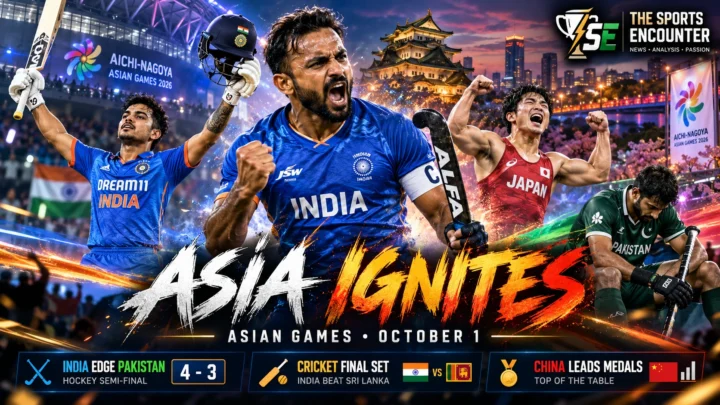
What began as another controlled Indian performance turned into one of the fiercest India-Pakistan hockey contests in years as Pakistan recovered from three goals down to level the Asian Games semifinal at 3-3.
For nearly 11 minutes, the game sat on the edge of a shootout.
Story at a glance

India vs Pakistan Asian Games 2026 Semifinal at a Glance
The semifinal carried even more weight because both teams had entered the tournament with attacking momentum.
Harmanpreet Punishes Pakistan’s Early Penalty-Corner Problems
India took control almost immediately.
Sukhjeet Makes It 3-0 and India Appear to Have Broken the Semifinal
India’s third goal was the best move of the first half.
Abu Mahmood Gives Pakistan Something to Believe In
Pakistan desperately needed the next goal.
Pakistan’s Second-Half Pressure Exposes India’s Defensive Problems
Pakistan came out after halftime with a different rhythm.
Then Abhishek found the final touch.
With only 49.2 seconds remaining, his shot from the edge of the circle took a deflection off Sufiyan Khan’s stick and beat Pakistan goalkeeper Muneeb Ur Rehman Raza, giving India a 4-3 victory and a place in the Asian Games gold-medal match.
Pakistan’s gold-medal hopes ended in the cruelest possible way.
India survived a collapse of control.
The rivalry finally produced the kind of match its history promised.
India vs Pakistan Asian Games 2026 Semifinal at a Glance
| Match Detail | Information |
|---|---|
| Competition | Asian Games 2026 Men’s Hockey |
| Stage | Semifinal |
| Venue | Gifu Prefectural Green Stadium, Kakamigahara |
| Result | India 4-3 Pakistan |
| India Scorers | Harmanpreet Singh 5′, 13′; Sukhjeet Singh 23′; Abhishek 60′ |
| Pakistan Scorers | Abu Mahmood 30′; Hannan Shahid 45′; Waheed Ashraf Rana 49′ |
| India’s Biggest Lead | 3-0 |
| Pakistan Comeback | 3-0 to 3-3 |
| Winning Goal | Abhishek, 49.2 seconds remaining |
| Consequence | India reach gold-medal match; Pakistan move to bronze-medal match |
The semifinal carried even more weight because both teams had entered the tournament with attacking momentum.
India opened the Games by beating Indonesia 13-1, while Pakistan began with a 9-0 victory over Thailand. The Sports Encounter covered those statements in its Asian Games opening-day report.
The semifinal proved far less forgiving.
Harmanpreet Punishes Pakistan’s Early Penalty-Corner Problems
India took control almost immediately.
Captain Harmanpreet Singh converted a penalty corner in the fifth minute to put India ahead.
Pakistan then compounded the problem by conceding another penalty corner.
Harmanpreet converted again in the 13th minute.
Two goals.
Two penalty corners.
A 2-0 first-quarter deficit.
Pakistan had opportunities of their own through set pieces but could not convert them, with Sufiyan Khan seeing one drag-flick blocked by the first runner.
That early imbalance became the first major difference between the teams.
India converted their best set-piece moments.
Pakistan did not.
Sukhjeet Makes It 3-0 and India Appear to Have Broken the Semifinal
India’s third goal was the best move of the first half.
Shilanand Lakra kept the ball alive near the baseline and sent it across the face of goal.
Sukhjeet Singh reacted sharply and deflected it beyond the goalkeeper in the 23rd minute.
India led 3-0.
At that stage, the semifinal looked close to finished.
India had greater control through midfield, clearer circle entries and superior set-piece execution.
Pakistan were being pushed into riskier attacks.
That should have favored India.
Instead, the entire momentum of the match changed before halftime.
Abu Mahmood Gives Pakistan Something to Believe In
Pakistan desperately needed the next goal.
Captain Abu Mahmood supplied it.
In the 30th minute, he converted a penalty corner and reduced the deficit to 3-1.
The timing mattered enormously.
A 3-0 halftime deficit would have left Pakistan chasing three goals while also needing to protect against Indian counterattacks.
At 3-1, there was a route back.
That single penalty-corner conversion altered the emotional state of the contest.
India walked into halftime still two goals ahead.
Pakistan walked off believing the semifinal was alive.
Pakistan’s Second-Half Pressure Exposes India’s Defensive Problems
Pakistan came out after halftime with a different rhythm.
They widened the pitch.
They moved the ball faster between both flanks.
They pressed India higher.
The result was the first sustained period in which India stopped dictating where the match was played.
India still had chances.
Abhishek hit the post.
But Pakistan increasingly carried the greater threat.
The Sports Encounter had already seen warning signs in India’s recent international defense. During the FIH Hockey World Cup, India beat Pakistan 5-3 but still conceded three goals in a match TSE examined in India Knock Pakistan Out as 49-Goal World Cup Day Delivers Drama.
This time, Pakistan went further.
Hannan Shahid Makes It 3-2 and Turns Pressure Into Belief
Pakistan’s second goal arrived in the 45th minute.
A scramble inside the Indian circle left Hannan Shahid with the chance to finish from close range.
He did.
India’s three-goal lead had been reduced to one.
Pakistan had gone from survival mode to genuine control.
That goal also reflected the change in where the semifinal was being played.
In the first half, Pakistan had struggled to stay inside India’s defensive circle long enough to build pressure.
By the end of the third quarter, they were creating repeated second-phase opportunities.
India’s structure had begun to loosen.
Waheed Ashraf Rana Completes One of Pakistan’s Best Comebacks of the Year
Pakistan did not wait long in the fourth quarter.
Waheed Ashraf Rana scored in the 49th minute to make it 3-3.
The comeback was complete.
From 3-0 down.
Against India.
In an Asian Games semifinal.
The nature of the third goal showed how far momentum had shifted.
Pakistan moved the ball quickly from the right, attacked the available space and forced India into a reactive defensive shape.
Rana finished the move.
India suddenly faced a problem few would have predicted after 23 minutes.
They were no longer protecting a lead.
They were trying to avoid elimination.
Pakistan’s Comeback Was Built on More Than Emotion
It would be easy to describe Pakistan’s recovery simply as passion.
The tactical shift mattered more.
Pakistan stretched India horizontally.
That created more room for Hannan and Rana between Indian defensive lines.
The midfield also became more aggressive in recovering second balls.
India’s first-half control depended heavily on winning possession early and attacking before Pakistan could reorganize.
Once Pakistan started winning those transitions, the game changed.
The comeback therefore was not accidental.
Pakistan altered the flow.
India failed to manage it.
India Survive a Penalty Corner That Could Have Changed Everything
At 3-3, Pakistan had opportunities to complete the comeback.
They earned another penalty corner in the 54th minute.
India’s first runner produced the block.
That defensive moment deserves more attention than it will receive.
If Pakistan had scored there, India would have needed to chase the match after surrendering a three-goal lead.
Instead, the score remained level.
India survived.
The final six minutes became increasingly frantic.
Raza’s Double Save Almost Takes the Match to a Shootout
Pakistan goalkeeper Muneeb Ur Rehman Raza then produced a decisive late intervention.
India pushed hard in the final minutes.
Raza made a double save and appeared to have done enough to send the semifinal toward a shootout.
Pakistan had already survived a late Indian penalty-corner situation when a successful referral overturned the decision to a free hit.
That looked like the final defensive escape.
It was not.
Abhishek Delivers With 49.2 Seconds Left
The decisive moment arrived almost at the end.
Abhishek received the ball near the edge of the circle and pushed it toward goal.
The shot deflected off Sufiyan Khan’s stick.
Raza could not adjust.
The ball crossed the line.
India led 4-3.
Only 49.2 seconds remained.
Pakistan had spent most of the second half rebuilding the semifinal.
One late deflection erased all of it.
Star Performer for India: Abhishek
Abhishek did not dominate the entire match.
He decided it.
That is the difference.
He had already come close earlier when one attempt hit the post.
When another chance arrived in the final minute, he made it count.
In a rivalry where individual moments often define careers, this goal will follow him for a long time.
Harmanpreet’s First-Quarter Brace Was Just as Important
Abhishek scored the winner.
Harmanpreet created the platform.
His two penalty-corner goals in the opening 13 minutes gave India the cushion they eventually needed.
The Indian captain’s drag-flicking remains one of the biggest tactical advantages in Asian hockey.
Pakistan knew where the danger was coming from.
They still could not stop it.
That is what makes elite penalty-corner execution so valuable.
The Sports Encounter’s FIH Hockey World Cup preview had already highlighted the importance of set-piece efficiency among the leading Asian teams.
This semifinal reinforced the point.
Pakistan’s Star Performer: Hannan Shahid
Hannan Shahid was Pakistan’s most influential attacking player.
His 45th-minute goal made the comeback possible.
More importantly, his movement between India’s midfield and defensive line helped Pakistan create the pressure that followed.
He repeatedly attacked space rather than waiting for possession.
That gave India’s defenders a much more difficult problem in the second half.
Pakistan’s comeback involved several players.
Hannan was the one who gave it shape.
Abu Mahmood’s Leadership Changed the Match
Captain Abu Mahmood also deserves significant credit.
Pakistan were 3-0 down and emotionally vulnerable.
His penalty-corner goal just before halftime gave the team something tangible to take into the break.
Captains are judged heavily in matches like this.
Mahmood’s contribution went beyond scoring.
Pakistan did not disappear after a disastrous opening.
They responded.
Why Pakistan Lost Despite the Comeback
The answer lies in two different phases.
Pakistan lost the first phase through poor penalty-corner execution and defensive vulnerability.
They lost the final phase because India created one more decisive moment.
Between those phases, Pakistan were arguably the better team.
That is what will make this defeat difficult to process.
They did enough to turn a 3-0 match into a 3-3 match.
They did not do enough to protect the last minute.
India Won, but the Semifinal Exposed Serious Warning Signs
India should celebrate reaching the final.
They should also study how close they came to throwing the opportunity away.
A 3-0 lead should normally allow a team to control tempo.
India instead became passive.
The defensive line dropped.
Pakistan found more space.
The midfield stopped protecting the circle as effectively.
Captain Harmanpreet later acknowledged that India made too many mistakes in the second half.
That is the central warning before the gold-medal match.
India survived Pakistan.
A final may punish the same mistakes more severely.
India’s Asian Games Hockey Campaign Remains Unbeaten
India entered the semifinal having won all five pool matches.
They started by beating Indonesia 13-1 and continued through the group phase without defeat.
The broader Asian Games campaign has been tracked throughout TSE’s Aichi-Nagoya 2026 coverage.
India now move within one victory of defending the men’s hockey title.
Their opponent will come from the second semifinal between Malaysia and South Korea.
Pakistan Still Have a Bronze Medal to Chase
Pakistan’s gold-medal campaign is over.
Their Asian Games campaign is not.
They will play the loser of Malaysia vs South Korea in the bronze-medal match.
That gives Pakistan an immediate challenge.
Emotionally, recovering from this defeat may be harder than preparing tactically.
Pakistan came within one minute of taking India into a shootout after trailing 3-0.
The danger is allowing the disappointment of the semifinal to damage the medal match.
A bronze medal will not erase the defeat.
It would still give Pakistan tangible reward for a tournament in which they have shown attacking quality and considerable resilience.
This Rivalry Finally Looked Like the India-Pakistan Hockey of Old
Recent India-Pakistan hockey meetings have often become one-sided.
India entered this semifinal on a long unbeaten run against Pakistan.
Their World Cup meeting in August ended 5-3.
This match felt different.
Pakistan recovered from three down.
India nearly lost control.
The final minute mattered.
The result remained uncertain until the closing seconds.
That tension is what made this semifinal worthy of the rivalry’s history.
Final Verdict: Pakistan Won the Comeback, India Won the Match
Pakistan can take pride from the recovery.
They should not be satisfied with the result.
Going from 0-3 to 3-3 against India in an Asian Games semifinal required tactical courage, physical intensity and belief.
India deserve equal credit for finding a winner after surrendering control.
Harmanpreet built the lead.
Pakistan dismantled it.
Hannan and Rana completed the comeback.
Raza kept them alive.
Then Abhishek produced the only moment that mattered more than all of them.
Forty-nine seconds.
One deflection.
One place in the final.
That was the difference.
Continue the Asian Games 2026 Story
 Asian Games 2026India-Pakistan Drama, Japan’s Wrestling Golds and China’s Medal Surge Define Asian Games Action
 Asian Games 2026China Reaches 100 Straight Diving Golds as India Sweeps Archery and Korea-Japan Final Takes Shape
 CricketAsian Games Cricket Semifinals: Pakistan-Bangladesh, India-Sri Lanka, Weather, Squads, and Washout Rules
FAQs
Who Won India vs Pakistan in the Asian Games 2026 Hockey Semifinal?
India beat Pakistan 4-3.
What Was the Score When Pakistan Completed Their Comeback?
Pakistan recovered from 3-0 down to make the score 3-3 in the 49th minute.
Who Scored India’s Winning Goal?
Abhishek scored the winner with 49.2 seconds remaining.
Who Scored for India?
Harmanpreet Singh scored twice, while Sukhjeet Singh and Abhishek scored one each.
Who Scored for Pakistan?
Abu Mahmood, Hannan Shahid and Waheed Ashraf Rana scored Pakistan’s goals.
How Did Pakistan Come Back From 3-0 Down?
Abu Mahmood scored before halftime, Hannan Shahid made it 3-2 in the 45th minute and Rana Waheed equalized in the 49th.
Will Pakistan Still Play for a Medal?
Yes. Pakistan will compete in the bronze-medal match.
Who Will India Play in the Final?
India will face the winner of Malaysia vs South Korea.
When Is the Asian Games Men’s Hockey Final?
The gold-medal match is scheduled for October 3.
India
- India-Pakistan Drama, Japan’s Wrestling Golds and China’s Medal Surge Define Asian Games Action
- Pakistan Erase 3-0 Deficit, but Abhishek’s Last-Minute Strike Sends India Into Asian Games Final
- China Reaches 100 Straight Diving Golds as India Sweeps Archery and Korea-Japan Final Takes Shape
- Shubman Gill’s 223 Turns 406 Into a Cruise as Five Centuries Expose Guwahati’s Batting ‘Road’
- Asian Games Cricket Semifinals: Pakistan-Bangladesh, India-Sri Lanka, Weather, Squads, and Washout Rules