


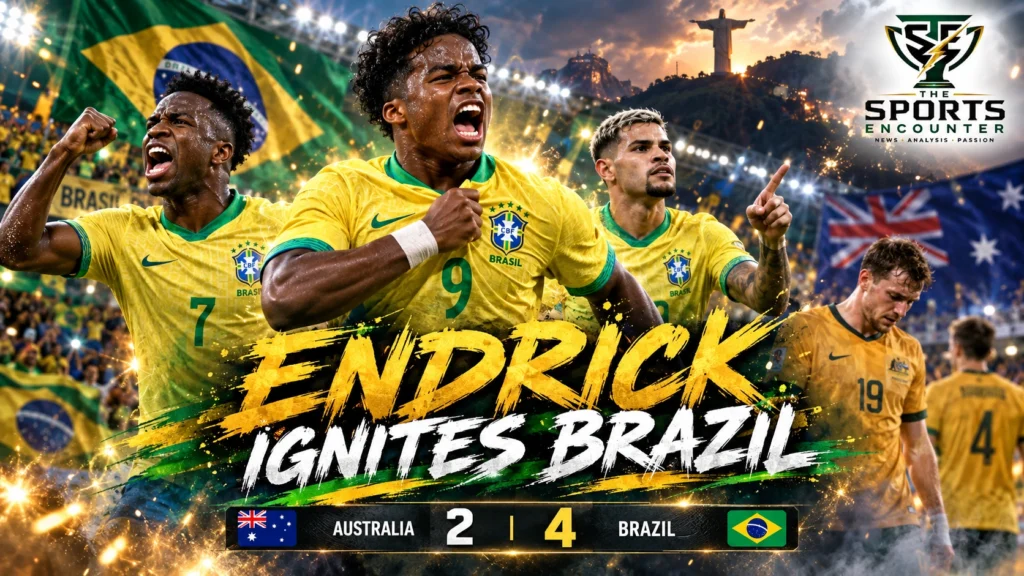
BRISBANE, Australia, September 29, 2026: Brazil needed more than an early goal to beat Australia. They needed a response after falling 2-1 behind, a halftime tactical change and a reminder that the next generation can alter matches rather than simply wait for its turn.
Endrick supplied that change.
Brazil recovered from Australia’s first-half turnaround to win 4-2 at Suncorp Stadium, with Vanderson, Raphinha, Bruno Guimarães and Vinícius Júnior scoring as Carlo Ancelotti claimed his first victory of the post-World Cup cycle.
Australia had threatened to turn the night into something very different. Alessandro Circati canceled out Vanderson’s third-minute opener before Connor Metcalfe put the Socceroos 2-1 ahead after 33 minutes. Raphinha’s penalty restored parity just before halftime, but muscle discomfort prevented him from returning for the second half.
Ancelotti sent on Endrick instead.
The Real Madrid forward helped create Bruno Guimarães’ 69th-minute goal and was central to the move that produced the penalty Vinícius converted in the 80th minute.
Four days after Australia pushed Brazil to a 1-1 draw in Townsville, Brazil finally found the separation their attacking quality had promised.
Australia vs Brazil 4-2: Match Summary
| Match Detail | Information |
|---|---|
| Competition | International Friendly |
| Venue | Suncorp Stadium, Brisbane |
| Result | Australia 2-4 Brazil |
| Australia Scorers | Alessandro Circati 28′, Connor Metcalfe 33′ |
| Brazil Scorers | Vanderson 3′, Raphinha 45′ pen, Bruno Guimarães 69′, Vinícius Júnior 80′ pen |
| Halftime | 2-2 |
| Brazil’s Next Match | India, October 3 |
How Did Australia Turn Brazil’s Early Lead Into a 2-1 Advantage?
Brazil could hardly have asked for a cleaner start.
Rayan and Gabriel Bontempo helped move the ball into Vanderson’s path inside the opening three minutes, and the full-back struck decisively to give Brazil the lead.
For a team that had needed a stoppage-time Rayan header simply to escape Townsville with a draw four days earlier, the early goal looked capable of changing the tone of the series.
Australia refused to accept it.
Circati equalized in the 28th minute before Metcalfe struck five minutes later, giving Tony Popovic’s team a 2-1 advantage and forcing Brazil into another uncomfortable test.
Metcalfe’s involvement was hardly unexpected. He had already shown his tournament value when Australia beat Turkey 2-0 at the 2026 World Cup, and his ability to arrive from midfield again gave Brazil problems in Brisbane.
The five-time world champions were suddenly in danger of completing two games against Australia without a victory.
Why Was Raphinha Substituted at Halftime?
Raphinha gave Brazil the goal they desperately needed before the interval.
Harry Souttar brought Danilo down inside the penalty area, the decision was confirmed after review, and Raphinha converted to make it 2-2.
He did not return for the second half.
The Brazilian Football Confederation confirmed that Raphinha reported muscle discomfort and was withdrawn as a precaution.
There was no official diagnosis of a significant injury immediately after the match, so it would be premature to describe the problem as anything more than muscle discomfort until Brazil or his club provides further medical information.
The timing nevertheless matters because Brazil travel directly to India for another friendly on October 3.
How Did Endrick Change Brazil’s Attack?
Endrick began the evening on the bench after starting the first match in Townsville.
By the end, his second-half contribution had become one of Ancelotti’s most useful pieces of evidence from the Australian tour.
Brazil had threatened before halftime, but Australia had repeatedly disrupted their rhythm and found opportunities when possession changed hands.
Endrick gave the attack a more natural central reference after replacing Raphinha.
He attacked defenders directly, occupied central spaces and helped connect Brazil’s attacking movements around Vinícius.
The most important contribution came in the build-up to the third goal. Endrick combined in the move that released Bruno Guimarães, who restored Brazil’s lead in the 69th minute.
It recalled another important feature of Brazil’s World Cup run. Endrick did not always need to score to change the shape of a match. When Brazil survived Japan in the World Cup Round of 32, his introduction similarly gave Ancelotti a stronger central presence and forced defenders closer to their own goal.
Brisbane provided another example.
Did Vinícius Júnior Finally Find His Moment in the Second Half?
Vinícius had not controlled the game in the first half.
Australia’s defensive organization restricted his space, and Brazil frequently looked more dangerous through movement elsewhere.
The second half opened.
Endrick’s presence created different angles around Australia’s back line, and Vinícius became increasingly involved as Brazil pushed the hosts backward.
His decisive moment came after Brazil won another penalty in the 80th minute. With Raphinha already substituted, Vinícius took responsibility and converted to make it 4-2.
Ancelotti later explained that Bruno Guimarães would normally have been next in the penalty order after Raphinha, but after Bruno had already scored from open play, he wanted Vinícius to have the opportunity.
It was a useful moment for a player who had already demonstrated how destructive he can be for Brazil. His two-goal performance against Scotland helped Brazil finish top of their World Cup group.
The question entering the new cycle is not whether Vinícius has elite ability. It is how consistently Brazil can create the conditions that allow him to dominate international matches.
What Did Carlo Ancelotti Learn From Seven Changes?
Ancelotti changed seven starters from the 1-1 draw in Townsville.
Otávio, Vanderson, Jair Cunha, Gabriel Magalhães, Mauro Júnior, Gabriel Bontempo and Rayan came into the starting lineup as Brazil continued using the September window to examine the next phase of the national team.
That experimentation matters after a World Cup that ended painfully against Norway.
Brazil had looked increasingly convincing during the group stage, including the 3-0 victory over Haiti in which Vinícius and Matheus Cunha gave Ancelotti the attacking response he wanted.
They also showed resilience against Japan.
But their tournament ultimately ended when Norway overturned the Round of 16 tie, a game in which goalkeeper Ørjan Nyland repeatedly frustrated Brazil before Erling Haaland struck late. TSE later examined how Nyland gave Norway the platform to eliminate Brazil.
September therefore represents something different.
Ancelotti is no longer preparing a finished World Cup team. He is building toward the Copa América 2028 and World Cup 2030 cycle while trying to determine which younger players can survive international pressure.
Before the tour, Ancelotti described Brazil’s established core as “very important players for the future” while explaining that experienced players would help integrate the younger group.
Brisbane showed why that balance matters.
Vanderson scored. Gabriel Bontempo started. Endrick changed the second half. Bruno Guimarães restored control. Vinícius finished the game.
The result came from both generations.
Brazil’s Second Half Showed More Than the Final Score
Brazil finished with 18 shots to Australia’s eight and eight efforts on target to Australia’s two, according to the official Socceroos match center.
Possession was almost even, which helps explain why the game felt less comfortable than a 4-2 scoreline might suggest.
Australia did not spend the entire evening retreating.
They pressed, attacked Brazil’s changed defensive unit and created enough first-half problems to take the lead.
Brazil’s superiority became clearer after halftime when the visitors converted their greater attacking volume into decisive chances.
That distinction matters.
This was not a routine four-goal victory against an opponent that never threatened. Australia made Brazil solve problems.
What Does the Defeat Say About Australia Before the Asian Cup?
Australia lost the second match, but the two-game series provided Tony Popovic with considerably more encouragement than the aggregate score might suggest.
The Socceroos drew 1-1 in Townsville and led 2-1 in Brisbane.
They also did it while continuing to integrate younger players around the experienced core.
That fits the broader direction Popovic has been pursuing since Australia’s World Cup campaign.
The Socceroos began that tournament impressively when Irankunda and Metcalfe powered them past Turkey, and they later showed sufficient discipline against Paraguay to reach the World Cup knockout stage.
The campaign ended in much harsher fashion when Egypt eliminated Australia on penalties in the Round of 32. That match, covered in TSE’s report on Australia’s shootout defeat to Egypt, exposed the narrow margins Popovic’s team still has to master.
The two Brazil friendlies offered another level of testing before the 2027 Asian Cup.
Australia did not prove they are ready to beat elite opposition consistently.
They did show that they can make elite opposition uncomfortable.
Was Brazil’s 4-2 Win Their First Victory Since the World Cup?
Yes.
The Australia series marked Brazil’s first matches since their World Cup elimination.
Friday’s first meeting ended 1-1 after Rayan’s stoppage-time equalizer denied Australia a famous win.
Tuesday’s victory therefore gave Brazil their first win of the new international cycle.
The importance is psychological as much as statistical.
Ancelotti is attempting to refresh the squad without abandoning the senior players expected to carry Brazil toward the next major tournaments.
A win does not prove that transition has succeeded.
It gives the process a more useful result to work from.
What Comes Next for Brazil?
Brazil now travel to Kolkata, where they will face India on October 3 at the Vivekananda Yuba Bharati Krirangan, also known as Salt Lake Stadium.
It will be the first meeting between the senior national teams of Brazil and India.
The fixture provides another opportunity for Ancelotti to give minutes to newcomers while assessing Raphinha’s condition after his withdrawal in Brisbane.
Brazil’s larger challenge remains rebuilding the authority that appeared during stretches of the World Cup before the knockout defeat ended the campaign. For broader context on that tournament, TSE’s World Cup Day 14 review captured the stage at which Brazil looked increasingly capable of becoming title contenders.
The new cycle has started with a draw and a victory.
More importantly, Brisbane gave Ancelotti new evidence about who might shape what comes next.
Australia vs Brazil FAQs
What Was the Final Score Between Australia and Brazil?
Brazil beat Australia 4-2 at Suncorp Stadium in Brisbane on September 29, 2026.
Who Scored for Brazil Against Australia?
Vanderson, Raphinha, Bruno Guimarães and Vinícius Júnior scored Brazil’s four goals.
Who Scored for Australia Against Brazil?
Alessandro Circati and Connor Metcalfe scored as Australia came from 1-0 down to lead 2-1 during the first half.
Why Did Raphinha Go Off?
Brazil said Raphinha reported muscle discomfort and was replaced by Endrick at halftime. No more serious diagnosis had been officially confirmed immediately after the match.
Did Endrick Score Against Australia?
No, but his second-half introduction had a major impact. He contributed to Brazil’s attacking improvement, helped create Bruno Guimarães’ goal and was involved in the move that produced Brazil’s second penalty.
Did Vinícius Júnior Score?
Yes. Vinícius converted a penalty in the 80th minute to complete Brazil’s 4-2 victory.
What Was the Result of the First Australia vs Brazil Friendly?
The first match in Townsville ended 1-1 on September 25. Nestory Irankunda scored for Australia before Rayan equalized for Brazil in stoppage time.
Who Do Brazil Play Next?
Brazil face India in Kolkata on October 3, 2026, in the final match of their September-October international window.