


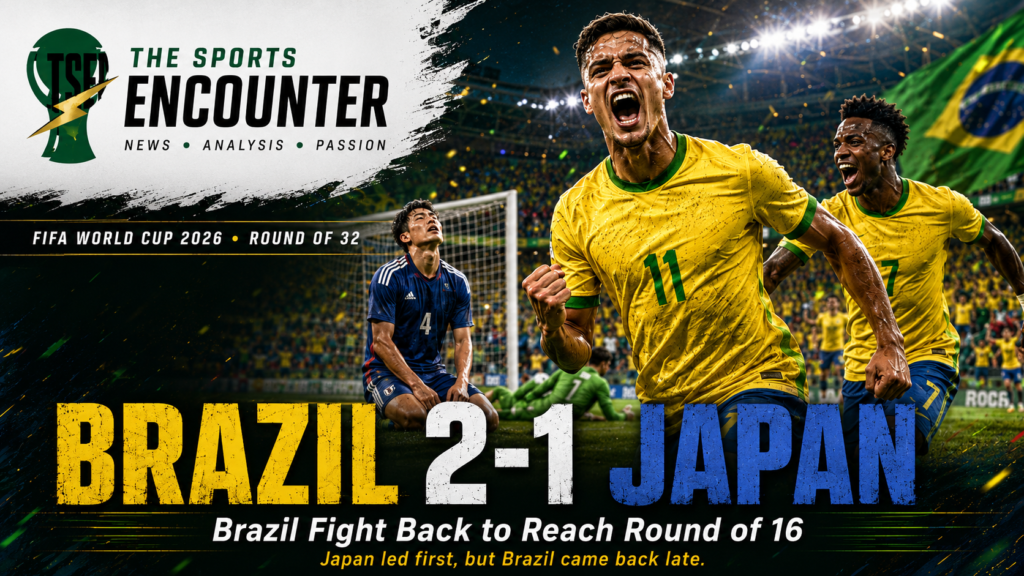
Brazil spent almost an hour in Houston staring at the kind of World Cup night that ruins reputations.
Japan had taken the lead, defended with steel, squeezed Vinícius Júnior into tight spaces, and made the five-time champions look hurried, annoyed, and strangely old in midfield. For a long stretch, Brazil had the ball without the comfort that usually comes with it.
For a deeper look at which third-place teams can actually survive the knockouts, read our full analysis of who among the Lucky 8 can survive the FIFA World Cup 2026 Round of 32.
TL;DR
| Match | Brazil vs Japan |
|---|---|
| Competition | FIFA World Cup 2026, Round of 32 |
| Result | Brazil 2-1 Japan |
| Japan goal | Kaishu Sano, 29’ |
| Brazil goals | Casemiro, 55’; Gabriel Martinelli, 90+6’ |
| Key moment | Martinelli’s late winner after Bruno Guimarães’ pass |
| Cards | No red cards reported; yellow cards included Danilo and Daichi Kamada, with Japan finishing ahead 3-2 on bookings |
| What it means | Brazil advance to the Round of 16 |
Then Casemiro rose. Then Gabriel Martinelli arrived.
Brazil’s 2-1 win over Japan in the FIFA World Cup 2026 Round of 32 was not smooth, but knockout football rarely rewards perfect manners. It rewards nerve, timing, and the ability to survive your worst spell without losing your head. Brazil found all three after Japan threatened to produce one of the tournament’s most dramatic upsets.
For full tournament tracking, fixtures, knockout updates, and daily coverage, follow The Sports Encounter’s FIFA World Cup 2026 coverage hub.
Japan’s Lead Was No Accident
Japan did not take the lead because Brazil switched off for one random second. They earned it through a smart first-half plan.
Hajime Moriyasu set his team up with a five-man defensive shape, and the idea was clear from the opening quarter. Japan wanted to crowd Vinícius Júnior, slow Brazil’s left-side rhythm, and force Carlo Ancelotti’s side to move the ball through congested central areas. Ritsu Doan worked hard on the flank, Takehiro Tomiyasu defended with calm authority, and Japan’s midfield pressed at the right moments instead of chasing shadows.
The reward came in the 29th minute.
Kaishu Sano picked up the ball in midfield, moved past Casemiro too easily, and drove a right-footed shot into the far corner. It was Japan’s first punch, but it landed clean. Brazil had enjoyed plenty of possession before that moment, yet Japan had the sharper emotional grip on the game.
The goal also changed the stadium mood. Brazil’s possession suddenly looked heavier. Japan’s defending looked braver. Every clearance carried more belief.
The early warning signs were there. Brazil had the ball, but they lacked speed in the final pass. Matheus Cunha tried to make himself useful across the front line, Rayan looked lively in moments, and Vinícius kept searching for half-yards. Still, Japan’s coverage around him was excellent.
For Brazil’s earlier group-stage rhythm and Vinícius’ breakout performance against Scotland, read The Sports Encounter’s report on how Brazil topped Group C after Vinícius Júnior’s double against Scotland.
Brazil Needed a Midfield Reset
The first half exposed Brazil’s biggest issue: their midfield had control without enough bite.
Casemiro struggled before halftime. Japan’s opener came after Sano moved beyond him, and Brazil’s buildup often looked too predictable through the middle. Bruno Guimarães had a patchy night, mixing useful forward passes with loose touches and rushed decisions. Lucas Paquetá could not give Brazil the clean creative bridge they needed between midfield and attack.
That is why Ancelotti’s halftime move mattered.
Endrick came on for Paquetá after the break, and Brazil immediately looked more direct. The change gave Japan a new problem. Instead of defending only against wide movement and slow midfield recycling, they now had to deal with a runner who wanted to attack the penalty area quickly.
Brazil began to stretch the match.
Casemiro almost made up for his difficult first half before he actually did. His diving header was cleared off the line, but that warning lasted only a couple of minutes. In the 55th minute, Gabriel Magalhães clipped a clever ball into the box, and Casemiro found the space Japan had denied Brazil for most of the match. His header brought the Seleção level and turned anxiety into momentum.
It was also a reminder that Brazil do not only win through flair. Sometimes, they need an old-school set-piece presence, a midfielder crashing the six-yard area, and a defender with the quality to pick the right delivery.
Vinícius Júnior Was Contained, Then Still Found Damage
Vinícius Júnior did not dominate this match in the way he dominated parts of the group stage. Japan made sure of that.
They doubled him early, supported the first defender quickly, and stopped him from receiving the ball with space to attack. In the first half, he barely had clean isolation moments. Japan forced him inside, crowded his touches, and made Brazil’s most dangerous player work for every yard.
Yet that is where elite forwards still matter.
Even on a night when Japan’s plan worked for long stretches, Vinícius kept pulling defenders toward him. That movement opened pockets for others. When he did finally break into the area in the second half, his outside-of-the-foot effort hit the post after Zion Suzuki got enough on it to keep Japan alive.
That moment captured his night. Japan did enough to stop him from becoming the headline, but they could not make him irrelevant.
Brazil will still need more from him in the Round of 16. Against stronger opponents, the Seleção cannot rely only on late pressure and set-piece rescue work. Vinícius remains their most explosive route to panic inside a defense. The challenge is giving him the ball earlier, faster, and with more support around him.
For more tournament talking points and knockout context, The Sports Encounter’s World Cup 2026 knockout picture explains how the expanded format has changed pressure, rhythm, and opportunity.
Brazil’s Strikers Gave Ancelotti Answers
Brazil started with Matheus Cunha, Rayan, and Vinícius Júnior across the front line. It gave Ancelotti mobility, pressing energy, and technical combinations, but not enough penalty-box threat in the first half.
Cunha worked, drifted, and tried to link play, but Japan’s compact back line limited his best actions. Rayan gave Brazil fresh legs and directness on the right, winning fouls and pushing Japan deeper late in the match. His sharp running helped tilt the final 20 minutes toward Brazil.
Endrick’s introduction added urgency. He did not need to score to change the feel of Brazil’s attack. His presence made Japan defend closer to goal and gave Brazil a more natural central reference point.
Then Martinelli delivered the defining moment.
Coming on in the second half, Martinelli brought vertical running and fresh aggression from the left side. In the sixth minute of stoppage time, Bruno Guimarães found him between the lines. Martinelli took the pass, shifted his body, and placed his finish inside the far post.
It was calm, clean, and ruthless.
That goal also gives Ancelotti a selection question. Brazil started this tournament leaning heavily into Vinícius’ star power, but knockout runs often need bench players who can flip matches. Martinelli just gave Brazil one of those moments.
Japan Leave With Pain, But Not Shame
Japan will feel this defeat deeply because they were close to something huge.
They led Brazil in a knockout match. They forced Ancelotti into early changes. They defended with discipline for most of the game and created enough transition danger to make Brazil uncomfortable. Ayase Ueda had a headed chance before the opener and later tested Alisson from the left after Brazil had equalized.
The regret will come from the second half.
Japan defended well, but they could not keep the ball long enough after Casemiro’s goal. Once Brazil increased the pressure, Japan’s clearances became shorter, their counters became rarer, and the match slowly moved toward their penalty area. The late booking count also reflected the strain. Brazil’s runners, especially Rayan and Martinelli, started forcing tired challenges.
Japan’s World Cup ends, but their performance fits the larger story of their rise. This team no longer arrives as a polite participant. It can hurt elite sides, defend with intelligence, and play without fear. What it still lacks is the final knockout edge: the ability to turn a lead over a giant into a finished job.
For Japan’s path into this matchup, read The Sports Encounter’s report on how Japan and Sweden shared the points as Group F sent both through.
Cards and Discipline
There were no red cards reported.
Daichi Kamada received a yellow card late in the first half after stopping a Brazil counterattack. Danilo was booked early in the second half for catching an opponent with his arm. Available live updates also indicated Japan moved ahead 3-2 on yellow cards by the 84th minute after another foul on Rayan near the right side.
The bookings mattered because they showed how the match shifted. In the first half, Japan controlled Brazil’s wide threats through shape. Late in the match, they had to stop runners with contact. That difference told the story of Brazil’s comeback as much as the scoreline did.
What This Means for Brazil
Brazil are through, but this win comes with a useful warning.
Their attacking depth looks real. Martinelli and Endrick changed the tempo, Rayan gave them outlet running, and Vinícius remained dangerous even when Japan surrounded him. Casemiro’s equalizer showed the value of experience in a tournament that can turn frantic quickly.
Still, Brazil cannot ignore the weaknesses.
The midfield looked slow before the break. Japan found space in transition. Casemiro appeared to leave late with a groin issue, which will worry Ancelotti before the Round of 16. Bruno Guimarães redeemed part of his uneven performance with the late assist, but Brazil need cleaner control from him earlier in matches.
The Seleção survived because their squad has layers. That matters in a World Cup. But survival should not become a habit.
Brazil now move into the Round of 16 with confidence, relief, and a sharper understanding of what knockout football will demand from them. Japan gave them a scare. Martinelli gave them a way out.
The Sports Encounter’s World Cup 2026 coverage focuses on fixtures, team news, match analysis, fan stories, tournament trends, and the biggest talking points from football’s global stage.