

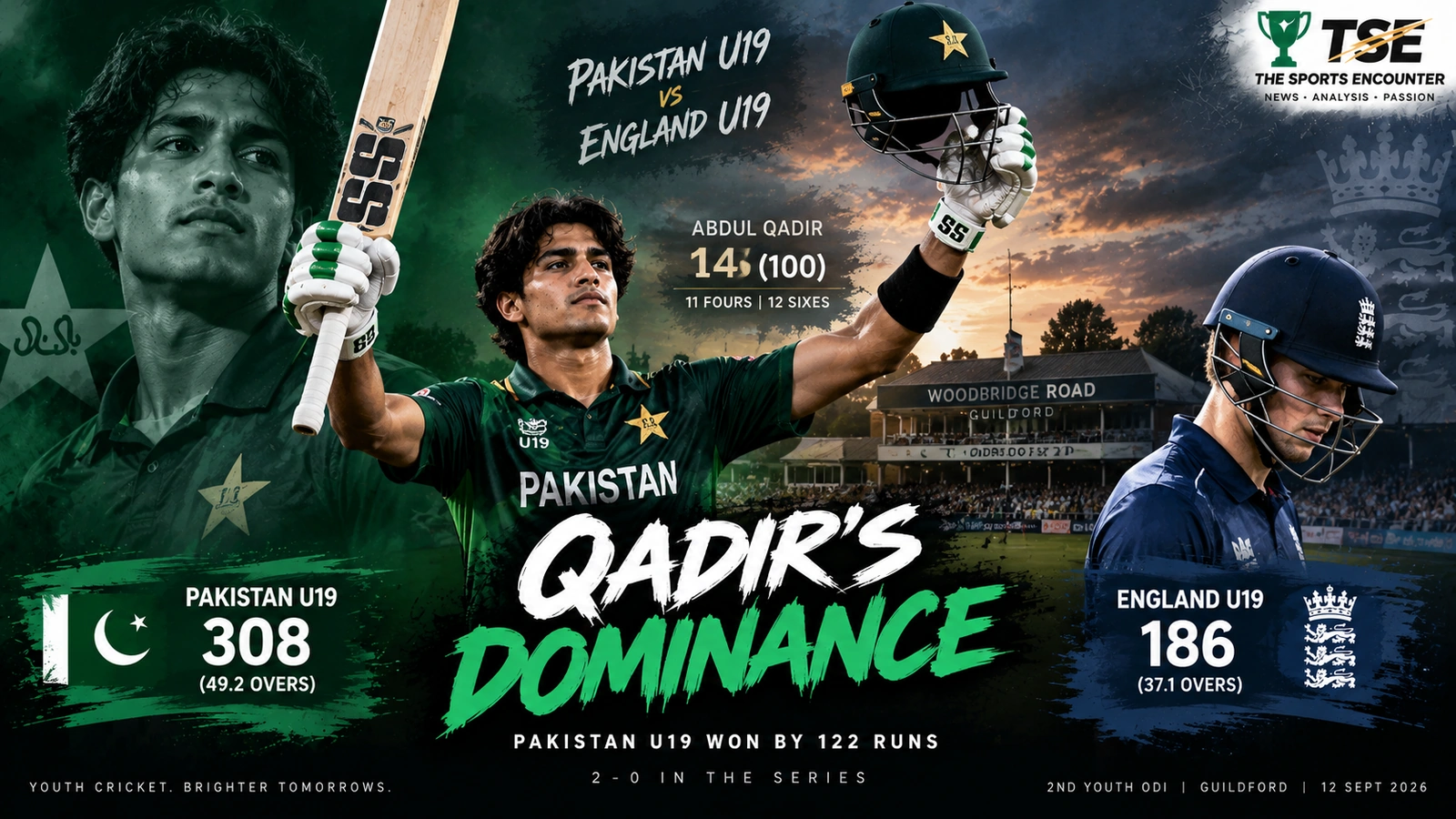
GUILDFORD, England, September 12, 2026: Pakistan Under-19s found a different match-winner but produced an equally convincing result against England Under-19s, riding Abdul Qadir’s spectacular 146 from 100 balls to a 122-run victory in the second Youth ODI at Woodbridge Road.
Pakistan were bowled out for 308 in 49.2 overs after being asked to bat first. Qadir struck 11 fours and 12 sixes at a strike rate of 146.00, rescuing and then transforming an innings that had slipped to 97 for three in the 13th over.
England never came close to controlling the chase. They lost five wickets for 76 before Robbie Bowman launched a spirited counterattack with 67 from 43 balls, including seven sixes. Once Bowman was dismissed, the remaining resistance disappeared quickly and England were bowled out for 186 in 37.1 overs.
Mohammad Sayyam and Rizwanullah took three wickets each, while Niqab Shafiq and Ahmed Hussain claimed two apiece as Pakistan completed their second emphatic one-day victory in four days.
The result gives Pakistan a 2-0 lead in the four-match series following their 177-run demolition of England in the opening Youth ODI at Arundel.
England U19 vs Pakistan U19: Second Youth ODI at a Glance
| Match detail | Information |
|---|---|
| Match | England U19 vs Pakistan U19, 2nd Youth ODI |
| Venue | Woodbridge Road, Guildford |
| Date | September 12, 2026 |
| Toss | England U19 won the toss and elected to field |
| Pakistan U19 | 308 all out in 49.2 overs |
| England U19 | 186 all out in 37.1 overs |
| Result | Pakistan U19 won by 122 runs |
| Series position | Pakistan lead 2-0 |
| Top scorer | Abdul Qadir, 146 from 100 balls |
| England top scorer | Robbie Bowman, 67 from 43 balls |
Abdul Qadir Turned an Unstable Start Into 308
The shape of Pakistan’s innings was very different from the first ODI.
At Arundel, Usman Khan and captain Farhan Yousaf dominated England through a 268-run third-wicket partnership, scoring 151 and 115 respectively. That performance allowed Pakistan to build 332 for nine before Mohammad Sayyam helped dismiss England for 155.
Guildford demanded another route.
Usman was caught behind for two in the opening over, immediately removing the batter who had controlled the first game.
Hayam Khan, making his Youth ODI debut, responded aggressively. His 37 from 27 balls contained six fours and a six and helped Pakistan reach 71 before Tom Edwards removed him.
Captain Farhan followed for four.
Pakistan were 97 for three after 12.5 overs and England had created the opening they needed.
Qadir closed it almost single-handedly.
Qadir’s century came from 80 balls
Qadir reached his half-century from 46 deliveries with five fours and three sixes.
His acceleration from there changed the innings completely.
The right-hander required only another 34 balls to move from 50 to 100, reaching his century from 80 deliveries with eight fours and eight sixes.
By the time he was dismissed for 146, he had struck 23 boundaries, 12 of them over the rope.
Those sixes accounted for 72 of his runs. His boundary count produced 116 runs in total, meaning almost 80 percent of the innings came through fours and sixes.
It was an extraordinary shift from the player who had contributed a quick 26 in the first ODI victory at Arundel.
Ahmed Hussain’s 28 Was More Important Than the Strike Rate Suggests
Qadir supplied the violence. Ahmed Hussain supplied the stability that allowed it to continue.
Ahmed made only 28 from 63 balls and did not hit a four, although he struck two sixes.
On a scorecard dominated by Qadir’s strike rate, Ahmed’s innings can easily look too slow.
The match situation suggests otherwise.
He arrived with Pakistan 97 for three and helped Qadir build a fourth-wicket partnership worth 101 runs.
England had a genuine opportunity to expose Pakistan’s middle order. Ahmed prevented them from doing so while Qadir progressively took control at the opposite end.
Pakistan reached 150 in the 22nd over and 198 before England finally broke the partnership.
That period was where the innings moved from vulnerable to imposing.
England Briefly Fought Back at 244 for Seven
George Harris eventually removed Qadir when Luke Symington completed the catch.
The wicket came at 244 for six in the 36th over.
Two balls later, Harris bowled Mohammad Sayyam for a duck.
Pakistan had suddenly lost three wickets for 12 runs after being 232 for four.
England had an opportunity to keep the final total below 280.
Hamza Zahoor prevented it.
Hamza Zahoor restored Pakistan’s finish
Hamza made 55 from 49 deliveries, hitting seven fours and two sixes.
His fifty came from 46 balls and gave Pakistan the second significant innings they required after Qadir’s dismissal.
Hamza and Abdul Subhan carried Pakistan from 244 for seven to 308 before the final three wickets fell without another run being added.
Pakistan were therefore all out in 49.2 overs rather than completing their 50 overs, but 308 had already given their bowling attack considerable room to operate.
England’s Bowlers Shared the Wickets but Could Not Contain Qadir
England actually dismissed Pakistan, which represented an improvement on allowing the visitors to complete 50 overs for 332 for nine at Arundel.
The cost of getting those wickets remained too high.
Tom Edwards took three for 66, Luke Hands three for 59 and George Harris three for 42.
Harris was easily the most economical of the wicket-takers, conceding only 4.20 per over across his 10 overs.
Tom Bradley also deserves credit for controlling his spell despite going wicketless. He conceded only 34 runs from 10 overs.
Pakistan attacked almost everyone else.
Edwards conceded 8.25 per over, Subhaan Ali 7.62, Hands 7.08 and Jack Nelson 8.20.
England also conceded 24 extras, including 15 wides and four no-balls.
Against an innings containing 12 sixes from one batter, giving Pakistan another 24 runs without making them earn them made the task considerably harder.
England’s Chase Never Developed a Foundation
A target of 309 required England to build at least one substantial top-order partnership.
Pakistan never allowed it.
Captain Isaac Mohammed was caught for five with the total on 13.
Harry Wallace and Leo Selvey-Clinton briefly rebuilt, but Mohammad Sayyam dismissed Wallace for 21 with England on 43 and then removed Selvey-Clinton for 19 only eight deliveries later.
England were 48 for three.
Rizwanullah then removed Luke Symington for nine and Jack Nelson for 12 in the space of four deliveries.
At 76 for five after 17.5 overs, England required 233 more runs.
The chase was already moving toward damage limitation.
Robbie Bowman Refused to Let England Disappear Quietly
Bowman provided England’s one sustained counterattack.
He reached fifty from 35 balls and eventually made 67 from 43, hitting four fours and seven sixes at a strike rate of 155.81.
His aggression briefly changed the visual rhythm of the chase.
England passed 100 in the 22nd over and reached 150 in the 29th.
Bowman and Luke Hands put together a 50-run seventh-wicket stand from only 41 deliveries, with Bowman contributing most of the acceleration.
There was never enough support around him to turn the recovery into a genuine chase.
Ahmed Hussain bowled Hands for eight at 156, and Sayyam then removed Bowman at 166.
That wicket effectively ended England’s resistance.
Sayyam and Rizwanullah Kept England Under Constant Pressure
Pakistan’s bowling figures reflected the depth of their attack.
Sayyam followed his four-wicket performance in the first ODI with three for 56 from nine overs.
Rizwanullah was even more economical, taking three for 32 from eight overs at four runs per over.
Niqab Shafiq claimed two for 37, including England captain Mohammed and George Harris.
Ahmed Hussain then complemented his earlier batting contribution with two for 16 from 6.1 overs.
His economy rate of 2.59 was the best among Pakistan’s bowlers.
Pakistan did not require a dominant five-wicket spell because wickets came from four different bowlers.
That distribution was also apparent at Arundel, where Sayyam took four wickets while Rizwanullah, Niqab and Ahmed collected two each.
Across two Youth ODIs, England have therefore struggled to identify a single bowler they can safely target.
Pakistan Have Won the Two ODIs in Different Ways
The most encouraging element for Pakistan is not simply the 2-0 scoreline.
It is how differently the victories were constructed.
In the first match, Usman and Farhan scored centuries and shared a huge partnership. At Guildford, Usman made two and Farhan four.
A side overly dependent on its two first-ODI centurions could easily have collapsed after losing both cheaply.
Instead, Abdul Qadir produced the largest innings of the match, Hayam attacked early, Ahmed absorbed pressure and Hamza rebuilt the finish.
That batting depth complements a bowling attack that has now dismissed England for 155 and 186 in successive matches.
The contrast is particularly striking against the difficulties endured by Pakistan’s senior side on the same England tour. The Sports Encounter has documented the senior team’s problems throughout the series, from the Headingley opener to the series-clinching defeat at Lord’s and the struggles at Edgbaston.
The Under-19 side has offered a very different picture of Pakistan’s depth during the same English summer.
Abdul Qadir Has Been Pakistan’s Most Consistent Batter Across Formats
Qadir’s Guildford century also fits into a broader tour rather than appearing from nowhere.
He had already made 66 and 80 in the four-day Youth Test at Arundel, where Pakistan came within 10 runs of completing a difficult fourth-innings chase.
He then struck 26 from only 13 deliveries in the first Youth ODI.
His 146 therefore extends a sequence of meaningful contributions across red-ball and white-ball cricket.
The PCB’s official squad announcement listed Qadir and Hamza Zahoor as Pakistan’s wicketkeeping options for the tour, while Farhan Yousaf continues to lead a group that won the ACC Men’s U19 Asia Cup in December 2025.
Pakistan’s youth results in England are beginning to reinforce the value of that continuity.
Complete Pakistan U19 Scorecard
| Batter | Dismissal | R | B | 4s | 6s | SR |
|---|---|---|---|---|---|---|
| Usman Khan | c Bowman b Edwards | 2 | 5 | 0 | 0 | 40.00 |
| Hayam Khan | c Subhaan Ali b Edwards | 37 | 27 | 6 | 1 | 137.03 |
| Abdul Qadir | c Symington b Harris | 146 | 100 | 11 | 12 | 146.00 |
| Farhan Yousaf (c) | b Hands | 4 | 9 | 0 | 0 | 44.44 |
| Ahmed Hussain | b Edwards | 28 | 63 | 0 | 2 | 44.44 |
| Hasnain Abbas Dar | c Symington b Harris | 6 | 10 | 1 | 0 | 60.00 |
| Hamza Zahoor (wk) | c Nelson b Subhaan Ali | 55 | 49 | 7 | 2 | 112.24 |
| Mohammad Sayyam | b Harris | 0 | 2 | 0 | 0 | 0.00 |
| Abdul Subhan | c Nelson b Hands | 6 | 30 | 1 | 0 | 20.00 |
| Niqab Shafiq | not out | 0 | 4 | 0 | 0 | 0.00 |
| Rizwanullah | c Isaac Mohammed b Hands | 0 | 1 | 0 | 0 | 0.00 |
| Extras | lb 5, nb 4, w 15 | 24 | ||||
| Total | 49.2 overs | 308 | Run rate: 6.24 | |||
England U19 Bowling
| Bowler | O | M | R | W | Econ |
|---|---|---|---|---|---|
| Tom Edwards | 8 | 1 | 66 | 3 | 8.25 |
| Subhaan Ali | 8 | 0 | 61 | 1 | 7.62 |
| Tom Bradley | 10 | 0 | 34 | 0 | 3.40 |
| Luke Hands | 8.2 | 0 | 59 | 3 | 7.08 |
| Jack Nelson | 5 | 0 | 41 | 0 | 8.20 |
| George Harris | 10 | 1 | 42 | 3 | 4.20 |
Complete England U19 Scorecard
| Batter | Dismissal | R | B | 4s | 6s | SR |
|---|---|---|---|---|---|---|
| Isaac Mohammed (c) | c Ahmed Hussain b Niqab Shafiq | 5 | 10 | 1 | 0 | 50.00 |
| Harry Wallace | c Hamza Zahoor b Mohammad Sayyam | 21 | 29 | 2 | 1 | 72.41 |
| Leo Selvey-Clinton | c Hamza Zahoor b Mohammad Sayyam | 19 | 29 | 3 | 0 | 65.51 |
| Luke Symington | b Rizwanullah | 9 | 19 | 0 | 0 | 47.36 |
| Jack Nelson | b Rizwanullah | 12 | 20 | 1 | 0 | 60.00 |
| Robbie Bowman (wk) | c Niqab Shafiq b Mohammad Sayyam | 67 | 43 | 4 | 7 | 155.81 |
| George Harris | b Niqab Shafiq | 11 | 12 | 2 | 0 | 91.66 |
| Luke Hands | b Ahmed Hussain | 8 | 23 | 1 | 0 | 34.78 |
| Subhaan Ali | c Ahmed Hussain b Rizwanullah | 15 | 19 | 3 | 0 | 78.94 |
| Tom Bradley | c Abdul Qadir b Ahmed Hussain | 6 | 17 | 0 | 0 | 35.29 |
| Tom Edwards | not out | 1 | 4 | 0 | 0 | 25.00 |
| Extras | lb 2, nb 2, w 8 | 12 | ||||
| Total | 37.1 overs | 186 | Run rate: 5.00 | |||
Pakistan U19 Bowling
| Bowler | O | M | R | W | Econ |
|---|---|---|---|---|---|
| Niqab Shafiq | 7 | 1 | 37 | 2 | 5.28 |
| Mohammad Sayyam | 9 | 1 | 56 | 3 | 6.22 |
| Abdul Subhan | 5 | 0 | 23 | 0 | 4.60 |
| Rizwanullah | 8 | 0 | 32 | 3 | 4.00 |
| Hasnain Abbas Dar | 2 | 0 | 20 | 0 | 10.00 |
| Ahmed Hussain | 6.1 | 0 | 16 | 2 | 2.59 |
What Pakistan’s 2-0 Lead Says About the Series
Pakistan have scored 640 runs across their two innings and bowled England out twice for a combined 341.
The margins are substantial: 177 runs at Arundel and 122 at Guildford.
England have therefore lost the opening two games by a combined 299 runs.
Pakistan’s batting has also produced three individual centuries in those matches: Usman’s 151, Farhan’s 115 and Qadir’s 146.
Three different batters crossing 100 in two games creates a difficult planning problem for England because simply solving the Usman-Farhan partnership from Arundel did not solve Pakistan’s batting.
England did remove both cheaply at Guildford.
Qadir simply replaced them as the central problem.
The Contrast With Pakistan’s Senior Tour Is Becoming Hard to Ignore
Pakistan’s Under-19 success is unfolding alongside a difficult senior tour of England.
The senior side’s batting problems were evident when England sealed the Test series at Lord’s, before Pakistan were bowled out for 133 on the opening day at Edgbaston. TSE’s Day 1 report from Birmingham examined another collapse, while the second-day analysis showed England stretching their control through batting depth.
The different trajectories do not make the Under-19 results a guarantee of senior success. Youth cricket development is rarely that simple.
They do, however, make performances from Qadir, Usman, Farhan, Sayyam, Rizwanullah and the wider squad increasingly significant.
The broader turmoil surrounding Pakistan’s senior tour has already been examined in TSE’s report on the structural questions facing the PCB.
Against that backdrop, the Under-19 side is supplying a much more encouraging development story.
What Comes Next for Pakistan U19 and England U19?
The series now moves to Sir Paul Getty’s Ground at Wormsley.
According to the PCB’s official tour schedule, the third Youth ODI will be played on September 14, followed by the fourth and final match at the same venue on September 16.
Pakistan therefore have two opportunities to turn a strong series lead into a clean sweep.
England need a response immediately.
The hosts have now conceded 332 and 308 while being dismissed for 155 and 186. Their first priority at Wormsley must be finding a top-order partnership capable of carrying the chase beyond its opening phase.
Pakistan’s challenge is different.
They have won through three different century-makers, repeated bowling contributions and the ability to recover after losing early wickets.
The next test is whether that standard can survive the comfort of a 2-0 lead.
The PCB’s official first-ODI report documented how Usman and Farhan opened the series. Guildford has now added Qadir to the list of Pakistan batters England must find a way to contain.
Frequently Asked Questions
Who won the second Youth ODI between Pakistan U19 and England U19?
Pakistan Under-19s won by 122 runs at Woodbridge Road in Guildford after scoring 308 and bowling England out for 186.
Who scored 146 for Pakistan U19 against England?
Abdul Qadir scored 146 from 100 balls, hitting 11 fours and 12 sixes at a strike rate of 146.00.
How many sixes did Abdul Qadir hit?
Qadir struck 12 sixes during his 146, along with 11 fours.
Who was England U19’s highest scorer?
Wicketkeeper Robbie Bowman top-scored with 67 from 43 balls, including four fours and seven sixes.
Who took the most wickets for Pakistan?
Mohammad Sayyam and Rizwanullah each took three wickets. Sayyam finished with 3/56 and Rizwanullah with 3/32.
What is the Pakistan U19 vs England U19 Youth ODI series score?
Pakistan lead the four-match series 2-0 after winning the opening game by 177 runs and the second by 122 runs.
When is the third Pakistan U19 vs England U19 Youth ODI?
The third Youth ODI is scheduled for September 14, 2026 at Sir Paul Getty’s Ground in Wormsley.
When is the fourth Youth ODI?
The final match of the series is scheduled for September 16 at Wormsley.