


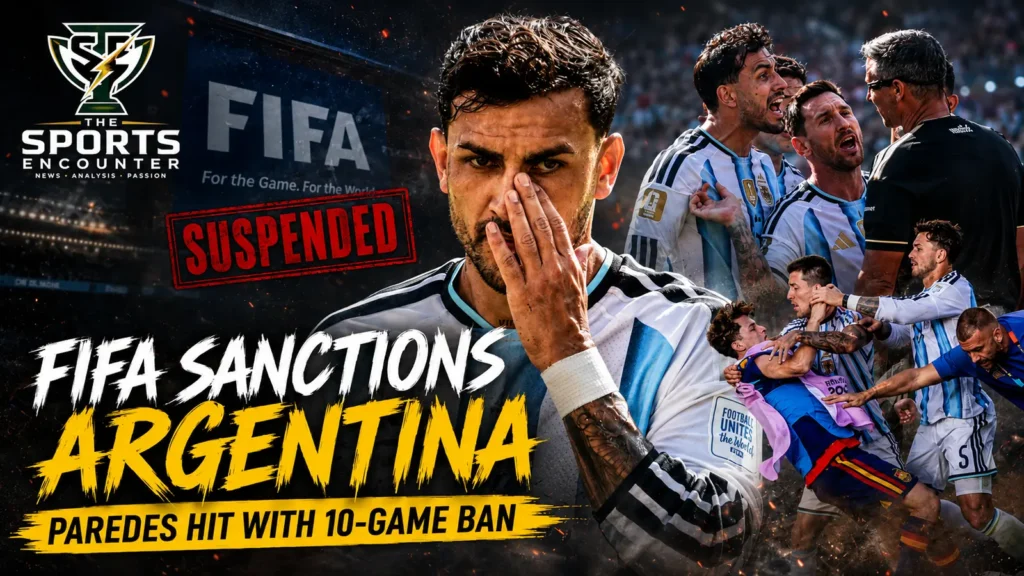
More than a month after Spain lifted the FIFA World Cup trophy in New Jersey, the fallout from the chaotic scenes that followed the final has landed heavily on Argentina.
FIFA has suspended Leandro Paredes for 10 international matches and Nahuel Molina for seven, while also handing penalties to Thiago Almada, Argentina assistant Roberto Ayala and Spain midfielder Gavi over incidents surrounding the July 19 final.
The punishment goes well beyond individual players. The Argentine Football Association has been fined $321,000 for a wider series of disciplinary breaches during the tournament, while Argentina will also face restrictions on spectator capacity at upcoming home internationals.
The sanctions bring a disciplinary conclusion to a World Cup campaign that ended with Spain beating Argentina 1-0 after extra time at New York New Jersey Stadium. The Sports Encounter’s full World Cup final report detailed how Ferran Torres scored the decisive goal in the 106th minute after Spain had controlled long periods of the match.
FIFA Sanctions After Spain vs Argentina World Cup Final
| Player / Organization | Sanction | Fine | Reason / Context |
|---|---|---|---|
| Leandro Paredes | 10-match suspension | $90,000 | Three assault counts linked to the post-final confrontation |
| Nahuel Molina | 7-match suspension | $90,000 | Two assault counts plus an unsporting-behavior charge |
| Thiago Almada | 1-match suspension | $30,000 | Unsporting behavior |
| Roberto Ayala | 3-match suspension | $30,000 | Assault-related disciplinary case |
| Gavi | 1-match suspension | $30,000 | Unsporting behavior |
| Argentine Football Association | Stadium-capacity sanctions and anti-discrimination requirements | $321,000 | Multiple breaches across the World Cup |
According to Reuters, Paredes received the longest suspension after facing three assault counts. Molina was charged over two alleged assault incidents, including one attempted act, as well as unsporting behavior.
Almada and Gavi were each suspended for one match for unsporting behavior, while Ayala received a three-game ban after being charged in connection with the confrontation.
What Happened After the World Cup Final?
The trouble began after the final whistle on July 19.
Spain had just completed a historic victory that secured the country’s second men’s world title. Ferran Torres’ extra-time goal finally broke Argentina’s resistance after Emiliano Martínez had produced an extraordinary goalkeeping performance.
As Spanish substitutes and staff moved onto the field to celebrate, tempers flared. Paredes became involved in a confrontation with Gavi, and a larger group of players and staff quickly gathered around the incident.
The images created an uncomfortable final scene for a tournament that had already produced enough controversy around officiating, security, crowd behavior and political messaging.
FIFA formally announced on July 29 that its Disciplinary Committee had opened proceedings following the final. The governing body’s official disciplinary update identified Paredes, Molina and Ayala in relation to potential assault violations, while Molina, Almada and Gavi also faced proceedings related to unsporting behavior.
Those proceedings have now produced punishments that will follow Argentina well beyond the World Cup.
Paredes Pays the Heaviest Price
Paredes’ 10-game suspension is the most significant individual penalty arising from the final.
Ten international matches can cover a substantial portion of a national team’s competitive calendar, meaning the punishment could disrupt Argentina’s plans well into their post-World Cup transition.
The midfielder had been an important part of Argentina’s tournament squad, particularly as Lionel Scaloni managed difficult knockout matches that often required experience and physical control.
Argentina’s road to the final had repeatedly tested that depth. The defending champions needed extra time to beat Switzerland 3-1 in the quarterfinal, a match covered in The Sports Encounter’s report on Argentina’s hard-fought win over Switzerland.
They then produced one of the tournament’s most dramatic comebacks against England, recovering from a late deficit to win 2-1 and reach the final. Our Argentina vs England semifinal report captured how Lionel Messi helped create both late goals.
The semifinal also generated controversy away from the football.
AFA Punishment Covers More Than the Final Brawl
The $321,000 fine imposed on the Argentine Football Association is tied to several disciplinary issues from across the World Cup rather than only the post-final confrontation.
FIFA’s original proceedings cited possible breaches involving team misconduct, discriminatory chants and gestures, security protocols, inappropriate messages and the use of sporting events for non-sporting demonstrations.
One prominent case involved a banner displayed following Argentina’s semifinal victory over England bearing the message “Las Malvinas Son Argentinas,” referring to the Falkland Islands dispute.
The political controversy featured prominently in The Sports Encounter’s analysis of what went wrong for England against Argentina, which examined both the tactical collapse that cost England a place in the final and the tension surrounding the post-match scenes.
FIFA had already made clear in its July disciplinary announcement that using a sporting event for demonstrations of a non-sporting nature could constitute a violation of its disciplinary code.
Argentina Face Home Crowd Restrictions
The AFA’s punishment also carries consequences for Argentina supporters.
FIFA ordered Argentina to play its next two home internationals with attendance limited to 50 percent of stadium capacity. However, part of the sanction has been suspended subject to a probationary period.
Reuters reported that implementation of one of the two capacity-restricted matches, along with $100,000 of the financial sanction, has been suspended. That distinction means Argentina faces one immediate restricted-capacity home fixture, while the additional sanction remains hanging over the association depending on compliance during the probationary period.
FIFA has also directed that $100,000 be invested in an anti-discrimination plan.
That turns the punishment into something broader than a fine. The governing body is attaching future conduct and remedial measures to the disciplinary outcome.
Gavi’s Ban Adds a Spanish Footnote to the Fallout
Spain did not escape the disciplinary process entirely.
Gavi received a one-game suspension and a $30,000 fine for unsporting behavior.
The punishment is minor compared with those imposed on Paredes and Molina, but it ensures the final’s disorder also carries a sporting consequence for the world champions.
Spain had arrived at the final after producing one of the most controlled knockout runs of the tournament. They beat France 2-0 in the semifinal, with The Sports Encounter’s Spain vs France analysis highlighting the tactical discipline that eventually carried into the final.
That control defined Spain’s football throughout the decisive stages. FIFA itself later described the champions as a team that had controlled virtually every phase of the tournament, from pressing and possession to transition play and set pieces, in its post-tournament review of Spain’s title.
The Final Already Had Enough Football Drama
The disciplinary fallout feels especially unfortunate because the final itself had produced a compelling football story without needing anything after the whistle.
Spain entered the match as a side increasingly comfortable controlling possession and territory, while Argentina arrived with Messi still driving a title defense that had survived several difficult knockout tests.
The scale of the occasion was evident well before kickoff. The Sports Encounter’s Argentina vs Spain final preview followed the ticket demand, team news, tactical questions and global attention surrounding the matchup.
Once the game began, Spain controlled the ball while Argentina defended deeper and relied heavily on Martínez. Enzo Fernández’s second yellow card left Argentina with 10 players heading into extra time, and Torres eventually scored the winner.
The result placed Spain’s 2026 generation alongside the champions of 2010. Our feature on Spain’s two World Cup-winning generations explored the connection between Andrés Iniesta’s Johannesburg winner and Torres’ decisive moment in New Jersey.
The brawl then shifted attention from that football history toward disciplinary hearings that lasted into August.
Argentina Are Preparing an Appeal
The case may not be finished.
The AFA intends to challenge the sanctions and plans to request the full grounds behind FIFA’s decisions before submitting an appeal.
According to Reuters, the association is particularly focused on reducing the suspensions imposed on Paredes and Molina. Argentine officials have also indicated that the dispute could eventually reach the Court of Arbitration for Sport if necessary.
That creates two separate questions.
The first is whether FIFA’s Appeal Committee reduces any of the individual bans or organizational sanctions. The second is how much of the punishment Argentina ultimately serves before the legal process is exhausted.
Until an appeal succeeds, the sanctions remain the operative disciplinary outcome.
What the Suspensions Mean for Argentina
Paredes and Molina are experienced internationals, and losing them for extended periods complicates the rebuilding process after a World Cup in which several members of Argentina’s core were already approaching the later stages of their international careers.
Messi’s tournament had again placed him among the competition’s most influential players. He ranked prominently in The Sports Encounter’s Top 10 Players of the FIFA World Cup 2026 as Argentina continued relying on his creativity throughout the knockout rounds.
The team must now move forward from the loss to Spain while also managing suspensions, institutional sanctions and the possibility of a prolonged appeals process.
Molina’s seven-game absence could be particularly disruptive because full-back continuity matters to Argentina’s defensive structure. Paredes’ 10-game ban removes an experienced midfield option who has spent years operating inside Scaloni’s tactical system.
Almada’s one-match suspension is easier to absorb, but the combined penalties create another layer of change for a national team already facing questions about its next cycle.
A World Cup Story That Refuses to End
The 2026 World Cup officially ended on July 19, but several of its most contentious stories have continued well beyond the final.
Spain left New Jersey with the trophy. Argentina left with defeat, frustration and a disciplinary case that has now produced some of the tournament’s heaviest post-event sanctions.
The punishment also illustrates the range of conduct FIFA is prepared to address under its disciplinary framework. Physical confrontations, discriminatory behavior, political messaging, crowd conduct and security failures have all been folded into the Argentina case.
For supporters who followed the full tournament through The Sports Encounter’s FIFA World Cup 2026 coverage and schedule, the sanctions provide another reminder that the consequences of a World Cup can continue long after the final whistle.
Argentina can appeal. Paredes and Molina may yet see their bans reduced. Parts of the AFA punishment are already suspended conditionally.
For now, however, FIFA’s message is clear. The confrontation at the end of the World Cup final, combined with the wider disciplinary problems surrounding Argentina’s campaign, has carried a substantial price into the next international cycle.