


Tennis has spent years asking whether its biggest tournaments should share more of their wealth with the players who create the product.
On August 20, two major developments moved that argument forward at the same time.
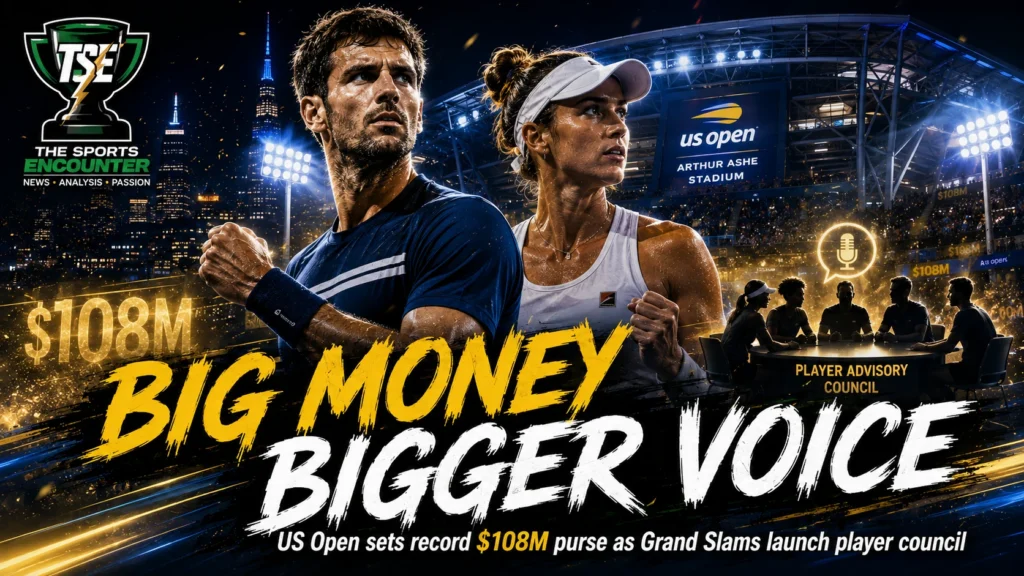
The US Open announced a record $108 million in total player compensation for 2026, the largest purse in tennis history and a 20% increase from last year.
Hours earlier, the four Grand Slams confirmed the creation of a new Grand Slam Player Advisory Council, designed to give players a direct voice on prize money, player welfare and other major issues affecting the sport’s most valuable tournaments.
Taken separately, one announcement is about money and the other about governance.
Taken together, they signal something much bigger.
The relationship between elite players and the Grand Slams is changing.
The US Open’s record purse shows that the financial pressure applied by players is producing results. The new advisory council shows that organizers understand money alone will not settle the larger debate over who gets to participate in the decisions shaping modern tennis.
For more tournament analysis, player news and Grand Slam coverage, follow The Sports Encounter’s tennis section and our complete US Open 2026 preview.
US Open 2026 Prize Money at a Glance
| Category | 2026 Amount | Change |
|---|---|---|
| Total player compensation | $108 million | Up 20% from 2025 |
| Men’s singles champion | $5.5 million | Up 10% |
| Women’s singles champion | $5.5 million | Up 10% |
| First-round singles payout | $140,000 | Up 27% |
| 2025 total player compensation | $90 million | Previous record |
| 2025 singles champions | $5 million each | Previous record |
$108 Million Changes the Scale of Grand Slam Prize Money
The US Open has spent several years positioning itself as the most aggressive Grand Slam when it comes to player compensation.
In 2025, the tournament became the first in tennis history to reach $90 million in total player compensation.
That record lasted one year.
The 2026 figure rises to $108 million.
That is not a cosmetic increase.
It represents another 20% jump in the amount distributed to players.
The men’s and women’s singles champions will each receive $5.5 million, up from $5 million in 2025 and $3.6 million in 2024.
The progression is striking.
In two years, the championship check has increased by more than 52%.
The Reuters report on the 2026 prize fund confirms that both the overall purse and individual singles-champion payouts are Grand Slam records.
The First-Round Number May Matter More Than the Winner’s Check
The $5.5 million championship payout makes the headline.
The $140,000 first-round payment may be more important structurally.
Main-draw players who lose their opening match will receive 27% more than they did last year.
That matters because tennis economics look very different outside the top 20.
Top players earn millions through prize money, endorsements and appearance fees.
Lower-ranked professionals face travel costs, coaching fees, physiotherapy, accommodation, agent commissions, equipment expenses and weeks when they earn nothing at all.
Increasing early-round compensation therefore distributes more money toward players who are less financially insulated.
The US Open has been moving in that direction for several years.
Its 2025 prize-money structure already emphasized larger payouts throughout the draw, including significant increases for qualifying and early-round players.
The 2026 structure extends that strategy.
Why Players Have Been Pushing So Hard for More Grand Slam Revenue
Prize money in tennis has risen substantially over time.
The underlying argument has not disappeared.
Players believe the Grand Slams generate enormous commercial value while distributing too small a share of total revenue back to the athletes.
That tension has become more visible during the last two seasons.
Players have increasingly spoken publicly about:
- revenue sharing;
- player welfare;
- calendar congestion;
- mandatory tournament obligations;
- insurance and pension structures;
- travel expenses;
- and the difference between tournament growth and player compensation.
The debate has also become less cautious.
Sabalenka’s French Open Warning Showed How Far the Frustration Had Gone
Aryna Sabalenka made the conflict unusually explicit earlier this year.
At Roland Garros, the women’s world No. 1 said players would consider boycotting the tournament if prize money did not increase.
Coco Gauff publicly supported the possibility of stronger collective action.
That was a significant escalation.
Top players rarely discuss boycotting Grand Slams lightly.
The tournaments remain the most prestigious events in tennis.
They define careers.
They generate the largest television audiences.
They create the records by which players are remembered.
For leading players to even raise the possibility of staying away showed that compensation and governance concerns had moved beyond private frustration.
The new advisory council is partly a response to that pressure. :contentReference[oaicite:0]{index=0}
The Grand Slam Player Advisory Council Is the Bigger Long-Term Story
The money is immediate.
The council could shape what happens next.
The Australian Open, Roland Garros, Wimbledon and the US Open jointly announced that a Grand Slam Player Advisory Council will launch after this year’s tournament in New York.
Players will be able to apply for council positions.
The group will discuss Grand Slam sporting matters collectively while also providing a regular forum for tournament-specific discussions around welfare and compensation.
That structure matters because the four majors are not governed identically.
They have different ownership models.
Different finances.
Different boards.
Different domestic relationships.
A single negotiation model would therefore be difficult.
The advisory council creates a mechanism that recognizes those differences while giving players one place to raise common concerns.
Ben Shelton’s Reaction Explains Why Players Wanted This
Ben Shelton described the council as something players had wanted for some time.
His comments cut directly to the issue.
Players do not simply want larger checks after decisions have already been made.
They want a voice before those decisions are finalized.
That distinction is crucial.
Prize money is one outcome.
Representation affects how future outcomes are produced.
The council gives players the possibility of influencing discussions about tournament structure, welfare and compensation before announcements reach the public.
A Seat at the Table Does Not Automatically Mean Power
The word “advisory” matters.
The council does not automatically give players binding authority over Grand Slam budgets or governance.
It creates access.
Whether that access produces meaningful influence will depend on how the council operates.
Key questions remain:
- How many players will serve?
- How will men and women be represented?
- Will singles and doubles players have equal access?
- Will lower-ranked players receive representation?
- How long will terms last?
- Will players see financial information?
- Will recommendations be published?
- What happens when the four Grand Slams disagree?
- Will the council have any formal mechanism beyond consultation?
Those details will determine whether the council becomes an influential institution or a well-branded listening exercise.
The Timing of the Two Announcements Is Impossible to Ignore
The prize-money announcement came almost immediately after the advisory council was unveiled.
That sequencing matters politically.
The Grand Slams can now point to two developments at once.
More money.
More representation.
That gives organizers a stronger response to players who have argued that the sport’s biggest events are not sharing enough revenue or involving athletes meaningfully in decision-making.
It also changes the tone going into the US Open.
A tournament that could have opened under another cloud of compensation disputes now arrives with record payments and a new governance mechanism already announced.
The US Open Is Setting a Benchmark the Other Slams Will Feel
Grand Slams compete with each other in ways that extend beyond tennis.
They compete for prestige.
They compete for sponsors.
They compete for global audiences.
They compete for hospitality revenue.
They also compete indirectly on player treatment.
If the US Open pays $5.5 million to its singles champions and $140,000 to first-round losers, those numbers become reference points for Melbourne, Paris and Wimbledon.
The other tournaments do not have to copy New York immediately.
They will be asked why they do not.
That pressure can accelerate prize-money growth across the entire Grand Slam calendar.
How Fast Has US Open Prize Money Grown?
| Year | Total Player Compensation | Singles Champion |
|---|---|---|
| 2024 | $75 million | $3.6 million |
| 2025 | $90 million | $5 million |
| 2026 | $108 million | $5.5 million |
The progression illustrates the commercial strength of the event.
Total player compensation has risen by 44% in only two years.
The winner’s check has increased by more than half.
That kind of growth creates a difficult argument for tournaments that simultaneously claim there is little additional room for player compensation.
The $5.5 Million Champion’s Check Is Symbolic and Strategic
Grand Slam winners already receive life-changing money.
The additional $500,000 from last year does not change Carlos Alcaraz’s financial security.
It does matter symbolically.
The biggest tournament in the largest commercial tennis market is telling the world that winning a major should carry a financial reward unlike anything else in the sport.
That helps distinguish Grand Slams from Masters 1000 events.
The contrast is enormous.
The National Bank Open, for example, offered around $1.15 million to its men’s champion this year, while the women’s champion earned roughly $1.09 million.
The Sports Encounter broke down those figures in our National Bank Open 2026 tournament guide.
A US Open champion will now earn roughly five times that amount.
But the Money Debate Is Not Really About the Champions
The public naturally focuses on the biggest checks.
Players are increasingly focusing on the distribution model.
A tennis ecosystem cannot remain healthy if only the top 50 players are financially comfortable.
The sport needs:
- qualifiers;
- doubles specialists;
- journeymen;
- young players climbing the rankings;
- veterans trying to remain competitive;
- and players returning from injury.
Those groups form the depth that makes Grand Slam draws competitive.
First-round and qualifying money therefore affects the quality of the sport several years later.
Tennis Has a Cost Problem That Prize Money Alone Cannot Solve
A professional tennis player operates like a small business.
There is no club paying the travel bill.
No franchise covering hotel rooms.
No team medical department automatically available every week.
Players commonly pay for:
- coaches;
- fitness trainers;
- physiotherapists;
- travel;
- hotels;
- food;
- equipment;
- stringing;
- agents;
- taxes;
- and insurance.
A player can earn six figures in gross prize money and still operate on relatively thin margins after expenses.
That is why the US Open’s player-support initiatives matter alongside prize money.
Last year, the tournament provided travel support, hotel accommodation or equivalent lodging payments, and free racket stringing as part of a broader compensation package.
The New Council Could Become a Forum for Welfare Issues Too
Compensation will receive the most attention.
Player welfare could become equally important.
The tennis calendar has become one of the sport’s biggest disputes.
Longer Masters 1000 events, expanded tournaments and limited recovery windows have forced players to make increasingly difficult choices.
Alexander Zverev recently argued that shortening Masters events back to one week would be an obvious way to reduce the strain. :contentReference[oaicite:1]{index=1}
The Sports Encounter has followed the same issue throughout the North American summer.
Our analysis of why Jannik Sinner and Novak Djokovic skipped Montreal showed how leading players are increasingly prioritizing recovery over ranking points and tournament obligations.
A Grand Slam council gives athletes another venue to raise those concerns.
The Grand Slams Cannot Pretend They Are Separate From Calendar Pressure
The majors occupy only eight weeks of the main draw calendar.
Their influence extends far beyond those weeks.
Players build entire seasons around them.
They adjust tournament schedules to arrive healthy.
They skip Masters events.
They change training blocks.
They manage injuries conservatively.
The Sports Encounter’s recent coverage of Novak Djokovic’s US Open preparation examined exactly that calculation: enough competitive tennis to build rhythm, but not enough to arrive exhausted in New York.
The Grand Slams benefit from those decisions.
That gives them a legitimate responsibility to participate in broader welfare discussions.
Carlos Alcaraz’s Return Is a Perfect Example of the Modern Trade-Off
The defending US Open champion will return in New York after more than four months out with a wrist injury.
Alcaraz skipped Roland Garros, Wimbledon, Toronto and Cincinnati before deciding that his first competitive match back should come at the US Open.
That choice shows the enormous gravitational pull of the majors.
Players will sacrifice other tournaments to protect their chances at Grand Slams.
The Sports Encounter examined that risk in our US Open 2026 curtain-raiser, where Alcaraz’s wrist and match fitness were already identified as defining questions.
When one tournament exerts that level of influence over player scheduling, welfare becomes part of its governance responsibility.
The New Council Could Also Change the Revenue-Sharing Debate
This is where the next major conflict may emerge.
Players are not only asking for larger prize-money pools.
They increasingly want a defined percentage of tournament revenue.
Those are different models.
A tournament can increase prize money every year while revenue grows even faster.
Players can therefore receive more dollars while receiving a smaller share of the overall business.
That is why revenue transparency matters.
If the advisory council gains access to meaningful financial information, negotiations could become more sophisticated.
If it does not, players may continue arguing that they are being asked to negotiate without seeing the full economics.
Why the Grand Slams Resist a Simple Revenue-Sharing Formula
The four majors have legitimate differences.
The Australian Open operates within Tennis Australia.
Roland Garros is controlled by the French Tennis Federation.
Wimbledon is run by the All England Club.
The US Open is operated by the USTA.
Each has different revenue streams, infrastructure costs, national-development obligations and governance structures.
A fixed percentage model that works in New York may not transfer cleanly to Paris or Melbourne.
That is part of why the new council will allow issues affecting all four tournaments to be addressed jointly while individual financial matters can be discussed separately.
The Council Also Changes Player Politics
Tennis already has multiple representation structures.
The ATP represents the men’s tour.
The WTA represents the women’s tour.
The Professional Tennis Players Association has pushed for stronger independent player representation.
Players also sit on tour councils.
The new Grand Slam council creates another layer.
That could help.
It could also complicate negotiations if players receive different messages from different representative bodies.
The success of the new structure will depend on whether it complements existing organizations rather than becoming another fragmented channel.
Who Gets Represented Will Be Crucial
A council composed entirely of top-10 singles stars would have obvious credibility problems.
The economics of Novak Djokovic, Coco Gauff and Carlos Alcaraz are not the economics of the player ranked No. 140.
Doubles players face different issues.
Qualifiers face different issues.
Players from smaller tennis nations may have different travel and support challenges.
The council needs enough diversity to represent the actual professional ecosystem.
Otherwise the Grand Slams risk creating a body that amplifies the voices they already hear most often.
Women’s Representation Will Be Closely Watched
The four Grand Slams have paid equal men’s and women’s singles prize money for years.
That does not mean every economic issue is identical.
Sabalenka and Gauff have been among the most outspoken recent voices on compensation.
The council’s composition therefore needs meaningful representation from the women’s game rather than symbolic balance.
The same applies to doubles and wheelchair players.
The US Open’s New Purse Raises the Pressure Before the Tournament Even Begins
Usually, the biggest US Open questions involve forehands, serves and draw placement.
This year, economics have become part of the opening narrative.
The tournament begins with:
- a record $108 million compensation package;
- $5.5 million for each singles champion;
- $140,000 for first-round singles players;
- a new player-support program;
- and the creation of a formal advisory mechanism between players and Grand Slams.
That gives the 2026 edition significance before anyone steps onto Arthur Ashe Stadium.
New York’s Commercial Strength Makes This Possible
The US Open operates in one of the strongest sports markets in the world.
It has enormous ticket demand.
Premium hospitality.
Global television rights.
Large sponsorship agreements.
Merchandising.
Corporate entertainment.
Digital revenue.
That commercial scale allows the USTA to distribute a record purse while still investing in the event and American tennis development.
The question players will continue asking is how the growing pie should be divided.
Arthur Ashe Stadium Is Becoming a Symbol of Tennis’s Economic Boom
The US Open’s main stadium already represents the scale modern tennis can reach.
More than 23,000 spectators can attend a night session.
Premium seats and hospitality generate significant revenue.
Television audiences receive one of the sport’s most recognizable settings.
Top players turn those nights into global entertainment properties.
That is the foundation of the compensation argument.
The athletes are not simply participants.
They are the central commercial product.
Why the US Open Can Afford to Be Aggressive
The tournament has another incentive.
Being the highest-paying Grand Slam is itself a marketing message.
It reinforces New York’s image as the biggest stage in tennis.
It gives the USTA positive publicity.
It strengthens relationships with players.
It differentiates the US Open from other majors.
Prize money therefore has commercial value beyond the checks themselves.
The 2026 US Open Already Has Enough Sporting Drama
The economic story arrives alongside a tournament loaded with competitive intrigue.
Carlos Alcaraz is returning from injury to defend the men’s title.
Jannik Sinner remains one of the strongest players in the world.
Novak Djokovic is still chasing a 25th major.
Aryna Sabalenka is trying to extend her New York dominance.
Coco Gauff carries another major American title opportunity.
The Sports Encounter’s complete tournament preview breaks down those title races, injuries and draw questions.
The $108 million purse now gives every one of those matches another financial dimension.
The Champion’s $5.5 Million Is Only Part of the Story
The winner will receive the largest singles check in Grand Slam history.
The runner-up will still leave with a major financial reward.
Semifinalists and quarterfinalists will earn substantial sums.
But the sustainability of professional tennis depends on the money flowing deeper than the second week.
The $140,000 first-round payment is therefore one of the strongest indicators that organizers understand the debate.
Could This Reduce Player Boycott Talk?
In the short term, probably.
A 20% overall increase and a formal council make it harder to argue that the Grand Slams are ignoring player concerns entirely.
That does not mean the dispute is finished.
The next argument may shift from “Are you listening?” to “How much influence are you actually giving us?”
That is a more advanced negotiation.
The First Real Test Will Come After New York
The council launches after the US Open.
That is when symbolic approval becomes practical governance.
Players will expect:
- clear membership rules;
- regular meetings;
- transparent agendas;
- access to decision-makers;
- and evidence that recommendations affect policy.
If those things happen, the council could become one of the most important institutional developments in modern tennis.
If not, player frustration will return quickly.
What Should Players Push for First?
The most useful early agenda could focus on issues with broad support rather than immediately reopening every financial dispute.
That might include:
- clearer scheduling standards;
- late-night match limits;
- expanded medical support;
- travel assistance for lower-ranked players;
- minimum compensation guarantees;
- more transparent prize-money formulas;
- and consultation before major format changes.
Early wins would build trust.
The Grand Slams Also Benefit From Better Player Relations
This is not a concession without upside for organizers.
Players who feel heard are less likely to escalate disputes publicly.
They are more likely to support tournament initiatives.
They can give useful feedback on:
- court conditions;
- practice facilities;
- transport;
- medical services;
- scheduling;
- media obligations;
- and player areas.
Those improvements can make the tournament better for everyone.
The Economics of Tennis Are Catching Up With Its Global Reach
Tennis has long been one of the world’s most international sports.
Its commercial structure has not always reflected that scale.
The top Grand Slams now generate enormous global interest.
Streaming expands reach.
Social media turns players into worldwide personalities.
New markets create sponsorship opportunities.
That growth inevitably leads players to ask for a larger share.
TSE Analysis: The $108 Million Is the Easy Part
Writing bigger checks is straightforward when revenue is growing.
Sharing decision-making power is harder.
That is why the advisory council may ultimately matter more than the record purse.
The US Open can increase prize money again next year.
The deeper question is whether players are becoming genuine stakeholders in how Grand Slam tennis is run.
The council creates the possibility.
It does not yet guarantee the outcome.
The Real Shift Is From Compensation to Participation
For years, the relationship largely followed one pattern.
Tournaments made decisions.
Players reacted.
The new model could become more collaborative.
Players raise issues earlier.
Tournaments explain constraints.
Solutions are negotiated before disagreements become public crises.
That would represent a meaningful change in tennis governance.
Final Verdict: Tennis Money Is Growing, and Players Want More Than a Bigger Check
The US Open’s $108 million purse is historic.
The $5.5 million champion’s prize is historic.
The $140,000 first-round payout is historic.
Those numbers deserve attention.
The Grand Slam Player Advisory Council may become the more consequential development.
Players have spent years asking for a larger share of the sport’s wealth.
They are now asking for influence over the decisions that create that wealth.
The Grand Slams have responded with money and a seat at the table.
Now comes the difficult part.
How much will that seat actually matter?
The answer will shape the next phase of the relationship between tennis’s biggest tournaments and the players who make them valuable.
FAQs
How much prize money will the US Open award in 2026?
The US Open will distribute $108 million in total player compensation, the largest purse in tennis history.
How much will the 2026 US Open singles champions earn?
The men’s and women’s singles champions will each receive $5.5 million.
How much will a first-round US Open player earn?
Main-draw singles players who lose in the first round will receive $140,000, up 27% from 2025.
How much prize money did the US Open pay in 2025?
Total player compensation was $90 million in 2025, with the men’s and women’s singles champions receiving $5 million each.
What is the Grand Slam Player Advisory Council?
It is a new body being created by the Australian Open, Roland Garros, Wimbledon and US Open to give players a regular forum for discussing prize money, welfare and other Grand Slam-related issues.
When will the new player council begin?
The council is expected to launch after the 2026 US Open.
Can players apply to join the council?
Yes. The Grand Slams said interested players will be able to apply for positions once the membership and operating structure are finalized.
Why was the council created?
Players have increasingly demanded more influence over compensation, welfare and tournament decisions, including calls for a greater share of Grand Slam revenue.
Did players threaten to boycott a Grand Slam over prize money?
Yes. Aryna Sabalenka said during the 2026 French Open that players could consider a boycott if prize money did not increase, and Coco Gauff expressed support for stronger action.
Does the advisory council have decision-making power?
The Grand Slams have described it as an advisory council. Its exact authority, membership structure and operating rules are still being developed.