


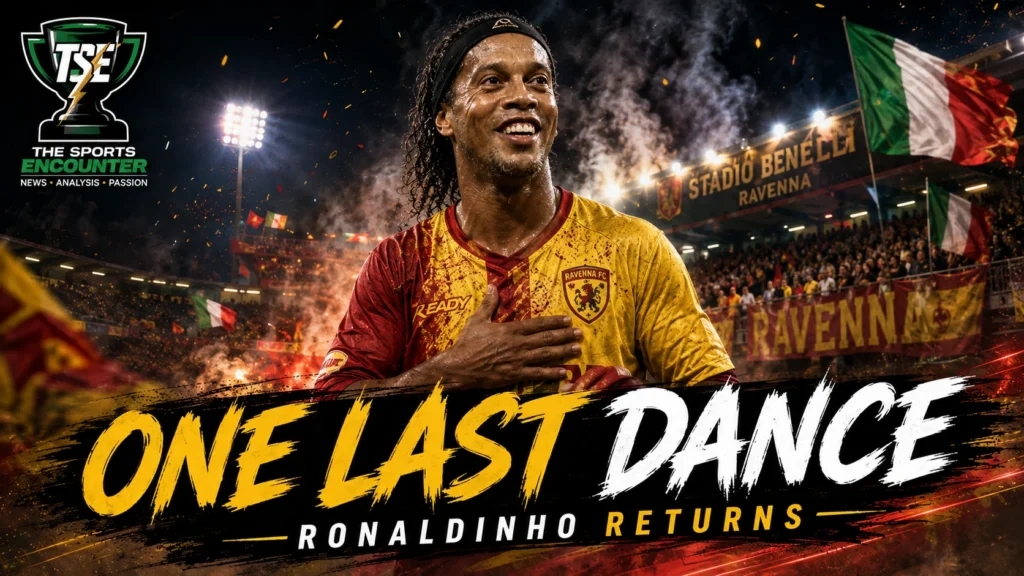
Eleven years after his last professional appearance, Ronaldinho has landed in Italy carrying the kind of football ambition that sounds almost too romantic to survive the modern game.
He wants one more official match.
And, if the ball cooperates one final time, one more goal.
The 46-year-old Brazilian arrived in Romagna on Thursday ahead of a spectacular public presentation with Ravenna FC, the Serie C club where he is already part of the ownership project and has now been registered as a player.
Ronaldinho is expected to play at least one official league match for Ravenna during the 2026-27 season. The exact fixture has not yet been announced, an important distinction as excitement builds around one of the most unusual comeback stories in modern soccer.
For a player whose career was built around imagination, the final chapter could hardly be more appropriate.
A former FIFA World Cup champion and Ballon d’Or winner, once adored at Barcelona and AC Milan, is preparing to wear the shirt of an ambitious Italian third-tier club with a very specific personal target: score the final professional goal of his career.
Ronaldinho’s Ravenna Return at a Glance
| Detail | Information |
|---|---|
| Player | Ronaldinho |
| Age | 46 |
| Club | Ravenna FC |
| Competition | Serie C, Italy |
| Role | Registered player and participant in Ravenna’s wider ownership project |
| Professional football absence | Since 2015 |
| Planned appearance | At least one official league match |
| Exact match date | Not yet confirmed |
| Personal target | Score the final professional goal of his career |
| Public presentation | August 20, Marina di Ravenna |
| Ravenna Serie C opener | August 24 away to Reggiana |
Ronaldinho Arrives and Ravenna Suddenly Feels Like the Center of Football
Ronaldinho arrived at Forlì’s Ridolfi Airport late Thursday morning after traveling from Milan, with Ravenna representatives waiting to welcome him.
Even before the major public event began, supporters were already gathering for photographs and autographs.
That reaction gives some sense of what Ravenna have brought into the city.
This is a club preparing for another Serie C campaign, yet one of the most recognizable footballers of the 21st century has suddenly become part of its sporting story.
Later on August 20, Ronaldinho is scheduled to appear alongside Ravenna’s players, management and staff at a beach presentation in Marina di Ravenna. Organizers have framed the evening as much more than a normal squad unveiling, with music, entertainment, merchandise and a DJ set built around the occasion.
Thousands of supporters are expected around an event that would have been almost unimaginable for a third-tier Italian club only months ago.
For continued coverage of global football stories, major personalities and unusual developments across the sport, visit The Sports Encounter’s soccer hub.
This Is a Real Registration, Not Ronaldinho Turning Up for a Friendly
The distinction is central to the story.
Ronaldinho has played in exhibitions, legends matches and entertainment events since stepping away from professional football. Ravenna’s project is different.
The club officially announced in June that Ronaldinho would be registered as a player for the coming season.
Ravenna’s own announcement described the move as one of the most significant signings in the club’s history and confirmed that the Brazilian intends to take the field in the club’s colors.
The objective is deliberately simple.
Ronaldinho wants his final professional goal to come for Ravenna.
That gives the comeback an emotional purpose beyond another nostalgic appearance.
There is still no confirmation of which league match will feature Ronaldinho. Ravenna begin their Serie C campaign away to Reggiana on Monday, August 24, but the Brazilian is not currently expected to make his appearance there.
His eventual match is expected to be treated as a major event in its own right.
One Goal Would Close a Career Built on Making Football Look Different
Trying to explain Ronaldinho through statistics has always felt slightly incomplete.
The goals mattered. The assists mattered. The trophies mattered.
The lasting memory is movement.
A defender shifting his weight in the wrong direction. A no-look pass entering a space nobody else had noticed. A free kick bending toward a goalkeeper who realized too late what was happening. A smile appearing while the ball was still at his feet.
Ronaldinho belonged to an era when highlights traveled across television, DVDs, early YouTube and message boards before today’s social-media machinery made every touch instantly global.
He became global anyway.
FIFA’s own retrospective on the Brazilian recalls the young attacker emerging internationally in 1999 before becoming part of Brazil’s triumphant 2002 World Cup team and later winning the FIFA World Player of the Year award in consecutive years.
His outrageous free kick against England in the 2002 World Cup quarterfinal remains one of the competition’s most recognizable goals.
Readers interested in how one defining moment can follow a legendary player for decades may also enjoy our feature on Roberto Baggio and the penalty that shaped his World Cup memory.
From Porto Alegre to Paris, Barcelona, Milan and One Final Stop in Ravenna
Ronaldinho’s professional journey began in Brazil with Grêmio before Europe changed the scale of his career.
Paris Saint-Germain brought him to France.
Barcelona turned him into the best player in the world.
AC Milan returned him to Italy.
Later came Flamengo, Atlético Mineiro, Querétaro and Fluminense.
His time at Barcelona remains the defining club chapter.
Ronaldinho won major domestic and European honors, collected the 2005 Ballon d’Or and became the centerpiece of a team that helped restore Barcelona among Europe’s elite.
There were evenings when even opposition supporters seemed reluctant to remain opponents.
His performance at the Santiago Bernabéu in November 2005 produced one of football’s rarest sights: sections of the Real Madrid crowd applauding a Barcelona player.
Now the career map has acquired an unexpected final pin.
Ravenna.
The 2002 World Cup Made Ronaldinho Part of Brazil’s Eternal Football Story
Before Barcelona made him a club icon, the World Cup made Ronaldinho immortal in Brazil.
He was 22 during the 2002 tournament in South Korea and Japan, playing alongside Ronaldo Nazário and Rivaldo in one of the most gifted attacking units of its generation.
The quarterfinal against England captured the contradictions that made him fascinating.
Ronaldinho drove through midfield to help create Brazil’s equalizer, scored the extraordinary long-range free kick that beat David Seaman, and was later sent off.
Brazil survived without him and eventually defeated Germany in the final to win its fifth World Cup.
The Brazilian’s place in that championship generation connects this Ravenna experiment with a broader question football is confronting more frequently: how long should legends keep playing when their relationship with the game still feels unfinished?
The Sports Encounter explored that theme recently in The Golden Generation Saying Goodbye After the FIFA World Cup 2026, examining the departure of players who shaped an entire era of modern soccer.
At 46, Nobody Should Pretend This Is Peak Ronaldinho
Romance should not erase reality.
Ronaldinho is 46.
He has been away from professional football since his brief spell with Fluminense in 2015.
Serie C is a serious professional competition filled with younger players whose conditioning, match rhythm and tactical preparation have been built through continuous seasons.
Ravenna are therefore not bringing back the Ronaldinho who terrorized defenders at the Camp Nou.
Nobody should expect that.
The attraction lies somewhere else.
Can a footballer whose game depended so heavily on touch, awareness and imagination still create one meaningful professional moment more than a decade after walking away?
Elite soccer has become increasingly fascinated by longevity.
Cristiano Ronaldo continued playing international football into his 40s, a remarkable career arc examined in The Sports Encounter’s complete review of Cristiano Ronaldo’s World Cup career.
Lionel Messi’s future has generated similar debate, including whether extraordinary players can keep redefining the traditional timeline of an elite career. Our recent analysis asked how long Messi could realistically continue playing.
Ronaldinho is attempting something entirely different.
He is returning after the competitive clock had already stopped.
Ravenna Are Selling a Dream Far Bigger Than One Appearance
Ronaldinho’s comeback makes more sense once Ravenna’s wider ambitions are understood.
President Ignazio Cipriani has spent much of his adult life in the United States but retains deep ties to Ravenna, his hometown.
Cipriani and investment partner Black Duck acquired the club in 2024 and began assembling a project intended to expand Ravenna’s sporting and commercial horizons.
Experienced Italian executive Ariedo Braida became part of the management structure. Braida’s history is especially relevant here because he spent decades helping construct major AC Milan teams and worked at the club during Ronaldinho’s time in the red-and-black shirt.
Ravenna subsequently entered a four-year technical partnership with Nike.
Then came Ronaldinho.
In sporting terms, a 46-year-old appearing once cannot transform an entire league campaign.
Commercially and culturally, his presence changes the size of Ravenna’s conversation overnight.
A Serie C club that would ordinarily fight for attention inside a crowded Italian football market suddenly has international media tracking an August beach presentation.
That is the Ronaldinho effect Ravenna are trying to convert into something lasting.
Ronaldinho the Shareholder Matters as Much as Ronaldinho the Player
The relationship is broader than 90 minutes of nostalgia.
Ronaldinho is connected to the club’s wider ownership and promotional project, giving Ravenna access to a global personality whose reach extends across generations and continents.
His image can introduce the club to supporters who might never otherwise watch Serie C.
The challenge begins after that introduction.
Attention is temporary.
A functioning football club requires recruitment, coaching, academy development, infrastructure, commercial discipline and results.
Cipriani’s project therefore becomes interesting precisely because Ronaldinho cannot solve the sporting problem himself.
He can open the door.
Ravenna have to build what sits behind it.
Serie A Is the Dream, but Serie C Will Judge the Project First
Ravenna’s ownership has spoken ambitiously about the club’s future, including a long-term desire to reach the highest level of Italian football.
The immediate reality is much less glamorous.
Serie C is difficult.
Promotion pathways are unforgiving. Established clubs with strong regional identities compete for limited places. Financial mistakes can punish teams long before a glamorous long-term plan reaches maturity.
Ravenna finished the previous season as the highest-ranked third-place team in Serie C and qualified for the preliminary round of the Coppa Italia, giving the new project a meaningful sporting base.
The 2026-27 league campaign begins with an away fixture against Reggiana on August 24, followed by the home opener against Latina on August 29.
Italian football itself is navigating deeper structural questions. Our recent examination of the wider problems confronting Italian soccer looked at leadership, development, identity and the pressure surrounding one of the game’s great football nations.
Ravenna’s attempt to build upward from Serie C therefore arrives inside a domestic game searching for new energy of its own.
The Beach Presentation Tells Us Exactly What Ravenna Think Ronaldinho Can Do
A standard football signing is introduced at a training ground or stadium.
Ronaldinho is being presented on a beach.
That sounds unconventional because it is.
The August 20 event at Marina di Ravenna is designed as a festival. The first team, youth setup, staff and leadership will be introduced on stage before the evening continues with music and entertainment.
Ronaldinho is the centerpiece.
This fits the broader Ravenna strategy of placing football alongside culture, lifestyle and international visibility.
Traditionalists will inevitably question whether all of this risks becoming spectacle before substance.
That skepticism is healthy.
Football history contains plenty of ownership projects that produced memorable launch parties and forgettable league tables.
Ravenna ultimately have to win matches.
Still, dismissing Ronaldinho’s involvement as a publicity stunt alone also misses what modern football clubs are becoming.
Audience growth matters.
Commercial reach matters.
Merchandise matters.
International relevance matters.
A club capable of turning new attention into sustainable revenue can strengthen the sporting operation underneath it.
Ravenna’s R10 Shirt Already Shows the Commercial Opportunity
The Ronaldinho connection began creating demand long before he reached Italy.
The club built merchandise around the R10 identity and new Ravenna collaboration, tying one of football’s most recognizable personal brands directly to its own.
That strategy explains why the project stretches beyond whether Ronaldinho plays 20 minutes, 45 minutes or an entire match.
Millions of supporters around the world remember the number 10 shirt, the headband, the grin and the celebrations.
For younger supporters, Ronaldinho’s influence survived largely through highlight culture.
His clips remain endlessly replayable because his football still looks unusual.
That intergenerational appeal is valuable to a club trying to build an international audience from Italy’s third tier.
A Small Italian Club Is Borrowing the World’s Attention
Ravenna cannot manufacture Ronaldinho’s history.
It can temporarily attach itself to it.
That creates a remarkable communications opportunity.
Someone searching for Ravenna this week may discover the football club for the first time because of Ronaldinho.
Someone watching his eventual return might learn who Ravenna’s younger players are.
Some may buy a shirt.
A smaller number may continue following results after Ronaldinho leaves.
That final group is the one that matters most.
The conversion from temporary curiosity to long-term support will determine whether the entire exercise produces something deeper than one globally viewed evening.
Football Has Always Loved the Last Dance
There is a reason stories like this travel so quickly.
Supporters understand that elite careers disappear faster than expected.
The first glimpse of greatness feels permanent. The farewell rarely does.
That tension explains why the final chapters of Messi, Ronaldo and their generation continue attracting enormous attention.
Our feature From Messi to Yamal, 19 Years Ago explored how quickly football passes its imagination from one generation to another.
Ronaldinho belongs to the generation before both ends of that bridge.
Many supporters watching Lamine Yamal today were not old enough to remember Ronaldinho’s Barcelona peak.
Their parents were.
That is what Ravenna have managed to put on one pitch.
Memory and curiosity.
One Final Goal Would Be Almost Too Perfect
There is no guarantee Ronaldinho will score.
That uncertainty is precisely why the idea works.
If Ravenna simply arranged a ceremonial penalty and allowed the Brazilian to walk away with a manufactured goal, the moment would lose much of its emotional value.
An official Serie C match creates risk.
The defenders are professionals.
The goalkeeper has his own career.
The result matters.
Ronaldinho will have to find space against players who may have watched his highlights as children and now have the surreal responsibility of stopping him.
Imagine that moment.
A pass arrives.
Ronaldinho controls it.
The stadium rises.
For a few seconds, age and time disappear from the conversation.
Then he still has to beat the goalkeeper.
What Happens if Ronaldinho Does Score?
The sporting consequence may be modest.
The cultural consequence would be enormous.
One official goal would connect Grêmio, Paris, Barcelona, Milan, Brazil and Ravenna through the strangest statistical line imaginable.
It would also provide the ending Ronaldinho himself appears to want.
His career never required another goal to validate it.
Few footballers have left a clearer imprint on how the sport can feel.
Yet athletes rarely think entirely in terms of legacy.
Sometimes they want one more touch.
One more stadium.
One more celebration.
Ronaldinho wants one more goal.
What Happens if He Does Not?
That may be equally human.
A comeback does not become meaningless because the perfect ending refuses to appear.
Football has never guaranteed its legends closure.
Roberto Baggio knows that better than almost anyone, which is why his 1994 World Cup story remains so powerful decades later.
Ronaldinho could return, fail to score, smile, wave and leave the field anyway.
The point would remain.
For one night, a player whose professional career seemed permanently closed stepped back inside it.
Ronaldinho’s Return Is Also a Reminder of What Made Him Different
Modern football increasingly measures everything.
Expected goals.
Pressing actions.
Progressive carries.
Shot-creating actions.
Possession value.
Ronaldinho emerged before that vocabulary dominated football conversation.
His greatness can survive analytics, but his attraction was emotional.
He made difficult things look playful.
That quality connects him with the rare players whose careers become larger than their statistical profiles. The Sports Encounter explored a similar question in our numbers-driven examination of Lionel Messi’s place among the greatest athletes ever.
Ronaldinho’s career cannot match Messi’s longevity or cumulative production.
His peak produced something different.
Football looked happy around him.
The Bigger Ravenna Question Begins After Ronaldinho Leaves
The final goal makes the headline.
The future of Ravenna FC will be decided elsewhere.
Can the ownership group build a promotion-caliber squad?
Can the club increase attendance without pricing out its existing supporters?
Can global interest create sustainable commercial revenue?
Can young players benefit from the attention surrounding the project?
Can Ravenna retain its local identity while selling an international story?
Those questions will take years to answer.
Ronaldinho’s role is to make more people interested in hearing the answers.
TSE Verdict: This Is Strange, Commercial, Romantic and Completely Ronaldinho
There are easier ways for a football legend to spend retirement.
Ronaldinho could continue playing exhibitions, attending sponsor events and appearing in stadiums where every touch comes without consequence.
Instead, at 46, he has agreed to register with Ravenna FC and step into an official professional match again.
Yes, the project carries an obvious marketing dimension.
Ravenna want attention. Ronaldinho provides it at a level almost no Serie C player possibly could.
But commerce does not cancel emotion.
Cipriani is trying to turn his hometown club into something much larger. Ronaldinho has attached his name to that ambition. And somewhere inside the global branding, beach festivals, shirts and cameras sits an uncomplicated football desire.
He wants to score again.
The exact match remains unknown.
The final outcome is impossible to script.
That is what makes this worth watching.
Football has already given Ronaldinho a World Cup, a Ballon d’Or, Champions League glory, famous nights in Barcelona and Milan, and a collection of moments that still circulate every day.
Ravenna are offering him something much smaller.
One official match.
One final chance.
One more goal, if the old magic has anything left to say.
FAQs
Is Ronaldinho really coming out of retirement for Ravenna FC?
Yes. Ravenna FC announced that Ronaldinho will be officially registered as a player and is expected to appear in at least one official league match during the 2026-27 season.
When will Ronaldinho play for Ravenna?
The exact match has not yet been confirmed. Ravenna open their Serie C season away to Reggiana on August 24, but current reporting indicates Ronaldinho is not expected to play in that opener.
Why is Ronaldinho playing for Ravenna?
Ronaldinho is involved in Ravenna’s wider project and wants to score the final professional goal of his career in the club’s colors. His involvement also forms part of Ravenna’s attempt to increase its international visibility and commercial reach.
How old is Ronaldinho?
Ronaldinho is 46 years old during the 2026-27 season.
When did Ronaldinho last play professional football?
His last professional club spell came with Fluminense in Brazil in 2015.
Does Ronaldinho own part of Ravenna FC?
Ronaldinho is involved in the club’s wider shareholder and ownership project in addition to being registered as a player.
What division does Ravenna FC play in?
Ravenna compete in Serie C, the third tier of professional Italian soccer.
Did Ronaldinho play in Italy before Ravenna?
Yes. Ronaldinho played for AC Milan from 2008 to 2011 after his celebrated spell with Barcelona.
Did Ronaldinho win the FIFA World Cup?
Yes. Ronaldinho was part of Brazil’s 2002 FIFA World Cup-winning team and played a major role in the quarterfinal victory over England.
What is Ronaldinho trying to achieve in his Ravenna appearance?
His symbolic personal objective is to score one final professional goal before closing his playing career.