


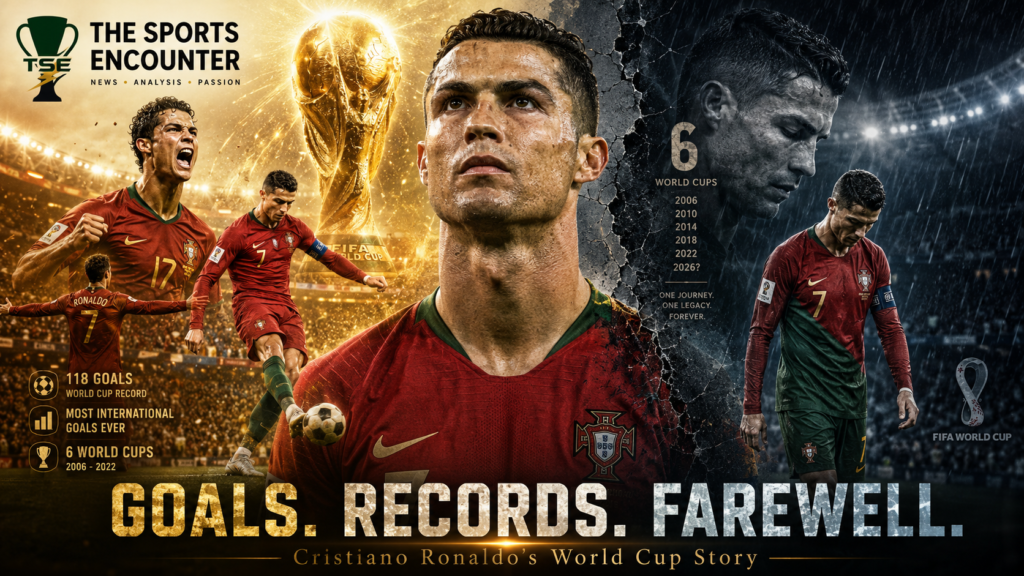
Cristiano Ronaldo spent more than two decades refusing to accept football’s normal limits. The World Cup was the one competition that kept reminding him they still existed.
He arrived at his first tournament in 2006 as a fearless winger with stepovers, speed and a confrontational confidence that Portugal could build around. He left his sixth World Cup in 2026 as a 41-year-old captain whose name had become inseparable from records, pressure and the relentless pursuit of one trophy he could never reach.
The final whistle against Spain did not produce a perfect farewell.
There was no lap of honor with the World Cup in his hands. No decisive knockout goal. No cinematic run to a final that could close the argument around his international career.
Spain scored through Mikel Merino in stoppage time and defeated Portugal 1-0 in the Round of 16. Ronaldo’s sixth and final World Cup ended with frustration, tears and another early exit from the competition that had followed him through every major phase of his career.
Yet his World Cup story cannot be measured only through the trophy he never won.
Ronaldo became the first male player to score at six different World Cups. He passed Eusébio as Portugal’s leading scorer in the competition. He produced one of the tournament’s most memorable hat-tricks against Spain in 2018. He played at six editions across 20 years, moving from a dribbling winger into a penalty-box forward while remaining central to his country’s hopes.
His career connected different generations of Portuguese football.
In 2006, he shared the field with Luís Figo and Pauleta. By 2026, he was playing alongside footballers who had grown up watching his goals for Manchester United, Real Madrid, Juventus and Al Nassr.
Ronaldo’s final World Cup therefore represented more than the conclusion of a tournament career.
It marked the end of an era in which one footballer treated time as an opponent he could outwork.
TL;DR
- Cristiano Ronaldo played at six FIFA World Cups: 2006, 2010, 2014, 2018, 2022 and 2026.
- He became the first male player to score in six different World Cup editions.
- Ronaldo finished with 10 World Cup goals, passing Eusébio as Portugal’s record scorer in the tournament.
- His best World Cup finish was fourth place in 2006.
- His defining tournament performance came in 2018, when he scored a hat-trick against Spain.
- Ronaldo scored his first World Cup knockout goal against Croatia in the 2026 Round of 32.
- Portugal’s 1-0 defeat to Spain in the 2026 Round of 16 ended his final World Cup.
- He confirmed that 2026 was his last World Cup but initially delayed a final decision on his complete international retirement.
- Ronaldo’s international legacy also includes UEFA Euro 2016 and UEFA Nations League titles in 2019 and 2025.
Cristiano Ronaldo’s World Cup Record at a Glance
| Category | Record |
|---|---|
| World Cups played | Six |
| Tournaments | 2006, 2010, 2014, 2018, 2022 and 2026 |
| World Cup goals | 10 |
| Best finish | Fourth place in 2006 |
| First World Cup goal | Against Iran in 2006 |
| Most goals in one World Cup | Four in 2018 |
| Final World Cup goals | Two against Uzbekistan in 2026 |
| First knockout-stage goal | Against Croatia in 2026 |
| Final World Cup match | Portugal 0-1 Spain, July 6, 2026 |
| Historic distinction | First male player to score in six World Cups |
2006: The Young Challenger Arrives
Ronaldo entered the 2006 World Cup as one of Europe’s most exciting young attackers.
He was 21, still developing at Manchester United and known primarily for his speed, stepovers and willingness to attack defenders repeatedly. The more efficient, ruthless goalscorer who would later dominate European football had not fully emerged.
Portugal’s team still belonged largely to the generation led by Figo. Ronaldo represented what would come next.
He scored his first World Cup goal from the penalty spot against Iran, becoming one of Portugal’s youngest scorers at the tournament. The goal itself was not the most spectacular of his career, but it placed him inside a competition he would continue chasing for another 20 years.
Portugal advanced through the group stage and survived a chaotic Round of 16 match against the Netherlands. The contest became known as the Battle of Nuremberg after referee Valentin Ivanov issued a World Cup-record number of cards.
Ronaldo was injured by a challenge from Khalid Boulahrouz and left the field in tears. Portugal advanced without him completing the match.
He recovered in time for the quarterfinal against England.
That match created one of the earliest major controversies of his international career. Wayne Rooney, Ronaldo’s Manchester United teammate, was sent off after a clash involving Ricardo Carvalho. Ronaldo approached the referee during the confrontation and was later captured winking toward the Portugal bench.
England supporters interpreted the moment as betrayal. Ronaldo returned to Manchester as a target of intense anger, but the episode also revealed a trait that would define him.
He did not retreat from pressure.
Ronaldo converted Portugal’s decisive penalty in the shootout and celebrated with the confidence of a player prepared to accept the consequences.
Portugal lost 1-0 to France in the semifinal and then fell to Germany in the third-place match. Fourth place remained the country’s best World Cup finish of Ronaldo’s career.
His first tournament did not revolve around goals. It established his emotional and competitive relationship with the competition.
He arrived as a gifted young player. He left as the future of Portuguese football.
2010: Captaincy, Frustration and a Goal That Solved Little
By the 2010 World Cup, Ronaldo had changed completely.
He had won the Ballon d’Or, lifted the Champions League with Manchester United and moved to Real Madrid in a transfer that reshaped the commercial and competitive landscape of football.
Portugal now looked to him as captain, primary scorer and global symbol.
The tournament in South Africa never fully opened for him.
Portugal drew 0-0 with Ivory Coast before defeating North Korea 7-0. Ronaldo scored in the victory, ending a prolonged international goal drought, but the goal arrived during a match Portugal had already controlled.
A goalless draw with Brazil sent Portugal into the Round of 16, where eventual champions Spain won 1-0 through David Villa.
Ronaldo’s visible frustration after elimination attracted attention. When asked to explain the defeat, he appeared to direct the question toward coach Carlos Queiroz.
The incident reflected a wider problem.
Portugal had one of the world’s best players but lacked a system that consistently brought him into decisive areas. Ronaldo could carry the ball, attack from the left and shoot from distance, yet opponents understood that limiting him often meant limiting Portugal.
His 2010 World Cup contained one goal and no defining knockout contribution.
At club level, he was becoming a scoring machine. With Portugal, the World Cup still felt structurally beyond his control.
2014: The Body Reaches Brazil Before It Is Ready
The 2014 World Cup should have found Ronaldo at his physical peak.
He was 29, had just completed an extraordinary season with Real Madrid and was collecting goals at a rate few players in history had matched.
His body arrived damaged.
Ronaldo had been dealing with knee and thigh problems before the tournament. Portugal faced a difficult group containing Germany, the United States and Ghana, leaving almost no room for physical limitation.
Germany defeated Portugal 4-0 in the opening match. Pepe was sent off, the defensive structure collapsed and Ronaldo spent much of the game isolated.
Against the United States, Portugal moved close to elimination before Ronaldo delivered a precise cross for Silvestre Varela’s late equalizer. The assist kept the campaign alive.
He finally scored against Ghana in the last group match.
Portugal won 2-1 but were eliminated on goal difference.
The goal meant Ronaldo had scored at three consecutive World Cups. It could not hide the disappointment of another tournament in which his physical condition and Portugal’s collective weaknesses prevented a serious challenge.
There was also an important contrast between his club and international careers.
At Real Madrid, Ronaldo played inside a team designed to produce chances for him. His movement was supplied by elite creators, overlapping full-backs and midfielders who could control matches.
Real Madrid’s official record still recognizes Ronaldo as the club’s all-time leading scorer, with 451 goals in 438 competitive appearances. That spell turned him from a devastating winger into one of football’s most efficient finishers.
Portugal could rarely recreate the same environment.
The national team depended on Ronaldo’s finishing but often struggled to deliver the volume and quality of chances his game required.
2018: The Hat-Trick That Defined His World Cup Greatness
If one match explains why Ronaldo’s World Cup career remains significant without the trophy, it is Portugal’s 3-3 draw with Spain in 2018.
He entered the tournament at 33, already adapting his game around movement, positioning, timing and finishing. The explosive dribbler of 2006 had become a scorer who studied defenders and goalkeepers for small weaknesses.
Spain represented one of the strongest technical teams in the tournament.
Ronaldo scored after winning and converting an early penalty. He added a second when David de Gea mishandled his shot, but Portugal trailed 3-2 late in the match.
With two minutes remaining, Ronaldo stood over a free kick outside the penalty area.
He had taken hundreds throughout his career. His conversion rate had declined. Spain formed the wall, and the match appeared to be slipping away.
Ronaldo curled the ball over the wall and into the top corner.
The hat-trick was complete.
His celebration carried no surprise. He stood before the crowd as though the moment had followed the plan.
That performance combined every major element of his football identity: penalty-box movement, shooting confidence, emotional control and the conviction that the biggest stage belonged to him.
Ronaldo scored again against Morocco, heading Portugal to a 1-0 victory. The goal moved him ahead of Ferenc Puskás among Europe’s leading international scorers at the time.
Portugal drew with Iran and advanced to face Uruguay in the Round of 16.
Edinson Cavani scored twice as Uruguay won 2-1. Ronaldo could not find an equalizer.
His four goals made 2018 his most productive World Cup. The Spain hat-trick remains his finest performance in the competition because it showed how one player could repeatedly rescue a team from a technically superior opponent.
Ronaldo had still not scored in a World Cup knockout match.
That missing line in his record grew more visible as the years passed.
2022: History, the Bench and a Painful Loss of Control
Qatar began with another Ronaldo record.
He scored a penalty against Ghana and became the first male player to score in five different World Cups.
The moment should have opened a triumphant final campaign.
Instead, the tournament became his most difficult.
Ronaldo arrived after a breakdown in his second spell with Manchester United. His relationship with manager Erik ten Hag had deteriorated, his playing time had declined and a controversial interview accelerated his departure from the club during the tournament.
The tension followed him into the national team.
Portugal coach Fernando Santos substituted Ronaldo during the group-stage defeat to South Korea. His reaction generated debate. Santos then left him out of the starting lineup against Switzerland in the Round of 16.
Gonçalo Ramos replaced him and scored a hat-trick in a 6-1 victory.
For the first time in years, Portugal had produced its most complete attacking performance without Ronaldo at the center.
The quarterfinal against Morocco confirmed the change. Ronaldo again started on the bench and entered as Portugal chased the match.
Morocco defended its 1-0 lead and became the first African nation to reach a World Cup semifinal.
Ronaldo walked down the tunnel crying.
The image carried the pain of elimination and the shock of reduced authority. His body remained capable of competing, but Portugal had begun imagining a future in which he was no longer automatically selected.
The 2022 World Cup challenged the central principle of Ronaldo’s career.
He had always believed he could respond through work, goals and physical preparation. In Qatar, the decision belonged to someone else.
That loss of control may have hurt as deeply as the defeat.
Saudi Arabia Extended the Career Everyone Thought Was Ending
Ronaldo’s move to Al Nassr after leaving Manchester United was initially treated by many observers as the closing stage of his elite career.
The Saudi Pro League offered financial power, a new audience and a less demanding competitive environment than the leading European leagues.
Ronaldo treated the move as another platform for records.
He continued scoring, maintained his physical standards and remained central to Portugal. His influence also helped draw global attention and other prominent footballers toward Saudi Arabia.
The move mattered to his 2026 World Cup story because it gave him regular football and control over his preparation. Critics questioned the standard of the league, but Ronaldo arrived at the tournament fit enough to play at 41.
His club career had already connected three different versions of the player.
Manchester United developed the winger. Real Madrid perfected the scorer. Al Nassr extended the athlete’s career beyond the point most elite forwards disappear.
Portugal benefited from all three phases.
2026: The Sixth World Cup Becomes Reality
Ronaldo’s presence at the 2026 World Cup changed the emotional temperature of the tournament before he kicked a ball.
FIFA confirmed that he, Lionel Messi and Mexico goalkeeper Guillermo Ochoa were set to appear at a record sixth edition.
At 41, Ronaldo was no longer expected to dominate every match. The central question was narrower and more realistic.
Could he still decide one moment?
The Sports Encounter’s World Cup 2026 curtain-raiser identified Ronaldo’s final chapter as one of the tournament’s greatest emotional storylines.
Portugal opened Group K against DR Congo.
João Neves scored early, but Yoane Wissa equalized and the match ended 1-1. Ronaldo’s inability to reshape the game raised immediate questions about Portugal’s dependence on an aging center-forward. Our report, DR Congo Stun Portugal as Ronaldo’s World Cup Question Grows Louder, examined how the draw exposed the tension between his status and the team’s tactical needs.
Portugal’s response arrived against Uzbekistan.
Ronaldo scored twice in a 5-0 victory, becoming the first male footballer to score in six World Cups. The achievement was covered in Portugal 5-0 Uzbekistan: Ronaldo Magic Returns.
The two goals moved him to 10 in World Cup competition and took him past Eusébio as Portugal’s record scorer at the tournament.
It was a historic answer to the doubts raised by the opening match.
The performance also reinforced the central truth about late-career Ronaldo. He no longer controlled 90 minutes through dribbling or constant involvement. His value existed in the penalty area, where anticipation and finishing could still alter a match quickly.
The Sports Encounter also identified Ronaldo’s response as one of the five defining moments of World Cup Day 13.
The Pass That Never Came Explained Portugal’s Ronaldo Problem
Portugal’s campaign repeatedly showed that the debate around Ronaldo was more complex than choosing between respect and removal.
His presence still attracted defenders. He remained one of the team’s strongest finishers and carried unrivaled tournament experience.
Yet teammates sometimes appeared caught between serving Ronaldo and making the best decision for the attack.
One missed connection involving Bruno Fernandes became symbolic. A passing opportunity toward Ronaldo was ignored, prompting visible frustration and a wider discussion about Portugal’s attacking relationships.
The Pass That Never Came: Ronaldo, Bruno and Portugal’s Big Warning examined how one moment exposed the difficulty of balancing a legendary captain with a team that needed freedom to evolve.
Portugal’s final group match against Colombia ended goalless.
Ronaldo remained quiet as Colombia won the group and Portugal advanced in second place. Our analysis, Ronaldo Quiet as Colombia Frustrate Portugal, showed how the team entered the knockouts without convincing attacking rhythm.
The group stage had delivered history.
It had not delivered certainty.
Croatia Finally Gives Ronaldo a Knockout Goal
Portugal faced Croatia in the Round of 32.
The match brought together two of the defining European players of the modern era. Ronaldo was 41. Luka Modrić was 40. They had shared years of Champions League success at Real Madrid and now faced a match that could end either international journey.
The emotional and tactical context was explored in Portugal vs Croatia: Ronaldo and Modrić Walk Into One More World Cup Knife-Edge.
Ronaldo scored.
After five previous World Cups and years of criticism about his knockout record, he finally found the net beyond the group stage.
The goal became one of the most watched moments of the tournament, with FIFA reporting enormous digital reach around the clip.
Statistically, it filled the most obvious gap in his World Cup scoring record.
Emotionally, it gave his last campaign a moment of release.
Ronaldo’s tournament career would no longer end with the claim that he had never scored in a World Cup knockout match.
Portugal advanced to face Spain.
The final opponent was brutally appropriate.
Spain Ends the Dream Before Ronaldo Can Rewrite the Ending
Ronaldo had produced arguably his finest World Cup performance against Spain eight years earlier.
In 2026, the teams met under completely different conditions.
Spain were younger, more balanced and more comfortable controlling possession. Portugal had experience and individual talent but struggled to build consistent attacking patterns around Ronaldo.
The Round of 16 remained scoreless deep into the match.
Then Mikel Merino scored in stoppage time.
The late winner defeated Portugal 1-0 and ended Ronaldo’s final World Cup. The complete match analysis is available in Spain End Ronaldo’s World Cup Dream With Brutal Late Winner.
Ronaldo had wanted one more opportunity to move closer to the trophy.
Spain gave him almost no time to respond.
After the defeat, he confirmed that the World Cup chapter was over. He stopped short of immediately announcing a full retirement from Portugal, saying that such a decision required reflection.
That distinction matters.
The match represented his final World Cup farewell, even if it did not necessarily mark his final appearance in the shirt governed by the Portuguese Football Federation.
Ronaldo also defended Portugal’s broader international achievements. He had helped the country win its first major trophy at Euro 2016 and later lifted Nations League titles in 2019 and 2025.
The World Cup remained the missing prize.
The Records Ronaldo Leaves Behind
Ronaldo’s World Cup legacy is unusually rich in longevity records.
First male player to score at six World Cups
He scored in 2006, 2010, 2014, 2018, 2022 and 2026. The sequence covers multiple tactical eras, coaches, teammates and versions of Ronaldo himself.
Portugal’s leading World Cup scorer
His 10 goals moved him beyond Eusébio’s nine. Eusébio achieved his total during one extraordinary tournament in 1966, while Ronaldo accumulated his record across six editions.
A six-tournament career spanning 20 years
Few elite footballers remain internationally relevant long enough to participate in six World Cups. Ronaldo did so as an attacking player whose role required repeated physical duels, acceleration and movement inside crowded penalty areas.
Goals across 23 consecutive calendar years for Portugal
His international scoring stretched from the early 2000s into 2026. UEFA listed him as the men’s international scoring record holder with 146 Portugal goals after the tournament.
First World Cup knockout goal at 41
The Croatia goal showed that even late in his career, Ronaldo could still add a new line to one of football’s most examined records.
The records explain his consistency.
They do not fully explain why so many people remained emotionally invested in his final tournament.
Why Ronaldo Never Won the World Cup
Portugal’s failure to win a World Cup during Ronaldo’s career cannot be attributed to one cause.
His early national teams lacked the depth enjoyed by Brazil, France, Germany or Spain. Later generations became stronger, but the tactical relationship between Ronaldo and Portugal grew more difficult as he aged.
Ronaldo also failed to deliver enough decisive knockout performances during his physical prime.
He scored memorable group-stage goals, yet his first knockout goal did not arrive until 2026. The greatest World Cup careers are often built in quarterfinals, semifinals and finals, where Ronaldo’s influence was limited.
There was bad timing as well.
Portugal’s strongest title-winning moment came at Euro 2016, when Ronaldo was forced off injured during the final. The team learned to survive without him and delivered the country’s first major trophy.
At World Cups, Portugal rarely found the same balance between Ronaldo’s individual value and collective resilience.
The 2022 and 2026 tournaments revealed the final stage of that problem. Starting Ronaldo could reduce pressing intensity and movement. Leaving him out created political pressure and removed the team’s most experienced scorer.
Neither option was simple.
How the World Cup Shapes the Messi vs Ronaldo Debate
No discussion of Ronaldo’s tournament legacy escapes comparison with Lionel Messi.
Messi won the World Cup in 2022 and reached another final in 2026. Ronaldo never progressed beyond the semifinal he reached as a young player in 2006.
That difference carries enormous weight in the historical argument.
Our detailed feature, Messi vs Ronaldo: Has 2026 Settled the GOAT Debate?, explains why the debate now concerns different models of greatness rather than a simple goals comparison.
Ronaldo’s strongest claims come from Champions League dominance, longevity, scoring volume, physical reinvention and success in multiple leagues. Messi’s World Cup title, playmaking and broader influence on matches strengthen his all-around case.
Ronaldo’s failure to win the World Cup does not erase his greatness.
It creates the clearest separation between two careers that were otherwise compared through almost every available statistic.
Ronaldo’s Exit Changed the Tournament Beyond Portugal
Ronaldo’s elimination affected more than the sporting bracket.
He remained one of the tournament’s largest sources of attention. Questions about his role, goals, future and interactions with younger players continued after Portugal had left.
The Sports Encounter’s analysis of the most viral players at World Cup 2026 found that Ronaldo continued generating major interest even after elimination.
His departure also contributed to a change in ticket demand. Portugal joined Brazil, the host nations and other commercially important teams in exiting before the quarterfinals. Our report on why World Cup ticket revenues came under pressure examined how the disappearance of major stars weakened resale demand for later matches.
Ronaldo’s value extended beyond performance.
He changed how audiences perceived a match before it began.
The Final Farewell Was Imperfect, Which Made It Honest
Sports rarely give their greatest figures the ending an audience would write for them.
Ronaldo spent his career creating moments that felt scripted: late headers, decisive penalties, Champions League comebacks and celebrations delivered with complete certainty.
His World Cup farewell resisted that pattern.
Portugal did not reach the final. Ronaldo did not score against Spain. The match ended through a late goal that left almost no opportunity for one final response.
That imperfect ending reflected the competition itself.
The World Cup never adjusted to Ronaldo’s desires. It injured him, isolated him, benched him and eliminated him. Even when he produced records, the tournament kept its greatest reward beyond reach.
Ronaldo kept returning.
That persistence forms the emotional center of his legacy.
Final Verdict: The Trophy Is Missing, the Career Is Not
Cristiano Ronaldo leaves the World Cup without the image he wanted most.
There is no photograph of him lifting the trophy for Portugal. No final-winning goal. No complete tournament campaign comparable to Pelé in 1970, Diego Maradona in 1986, Ronaldo Nazário in 2002 or Messi in 2022.
His World Cup career still changed the record book.
Six tournaments. Twenty years. Ten goals. A hat-trick against Spain. Portugal’s scoring record. The first male player to score in six editions. A long-awaited knockout goal at 41.
Those achievements describe a player who refused to disappear on schedule.
His international career also gave Portugal something larger than World Cup progress. Ronaldo helped transform the expectations surrounding the national team. Qualification became normal. Competing for trophies became realistic. Winning Euro 2016 and two Nations League titles changed the country’s football identity.
The World Cup remained unfinished business.
Perhaps that is why the final farewell felt so painful. Ronaldo built a career around turning ambition into evidence. At this tournament, ambition remained ambition.
Spain’s late goal closed the door before he could force it open again.
Ronaldo walked away without the trophy, but he left behind a tournament record shaped by goals, reinvention and extraordinary endurance.
The World Cup defeated him repeatedly.
It never made him stop believing he could return.
The Sports Encounter’s World Cup 2026 coverage focuses on fixtures, team news, match analysis, fan stories, tournament trends, and the biggest talking points from football’s global stage.