


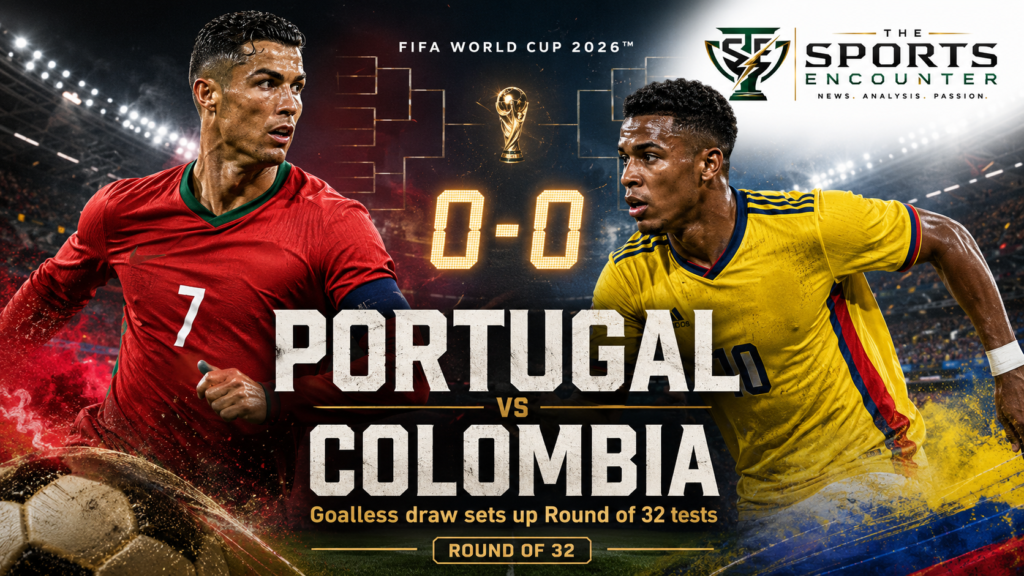
Portugal needed one sharp attacking night to take control of Group K. Instead, they left Miami with a draw, second place, and a Round of 32 meeting with Croatia that now feels more complicated than it looked a week ago.
Colombia left with the better feeling.
The 0-0 scoreline at Miami Stadium may look flat on paper, but the match had enough movement, noise, missed chances, and late VAR drama to carry the weight of a proper World Cup group finale. Colombia pushed harder, created more, and looked more settled in their identity. Portugal defended with enough discipline to survive, but Roberto Martínez’s side again showed the same concern that has followed them through parts of this FIFA World Cup 2026 campaign: too much attacking talent, not enough attacking rhythm.
The result sent Colombia through as Group K winners with seven points. Portugal advanced as runners-up with five. Both are alive, but they move into the knockouts with very different moods.
Match Key Information
| Match | Colombia vs Portugal |
|---|---|
| Competition | FIFA World Cup 2026 |
| Stage | Group K |
| Venue | Miami Stadium, Miami |
| Final Score | Colombia 0-0 Portugal |
| Group Finish | Colombia 1st, Portugal 2nd |
| Colombia Round of 32 Opponent | Ghana |
| Portugal Round of 32 Opponent | Croatia |
| Yellow Cards | Gustavo Puerta, Colombia, 86th minute |
| Red Cards | None reported |
Colombia Looked Like the Team With the Clearer Plan
Colombia did not play like a team protecting top spot. They played like a team trying to confirm why they deserved it.
From the opening minutes, Néstor Lorenzo’s side brought energy through wide areas, especially with Luis Díaz stretching Portugal and Jhon Arias finding pockets between the lines. Jhon Córdoba caused early problems, while James Rodríguez gave Colombia the kind of calm creative direction that still makes him valuable on the biggest stage.
Colombia’s best work came from the way they attacked in waves. They moved Portugal side to side, tested Diogo Costa, and kept recycling pressure when attacks broke down.
That is why the draw will feel slightly frustrating for Colombia. They had the better chances and the stronger overall pattern. Davinson Sánchez thought he had delivered the winner late on, only for the assistant’s flag and VAR to rule the header out for a narrow offside.
Still, Colombia should not walk away discouraged. They finished above Portugal, stayed unbeaten, and now face Ghana in the Round of 32 with belief rather than doubt. For readers following the wider knockout race, The Sports Encounter’s breakdown of the World Cup 2026 knockout picture and Lucky 8 battle explains how the expanded format has kept more teams alive deeper into the group stage.
Portugal Survived, But Did Not Convince
Portugal’s night had two sides.
Defensively, they showed enough concentration to handle long spells of Colombian pressure. Diogo Costa was important, especially when Colombia found space around the box and forced Portugal into uncomfortable recovery runs. Ruben Dias and the back line had to work hard, particularly in the second half when Colombia kept coming.
In attack, Portugal still looked uneven.
Bruno Fernandes came closest when he forced Camilo Vargas into a sharp save. João Félix had moments but lacked precision. Rafael Leão arrived from the bench to add pace and direct running, but Portugal never truly pinned Colombia back for long enough to change the match.
Martínez admitted afterward that Portugal had not controlled the game the way they wanted. That matters because Croatia will not offer Portugal the same kind of loose transitional rhythm Uzbekistan did. Croatia will ask questions in midfield, control tempo when allowed, and punish wasteful possession.
Portugal’s 5-0 win over Uzbekistan had changed the mood around the team. Ronaldo scored twice in that match and Portugal looked liberated. This draw pulled some of the old questions back into the room, especially after Portugal had seemed to take charge of Group K in their dominant win over Uzbekistan.
Cristiano Ronaldo Was Present, But Not Decisive
Cristiano Ronaldo’s night will attract attention because every Portugal match still bends toward his presence.
Against Colombia, he worked, moved, demanded service, and tried to influence the game. Yet his impact stayed limited. His clearest moment came from a long-range free kick that went straight at the goalkeeper. He also attempted an overhead effort after Bruno Fernandes’ chance, but Colombia’s defense closed the space quickly.
The bigger issue was service.
Ronaldo can still finish chances. He proved that against Uzbekistan. But when Portugal cannot move the ball into dangerous zones cleanly, his role becomes easier for strong opponents to manage. Colombia kept him crowded, denied him clean deliveries, and forced Portugal’s creators to play under pressure.
That does not mean Ronaldo is the problem by himself. It means Portugal must decide how to make his presence useful against elite knockout opponents. If the team becomes too focused on finding him from poor angles, attacks slow down. If they ignore him, they lose one of football’s most ruthless penalty-box players.
That balance now becomes one of Portugal’s biggest knockout questions. It was also visible earlier in the tournament, when The Sports Encounter examined Ronaldo, Bruno Fernandes, and Portugal’s attacking warning signs.
Colombia’s Round of 32 Test Against Ghana
Colombia vs Ghana has the feel of a high-energy knockout tie.
Colombia will enter as group winners and likely favorites, but Ghana’s athleticism, transition threat, and emotional edge can make this a dangerous matchup. Lorenzo’s biggest concern is finishing. Colombia created enough against Portugal to win, but knockout football does not always give teams that many chances.
James Rodríguez said Colombia played well but “just lacked the goal.” That is the cleanest summary of their night.
Against Ghana, Colombia must turn control into scoreboard pressure. Díaz and Arias can stretch the game, but the final action has to improve. If Colombia convert early, they can become one of the tournament’s most uncomfortable teams to chase.
Portugal’s Round of 32 Clash With Croatia Looks Tricky
Portugal now face Croatia in Toronto, and that is a dangerous reward for finishing second.
Croatia are experienced, patient, and rarely intimidated by reputation. Portugal will need better midfield control than they showed in Miami. They also need a clearer attacking structure around Ronaldo, Fernandes, Félix, Leão, and the wide players.
The knockout stage often strips teams down to their habits. Portugal’s habit right now is inconsistency. They were held by DR Congo, crushed Uzbekistan, then struggled to impose themselves on Colombia.
Croatia will see that pattern. They will try to slow the match, force Portugal into frustration, and make every missed chance feel heavier. For wider coverage of the knockout stage, readers can follow The Sports Encounter’s football coverage as the Round of 32 takes shape.
Cards and Discipline
The match stayed competitive without turning ugly.
Gustavo Puerta received Colombia’s only reported yellow card in the 86th minute for a serious foul. No red cards were reported.
That matters for both teams because knockout football leaves little room for suspension risk or emotional loss of control. Colombia kept their intensity mostly disciplined. Portugal also avoided unnecessary damage before the Croatia tie.
Final Word
Colombia earned top spot with a performance that had personality, pressure, and courage. The only thing missing was the finish.
Portugal earned qualification, but not comfort. They still have the names, the talent, and Ronaldo’s aura. What they need now is connection. The Round of 32 will not care about reputation, past records, or sentimental storylines.
Colombia go to Ghana with momentum.
Portugal go to Croatia with questions.
And Cristiano Ronaldo goes into another knockout match knowing that every touch, every run, and every missed connection will be judged through the lens of one final World Cup chase.