


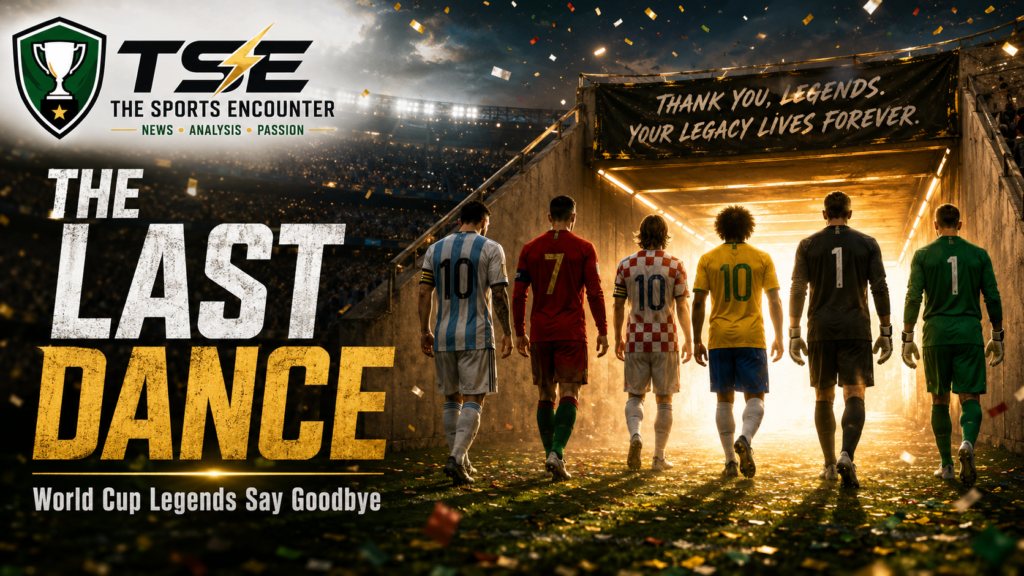
The 2026 FIFA World Cup did more than crown a champion. It quietly closed the international chapter for one of soccer’s most recognizable generations, from Lionel Messi and Cristiano Ronaldo to Luka Modrić, Neymar, Manuel Neuer, Guillermo Ochoa, Robert Lewandowski, Sadio Mané, Riyad Mahrez, and others who carried the game through its most global, social, and commercially explosive era.
Every World Cup produces farewells.
Some come with tears. Some come with applause. Some arrive through a substituted captain walking slowly toward the touchline, waving to supporters who understand what they are watching. Others arrive without ceremony, hidden inside a quarterfinal defeat, a missed penalty, an injury, a group-stage exit, or a post-match interview that sounds ordinary until the words settle.
The 2026 FIFA World Cup felt different because the goodbye was not limited to one player, one country, or one golden generation. It felt like an entire era of football was stepping away at the same time.
Lionel Messi was 39 during the tournament. Cristiano Ronaldo was 41. Luka Modrić was 40. Guillermo Ochoa was 40. Neymar, Manuel Neuer, Robert Lewandowski, Sadio Mané, Riyad Mahrez, Nicolás Otamendi, Enner Valencia, Marko Arnautović, Craig Gordon, Edin Džeko, Yuto Nagatomo, and others belonged to a generation that shaped how modern fans watched, argued about, consumed, and emotionally understood international soccer.
Some of them formally retired from international duty after the tournament. Others have not needed a formal announcement for the message to feel clear. By 2030, most will either be gone from the World Cup stage or present only as coaches, ambassadors, pundits, mentors, or memories.
The 2026 World Cup was not only a tournament. It was a closing credits sequence.
For The Sports Encounter’s wider football coverage, this farewell matters because it connects directly with the emotional scale of modern tournament football. We have already explored how the 2026 tournament could reshape the game’s commercial future through World Cup 2026’s impact on soccer’s rise in the United States, fan identity through the FIFA World Cup 2026 fan-voted dream team, and national heartbreak through England’s World Cup 2026 semifinal defeat.
This story sits in the same emotional universe.
It asks a simple question with a difficult answer: what happens when the players who defined the modern World Cup finally leave it behind?
TL;DR: The 2026 World Cup Farewell Generation
| Player | Country | 2026 Age | Why 2026 Felt Like a Goodbye |
|---|---|---|---|
| Lionel Messi | Argentina | 39 | Played in a sixth World Cup and reached another final deep into his late-career chapter. |
| Cristiano Ronaldo | Portugal | 41 | His 2026 appearance carried the emotional weight of a final World Cup pursuit. |
| Luka Modrić | Croatia | 40 | Reached another major milestone after leading Croatia’s golden era across multiple tournaments. |
| Neymar | Brazil | 34 | Injury and Brazil’s exit turned his international chapter into one of the tournament’s most painful endings. |
| Manuel Neuer | Germany | 40 | Returned for another World Cup before Germany’s latest disappointment ended his international run. |
| Guillermo Ochoa | Mexico | 40 | Closed one of the most beloved goalkeeper stories in modern World Cup culture. |
| Robert Lewandowski | Poland | 37 | Reached the end of an era as Poland’s defining modern striker. |
| Sadio Mané | Senegal | 34 | His farewell carried the weight of Senegal’s modern rise and African football’s changing identity. |
| Riyad Mahrez | Algeria | 35 | Stepped away after shaping Algeria’s most technically gifted modern era. |
| Nicolás Otamendi | Argentina | 38 | Closed a long Argentina chapter built on resilience, edge, and late-career redemption. |
The World Cup Changed With This Generation
To understand why this farewell feels so big, we need to remember what this generation changed.
Messi and Ronaldo did not simply play football. They turned football into a 15-year global comparison machine. Their rivalry moved across La Liga, the Champions League, Ballon d’Or debates, social media arguments, international tournaments, commercial campaigns, and generational identity. Fans did not only support them. They built football personalities around them.
Modrić gave Croatia a football soul that traveled far beyond population size. Neymar carried Brazilian flair into the streaming and social-media age. Neuer changed how many people understood goalkeeping. Lewandowski became the model of finishing efficiency. Ochoa became the World Cup’s cult goalkeeper, the man casual fans somehow rediscovered every four years as if the tournament had a secret contract with him.
There were others too.
Di María gave Argentina clutch moments across multiple eras. Otamendi survived criticism to become part of a world champion’s defensive backbone. Mané became Senegal’s global face. Mahrez gave Algeria style, touch, and continental pride. Džeko carried Bosnia and Herzegovina’s football identity for years. Nagatomo became a symbol of Japanese consistency. Arnautović finally tasted a World Cup late in his career. Neuer, even after injuries and retirement questions, remained tied to Germany’s modern goalkeeping revolution.
This generation did not grow up inside today’s football ecosystem. They helped create it.
They began in a world where YouTube compilations were still rough, tactical data was less public, social media did not drive every debate, and international football still felt separated from the daily club-content machine. By 2026, they were playing in a tournament shaped by streaming clips, fan votes, data graphics, fantasy games, tactical breakdowns, instant outrage, and global conversations across every platform.
They were the bridge.
Messi: The Last World Cup Chapter of the Game’s Quiet Genius
Lionel Messi’s 2026 World Cup did not need to be perfect to matter.
By the time he arrived in North America, his legacy had already escaped normal football measurement. The 2022 World Cup win in Qatar changed the emotional conversation around him forever. Before that triumph, every Argentina tournament carried the same question: could the greatest club footballer of his era finally win the World Cup?
After Qatar, the pressure shifted.
Messi no longer had to complete anything. He was playing with the strange freedom of a man whose greatest burden had already lifted. That made 2026 feel less like a chase and more like a final public appearance by a figure who had spent two decades bending football toward his rhythm.
His sixth World Cup carried historic weight. Very few players even survive long enough to play across that many cycles. Fewer still remain emotionally central to their country’s story at that age.
Argentina’s 2026 run added another layer to his final World Cup image. The country no longer looked like a team waiting for Messi to rescue it in the old way. It looked like a modern football nation still shaped by him, but increasingly prepared to live beyond him.
That may be the real beauty of Messi’s goodbye.
He leaves Argentina with memories, trophies, belief, and a new standard for what the shirt can mean. The sadness is obvious. The stability he leaves behind matters even more.
Ronaldo: The Final World Cup Chase of Football’s Great Competitor
Cristiano Ronaldo’s World Cup story has always carried a different emotional rhythm.
Messi’s international arc was often framed around destiny. Ronaldo’s was framed around defiance. He pushed against age, criticism, tactical change, role reduction, selection debate, and the biological limits that catch every athlete eventually.
At 41, Ronaldo’s 2026 World Cup appearance was already remarkable. Playing at that level, on that stage, at that age, says something about obsession. It also says something about the modern athlete’s ability to extend elite careers through nutrition, recovery, training science, mentality, and ruthless personal discipline.
Ronaldo’s greatest international achievement remains Portugal’s Euro 2016 triumph. Yet the World Cup always sat as the one prize missing from his record. That absence gave every tournament a sharper edge.
By 2026, the question had changed. It was no longer whether Ronaldo could dominate a World Cup in his prime. That version of the conversation belonged to another decade. The question became whether he could still force one last meaningful moment from a tournament that had never fully belonged to him.
That made his farewell powerful in a different way.
Ronaldo’s World Cup ending reminds fans that greatness does not guarantee closure. Some careers end with the trophy. Others end with pursuit itself. His career has always been built on hunger, and perhaps the most honest version of his final World Cup image is not victory, but refusal.
He kept chasing until the tournament moved on without him.
Modrić: Croatia’s Golden Era Reaches Its Natural Sunset
Luka Modrić may be the purest example of a player who changed what a small football nation could imagine.
Croatia had history before him, of course. The 1998 team left a major mark. But Modrić’s era turned Croatia from a dangerous tournament side into a country that repeatedly forced itself into the final stages of global football.
The 2018 World Cup final run was one of the great modern tournament stories. Croatia did not have the population, financial scale, or player pool of the biggest nations. It had midfield courage, emotional toughness, technical control, and a captain who could make a match feel manageable even when his team looked physically exhausted.
Then came another deep run in 2022, when Croatia again showed that tournament football rewards mentality as much as talent.
By 2026, Modrić was no longer simply a midfielder. He was a national artifact. Every touch carried memory. Every pass reminded fans of Russia 2018, Qatar 2022, Real Madrid nights, Ballon d’Or recognition, and that rare ability to make pressure feel elegant.
His farewell is not only personal. It raises a national question for Croatia.
How does a country replace not just a player, but an operating system?
Modrić gave Croatia rhythm, authority, tactical intelligence, emotional composure, and global respect. Future Croatian teams may still be strong. They may still produce brilliant players. But replacing Modrić is not a recruitment issue. It is a football identity issue.
Neymar: The Most Complicated Goodbye
Neymar’s World Cup farewell, if 2026 proves to be the last one, may be the hardest to process.
Messi’s international story found fulfillment. Ronaldo’s found defiant longevity. Modrić’s found national transcendence. Neymar’s story feels more wounded.
Brazil has always carried a different kind of expectation. Every great Brazilian attacker enters a conversation shaped by Pelé, Zico, Romário, Ronaldo Nazário, Rivaldo, Ronaldinho, Kaká, and the country’s long romance with beauty and pressure. Neymar inherited that burden in the social-media age, when every dribble could become a clip and every defeat could become a character trial.
He gave Brazil many moments of brilliance. He became Brazil’s all-time leading men’s scorer. He carried the national team through multiple cycles. He absorbed fouls, criticism, adoration, injury trauma, tactical imbalance, and impossible expectations.
Yet the World Cup never gave him the ending his talent seemed to deserve.
That is why Neymar’s farewell hurts. It feels unfinished, even after everything he achieved.
Brazil’s 2026 exit and Neymar’s injury-limited role sharpened the sadness. The world did not get the clean goodbye. Brazilian fans did not get the final dazzling tournament run. Instead, they got something more human: a great player caught between brilliance, pain, timing, and the cruel arithmetic of tournament football.
Neymar’s legacy will always divide people because his career asked fans to hold two truths together. He was one of the most gifted players of his generation. He also leaves the World Cup without the defining team triumph that would have quieted many of the arguments around him.
That tension will follow his name for years.
The Goalkeepers Saying Goodbye: Neuer and Ochoa
World Cup nostalgia often belongs to attackers, but 2026 also closed major goalkeeper chapters.
Manuel Neuer changed the position. Before him, goalkeepers could be good with their feet. After him, elite goalkeeping had a new tactical vocabulary. His sweeping, passing, starting positions, courage outside the box, and confidence under pressure influenced how clubs and national teams judged the role.
Germany’s 2014 World Cup win remains the great Neuer image. He was not only saving shots. He was controlling space. He was defending behind a high line like an extra outfield player. That version of Neuer felt modern before modern goalkeeping became a requirement.
By 2026, Neuer’s final international chapter carried the weight of a German team still searching for full stability after years of uneven tournament performances. His goodbye was not as triumphant as 2014. Few farewells are. Still, his influence on the position remains secure.
Guillermo Ochoa’s story is different, and that is what makes it special.
Ochoa became a World Cup figure in the most World Cup way possible. He turned tournament appearances into folklore. He produced saves that lived longer than many match reports. He became a player whom neutral fans associated with June and July, with Mexico, with reflexes, with survival, with the strange magic of a goalkeeper who seemed to rise every four years.
His 2026 farewell mattered deeply because Mexico co-hosted the tournament. That gave his final appearance a home-continent emotion few players ever receive.
Ochoa’s greatness was never only statistical. It was cinematic. He looked built for tournament memory.
Lewandowski, Mané and Mahrez: National Icons Without the Perfect World Cup Ending
Not every great player gets a World Cup run that matches his club career.
Robert Lewandowski knows that better than most.
At club level, Lewandowski built one of the finest scoring careers in modern football. He combined movement, timing, finishing technique, strength, discipline, and ruthless efficiency. At international level, he carried Poland through years in which the national team often depended heavily on his finishing.
The World Cup never fully unlocked him in the way the Champions League and domestic football did.
That does not weaken his status as Poland’s defining modern footballer. It actually explains the burden. Some players represent great teams. Others carry imperfect ones. Lewandowski spent much of his international career doing the second job.
Sadio Mané’s farewell carries a different emotional charge. Senegal’s modern rise cannot be understood without him. He brought elite-level credibility, attacking quality, and global recognition to a national team that became one of Africa’s most important football stories. His journey connected club brilliance with national pride in a way that mattered far beyond individual numbers.
Riyad Mahrez gave Algeria another kind of beauty. His touch, balance, left foot, and calm made him one of the most stylish players of his generation. His international legacy will always connect with Algeria’s 2019 Africa Cup of Nations triumph, a tournament that gave his country a night of continental glory.
These players remind us that World Cup greatness has layers.
A player can be a national legend without winning the tournament. He can lift a country’s expectations, change its global image, inspire a generation, and still leave the World Cup with some sadness attached.
The South American Farewell: Otamendi, Valencia and the End of Old Edges
South American football also said goodbye to important figures after 2026.
Nicolás Otamendi’s Argentina career is a study in survival. He lived through criticism, tactical changes, painful defeats, and the long shadow of Argentina’s pre-2021 frustration. Then he became part of the group that helped the country win the Copa América and the World Cup, changing the emotional frame around an entire generation.
Otamendi’s final years with Argentina were not about perfection. They were about edge, experience, and the ability to keep fighting inside tournament pressure.
Enner Valencia’s Ecuador farewell belongs to the same category of national importance. He gave Ecuador goals, leadership, visibility, and belief. For countries outside the traditional title-winning powers, players like Valencia matter because they become reference points. They show younger players what an international career can look like.
South American football has always understood the emotional weight of national-team identity. Club careers matter, but the shirt carries family, neighborhood, language, history, and pride. When players like Otamendi and Valencia walk away, countries lose more than minutes on the pitch.
They lose emotional continuity.
Why the 2026 Goodbye Feels Bigger Than Past Farewells
World Cups have always created generational endings.
2006 closed chapters for icons such as Zinedine Zidane and several members of older European and South American cores. 2014 marked the end or decline of major figures from Spain’s golden generation. 2018 and 2022 reshaped multiple national teams.
But 2026 feels bigger because the departing players belonged to football’s first fully global digital generation.
Fans did not only watch Messi, Ronaldo, Neymar, Modrić and others during tournaments. They watched their training clips, interviews, transfer sagas, endorsements, family posts, tactical breakdowns, arguments, stats graphics, fan edits, goal compilations, and live reactions. These players became part of daily football life in a way previous generations did not.
That changed the emotional relationship.
A fan in Karachi, Lagos, Los Angeles, London, Buenos Aires, Zagreb, Lisbon, Mexico City, São Paulo, Riyadh, Jakarta, or Sydney could build a football identity around the same player. The World Cup then became the one stage where all those private attachments became public again.
That is why the goodbye feels personal even for fans who never saw these players live.
They grew up with them through screens.
The New Generation Has Already Arrived
The hardest part of any football farewell is that the game never waits long enough for grief.
As Messi, Ronaldo, Modrić, Neymar, Ochoa, Neuer and others step away, the next era is already visible. Kylian Mbappé, Erling Haaland, Jude Bellingham, Vinícius Júnior, Lamine Yamal, Jamal Musiala, Florian Wirtz, Pedri, Gavi, Rodri, Endrick, Benjamin Šeško, Michael Olise, and many others now carry the sport’s next set of arguments.
The 2026 World Cup made that transition sharper.
Haaland’s tournament pushed Norway into a new global conversation. Mbappé continued to chase World Cup history. Bellingham’s profile kept expanding. Spain’s younger core showed how quickly a national team can combine technical quality, tactical discipline, and competitive maturity. Emerging teams from Africa, Asia, and smaller football nations made the tournament feel wider than ever.
The expanded 48-team format also changed the emotional landscape. More nations created stories. More players reached the stage. More fan bases found themselves inside the World Cup conversation.
That matters because the next era will not belong to one rivalry in quite the same way Messi vs Ronaldo did.
The future may be more scattered, more global, more positionally diverse, and more tournament-driven. Instead of two names dominating everything, fans may follow a wider cast of stars across more countries and more tactical roles.
That could be healthy for the sport.
It will still feel strange.
What National Teams Lose When Legends Leave
When a great player retires from international football, the loss is rarely limited to output.
Goals can be replaced. Minutes can be redistributed. Captaincy can be reassigned. Shirts can be handed to younger players. Tactical systems can adapt.
Presence is harder.
Argentina without Messi will still have talent, but it will no longer have the player around whom the country built 20 years of emotional weather. Portugal without Ronaldo will no longer carry the same obsessive pursuit. Croatia without Modrić loses the midfielder who made the impossible feel organized. Brazil without Neymar loses a player who absorbed both the fantasy and the criticism of an entire football culture.
Mexico without Ochoa loses one of its most familiar World Cup faces. Germany without Neuer loses a goalkeeper who changed the language of the position. Poland without Lewandowski loses a striker whose standard may be impossible to match for decades.
This is the invisible work of legends.
They give teammates certainty. They give fans identity. They give opponents a mental problem before the match begins. They give broadcasters a story. They give tournaments a face.
When they leave, football becomes younger, faster, and possibly fresher. It also becomes less familiar.
Why Fans Should Celebrate Instead of Only Mourn
There is sadness in this transition, but there should also be gratitude.
This generation gave fans extraordinary football volume. Messi and Ronaldo stretched the idea of prime years. Modrić made midfield intelligence feel beautiful. Neymar kept Brazilian individualism alive in a colder tactical age. Neuer changed goalkeeping. Ochoa turned World Cup goalkeeping into theatre. Lewandowski showed the craft of elite finishing. Mané and Mahrez expanded the emotional map of African football. Otamendi, Valencia, Džeko, Nagatomo and others gave their countries years of commitment.
They also gave fans arguments that made football feel alive.
Who was greater, Messi or Ronaldo? Did Neymar fulfill his talent? Was Modrić the best midfielder of his era? Did Neuer redefine goalkeeping more than any modern keeper? Was Lewandowski underrated because he played for Poland? Did Mané’s national-team impact deserve more global attention? How much should World Cup success shape a player’s legacy?
These debates can be exhausting, but they are also part of football’s social bloodstream.
The Sports Encounter has leaned into these comparison-driven legacy questions across sports, from LeBron James vs Michael Jordan vs Kareem Abdul-Jabbar to the 10 best NHL players ever ranked. Soccer now has its own version of that turning point.
The arguments will not end because the players leave. They may become sharper.
The 2030 World Cup Will Feel Like a Different Sport
By 2030, the World Cup will likely look emotionally different.
Messi will be 43. Ronaldo will be 45. Modrić will be 44. Ochoa will be 44. Neuer will be 44. Lewandowski will be 41. Neymar will be 38. Some may remain around football in other roles, but the central playing stage will almost certainly belong to another cast.
That does not mean the 2030 World Cup will be weaker. It may be spectacular. New stars will arrive. New rivalries will form. New nations will rise. New heartbreaks will create new memories.
Still, something will be missing.
For nearly two decades, fans could enter any World Cup conversation and immediately locate themselves through familiar names. Messi. Ronaldo. Neymar. Modrić. Neuer. Ochoa. Lewandowski. Mané. These names gave tournaments continuity.
2030 will not have the same emotional security blanket.
That may be good for football. It will force fans to watch differently. It will push attention toward teams, systems, new stories, and emerging nations. It will create room for new heroes instead of endlessly measuring younger players against impossible shadows.
But for those who grew up with this generation, the first World Cup without them will feel like walking into a childhood room after the furniture has been moved.
Final Verdict: 2026 Was the End of the World Cup’s Modern Superstar Era
The 2026 FIFA World Cup will be remembered for many things.
It was the first 48-team edition. It stretched across the United States, Canada, and Mexico. It created new commercial records, new fan experiences, new tournament debates, and new global visibility for teams outside the usual elite circle. It gave the game fresh stars, fresh stories, and a glimpse of soccer’s next decade.
Yet emotionally, it may be remembered most clearly as the tournament where the modern superstar generation began saying goodbye.
Messi’s sixth World Cup. Ronaldo’s final chase. Modrić’s last dance with Croatia. Neymar’s painful closing chapter. Neuer’s goalkeeping sunset. Ochoa’s final tournament theatre. Lewandowski’s fading Poland era. Mané and Mahrez stepping away from national-team centrality. Otamendi and Valencia closing South American chapters built on grit and pride.
This generation did not simply play in World Cups. It taught millions of fans how to feel World Cups in the digital age.
They gave us debates, memories, arguments, heartbreaks, clips, tears, celebrations, and impossible standards. They carried their countries and, at times, carried the sport’s global imagination.
The next generation will bring speed, power, tactical intelligence, fresh personalities, and new emotional attachments. Football will survive because football always does. The game never pauses for nostalgia, even when fans need a moment.
But 2026 deserves that moment.
It was the tournament where many of the faces that defined modern soccer looked at the World Cup stage one last time and began walking away.
For official tournament information, fixtures, records, and competition updates, visit the official FIFA World Cup 2026 website.
For more football analysis, legacy debates, and World Cup coverage, follow The Sports Encounter’s football section, including our work on the rise of soccer viewership in America, the World Cup 2026 fan-voted dream team, Argentina vs Spain’s final preview, and France vs England’s third-place match.