


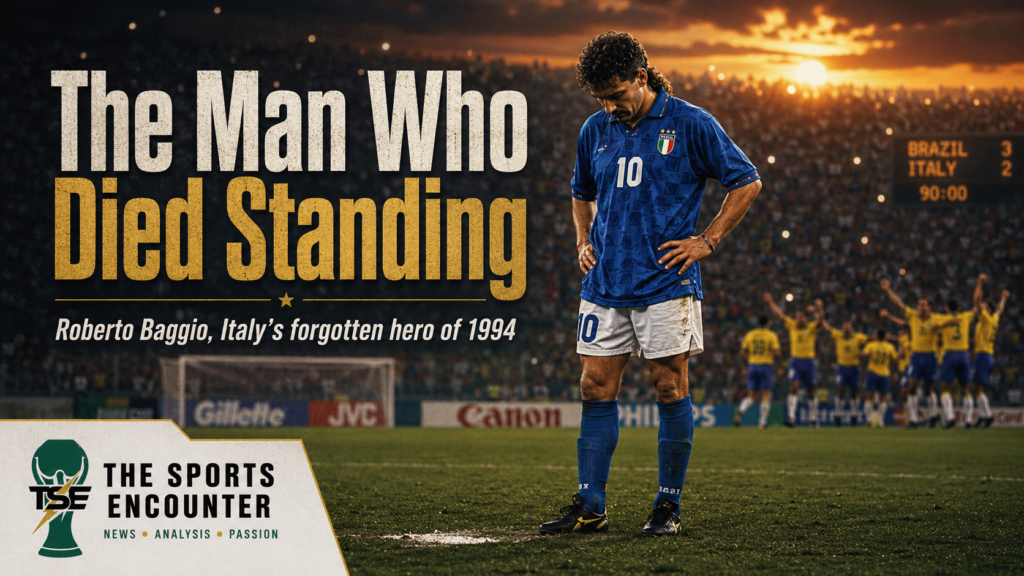
Some footballers are remembered for lifting trophies. Some are remembered for goals, medals, celebrations, and parades. Roberto Baggio is remembered for silence.
A painful silence.
The kind of silence that falls over a stadium when one man realizes that the whole world will remember him for the one thing he failed to do, not for everything he had done before it, The Sports Encounter observed.
At the 1994 FIFA World Cup, Baggio did not simply play for Italy. He carried Italy. He dragged a nervous, unconvincing, struggling side through danger, doubt, and near elimination. He gave his country life when the tournament looked lost. He turned broken matches into miracles.
Then, in the final, football did something cruel.
It reduced his entire World Cup to one missed penalty.
Brazil celebrated. Italy froze. Baggio stood alone in the middle of the Rose Bowl in Pasadena, head down, hands on hips, the ball gone over the bar and a lifetime of pain suddenly written across his face.
That image became history.
But it was never the full truth.
Roberto Baggio was not the villain of the 1994 World Cup final.
He was the reason Italy reached it.
Italy Were Falling Before Roberto Baggio Lifted Them
Italy arrived at USA 1994 with pride, tradition, and expectation, but their tournament began badly. A 1-0 defeat to the Republic of Ireland immediately placed the Azzurri under pressure.
They were not playing like champions. They looked tense. They looked heavy. They looked like a team carrying history rather than writing it.
For large parts of that tournament, Italy did not flow.
They survived.
And survival needed someone special.
That someone was Roberto Baggio.
He was not loud. He was not physically imposing. He did not need to dominate with anger or arrogance. Baggio carried a different kind of strength. He had softness in his feet and steel in his mind. He played like a man who could hear football differently from everyone else.
ALSO READ: Mexico vs South Africa Analysis: 5 Takeaways from the 2026 World Cup Opener
When Italy reached the knockout stage, their World Cup nearly ended against Nigeria.
Italy trailed 1-0. Gianfranco Zola had been sent off. Time was running out. The Italians were almost gone.
Then Baggio appeared.
In the 88th minute, with Italy standing on the edge of elimination, he scored.
Not a wild strike. Not a desperate swing. A calm finish under impossible pressure.
That was Baggio.
When others panicked, he breathed.
When Italy were dying, he gave them air.
He then scored again from the penalty spot in extra time. Italy won 2-1 and stayed alive.
That match should have been remembered as one of the greatest rescue acts in Italian football history. Instead, it became one chapter that many people forgot because the ending of the tournament was louder than the journey.
Spain Felt His Genius
Against Spain in the quarterfinal, Italy again needed someone to break the tension.
The match was level at 1-1. The clock was moving toward extra time. Every touch mattered. Every mistake could become fatal.
Then Baggio made his move.
He slipped through, rounded the goalkeeper, and finished from a tight angle. It was not just a goal. It was a moment of cold courage.
Many players can score when a team is already flying.
Baggio scored when a nation was holding its breath.
That is what made him different.
He did not decorate Italy’s World Cup. He saved it.
Bulgaria Saw the Divine Ponytail at His Best
By the semifinal, Baggio had already rescued Italy twice.
Still, he was not finished.
Bulgaria had become one of the stories of the tournament. They had beaten Germany. Hristo Stoichkov was playing with fire in his boots. Bulgaria believed destiny had opened a door for them.
Baggio closed it.
Two first-half goals. Two moments of technical beauty. Two reminders that some players do not need many chances to change history.
Italy won 2-1.
Baggio had taken them to the final.
By that point, his 1994 World Cup had already become legendary. He had scored five goals in the knockout rounds. He had rescued Italy against Nigeria. He had punished Spain. He had stopped Bulgaria.
He had done what only the very greatest players do.
He had made an imperfect team believe it could touch glory.
Then Came Pasadena
The final against Brazil was tense, cautious, and exhausting.
Brazil had Romario, Bebeto, Dunga, and a team full of power, discipline, and belief. Italy had defensive pride, tactical structure, and one tired genius carrying too much emotional weight.
The match ended 0-0 after extra time.
Then came penalties.
Football can be beautiful for 120 minutes and brutal in five kicks.
Franco Baresi missed for Italy.
Daniele Massaro missed for Italy.
Brazil moved ahead.
Then Baggio walked toward the penalty spot.
This is the part that still hurts.
Because that walk was not just a football moment. It looked like a man walking into judgment.
He had carried Italy for weeks. He had answered every emergency. He had turned fear into hope. But now, with his body tired and the World Cup almost gone, Italy still needed him to save them one more time.
One more miracle.
One more rescue.
One more act of genius.
He struck the ball.
It flew over the bar.
Brazil were world champions.
Baggio stood still.
No fall. No scream. No dramatic collapse.
Just stillness.
His head lowered. His hands on his hips. His body upright, but something inside him clearly broken.
That is why he became the man who died standing.
Roberto Baggio: The Cruelty of One Image
Football can be unfair in the way it remembers.
It loves simple stories. Winners and losers. Heroes and villains. Glory and failure.
Baggio’s story was too complex for that.
So football made it simple.
It took one image from Pasadena and allowed it to swallow the whole tournament.
The miss became bigger than the miracle.
The final became bigger than the road to the final.
The pain became bigger than the greatness.
That is the tragedy.
ALSO READ: FIFA World Cup 2026 Curtain Raiser: The B(oldest) Event Ever?
People remember the ball going over the bar before they remember the goal against Nigeria.
They remember the silence before they remember the winner against Spain.
They remember the heartbreak before they remember the two goals against Bulgaria.
They remember the failure of one kick before they remember the courage of an entire World Cup.
But truth does not disappear just because memory becomes lazy.
Roberto Baggio did not lose Italy the World Cup.
Roberto Baggio gave Italy a World Cup final.
Roberto Baggio: A Hero Without Full Recognition
Baggio is loved. No one can deny that.
But love is not always the same as recognition.
He is admired as a beautiful footballer. He is respected as a genius. He is remembered as one of Italy’s greats.
Still, his 1994 World Cup is not honored with the full weight it deserves.
If another player had carried a nation through the knockout rounds and won the trophy, that campaign would be treated as immortal.
Baggio did almost everything except lift the cup.
That missing final step changed the way history judged him.
And that is painfully unfair.
Because greatness should not always depend on the last kick.
Sometimes greatness is found in the burden carried before that kick ever happens.
Baggio’s burden was enormous.
He played with the expectation of a football nation. He played through pressure, pain, and exhaustion. He became Italy’s answer to every problem. Then, when he finally missed, the same football world that had relied on him allowed him to stand alone with the blame.
There is something deeply human in that.
Many people know that feeling.
You can do ten things right, then one mistake becomes your identity.
You can carry people through difficult days, then they remember the one day you could not carry them anymore.
That is why Baggio’s story still hurts.
It is not only about football.
It is about how cruel memory can be to those who gave everything.
The Divine Ponytail Was Still Human
His nickname, Il Divin Codino, “The Divine Ponytail,” made him sound untouchable.
But he was not untouchable.
He was human.
That is what made the moment so painful.
The man who looked so calm with the ball at his feet suddenly looked completely alone. The player who had given Italy belief now stood as the face of national heartbreak.
There was no hiding place in Pasadena.
The camera found him. History froze him. The world judged him.
But maybe that stillness was also his final act of courage.
He did not run from the moment.
He did not turn away.
He stood there and took the pain.
That image is often treated as failure.
Maybe it should be seen differently.
Maybe it was dignity.
Maybe it was a man accepting the most painful moment of his career without asking anyone else to carry it for him.
The Final Verdict
Roberto Baggio’s 1994 World Cup story should not be remembered as the story of a missed penalty.
It should be remembered as the story of a man who carried Italy as far as his body and soul could take them.
He saved them against Nigeria.
He punished Spain.
He broke Bulgaria.
He gave Italy a final they probably had no right to reach.
Then, at the very end, he missed.
That is the painful truth. But it is not the whole truth.
The whole truth is that Roberto Baggio was Italy’s hero before football turned him into its scapegoat.
He was the miracle before he became the memory.
He was the light before the shadow.
He was the man who stood alone while others celebrated, carrying not just defeat, but the weight of being misunderstood forever.
History gave Brazil the trophy.
But it gave Baggio something different.
A wound that never fully healed.
A legacy that still makes football fans emotional.
A silence that still speaks.
Roberto Baggio did not die as a villain in Pasadena.
He died standing as a hero football never fully thanked.