


Published: August 11, 2026
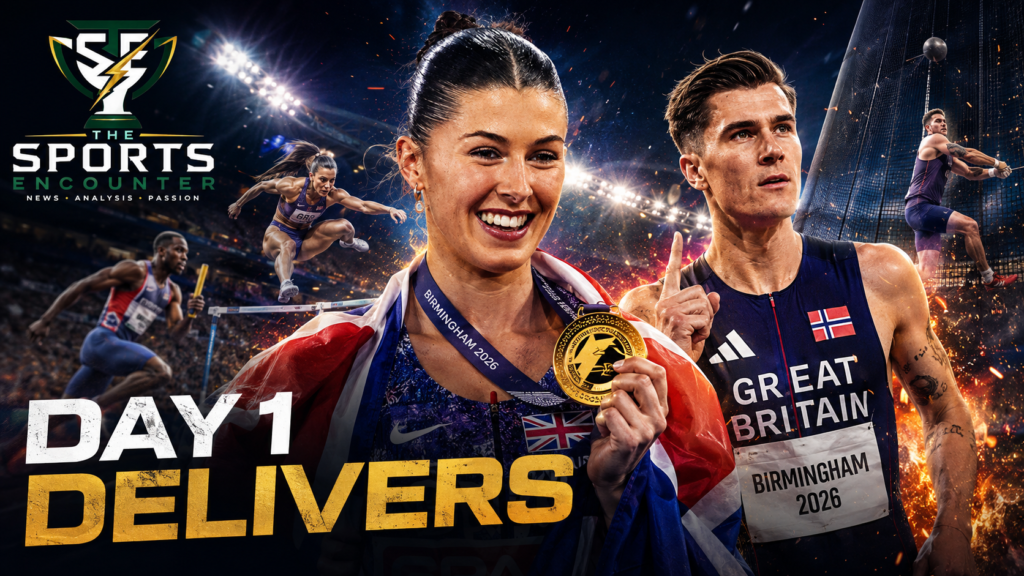
Birmingham waited 92 years to host the European Athletics Championships. It needed only one night to produce a home champion, a remarkable comeback, two successful shot put title defenses and a relay finish that sent Norway to the top of the first medal table.
Amy Hunt delivered the moment the British crowd had been waiting for, charging through the second half of the women’s 100m final to win her first major senior individual title in 11.00 seconds. Poland’s Ewa Swoboda finished just 0.02 seconds behind, Belgium’s Delphine Nkansa took bronze in 11.06, and defending champion Dina Asher-Smith finished fifth.
Earlier, Jakob Ingebrigtsen completed an extraordinary return from a lengthy injury layoff by winning the men’s 5000m in 13:15.29. Norway then added the mixed 4x400m relay title in 3:09.62, while Jessica Schilder retained the women’s shot put crown and Leonardo Fabbri successfully defended the men’s title. :contentReference[oaicite:0]{index=0}
Five finals. Five very different stories.
The first night at Alexander Stadium established the rhythm for a championship that will run through Sunday, August 16, and already gave Birmingham 2026 several performances that could still feature prominently when the event is remembered at the end of the week. The official timetable, live results and medal standings can be followed through the European Athletics Birmingham 2026 results center. :contentReference[oaicite:1]{index=1}
Birmingham 2026 Day 1 at a Glance
| Event | Gold Medalist | Winning Mark | Day 1 Story |
|---|---|---|---|
| Women’s 100m | Amy Hunt, Great Britain | 11.00 | First major senior individual title |
| Men’s 5000m | Jakob Ingebrigtsen, Norway | 13:15.29 | Golden return after long injury absence |
| Mixed 4x400m relay | Norway | 3:09.62 | Late surge from Henriette Jæger secures gold |
| Women’s shot put | Jessica Schilder, Netherlands | 20.73m | Third consecutive European title |
| Men’s shot put | Leonardo Fabbri, Italy | 22.31m | Dominant successful title defense |
Amy Hunt Gives Birmingham Its First Great Home Moment
The final event of the opening night produced its loudest reaction.
Hunt had already signaled her form by running 10.99 in the semifinal, the fastest qualifying performance of the evening. That made her more than a home medal hope. She entered the final carrying the expectation of a favorite. :contentReference[oaicite:2]{index=2}
Swoboda started quickly and immediately applied pressure.
Hunt did not panic.
Her strength emerged once the race entered the upright phase. She began eating into Swoboda’s advantage, stayed relaxed through the final 30 meters and reached the line in 11.00, two hundredths ahead of the Polish sprinter. Nkansa followed in 11.06 to secure bronze. :contentReference[oaicite:3]{index=3}
For Hunt, the victory completes a remarkable sequence of progress.
She had already won Commonwealth 100m silver in Glasgow, where New Zealand’s Zoe Hobbs ran 10.93. The Sports Encounter covered that breakthrough in our Glasgow 2026 Day 5 wrap-up.
Birmingham changed the medal color.
Hunt had also beaten Asher-Smith at the British Championships earlier this summer. Winning again at the same stadium, this time with a continental title at stake, makes the result considerably more significant than a one-night upset.
Asher-Smith’s European reign ends
Asher-Smith reached the final after running a season-best 11.10 in the semifinal, but she could not recreate the form that carried her to European gold in Rome two years ago. She finished fifth in 11.10. :contentReference[oaicite:4]{index=4}
The result should not be interpreted as the end of Asher-Smith’s relevance. Her record remains far beyond anything Hunt has yet built.
But the current British 100m hierarchy has changed.
Hunt has now beaten Asher-Smith at the national championships and succeeded her as European champion.
The next question is no longer whether Hunt can become Britain’s leading female sprinter.
It is how far this version of Amy Hunt can go internationally.
Jakob Ingebrigtsen Returns From the Unknown With Another European Gold
If Hunt provided the emotional home story, Ingebrigtsen delivered the night’s most compelling comeback.
The Norwegian had gone almost a year without racing after Achilles problems and surgery disrupted his career. He arrived in Birmingham with only a relatively short period of uninterrupted training behind him.
Yet the tactical instincts remained intact.
The men’s 5000m unfolded slowly enough to keep a large group involved, increasing the danger for a runner returning from injury. Ingebrigtsen entered the final bend boxed behind Germany’s Florian Bremm and France’s Jimmy Gressier.
Then the gap appeared.
Ingebrigtsen accelerated through it and produced the decisive final sprint, winning in 13:15.29. Bremm claimed silver in 13:15.60, while Etienne Daguinos of France secured bronze. :contentReference[oaicite:5]{index=5}
It was Ingebrigtsen’s fourth consecutive European 5000m title and seventh outdoor European gold overall. :contentReference[oaicite:6]{index=6}
The time mattered less than the body language
The 13:15.29 did not tell the full story.
Ingebrigtsen had spent months wondering whether his body would allow him to compete at this level again. After the race, he acknowledged that simply feeling healthy and recognizably like himself again had been the objective of the previous year. :contentReference[oaicite:7]{index=7}
For Norway, the victory immediately placed a gold medal on the board.
For Ingebrigtsen, it restored something more important: proof that he can still execute a championship race under pressure.
Norway Turns One Gold Into Two in the Mixed 4x400m
Norway did not have to wait long for another celebration.
The mixed 4x400m relay became one of the most dramatic races of the opening night.
Karsten Warholm gave Norway a powerful start, but the Netherlands moved into a strong position after Lieke Klaver’s leg. Great Britain remained involved, setting up a three-team battle entering the final lap. :contentReference[oaicite:8]{index=8}
Yemi Mary John surged past Dutch anchor Myrte van der Schoot and briefly appeared capable of stealing gold for the hosts.
Henriette Jæger had one more acceleration.
The Norwegian anchor produced a devastating final straight and carried her team to victory in 3:09.62. Great Britain took silver and the Netherlands bronze. :contentReference[oaicite:9]{index=9}
The victory meant Norway finished Day 1 with two gold medals, more than any other nation.
Why the relay mattered tactically
The mixed relay is especially unforgiving because teams must balance male and female athletes across four legs while accounting for traffic, exchange positioning and the strengths of rival lineups.
Norway built its strategy around two elite 400m performers in Warholm and Jæger.
That gave them quality at both ends of the race.
The Netherlands briefly appeared to have broken the contest open, while Britain timed its challenge well enough to threaten on the final bend.
Jæger’s closing speed ultimately decided everything.
Jessica Schilder Starts Birmingham 2026 With a Throwing Statement
The first gold medal of Birmingham 2026 went to a familiar champion.
Jessica Schilder won the women’s shot put with 20.73m, producing her best throw with the final attempt of the competition.
The Dutch star had already led with 20.52m from round three. Rather than protect the victory, she improved again after the medals were effectively decided. :contentReference[oaicite:10]{index=10}
Jorinde van Klinken completed a Dutch one-two with a personal-best 19.64m, while Germany’s Yemisi Mabry took bronze at 19.50m. The podium was identical in order to the one from Rome 2024. :contentReference[oaicite:11]{index=11}
Schilder’s victory was her third consecutive European outdoor title.
That is the real measure of her dominance.
Athletics champions frequently survive one cycle. Schilder has now controlled the European event across several seasons while the chasing group has changed around her.
Her final throw also underlined the difference between simply winning and continuing to attack a championship when the gold is already secure.
Leonardo Fabbri Leaves No Argument in the Men’s Shot Put
Fabbri’s title defense was even more decisive.
The Italian won with 22.31m, more than a meter ahead of compatriot Zane Weir’s 21.12m. Sweden’s Wictor Petersson took bronze with 20.97m, while Great Britain’s Scott Lincoln suffered another painful fourth-place finish with 20.81m. :contentReference[oaicite:12]{index=12}
Fabbri entered Birmingham as the clear favorite after producing a world-leading 22.74m earlier in the season. The final confirmed that the gap between him and the rest of Europe remains substantial. :contentReference[oaicite:13]{index=13}
The Italian did not need his absolute best.
His 22.31m was enough to control the competition decisively, and by the time Petersson and Weir took their final attempts, Fabbri already knew the title belonged to him.
Italy gets a one-two, Britain gets another fourth
Weir’s silver gave Italy both of the top two positions.
Lincoln’s fourth place was more painful.
He finished only 0.16m behind Petersson and once again found himself immediately outside the medals at a major championship.
For Britain, Hunt’s gold and the mixed relay silver softened that disappointment considerably.
Opening Morning Produces Important British Progress
The medal finals dominated the evening, but Day 1 began much earlier.
Max Burgin won his men’s 800m heat in 1:45.80 after recovering from illness, while fellow Brit Ben Pattison also progressed. Ireland’s Mark English won his own heat. :contentReference[oaicite:14]{index=14}
Those results matter because the men’s 800m is one of the deepest events of the championships.
Burgin and Pattison remain part of Britain’s medal conversation, but surviving the early round efficiently is essential when multiple races are required across several days.
Britain also made progress elsewhere.
Lina Nielsen won her women’s 400m hurdles heat comfortably, Archie Yeo secured a place in the men’s long jump final, and Jake Norris qualified ninth for the men’s hammer final. :contentReference[oaicite:15]{index=15}
Elise Thorner produced another encouraging home performance in the women’s 3000m steeplechase, controlling her heat and qualifying comfortably for Thursday’s final. Defending champion Alice Finot also advanced. :contentReference[oaicite:16]{index=16}
Not Every British Hope Survived Day 1
Opening rounds always produce casualties.
Emma Nwofor missed qualification for the women’s 100m hurdles semifinals after running 13.04. She ultimately finished outside the 12 fastest athletes needed to advance. :contentReference[oaicite:17]{index=17}
Sarah Tait also failed to reach the women’s 3000m steeplechase final after finishing 12th in her heat.
Those eliminations are easy to lose beneath the medals, but they matter in a seven-day championship where every missed progression reduces a host nation’s later medal opportunities.
Norway Leads the First Birmingham 2026 Medal Table
With five finals completed, Norway ended the opening night on top.
| Rank | Nation | Gold | Silver | Bronze | Total |
|---|---|---|---|---|---|
| 1 | Norway | 2 | 0 | 0 | 2 |
| 2 | Netherlands | 1 | 1 | 1 | 3 |
| 3 | Great Britain | 1 | 1 | 0 | 2 |
| 3 | Italy | 1 | 1 | 0 | 2 |
Norway’s lead came through two very different forms of excellence: Ingebrigtsen’s tactical 5000m victory and the speed of its mixed relay team.
The Netherlands collected the most medals of any nation on Day 1, taking gold and silver in the women’s shot put plus bronze in the relay.
Great Britain ended the night with Hunt’s 100m title and mixed relay silver, while Italy’s entire medal haul came from its men’s shot put strength. :contentReference[oaicite:18]{index=18}
TSE Analysis: Day 1 Was About Champions Who Already Knew How to Win and One Who Finally Did
There was a clear pattern running through the five finals.
Schilder retained her title.
Fabbri retained his title.
Ingebrigtsen retained his 5000m crown.
Norway used experienced elite athletes to win the mixed relay.
Then Hunt changed the script.
The 24-year-old had already accumulated major medals, national titles and sub-11-second performances. What she lacked was an individual senior championship gold.
Birmingham gave her that medal at home.
That contrast gave the opening night its character.
The established champions showed why removing them from the top requires more than a strong season. Hunt showed what happens when a rising athlete finally converts form into championship authority.
The Birmingham Crowd Was Strongest When Britain Gave It Something to Believe In
Alexander Stadium was not completely full on the opening evening, although later sessions in the week are expected to draw larger crowds. :contentReference[oaicite:19]{index=19}
The atmosphere changed noticeably when British athletes entered decisive moments.
Hunt’s final was the clearest example.
The home crowd had watched her progress through the semifinal and understood that a genuine gold-medal opportunity existed. The reaction at the finish provided the first signature crowd moment of the championships.
That matters beyond Birmingham.
Britain is also bidding to host the 2029 World Athletics Championships in London. The Sports Encounter recently examined the proposal in London’s £400 million World Athletics Championships bid.
Nairobi has now entered that same race, seeking to become the first African host of the senior World Championships. Our analysis of the competing vision can be found in Nairobi’s 2029 World Athletics Championships bid.
Successful home championships provide Britain with another piece of evidence when arguing that major athletics still has a strong audience in the country.
From Glasgow to Birmingham: Britain’s Athletics Summer Keeps Moving
Birmingham began only eight days after the Commonwealth Games concluded in Glasgow.
That compressed calendar creates an unusual challenge for British athletes who competed at both championships.
Hunt has managed it superbly.
Her Commonwealth silver became European gold.
Several other athletes now face the same problem of recovering physically and mentally from Glasgow before competing again against Europe’s best.
The Sports Encounter followed that Commonwealth campaign throughout the competition, including our Day 4 report, Day 6 wrap-up, Day 7 analysis and Day 9 report.
Glasgow showed how quickly athletes can build momentum during a major championship.
Birmingham now asks whether they can do it again.
Day 2: Hodgkinson Enters and the Men’s 100m Takes Center Stage
The second day shifts attention toward another set of major British medal hopes.
Olympic champion Keely Hodgkinson begins her women’s 800m campaign, starting a path toward what may become one of the most anticipated races of the championships later in the week.
Her main long-term rivals include Switzerland’s Audrey Werro, who ran 1:53.98 earlier this season, and Femke Bol, now competing as Femke Broeders-Bol, whose move into the 800m has created one of Birmingham’s most fascinating experiments. :contentReference[oaicite:20]{index=20}
The men’s 100m final should provide Tuesday evening’s headline sprint event.
Defending champion Marcell Jacobs will attempt to retain his title, while Britain’s Romell Glave is among the principal home challengers. :contentReference[oaicite:21]{index=21}
The women’s 100m hurdles will also move toward its medal conclusion.
After Hunt’s opening-night gold, expectations around the British team will inevitably rise.
That can help athletes.
It can also create pressure.
Day 1 Winners and Medalists
Women’s 100m
- Amy Hunt, Great Britain – 11.00
- Ewa Swoboda, Poland – 11.02
- Delphine Nkansa, Belgium – 11.06
Men’s 5000m
- Jakob Ingebrigtsen, Norway – 13:15.29
- Florian Bremm, Germany – 13:15.60
- Etienne Daguinos, France – Bronze
Mixed 4x400m Relay
- Norway – 3:09.62
- Great Britain – Silver
- Netherlands – Bronze
Women’s Shot Put
- Jessica Schilder, Netherlands – 20.73m
- Jorinde van Klinken, Netherlands – 19.64m
- Yemisi Mabry, Germany – 19.50m
Men’s Shot Put
- Leonardo Fabbri, Italy – 22.31m
- Zane Weir, Italy – 21.12m
- Wictor Petersson, Sweden – 20.97m
Final Verdict: Birmingham Gets the Opening Night It Needed
A major championship opening day has two jobs.
It must introduce the event.
It must also give people a reason to come back tomorrow.
Birmingham succeeded on both fronts.
Hunt produced the home gold.
Ingebrigtsen turned his first race in almost a year into another European title.
Norway transformed individual success into relay dominance.
Schilder demonstrated that European women’s shot put still belongs to her.
Fabbri showed the scale of the gap he has opened over the rest of the continent.
And beneath those five gold medals, qualifiers and eliminations quietly began shaping the finals that will define the rest of the week.
The first night did not settle Birmingham 2026.
It established the standard.
For official results, athlete profiles, schedules and medal standings, visit European Athletics and the World Athletics competition calendar and results center. :contentReference[oaicite:22]{index=22}
Frequently Asked Questions About Birmingham 2026 Day 1
Who won the women’s 100m at Birmingham 2026?
Great Britain’s Amy Hunt won the European women’s 100m title in 11.00 seconds. Ewa Swoboda of Poland took silver in 11.02 and Belgium’s Delphine Nkansa won bronze in 11.06.
Where did Dina Asher-Smith finish in the 100m final?
Defending champion Dina Asher-Smith finished fifth in 11.10 seconds.
Who won the men’s 5000m?
Norway’s Jakob Ingebrigtsen won in 13:15.29 on his return from a lengthy injury absence.
How many gold medals did Norway win on Day 1?
Norway won two gold medals. Ingebrigtsen won the men’s 5000m before Norway claimed the mixed 4x400m relay.
Who won the women’s shot put?
Jessica Schilder of the Netherlands won with 20.73m, securing her third consecutive European outdoor title.
Who won the men’s shot put?
Italy’s Leonardo Fabbri successfully defended his European title with 22.31m.
Who leads the Birmingham 2026 medal table after Day 1?
Norway leads on gold medals with two. The Netherlands collected three medals overall, while Great Britain and Italy each finished the opening day with one gold and one silver.
When does Birmingham 2026 end?
The European Athletics Championships run through Sunday, August 16, 2026.
What are the biggest events on Day 2?
Keely Hodgkinson begins her women’s 800m campaign, while the men’s 100m and women’s 100m hurdles are among the main medal events on Tuesday.