


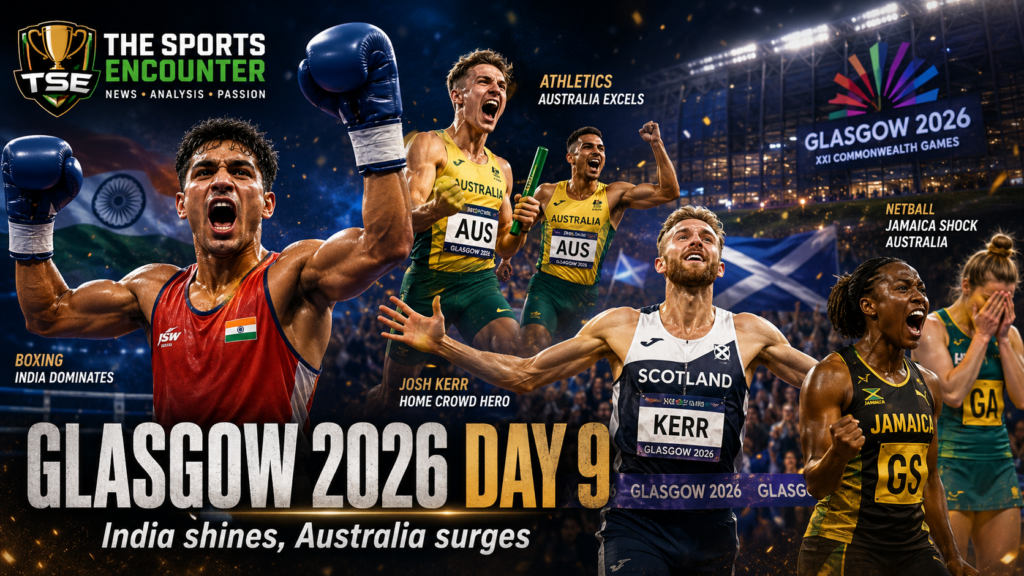
Glasgow 2026 saved one of its most dramatic days for the penultimate stage of the Commonwealth Games.
India produced a record-breaking boxing campaign, Australia delivered its greatest single day of Commonwealth athletics, Josh Kerr gave Scotland a home victory in the blue-riband mile, Jamaica removed the defending champions from the netball gold-medal match, and Neil Fachie ended a historic Para-cycling career with one final title.
Nineteen athletics medals were decided on Saturday, August 1, while boxing, track cycling, judo, and netball transformed the wider medal race before Sunday’s final program.
Australia remained untouchable at the top, reaching 63 gold medals and 154 overall. India’s extraordinary 16-medal day lifted it to fourth place, while England and Canada retained their positions inside the top three.
For schedules, official results, athlete information, and final-day updates, readers can visit the official Glasgow 2026 Commonwealth Games website.
Glasgow 2026 Day 9 at a Glance
| Day 9 storyline | What happened |
|---|---|
| India’s boxing surge | India won seven of its 10 boxing finals and finished with 10 boxing medals |
| Australia’s athletics record | Australia claimed seven athletics gold medals, its best single-day Commonwealth track-and-field haul |
| Josh Kerr’s home title | The Scottish star won the men’s mile with a decisive final-lap finish |
| Netball shock | Jamaica defeated Australia 46-45 to reach the gold-medal match |
| Neil Fachie’s farewell | The Scottish Para-cyclist won his seventh Commonwealth gold in his final race |
| Judo history | Malaysia and Mauritius won their first Commonwealth Games judo titles |
| India’s medal position | India climbed to fourth with 13 gold, 17 silver, and nine bronze medals |
| Medal-table leader | Australia ended the day with 63 gold medals and 154 overall |
India Turns the Boxing Ring Into Its Strongest Arena
India entered Day 9 with 10 boxers preparing for gold-medal bouts.
Seven left the SEC Centre as Commonwealth champions.
The scale of that success made this India’s finest boxing performance at a Commonwealth Games and turned a relatively modest overall campaign into a fourth-place medal-table position.
Sachin Siwach delivered one of the most dramatic victories of the evening in the men’s 60kg final against Namibia’s Tryagain Morning Ndevelo.
Ndevelo appeared to be moving toward victory before Sachin produced a knockdown with the final punch of the contest. That late intervention helped the Indian boxer secure a narrow decision and captured the emotional volatility of the entire finals session.
Jaismine Lamboria defeated Northern Ireland’s Michaela Walsh in the women’s 57kg final. The result denied Walsh gold, although the Northern Irish boxer still created history by becoming the first athlete to win four Commonwealth Games boxing medals.
Preeti Pawar won the women’s 54kg title, Sakshi Chaudhary claimed the women’s 51kg crown, Priya Ghanghas took gold at 60kg, Arundhati Choudhary won the women’s 70kg division, and Ankush Panghal defeated England’s Dimeji Shittu in the men’s 80kg final.
India finished the boxing competition with seven gold medals and three silvers.
That conversion rate mattered more than the overall volume. Ten finalists guaranteed India a strong return, but winning seven of those bouts transformed the team’s position in the wider Games.
The country began Day 9 outside the leading group. By the end of the night, India had climbed above Scotland and entered the final day with 39 medals.
The rise continued the momentum created by India’s historic opening victories in judo, covered in The Sports Encounter’s Glasgow 2026 Day 8 wrap-up.
India’s Success Was Bigger Than Boxing
Boxing supplied the headlines, but India’s 16-medal day stretched across several disciplines.
Para athletes helped the country complete its best Commonwealth Para-sport campaign, with India collecting three gold, two silver, and two bronze medals across the Games.
Strong results in athletics and Para athletics added further value on Saturday. India produced podium finishes in the triple jump and distance events, while Unnati Sharma collected bronze in the women’s -63kg judo competition.
The wider significance is difficult to miss.
Several sports that have traditionally strengthened India’s Commonwealth medal total were absent from Glasgow’s streamlined program. Shooting, wrestling, badminton, and hockey were not part of the 10-sport schedule.
India therefore needed boxing, athletics, weightlifting, judo, and Para sport to compensate.
Day 9 showed what was possible when those disciplines converted opportunities into gold.
The country’s rise also followed the world-record excellence seen earlier in the Games, when Nigeria’s Goodness Nwachukwu rewrote the Para discus record during a medal-rich sixth day.
Australia Produces a Historic Athletics Masterclass
Australia had already dominated swimming, topped the medal table, and passed 100 overall medals before the final weekend.
Day 9 proved that its authority extended far beyond the pool.
Australia won seven athletics gold medals, the country’s best single-day track-and-field return in Commonwealth Games history.
The men’s 4x100m relay provided the most dramatic Australian victory.
Lachlan Kennedy, Josh Azzopardi, Calab Law, and Rohan Browning completed the race in 38.07 seconds, edging Canada by four hundredths of a second. Nigeria finished only one hundredth behind Canada in third.
Australia had not won the Commonwealth men’s sprint relay since 1974.
That 52-year wait ended through clean exchanges, composure under pressure, and Browning’s ability to protect the smallest of margins on the anchor leg.
The women’s mile produced another remarkable result as Australia swept all three medals.
Abbey Caldwell won gold, Jess Hull collected silver, and Claudia Hollingsworth completed the podium. A clean sweep in a major athletics final represented the depth of Australian middle-distance running rather than a single breakthrough performance.
Kurtis Marschall added pole-vault gold with a Commonwealth Games record of 5.85 meters.
Australia’s earlier dominance had been driven by swimming, including the medal rush detailed in The Sports Encounter’s Glasgow 2026 Day 6 results and medal-table analysis.
Saturday changed the interpretation of that success. Australia was no longer leading because of one exceptional program. It was producing champions across athletics, cycling, boxing, gymnastics, basketball, swimming, weightlifting, and Para sport.
Josh Kerr Gives Scotland the Race It Wanted
Josh Kerr arrived at Glasgow 2026 carrying expectations few athletes could escape.
The Scottish crowd wanted a home champion. Kerr entered the men’s mile as the central figure, only two weeks removed from a world-record performance in London.
He delivered through patience rather than reckless aggression.
Kerr remained inside the pack during the early stages, resisted the temptation to control the race from the front, and waited until the final lap before making his decisive move.
Australia’s Cameron Myers took silver, while Kenya’s Timothy Cheruiyot earned bronze.
The victory gave Scotland one of the loudest moments of the Games and confirmed Kerr’s ability to adjust from a record-paced race to a tactical championship final.
A fast time proves physical quality. A crowded final requires positioning, nerve, and the confidence to act before the opening disappears.
Kerr found the right moment.
His success continued a strong home campaign that included Angharad Evans’ memorable swimming double. The Scottish breaststroker’s second title is examined in our feature on how Angharad Evans completed her Glasgow 2026 golden double.
Samuel Ogazi Announces Himself in the Men’s 400m
Nigeria’s Samuel Ogazi delivered one of the most commanding individual victories of Day 9.
Ogazi won the men’s 400m by 0.57 seconds, defeating Trinidad and Tobago’s defending Commonwealth champion Jereem Richards.
The margin stood out because championship 400m finals are often decided by fractions.
Ogazi controlled the race with a strong opening 200 meters, maintained his form around the final bend, and entered the home straight with enough strength to prevent the field from closing.
Afterward, the Nigerian spoke openly about his desire to win Olympic and world titles and become one of the greatest athletes in the sport.
Those ambitions will require years of development, but his Glasgow performance gave them a credible foundation.
Nigeria’s Games had already been shaped by weightlifting, Para athletics, throwing events, and boxing. Ogazi provided the country with a major men’s track title and another potential global star.
Jamaica Ends Australia’s Netball Final Streak
The greatest team-sport shock of Day 9 came at The Hydro.
Jamaica defeated Australia 46-45 in the netball semifinal, eliminating the defending champions and preventing the Diamonds from reaching the Commonwealth gold-medal match for the first time.
The final seconds carried almost unbearable tension.
Australia’s Sophie Dwyer had an opportunity to level the contest and force extra time, but her shot did not fall. Jamaica protected the rebound and survived the closing moments.
The result was not built on one missed Australian attempt.
Jamaica’s defensive pressure disrupted the Diamonds’ usual rhythm, reduced the quality of their feeding into the circle, and forced Australia to operate under scoreboard pressure.
The Sunshine Girls also showed greater composure during the decisive possessions.
Jamaica advanced to face New Zealand, which defeated England in the other semifinal. The Silver Ferns controlled that contest more comfortably, denying England the chance to challenge for gold.
Australia’s loss reshaped the final weekend. The pre-tournament favorite must now recover for the bronze-medal match, while Jamaica has an opportunity to win one of the most significant titles in its netball history.
The semifinal drama followed England’s difficult route through the pool stage, discussed in our Glasgow 2026 Day 7 wrap-up.
Neil Fachie Ends a Historic Career With Gold
Neil Fachie’s final race could hardly have carried more emotional weight.
The Scottish Para-cycling great and pilot Aaron Pope won the men’s tandem B sprint at the Sir Chris Hoy Velodrome, securing Fachie’s seventh Commonwealth Games gold medal.
The home crowd understood the meaning immediately.
Fachie had already established himself among Scotland’s most accomplished Commonwealth athletes. Winning his farewell race in Glasgow allowed him to close the story in the venue, city, and atmosphere that made the moment feel complete.
His success carried significance beyond the medal.
Para events were integrated across six sports at Glasgow 2026, giving athletes such as Fachie the same central Games platform, medal ceremony, broadcast attention, and home-crowd emotion as their non-Para counterparts.
Fachie’s victory became one of the strongest examples of why that integration matters.
Wales also enjoyed an excellent cycling session. Anna Morris won the women’s 25km points race, with teammate Jessica Roberts taking silver.
The one-two finish formed part of a four-medal Welsh day at the velodrome and strengthened Wales’ position inside the top 10.
Malaysia and Mauritius Make Judo History
Day 9 created two first-time Commonwealth judo champions for their nations.
Amir Daniel Bin Abdul Majeed won Malaysia’s first Commonwealth Games judo gold in the men’s -81kg division.
The 21-year-old defeated South Africa’s Timothy Meuwsen with a decisive waza-ari. Their history added unusual depth to the final because the two judokas had previously trained together when neither could find suitable sparring partners before Birmingham 2022.
Remi Feuillet then gave Mauritius its first Commonwealth judo title.
Feuillet defeated Canada’s Guillaume Gaulin by a single yuko in the men’s -90kg final, upgrading the silver medal he won at Birmingham four years earlier.
Canada’s Laurence Biron won the women’s -63kg title, securing Canada’s third judo gold of the Games.
England added two more championships through Ethan Nairne in the men’s -73kg category and Kelly Petersen-Pollard in the women’s -70kg final.
Petersen-Pollard’s win carried particular value because she defeated Australia’s defending champion Aoife Coughlan, who had beaten her in all five of their previous meetings.
The judo session also produced deeply personal bronze medals.
England’s Jemima Yeats-Brown earned her third Commonwealth bronze four years after losing her sister Jenny to brain cancer. Yeats-Brown announced her retirement after the competition and is preparing for a fourth anterior cruciate ligament operation.
Scotland’s Scott Cusack won bronze in the men’s -90kg category, following the family path established by his parents, Loretta and Billy Cusack, who won Commonwealth medals in 1990.
Glasgow 2026 Medal Table After Day 9
Australia remained far ahead of the field after adding gold medals across athletics, cycling, boxing, and other events.
England stayed second by combining a strong overall medal volume with 25 golds. Canada held third, while India’s record Saturday moved it above Scotland into fourth.
| Rank | Nation | Gold | Silver | Bronze | Total |
|---|---|---|---|---|---|
| 1 | Australia | 63 | 40 | 51 | 154 |
| 2 | England | 25 | 40 | 34 | 99 |
| 3 | Canada | 18 | 19 | 21 | 58 |
| 4 | India | 13 | 17 | 9 | 39 |
| 5 | Scotland | 12 | 8 | 17 | 37 |
| 6 | Nigeria | 10 | 6 | 5 | 21 |
| 7 | Wales | 8 | 10 | 12 | 30 |
| 8 | New Zealand | 8 | 10 | 9 | 27 |
| 9 | Malaysia | 8 | 3 | 3 | 14 |
| 10 | South Africa | 7 | 10 | 10 | 27 |
Medal tables are ordered by gold medals, followed by silver and bronze. That system explains why India ranked fourth despite Scotland and several other nations remaining competitive in total-medal volume.
Australia’s progress has been relentless. The team held 26 golds and 59 total medals after the program analyzed in The Sports Encounter’s Day 4 wrap-up.
By Day 6, Australia had passed 100 medals. Three days later, it had reached 154.
How Day 9 Changed the Games
The penultimate day settled several major narratives.
Australia confirmed that its Glasgow dominance cannot be explained by swimming alone. Seven athletics golds gave the team one of the greatest track-and-field sessions in its Commonwealth history.
India found the event capable of changing its entire medal position. The country moved from a respectable campaign to fourth place through one exceptional boxing session and wider podium contributions.
Scotland gained two powerful home memories through Kerr and Fachie. One represented a global middle-distance star meeting expectation. The other marked the closing chapter of an extraordinary Para-sport career.
Jamaica broke the expected netball script, while Malaysia and Mauritius created national history in judo.
Earlier stages of the Games had already produced Australian basketball success and Uganda’s breakthrough silver. That final is revisited in our report on Australia’s victory over the Uganda Gazelles.
England also retained the men’s 3×3 basketball crown, as detailed in our analysis of England’s tense 19-17 victory over Australia.
What to Watch on the Final Day
Sunday’s closing program will decide the remaining titles before the closing ceremony brings Glasgow 2026 to an end.
The netball final between Jamaica and New Zealand carries the greatest team-sport interest. Jamaica enters with momentum after removing Australia, while New Zealand looked composed and efficient against England.
Australia and England will contest bronze, a matchup few expected before the semifinals.
Bowls and Para bowls will complete several medal contests, including England, Northern Ireland, Australia, New Zealand, Scotland, Malaysia, Canada, Guernsey, and Norfolk Island.
Judo will conclude with the heavier weight categories, while the remaining track-cycling program offers further opportunities for Australia, England, Scotland, India, and other leading nations.
The medal-table winner is already clear.
The final day will instead decide the last national breakthroughs, career farewells, and podium positions beneath Australia.
Conclusion
Glasgow 2026 Day 9 delivered the kind of range that gives the Commonwealth Games their identity.
India turned 10 boxing finals into seven gold medals and climbed to fourth in the standings. Australia produced a record athletics day, ended a 52-year wait in the men’s sprint relay, and pushed its overall medal total beyond 150.
Kerr gave Scotland the mile title its crowd desperately wanted. Fachie ended his career with gold. Jamaica defeated the most successful force in Commonwealth netball, while Malaysia and Mauritius heard their anthems after historic judo victories.
The medal table still belonged overwhelmingly to Australia.
The memories belonged to many more nations.
With one day remaining, Glasgow had already shown that a streamlined Commonwealth Games could still produce scale, emotion, historic firsts, and sporting stories capable of surviving long after the closing ceremony.
Frequently Asked Questions About Glasgow 2026 Day 9
Who led the Glasgow 2026 medal table after Day 9?
Australia led the medal table with 63 gold, 40 silver, and 51 bronze medals. Its overall total stood at 154.
How many medals did India win on Day 9?
India won 16 medals on Day 9, its largest single-day haul at Glasgow 2026. The surge lifted India to fourth place with 39 medals overall.
How many boxing gold medals did India win at Glasgow 2026?
India won seven boxing gold medals and three silvers from 10 finals, completing its best Commonwealth Games boxing campaign.
Which Indian boxers won gold on Day 9?
Sachin Siwach, Ankush Panghal, Jaismine Lamboria, Preeti Pawar, Sakshi Chaudhary, Priya Ghanghas, and Arundhati Choudhary won boxing gold medals for India.
Who won the men’s mile at Glasgow 2026?
Scotland’s Josh Kerr won the men’s mile. Australia’s Cameron Myers took silver, while Kenya’s Timothy Cheruiyot earned bronze.
Who won the Glasgow 2026 men’s 4x100m relay?
Australia won the men’s 4x100m relay in 38.07 seconds, defeating Canada by 0.04 seconds. It was Australia’s first Commonwealth title in the event since 1974.
How many athletics gold medals did Australia win on Day 9?
Australia won seven athletics gold medals on Day 9, its highest single-day Commonwealth Games athletics total.
Who won the women’s mile at Glasgow 2026?
Abbey Caldwell won the women’s mile as Australia completed a podium sweep. Jess Hull earned silver and Claudia Hollingsworth took bronze.
What happened in the Jamaica vs Australia netball semifinal?
Jamaica defeated defending champion Australia 46-45. Sophie Dwyer missed a late opportunity to force extra time, sending Jamaica into the final against New Zealand.
Who will play in the Glasgow 2026 netball final?
Jamaica will face New Zealand in the gold-medal match. Australia and England will contest bronze.
How many Commonwealth gold medals did Neil Fachie win?
Neil Fachie finished his career with seven Commonwealth Games gold medals after winning the men’s tandem B sprint with pilot Aaron Pope.
Which nations won their first Commonwealth judo gold medals on Day 9?
Malaysia and Mauritius won their first Commonwealth Games judo titles. Amir Daniel Bin Abdul Majeed won for Malaysia, while Remi Feuillet secured Mauritius’ historic gold.
Where did India rank after Day 9?
India ranked fourth with 13 gold, 17 silver, and nine bronze medals for a total of 39.
When does Glasgow 2026 end?
The Glasgow 2026 Commonwealth Games conclude on Sunday, August 2, following the final medal events and closing ceremony.