Connect with us
Luke Edelman The Sports Encounter

Published

on

Andrew Flintoff has resigned as England Lions head coach and committed himself to rebuilding Sydney Thunder, turning what initially looked like another coaching appointment into the biggest test yet of whether one of England cricket’s most magnetic figures can become an elite head coach in his own right.

Andrew Flintoff has spent much of his cricket life carrying something larger than the job written beside his name.

As an England player, he carried expectation.

During the 2005 Ashes, he carried an entire summer.

After retirement, he became a television personality whose fame reached well beyond cricket.

Then came the December 2022 Top Gear crash that changed the direction of his life and eventually brought him back toward the game that had first made him famous.

Cricket gave Flintoff a route back.

Now he appears ready to discover where that route leads.

The 48-year-old has resigned as head coach of the England Lions, ending a role he began in September 2024, and will concentrate on his new position as Sydney Thunder men’s head coach in Australia’s Big Bash League.

The decision is more significant than a simple change of employer.

When Sydney Thunder appointed Flintoff in June, the original plan was for him to retain his Lions position. The ECB had accepted that he would leave a scheduled Lions tour of South Africa early in order to join Thunder for the BBL season.

Two months later, Flintoff has chosen something more decisive.

He is leaving the England development structure completely.

In doing so, he is stepping away from one of the safest and most influential positions available to an emerging English coach and taking responsibility for a franchise that finished last in the previous Big Bash season.

That is why this move matters.

Sydney Thunder are not hiring a ceremonial celebrity coach.

They are asking Andrew Flintoff to rebuild them.

And Flintoff, for the first time in his coaching career, is moving outside English cricket to find out whether he can do it.

Readers can follow this developing story through The Sports Encounter’s Cricket coverage, including our recent analysis of Sydney Thunder’s looming leadership decision involving David Warner.

The England and Wales Cricket Board confirmed Flintoff’s departure, while Cricket Australia has detailed the two-year contract taking him back to the Big Bash League. :contentReference[oaicite:1]{index=1}

TL;DR: Why Flintoff Leaving the England Lions Matters

DevelopmentWhy It Matters
Flintoff leaves England LionsEnds a development role he held from September 2024 to August 2026
Moves focus to Sydney ThunderBecomes his first head coaching job outside the United Kingdom
Thunder contractTwo-year deal covering BBL|16 and BBL|17
Original arrangementHe had initially planned to combine Thunder and Lions responsibilities
Thunder’s recent positionFinished last in BBL|15 with only two wins
Previous Thunder coachTrevor Bayliss, who departed after five seasons
Flintoff’s franchise experienceTwo seasons leading Northern Superchargers in The Hundred
England pathway experienceHead coach of England Lions plus earlier work with the senior white-ball setup
Immediate Lions replacementMike Yardy will lead the county select side against Pakistan
Bigger questionCan Flintoff convert leadership, presence and player development into sustained franchise success?

This Was Supposed to Be Two Jobs

The detail that changes the entire interpretation of Flintoff’s resignation is simple.

He did not initially have to choose.

When Sydney Thunder unveiled him as their new men’s head coach in June, the expectation was that Flintoff would continue working with the England Lions.

The arrangements had already been discussed.

England’s development calendar and the Big Bash League created a clash, particularly around a planned Lions tour of South Africa. Flintoff was expected to leave that assignment early and travel to Australia to begin work with Thunder.

The ECB had accepted the compromise.

There was therefore no institutional requirement forcing him to resign.

He chose to.

That makes the decision far more revealing.

Flintoff appears to have decided that the next phase of his development requires concentration rather than accumulation. Instead of collecting coaching jobs and moving between environments, he will invest his energy in one major franchise project.

He said in the ECB announcement that he had made the decision to step away after taking great pride in helping young English players develop. His final sentence carried the clearest indication of where his attention now lies: he said he could not wait to start with Thunder and discover where coaching takes him. :contentReference[oaicite:2]{index=2}

England Are Losing More Than a Famous Name

Flintoff’s Lions appointment attracted skepticism when it was announced in 2024.

That was understandable.

His coaching résumé remained relatively short.

He had worked around England’s white-ball squads and taken charge of Northern Superchargers, but his reputation still came overwhelmingly from what he had achieved as a player.

The Lions job was different.

It involved identifying and developing players who could eventually represent England, creating an elite training environment, managing coaches around those players, and balancing short-term results against long-term development.

The ECB’s assessment of his tenure suggests Flintoff became considerably more than a figurehead.

Men’s Performance Director Ed Barney credited him with transforming the Lions environment, pushing young players toward higher standards while simultaneously allowing other coaches to develop alongside him. :contentReference[oaicite:3]{index=3}

That language matters.

The strongest coaches do not simply teach technique.

They create environments.

Players understand what is expected before the coach needs to repeat it. Staff members know their responsibility. Standards become collective rather than dependent on one personality.

If Flintoff succeeded in doing that with the Lions, Sydney Thunder have recruited something considerably more valuable than a famous former cricketer.

The Lions Role Was Never a Minor England Job

When Flintoff accepted the Lions position in September 2024, he described the program as a vital stepping stone for players attempting to reach international cricket.

His original schedule included assignments in South Africa and Australia before home series against India A and Zimbabwe. :contentReference[oaicite:4]{index=4}

The job therefore sat directly beneath the senior England structure.

That position creates a distinctive responsibility.

A Lions coach may work with a player who is several years from international cricket one month and someone who could be called into an England squad almost immediately the next.

Development cannot become detached from winning.

Results matter because the players need exposure to pressure.

But results cannot become the only measurement because the ultimate purpose of the program is to produce senior internationals.

Flintoff appeared suited to that tension.

His own career had been shaped by imperfection.

He knew what it was like to enter international cricket before becoming a finished player.

He knew injury.

He knew expectation.

He knew criticism.

He understood the strange space between immense talent and consistent international performance because he had lived inside it.

Why Young Players Could Listen to Flintoff

Many former stars struggle when they move into coaching because their playing greatness can become an obstacle.

They remember what came naturally to them and cannot always explain it to someone for whom the same skill is difficult.

Flintoff’s advantage may be different.

His cricket career was never technically pristine.

He became great through experience, physical development, resilience, tactical maturity and competitive force.

The raw career numbers show a fine all-rounder: 3,845 Test runs and 226 wickets across 79 Tests, plus 3,394 ODI runs and 169 wickets. :contentReference[oaicite:5]{index=5}

But statistics do not capture why English supporters remember him so vividly.

His peak was visceral.

Fast bowling, counterattacking batting, slips catching, hostile spells, crowd interaction and visible emotion combined into a player who could alter the atmosphere of a Test match.

The Sports Encounter recently compared that legacy with the careers of Ian Botham and Ben Stokes in our analysis of England’s greatest Test all-rounders.

That feature concluded that Flintoff’s overall career statistics sit behind Botham and Stokes, but his 2005 Ashes represented one of the most influential individual series produced by an England player.

That distinction explains part of his coaching appeal.

Flintoff knows what elite performance feels like when an entire sporting culture is watching.

The 2005 Ashes Still Follows Him Everywhere

Almost every discussion about Andrew Flintoff eventually arrives at 2005.

That summer remains impossible to remove from his identity.

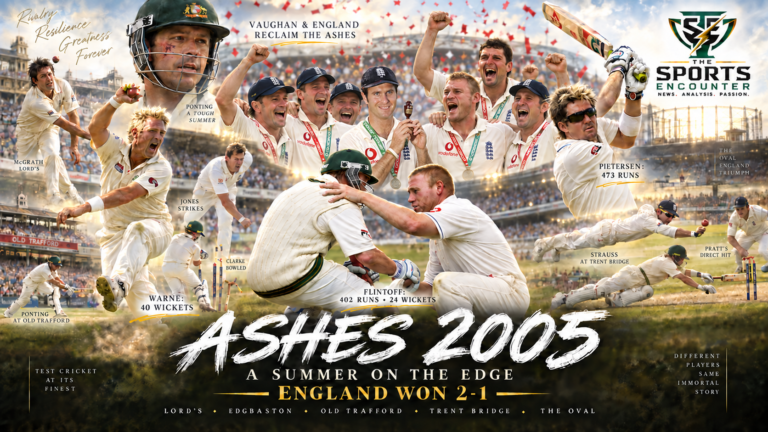
England regained the Ashes after an 18-year wait by defeating one of Australia’s strongest teams 2-1, and Flintoff became the emotional center of the series.

He scored 402 runs and took 24 wickets.

He produced defining performances at Edgbaston, Trent Bridge and The Oval.

His sportsmanship toward Brett Lee after the extraordinary two-run victory in Birmingham became one of English cricket’s enduring images.

Cricket Australia still describes him as the Player of the Series from that landmark contest. :contentReference[oaicite:6]{index=6}

Twenty-one years later, he is returning to Australia carrying a completely different responsibility.

He will no longer be trying to break Australian resistance.

He will be trying to build an Australian team.

Sydney Thunder Are Giving Him a Real Rebuild

The context at Thunder could hardly be more different from the England Lions.

The Lions job involved talent development inside a national system.

Sydney Thunder need results.

They finished BBL|15 with only two victories and ended the season at the bottom of the standings. It was their second last-place finish in three seasons. :contentReference[oaicite:7]{index=7}

Trevor Bayliss left after five seasons.

Thunder then considered a coaching field that reportedly included former players Shane Watson and Dan Christian before choosing Flintoff. :contentReference[oaicite:8]{index=8}

This was therefore not an appointment made without alternatives.

Thunder actively chose him for a turnaround project.

General Manager Trent Copeland described Flintoff as a modern leader capable of establishing high-performance environments, connecting with players personally and creating standards designed to last beyond one season. :contentReference[oaicite:9]{index=9}

The phrase “sustained success” may be the most important part of Thunder’s public explanation.

They are not asking Flintoff merely to make the playoffs.

They want him to change the identity of the team.

Thunder Need an Identity More Than Another Tactical Adjustment

Franchise teams can become trapped in short-term thinking.

Change an overseas player.

Change the batting order.

Replace the captain.

Sign another bowler.

Move the powerplay strategy.

Each decision can help, but repeated failure usually indicates something broader.

Thunder finishing last twice in three years suggests the issue is bigger than one selection mistake.

Flintoff’s first challenge will therefore be cultural.

What does Sydney Thunder cricket look like?

Which players define it?

What behavior does the coaching group reward?

How aggressively should they play?

How should young players be developed?

How much responsibility belongs to experienced players?

Those questions become particularly important because Thunder also face uncertainty around David Warner’s captaincy.

The Sports Encounter has already examined why Thunder may reconsider Warner’s leadership ahead of BBL|16.

Flintoff could therefore arrive in Sydney and immediately find himself involved in one of the franchise’s most important leadership decisions.

David Warner and Flintoff Could Define the New Thunder Era

Warner remains one of the most accomplished T20 batters Australia has produced.

He was also Thunder’s leading run-scorer last season. Cricket Australia’s June announcement still listed him among the core players under contract for BBL|16. :contentReference[oaicite:10]{index=10}

That gives Flintoff an interesting challenge.

He inherits a team whose most famous player may still be its best batter but whose formal leadership position carries uncertainty.

There are obvious similarities between the two personalities.

Both played aggressively.

Both became national sporting celebrities.

Both experienced controversy.

Both understand what happens when a cricketer becomes bigger in public imagination than his immediate sporting role.

That shared experience could become useful.

Flintoff does not need Warner to become quiet.

He needs Warner’s cricket knowledge, competitive instinct and batting output to operate inside a structure that serves the entire team.

Flintoff Has Already Coached Franchise Cricket

Sydney will not be Flintoff’s first franchise dressing room.

Northern Superchargers gave him his first major head coaching role in The Hundred.

He led the team across the 2024 and 2025 seasons, finishing fourth in his first campaign before reaching the Eliminator in his second. :contentReference[oaicite:11]{index=11}

That progress matters because it offers evidence beyond reputation.

Flintoff inherited a team and improved its competitive position.

His exit from the Superchargers in 2025 came after a change in ownership and unsuccessful discussions over his future rather than a simple dismissal for poor performance. :contentReference[oaicite:12]{index=12}

His experience in The Hundred also exposed him to exactly the kind of compressed decision-making he will encounter in the Big Bash.

Franchise cricket offers almost no time for correction.

A losing sequence that might represent a temporary problem across a county season can destroy a short-format campaign.

Selection, matchups, player roles and dressing-room confidence all need rapid management.

Australia Is Also Where Flintoff’s Playing Career Ended

There is a useful symmetry in his return.

Flintoff last played professional cricket in Australia.

After initially retiring, he returned for Lancashire in domestic T20 cricket during 2014 and then joined Brisbane Heat for BBL|04.

He played seven matches for the Heat during what became the final chapter of his professional playing career.

The numbers were modest: 74 runs and three wickets. :contentReference[oaicite:13]{index=13}

At the time, the Big Bash represented an unusual epilogue for a player whose defining international battles had often come against Australia.

Now the competition becomes the beginning of something rather than the end.

Flintoff returns to the BBL not as a fading all-rounder trying to squeeze a few more performances from his body, but as a coach with enough institutional backing to shape an entire franchise.

The Top Gear Crash Changed the Meaning of His Return to Cricket

No serious account of Flintoff’s coaching journey can ignore December 2022.

He suffered severe injuries in a crash while filming Top Gear and spent considerable time away from public life.

His eventual return through cricket therefore carried significance far beyond employment.

He worked around England’s white-ball environment in 2023 before progressing into head coaching roles. Reuters noted that his Lions appointment came after his involvement with the senior white-ball setup and Northern Superchargers. :contentReference[oaicite:14]{index=14}

Coaching gave Flintoff a professional identity that was neither a recreation of his playing career nor a continuation of television celebrity.

That may explain why his next move feels particularly important.

He is no longer merely returning to cricket.

He is building a second career inside it.

Sydney Thunder Is Flintoff’s First Coaching Job Outside Britain

This is another reason the appointment carries weight.

Everything Flintoff has done as a coach so far has existed within English cricket.

England white-ball squads.

Northern Superchargers.

England Lions.

Sydney Thunder removes the familiarity.

Different domestic structures.

Different players.

Different support staff.

Different media environment.

Different expectations.

Different cricket culture.

Cricket Australia describes the role as his first coaching position outside the United Kingdom. :contentReference[oaicite:15]{index=15}

That distinction will provide a better measurement of Flintoff’s coaching ability than almost anything he has done so far.

If his methods work in Sydney, it becomes harder to explain his success purely through personality, English familiarity or the authority created by his playing reputation.

What Kind of Coach Is Andrew Flintoff Becoming?

Flintoff does not present as a conventional technical coach.

His value appears to sit more heavily in environment, psychology, competition and relationships.

That does not mean tactics are unimportant.

A modern franchise coach cannot survive without data, matchup planning, opposition analysis, bowling deployment and batting-order flexibility.

But elite coaching staffs increasingly divide those responsibilities.

A head coach does not need to be the greatest batting technician, bowling analyst and data scientist in the room.

He needs to make those specialists function together.

The ECB’s comments after his resignation are revealing in that regard.

Barney specifically praised Flintoff for maximizing the expertise of coaches around him. :contentReference[oaicite:16]{index=16}

That may be his coaching identity.

Not knowing everything.

Knowing how to make everyone useful.

Leadership Has Always Been Flintoff’s Strongest Currency

Flintoff’s England captaincy record was complicated.

He captained 11 Tests and also led the ODI side, but his leadership career included difficult tours and significant physical demands.

He was not Michael Vaughan tactically.

He was not Mike Brearley intellectually.

His influence came from visibility.

Players could see how much he was willing to give.

At his peak, he bowled long spells, batted under pressure and threw himself into the contest.

The characteristics that once made captaincy physically costly may suit coaching better.

A coach can establish emotional standards without bowling 25 overs himself.

The Lions Departure Also Creates a Problem for England

English cricket now needs to replace a coach the ECB publicly believes transformed one of its most important development environments.

Mike Yardy will take charge of the Professional County Club Select XI for Pakistan’s four-day warm-up match at Beckenham beginning August 12. :contentReference[oaicite:17]{index=17}

That addresses the immediate fixture.

It does not answer the longer-term question.

The Lions program sits at a particularly important point because England are navigating a generational transition across formats.

Development pathways become more valuable when senior teams are changing.

The coach needs to understand which young players can survive international cricket, not merely which players dominate domestic statistics.

Flintoff’s departure therefore removes continuity at exactly the level designed to connect those two worlds.

England’s Development System Cannot Depend on One Personality

The ECB will also need to prove that whatever Flintoff helped build can survive him.

This is one of the central tests of good leadership.

If an environment collapses when its leader leaves, it was never truly institutionalized.

Barney’s statement suggests the ECB believes Flintoff created standards and coaching development that will continue after his departure. :contentReference[oaicite:18]{index=18}

That claim will now be tested.

England need the Lions to remain demanding, innovative and connected to the senior setup without simply searching for another charismatic former international to reproduce Flintoff’s personality.

Rob Key’s Trust Was Central to Flintoff’s Rise

Flintoff specifically thanked Rob Key when announcing his departure, describing the Lions position as one of the most important roles in English cricket and acknowledging Key for trusting him with it. :contentReference[oaicite:19]{index=19}

That relationship deserves attention.

Key helped create opportunities for Flintoff during his return to professional cricket.

Only days before the resignation, Key had publicly defended Flintoff’s work amid criticism and reportedly described him as an unsung hero within the England structure. :contentReference[oaicite:20]{index=20}

That timing makes the departure surprising.

This does not resemble an unwanted coach being quietly moved aside.

England wanted him.

He chose another direction.

This Is Not Necessarily Goodbye to England

The ECB’s statement contained one particularly interesting sentence.

Barney said the board looked forward to a time when Flintoff returns to the English game. :contentReference[oaicite:21]{index=21}

That is not standard farewell language when a relationship has broken down.

It suggests this departure may be viewed internally as development rather than divorce.

If Flintoff succeeds in Australia, England could eventually regain a more experienced coach than the one leaving today.

That creates obvious long-term speculation.

Could Flintoff one day coach England’s senior side?

There is no current appointment to discuss and no reason to treat that outcome as inevitable.

But successful coaches with international playing authority, development experience and franchise success naturally enter those conversations.

Sydney will determine whether Flintoff deserves to.

Thunder Have Given Him Two Years, and That Matters

Flintoff has signed a two-year contract.

That provides enough time to distinguish a genuine rebuild from a single good or bad tournament. :contentReference[oaicite:22]{index=22}

The first season will reveal his immediate methods.

The second should reveal whether those methods create something sustainable.

Short franchise competitions contain considerable randomness.

An injury can change a season.

An overseas player can become unavailable.

A few close losses can destroy a playoff campaign.

Judging Flintoff solely on one BBL table would therefore be simplistic.

The stronger measures will include squad development, role clarity, retention, young-player improvement, bowling plans, batting identity and whether Thunder become a team opponents can understand but still struggle to stop.

Five Things Flintoff Must Fix at Sydney Thunder

1. Restore a Winning Identity

Two wins in BBL|15 and two last-place finishes in three seasons indicate a team that needs more than cosmetic change. :contentReference[oaicite:23]{index=23}

Thunder need to know what type of cricket they are trying to play before pressure arrives.

2. Resolve the Leadership Structure

David Warner’s captaincy situation cannot become background noise throughout the season.

Flintoff needs a captain whose authority aligns with the culture he wants to create.

3. Make Young Players Better

This is where his Lions experience should matter most.

Thunder cannot rebuild sustainably through overseas recruitment alone.

4. Build a Complete Bowling Plan

BBL seasons are often decided by how effectively teams control powerplays and death overs.

Flintoff will need specialists around him who can translate analysis into simple execution.

5. Make Thunder Attractive Again

Flintoff told Cricket Australia that he wants players to finish a season thinking Thunder was the best part of their year. :contentReference[oaicite:24]{index=24}

That ambition is strategic.

Players talk.

Agents talk.

A strong environment helps recruitment.

Why This Move Fits Modern Cricket

Flintoff’s decision also reflects how the coaching profession itself is changing.

Franchise cricket is no longer a secondary career for coaches waiting between international jobs.

The IPL, Big Bash League, SA20, ILT20, Major League Cricket and other competitions have created increasingly sophisticated coaching markets.

A successful franchise coach can work with international stars, build teams across auction or draft systems, develop younger players and gain experience under intense short-term pressure.

For Flintoff, Sydney Thunder may therefore offer something the Lions cannot.

Ownership.

The Lions were ultimately a development program serving England.

Thunder becomes his team.

The results belong to him.

The culture belongs to him.

The failures will belong to him too.

Flintoff Has Never Seemed Interested in a Quiet Cricket Life

That may be why this move feels natural despite the surprise.

Andrew Flintoff’s cricket career has rarely existed at low volume.

The Sports Encounter’s comparison of Flintoff, Botham and Stokes showed that his historical standing comes less from the largest cumulative numbers and more from the scale of his biggest moments.

He belonged to occasions.

The same was true of Sir Ian Botham, whose legacy we examined as another English all-rounder who became larger than the scorecard.

Flintoff now has an opportunity to discover whether that instinct translates into coaching.

From England’s Hero to an Australian Franchise Builder

There is undeniable irony in where this next chapter will unfold.

Australia helped create the myth of Freddie Flintoff.

The Ashes rivalry gave his playing career its largest stage.

Australian batters tested his body.

Australian bowlers tested his courage.

Australian crowds tested his temperament.

The defining image of his career involves an Australian opponent.

His final professional matches came in Australia’s domestic T20 competition.

Now an Australian franchise is trusting him with its future.

That is an extraordinary circle.

The Bigger BBL Context

Sydney Thunder’s decision should also be read within a Big Bash League that continues competing for players, coaches, relevance and attention inside an increasingly crowded global franchise calendar.

High-profile coaches matter commercially as well as technically.

Flintoff’s presence gives Thunder international recognition immediately.

But reputation will only carry the project through the announcement.

Once BBL|16 begins, all of that celebrity compresses into ordinary coaching questions.

Who opens?

Who bowls the difficult overs?

Who gets dropped?

Who captains?

Who develops?

Who performs under pressure?

The Sports Encounter recently examined another major BBL question in our analysis of David Warner’s future as Sydney Thunder captain.

For broader context on how modern T20 careers now stretch across multiple leagues and generations, our feature on Jos Buttler becoming T20 cricket’s leading run-scorer charts the evolution of the franchise era Flintoff is now entering as a coach.

Could Flintoff Become an Elite Franchise Coach?

This is the question Sydney Thunder will help answer.

His résumé already contains enough evidence to take seriously.

He improved Northern Superchargers across two seasons.

He worked around England’s senior white-ball program.

He led the Lions.

The ECB believes he improved that environment significantly.

Players appear to respond to him.

He understands elite pressure.

What has not yet been demonstrated is sustained success when the entire program belongs to him and results become the primary measurement.

Thunder provide that test.

What Success Would Look Like in Year One

Winning the Big Bash immediately would obviously represent extraordinary success.

It should not be the only standard.

After a last-place season, meaningful progress can be measured more broadly.

AreaWhat Progress Could Look Like
League positionReturn to genuine playoff contention
Team identityClear batting and bowling philosophy
Young playersAt least two emerging players establish larger roles
LeadershipCaptaincy question resolved without prolonged instability
RecruitmentOverseas and domestic players complement rather than duplicate each other
Close gamesImproved tactical execution under pressure
EnvironmentPlayers publicly want to return and remain part of the project

Flintoff Is Betting on Himself

This may ultimately be the simplest interpretation.

He had a respected role inside English cricket.

The ECB valued him.

The Lions gave him access to the country’s strongest emerging players.

He could have retained that position while testing himself in Australia.

Instead, he has cleared the calendar.

That is a bet.

Not necessarily a financial one.

A professional one.

Flintoff is choosing the uncertainty of building something over the security of remaining part of something already established.

England May Eventually Benefit From Losing Him

There is another possibility.

If Flintoff remained forever inside England’s system, the ECB might never discover how good he could become independently.

Sydney Thunder now become the laboratory.

He will work in another cricket culture.

He will recruit differently.

He will manage players who did not grow up viewing him as a national hero.

He will confront opposition coaches who know Australian conditions better than he does.

He will make mistakes without an England structure around him.

If he returns eventually, he may return better.

The ECB’s explicit reference to a future return suggests it recognizes that possibility. :contentReference[oaicite:25]{index=25}

Andrew Flintoff’s Coaching Journey

PeriodRoleSignificance
2023England white-ball support roleMajor step back into professional cricket after his Top Gear accident
2024Northern Superchargers head coachFirst major franchise head-coaching role
September 2024Appointed England Lions head coachEntered England’s elite development pathway
2025Northern SuperchargersReached The Hundred Eliminator after finishing fourth the previous year
October 2025Leaves Northern SuperchargersEnds two-season Hundred tenure
June 2026Appointed Sydney Thunder head coachSigns two-year BBL contract and accepts first overseas coaching job
August 2026Resigns England Lions roleChooses to focus on next stage of coaching career

Why the Decision Feels Bigger Than Cricket Administration

Administrative language can make sporting decisions sound smaller than they are.

“Steps down.”

“Takes up another opportunity.”

“Focuses on franchise responsibilities.”

Those phrases describe the transaction.

They do not describe what Andrew Flintoff is actually doing.

A man once defined by what he could do with a bat and ball, then known to millions through television, has gradually reconstructed himself as a coach.

The Lions gave that transition credibility.

Sydney Thunder will test its ceiling.

Final Verdict: This Is Flintoff’s Biggest Coaching Gamble Yet

Andrew Flintoff could have remained comfortable.

He had standing inside English cricket.

He had Rob Key’s trust.

The ECB publicly valued his work.

Young players responded to him.

His Lions environment had been praised for developing not only cricketers but coaches.

And the original agreement meant he did not even need to sacrifice that role to coach Sydney Thunder.

He left anyway.

That decision tells us more than the resignation announcement.

Flintoff wants to find out what comes next.

Sydney Thunder provide the right level of danger.

They finished last.

The captaincy could change.

The squad needs direction.

The franchise needs an identity.

There is nowhere for the head coach to hide if the project fails.

There is also enormous upside if it works.

If Flintoff takes a struggling Thunder side and makes them competitive, improves young players, creates a strong dressing room and builds a recognizable cricket identity, the conversation around him will change.

He will no longer be Andrew Flintoff, former England star, trying coaching.

He will be Andrew Flintoff, coach.

Australia once helped turn Freddie Flintoff into an English sporting icon.

Twenty-one years after the Ashes series that defined his playing career, he is going back there to discover whether it can help define his second one.

Frequently Asked Questions

Why has Andrew Flintoff resigned as England Lions coach?

Flintoff has decided to step away from the England Lions and focus on the next stage of his coaching career, including his new position as Sydney Thunder men’s head coach. The ECB had originally expected him to combine the two roles. :contentReference[oaicite:26]{index=26}

When did Andrew Flintoff become England Lions coach?

The ECB appointed Flintoff in September 2024, with his first major assignments including tours of South Africa and Australia and home development fixtures. :contentReference[oaicite:27]{index=27}

Has Andrew Flintoff joined Sydney Thunder?

Yes. Sydney Thunder appointed Flintoff as men’s head coach in June 2026. :contentReference[oaicite:28]{index=28}

How long is Andrew Flintoff’s Sydney Thunder contract?

Flintoff signed a two-year deal covering the next two Big Bash League seasons. :contentReference[oaicite:29]{index=29}

Is Sydney Thunder Flintoff’s first overseas coaching job?

Yes. Cricket Australia confirmed that the Thunder position is his first coaching role outside the United Kingdom. :contentReference[oaicite:30]{index=30}

Who did Andrew Flintoff replace at Sydney Thunder?

He replaced former England coach Trevor Bayliss, who left Sydney Thunder after five seasons. :contentReference[oaicite:31]{index=31}

How did Sydney Thunder perform last season?

Thunder won only two matches in BBL|15 and finished at the bottom of the table, their second last-place finish in three seasons. :contentReference[oaicite:32]{index=32}

Did Flintoff previously play in the Big Bash League?

Yes. Flintoff played seven matches for Brisbane Heat during BBL|04 in what became the final phase of his professional playing career. He scored 74 runs and took three wickets. :contentReference[oaicite:33]{index=33}

Did Andrew Flintoff coach in The Hundred?

Yes. He coached Northern Superchargers during the 2024 and 2025 seasons, taking them from fourth place in his first campaign to the Eliminator in his second. :contentReference[oaicite:34]{index=34}

Who will replace Flintoff for England’s upcoming Pakistan warm-up match?

Mike Yardy will coach the Professional County Club Select XI in the four-day match against Pakistan beginning at Beckenham on August 12. :contentReference[oaicite:35]{index=35}

Could Andrew Flintoff return to England cricket?

The ECB has left that possibility open. Men’s Performance Director Ed Barney said the board looks forward to a time when Flintoff returns to the English game. :contentReference[oaicite:36]{index=36}

What were Andrew Flintoff’s career Test statistics?

Flintoff played 79 Tests for England, scoring 3,845 runs at 31.77 and taking 226 wickets. He remains most closely associated with England’s 2005 Ashes victory, when he was named Player of the Series. :contentReference[oaicite:37]{index=37}

Luke Edelman is a London-based sports psychologist covering cricket and tennis across Europe for The Sports Encounter. His work focuses on athlete mindset, pressure management, performance routines, confidence, recovery from setbacks, and the mental side of elite competition. Coverage areas: sports psychology, cricket, tennis, athlete performance, mental resilience, European sports, tournament pressure.

Cricket

LPL 2026 Final Preview: Galle Seek Revenge as Jaffna Chase a Fifth Crown

Galle Gallants and Jaffna Kings meet in the Lanka Premier League 2026 final after three dramatic clashes this season, with revenge, history and a fifth Jaffna title on the line.

Published

on

Galle Gallants and Jaffna Kings players face off under the floodlights at R. Premadasa Stadium ahead of the LPL 2026 final, with Galle seeking revenge and Jaffna chasing a fifth Lanka Premier League title.

Galle Gallants and Jaffna Kings meet at Colombo’s R. Premadasa Stadium on August 8 for the Lanka Premier League 2026 title, three days after Jaffna survived a 470-run Qualifier 1 shootout and two years after the Kings demolished the Galle franchise in the 2024 final at the same venue.

For almost three weeks, Galle Gallants and Jaffna Kings have kept finding their way back toward each other.

Galle won the first meeting by 36 runs.

They won the second by 60.

Then Jaffna produced the answer that changed the balance of the rivalry.

Kamil Mishara’s unbeaten 108 powered the Kings to 242 for two in Qualifier 1 at the R. Premadasa Stadium. Galle responded with 228 for eight, an extraordinary score that would have won almost every other match in the tournament, yet still finished 14 runs short.

Three days later, the teams meet again.

This time there is no second chance.

Jaffna are trying to turn another strong campaign into their fifth Lanka Premier League championship. Galle are attempting to avenge both Wednesday’s playoff defeat and a much older wound: Jaffna’s nine-wicket demolition of the Galle franchise in the 2024 final.

Readers can follow the tournament through The Sports Encounter’s Lanka Premier League hub and our broader Cricket coverage.

Official tournament information is available through Sri Lanka Cricket’s Lanka Premier League section.

LPL 2026 Final: Key Information

DetailInformation
FinalGalle Gallants vs Jaffna Kings
DateAugust 8, 2026
VenueR. Premadasa International Cricket Stadium, Colombo
Scheduled start7:00 PM local time
Galle captainDasun Shanaka
Jaffna’s LPL titlesFour
2026 head-to-headGalle 2 wins, Jaffna 1 win
Most recent meetingJaffna won Qualifier 1 by 14 runs
Galle’s route to finalLost Qualifier 1, beat Colombo Kaps in Qualifier 2
Jaffna’s route to finalBeat Galle in Qualifier 1

TL;DR

  • Galle Gallants face four-time champions Jaffna Kings in the LPL 2026 final in Colombo.
  • Galle have beaten Jaffna twice in three meetings this season.
  • Jaffna won the latest meeting, scoring 242/2 before restricting Galle to 228/8 in Qualifier 1.
  • Kamil Mishara enters the final after an unbeaten 108 from 55 balls against Galle.
  • Sam Harper and Charith Asalanka are Galle’s most productive recent batters.
  • Harper scored 77 and Asalanka 59 in Friday’s six-wicket Qualifier 2 win over Colombo Kaps.
  • Lizaad Williams has taken 16 wickets in seven recent matches for Jaffna.
  • Eshan Malinga and Akif Javed have 14 wickets apiece in their recent LPL records.
  • Jaffna beat the Galle franchise by nine wickets in the 2024 LPL final at the same venue.
  • The final could turn on whether Galle can prevent Mishara and Jaffna’s middle order from dominating the middle and death overs again.

Three Meetings Have Produced Three Very Different Matches

The most useful way to understand this final is to examine what these teams have already done to each other.

They opened the tournament against each other on July 17.

Galle scored 213 for six, driven by Charith Asalanka’s 65 and Dasun Shanaka’s unbeaten 31 from only nine deliveries. Eshan Malinga then took four for 26 as Jaffna were dismissed for 177.

The 36-run victory gave Galle an immediate advantage and established several themes that still matter now.

Asalanka could control the middle overs. Shanaka could finish. Malinga could attack Jaffna’s batting lineup rather than merely contain it.

The Sports Encounter covered that opening statement in Galle’s 36-run victory over Jaffna.

Galle’s Second Victory Was Even More Convincing

The rematch in Dambulla produced a different Galle hero.

Sahan Arachchige made 63 from 36 balls after Galle had slipped into difficulty, while Chris Lynn contributed a rapid 46 from 22.

Galle reached 193 for eight.

Jaffna collapsed to 133.

Eshan Malinga took three for 13 and Tharindu Ratnayake three for 19 as only Dunith Wellalage, with 56 from 39 balls, mounted meaningful resistance.

Galle’s 60-run victory made the season head-to-head 2-0 and temporarily suggested there might be a significant gap between the sides.

That match is detailed in The Sports Encounter’s report on Galle’s dominant second win over Jaffna.

The assumption that Galle had solved the Kings lasted until Qualifier 1.

Qualifier 1 Changed the Rivalry Completely

Jaffna did more than defeat Galle on Wednesday.

They forced the Gallants into a type of cricket they had not previously needed against them.

Jaffna reached 242 for two, the highest total of the tournament at the time.

Kamil Mishara was central to everything.

He reached fifty from 31 balls and then accelerated violently, adding another 58 from his next 24 deliveries to finish unbeaten on 108 from 55.

Khawaja Nafay contributed 54 from 32 balls. Together, Mishara and Nafay added 138 for the second wicket from just 65 deliveries.

Then Towhid Hridoy arrived.

His unbeaten 54 required only 21 balls.

Jaffna’s final total asked Galle to chase at 12.15 runs per over from the opening delivery.

Remarkably, they almost did it.

Galle scored 81 during the powerplay and eventually finished on 228 for eight.

The complete 470-run contest is covered in our Qualifier 1 match report.

Why Galle’s 228 May Matter More Than the Defeat

Losses usually expose weaknesses.

Galle’s Qualifier 1 defeat also demonstrated how difficult they are to remove from a match.

Chasing 243 in a knockout contest should have produced either reckless hitting or a severe collapse.

Galle instead reached 228.

Sam Harper attacked from the beginning and made 44 from 21 balls.

Galle reached 81 for two after six overs.

The innings deteriorated when several wickets fell through the middle overs, but the Gallants still remained close enough to make Jaffna uncomfortable.

That matters psychologically before the final.

Jaffna know that even 200 may not guarantee control against this Galle batting lineup.

Sam Harper Arrives at the Final in Outstanding Form

Galle had only 48 hours to recover from Qualifier 1 and face Colombo Kaps.

Harper made sure the second route to the final did not become another exhausting shootout.

Colombo scored 176 before being dismissed in 18.5 overs.

Galle lost an early wicket at 21, but Harper and Asalanka then constructed the partnership the Kaps never managed to create.

They added 126 runs for the second wicket from 85 deliveries.

Harper scored 77 from 51 balls with four fours and four sixes.

Asalanka made 59 from 42.

Galle reached 177 for four with eight balls remaining and booked their place in the final.

The full tactical breakdown is available in our report on Harper and Asalanka carrying Galle past Colombo.

Harper vs Mishara Could Decide the Batting Battle

PlayerRecent MatchesRunsAverageStrike Rate
Sam Harper1042442.40164.34
Kamil Mishara937052.86170.50
Charith Asalanka1038342.56154.43
Avishka Fernando1021226.50149.29

Harper and Mishara approach the match differently, but their numbers show why both bowling units will build plans around them.

Harper has produced greater aggregate output across the recent sample.

Mishara has been more explosive and harder to dismiss.

The critical difference may come in how quickly each attacks.

Mishara demonstrated during Qualifier 1 that he can spend several overs building an innings before suddenly moving above two runs per ball.

Harper generally applies pressure earlier.

If either survives beyond ten overs, the opposition captain could spend the second half of the innings reacting rather than controlling.

Charith Asalanka Gives Galle a Second Batting Anchor

Harper’s form prevents opponents from ignoring the opening phase.

Asalanka makes the middle overs equally complicated.

His recent record stands at 383 runs from ten matches at an average above 42 and a strike rate above 154.

He has already produced 65 against Jaffna in the season opener, 58 against Colombo in the final league-stage match and 59 in Qualifier 2.

That last league-stage performance was particularly valuable because it helped Galle defeat Colombo by 13 runs and secure their place in Qualifier 1. Mohammad Nawaz then took three for 24.

Our report on Galle’s victory over Colombo in Match 19 showed why their middle-order depth became such an advantage during the playoff race.

Jaffna’s Greatest Weapon May Be Their Batting Ceiling

Galle have arguably been the more balanced team across the season.

Jaffna may possess the higher batting ceiling.

They scored 221 for six against Kandy Royals before pushing that ceiling further to 242 for two against Galle.

Kamil Mishara has become increasingly important, but he is surrounded by hitters capable of transforming an innings.

Khawaja Nafay demonstrated that in Qualifier 1.

Towhid Hridoy demonstrated it even more dramatically.

Chamindu Wickramasinghe had already shown similar finishing ability against Kandy, smashing 43 from only 15 balls as Jaffna reached 221.

The Kings won that match by 21 runs, with Shakib Al Hasan and Wellalage taking three wickets each. The Sports Encounter covered the performance in our report on Jaffna’s 221-run assault against Kandy.

Galle therefore cannot build the final around removing one batter.

They have to repeatedly restart Jaffna’s innings.

Lizaad Williams vs Harper Could Be the Final’s First Major Contest

The individual matchup with the clearest tactical importance may arrive immediately.

Lizaad Williams enters the match with 16 wickets from seven recent appearances.

His strike rate of 9.18 means he has been taking a wicket roughly every ten deliveries.

Against a batter such as Harper, that attacking threat carries obvious value.

Jaffna need early wickets because Harper becomes harder to contain once he understands the surface and begins targeting matchups.

Williams also knows that simply attacking the stumps may not be enough at the R. Premadasa Stadium if the ball does not move.

Changing pace and forcing Harper to generate his own power could become important.

Galle’s Pace Attack Has Already Hurt Jaffna Twice

BowlerRecent MatchesWicketsEconomyStrike Rate
Eshan Malinga9149.7213.35
Akif Javed101410.0214.92
Lizaad Williams7169.519.18
Dunith Wellalage9147.2112.42

Eshan Malinga’s economy rate may appear expensive in isolation.

His value lies in wickets.

He took four for 26 against Jaffna on opening night and three for 13 in the second league meeting.

Seven wickets across those two matches represent compelling evidence that his pace, angle and variations have created problems for the Kings.

Jaffna solved him much better during Qualifier 1.

The final will tell us whether that was a tactical adjustment or simply the result of Mishara and Nafay playing extraordinary innings.

Dunith Wellalage Could Become Jaffna’s Most Important Bowler

If the final slows down through the middle overs, Wellalage’s importance increases considerably.

His recent economy rate of 7.21 is comfortably better than those of the three frontline seamers highlighted above.

He also has 14 wickets from nine matches.

More importantly, Wellalage understands how to bowl when batters are actively looking for boundaries.

Galle’s top order contains enough power to punish predictable pace. Spin may allow Jaffna to remove pace from the ball and force Harper, Asalanka and Shanaka to create scoring angles instead.

Wellalage has already influenced this matchup with the bat too.

His 56 from 39 balls was the only substantial resistance when Jaffna were bowled out for 133 in the 60-run league-stage defeat.

Dasun Shanaka’s Captaincy Faces Its Hardest Test

Shanaka’s captaincy played an important role against Colombo.

When the Kaps attacked early, he continued rotating bowlers instead of allowing one matchup to be repeatedly targeted.

Colombo recovered from 52 for five to 176, but they were dismissed with seven balls unused.

The final presents a more complicated challenge.

Jaffna have several batters who can change tempo quickly, and Mishara’s left-handedness creates natural matchup questions alongside right-handers such as Nafay and Hridoy.

Shanaka will have to decide how much of Malinga and Akif Javed to spend during the powerplay and how much pace to preserve for Hridoy and the finishers.

The Toss Could Matter, but Recent Results Offer No Simple Answer

R. Premadasa has already produced enormous totals during these playoffs.

Jaffna made 242 batting first in Qualifier 1 and defended it.

Galle successfully chased 177 against Colombo in Qualifier 2.

That leaves captains with evidence for both strategies.

A dry surface that begins gripping could make batting first attractive.

Dew later in the evening could shift the advantage toward the chasing side.

The stronger lesson from the playoffs is simpler: powerplay execution may matter more than the toss itself.

Jaffna survived early against Galle and then exploded through Mishara and Nafay.

Colombo lost five wickets before their innings could establish any structure.

The final may be decided well before the death overs if either team repeats those extremes.

Jaffna Carry the Rest Advantage

There is one factor that does not appear on any batting or bowling table.

Jaffna have had significantly more recovery time.

The Kings secured direct passage to the final on August 5.

Galle had to return on August 7, bowl 18.5 overs against Colombo and then chase for another 18.4.

Harper faced 51 balls.

Asalanka faced 42.

Galle’s bowlers and fielders completed an entire knockout match less than 24 hours before the final.

That can matter in the closing overs.

Fatigue often appears through slower reactions, missed yorkers, reduced running intensity and fielding errors rather than through dramatic physical breakdown.

Galle’s advantage is rhythm.

Jaffna’s advantage is freshness.

The 2024 Final Still Hangs Over This Matchup

The names around the two franchises have changed, but the history is difficult to ignore.

In 2024, the Galle Marvels defeated Jaffna Kings by seven wickets in Qualifier 1.

Jaffna took the longer route back to the final.

Then they demolished Galle when the trophy was at stake.

Galle posted 184 for six.

Jaffna chased 185 in only 15.4 overs.

Rilee Rossouw produced one of the great LPL final innings, making an unbeaten 106 from 53 deliveries, while Kusal Mendis finished unbeaten on 72 from 40.

The nine-wicket victory gave Jaffna their fourth title.

Two years later, the structure has almost reversed.

Jaffna have taken the direct route into the final.

Galle have arrived through Qualifier 2.

Now Galle must prove that the extra match can prepare rather than exhaust them.

Jaffna Have Played Through an Unusual Off-Field Season

There is another reason Jaffna’s run to the final deserves attention.

The franchise has played through considerable ownership instability.

During the tournament, Innovative Production Group and Sri Lanka Cricket terminated Sports Commune’s franchise agreement after financial obligations were not fulfilled. Operational control of the Kings passed to IPG and SLC, while organizers confirmed the squad, schedule and tournament participation would continue unchanged.

That development could easily have destabilized a team.

Instead, Jaffna finished the league stage with five wins from eight matches plus one no-result, accumulated 11 points and advanced directly to the final through Qualifier 1.

The Sports Encounter examined the wider playoff adjustments in our report on late squad changes ahead of the LPL playoffs.

Five Battles That Could Decide the LPL 2026 Final

Sam Harper vs Lizaad Williams

Jaffna need Harper early. Williams has the strike rate to attack him, but Harper’s 164-plus recent scoring rate means poor execution can disappear quickly.

Kamil Mishara vs Eshan Malinga

Malinga dominated Jaffna during the league phase. Mishara dominated Galle in Qualifier 1. Their rematch could define the powerplay and middle overs.

Charith Asalanka vs Dunith Wellalage

One of Galle’s most important middle-order batters against Jaffna’s most economical frontline wicket-taker.

Dasun Shanaka vs Jaffna’s death bowling

Shanaka’s nine-ball 31 in the season opener demonstrated how quickly he can add 20 or 30 runs to a total. Williams and Jaffna’s supporting seamers cannot allow him access to predictable lengths.

Galle’s middle overs vs Towhid Hridoy

Hridoy’s unbeaten 54 from 21 balls changed Qualifier 1 from a huge total into a record-threatening one. If he enters with wickets in hand again, Galle must have a specific plan ready.

What Galle Must Do to Win

  • Remove Mishara before he moves into his acceleration phase.
  • Use Malinga aggressively rather than purely defensively.
  • Avoid allowing one Jaffna partnership to exceed 80 or 100 runs.
  • Give Harper enough freedom to attack during the powerplay.
  • Keep Asalanka at the crease through the middle overs.
  • Preserve Shanaka and lower-order power for the final five overs.
  • Manage fatigue after the Qualifier 2 turnaround.

What Jaffna Must Do to Win

  • Attack Harper with Williams before he settles.
  • Use Wellalage to slow Galle’s middle-order scoring.
  • Protect Mishara from unnecessary early risks.
  • Give Hridoy enough deliveries to influence the closing phase.
  • Exploit Galle’s shorter recovery window through aggressive running and sustained pressure.
  • Remember that Galle have already chased and scored above 200 repeatedly during the tournament.

Who Starts as Favorite?

There is very little between these teams.

Galle have the season head-to-head advantage at 2-1.

They also demonstrated greater balance through much of the league phase and finished with the better net run rate.

Jaffna, however, topped the league standings and won the most recent head-to-head meeting.

That latest match matters because it occurred at the same venue and under playoff pressure.

Jaffna also enter the final fresher.

Galle arrive with momentum from beating Colombo only a day earlier.

If the pitch again rewards clean stroke-making, Jaffna’s explosive ceiling gives them a slight advantage.

If the surface becomes slower and forces teams to build through the middle overs, Galle’s balance, Asalanka’s control and their bowling variety may become more valuable.

The Sports Encounter Prediction

Jaffna Kings 51% | Galle Gallants 49%

The margin is deliberately tiny.

Galle have already beaten Jaffna twice and possess enough batting depth to chase an enormous score.

Jaffna receive the narrow edge because they produced the better performance in the most recent meeting, have had an additional recovery window and know how to win LPL finals.

But this is close enough that the first powerplay could completely reverse the expectation.

Final Word

Most finals arrive after the tournament has spent weeks identifying two strong teams.

This one arrives after Galle and Jaffna have spent the entire competition testing each other’s limits.

Galle have beaten Jaffna by 36 runs.

They have beaten them by 60.

Jaffna responded with 242 for two and a 14-run playoff victory.

Harper enters with runs.

Asalanka enters with runs.

Mishara enters after a century against the same opposition.

Williams, Wellalage, Malinga and Akif Javed all enter among the tournament’s major wicket-taking threats.

Then there is history.

Jaffna have four LPL championships and already know what it feels like to beat the Galle franchise in a Colombo final.

Galle have one final opportunity to reverse that memory.

After three meetings, hundreds of runs and two different playoff routes, the fourth encounter will settle the only question that still matters.

Who leaves Colombo as the Lanka Premier League 2026 champion?

Frequently Asked Questions

When is the Lanka Premier League 2026 final?

The LPL 2026 final between Galle Gallants and Jaffna Kings is scheduled for August 8, 2026 at the R. Premadasa International Cricket Stadium in Colombo.

What time does the LPL 2026 final start?

The match is scheduled to begin at 7:00 PM local time.

Who is playing in the LPL 2026 final?

Galle Gallants will face Jaffna Kings.

How many times have Galle and Jaffna played in LPL 2026?

They have met three times before the final. Galle won both league-stage meetings, while Jaffna won Qualifier 1.

Who won Galle vs Jaffna Qualifier 1?

Jaffna Kings won by 14 runs after scoring 242 for two and restricting Galle Gallants to 228 for eight.

How many runs did Kamil Mishara score against Galle in Qualifier 1?

Mishara scored an unbeaten 108 from 55 balls.

How did Galle qualify for the final?

Galle lost Qualifier 1 to Jaffna before defeating Colombo Kaps by six wickets in Qualifier 2. Sam Harper scored 77 and Charith Asalanka made 59.

How many LPL titles have Jaffna Kings won?

Jaffna Kings have won four Lanka Premier League titles and are attempting to add a fifth championship in 2026.

Did Jaffna beat Galle in an earlier LPL final?

Yes. Jaffna Kings defeated the Galle franchise by nine wickets in the 2024 final at the R. Premadasa Stadium, chasing 185 in 15.4 overs.

Who are the key players in the LPL 2026 final?

Major players to watch include Sam Harper, Charith Asalanka, Dasun Shanaka and Eshan Malinga for Galle, along with Kamil Mishara, Avishka Fernando, Lizaad Williams and Dunith Wellalage for Jaffna.

Where can fans follow official LPL information?

Official competition information is available through Sri Lanka Cricket’s Lanka Premier League section.

Continue Reading

CPL 2026

Tajinder Singh Rescues Falcons Before Last-Ball Chaos Opens CPL 2026 With a Thriller

Antigua and Barbuda Falcons opened CPL 2026 with a dramatic two-wicket victory over Jamaica Kingsmen after Tajinder Singh’s 62 and Alzarri Joseph’s 3/34 set up a final-ball finish at Kingstown.

Published

on

Antigua and Barbuda Falcons celebrate a dramatic last-ball victory over Jamaica Kingsmen in the opening match of CPL 2026, featuring Tajinder Singh and Player of the Match Alzarri Joseph.

Antigua and Barbuda Falcons beat Jamaica Kingsmen by two wickets from the final ball of the opening match of the Caribbean Premier League 2026 after Tajinder Singh’s 62 and Alzarri Joseph’s three wickets survived a remarkable late collapse in Kingstown.

For most of Friday night at Arnos Vale Ground, Antigua and Barbuda Falcons looked as though they had understood the match better than Jamaica Kingsmen.

Alzarri Joseph had prevented Jamaica from turning an encouraging batting start into a dominant total. Tajinder Singh then absorbed the pressure of a slowing chase, accelerated at exactly the right time and appeared to have reduced the final overs to routine.

Nothing about the finish was routine.

The Falcons lost five wickets for 37 runs after reaching 128 for three, including two wickets from consecutive deliveries in the final over. Jamaica suddenly found themselves defending three runs from the last ball after spending much of the chase struggling to control the middle overs.

Shamar Springer squeezed Hunain Shah’s yorker toward wide long-on and immediately committed to the second run. Jamaica captain Rovman Powell reached the ball but could not complete a clean pickup, allowing Springer and Alzarri Joseph to scramble home.

Antigua finished on 168 for eight, defeating Jamaica’s 167 for seven by two wickets with no deliveries remaining.

It was an appropriately chaotic beginning to the 14th season of the Caribbean Premier League, whose official fixtures and tournament information are available through the Caribbean Premier League’s official website.

Readers can follow tournament reports, player performances and wider franchise cricket analysis through The Sports Encounter’s cricket coverage.

CPL 2026 Match 1: Key Information

Match DetailInformation
CompetitionCaribbean Premier League 2026
MatchAntigua and Barbuda Falcons vs Jamaica Kingsmen
DateAugust 7, 2026
VenueArnos Vale Ground, Kingstown, St Vincent
TossAntigua and Barbuda Falcons elected to field
Jamaica Kingsmen167/7 in 20 overs
Antigua and Barbuda Falcons168/8 in 20 overs
ResultFalcons won by two wickets from the final ball
Player of the MatchAlzarri Joseph, 3/34
Top scorerTajinder Singh, 62 from 37 balls
Best Jamaica batterRovman Powell, 47 from 37 balls
Best Jamaica bowlerKeemo Paul, 3/29
PointsAntigua and Barbuda Falcons 2, Jamaica Kingsmen 0

TL;DR

  • Antigua and Barbuda Falcons defeated Jamaica Kingsmen by two wickets from the final delivery of CPL 2026 Match 1.
  • Jamaica posted 167 for seven after Reeza Hendricks made 42 from 25 balls and captain Rovman Powell scored 47 from 37.
  • Alzarri Joseph took 3 for 34 and was named Player of the Match.
  • Tajinder Singh transformed the chase with 62 from 37 balls, including seven fours and one six.
  • Tim Robinson contributed 40 from 30 and shared a critical 64-run third-wicket partnership with Tajinder.
  • Keemo Paul took 3 for 29, while Andre Russell and Hunain Shah claimed two wickets each.
  • The Falcons slipped from 150 for five to 165 for eight before Springer and Joseph completed two runs from the final ball.
  • Fabian Allen began his Falcons captaincy with a victory.

Jamaica’s 167 Contained Two Very Different Innings

Jamaica’s total initially looked competitive. After twenty overs, it also looked slightly unfinished.

The distinction mattered.

Shayan Jahangir and Reeza Hendricks carried Jamaica to 25 before Jahangir was run out for 13. Shaqkere Parris lasted only five balls for one, but Hendricks refused to allow the early wickets to dictate the scoring rate.

The South African struck three fours and four sixes during a 25-ball 42, operating at a strike rate of 168.00. Jamaica reached 54 for one at the end of the six-over powerplay, already scoring at nine runs per over.

That was the phase Antigua needed to survive rather than dominate.

Jayden Seales and Usama Mir eventually changed the shape of the innings.

Usama conceded only 17 from four overs and dismissed Hendricks, while Seales completed an outstanding four-over spell of one for 19. Between them, they made the middle overs far more difficult than the powerplay had suggested.

Modern franchise tournaments frequently turn on exactly this type of compression. The Sports Encounter has seen similar middle-over control define matches across the Lanka Premier League, the Global Super League final and other recent T20 competitions.

Hendricks’ Exit Changed Jamaica’s Tempo

Hendricks was bowled by Usama from the final ball of the eighth over, leaving Jamaica 62 for three.

The next six overs yielded only 48 runs.

Keacy Carty struggled to create momentum, making eight from 17 deliveries before Seales removed him at 96 for four in the 14th over.

That innings became one of Jamaica’s hidden problems.

Carty occupied nearly three overs while scoring at 47.05. On a night when Jamaica captain Rovman Powell later felt his team had finished five to ten runs short, those 17 balls became significant.

The point is not that Carty alone cost Jamaica the match. Antigua bowled intelligently through the middle. But Jamaica entered the final six overs needing acceleration partly because the innings had stalled after Hendricks departed.

Powell Rebuilt, but Joseph Denied Jamaica the Finish They Needed

Powell gradually repaired the innings.

The Jamaica captain scored 47 from 37 balls, striking two fours and three sixes, but he spent much of his innings managing wickets rather than launching an uninterrupted attack.

Andre Russell never found his usual rhythm either.

Joseph removed Russell for eight from ten balls at the end of the 17th over before returning to dismiss Powell for 47 in the 19th.

Those were the wickets that defined Joseph’s Player of the Match performance.

He finished with 3 for 34 from four overs, having earlier removed Parris.

Joseph explained afterward that he noticed variable bounce and a two-paced surface after his opening over and adjusted rather than searching for something more complicated. The strong crosswind also influenced the areas he was prepared to defend.

His approach mattered because Jamaica still had enough lower-order hitting to push beyond 175.

Keemo Paul hammered 16 from six balls, Hassan Khan added an unbeaten ten from six and Jamaica collected 22 extras across the innings. Yet Joseph’s late wickets prevented Powell and Russell from providing the sustained finishing assault the innings required.

Was 167 Enough at Arnos Vale?

Powell thought Jamaica were approximately five to ten runs short.

The scorecard supports that assessment.

Jamaica reached 54 for one after six overs and had Hendricks striking the ball cleanly. From such a start, 175 was realistic.

Instead, Antigua’s four most economical overs came from Usama Mir and Seales, who combined for figures of two wickets for 36 runs across eight overs.

Jamaica eventually scored 167 despite receiving 22 extras. Their batters therefore contributed only 145 runs from the bat.

That made Antigua’s middle-over control more consequential than the final scoreboard initially suggested.

Evin Lewis Falls Early, but Cornwall Keeps Falcons Moving

Antigua’s chase began badly when Keemo Paul bowled Evin Lewis for six in the third over.

Rahkeem Cornwall responded by refusing to allow Jamaica to immediately build pressure.

His 24 from 21 balls contained two fours and two sixes. It was not a dominant innings, but his boundary-hitting kept Antigua close enough to the required rate while Tim Robinson settled.

Paul removed Cornwall at 53 for two in the seventh over, with Powell taking the catch at long-on.

Antigua were not in control yet.

The decisive partnership was about to begin.

Tajinder Singh Changes the Match

Tajinder joined Robinson with Antigua needing 115 more runs.

They added 64 for the third wicket.

The value of the partnership came from how differently the two batters operated.

Robinson gave Antigua stability. Tajinder supplied acceleration.

At the ten-over timeout, the Falcons were 80 for two. Robinson had 26 and Tajinder 19. The required rate remained manageable, but Jamaica were still only one wicket away from exposing Antigua’s middle order.

Tajinder eliminated that possibility by attacking before the asking rate became uncomfortable.

The third-wicket partnership reached fifty from 33 balls. Tajinder contributed 38 of those runs, while Robinson supplied 12.

That distribution tells the story.

Robinson allowed Tajinder to choose the moments of aggression rather than forcing both batters to attack simultaneously.

The role resembled the measured chase construction Tim Robinson recently produced for San Francisco Unicorns in their Global Super League semifinal victory over Desert Vipers, where his unbeaten 68 controlled another target without allowing scoreboard pressure to dictate every decision.

Russell Removes Robinson, but Tajinder Keeps Attacking

Andre Russell finally broke the partnership when Robinson attempted to clear long-off in the 15th over.

Robinson departed for 40 from 30 balls, having struck two fours and two sixes.

The Falcons were 117 for three.

Jamaica needed Tajinder immediately.

They did not get him.

Tajinder reached fifty from only 31 deliveries, with five fours and one six. His scoring zones remained conventional rather than reckless, and that was important on a surface Joseph had already identified as slightly two-paced.

He eventually made 62 from 37 balls at a strike rate of 167.56, hitting seven fours and one six.

By the time Russell dismissed him in the 19th over, Antigua needed nine from nine balls.

Tajinder had done almost enough.

Almost.

The Falcons Somehow Turn a Comfortable Chase Into Chaos

The most revealing section of the chase began before Tajinder’s dismissal.

Captain Fabian Allen fell for three from six balls at 128 for four. Karima Gore counterattacked with 12 from eight before Paul removed him at 150 for five.

Then Tajinder departed.

Antigua were suddenly 159 for six with nine balls remaining.

The match should still have belonged to them.

Instead, Jamaica discovered the pressure they had been searching for throughout the middle overs.

Keemo Paul completed figures of 3 for 29. Russell finished with 2 for 34.

Hunain Shah then entered the final over with Jamaica requiring something extraordinary.

Antigua needed three.

Hunain Shah Almost Produces Another Impossible Final Over

Hunain has already developed a reputation for defending tiny totals under pressure, including a remarkable six-run defense in the Pakistan Super League earlier in 2026.

This situation appeared far less promising.

Yet Jahmar Hamilton was caught by Powell from the third ball of the over.

Usama Mir then fell next delivery for a golden duck, caught by Hassan Khan.

The Falcons had moved from 165 for six to 165 for eight without adding a run.

Suddenly three runs were required from two deliveries.

Joseph took a single from the penultimate ball.

Two were needed from one.

Powell’s Final-Ball Fumble Decides the Opener

Hunain executed the delivery he needed.

Springer received a full ball close to the blockhole and could not strike it cleanly. The ball travelled from the inside half of the bat toward wide long-on.

It should have created a difficult second run.

Powell attacked the ball.

Then came Jamaica’s final mistake.

The captain failed to gather cleanly.

Springer and Joseph completed the second run, triggering celebrations in the Falcons dugout and ending a chase that had moved from control to panic within minutes.

Powell had taken three catches during the innings and had been one of Jamaica’s safest fielders. Cricket’s cruelty placed the final chance in his hands anyway.

Why Jamaica Kingsmen Lost the Match

The final-ball fumble will dominate highlights, but Jamaica did not lose solely because of one fielding error.

Three earlier phases mattered more.

1. Their middle overs slowed too sharply

Hendricks had placed Jamaica in an excellent position, but Carty’s 8 from 17 and Russell’s 8 from 10 reduced the innings’ momentum. Antigua exploited the period through Seales and Usama.

2. Jamaica could not control Robinson and Tajinder together

The 64-run partnership removed the pressure created by Lewis and Cornwall’s dismissals. Tajinder scored aggressively without forcing Robinson to abandon his role.

3. They began taking wickets too late

Jamaica’s death bowling was excellent enough to create a final-ball finish, but by then Tajinder had reduced the chase to a margin that gave Antigua several opportunities to survive.

Powell acknowledged afterward that Jamaica struggled to build sufficient pressure through the middle overs despite encouraging performances from Paul and Russell.

Alzarri Joseph’s Three Wickets Were More Valuable Than the Economy Rate Suggests

Joseph conceded 34 from four overs, which does not immediately resemble a dominant T20 spell.

The dismissals explain why he received Player of the Match.

He removed Parris before Jamaica could fully exploit the powerplay, dismissed Russell just as the innings entered its finishing phase and then removed Powell before the captain could launch a final assault.

Those wickets attacked Jamaica’s ability to accelerate rather than merely reducing the score.

Fast-bowling impact in modern T20 cricket cannot always be evaluated through economy alone. The Sports Encounter has explored the wider changes affecting pace bowling in its analysis of how modern fast bowlers operate across increasingly crowded schedules.

Tajinder Gives Antigua Something Bigger Than 62 Runs

The Falcons already possess internationally established names in Lewis, Cornwall, Allen, Joseph, Seales and Usama.

Tajinder’s innings therefore provided something particularly valuable: production from outside the obvious match-winners.

His 62 contained intelligence alongside power.

He entered at 53 for two, did not immediately chase boundaries and then increased his scoring rate as Robinson settled. Five of his first fifty runs came through boundaries, while the rest required strike rotation and control.

That profile can become important across a long CPL season.

Franchise competitions are often decided by players beyond the biggest names. The recent race for the all-time T20 run-scoring record illustrates the star power surrounding modern short-form cricket, but championships still require supporting batters capable of winning matches when established players fail.

Fabian Allen Starts His Captaincy With a Win and a Warning

Fabian Allen’s first match as Falcons captain produced two points and several lessons.

His bowling changes worked well enough to prevent Jamaica reaching the total their powerplay had promised. Seales and Usama combined for eight overs at an economy rate below five, while Joseph delivered the attacking wickets.

The chase was less comfortable.

Allen made only three himself, and Antigua’s lower middle order nearly wasted Tajinder and Robinson’s work.

The captain admitted afterward that the finish had been tight but emphasized the overall contribution from both the batting and bowling groups.

That assessment is fair.

Antigua were the better side across more phases of the match. They were not necessarily the calmer side when the result became close.

What the CPL 2026 Opener Told Us

The first match offered an early reminder that the strongest T20 performances are rarely built entirely through boundary counts.

Jamaica won several explosive moments.

Hendricks struck four sixes. Powell rebuilt intelligently. Paul and Russell triggered a late collapse. Hunain created a final-ball contest from a situation that looked almost finished.

Antigua won the longer phases.

Seales and Usama controlled eight overs. Joseph removed the right batters. Robinson occupied the crease for 30 balls. Tajinder dominated the partnership that decided the chase.

That combination eventually mattered more.

It follows a pattern visible throughout recent franchise cricket coverage on The Sports Encounter. The 2026 Major League Cricket final was decided by execution from the final ball, while the LPL Qualifier 2 between Galle and Colombo showed how controlled partnerships can punish teams that continue searching for aggression when the match requires stability.

CPL Match 1 managed to contain both lessons in one night.

Final Verdict

Antigua and Barbuda Falcons deserved the victory because they controlled more of the cricket.

Joseph prevented Jamaica’s batting innings from reaching its logical ceiling. Seales and Usama created pressure without requiring wickets every over. Robinson stabilized the chase. Tajinder then converted control into acceleration.

The final two overs exposed something Antigua will need to address quickly.

A chase requiring 18 runs from the last 17 deliveries eventually required two from the final ball. Better teams will punish that type of hesitation later in the tournament.

Jamaica should leave Kingstown frustrated rather than discouraged.

Paul, Russell and Hunain almost recovered a match their attack had struggled to influence for much of the chase. Powell and Hendricks provided enough evidence that the batting lineup can score competitively. The fielding, however, must improve, and the middle overs cannot repeatedly become recovery periods after fast starts.

For Antigua, two points arrived with relief attached.

Fabian Allen’s first match as captain ended with a win. Joseph began his home-franchise campaign with three wickets. Tajinder produced the innings of the chase.

And after 40 overs, eight Falcons wickets and one final sprint between the wickets, CPL 2026 had its first thriller.

Frequently Asked Questions

Who won the first match of CPL 2026?

Antigua and Barbuda Falcons defeated Jamaica Kingsmen by two wickets from the final delivery at Arnos Vale Ground in Kingstown.

What was the score in Antigua and Barbuda Falcons vs Jamaica Kingsmen?

Jamaica Kingsmen scored 167 for seven from 20 overs. Antigua and Barbuda Falcons replied with 168 for eight from 20 overs.

Who was Player of the Match in the CPL 2026 opener?

Alzarri Joseph was named Player of the Match after taking three wickets for 34 runs from four overs.

How many runs did Tajinder Singh score?

Tajinder Singh scored 62 from 37 deliveries, including seven fours and one six, at a strike rate of 167.56.

Who took the most wickets for Jamaica Kingsmen?

Keemo Paul took three wickets for 29 runs from four overs. Andre Russell and Hunain Shah claimed two wickets each.

How did the Falcons win from the final ball?

Antigua needed two runs from the final delivery. Shamar Springer dug out Hunain Shah’s yorker toward wide long-on, and he and Alzarri Joseph completed two runs after Rovman Powell fumbled while attempting to field the ball.

How many runs did Rovman Powell score?

Powell scored 47 from 37 balls, including two fours and three sixes.

Where was the CPL 2026 opening match played?

The match was played at Arnos Vale Ground in Kingstown, St Vincent.

Who is captain of Antigua and Barbuda Falcons in CPL 2026?

Fabian Allen captained Antigua and Barbuda Falcons and began his tenure with a two-wicket victory.

How many points did Antigua and Barbuda Falcons receive?

The Falcons collected two points for the victory, while Jamaica Kingsmen received none.

The Sports Encounter’s cricket coverage focuses on match reports, player comparisons, tactical debates, tournament stories, and the deeper questions shaping the modern game.

Continue Reading

Cricket

Rickelton and Carse Crush Birmingham Phoenix as SunRisers Leeds Surge to Second in The Hundred

Ryan Rickelton’s 65 set up SunRisers Leeds before Brydon Carse and Matthew Potts tore through Birmingham Phoenix, sealing a 45-run win that lifted Leeds to second and ended Phoenix’s qualification hopes.

Published

on

Ryan Rickelton leads SunRisers Leeds with 65 as Brydon Carse and Matthew Potts celebrate a dominant 45-run win over Birmingham Phoenix in Match 24 of The Hundred 2026 at Edgbaston.

Ryan Rickelton’s 65 from 37 balls gave SunRisers Leeds the platform before Brydon Carse and Matthew Potts dismantled Birmingham Phoenix’s chase, sealing a 45-run win at Edgbaston that moved Leeds into second place in The Hundred 2026 and ended Phoenix’s qualification hopes.

Birmingham Phoenix needed a result to preserve the faint possibility that their season could still become something meaningful.

SunRisers Leeds arrived at Edgbaston with a very different problem. The top of The Hundred table had become crowded enough that winning alone was beginning to feel insufficient. Net run rate was becoming almost as valuable as the four points available for victory.

By the end of Match 24, Leeds had taken care of both.

Ryan Rickelton struck 65 from 37 deliveries and combined with Mitchell Marsh to build the innings before SunRisers reached 169 for seven from their 100 balls. Birmingham’s response never recovered from a brutal opening spell by Brydon Carse and Matthew Potts, slipping to 27 for three inside the 25-ball powerplay before finishing on 124 for eight.

The 45-run victory gave SunRisers their second consecutive win, strengthened their net run rate and lifted them above MI London and Welsh Fire into second place. :contentReference[oaicite:1]{index=1}

Phoenix, meanwhile, were eliminated from knockout contention after another batting performance in which the pressure of the required rate arrived almost immediately and never disappeared.

For continued tournament coverage, follow The Sports Encounter’s Cricket section, including our earlier report on SunRisers’ five-run defeat to Trent Rockets.

Official results, fixtures, standings and tournament information are available through The Hundred’s official website. :contentReference[oaicite:2]{index=2}

SunRisers Leeds vs Birmingham Phoenix: Match 24 Summary

Match DetailInformation
CompetitionThe Hundred Men’s Competition 2026
MatchMatch 24
DateAugust 7, 2026
VenueEdgbaston, Birmingham
TossBirmingham Phoenix elected to field
SunRisers Leeds169/7 from 100 balls
Birmingham Phoenix124/8 from 100 balls
ResultSunRisers Leeds won by 45 runs
Match HeroRyan Rickelton, 65 from 37 balls
Best SunRisers bowlingBrydon Carse 3/17, Matthew Potts 3/22
Phoenix top scorerSean Dickson, 34 from 27 balls
PointsSunRisers Leeds 4, Birmingham Phoenix 0

TL;DR

  • SunRisers Leeds beat Birmingham Phoenix by 45 runs at Edgbaston.
  • Ryan Rickelton scored 65 from 37 balls with six fours and three sixes.
  • Mitchell Marsh gave SunRisers another fast start with 34 from 23.
  • Rickelton and Marsh added 52 for the first wicket from 32 balls.
  • Brydon Carse took 3 for 17 from 20 balls and delivered 13 dot balls.
  • Matthew Potts finished with 3 for 22 from 20 balls.
  • Phoenix slipped to 23 for three after 22 balls and never recovered.
  • Sean Dickson top-scored for Birmingham with 34 from 27.
  • SunRisers moved into second place on 16 points.
  • Birmingham Phoenix were eliminated from knockout contention.

Rickelton and Marsh Put Phoenix Under Pressure Before a Wicket Falls

Birmingham captain Donovan Ferreira chose to field, presumably believing Edgbaston would give his attack an opportunity to control the opening phase.

Instead, Mitchell Marsh immediately imposed the rhythm SunRisers wanted.

Marsh has spent much of The Hundred 2026 attacking before his opening partners need to take significant risks. That pattern appeared again.

He struck five fours and a six during a 23-ball 34, giving Ryan Rickelton time to settle into the innings without allowing the scoring rate to stall.

SunRisers reached 46 without loss after the 25-ball powerplay.

The first-wicket partnership reached 50 from 30 balls, with Marsh contributing 34 and Rickelton 17.

That distribution helps explain how the partnership functioned.

Marsh attacked early. Rickelton watched, adjusted and then took over.

SunRisers have used similar top-order aggression throughout the competition. Earlier in the tournament, Marsh, Zak Crawley and Harry Brook combined to produce a record Headingley chase against Manchester Super Giants.

Usman Tariq Gives Birmingham Their First Opening

Usman Tariq ended the partnership by bowling Marsh from the 32nd delivery.

At 52 for one, Birmingham finally had a chance to slow the innings.

Harry Brook refused to allow that opening to develop.

The England batter struck 19 from only 11 balls, including two fours and a six, maintaining a strike rate above 170.

Usman struck again by trapping Brook lbw, completing the most productive spell of the Phoenix attack.

He finished with two for 28 from 20 balls.

Tom Helm also provided valuable control, conceding only 25 from his 20 deliveries.

Those spells prevented SunRisers from reaching the type of total they had produced only three days earlier when Marsh, Rickelton and Brook powered them to a record 241 against London Spirit. The Hundred’s official coverage confirmed that 241 was the highest men’s total in competition history. :contentReference[oaicite:3]{index=3}

Rickelton Turns Stability Into Acceleration

Rickelton reached his half-century from 27 balls.

By then, the South African had transformed from the supporting player in the opening partnership into the central figure of SunRisers’ innings.

His 65 came from 37 deliveries at a strike rate of 175.67 and included six fours and three sixes.

The timing of the acceleration mattered as much as the final number.

SunRisers reached 100 after 62 balls. That left 38 balls for an attack on 170 or beyond.

Rickelton remained at the crease through most of that phase while wickets fell around him.

Zak Crawley managed only three from five balls. Dan Lawrence contributed 14 from 12. Matthew Revis provided a brief burst with six from two deliveries before being run out.

Rickelton was eventually run out for 65 on ball 93.

He later admitted SunRisers probably left another 10 or 20 runs unused, which is a reasonable assessment given their position during the middle phase.

Yet 169 soon looked considerably larger once Carse took the ball.

SunRisers Leave Runs Behind but Still Find 169

The final 15 deliveries contained enough disruption to prevent SunRisers from finishing with the flourish their platform suggested.

Dan Lawrence fell at 139.

Revis was run out at 145.

Rickelton departed at 154, and Carse followed without scoring two balls later.

Liam Patterson-White and Matthew Potts rescued the finish.

Patterson-White struck an unbeaten 10 from six balls, including a six, while Potts launched eight from three deliveries.

Those late runs took the score from 154 for seven after 95 balls to 169 for seven from the full allocation.

Fifteen from the final five balls changed the psychological shape of the chase.

Phoenix now required 1.70 runs per delivery from the beginning.

Carse Destroys Birmingham’s Powerplay

Brydon Carse said afterward that SunRisers entered the innings with a simple plan: use him for ten balls during the powerplay and attack the surface with hard lengths and variations.

The plan could hardly have worked better.

Mitchell Owen struck three boundaries while scoring 12 from ten balls, but Carse removed him from ball ten, with Abrar Ahmed taking the catch.

Matthew Potts then dismissed Will Smeed for nine.

Three deliveries later, Carse removed Rehan Ahmed for a duck.

Birmingham were 23 for three after 22 balls.

By the end of the 25-ball powerplay, they had reached only 27 for three.

The required rate had already become punishing.

SunRisers had scored 46 without loss from their first 25 deliveries.

Phoenix managed 27 for three.

That 19-run difference came with three wickets attached.

The match was already leaning heavily toward Leeds.

Carse’s 13 Dot Balls Explain the Real Damage

Carse completed his 20 deliveries with figures of three for 17.

The wickets were obvious.

The 13 dot balls were equally important.

He conceded runs from only seven deliveries.

In a format where teams have only 100 balls, a bowler effectively consuming 13 percent of an innings without conceding a run is enormously valuable.

Carse also removed Phoenix captain Donovan Ferreira for three from seven balls later in the innings.

His three dismissals therefore included an aggressive opener, a top-order batter and the captain.

That is why his spell carried as much influence as Rickelton’s innings, even though the batter received the official Match Hero award.

Abrar Ahmed Makes the Middle Overs Equally Uncomfortable

Birmingham needed a rebuilding period after losing three wickets early.

Joe Clarke and Sean Dickson attempted to provide it.

The pair added 44 for the fourth wicket and briefly restored some stability.

Clarke reached 25 from 22 deliveries, including three fours and a six.

Abrar Ahmed ended the partnership.

The Pakistan spinner conceded just 19 from his 20 balls, delivered 11 dots and removed Clarke.

His economy gave Birmingham no opportunity to compensate for Carse’s damage at the opposite end.

This is what separated the two bowling attacks.

Phoenix found wickets during SunRisers’ innings, but they rarely combined wickets with sustained periods of dots.

Leeds did both.

Phoenix Reach 82 for Five After 70 Balls and the Chase Is Effectively Gone

Ferreira’s dismissal left Birmingham 72 for five after 63 balls.

At the strategic timeout after 70 deliveries, Phoenix were 82 for five.

They needed 88 from the final 30.

At almost three runs per ball, the equation had moved beyond realistic recovery.

Dickson kept batting.

Jordan Thompson tried to create some late aggression.

But SunRisers no longer needed to chase wickets. They simply had to avoid giving away consecutive boundaries.

Dickson eventually made 34 from 27 balls, with three fours and a six.

Nathan Ellis removed him on ball 83.

By then, the target was unreachable.

Potts Finishes What Carse Started

Potts had damaged Birmingham early by dismissing Smeed.

He returned to prevent the lower order from generating even a cosmetic recovery.

Scott Currie struck five from three balls before Potts bowled him.

Tom Helm was bowled next delivery for a duck.

Potts completed his spell with three wickets for 22 runs from 20 balls and 11 dot deliveries.

Carse and Potts therefore combined for:

  • 40 deliveries
  • 39 runs conceded
  • Six wickets
  • 24 dot balls

That meant nearly one quarter of Birmingham’s entire innings consisted of scoreless deliveries from only two bowlers.

No chase of 170 can survive that level of compression.

SunRisers’ Bowling Attack Has Become Their Qualification Weapon

Rickelton acknowledged afterward that the batters probably left runs behind but added that the bowlers have been carrying the side through important moments.

That observation fits the last two matches.

Against London Spirit, the headline belonged to the record-breaking 241, but Leeds still had to defend against a side that eventually scored 204 for six. :contentReference[oaicite:4]{index=4}

At Edgbaston, there was no need for a batting record.

Carse, Potts and Abrar made 169 look far beyond reach.

The broader pattern also represents a recovery from SunRisers’ earlier defeat at Trent Bridge, when Mohammad Amir removed Marsh and Brook and Trent Rockets defended 146 by five runs.

SunRisers have responded to that defeat with consecutive victories.

Why Birmingham Phoenix Lost

The 45-run margin came from several phases rather than one collapse.

The powerplay was almost unrecoverable

SunRisers scored 46 for no wicket from the first 25 balls.

Birmingham made 27 for three.

That alone created a 19-run gap and removed three Phoenix batters.

Phoenix produced too many dot balls

Carse delivered 13 dots, Potts 11 and Abrar 11.

Those three bowlers supplied 35 scoreless deliveries from 60 balls.

More than half their combined deliveries produced no run.

The middle order could not generate acceleration

Joe Clarke made 25 from 22, Dickson 34 from 27 and Ferreira three from seven.

All three innings consumed deliveries without bringing the required rate back under control.

Phoenix never had one dominant innings

SunRisers had Rickelton’s 65 at a strike rate above 175.

Birmingham’s highest score was Dickson’s 34 at 125.92.

The difference between those two innings was enormous in a 100-ball match.

Birmingham’s Season Ends Without a Late Escape

The defeat confirmed what their position had increasingly suggested.

Phoenix are out of the qualification race.

The men’s team sits at the bottom of the standings after a campaign that repeatedly produced isolated good performances without enough complete team displays. The official schedule leaves Phoenix with matches against London Spirit and MI London, but those games now concern pride and the final standings rather than qualification. :contentReference[oaicite:5]{index=5}

Their earlier 45-run defeat to Southern Brave exposed similar batting problems, while Trent Rockets subsequently defeated them convincingly in Match 22. Our report on Trent Rockets’ win over Birmingham showed how increasingly narrow the Phoenix route to the knockouts had become.

The campaign has also unfolded against wider questions around the competition’s audience and presentation, which we examined in our analysis of whether The Hundred is losing some of its early momentum with English cricket fans and our later look at empty seats and attendance at Trent Bridge.

SunRisers Leeds Move Into Second Place

The size of the victory carried almost as much value as the result.

SunRisers now have four wins from six games and 16 points.

Trent Rockets remain first with 20 points.

Leeds, MI London and Welsh Fire are all tied on 16, but SunRisers hold second place because their net run rate has improved to +0.674. MI London sit third at +0.448, while Welsh Fire have fallen to fourth with -0.537. :contentReference[oaicite:6]{index=6}

The Hundred 2026 Men’s Standings After Match 24

PositionTeamPlayedWonLostNRRPoints
1Trent Rockets651+0.89320
2SunRisers Leeds642+0.67416
3MI London642+0.44816
4Welsh Fire642-0.53716
5Manchester Super Giants633+0.49512
6Southern Brave624+0.0228
7London Spirit615-0.4584
8Birmingham Phoenix615Negative NRR4

The official standings confirm that the group winner advances directly to the final, while second and third contest the Eliminator. :contentReference[oaicite:7]{index=7}

Net Run Rate Has Become a Major Part of the Qualification Race

Four points separated first from fifth after Match 24, but the more important cluster sits immediately behind Trent Rockets.

SunRisers, MI London and Welsh Fire all have 16 points.

Manchester remain alive on 12.

That means a substantial victory can alter qualification position even when two teams have identical win-loss records.

Leeds understood that.

Rickelton explicitly referenced the importance of a large net-run-rate victory during the post-match interview.

The 45-run margin provided exactly that.

Manchester demonstrated the same value two days earlier when Tim Seifert and Jos Buttler chased 156 in only 69 balls against Welsh Fire. That result revived Manchester’s campaign while damaging Welsh Fire’s NRR, as detailed in our report on the Super Giants’ 31-ball demolition of Welsh Fire.

SunRisers’ Remaining Matches Put Qualification in Their Own Hands

Carse described the situation accurately after the match: two games remain, and SunRisers now control their own route.

They face Welsh Fire at Headingley on August 9 before visiting Manchester Super Giants at Emirates Old Trafford on August 11. Both matches are against direct qualification rivals. :contentReference[oaicite:8]{index=8}

The Welsh Fire fixture may be particularly important.

Both teams currently have 16 points, but their net-run-rate positions could make the match effectively worth more than four points in the qualification race.

Manchester are also dangerous after rediscovering their batting explosiveness. Jos Buttler’s unbeaten 51 in the win over Welsh Fire took him to the top of T20 cricket’s all-time run-scoring list, a milestone explored in our feature on how Buttler became T20 cricket’s leading run-scorer.

Three Turning Points That Decided Match 24

1. Marsh’s powerplay aggression

Marsh ensured Rickelton could settle without SunRisers falling behind the scoring rate. Their 52-run partnership set the innings structure.

2. Rickelton’s acceleration after Marsh departed

His 65 from 37 provided the one substantial innings neither side could replicate.

3. Carse and Potts reduce Phoenix to 27 for three

The chase effectively became damage limitation once Birmingham lost three wickets during a powerplay in which they scored only 27.

Player of the Match: Ryan Rickelton

Rickelton’s 65 earned him the Meerkat Match Hero award.

His innings was valuable because of the role changes within it.

He initially supported Marsh.

Once Marsh departed, Rickelton increased the tempo.

When wickets began falling through the middle and closing phases, he remained long enough to make sure SunRisers retained a defendable total.

He reached fifty from 27 deliveries and eventually finished with six fours and three sixes.

His form is becoming particularly important because opponents can no longer build their plans entirely around Marsh and Brook.

Carse May Have Produced the More Decisive Performance

Rickelton deserved his award.

Carse had a legitimate case of his own.

His 3 for 17 contained 13 dot balls and three strategically valuable wickets.

More importantly, he dictated how Birmingham were forced to approach the remaining 80 deliveries.

The match ceased to be a normal chase after the powerplay.

Phoenix were attempting to rebuild while simultaneously needing almost two runs per ball.

That contradiction came directly from Carse and Potts.

What This Result Means for The Hundred 2026

Trent Rockets still possess the strongest position after winning five of their first six matches.

The battle beneath them has become much less comfortable.

SunRisers’ victory places them second.

MI London remain level with them.

Welsh Fire have the same points total but are paying heavily for their net-run-rate collapse against Manchester.

Manchester themselves remain close enough to punish any team that slips.

That creates precisely the kind of qualification pressure a short league phase is designed to produce.

SunRisers also carry something the table cannot quantify: form.

They have followed their narrow defeat against Trent Rockets with a record 241 against London Spirit and a 45-run away victory at Edgbaston.

Two very different wins have produced the same message.

Leeds are becoming increasingly difficult to beat.

Final Verdict

Ryan Rickelton gave SunRisers Leeds the innings they needed.

Brydon Carse and Matthew Potts gave Birmingham Phoenix almost no realistic opportunity to chase it.

The 169 for seven was competitive rather than extraordinary, especially only three days after Leeds had scored a tournament-record 241. But the bowling performance turned that total into something Phoenix never seriously approached.

Carse attacked the powerplay. Potts supported him. Abrar Ahmed made the middle phase equally restrictive. Nathan Ellis removed Birmingham’s only established batter before any late revival could develop.

Phoenix’s campaign now moves into its final two matches with qualification gone.

SunRisers have the opposite problem.

They have climbed into second place, repaired their net run rate and placed their path to the knockouts largely under their own control.

The final week will decide whether this surge leads only to the Eliminator or something bigger.

Frequently Asked Questions

Who won Birmingham Phoenix vs SunRisers Leeds in The Hundred 2026?

SunRisers Leeds defeated Birmingham Phoenix by 45 runs at Edgbaston in Match 24 of The Hundred Men’s Competition 2026.

What was the score in Birmingham Phoenix vs SunRisers Leeds?

SunRisers Leeds scored 169 for seven from 100 balls. Birmingham Phoenix replied with 124 for eight from their full 100-ball allocation.

Who was Match Hero?

Ryan Rickelton received the Meerkat Match Hero award after scoring 65 from 37 balls.

How many runs did Ryan Rickelton score?

Rickelton made 65 from 37 deliveries, hitting six fours and three sixes at a strike rate of 175.67.

What were Brydon Carse’s bowling figures?

Carse took three wickets for 17 runs from 20 balls and delivered 13 dot balls.

How many wickets did Matthew Potts take?

Potts claimed three wickets for 22 runs from 20 deliveries.

Who top-scored for Birmingham Phoenix?

Sean Dickson made 34 from 27 balls, Birmingham’s highest individual score.

Are Birmingham Phoenix eliminated from The Hundred 2026?

Yes. The defeat ended Phoenix’s qualification hopes. Their remaining group matches will determine their final position rather than a place in the knockouts.

Where are SunRisers Leeds in The Hundred table?

SunRisers Leeds moved into second place after Match 24 with 16 points and a net run rate of +0.674. :contentReference[oaicite:9]{index=9}

Who do SunRisers Leeds play next?

SunRisers Leeds next face Welsh Fire at Headingley on August 9 before playing Manchester Super Giants at Emirates Old Trafford on August 11. :contentReference[oaicite:10]{index=10}

How does qualification work in The Hundred?

The team finishing first in the group qualifies directly for the final. The teams finishing second and third meet in the Eliminator for the other place in the final. :contentReference[oaicite:11]{index=11}

Continue Reading

FIFA World Cup 2026 Hub

Lionel Messi raises both index fingers toward the sky in Argentina’s No. 10 jersey during a match, illustrating the uncertainty around when the 39-year-old legend will retire from international football. Lionel Messi raises both index fingers toward the sky in Argentina’s No. 10 jersey during a match, illustrating the uncertainty around when the 39-year-old legend will retire from international football.
Editor's Choice2 hours ago

When Will Lionel Messi Retire? Argentina President Says Only Messi Has the Answer

Lionel Messi’s retirement remains an open question after his eight-goal 2026 World Cup. Argentina president Claudio Tapia says only Messi...

Cinematic FIFA governance graphic showing a somber football executive at a FIFA Congress podium, a glowing FA letter stamped “Support Withdrawn,” the headline “FA Turns Against Infantino,” international flags, a connected globe, and The Sports Encounter logo. Cinematic FIFA governance graphic showing a somber football executive at a FIFA Congress podium, a glowing FA letter stamped “Support Withdrawn,” the headline “FA Turns Against Infantino,” international flags, a connected globe, and The Sports Encounter logo.
Breaking News2 days ago

English FA Turns Its Back on Gianni Infantino, Withdraws Support for Re-Election

The English FA has formally withdrawn its support for Gianni Infantino’s bid for another term as FIFA president, adding major...

A suited FIFA official bows at a crisis meeting beneath a fractured world football graphic, surrounded by delegates, torn $4.2 billion deal papers and the headline “World Cup Not for Sale.” A suited FIFA official bows at a crisis meeting beneath a fractured world football graphic, surrounded by delegates, torn $4.2 billion deal papers and the headline “World Cup Not for Sale.”
Editor's Choice2 days ago

FIFA President Apologizes to Member Nations After FIFA World Cup Selloff Plan Fails to Inspire

FIFA has apologized to its member associations after abandoning a controversial plan to sell a 20% stake in a new...

Gianni Infantino stands under pressure as FIFA officials hold crisis talks in Morocco following the rejected World Cup commercial stake sale proposal. Gianni Infantino stands under pressure as FIFA officials hold crisis talks in Morocco following the rejected World Cup commercial stake sale proposal.
Breaking News3 days ago

Infantino in Survival Mode After World Cup Stake Sale Idea Results in Global Revolt

Gianni Infantino’s abandoned World Cup commercial rights proposal has triggered an internal FIFA revolt, lost European support, and drawn a...

Gianni Infantino stands isolated at a FIFA podium as Arsène Wenger, Mattias Grafstrom, Prince Ali and divided football officials surround him, with fractured blue-and-red VFX imagery, The Sports Encounter logo, and the headline “Allies Break Ranks.” Gianni Infantino stands isolated at a FIFA podium as Arsène Wenger, Mattias Grafstrom, Prince Ali and divided football officials surround him, with fractured blue-and-red VFX imagery, The Sports Encounter logo, and the headline “Allies Break Ranks.”
Editor's Choice3 days ago

Crisis Plagues FIFA as Wenger, Grafstrom and Federations Break Ranks

Gianni Infantino’s grip on FIFA is under growing pressure after senior officials, European federations and former allies distanced themselves from...

Gianni Infantino stands between representatives of smaller football nations and the rejected UEFA and CONCACAF blocs, with a glowing world map, voting imagery, and the headline “Small Nations, Big Power” beneath The Sports Encounter logo. Gianni Infantino stands between representatives of smaller football nations and the rejected UEFA and CONCACAF blocs, with a glowing world map, voting imagery, and the headline “Small Nations, Big Power” beneath The Sports Encounter logo.
Editor's Choice5 days ago

Infantino Looks to Smaller Nations After UEFA, CONCACAF Snub

Gianni Infantino’s FIFA future may depend on smaller and emerging nations after UEFA and CONCACAF lost confidence in his leadership....

Gianni Infantino appears under a fractured World Cup trophy as UEFA, AFC, and other football stakeholders reject FIFA’s failed private investment stake plan. Gianni Infantino appears under a fractured World Cup trophy as UEFA, AFC, and other football stakeholders reject FIFA’s failed private investment stake plan.
Editor's Choice5 days ago

FIFA’s World Cup Stake Plan Failed in Three Days. The Damage to Gianni Infantino May Last Much Longer

FIFA’s attempt to sell a 20% stake in a new World Cup commercial entity collapsed within days after a global...

Cinematic tribute to Cristiano Ronaldo’s World Cup career, showing his rise, record-breaking goals and six-tournament journey on one side, and his emotional final farewell with Portugal on the other, under the headline “Goals. Records. Farewell.” with The Sports Encounter logo. Cinematic tribute to Cristiano Ronaldo’s World Cup career, showing his rise, record-breaking goals and six-tournament journey on one side, and his emotional final farewell with Portugal on the other, under the headline “Goals. Records. Farewell.” with The Sports Encounter logo.
Editor's Choice6 days ago

Cristiano Ronaldo’s World Cup Career: Goals, Records and Final Farewell

Cristiano Ronaldo became the first man to score in six FIFA World Cups, but football’s greatest tournament never gave him...

Cinematic VFX featured image showing fictionalized World Cup legend silhouettes walking toward a glowing stadium tunnel, with farewell confetti, The Sports Encounter logo, and the headline “The Last Dance: World Cup Legends Say Goodbye.” Cinematic VFX featured image showing fictionalized World Cup legend silhouettes walking toward a glowing stadium tunnel, with farewell confetti, The Sports Encounter logo, and the headline “The Last Dance: World Cup Legends Say Goodbye.”
Editor's Choice6 days ago

The Golden Generation Saying Goodbye After the FIFA World Cup 2026

The 2026 World Cup did more than crown a champion. It marked the emotional farewell of a generation that shaped...

Cinematic tribute to Neymar Jr.’s World Cup journey, showing his Brazilian flair and rainbow-flick skill on one side and his pain, injuries and emotional heartbreak on the other, with the headline “Skill. Pain. Legacy.” and The Sports Encounter logo. Cinematic tribute to Neymar Jr.’s World Cup journey, showing his Brazilian flair and rainbow-flick skill on one side and his pain, injuries and emotional heartbreak on the other, with the headline “Skill. Pain. Legacy.” and The Sports Encounter logo.
Editor's Choice1 week ago

Neymar’s World Cup Career: Skill, Pain, and the Rainbow Flick Legacy

Neymar carried Brazil’s World Cup hopes across four tournaments, producing unforgettable goals while enduring injuries, criticism and elimination heartbreak. His...

Cinematic FIFA World Cup 2030 graphic showing the golden trophy at the center of a global football revolt, with protesting delegates, distressed executives, collapsing financial charts, torn investment documents, and the headline “World Cup 2030: Not for Sale?” alongside The Sports Encounter logo. Cinematic FIFA World Cup 2030 graphic showing the golden trophy at the center of a global football revolt, with protesting delegates, distressed executives, collapsing financial charts, torn investment documents, and the headline “World Cup 2030: Not for Sale?” alongside The Sports Encounter logo.
Editor's Choice1 week ago

Is the FIFA World Cup 2030 Not for Sale Anymore?

FIFA’s proposal to sell a minority stake in a $20 billion World Cup commercial company appears to have collapsed after...

A cinematic World Cup 2030 graphic compares a 48-team format with a proposed 64-team expansion, surrounded by national teams, global flags, the trophy, and contrasting calls to grow or protect the tournament. A cinematic World Cup 2030 graphic compares a 48-team format with a proposed 64-team expansion, surrounded by national teams, global flags, the trophy, and contrasting calls to grow or protect the tournament.
Editor's Choice1 week ago

FIFA Explores 64-Nation World Cup for 2030: Is Another Expansion Worth It?

FIFA is examining whether the 2030 World Cup should expand from 48 to 64 teams. The proposal could increase global...

Gianni Infantino faces mounting internal opposition at FIFA as Carlos Cordeiro resigns and Kevin Lamour publicly challenges the proposed World Cup stake sale. Gianni Infantino faces mounting internal opposition at FIFA as Carlos Cordeiro resigns and Kevin Lamour publicly challenges the proposed World Cup stake sale.
Editor's Choice1 week ago

FIFA Revolt Moves Inside Infantino’s Office as Cordeiro Quits and Kevin Lamour Condemns World Cup Selloff

FIFA’s World Cup stake crisis has moved inside the organization. Carlos Cordeiro has resigned in protest, while chief operating officer...

Gianni Infantino faces mounting opposition to FIFA’s proposed World Cup stake sale as UEFA officials threaten a boycott and private investors circle the tournament’s commercial future. Gianni Infantino faces mounting opposition to FIFA’s proposed World Cup stake sale as UEFA officials threaten a boycott and private investors circle the tournament’s commercial future.
Editor's Choice1 week ago

Infantino’s World Cup Selloff Crisis Deepens as Adviser Quits and UEFA Backs FIFA Boycott

Gianni Infantino’s plan to bring private investors into a $20 billion FIFA commercial company has triggered a global soccer revolt....

Cinematic VFX-style featured image showing a cracked FIFA World Cup trophy chained at the center beneath a fractured globe as CONCACAF rejects FIFA’s World Cup stake sale proposal. A CONCACAF flag with a red “Rejected” stamp faces a FIFA flag in a storm-lit stadium, with the headline “CONCACAF Rejects FIFA Stake Plan” and the official The Sports Encounter logo in the top-left. Cinematic VFX-style featured image showing a cracked FIFA World Cup trophy chained at the center beneath a fractured globe as CONCACAF rejects FIFA’s World Cup stake sale proposal. A CONCACAF flag with a red “Rejected” stamp faces a FIFA flag in a storm-lit stadium, with the headline “CONCACAF Rejects FIFA Stake Plan” and the official The Sports Encounter logo in the top-left.
Editor's Choice1 week ago

CONCACAF Rejects FIFA’s World Cup Stake Plan as Infantino Faces a Global Governance Revolt

CONCACAF has unanimously rejected FIFA’s proposal to bring private investors into a new company controlling the commercial business of the...

Cinematic graphic showing a cracked World Cup trophy between UEFA and FIFA, symbolizing Europe’s boycott threat and the possibility of a rival international tournament. Cinematic graphic showing a cracked World Cup trophy between UEFA and FIFA, symbolizing Europe’s boycott threat and the possibility of a rival international tournament.
Breaking News1 week ago

Could UEFA Create Its Own World Cup? Kaveh Solhekol’s Warning Shows How Far the FIFA Crisis Could Go

UEFA’s threat to boycott FIFA competitions has opened a much bigger question for world soccer: if Europe walks away from...

European football representatives confront FIFA’s World Cup investment proposal across a fractured stadium pitch, with the headline “Europe Draws the Line.” European football representatives confront FIFA’s World Cup investment proposal across a fractured stadium pitch, with the headline “Europe Draws the Line.”
Breaking News1 week ago

UEFA Votes 55-0 for FIFA Boycott as Infantino’s World Cup Plan Sparks Open Revolt

UEFA’s 55 member associations have unanimously threatened to withdraw their national teams from FIFA competitions unless Gianni Infantino abandons plans...

Cinematic illustration of a global football trophy caught between passionate fans and private investors, symbolizing FIFA’s proposed $20 billion World Cup commercial stake sale. Cinematic illustration of a global football trophy caught between passionate fans and private investors, symbolizing FIFA’s proposed $20 billion World Cup commercial stake sale.
Editor's Choice1 week ago

Why FIFA Selling Stakes in the World Cup Isn’t a Good Idea

FIFA plans to raise up to $4.2 billion by selling minority stakes in a new commercial company valued at $20...

Cinematic FIFA vs UEFA confrontation with rival soccer executives facing off across a fractured pitch as global federation delegates gather around the World Cup trophy. Cinematic FIFA vs UEFA confrontation with rival soccer executives facing off across a fractured pitch as global federation delegates gather around the World Cup trophy.
Breaking News2 weeks ago

FIFA and UEFA at Loggerheads: Could the $20 Billion World Cup Plan Trigger a Global Soccer Revolt?

UEFA has opened a direct confrontation with FIFA over its proposed $20 billion World Cup company. The decisive battle will...

VFX cinematic featured image showing Cape Verde’s Sidny Lopes Cabral-inspired footballer celebrating a dramatic long-range goal against Argentina, with The Sports Encounter logo and the headline “Goal of a Nation.” VFX cinematic featured image showing Cape Verde’s Sidny Lopes Cabral-inspired footballer celebrating a dramatic long-range goal against Argentina, with The Sports Encounter logo and the headline “Goal of a Nation.”
Breaking News2 weeks ago

Sidny Lopes Cabral’s World Cup Wonder Goal Gave Cape Verde a Moment No One Can Take Away

Sidny Lopes Cabral’s stunning 25-yard strike against Argentina gave Cape Verde its defining World Cup 2026 moment. The 23-year-old left-back...

ASEAN Championship 2026

English Premier League 2026

NHL 2026

The Hundred 2026

Wimbledon 2026

French Open 2026

Lanka Premier League 2026

Global Super League 2026

The World of LeBron James

NFL 2026-27

Boxing Gloves On

US Open 2026

Breaking News