Qualified Teams Give Final Touches to Squads Ahead of LPL 2026 Playoffs
The Lanka Premier League 2026 playoff contenders have made eleventh-hour squad changes as injuries, national-team call-ups, and availability issues reshape their knockout-stage plans. Sikandar Raza joins Dambulla, Towhid Hridoy boosts Jaffna, while Colombo and Galle adjust key roles.
The Lanka Premier League 2026 playoff race has entered its decisive phase, but the teams still standing have not treated qualification as the end of their squad-building work.
Dambulla Sixers, Colombo Kaps, Jaffna Kings, and Galle Gallants have all made late personnel adjustments as injuries, international call-ups, scheduling conflicts, and form concerns reshape their options before the knockout stage.
The changes range from experienced international reinforcements to less-heralded domestic replacements who may suddenly be asked to influence the most important matches of the season.
Sikandar Raza has joined Dambulla in place of the injured Marques Ackerman. Sonal Dinusha has also entered the Sixers squad, while Afghanistan fast bowler Fazalhaq Farooqi has departed for national duty.
Colombo have retained Crishan Kalugamage after Kushal Bhurtel was ruled out of his expected arrival. Ashen Bandara replaced the injured Kusal Mendis, while Bangladesh seamer Ripon Mondol came in for Hasan Mahmud.
Galle lost Chris Lynn and Mehidy Hasan Miraz but added Australia’s Thomas Rogers, while Kavija Gamage had already replaced the injured Vishen Halambage.
Jaffna’s most successful late move has been the arrival of Towhid Hridoy after Taskin Ahmed withdrew following an international call-up. Hridoy responded with two aggressive innings that helped lift the Kings from the bottom of the table into a guaranteed playoff place.
These are not cosmetic squad updates. Each one changes a team’s balance, overseas combination, tactical options, and ability to survive the compressed pressure of the playoffs.
Readers can follow every result, squad development, and knockout-stage storyline through The Sports Encounter’s Lanka Premier League coverage.
LPL 2026 Late Squad Changes at a Glance
| Team | Player in | Player out or unavailable | Reason or impact |
|---|---|---|---|
| Dambulla Sixers | Sikandar Raza | Marques Ackerman | Raza joined as an injury replacement |
| Dambulla Sixers | Sonal Dinusha | Squad reinforcement | Adds local all-round depth |
| Dambulla Sixers | No direct replacement confirmed in the update | Fazalhaq Farooqi | Left for Afghanistan duty |
| Colombo Kaps | Crishan Kalugamage retained | Kushal Bhurtel unavailable | Temporary squad member now stays for the tournament |
| Colombo Kaps | Ashen Bandara | Kusal Mendis | Mendis ruled out through injury |
| Colombo Kaps | Ripon Mondol | Hasan Mahmud | Mahmud returned for Bangladesh duty |
| Galle Gallants | Thomas Rogers | Mehidy Hasan Miraz | Mehidy’s early departure had been scheduled |
| Galle Gallants | Squad adjusted internally | Chris Lynn | Lynn failed to recover fully from injury |
| Galle Gallants | Kavija Gamage | Vishen Halambage | Halambage ruled out through injury |
| Jaffna Kings | Towhid Hridoy | Taskin Ahmed | Taskin withdrew after a national-team call-up |
Dambulla Turn to Sikandar Raza in Must-Win Territory
Dambulla’s decision to bring in Sikandar Raza carried the greatest urgency.
The Sixers had lost three consecutive matches and five of their first six by the time the Zimbabwe all-rounder entered the squad on July 29. Their qualification hopes were no longer entirely under their control, and the final league match against Jaffna had become a must-win contest.
Raza replaced Marques Ackerman, but his first appearance did not produce the immediate impact Dambulla needed.
Against Colombo, he scored 23 from 25 balls and failed to take a wicket from four overs. Dambulla lost again, leaving the experienced all-rounder with the possibility of an extremely short LPL campaign.
Those figures should not obscure the logic behind the signing.
Raza offers three qualities that become particularly valuable in knockout cricket: experience under pressure, middle-order flexibility, and a second spin option. He can enter during a collapse, accelerate against slower bowling, or provide four overs of off-spin and variation when conditions favor grip.
Dambulla’s problem has rarely been a complete lack of talent. Their season has been shaped by inconsistency, disrupted combinations, and an inability to sustain control across both innings.
They began strongly with a high-scoring victory over Kandy, driven by Reeza Hendricks. The Sports Encounter examined that opening statement in its report on how Hendricks and Gulbadin Naib punished Kandy in Match 2.
Dambulla later defeated Galle through another commanding Hendricks performance, showing that their best batting could trouble the strongest sides. That victory is covered in our analysis of how Dambulla handed Galle a major league-stage setback.
The subsequent decline forced management to search for immediate solutions.
What Sonal Dinusha Adds to Dambulla
Sonal Dinusha’s inclusion attracted less attention than Raza’s arrival, but it may offer important structural value.
Dinusha gives Dambulla another Sri Lankan all-round option and greater flexibility when balancing overseas selections. In franchise cricket, local players capable of contributing in more than one discipline can determine whether a team is able to carry an additional overseas batter or specialist bowler.
His value may come through matchup use rather than star billing.
If Dambulla require another left-handed batter, an extra spin option, or a player capable of filling a lower-order role without disturbing the top six, Dinusha provides cover.
The timing also matters because Farooqi’s departure removed one of the squad’s most dangerous overseas pace options.
The Afghanistan left-armer left after Dambulla’s defeat to Colombo to join his national side. His absence reduces the Sixers’ ability to attack with left-arm pace during the powerplay and at the death.
Raza and Dinusha cannot replicate Farooqi’s bowling profile. Their inclusion instead shifts Dambulla toward greater spin and batting depth.
That makes selection more dependent on venue conditions. A slow surface may reward the new balance. A pitch offering pace and carry could expose the loss of Farooqi.
Colombo Lose Kusal Mendis but Gain Middle-Order Cover
Colombo’s most damaging squad change was the loss of Kusal Mendis.
Mendis provides more than top-order runs. He is an experienced wicketkeeper, a strong player of spin, and a batter capable of controlling an innings without losing boundary-scoring intent.
Ashen Bandara was drafted in as his replacement.
Bandara does not offer the same attacking ceiling, but he strengthens Colombo’s middle order and adds a batter familiar with Sri Lankan conditions. His role is likely to involve rebuilding after early wickets, targeting spin through placement, and giving the lineup another dependable domestic option.
That became particularly relevant after Colombo repeatedly required middle-order recoveries during the league stage.
Janith Liyanage and James Neesham rescued one difficult chase against Kandy after the Kaps slipped to 67 for four. Their unbeaten partnership demonstrated Colombo’s depth and is revisited in our report on how Liyanage and Neesham completed a composed recovery.
The playoffs will make similar collapses far more dangerous.
Bandara’s presence gives Colombo another batter capable of occupying the middle overs, but the team must ensure that stability does not become stagnation. Their loss to Galle exposed what happens when wickets and dot balls arrive together.
That 13-run defeat is analyzed in The Sports Encounter’s report on how Mohammad Nawaz dismantled Colombo after a flying powerplay.
Bhurtel’s Absence Keeps Kalugamage in the Squad
Kushal Bhurtel had been expected to join Colombo, but the Nepal international is no longer scheduled to link up with the franchise.
That change means Crishan Kalugamage, initially included on a temporary basis, will remain with the Kaps until the end of the tournament.
Bhurtel would have offered aggressive top-order batting and international T20 experience. His absence reduces the number of options available if Colombo want to alter their opening combination during the playoffs.
Kalugamage’s retention brings continuity.
Late replacements often arrive with little time to understand team roles, training routines, and tactical plans. A player already embedded in the squad may be easier to use, even when he carries less international recognition.
The decision also shows that playoff squad management is not always about finding the biggest available name. Teams must consider availability, role clarity, overseas limits, familiarity, and the time required to settle into a new environment.
Ripon Mondol Replaces Hasan Mahmud
Bangladesh fast bowler Hasan Mahmud returned home for national duty and was replaced by compatriot Ripon Mondol.
The exchange preserves a Bangladeshi pace option but changes Colombo’s risk profile.
Hasan brings greater senior international experience and a clearer record under high-level pressure. Mondol arrives with pace and potential but less exposure to major franchise matches.
His debut against Galle was difficult. Mondol conceded 34 runs from two overs and was involved in the chaotic run-out that ended Colombo’s chase.
A poor first appearance does not settle his value, but playoff cricket offers little patience.
Colombo must decide whether to back his pace, protect him through favorable matchups, or rely more heavily on their established seamers and slower bowlers.
The Galle match also showed that attacking pace can become vulnerable when a bowler misses length at Pallekele. Mondol may be more effective if used in short, clearly defined bursts rather than being expected to solve multiple phases of an innings.
Galle Move On From Chris Lynn
Galle’s squad changes carried less desperation because the Gallants had already built one of the competition’s strongest combinations.
Chris Lynn left Sri Lanka after failing to recover fully from an injury that had caused him to miss matches earlier in the tournament.
On reputation, losing Lynn would appear significant. At his best, he can dominate a powerplay and change the scoring ceiling of an innings within a few overs.
In practical terms, Galle had already learned to operate without him.
Sam Harper, Charith Asalanka, Sahan Arachchige, and Dasun Shanaka had given the batting order several methods of building totals and completing chases.
Harper played a central role when Galle defeated Colombo earlier in the season, scoring 65 during a successful pursuit. That performance is covered in our report on how Harper and Arachchige guided the Gallants home.
Asalanka and Eshan Malinga had already set the tone in the tournament opener against Jaffna. Their influence is detailed in The Sports Encounter’s analysis of how Galle launched its campaign with a 36-run victory.
Lynn’s departure therefore removes a high-impact option without forcing Galle to redesign its entire batting structure.
Thomas Rogers Replaces Mehidy Hasan Miraz
Mehidy Hasan Miraz also left the Galle squad, although his early departure had been expected.
Australia’s Thomas Rogers came in as his replacement.
This was not a like-for-like change.
Mehidy offered off-spin, lower-order batting, and experience in subcontinental conditions. Rogers is primarily a top-order batter who changes the shape of the lineup rather than replacing Mehidy’s bowling contribution.
The move suggests Galle believed its existing slow-bowling resources were sufficient.
Mohammad Nawaz, Sahan Arachchige, Sachindu Colombage, and other local options give the Gallants several ways to cover spin overs. That allowed management to prioritize another specialist batter.
Rogers immediately entered the lineup and contributed during Galle’s win over Colombo, while Asalanka and Nawaz produced the decisive performances.
The signing gives the Gallants an alternative opening or top-order option as they prepare for Qualifier 1. It also creates competition for places, something strong teams can use to protect standards before knockout matches.
Kavija Gamage Adds Local Cover
Kavija Gamage had already entered the Galle squad as a replacement for the injured Vishen Halambage.
The change attracted little attention compared with the overseas movements, but local depth is especially important during a tournament compressed into a few weeks.
Injuries, workload, form, and impact-player combinations can force teams to move beyond their preferred eleven.
Galle’s advantage is that replacements are joining a settled structure rather than being asked to rescue a broken one.
The Gallants finished the league stage at the top after defeating Colombo. Asalanka’s 58 and Nawaz’s three-wicket spell confirmed their Qualifier 1 place and demonstrated why their current balance remains difficult to disrupt.
Towhid Hridoy Transforms Jaffna’s Season
No late replacement has influenced the playoff race more dramatically than Towhid Hridoy.
Jaffna brought in the Bangladesh batter after Taskin Ahmed withdrew following a national-team call-up.
Losing Taskin removed an experienced fast bowler. Adding Hridoy did not replace that skill set, but it solved another urgent problem: Jaffna needed more power and intent in the batting order.
Hridoy scored 35 from 21 balls and followed it with 31 from only eight deliveries.
Those innings helped lift Jaffna from the bottom of the standings into a guaranteed playoff position.
His impact came from tempo rather than volume alone.
A short innings can change a T20 match when it arrives at the right moment. Hridoy’s ability to attack spin and pace immediately gave Jaffna more freedom around him and reduced the burden on Bhanuka Rajapaksa, Kamil Mishara, Ibrahim Zadran, and Chamindu Wickramasinghe.
Wickramasinghe had already delivered one of Jaffna’s most important late assaults against Colombo, helping the Kings defend 179 in a five-run victory. That contest is revisited in our report on how Jaffna survived a dramatic final-over finish.
Jaffna later crushed Kandy by 93 runs as Mishara led a far more complete batting performance. The result confirmed that the Kings had moved beyond their difficult start.
Why Taskin’s Departure Still Matters
Hridoy’s success does not erase the loss of Taskin.
Taskin would have strengthened Jaffna’s powerplay and death bowling, two phases that become increasingly important when playoff matches narrow into a few decisive overs.
Jaffna have effectively traded bowling experience for batting aggression.
That can work if their remaining pace attack controls the new ball and avoids expensive closing overs. It becomes dangerous if opponents survive the early phase and force the Kings to defend under pressure.
The adjustment places greater responsibility on Jaffna’s local bowlers and overseas combination.
It also makes team selection dependent on conditions. On a batting surface, Hridoy’s power may provide more value than the pace option lost through Taskin’s withdrawal. On a pitch offering movement, Jaffna may feel the absence more strongly.
Late Replacements Can Change Playoff Roles
Squad changes made near the end of a tournament differ from preseason recruitment.
There is little time for experimentation.
A replacement must understand the expected role quickly, fit within overseas-player limits, adapt to local conditions, and contribute without disrupting established relationships.
The four teams have approached that challenge differently.
- Dambulla: Added experience and all-round flexibility because their season was in danger.
- Colombo: Replaced injured and unavailable players while trying to preserve depth.
- Galle: Adjusted a successful squad without changing its core structure.
- Jaffna: Turned an international withdrawal into a batting upgrade that immediately changed results.
The quality of the player matters, but so does the accuracy of the role.
Raza may be the biggest name among the additions, yet Hridoy has produced the clearest immediate return. Rogers entered a strong side with a defined top-order function. Mondol arrived in a pressured situation and endured a difficult debut.
That contrast shows why recruitment cannot be judged through reputation alone.
How the Changes Affect the Playoff Picture
Galle and Jaffna secured the most valuable positions by reaching Qualifier 1.
The winner will advance directly to the final, while the loser receives another opportunity in Qualifier 2.
Colombo entered the Eliminator route, where one defeat ends the campaign.
Dambulla’s position remained more fragile when the late changes were announced. Their final league match against Jaffna carried must-win significance, while other results and net run rate also shaped the qualification equation.
The official schedule, team information, fixtures, and tournament updates are available through the official Lanka Premier League website.
The playoff structure rewards the teams that built consistency across the league stage, but late squad changes can still reshape the final week.
Galle enter with the strongest balance. Jaffna carry renewed batting confidence. Colombo retain enough depth to survive knockout pressure. Dambulla have added experience but must prove the changes arrived in time.
Which Team Benefited Most?
Jaffna have received the clearest immediate benefit.
Hridoy did not require a long adjustment period. He attacked from his first appearances and helped change the rhythm of a side that had been struggling near the bottom.
Galle may have managed the changes most effectively.
Losing Lynn and Mehidy could have disrupted another franchise. The Gallants had enough depth and role clarity to replace them without losing their position at the top.
Colombo’s moves are more defensive.
Bandara, Kalugamage, and Mondol help maintain squad numbers and tactical options, but the Kaps have lost significant experience in Mendis and Hasan Mahmud.
Dambulla’s changes carry the greatest uncertainty.
Raza can still transform a decisive match, but his first outing showed that late arrivals cannot automatically reverse a team’s form. Farooqi’s departure also leaves a clear bowling gap.
Conclusion
The final days before the LPL 2026 playoffs have revealed how quickly franchise squads can change.
International duty removed Taskin Ahmed, Hasan Mahmud, and Fazalhaq Farooqi. Injuries ended or disrupted the campaigns of Kusal Mendis, Chris Lynn, Marques Ackerman, and Vishen Halambage. Scheduled departures created further movement.
The replacements have produced different outcomes.
Hridoy immediately changed Jaffna’s batting. Rogers entered a settled Galle lineup. Bandara and Kalugamage gave Colombo domestic cover. Raza arrived with Dambulla’s season already close to the edge.
The playoffs will determine whether these were administrative adjustments or championship-shaping decisions.
Galle and Jaffna have earned the protection of Qualifier 1. Colombo face the sharper pressure of an Eliminator. Dambulla’s late reinforcements must help turn uncertainty into survival.
At this stage of the season, a replacement does not need to dominate an entire tournament.
A single innings, spell, catch, or tactical matchup may be enough to decide who reaches the final.
Breaking News
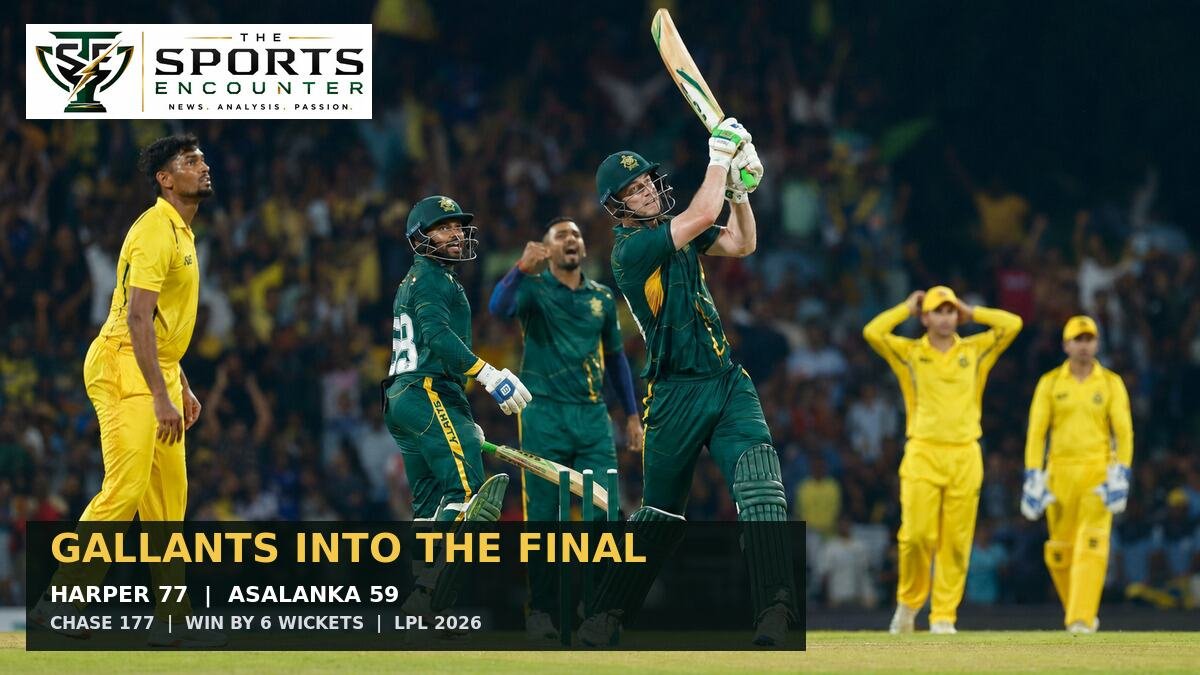
Harper and Asalanka Punish Colombo’s Chaos as Galle Reach LPL Final
Sam Harper’s commanding 77 and Charith Asalanka’s composed 59 carried Galle Gallants past Colombo Kaps and into the LPL 2026 final against Jaffna Kings.
Colombo Kaps scored quickly enough to threaten Galle Gallants, but they never batted long enough to control the match.
That difference decided Qualifier 2.
Colombo lost five wickets inside seven overs, recovered through Rubin Hermann and Ravindu Fernando, and then surrendered its remaining batting resources before completing 20 overs. Galle responded with a far calmer chase, riding Sam Harper’s masterful 77 and Charith Asalanka’s 59 to reach 177 for four in 18.4 overs.
The six-wicket victory at the R. Premadasa Stadium sends Galle into Saturday’s Lanka Premier League 2026 final against Jaffna Kings. Colombo’s promising playoff run ends one victory short of the title match.
TL;DR
- Galle Gallants chased 177 in 18.4 overs to win Qualifier 2 by six wickets.
- Sam Harper led the chase with 77 from 51 balls, including four fours and four sixes.
- Charith Asalanka scored 59 from 42 and shared a match-defining 126-run partnership with Harper.
- Colombo recovered from 52 for five to reach 176, but was bowled out in 18.5 overs.
- Dasun Shanaka’s constant bowling changes prevented Colombo from controlling the innings.
- Galle will face Jaffna Kings in the LPL 2026 final on August 8.
Galle Gallants vs Colombo Kaps Scorecard
| Detail | Information |
|---|---|
| Competition | Lanka Premier League 2026, Qualifier 2 |
| Venue | R. Premadasa Stadium, Colombo |
| Date | August 7, 2026 |
| Toss | Colombo Kaps elected to bat |
| Colombo Kaps | 176 all out in 18.5 overs |
| Galle Gallants | 177/4 in 18.4 overs |
| Result | Galle Gallants won by six wickets |
| Top Galle batter | Sam Harper, 77 from 51 balls |
| Galle support | Charith Asalanka, 59 from 42 balls |
| Top Colombo batters | Ravindu Fernando 48; Rubin Hermann 45 |
| Best Galle bowling | Sachindu Colombage 2/34; Charith Asalanka 2/34 |
| Turning point | Harper and Asalanka added 126 after Galle slipped to 21/1 |
| What comes next | Galle face Jaffna Kings in the August 8 final |
Colombo’s Run Rate Hid a Deeper Batting Failure
A total of 176 from 18.5 overs suggests aggression. The scorecard tells a harsher story.
Colombo fell to 20 for three before the third over had ended. Sadeera Samarawickrama made five, Thanuka Dabare scored 11, and captain Kamindu Mendis managed one. Janith Liyanage briefly counterattacked with 23 from nine balls, but his dismissal left the Kaps at 47 for four.
James Neesham then fell for one, reducing Colombo to 52 for five in 6.1 overs.
The Kaps kept swinging when the situation called for one decisive partnership. That approach produced boundaries, but it repeatedly exposed new batters before they had understood the surface or match situation.
Hermann supplied some resistance with 45 from 33 balls. Ravindu Fernando changed the innings’ pace with five sixes in a 27-ball 48, while Malsha Tharupathi contributed a valuable 28 from 17. Their hitting dragged Colombo toward a defendable total, yet the team lost its seventh wicket at 158 in the 17th over and was dismissed with seven balls unused.
Those missing deliveries mattered. Even at a modest late-innings rate, Colombo could have added another 10 to 15 runs. Against a Galle batting lineup that eventually needed eight runs from the final eight balls, that extra cushion could have changed the pressure entirely.
Colombo had shown much better knockout control while eliminating Kandy, as detailed in The Sports Encounter’s report on McDermott, Neesham and Wanuja Sahan ending the Royals’ campaign. Qualifier 2 exposed the opposite version of their batting.
Shanaka Kept Searching Until Galle Found Control
Dasun Shanaka’s captaincy deserves as much credit as the wickets.
Colombo’s batters attacked nearly every bowling matchup, which could easily have forced a captain into defensive thinking. Shanaka continued rotating his options instead. Six bowlers entered the attack, preventing any Colombo batter from settling against one repeated pace or angle.
Charith Asalanka conceded 34 from three overs but removed Dabare and Kamindu. Mohammad Nawaz delivered the evening’s most economical spell, taking one for 12 from two overs. Akif Javed and Tharindu Ratnayake collected one wicket each, while Sachindu Colombage returned two for 34.
The changes did not stop every boundary. They kept producing questions, and Colombo’s reckless shot selection eventually supplied the answers.
Galle had already beaten the Kaps twice during the league stage, including a 13-run victory that secured a top-two finish. Shanaka again showed why his team has handled changing match situations better across the tournament.
Harper and Asalanka Remove the Panic From the Chase
Galle lost Thomas Rogers for 13 at 21 for one, giving Colombo the early opening it needed. Harper and Asalanka closed it with patience, strike rotation and controlled aggression.
Their 126-run partnership lasted 84 balls. Harper struck four fours and four sixes during his 77 from 51, while Asalanka contributed three fours and four sixes in a 42-ball 59.
Both batters understood that the required rate demanded intent without desperation. They targeted weaker deliveries, kept the scoreboard moving between boundaries and denied Colombo the clusters of wickets that had damaged the first innings.
Harper has repeatedly shaped Galle’s successful chases. His earlier 65 against the same opponent helped produce another victory, covered in The Sports Encounter’s report on Galle’s five-wicket win over Colombo.
Asalanka again provided the calm middle-overs influence that defined his 65 in Galle’s opening victory over Jaffna.
Colombo dismissed Asalanka, Harper and Chamika Karunaratne late, but the damage had already been done. Shanaka completed the chase with a six, finishing unbeaten on eight from three balls.
The Final Brings Galle Back to Jaffna
Galle’s reward is an immediate rematch with Jaffna Kings, who defeated them by 14 runs in Qualifier 1 after Kamil Mishara’s unbeaten century.
Jaffna will enter the final rested and confident after posting 242 for two in that meeting. Galle arrives with momentum, a proven chasing structure and fresh evidence that Harper and Asalanka can manage knockout pressure.
The official Lanka Premier League schedule confirms that the final will take place at the R. Premadasa Stadium on August 8. Readers can follow the buildup through The Sports Encounter’s Lanka Premier League coverage hub and wider cricket reporting and analysis.
Colombo leaves with clear evidence of its attacking ability, but also with the question that ended its season: why keep swinging when the match was asking someone to stay?
Galle found the balance Colombo could not. One more victory will make them champions.
Breaking News
Pakistan Leave Trinidad With Relief, West Indies With Regret After a Series That Exposed Both
Pakistan needed 75 runs to prevent Babar Azam’s return as Test captain from beginning with another overseas series defeat. West Indies needed early wickets to protect a home summer that had finally restored some belief in their red-ball cricket.
By the time Babar launched Jomel Warrican for consecutive sixes at Queen’s Park Oval, the pressure had found its answer. Pakistan had won the second Test by eight wickets, ended their longest away losing streak and leveled a closely contested series 1-1.
The scoreline suited the cricket. West Indies handled the seam-friendly conditions better in Tarouba. Pakistan read the turning surface more accurately in Port of Spain. Both teams found players capable of changing Tests, yet neither produced enough consistency to claim the series.
Readers can revisit the original expectations in our West Indies vs Pakistan series preview and follow further international coverage through The Sports Encounter’s Cricket Hub.
TL;DR
- West Indies won the first Test at Tarouba by 90 runs before Pakistan answered with an eight-wicket victory in Port of Spain.
- Justin Greaves produced a historic five-wicket spell and shared Player of the Series honors with Babar Azam.
- Abdullah Shafique marked his unexpected recall with an unbeaten 160 and earned Player of the Match in the second Test.
- Babar and head coach Sarfaraz Ahmed made four changes, including the surprising omission of Mohammad Abbas.
- Roston Chase admitted West Indies underestimated how early the second-Test pitch would turn and should have selected another spinner.
- Babar sustained a bruised finger during Pakistan’s final chase, but there is currently no indication that he will miss the first Test against England.
West Indies vs Pakistan 2026 Test Series Results
| Detail | First Test | Second Test |
|---|---|---|
| Venue | Brian Lara Cricket Academy, Tarouba | Queen’s Park Oval, Port of Spain |
| Dates | July 25-28, 2026 | August 2-5, 2026 |
| West Indies totals | 311 and 181 | 344 and 117 |
| Pakistan totals | 282 and 120 | 387 and 77/2 |
| Result | West Indies won by 90 runs | Pakistan won by eight wickets |
| Player of the Match | Justin Greaves | Abdullah Shafique |
| Defining performance | Greaves took 5/27 and 2/12 | Shafique scored 160 not out |
| Series result | Drawn 1-1 | Drawn 1-1 |
| Players of the Series | Babar Azam and Justin Greaves | Babar Azam and Justin Greaves |
Tarouba: Pakistan Created Chances, West Indies Took Them
The opening Test gave Pakistan several opportunities to control the match. That made the eventual 90-run defeat more troubling than the margin alone suggested.
West Indies made 311 after Kavem Hodge scored 84 and Shai Hope contributed 92. Pakistan’s seamers kept the innings within reach, with Mohammad Ali taking 4/50 and Mohammad Abbas collecting 3/63.
Shan Masood answered with 109, the first Test century recorded at Brian Lara Cricket Academy. His 155-run partnership with Imam-ul-Haq, who made 63, brought Pakistan back into the contest after an early setback.
Masood’s innings carried added meaning because he had recently lost the captaincy. He responded as an experienced batter should, focusing on the match rather than turning his hundred into a public statement about the leadership change.
Pakistan reached a position from which they could have secured a first-innings advantage. Greaves changed the direction of the match with one of the most productive spells seen in recent Test cricket.
Justin Greaves Finds the Length That Pakistan Could Not Handle
Greaves took five wickets during five consecutive wicket-maiden overs, becoming the first bowler in Test history to achieve that sequence. His 5/27 restricted Pakistan to 282 and protected a 29-run West Indies lead.
The all-rounder later revealed that he had watched Abbas and copied the Pakistan seamer’s fuller length. That small technical adjustment delivered a historic spell.
Greaves added two wickets in the second innings to finish with match figures of 7/39. Our first-Test report from Tarouba explains how his control and Jayden Seales’ pace turned Pakistan’s promising positions into another painful defeat.
West Indies’ Tail Changes the Chase
Pakistan regained control through Abbas in West Indies’ second innings. He took 5/22, repeatedly challenging the stumps and making scoring difficult. Mohammad Ali supported him with two wickets as the hosts slipped to 93/7.
Shamar Joseph then attacked his way to 38 from 27 balls. Kemar Roach and the remaining lower order provided enough support to push West Indies to 181, leaving Pakistan 211 to win.
Those lower-order runs became one of the series’ major turning points. A chase closer to 160 would have felt manageable. Passing 200 increased the pressure on a batting side with a damaging recent record in second innings.
Seales exploited that vulnerability by taking 5/20. Pakistan collapsed for 120 while Babar remained stranded on 58 not out. The captain showed patience and resilience, but no partnership survived long enough to support him.
West Indies deserved the victory because they controlled the final exchanges of each innings. Pakistan played good cricket in long stretches, yet their inability to remove the tail and protect Babar in the chase proved decisive.
Four Changes Reveal the Intent Behind Babar 2.0
The defeat left Babar and head coach Sarfaraz Ahmed with a difficult decision. They could retain the same combination and demand better execution, or reshape the team for a Queen’s Park Oval surface expected to offer more assistance to spin.
They chose change.
Shan’s fractured left index finger ruled him out, creating an opening for Abdullah Shafique. Pakistan also brought in Awais Zafar, Sajid Khan and Ubaid Shah. Awais and Ubaid received their Test debuts.
Aamer Jamal, Khurram Shahzad, Mohammad Abbas and the injured Shan made way. Abbas’ omission attracted the most attention because he had taken eight wickets in Tarouba and almost rescued the opening match.
The selection made sense once the surface began to turn. Pakistan strengthened the batting order, added an experienced off-spinner and retained Ali Usman as the left-arm option.
Those who followed our earlier analysis of Babar Azam’s return as Test captain will recognize why the decision mattered. His second tenure needed a visible tactical identity. Port of Spain provided the first convincing evidence of one.
Sajid Khan Prevents West Indies From Escaping
West Indies still reached a respectable 344 after winning the toss. Greaves made 73, Chase scored 70 and Brandon King contributed 46.
Sajid prevented a larger total with 4/85. He bowled long spells, changed pace intelligently and gave Babar enough control to rotate Mohammad Ali, Ubaid and Ali Usman around him.
The decision to select two specialist spinners had already started working. West Indies would later regret failing to make the same adjustment.
Abdullah Shafique Turns an Unexpected Recall Into a Series-Saving Innings
Shafique had not entered the tour as an automatic selection. Shan’s injury created the opening, and the recalled batter treated it like a fresh start.
“This comeback match felt like a debut for me,” Shafique said. “I had been working hard for the last one year.”
His unbeaten 160 came from 323 balls and included 15 fours and three sixes. The innings carried patience, technical discipline and a clear understanding of the match situation. Shafique became the first Pakistan batter since 1977 to score more than 150 in a Test innings in the West Indies.
Azan Awais also justified Pakistan’s faith with 55. The young opener handled the new ball carefully and helped establish a platform before Shafique and Babar took command.
Babar’s 88 Restores Authority but Extends His Century Drought
Babar joined Shafique with Pakistan still needing a substantial stand. Their 183-run third-wicket partnership became the central passage of the match.
The captain scored 88 from 147 balls, striking 10 fours and a six. He appeared set for his first Test hundred since making 161 against New Zealand in December 2022 before a mix-up with Shafique ended in King’s direct-hit run-out.
That dismissal extended Babar’s Test century drought beyond three and a half years. His wider contribution still carried significant weight. He finished the series with 193 runs, more than any other batter, and earned a share of the Player of the Series award.
Pakistan reached 387, with Sajid’s 30 helping secure a 43-run lead. The advantage looked modest, but it forced West Indies to bat against two spinners on a deteriorating surface.
Roston Chase Admits West Indies Got Their Balance Wrong
West Indies retained an unchanged XI despite moving from a seam-dominated Tarouba pitch to a surface offering increasing turn at Queen’s Park Oval.
That decision became one of the defining mistakes of the series.
Warrican remained the only specialist spinner in the team. Chase could normally have provided another off-spin option, but his finger injury prevented him from bowling a meaningful number of overs. Greaves then sustained a leg injury and could not bowl at all.
In his post-match interview, Chase admitted that West Indies had underestimated the conditions.
“I don’t want to say we misread the pitch, but we didn’t think that it was going to spin as much from so early,” he said.
The captain also accepted that West Indies should have found room for another spinner.
“We probably would have gone with an extra spinner,” Chase said while reconsidering the team combination.
Joshua Bishop had earned his first Test call-up after taking 119 wickets in 25 first-class matches, but West Indies left him out. His inclusion would have given the team another specialist spin option as the pitch deteriorated.
Chase also felt his fast bowlers took too long to adapt. They continued searching aggressively for wickets when the surface required patience, changes of pace and control of one side of the field.
Pakistan selected for the conditions before the match. West Indies started adjusting after Shafique and Babar had already taken control.
Sajid Khan and Ali Usman Finish the Job
Pakistan’s 43-run lead became decisive when Sajid and Ali Usman attacked together in West Indies’ second innings.
Sajid varied his pace and challenged the right-handed batters around the front pad. Ali Usman created a different angle from the opposite end and kept the stumps involved.
West Indies fell to 103/6 by stumps on Day 3 and lasted less than half an hour the following morning. Sajid took 4/32, Ali Usman returned 4/39, and the hosts were dismissed for 117.
Mohammad Ali added another wicket and ended the series as its leading bowler with nine dismissals.
King could not bat after sustaining a lower-back injury while completing the run-out of Babar. His absence hurt, although the remaining batters still failed to negotiate Pakistan’s spin pair with enough clarity.
The collapse left Pakistan requiring only 75. For a complete account of the series-leveling victory, read our Pakistan vs West Indies second-Test report.
Babar’s Injury Creates a Question Before England
Pakistan’s victory came with one late concern. Babar hurt his finger during the final chase and required treatment before continuing his innings.
The injury did not prevent him from batting. He remained unbeaten on 24 and finished the match with consecutive sixes off Warrican. Babar later described the problem as soreness and bruising.
“Right now it’s a bit sore, but I think it’s fine. It’s a little bit bruised,” he said during the presentation ceremony.
Based on that assessment, the injury currently appears minor. Pakistan have not reported a fracture, announced further medical tests or listed Babar as doubtful for the opening Test against England at Headingley on August 19.
Almost two weeks separate the Trinidad Test from the start of the England series. That recovery window should be sufficient for a minor bruise, although Pakistan’s medical staff will monitor his grip, pain level and ability to train.
English conditions make complete recovery important. Movement and bounce can expose a sore bottom hand or finger, particularly when fast bowlers attack the body.
Babar’s availability appears safe at this stage. His case also looks far less serious than Shan’s fractured finger, which could affect the former captain’s participation at Headingley.
The Seven Turning Points of the Series
| Turning point | Why it mattered |
|---|---|
| Shan Masood and Imam-ul-Haq added 155 | Pakistan recovered from an early wicket and threatened to take control in Tarouba |
| Greaves took five wickets in five consecutive maidens | West Indies protected a valuable 29-run first-innings lead |
| Shamar Joseph scored 38 from 27 balls | The West Indies tail pushed Pakistan’s target to 211 |
| Seales took 5/20 | Pakistan collapsed for 120 and lost the opening Test |
| Pakistan made four changes | Babar and Sarfaraz rebuilt the team for Port of Spain’s spin-friendly conditions |
| Shafique and Babar added 183 | Pakistan moved past West Indies and created a decisive first-innings lead |
| Sajid and Ali Usman took four wickets each | West Indies fell for 117, leaving Pakistan only 75 to win |
What West Indies Learned From Their Home Summer
West Indies finished their 2026 home Test season with a 1-0 series victory over Sri Lanka and a 1-1 draw against Pakistan. After years of frequent red-ball disappointment, that represents progress.
Amir Jangoo’s 233 against Sri Lanka gave the team a potential long-term middle-order anchor. His 401-run sixth-wicket partnership with Chase set a Test record and showed that West Indies can build matches through sustained batting.
Hope supplied stability and led West Indies’ run-scoring against Pakistan with 146. Greaves established himself as a valuable all-round option. Seales reached 100 Test wickets during the Sri Lanka series before collecting eight against Pakistan. Shamar Joseph continued to provide express pace and fearless lower-order hitting.
Chase also enhanced his standing as captain. He scored important runs, communicated a clear ambition to improve West Indies at home and guided the team through an unbeaten Test summer.
His selection in Port of Spain deserves scrutiny, but his honest post-match assessment showed accountability. West Indies now need to turn those lessons into greater adaptability.
The emotional significance of the summer also connected with the passing of a Caribbean icon. Our tribute to Sir Garfield Sobers and his unmatched all-round legacy provides the wider historical context behind West Indies’ dedication in Tarouba.
What Pakistan Found and What Still Needs Repair
Pakistan leave Trinidad with several useful answers. Shafique has reopened the selection conversation. Azan showed the temperament required of a Test opener. Mohammad Ali produced nine wickets through persistence and control. Sajid and Ali Usman proved they can operate as an effective pairing when conditions suit spin.
Babar’s captaincy also gained credibility. Leaving Abbas out after an eight-wicket match carried risk, but Pakistan selected for the new surface rather than rewarding the previous scorecard.
Serious questions remain. Pakistan were bowled out for 120 while chasing 211 in Tarouba. Their management of opposition tailenders remains inconsistent. Babar’s century drought continues, while Mohammad Rizwan and Salman Agha did not make the sustained contributions expected from senior middle-order batters.
Pakistan’s broader fast-bowling direction also remains unsettled. The omission of Shaheen Afridi and the decision to rest Abbas in Port of Spain show how quickly the hierarchy has changed, an issue examined in our analysis of Shaheen Afridi’s red-ball career crossroads.
England Will Give Babar 2.0 a Harder Examination
Pakistan begin a three-Test series against England at Headingley on August 19. Lord’s hosts the second Test from August 27, with the final match scheduled at Edgbaston from September 9.
England are also entering a leadership transition. Joe Root has returned as Test captain, while Marcus Trescothick will oversee the Pakistan series before Stephen Fleming takes permanent charge. Our report on Joe Root’s captaincy return and England’s red-ball reset explains the challenge awaiting Pakistan.
English conditions will require a different balance. Abbas could return immediately, while Sajid’s place may depend on the Headingley surface. Shan’s recovery will affect whether Shafique retains his position, although dropping the Player of the Match after an unbeaten 160 would create another difficult selection debate.
The series forms part of the ICC World Test Championship 2025-27. Pakistan remain well outside the leading qualification positions, making the search for a reliable Test identity more realistic than talk of reaching the final.
Final Takeaway: A Fair Draw With Unequal Emotions
West Indies can feel encouraged by an unbeaten home Test summer, the growth of Chase’s captaincy and the emergence of several dependable performers. They can also regret allowing a 1-0 lead to disappear through an inflexible selection and a second-innings collapse.
Pakistan leave with greater relief. Their eight-match away losing streak has ended, Babar’s leadership has its first meaningful result, and Shafique has returned with an innings that could revive his career.
The 1-1 scoreline reflected an evenly fought series. It also left both teams with work ahead. West Indies need a batting order and selection strategy that adapt more quickly to changing conditions. Pakistan must prove that Port of Spain represented the beginning of better decision-making rather than another brief recovery between crises.
England will provide the next answer. Until then, Trinidad belongs equally to Greaves’ historic spell, Shan’s landmark hundred, Shafique’s comeback and Babar’s two winning sixes.
Visit The Sports Encounter for more match reports, series reviews and international cricket analysis.
West Indies vs Pakistan Test Series FAQs
Who won the West Indies vs Pakistan Test series in 2026?
The two-match series ended 1-1. West Indies won the opening Test by 90 runs, while Pakistan won the second Test by eight wickets.
Who was named Player of the Series?
Pakistan captain Babar Azam and West Indies all-rounder Justin Greaves shared the Player of the Series award.
Who scored the most runs?
Babar led the series with 193 runs. Shai Hope topped the West Indies batting list with 146.
Who took the most wickets?
Pakistan fast bowler Mohammad Ali finished with a series-high nine wickets. Jayden Seales led West Indies with eight.
Will Babar Azam play the first Test against England?
Babar described his finger injury as soreness and bruising. Pakistan have not reported a fracture or listed him as doubtful, so he is currently expected to play at Headingley.
When does the England vs Pakistan Test series begin?
The first Test begins at Headingley on August 19, 2026.
Breaking News
Raza’s Late Power Carries MI London Through Lord’s Chase
Sikandar Raza supplied the late power after Nicholas Pooran and Sam Curran rebuilt the chase, carrying MI London past London Spirit with six balls remaining at Lord’s.
London Spirit had 160 runs to defend and the Lord’s crowd behind them, but their room for error had disappeared long before the final six balls. When Sikandar Raza began finding the boundary, a competitive contest turned into another damaging defeat for a team whose qualification hopes were already fading.
Raza struck four sixes in a rapid 32 from 16 balls after Nicholas Pooran and captain Sam Curran had repaired MI London’s chase. Their combined work carried the visitors to 164 for six from 94 balls, completing a four-wicket victory on Thursday, August 6.
The result moved MI London onto 16 points and strengthened their control of a top-three place. Spirit remained on four points and, with only two matches left, were mathematically eliminated from the knockout race.
TL;DR
- MI London chased 161 in 94 balls to win by four wickets.
- Sikandar Raza’s 32 from 16 balls, featuring four sixes, provided the decisive acceleration.
- Nicholas Pooran made 39, while Sam Curran added a measured 33.
- Lhuan-dre Pretorius led London Spirit with an explosive 52 from 28 balls.
- Nathan Sowter and Trent Boult took two wickets each to restrict Spirit to 160 for five.
- MI London strengthened their qualification position, while Spirit’s top-three hopes ended.
MI London vs London Spirit Scorecard
| Detail | Information |
|---|---|
| Match | London Spirit vs MI London |
| Competition | The Hundred Men’s Competition 2026 |
| Date | August 6, 2026 |
| Venue | Lord’s, London |
| Toss | MI London won the toss and bowled |
| London Spirit | 160/5 from 100 balls |
| MI London | 164/6 from 94 balls |
| Result | MI London won by four wickets with six balls remaining |
| Top Performer | Sikandar Raza, 32 from 16 balls |
| Leading Spirit Batter | Lhuan-dre Pretorius, 52 from 28 balls |
| Best MI London Bowlers | Trent Boult 2/35; Nathan Sowter 2/29 |
| Turning Point | Curran and Raza added 41 from 18 balls |
| Tournament Impact | MI London climbed to 16 points; Spirit were eliminated |
Pretorius Gives Spirit an Aggressive Start
MI London chose to bowl and quickly removed Jonny Bairstow, but Pretorius refused to let the early wicket dictate the innings. The South African prospect attacked pace and spin with clean swings, reaching 52 from only 28 balls with five fours and three sixes.
His willingness to hit through the line gave Spirit momentum, although the innings became increasingly dependent on him. Liam Livingstone struggled to six from nine balls, while Dewald Brevis managed four from nine.
Nathan Sowter changed the shape of the innings by removing Livingstone and Pretorius. Spirit slipped from 61 for one to 79 for three, losing their most dangerous batter before he could launch a sustained assault through the final quarter.
David Willey responded with 31 from 18 balls, but another cluster of wickets left Spirit at 118 for five after 80 balls. James Coles and Jamie Overton then rescued the finish, adding 42 from the last 20 deliveries. Coles remained unbeaten on 30 from 23, while Overton struck 13 from six.
A total of 160 offered Spirit something to defend. It also felt short of what Pretorius’ innings had briefly promised.
Boult finished with two for 35, while Sowter’s two for 29 gave MI London control during the middle phase. Their work continued a campaign in which the franchise’s power hitters have frequently received a useful platform from the bowling unit, as seen in MI London’s victory over Manchester Super Giants.
Pooran and Curran Rebuild the Chase
MI London lost Will Jacks and James Vince inside the first 31 balls, leaving the chase delicately placed at 48 for two. Spirit had created pressure, and Lord’s began to sense that 160 might be enough.
Pooran settled the situation without abandoning his natural aggression. He scored 39 from 25 balls, hitting two fours and three sixes, and shared a 43-run partnership with Curran.
Their approach mattered as much as the runs. Pooran forced Spirit to protect the boundary, while Curran worked the spaces and kept the required rate under control. Pooran’s dismissal at 91 for three gave the hosts another opening, but Raza immediately refused to let the pressure settle.
Curran and Raza added 41 from 18 balls, the partnership that decided the match. Raza targeted the short boundary and punished anything delivered in his hitting arc. His four sixes transformed a manageable chase into one MI London could finish without needing the final set.
Curran departed for 33 from 23, and Spirit removed Sherfane Rutherford before Raza fell with six runs still required. Tom Curran and Ollie Pope completed the job, with Pope’s boundary taking MI London to 164 for six.
Jamie Overton led Spirit’s attack with two for 23, but the bowlers could not contain all three of Pooran, Sam Curran and Raza. That middle-order depth also proved decisive in MI London’s earlier win over Southern Brave.
Updated Hundred 2026 Points Table
Standings immediately after this match. Net run rate is omitted because the official table had not yet refreshed it.
| Position | Team | Played | Won | Lost | Points |
|---|---|---|---|---|---|
| 1 | Trent Rockets | 6 | 5 | 1 | 20 |
| 2 | MI London | 6 | 4 | 2 | 16 |
| 3 | Welsh Fire | 6 | 4 | 2 | 16 |
| 4 | Manchester Super Giants | 6 | 3 | 3 | 12 |
| 5 | SunRisers Leeds | 5 | 3 | 2 | 12 |
| 6 | Southern Brave | 6 | 2 | 4 | 8 |
| 7 | London Spirit | 6 | 1 | 5 | 4 |
| 8 | Birmingham Phoenix | 5 | 1 | 4 | 4 |
The top team advances directly to the final, while second and third contest the Eliminator. MI London now have four wins from six and hold a strong position with two league matches remaining.
Their next game against Trent Rockets on August 8 could influence both the direct-final race and the battle for home advantage in the Eliminator. The wider qualification picture remains available through The Sports Encounter’s cricket coverage hub, including analysis of Trent Rockets’ campaign against Birmingham Phoenix.
Spirit can reach only 12 points by winning their remaining matches. With the third-placed side already on 16, their elimination is confirmed. That outcome completes a difficult stretch that included Jofra Archer’s destructive spell against Spirit and the record-breaking batting assault they suffered at Headingley.
MI London Find the Depth Spirit Lack
Pretorius gave London Spirit the most exciting individual innings of the night, but MI London produced contributions across both disciplines. Sowter and Boult controlled the first innings before Pooran, Curran and Raza divided the responsibility of the chase.
Spirit found another promising player in Pretorius, yet their inability to build around his innings exposed the problem that has followed them through the tournament. MI London, by contrast, found an answer each time the match tightened.
That difference left one side looking toward the knockout stage and the other facing two remaining fixtures with pride, development and selection planning as its principal rewards.https://chatgpt.com/backend-api/sentinel/frame.html?sv=20260423af3c
-
Editor's Choice4 weeks agoWhat Counts as a Foul in Soccer? A Simple Guide for World Cup Fans
-
Editor's Choice4 weeks agoWhy Ticket Prices Crashed Ahead of the Biggest Matches of FIFA World Cup 2026
-
Editor's Choice3 weeks ago2026 WNBA All-Star Game: Full Rosters, Schedule, Stats, Injury News and More