


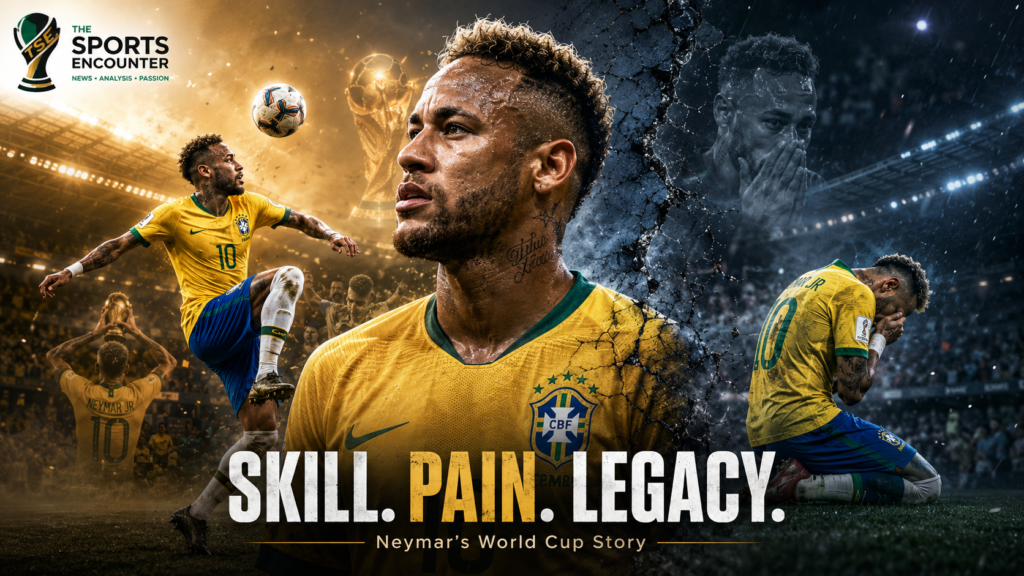
Neymar Junior’s World Cup career will be remembered through two contrasting images.
One shows a footballer lifting the ball over a defender with a rainbow flick, moving through pressure with the imagination of a child who still believes football should be fun.
The other shows him on the ground.
Sometimes he was holding his ankle. In Brazil in 2014, he left the field on a stretcher with a fractured vertebra. In Qatar in 2022, he sat on the grass after the penalty shootout defeat to Croatia, struggling to process how one of the finest goals of his international career had failed to save Brazil. Four years later, his final World Cup ended with another painful elimination, this time against Norway.
Brazil spent more than a decade asking Neymar to carry the nation toward a sixth World Cup. He gave the shirt goals, assists, creativity, personality, controversy and parts of his body that never fully recovered from the punishment.
He never delivered the trophy Brazil wanted most.
That absence will shape every argument about his place in the Seleção’s history. Yet reducing Neymar’s international career to the World Cup he did not win would erase the burden he carried and the football he produced while carrying it.
His final international numbers remain extraordinary: 130 appearances, 80 goals and 58 assists. He left as Brazil’s leading men’s international scorer and one of its most productive creators. His record was built across 16 years, four World Cups and several different versions of a national team that rarely looked capable of matching his individual imagination.
Carlo Ancelotti has now confirmed that Brazil are moving toward a younger generation. Neymar, Casemiro and Danilo are outside the long-term plan as the five-time world champions begin building toward the 2028 Copa América and, eventually, the 2030 World Cup.
The announcement formally closes a generation that had already ended emotionally.
Neymar retired from international football after Brazil’s 2-1 defeat to Norway in the 2026 World Cup Round of 16. He later made his decision unmistakable. His time had passed. He had given his life and blood to the national team. He no longer wanted to continue.
His farewell carried no World Cup medal.
It carried something more complicated: the legacy of a footballer who represented Brazil’s beauty, absorbed Brazil’s frustration and became the face of a national identity struggling to decide whether it still believed in expressive football.
TL;DR
- Neymar represented Brazil at the 2014, 2018, 2022 and 2026 World Cups.
- He scored at four World Cups and finished among Brazil’s leading World Cup goalscorers.
- His 2014 campaign ended with a fractured vertebra before Brazil’s semifinal defeat to Germany.
- He returned from major injury before the 2018 World Cup but became a target of criticism over his reactions to fouls.
- In 2022, he scored a magnificent extra-time goal against Croatia before Brazil lost on penalties.
- His final World Cup appearance came in Brazil’s 2-1 Round of 16 defeat to Norway in 2026.
- Neymar retired from international football with 80 goals and 58 assists in 130 appearances.
- The rainbow flick became a symbol of his creativity, confidence and resistance to football’s hostility toward individual expression.
- Ancelotti’s decision to move beyond Neymar, Casemiro and Danilo confirms the end of a major Brazilian generation.
Neymar’s Brazil and World Cup Career at a Glance
| Category | Record |
|---|---|
| Brazil career | 2010–2026 |
| International appearances | 130 |
| International goals | 80 |
| International assists | 58 |
| World Cups played | 2014, 2018, 2022 and 2026 |
| Best World Cup finish | Fourth place in 2014 |
| Senior international title | 2013 FIFA Confederations Cup |
| Final Brazil match | Brazil 1-2 Norway, July 5, 2026 |
| Final Brazil goal | Stoppage-time penalty against Norway |
| Defining skill | Rainbow flick and close-control dribbling |
Brazil Gave Neymar the Shirt and the Weight of an Era
Neymar arrived in the senior Brazil team in 2010 when the national side was entering an uncertain period.
The great 2002 champions had disappeared. Ronaldo, Rivaldo, Ronaldinho, Cafu and Roberto Carlos belonged to history. Kaká’s generation had fallen short in 2006 and 2010. Brazil still produced gifted footballers, but the team no longer frightened opponents through the same combination of personality, technique and competitive authority.
Neymar became the answer before he had fully become an adult.
At Santos, he dribbled with a freedom that recalled Brazilian street football. His body feints, acceleration and improvised finishes made defenders look as though they had entered the wrong game. He could attack from the left, move centrally, combine in small spaces or turn ordinary possession into a moment worth replaying.
Brazil saw more than a promising forward. The country saw continuity.
Pelé had made Brazilian football global. Garrincha gave it mischief. Zico gave it elegance. Romário gave it sharpness. Ronaldo gave it explosive power. Ronaldinho made joy feel like a competitive weapon.
Neymar inherited pieces of all those traditions without becoming a copy of any of them.
He was lighter than Ronaldo, more direct than Ronaldinho and more emotionally visible than almost every Brazilian superstar before him. Supporters saw every celebration, complaint, injury, tear and argument. Social media turned those reactions into content. Every touch became evidence for one side of an endless debate.
For Brazil, he remained the player most capable of solving a match independently. That dependence became a strength and a structural weakness.
Opponents could prepare for Brazil by preparing for Neymar. Teammates often waited for him to create the decisive action. Coaches changed, systems shifted and supporting forwards came and went, yet the central instruction rarely changed: give Neymar the ball and hope he invents something.
His emotional return to the national team before the 2026 tournament was explored in Neymar’s Last Dance: Brazil’s Prodigal Son Returns for His Fourth World Cup.
2014: The World Cup That Nearly Broke Brazil With One Knee
The 2014 World Cup was supposed to complete Neymar’s rise.
Brazil hosted the tournament carrying national expectation, political tension and the memory of 1950. Neymar was 22 years old and already the team’s emotional center.
He scored twice against Croatia in the opening match and added another two goals against Cameroon. His tournament was not technically perfect, but he gave Brazil the individual moments a nervous team needed.
The pressure surrounding the host nation was visible. Brazil struggled to control matches cleanly and needed penalties to survive Chile in the Round of 16. Neymar converted his kick in the shootout while carrying an injury and the emotional weight of a stadium that feared another national trauma.
Then came Colombia.
Brazil won the quarterfinal 2-1 through goals from Thiago Silva and David Luiz. The result should have sent the country into celebration.
Instead, the defining image came in the closing minutes.
Colombia defender Juan Camilo Zúñiga challenged Neymar from behind, driving a knee into his lower back. Neymar collapsed and left the field on a stretcher. Medical examinations revealed a fractured vertebra.
His World Cup was over.
The injury landed only centimeters away from causing consequences far beyond football. Neymar later spoke about how close the contact came to threatening his ability to walk. Brazil had lost its best attacker, but the human fear exceeded the tactical damage.
Without Neymar and suspended captain Thiago Silva, Brazil faced Germany in the semifinal. The 7-1 defeat became one of the darkest nights in the history of the national team.
Neymar did not play, yet the result became part of his World Cup story. His absence exposed how deeply Brazil had built its identity around one player. The structure collapsed when the central source of confidence disappeared.
The 2014 tournament established the pattern that would follow him. He had played well. He had scored important goals. Brazil had reached the semifinals. Still, Neymar left the tournament in physical pain while the country remembered the failure more loudly than his contribution.
2018: Talent Returned, but the Conversation Changed
Neymar entered the 2018 World Cup after another race against injury.
A fractured metatarsal suffered with Paris Saint-Germain had kept him out for months. His recovery became a daily national story. Brazil needed him available, even if he lacked full rhythm.
He scored against Costa Rica and Mexico, helping Brazil reach the quarterfinals. He created chances, carried the ball through pressure and remained the player opponents feared most.
Yet the football became secondary to the reaction around him.
Neymar was repeatedly fouled. He also exaggerated some of the contact, rolling across the ground and reacting theatrically. Television replays and social media transformed those moments into global ridicule. The “Neymar Challenge” became a meme in which people imitated his falls.
The criticism was not entirely unfair. Neymar sometimes extended a genuine foul into a performance. His frustration became visible in ways that weakened sympathy for the punishment he was actually receiving.
However, the mockery also distorted reality.
Defenders targeted him because ordinary defensive methods often failed. His ability to change direction at speed forced opponents into desperate contact. Repeated fouls accumulated across matches, and officials did not always protect the player consistently.
Neymar became trapped between two truths. He was genuinely fouled at an exceptional rate. He sometimes reacted in a manner that made people doubt him.
Brazil’s quarterfinal defeat to Belgium ended the campaign. Neymar helped create late opportunities, but Thibaut Courtois denied his final attempt and Belgium advanced 2-1.
The post-tournament discussion focused heavily on his behavior. That damaged the public understanding of his performance. Neymar had returned from a significant injury, scored twice and helped Brazil reach the last eight. Those facts could not compete with the memes.
From that point forward, every Neymar injury carried suspicion among part of the audience. His pain had become entertainment.
The Rainbow Flick Became More Than a Skill
A rainbow flick begins with an act of confidence.
The player traps the ball between the feet, rolls or lifts it upward and sends it over the defender’s head. The move has little margin for error. Failure looks foolish. Success can humiliate an opponent and electrify a stadium.
Neymar did not invent the skill. Brazilian football had long embraced the carretilha or lambreta, while players across generations and countries had used variations of it.
He became its most recognizable modern ambassador.
For Neymar, the rainbow flick expressed a larger idea. Football could remain playful at the highest level. A player did not need to remove imagination from his game simply because the stakes had increased.
Critics called it showboating. Defenders often responded with anger. Some believed the trick lacked respect, particularly when Neymar attempted it late in matches or against beaten opponents. Referees occasionally appeared more offended by the skill than by the retaliatory foul that followed.
Neymar’s position was consistent. Skill belonged inside football. A dribble was not disrespectful merely because it embarrassed someone.
That argument touches the heart of Brazilian football culture.
The Seleção’s global identity was built through competitive success and expressive technique. Pelé’s body feints, Garrincha’s dribbling, Rivelino’s elastico and Ronaldinho’s improvisation all made winning feel creative.
Modern football increasingly prizes structure, pressing, physical coverage and risk management. Players are coached to protect possession and occupy defined zones. Individual expression survives, but it often requires permission from the system.
Neymar played as though permission had already been granted.
The rainbow flick therefore became part of his legacy because it captured the tension surrounding him. Fans who loved Neymar saw courage, joy and Brazilian identity. Critics saw vanity and unnecessary provocation.
Both reactions revealed how football had changed.
2022: Neymar Scored the Goal His World Cup Career Deserved
Qatar offered Neymar what looked like his best final chance.
Brazil entered the 2022 World Cup with depth, balance and attacking options. Vinícius Júnior had developed into an elite forward. Casemiro protected the midfield. Richarlison brought movement and finishing. Thiago Silva continued to provide leadership.
Neymar no longer needed to create every moment alone.
Then he injured his ankle against Serbia in the opening match.
Images of the swelling created immediate fear that his tournament was over. Once again, a World Cup had placed Neymar’s body at the center of Brazil’s hopes.
He missed the remaining group matches but returned against South Korea in the Round of 16. Brazil won 4-1, producing one of the tournament’s most fluid attacking performances. Neymar scored from the penalty spot and helped connect the team’s combinations.
The quarterfinal against Croatia became the most painful defeat of his international career.
Croatia slowed the game, controlled emotional rhythms and prevented Brazil from finding clean attacking spaces. The match entered extra time without a goal.
Then Neymar produced a sequence worthy of any World Cup.
He exchanged quick passes through Croatia’s defense, accelerated into the penalty area, moved around goalkeeper Dominik Livaković and finished from a tight angle.
The goal was beautiful, difficult and decisive in appearance. It also equaled Pelé’s official Brazil scoring record at the time.
Brazil failed to protect the lead.
Bruno Petković equalized following a late counterattack, and Croatia won the penalty shootout. Neymar had been scheduled to take Brazil’s fifth penalty. The shootout ended before he could step forward.
He remained on the field in tears.
This was the cruelest summary of his World Cup career. Neymar had produced the required moment. The team had failed to carry it safely to the finish.
2026: A Final World Cup Reduced to 37 Minutes and One Last Goal
Neymar’s path to the 2026 World Cup required another recovery few players could have completed.
An anterior cruciate ligament injury suffered in 2023 kept him away from Brazil for an extended period. His move to Al-Hilal produced little football, and recurring physical problems raised serious questions about whether he could return to elite international competition.
He went back to Santos, the club where his career had begun.
The return carried emotion and practical purpose. Neymar needed matches, fitness and a familiar environment. Ancelotti needed evidence that the 34-year-old could still contribute to Brazil.
He made the squad, but his role had changed.
Vinícius Júnior had become the primary attacking figure. Younger players offered greater physical intensity. Neymar entered the tournament as a veteran option whose creativity remained valuable but whose body could no longer be trusted for a full campaign.
Brazil opened slowly before finding greater authority. Vinícius scored twice as the Seleção defeated Scotland 3-0 and topped Group C. The full match story is available in Brazil Top Group C After Vinícius Júnior Double Sinks Scotland.
Neymar’s return that night created an emotional lift, but the hierarchy had shifted.
Brazil then survived a serious Round of 32 scare against Japan. Casemiro scored before Gabriel Martinelli produced a late winner, as detailed in Brazil Survive Their First Real World Cup Scare as Japan Fall Late.
The wider emotional relationship between Brazilian football and supporters far from South America was captured in Brazil’s Loudest Second Home Is Hidden in Karachi’s Lyari.
The Round of 16 brought Norway and Erling Haaland.
Before the match, attention centered on whether Vinícius Júnior or Haaland would control the knockout contest. The tactical and emotional stakes were examined in Vini Jr vs Haaland Gives Brazil and Norway a World Cup Clash With Bite.
Brazil had an early penalty, but Bruno Guimarães failed to convert. Norway stayed alive, and goalkeeper Ørjan Nyland produced a career-defining performance.
Haaland scored twice late in the match.
Neymar entered and converted a stoppage-time penalty, giving Brazil brief hope. The finish showed the calm and deception examined in Stutter-Step Penalties Divide World Cup Fans.
Brazil still lost 2-1. The full elimination report, including Haaland’s late double and Neymar’s final goal, can be read in Haaland Turns Brazil’s Missed Penalty Into a World Cup Nightmare.
Neymar had played only 37 minutes during the tournament.
His final touch of consequence for Brazil was a goal. His final image was another elimination.
Ancelotti’s Reset Confirms That Brazil Cannot Keep Waiting
Ancelotti’s decision to move beyond Neymar, Casemiro and Danilo reflects football reality rather than personal rejection.
All three players were over 30 at the 2026 World Cup. Each had provided leadership and experience. Their generation, however, failed to return Brazil to a World Cup final.
The coach’s next immediate target is the 2028 Copa América. He wants younger players to enter the squad early enough to develop under competitive pressure before the 2030 World Cup.
Brazil will retain selected veterans, with Marquinhos cited as a possible figure of continuity. The broader direction is clear.
Vinícius Júnior, Endrick, Estêvão and the next wave must inherit responsibility. Rodrygo’s injury complications have created further uncertainty, while Brazil’s midfield also requires renewal after years of depending on Casemiro’s defensive intelligence.
Vinícius’ growing place at the center of Brazil’s next cycle is also reflected in Vinícius Júnior Set to Stay at Real Madrid, which examines how his World Cup performances strengthened his status for club and country.
For Neymar, Ancelotti’s comments confirm what retirement had already established.
There will be no comeback campaign, no fifth World Cup and no final attempt to repair the story in 2030.
Brazil’s next generation must create a different ending without the player who shaped the previous four tournaments.
Did Neymar Fail Brazil, or Did Brazil Fail to Build Around Him?
The fairest answer sits between those extremes.
Neymar was responsible for parts of his own complicated legacy. His reactions to fouls harmed his credibility. His career choices did not always maximize his competitive potential. Injuries were sometimes followed by public appearances that made supporters question priorities, even when the criticism lacked full context.
He also played in Brazilian teams that depended on him excessively.
Brazil never consistently built the kind of collective attacking structure that allowed Lionel Messi to flourish in Argentina’s later years. Neymar often received the ball far from goal and had to dribble through several lines before creating danger.
During his prime, Brazil lacked a stable elite striker comparable to Ronaldo. Midfield creativity fluctuated. Coaches frequently prioritized defensive security and expected Neymar to supply the imagination.
When he succeeded, Brazil advanced. When opponents isolated or injured him, the attack often became predictable.
His World Cup record contains important production, but tournament legacy is judged through decisive rounds. Pelé won three titles. Romário controlled 1994. Ronaldo scored twice in the 2002 final.
Neymar’s defining knockout goal came against Croatia in 2022, and Brazil still lost.
That difference separates him from the country’s most celebrated World Cup icons. It should not remove him from the conversation about Brazil’s greatest players.
How Should Neymar’s World Cup Career Be Ranked?
Neymar belongs below Brazil’s World Cup-winning legends.
Pelé remains in a separate historical category. Garrincha, Romário, Ronaldo, Rivaldo and other champions delivered performances connected directly to the trophy.
Neymar’s case rests on longevity, production and the difficulty of his circumstances.
He scored across four World Cups. He entered tournaments after major injuries. He became the central creative force for a country that often lacked comparable attacking structure. His influence reached beyond goals through chance creation, set pieces, dribbling and the fear he created in defenders.
His limited role in 2026 prevented him from featuring prominently among the tournament’s leading scorers. For comparison, The Sports Encounter’s ranking of the top 10 goalscorers at FIFA World Cup 2026 shows how the tournament’s attacking hierarchy had moved toward a younger generation.
For complete tournament reporting, analysis and legacy coverage, readers can also visit The Sports Encounter’s FIFA World Cup 2026 coverage hub.
Neymar’s World Cup legacy belongs in the category of brilliant careers without completion.
Johan Cruyff never won the World Cup. Cristiano Ronaldo did not reach a final. George Best never played at the tournament. Football history has room for greatness beyond the trophy.
Brazilian history is less forgiving because the country measures itself through championships.
Neymar knew that standard when he accepted the No. 10 shirt.
The Rainbow Flick Legacy Will Outlive the Arguments
Years from now, younger supporters may discover Neymar through short clips.
They will see the acceleration, elastic touches and the ball moving over defenders. They may wonder why such a gifted player generated so much anger.
The answer lies partly in expectation.
Neymar followed Pelé, Ronaldo and Ronaldinho. He played during the era of Lionel Messi and Cristiano Ronaldo. His transfer fees, celebrity, injuries and public personality created a standard no footballer could satisfy consistently.
The rainbow flick survived all of that noise.
It remains the purest image of his football because it had no guarantee of success. Neymar attempted it because he saw a possibility others did not see or did not dare to try.
That instinct created goals and assists. It also invited fouls, accusations of arrogance and demands that he play more safely.
Neymar rarely played safely. His body eventually paid for that choice.
Final Verdict: Skill, Pain and an Unfinished World Cup Story
Neymar Junior leaves international football as Brazil’s record scorer, one of its leading appearance-makers and the central figure of a 16-year era.
He also leaves without a World Cup title or Copa América medal.
Those facts should remain together.
His international career contained genuine shortcomings, but it cannot be described honestly without acknowledging the injuries, tactical dependence and emotional pressure surrounding him.
In 2014, a fractured vertebra removed him before the semifinal.
In 2018, his football disappeared beneath a global argument about fouls and exaggeration.
In 2022, he scored one of his finest goals before Brazil surrendered the lead and lost on penalties.
In 2026, he played 37 minutes, scored one final goal and watched another World Cup leave Brazil behind.
Ancelotti’s generational reset now gives the Seleção a necessary chance to move forward. The Brazilian Football Confederation and its coaching staff must develop a team whose identity does not depend on waiting for one individual to solve every difficult moment.
Neymar’s story has already moved from active hope into history.
The trophy never arrived. The pain often did.
Yet somewhere inside every compilation of his greatest moments, the ball still rises over a defender’s head.
The rainbow flick remains suspended in the air for a fraction of a second, carrying everything Neymar represented: risk, beauty, rebellion and the belief that football should still contain surprise.
Brazil wanted him to win the World Cup.
Neymar gave Brazil a different legacy. He reminded the world that skill could still challenge structure, even when structure, injury and time eventually won.
The Sports Encounter’s World Cup 2026 coverage focuses on fixtures, team news, match analysis, fan stories, tournament trends, and the biggest talking points from football’s global stage.