


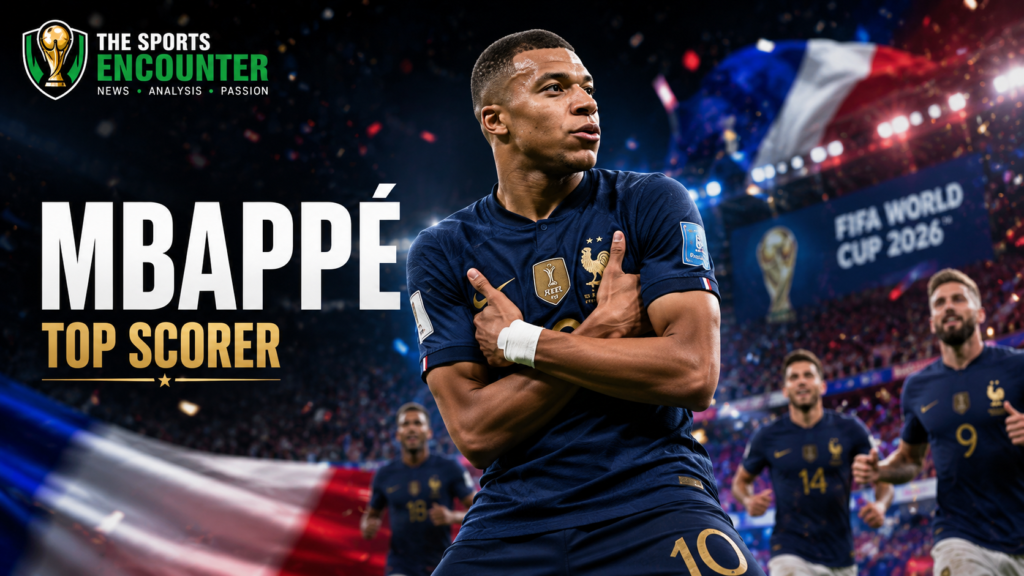
Kylian Mbappé finished as the top scorer at the FIFA World Cup 2026, winning the Golden Boot with 10 goals as his pace, agility, movement, and ruthless finishing carried France to fourth place.
The tournament ended with Spain lifting the trophy, Argentina finishing second, and England claiming third place. Yet the individual scoring race belonged to Mbappé. France’s captain scored in the group stage, the Round of 32, the Round of 16, the quarterfinal, and the third-place playoff.
His two goals against England took him into double figures and moved him clear of Lionel Messi, who finished with eight. Mbappé also reached 22 career World Cup goals, strengthening his claim as the most productive tournament scorer of his generation.
The final list of the top goal scorers at the FIFA World Cup 2026 featured established superstars, a breakout World Cup debutant, two England players, and one member of Spain’s championship team.
FIFA World Cup 2026 Top Scorers at a Glance
| Rank | Player | Country | Goals |
|---|---|---|---|
| 1 | Kylian Mbappé | France | 10 |
| 2 | Lionel Messi | Argentina | 8 |
| 3 | Jude Bellingham | England | 7 |
| 4 | Erling Haaland | Norway | 7 |
| 5 | Ousmane Dembélé | France | 6 |
| 6 | Harry Kane | England | 6 |
| 7 | Mikel Oyarzabal | Spain | 5 |
| 8 | Ismaïla Sarr | Senegal | 4 |
| 9 | Julián Quiñones | Mexico | 4 |
| 10 | Vinícius Júnior | Brazil | 4 |
1. Kylian Mbappé, France: 10 Goals
Mbappé began the World Cup as one of the favorites for the Golden Boot and quickly turned expectation into production. He scored twice against Senegal, added another brace against Iraq, and struck twice more as France defeated Sweden in the Round of 32.
His movement made him almost impossible to contain. Mbappé could begin on the left, drift centrally, attack the gap between defenders, or accelerate behind the back line before opponents had time to reorganize. His goals came through speed, sharp positioning, controlled finishing, and an ability to recognize danger a second earlier than everyone around him.
Further goals against Paraguay and Morocco helped France reach the semifinals. Spain denied him space during its disciplined 2-0 victory, but Mbappé responded with two goals in the extraordinary 6-4 third-place playoff defeat against England.
France finished fourth, below its pre-tournament target, but Mbappé remained the tournament’s most devastating scorer. He became the first man to win two FIFA World Cup Golden Boots after also leading the scoring table in 2022.
2. Lionel Messi, Argentina: 8 Goals
At 39, Messi produced another World Cup campaign filled with records and moments of individual brilliance.
He opened with a hat trick against Algeria, scored twice against Austria, and added a free kick against Jordan. Further goals against Cape Verde and Egypt took him to eight for the tournament.
Messi’s influence stretched beyond scoring. He supplied decisive passes during Argentina’s path through the knockout rounds and helped the defending champions reach another final. Spain eventually won 1-0 after extra time, but Messi remained Argentina’s main creative reference throughout the competition.
His eight goals earned second place in the scoring chart and the Silver Ball behind Spain captain Rodri.
3. Jude Bellingham, England: 7 Goals
Bellingham delivered one of the strongest tournament performances ever produced by an England midfielder.
He scored against Croatia and Panama, struck twice during England’s comeback victory over Mexico, and added another double in the quarterfinal against Norway. His extra-time winner in that match carried England into the semifinals.
A final goal against France in the third-place playoff brought his total to seven. That made Bellingham the first England player to score seven times at a single World Cup.
His goals reflected his complete attacking range. Some came from late runs into the penalty area. Others required physical strength, timing, or calm finishing under pressure.
4. Erling Haaland, Norway: 7 Goals
Haaland’s first World Cup produced exactly the kind of impact Norway had hoped for.
The striker scored twice against Iraq and twice against Senegal before finding the winner against Ivory Coast in the Round of 32. He then delivered two more goals as Norway stunned Brazil in the Round of 16.
Norway’s run ended against England in the quarterfinals, but Haaland left with seven goals and proof that his club-level scoring power could transfer to international football’s biggest stage.
His finishing was direct and unforgiving. Norway rarely needed to create several chances for him. One loose ball, mistimed defensive step, or accurate cross was often enough.
5. Ousmane Dembélé, France: 6 Goals
Dembélé gave France a second player among the tournament’s leading scorers.
His campaign gathered momentum after he scored against Iraq. A hat trick against Norway pushed him into the Golden Boot conversation, while another goal against Morocco helped France reach the semifinals.
Dembélé completed his tournament by scoring against England in the third-place playoff. His six goals, combined with his creative contribution, made him one of the most productive attackers at the competition.
France’s attack often depended on Mbappé’s directness, but Dembélé provided unpredictability from different positions. His ability to use either foot made defenders reluctant to force him in one direction.
6. Harry Kane, England: 6 Goals
Kane remained England’s reliable penalty-area finisher even as Bellingham and Bukayo Saka produced major attacking moments around him.
He scored twice against Croatia and added another goal against Panama. A brace against DR Congo moved England through the Round of 32, while his penalty against Mexico helped complete a difficult comeback.
Kane’s six-goal campaign also carried historical weight. He moved beyond Gary Lineker to become England’s leading scorer in World Cup finals.
England missed the final after losing to Argentina, but its victory over France secured third place and completed another productive tournament for its captain.
7. Mikel Oyarzabal, Spain: 5 Goals
Spain won the World Cup through collective control, defensive discipline, and attacking variety. Oyarzabal emerged as their leading scorer.
He struck twice against Saudi Arabia and scored another double against Austria in the Round of 32. His penalty against France in the semifinal took him to five goals.
Oyarzabal did not score in the final, where Ferran Torres produced the decisive extra-time finish against Argentina. His earlier goals, however, gave Spain a dependable central threat during its journey to the title.
His presence also prevented opponents from focusing entirely on Lamine Yamal, Nico Williams, and Spain’s midfield runners.
8. Ismaïla Sarr, Senegal: 4 Goals
Sarr was Senegal’s most dangerous attacker during a tournament that ended in the Round of 32.
He scored twice against Norway, found the net against Iraq, and struck again as Senegal built a lead against Belgium. The African side could not protect that advantage, but Sarr’s four goals underlined his importance.
His acceleration and direct running repeatedly stretched defensive lines. Senegal’s elimination arrived earlier than supporters hoped, although Sarr left as one of the tournament’s leading African scorers.
9. Julián Quiñones, Mexico: 4 Goals
Quiñones became one of the central figures in Mexico’s home World Cup campaign.
He scored during the group stage against South Africa and Czechia, then struck against Ecuador in the Round of 32. His fourth goal came in Mexico’s 3-2 defeat against England.
Mexico did not reach the quarterfinals, but Quiñones gave the co-hosts power, athleticism, and a reliable finishing presence. His performances also made him one of the tournament’s standout scorers from the CONCACAF region.
10. Vinícius Júnior, Brazil: 4 Goals
Vinícius opened his tournament with an outstanding strike against Morocco and followed it with a goal against Haiti. Two more against Scotland brought him to four before the knockout stage.
Brazil then defeated Japan but suffered a surprise Round of 16 loss to Norway. Vinícius could not add to his total during those matches, leaving his World Cup with a sharp divide between an explosive group stage and a frustrating knockout campaign.
His four goals still earned him a place among the competition’s 10 leading scorers.
Why Mbappé Won the FIFA World Cup 2026 Golden Boot
Mbappé separated himself through consistency across the tournament. He scored against different opponents, in different rounds, and through different types of finishes.
His agility allowed him to change direction without losing momentum. Elite acceleration made defensive recovery difficult, while improved movement through central areas gave him more routes to goal than in previous tournaments.
France fell short of the final after losing to Spain, but Mbappé kept producing until the last match. His brace against England became the difference between sharing the scoring lead and winning the Golden Boot outright.
The World Cup ultimately belonged to Spain. Its scoring crown belonged to Mbappé.
Frequently Asked Questions
Who was the top scorer at the FIFA World Cup 2026?
Kylian Mbappé finished as the tournament’s top scorer with 10 goals and won the FIFA World Cup 2026 Golden Boot.
How many goals did Mbappé score at World Cup 2026?
Mbappé scored 10 goals in eight matches for France.
Who finished second in the 2026 World Cup scoring chart?
Lionel Messi finished second with eight goals for Argentina.
How many goals did Jude Bellingham score?
Bellingham scored seven goals and became the first England player to reach that total in a single World Cup.
Who was Spain’s leading scorer at World Cup 2026?
Mikel Oyarzabal led the champions with five goals.
Did Mbappé win consecutive World Cup Golden Boots?
Yes. Mbappé won the Golden Boot in 2022 and again in 2026, becoming the first male player to win the award twice.
The Sports Encounter’s World Cup 2026 coverage focuses on fixtures, team news, match analysis, fan stories, tournament trends, and the biggest talking points from football’s global stage.