


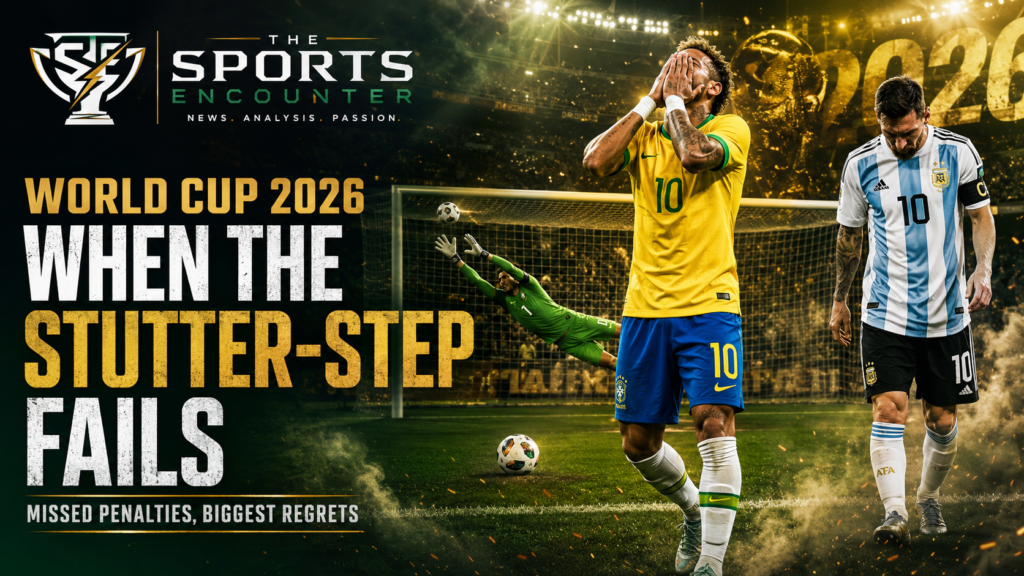
The stutter-step penalty technique annoys plenty of fans. However, players keep trusting it anyway.
FIFA World Cup 2026 has turned the penalty run-up into a tactical debate again, and Brazil’s shock defeat to Norway gave that debate its sharpest image yet. Bruno Guimarães walked up to the spot, slowed his run, tried to read Ørjan Nyland, and produced the kind of weak penalty that makes supporters question the entire method.
Nyland saved. Brazil lost. The conversation exploded.
The same match also showed why the technique refuses to disappear. Neymar later used deception from the spot and scored in stoppage time. Across the tournament, Cristiano Ronaldo and Kylian Mbappe have also found success with deceptive run-ups, while failures from Bruno and Lionel Messi have kept the criticism alive.
That is the strange life of this technique.
When it works, it looks clever.
When it fails, it looks unforgivable.
For wider tournament coverage, follow The Sports Encounter’s FIFA World Cup 2026 hub.
Key Penalty Talking Points
| Talking Point | Why It Matters |
|---|---|
| Bruno Guimarães missed against Norway | His stutter-step penalty was saved by Ørjan Nyland and became a defining moment in Brazil’s exit |
| Neymar scored late in the same match | The same idea of deception succeeded when executed with authority |
| Ronaldo and Mbappe used deceptive run-ups successfully | Elite players continue to trust hesitation and goalkeeper manipulation |
| Fans want the technique banned | Many supporters see the stop-start run-up as unsporting or ugly |
| IFAB allows feinting during the run-up | The law separates legal deception before the kick from illegal feinting after the run-up is complete |
What the Law Actually Says
The first question is simple: is the stutter-step legal?
Yes, within limits.
Under the Laws of the Game, feinting during the run-up is permitted. The issue begins when the kicker completes the run-up and then feints to kick the ball. IFAB’s guidance on feinting makes the distinction clear: feinting during the run-up is allowed, but feinting to kick the ball once the run-up has been completed is an offense.
That distinction is the entire debate.
A player can slow down, hesitate, change rhythm, or stutter while approaching the ball. What he cannot do is reach the ball, pretend to shoot, and then delay the actual kick after the run-up has ended.
This is why most stutter-step penalties survive legal scrutiny. They happen before the final kicking action. They may frustrate goalkeepers and fans, but frustration is different from illegality.
Football has always allowed deception. A step-over is legal. A body feint is legal. A no-look pass is legal. A Panenka is legal. The stutter-step sits in that same family of tricks, except it happens in the most emotionally exposed moment of the game.
That is why people react so strongly.
Why Bruno Guimarães’ Miss Changed the Mood
Brazil’s defeat to Norway was already one of the biggest shocks of FIFA World Cup 2026. The penalty miss made it feel even more painful.
Brazil had a chance to take control early. Vinícius Júnior initially had the ball near the spot, but Bruno Guimarães eventually took the penalty. He tried to pause, read Nyland, and send the goalkeeper the wrong way. Instead, the shot lacked conviction and sat close enough for Nyland to save.
Bruno Guimarães’ missed penalty against Norway became one of the defining moments of Brazil’s World Cup exit. Neymar’s stoppage-time penalty gave Brazil hope, but it came too late to repair the damage.
The miss also made the penalty-choice debate louder. A missed penalty is painful in any match. In a World Cup knockout tie, it becomes a national argument.
The technique took much of the blame because it looked soft. Had Bruno smashed the ball over the bar, supporters may have criticized execution. Because he slowed down and gave Nyland time to read him, the miss felt avoidable.
That perception matters.
Fans often forgive power. They rarely forgive hesitation that fails.
Why Players Still Use It
Penalty taking is no longer only about power or placement.
It is data, body language, goalkeeper manipulation, and nerve.
Goalkeepers study takers. Analysts track preferred corners. Coaches review body shape, run-up angle, foot position, hip opening, and historical patterns. At this level, a penalty taker who runs straight through the ball without variation can become predictable.
The stutter-step is one way to fight that predictability.
By slowing the run-up, the taker tries to force the goalkeeper to move first. Once the goalkeeper leans or commits, the taker can roll the ball into the opposite corner. The technique gives the shooter a fraction of extra information.
That fraction is the appeal.
It also creates the risk.
If the goalkeeper refuses to move, the taker suddenly has less momentum, less rhythm, and less margin for error. That is when the shot becomes weak. Bruno’s miss showed the danger perfectly. Neymar’s goal showed why players continue to trust it.
The method itself is not good or bad. The execution decides everything.
Why Fans Hate It
Supporters dislike stutter-step penalties for three main reasons.
First, they feel unnatural. A penalty has an old-school purity to it: one player, one ball, one goalkeeper, one strike. The stutter-step disrupts that image. It turns the kick into theater.
Second, it can look unfair to goalkeepers. Fans see the taker delay, wait, and manipulate, while the goalkeeper must stay on the line and avoid moving too early. Even when the law allows the run-up deception, the optics can feel tilted toward the shooter.
Third, failed stutter-steps look terrible. A missed Panenka looks arrogant. A weak stutter-step looks nervous. Supporters tend to punish both emotionally because the player appears to have chosen style over certainty.
That is not always fair.
Many stutter-step takers are not showing off. They are using a practiced method designed to increase the chance of scoring. Yet football is judged through emotion as much as logic. A penalty miss in a World Cup knockout game will never be treated as a technical detail.
It becomes a character test.
Ronaldo, Neymar, Mbappe, and the Star Factor
The technique survives because elite players keep validating it.
Neymar has used hesitation for years. Cristiano Ronaldo has long understood how to manipulate goalkeeper timing. Kylian Mbappe’s penalty style often mixes speed, confidence, and late adjustment. These players know that the goalkeeper is not only reacting to the ball. He is reacting to reputation.
That is why star power matters.
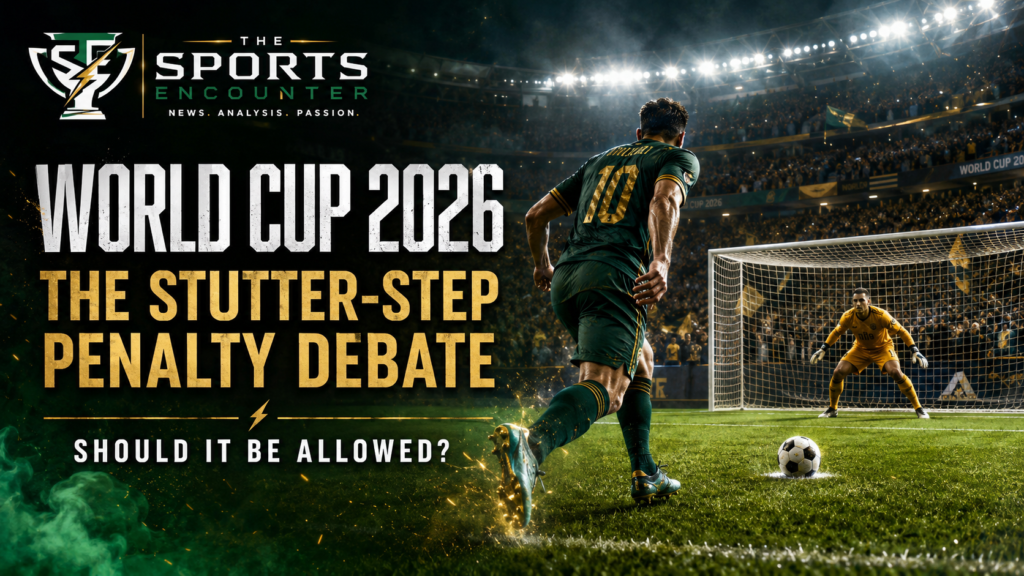
When Ronaldo slows his run-up, a goalkeeper knows he is facing a player with years of penalty authority. When Neymar pauses, the goalkeeper expects disguise. When Mbappe shapes his body, the goalkeeper has to decide whether the shot is going across him or back the other way.
The stutter-step works best when the taker owns the moment.
Bruno Guimarães did not. That does not make him a poor player. It does show that penalty technique must match personality, repetition, and pressure history.
Some players are better suited to clean power. Others thrive on deception. The mistake is treating one method as a universal solution.
Ronaldo’s World Cup also showed how heavy late-tournament pressure can become for even the greatest names. His tournament ended when Spain knocked Portugal out with a brutal late winner, adding another emotional layer to the tournament’s penalty and knockout pressure debates.
Should the Technique Be Banned?
The emotional answer from many fans is yes.
The football answer is more complicated.
Banning all stutter-steps would create enforcement problems. How much hesitation is too much? Is a slow run-up illegal? Is a change of pace illegal? Can a player pause for half a second? What about a player who naturally takes short steps before striking?
The current law gives referees a cleaner distinction. Feinting during the run-up is allowed. Feinting after completing the run-up is prohibited.
That does not remove every gray area, but it gives officials a workable line.
A full ban would also remove a legitimate psychological skill from penalty taking. Football has always rewarded disguise. The best players use their eyes, hips, feet, and timing to mislead opponents. The penalty spot should not be completely separated from that wider logic.
The better question is whether referees should enforce the existing law more strictly when the run-up clearly ends and the kicker still feints.
That would preserve deception while cutting out the most excessive versions.
How This Fits World Cup 2026’s Bigger Rules Debate
The stutter-step argument is part of a wider World Cup 2026 pattern.
This tournament has repeatedly turned rules, officials, VAR decisions, red cards, hydration breaks, and stoppages into major fan debates. Supporters are not only watching goals anymore. They are watching the machinery around the game.
That is why the stutter-step debate sits naturally alongside the sudden fan obsession with World Cup referees. Fans want to know what is legal, what is fair, how decisions are made, and why certain moments feel wrong even when they fit the rulebook.
The same curiosity also shaped the wider VAR and knockout-stage debates before the Round of 16, where disallowed goals, referee decisions, and match-turning calls became part of the tournament’s emotional rhythm.
Penalty law now belongs inside that bigger conversation.
When a taker hesitates, a goalkeeper waits, a referee watches, and millions of fans judge the result, the penalty becomes more than one kick. It becomes a referendum on how football balances skill, fairness, psychology, and spectacle.
The Sports Encounter View
Stutter-step penalties should remain legal, but the boundaries need to be enforced clearly.
A penalty is already weighted toward the taker. That is the point of the punishment. Yet the goalkeeper deserves a fair contest within the law. Allowing hesitation during the run-up keeps the tactical battle alive. Allowing a fake after the run-up is complete would tilt the contest too far.
So the balance is right in principle.
The problem is not the law. The problem is perception.
Fans see a stop-start penalty and often assume the taker has cheated the moment. Players see it differently. They see a goalkeeper waiting to read them, a scouting report trying to predict them, and a chance to win the psychological battle before contact with the ball.
That is why this argument will not disappear.
World Cup 2026 has only made it louder.
The stutter-step is ugly when it fails, beautiful when it works, and legal when performed inside the run-up. Bruno Guimarães became the warning. Neymar became the counterargument. Ronaldo and Mbappe remain proof that the world’s biggest players still believe deception is worth the risk.
Penalty taking has changed.
The spot kick is no longer only a strike.
It is a negotiation between nerve, data, timing, and ego.
That may annoy fans, but it is exactly why the stutter-step is here to stay.
Source Attribution
This article draws on The Guardian’s analysis of the stutter-step penalty trend, IFAB’s guidance on feinting during penalties, and match reporting around Brazil’s World Cup exit against Norway.
FAQs
What is a stutter-step penalty?
A stutter-step penalty is a spot kick where the taker slows, pauses, or changes rhythm during the run-up to make the goalkeeper move early before choosing where to shoot.
Are stutter-step penalties legal?
Yes, stutter-step penalties are legal if the feint happens during the run-up. IFAB rules prohibit feinting to kick the ball after the run-up is complete.
Why do fans dislike stutter-step penalties?
Many fans dislike them because they look unnatural, appear unfair to goalkeepers, and seem especially poor when the taker produces a weak shot or misses.
Why do players still use stutter-step penalties?
Players use them because they can force goalkeepers to commit early. At elite level, penalty taking involves body language, data, timing, and psychological manipulation.
Who missed a stutter-step penalty at World Cup 2026?
Bruno Guimarães missed a crucial penalty for Brazil against Norway in the FIFA World Cup 2026 Round of 16. Ørjan Nyland saved it, and Brazil later lost 2-1.
Who scored with a stutter-step penalty at World Cup 2026?
Neymar scored a late penalty for Brazil against Norway after using deception in the run-up. Cristiano Ronaldo and Kylian Mbappe have also used deceptive run-ups successfully during the tournament.
Should stutter-step penalties be banned?
They should not be fully banned, but referees should enforce the existing rule clearly. Feinting during the run-up should remain legal, while feinting after the run-up is complete should be punished.