


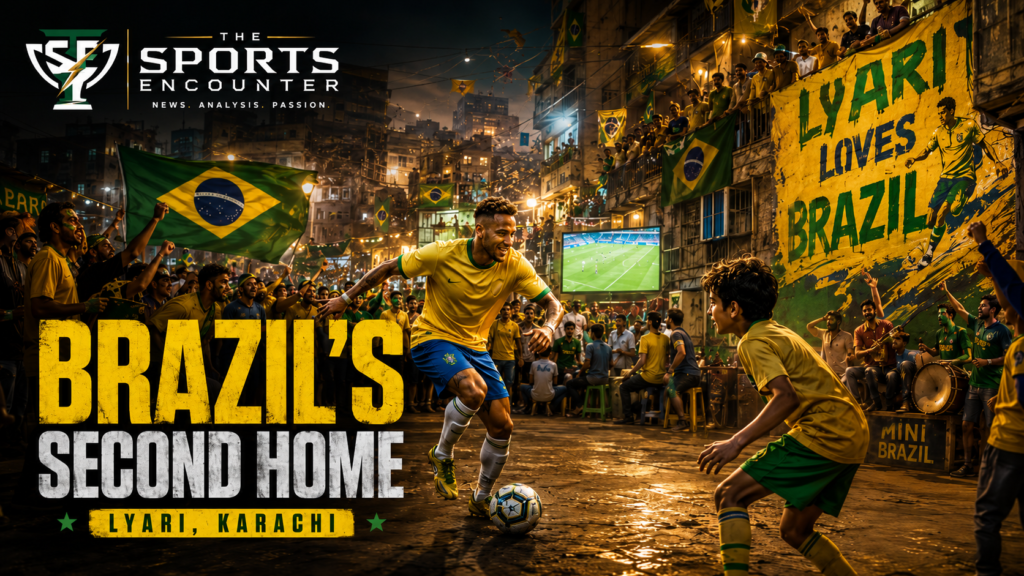
In Karachi’s Lyari, Brazil can feel closer than Rio.
A World Cup night in this old, crowded, under-resourced neighborhood does not look like a normal football gathering. Yellow shirts spill into narrow lanes. Brazilian flags hang from balconies, wires, shopfronts, tea stalls, rooftops, and motorcycle handles. Children paint their cheeks green and gold. Older men speak about Pelé, Romário, Ronaldo, Ronaldinho, Neymar Jr., and now Vinícius Júnior with the same emotional ownership usually reserved for local heroes.
Pakistan has never played at a FIFA World Cup. Brazil, somehow, has given Lyari a team to live through.
That is why the neighborhood’s football story matters. It does not come from luxury fan zones, glossy screens, or corporate-sponsored viewing parties. It rises from streets that have known hardship, fear, poverty, neglect, and years of gang-war headlines. Lyari has often appeared in the national conversation for the wrong reasons: turf wars, crime, drug trafficking, extortion, political violence, and lawlessness. For years, many outsiders saw it through a single dark frame.
Football tells another story.
Lyari has never been only the place described in crime reports. It is one of Karachi’s oldest communities, a place of working-class grit, Baloch identity, boxing rings, music, political memory, street talent, and stubborn pride. It has produced footballers, boxers, artists, rappers, and young dreamers who grew up with very little space but enormous imagination.
During the World Cup, that imagination wears Brazil’s colors.
For more on Brazil’s current tournament form, read The Sports Encounter’s report on how Brazil topped Group C after Vinícius Júnior’s double against Scotland.
Why Lyari Fell in Love With Brazil
Lyari’s connection with Brazil is not a social media trend. It runs deeper than one tournament, one player, or one generation.
Football has lived in Lyari’s alleys for decades. In a cricket-dominated country, Lyari stayed loyal to the world’s game. Boys played barefoot on uneven surfaces. Small grounds became community theaters. Street matches turned into neighborhood identity. Skill mattered. Flair mattered. Imagination mattered.
That made Brazil a natural obsession.
Brazilian football offered Lyari something familiar and something magical at the same time. The movement, rhythm, dribbling, improvisation, street-born confidence, and joy of expression spoke to people who understood how beauty can grow in hard places. Brazil’s football did not feel distant to Lyari. It felt emotionally recognizable.
The nickname “Mini Brazil” fits because Lyari does not support Brazil quietly. It adopts Brazil completely.
A Brazil match can slow the neighborhood’s usual rhythm. Tea shops fill early. Screens appear in streets. Children stay awake beyond bedtime. Fans argue about team selection, Neymar’s role, Vinícius Júnior’s finishing, and whether Brazil finally have the balance to win another World Cup. In many homes, the yellow shirt feels like an inherited family item.
The support has moved across generations. Older fans remember Brazil as the country of Pelé and Zico. Another generation grew up with Romário, Bebeto, Ronaldo, Rivaldo, Roberto Carlos, and Ronaldinho. Younger fans fell for Neymar Jr., and now many are watching Vinícius Júnior become the face of Brazil’s attack.
That generational relay gives the relationship its strength. Lyari does not simply follow Brazil because Brazil wins. Lyari follows Brazil because Brazil feels like football in full color.
Neymar, Vini Jr. and the Emotional Pull of Brazilian Stars
Neymar Jr. remains a special figure in Lyari because he represents fantasy, skill, fame, pain, and resilience in one body. His injuries have often frustrated Brazil fans, but they have also made his appearances feel more emotional. When Neymar plays, Lyari watches with the feeling that something precious might happen at any moment.
For many fans, Neymar became the modern bridge between Brazil’s golden past and its uncertain present. He carried the burden of expectation for more than a decade. In Lyari, where people understand pressure and public judgment, that burden adds to his appeal.
Now Vinícius Júnior has taken the spotlight.
Vini Jr.’s 2026 World Cup form has given Brazil a sharper edge. His speed, direct running, confidence, and finishing have changed the mood around Carlo Ancelotti’s side. Brazil’s 3-0 win over Scotland, powered by Vinícius, sent a clear message that this team has more than reputation. It has a player ready to own the stage.
That matters deeply in Lyari. The neighborhood loves footballers who attack defenders, demand the ball, and play with personality. Vini fits that emotional profile. He does not just move fast. He makes people lean forward.
The Sports Encounter’s wider tournament tracker explains how the expanded format has changed the knockout race. Read more in our World Cup 2026 knockout picture and Lucky 8 breakdown.
A Neighborhood Bigger Than Its Bad Reputation
Lyari’s football love story becomes more powerful because of the neighborhood’s past.
For years, Lyari’s name carried fear across Karachi. Gang wars damaged daily life. Families lived through uncertainty. Businesses suffered. Young people grew up around violence they did not choose. The area became shorthand for danger in conversations far removed from the people who actually lived there.
That kind of reputation can trap a community.
Football gave Lyari a way to speak back.
Every World Cup season, the neighborhood forces Karachi to look again. The same streets once described through crime and chaos become streets of flags, drums, paint, chants, late-night screenings, and arguments about tactics. Football does not erase Lyari’s wounds, and it should not turn poverty into a romantic backdrop. But it does show that the neighborhood owns more than its worst headlines.
This is where the story becomes bigger than Brazil.
Lyari’s support for the five-time world champions reflects a community trying to claim joy in public. It shows people using football as identity, release, pride, and emotional shelter. In a city where many areas are defined by class, language, and political fault lines, Lyari’s football culture gives it a global connection.
Brazil may never play a match in Lyari, but Lyari has played Brazil into its own story.
Why This Bond Feels Different in 2026
The FIFA World Cup 2026 has arrived at a moment when fan culture matters more than ever. Football no longer belongs only to stadiums. It lives in watch parties, neighborhood screenings, phone videos, street murals, reaction clips, and local traditions far away from host cities.
Lyari fits that new global football map perfectly.
When Brazil play Japan in the Round of 32, the emotional temperature in Lyari will rise again. Japan bring structure, discipline, and belief, as The Sports Encounter noted after their Group F campaign in Japan and Sweden’s draw in Dallas. Brazil bring Vini’s acceleration, Neymar’s aura, Ancelotti’s control, and the weight of expectation.
For Lyari, though, the match will carry a different layer. It will be another chance to feel part of the World Cup without needing a Pakistani flag on the pitch.
That emotional truth explains why Brazil’s second home in Karachi feels so unusual and so beautiful. Lyari does not have Brazil’s beaches, stadiums, samba schools, or World Cup trophies. It has its own rhythm, its own pain, its own narrow streets, its own football memory, and its own refusal to let hardship kill joy.
In many parts of the world, Brazil are admired.
In Lyari, Brazil are adopted.
The Story Football Keeps Telling
The most interesting thing about Lyari’s Brazil obsession is that it does not ask for permission. No one in Rio had to declare Lyari official. No federation had to approve the bond. No marketing campaign built it. Ordinary fans built it over decades through devotion, argument, celebration, heartbreak, and hope.
That makes it real.
The neighborhood that Karachi often misunderstood has turned the World Cup into its loudest introduction. It tells the world that football can belong to people who have no World Cup team of their own. It tells Pakistan that Lyari is not only a place of old wounds. It tells Brazil that their football travels further than trophies and television rights.
When Vini Jr. runs at a defender, Lyari runs with him. When Neymar touches the ball, Lyari holds its breath. When Brazil score, the celebration does not stop at the stadium. It crosses oceans, enters Karachi, turns into noise in the lanes, and reminds everyone that football’s deepest homes are not always found on maps.
Sometimes, they are found in places the world judged too quickly.
And in Karachi, Brazil’s loudest second home still answers in yellow and green.