


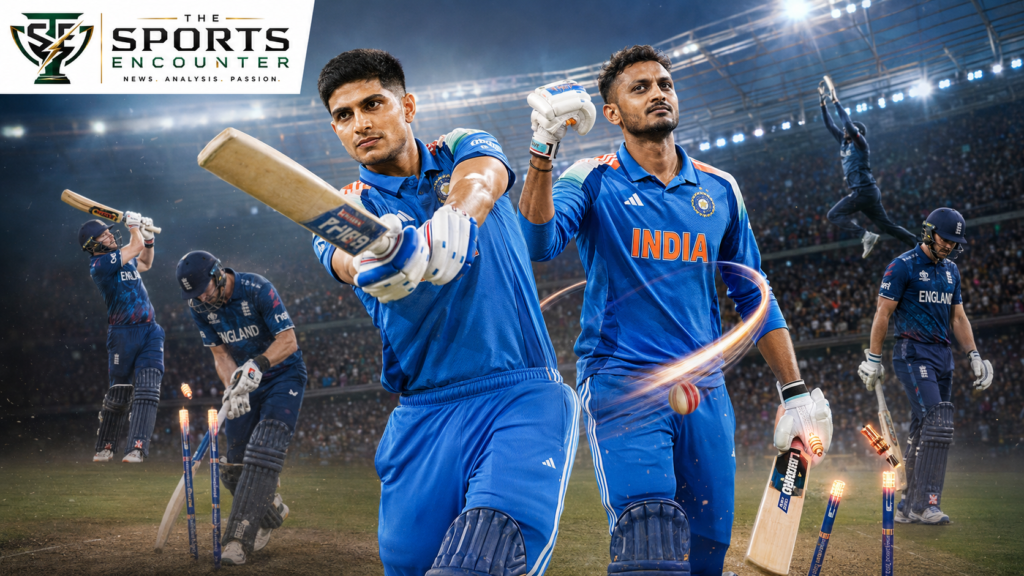
England had reduced India to 160 for four, Shubman Gill had left the field in pain, and Harry Brook’s direct hit had brought Edgbaston back into the contest. For a few overs, the hosts could see a route to an unlikely victory.
Axar Patel quickly shut it down.
The Indian all-rounder followed career-best ODI figures of 4 for 62 with an unbeaten 57, while Washington Sundar made a composed 52 not out as India reached 262 for four in 45.2 overs. The six-wicket victory gave the visitors a 1-0 lead in the three-match series and offered an immediate response to England’s emphatic 4-0 T20I series whitewash.
India looked far more comfortable after returning to the format that best suits the experience and game management of Gill, Rohit Sharma, Virat Kohli, KL Rahul, Jasprit Bumrah, and Axar. England, meanwhile, carried their aggressive T20 approach into situations that required patience and a better reading of the match.
Follow our cricket news and match analysis, along with dedicated coverage of the India cricket team and England cricket team.
TL;DR
- India beat England by six wickets in the first ODI at Edgbaston.
- England recovered from 80 for five to post 258, led by Joe Root’s unbeaten 76 and Liam Dawson’s 68.
- Axar Patel claimed career-best ODI figures of 4 for 62 before scoring 57 not out.
- Shubman Gill made 80 from 75 balls before retiring hurt with cramp.
- Washington Sundar scored an unbeaten 52 and shared an unbroken 102-run partnership with Axar.
- India lead the three-match ODI series 1-0 ahead of the second game in Cardiff.
India vs England 1st ODI Scorecard
| Detail | Information |
|---|---|
| Match | England vs India, 1st ODI |
| Date | July 14, 2026 |
| Venue | Edgbaston, Birmingham |
| England | 258 all out in 47.5 overs |
| India | 262 for 4 in 45.2 overs |
| Result | India won by six wickets |
| Top England batters | Joe Root 76*, Liam Dawson 68 |
| Top India batters | Shubman Gill 80 retired hurt, Axar Patel 57*, Washington Sundar 52* |
| Best bowler | Axar Patel, 4 for 62 |
| Turning point | Axar and Washington taking control after India slipped to 160 for four |
| Series position | India lead the three-match series 1-0 |
England Lose Control After a Promising Start
England chose to bat and reached 61 without loss, but too many of their top-order players failed to adjust once India found movement and extra bounce.
Ben Duckett made 43 from 45 balls and gave the innings early momentum. Gurnoor Brar changed the direction of the game by removing Jacob Bethell and Duckett in the space of three deliveries.
Harry Brook followed for one after Bumrah forced him into an uncomfortable shot that carried to Rohit. Jos Buttler made five, while Sam Curran departed without scoring. England had suddenly fallen from 61 without loss to 80 for five.
The collapse exposed a lack of game awareness. Several batters chased release shots before establishing themselves, even though the scoring rate remained manageable. Their choices created pressure that the match situation had not demanded.
England’s struggle looked even more surprising after the control they had shown during the T20Is. Archer and Josh Tongue had previously driven India to their heaviest defeat in T20I cricket, while Brook and Buttler dominated India’s attack in Southampton. The longer format required a different rhythm, and England’s middle order never found it.
Joe Root Becomes England’s Wall Again
Joe Root understood what the innings needed. His unbeaten 76 from 76 balls carried England through a collapse that could easily have left the hosts defending fewer than 200.
Will Jacks supported him briefly with 20 before Shivam Dube found the breakthrough at 107 for six. Liam Dawson then joined Root and produced the most valuable innings of his ODI career.
The pair added 121 for the seventh wicket. Dawson scored 68 from 83 deliveries, registering his maiden ODI half-century and giving England a realistic chance of recovery.
Root kept the board moving without taking unnecessary risks. His ability to absorb pressure stood out because so many teammates had treated patience as a burden. England needed someone to control the innings, and their most experienced batter once again accepted the job.
The recovery deserved credit, particularly after the damage suffered inside 17 overs. Still, 258 remained around 40 to 50 runs below a total capable of placing India under sustained pressure on a good Edgbaston batting surface.
Axar Patel Stops England’s Late Charge
India could have lost control after allowing Root and Dawson to rebuild. Axar prevented the recovery from turning into a late assault.
The left-arm spinner removed Dawson at 228 for seven before dismissing Jofra Archer, Adil Rashid, and Tongue. England lost their final four wickets for 30 runs and failed to use all 50 overs.
Axar finished with 4 for 62 from 9.5 overs, his best figures in ODI cricket. Prasidh Krishna and Brar took two wickets each, while Bumrah conceded only 31 runs from nine overs.
Bumrah’s figures captured his influence better than his single wicket. He challenged the batters with movement, bounce, and changes of pace, forcing England to search for runs against the other bowlers. That pressure helped India create wickets throughout the innings.
Gill Controls the Chase Before Injury Intervenes
Rohit and Kohli returned to their preferred international format, although neither produced the innings India expected. Rohit made 11 before finding Brook at mid-off, while Archer trapped Kohli lbw for five with a full, straight delivery.
Gill responded with the most fluent batting of the chase. The Indian captain struck 11 fours and one six in his 80 from 75 balls, controlling the tempo alongside Shreyas Iyer.
Their partnership carried India from 48 for two to 149 for two. Gill attacked whenever England missed their lengths, while Iyer remained patient during a slower 35 from 53 deliveries.
Cramp eventually forced Gill to retire hurt. England then found an opening when Brook ran out Iyer with a sharp direct hit and Tongue bowled Rahul for one. India had two new batters at the crease with the score at 160 for four.
Axar and Washington Remove England’s Final Chance
England had one last opportunity. Archer and Tongue still had overs available, while Axar and Washington needed time to settle against a varied attack.
Brook’s bowlers could not maintain pressure for long enough. The two left-handers kept the required rate under control, rotated the strike against spin, and punished loose deliveries without forcing the pace.
Axar became increasingly aggressive after settling in. His innings included five fours and one six, with his half-century arriving during a calculated attack on Will Jacks.
Washington played the steadier hand. His unbeaten 52 from 63 balls supplied the security India needed after Gill’s injury and the quick losses of Iyer and Rahul.
Their unbroken 102-run partnership completed the chase with 28 balls remaining. England’s bowlers created enough uncertainty to keep the game alive, but they lacked the control and wicket-taking support needed to defend an under-par score.
India Look Like a Different Team in ODI Cricket
India’s return to ODI cricket immediately changed the mood of the tour. Their nine-wicket defeat during the T20I series had raised questions about depth, bowling control, and the team’s ability to respond under pressure.
Those concerns felt less urgent at Edgbaston. Gill controlled the chase, Bumrah set the bowling standard, Axar delivered in both disciplines, and Washington handled the decisive stage with maturity.
Rohit, Kohli, and Rahul contributed only 17 runs between them, which gives England some encouragement. India still won with 28 balls to spare because their middle and lower order understood the chase better.
The return of India’s established ODI core made a visible difference. Kohli and Rohit missed out individually, but their presence gave the batting order greater experience. Bumrah restored control with the new ball, while Rahul resumed his wicketkeeping role and completed a sharp stumping to remove Rashid.
England had overwhelmed a younger Indian lineup during parts of the T20I series. The ODI side carried more experience, better batting depth, and several players capable of adjusting their game as conditions changed.
What Comes Next for England and India?
The second ODI will take place at Sophia Gardens in Cardiff on July 16, according to the official India tour schedule.
England must improve their shot selection and find a better balance between intent and patience. Their recent white-ball form shows a sharp split: excellent in T20Is and increasingly vulnerable in ODIs.
India will monitor Gill’s fitness after his cramp at Edgbaston. His 80 established the chase, but Axar and Washington ensured the captain’s exit did not become the central story of the match.
Brook also needs more from his experienced batters. Root provided the innings England required, and Dawson exceeded expectations under pressure. The top and middle order gave India too many openings before the match had properly developed.
Final Word
England recovered impressively from 80 for five, but Root and Dawson could only repair part of the early damage. Their partnership gave the bowlers something to defend without providing enough room for error.
Axar decided the contest at both ends. His bowling stopped England from turning recovery into momentum, while his unbeaten half-century removed the final chance of a home comeback.
India had spent the T20I series searching for answers. Back in their comfort format, they found them through experience, composure, and an all-rounder who controlled every important stage of the match.