Connect with us
Marcos Wetherfield | The Sports Encounter

Published

on

The World Cup reached its quarterfinal stage with the football growing more important and the ticket market suddenly growing less valuable.

Cristiano Ronaldo had left the tournament. Portugal had followed him out. The United States, Mexico, and Canada could no longer provide a home-country presence. Brazil and Colombia, two nations capable of filling stadiums far from home, had also disappeared.

Fans still had eight strong teams to watch. The confirmed quarterfinals offered Lionel Messi, Kylian Mbappé, Lamine Yamal, Harry Kane, Erling Haaland, and several compelling national stories.

However, the resale market had already placed its biggest bets on other possibilities.

TL;DR

World Cup 2026 entered its biggest knockout matches with fewer commercial attractions than the ticket market had expected.

Cristiano Ronaldo and Portugal were eliminated by Spain. Belgium removed the United States. Mexico and Canada had already gone home. Brazil and Colombia also disappeared from the bracket.

The consequences appeared quickly:

  • The cheapest resale ticket for Spain vs Belgium fell from $3,261 to $1,381.
  • England vs Norway dropped from $3,866 to $2,049.
  • Argentina vs Switzerland fell from $2,381 to $1,142.
  • Forbes reported that average quarterfinal resale prices declined 31.5% in one day and 50.4% across three days.
  • The secondary market was also flooded with more inventory as supporters of eliminated teams tried to sell their seats.

These figures show a sharp decline in ticket-market value and late-stage revenue potential. They do not yet prove that FIFA’s total revenue across the 2023–2026 commercial cycle has fallen by the same degree.

World Cup 2026 Ticket Market: Key Numbers

Ticket-market indicatorReported figure
Spain vs Belgium lowest TickPick price before USA exit$3,261
Spain vs Belgium later price$1,381
Approximate decline58%
England vs Norway earlier price$3,866
England vs Norway later price$2,049
Argentina vs Switzerland earlier price$2,381
Argentina vs Switzerland later price$1,142
Quarterfinal average price fall in one day31.5%
Quarterfinal average price fall over three days50.4%
Secondary-market listings reported by Forbes49,415
Listings at the start of the tournament28,285
FIFA 2023–2026 revenue budget$13 billion

A quarterfinal in Los Angeles carried the prospect of Ronaldo facing the United States. A Miami ticket offered the possibility of Mexico or Brazil arriving with thousands of emotionally invested supporters. Kansas City buyers could imagine Argentina meeting Colombia in a high-intensity South American occasion.

The bracket delivered different games.

Prices corrected almost immediately.

Ronaldo’s exit removed the biggest individual ticket premium

Ronaldo arrived at the 2026 World Cup at the age of 41, playing in a record sixth edition of the tournament and carrying the possibility that every match could become his final appearance on football’s largest stage. Reuters identified him as the competition’s oldest outfield player and one of the central figures in its generational story.

That possibility carried financial value.

Before Portugal met Croatia in the Round of 32, the average price of the cheapest resale ticket reportedly reached $3,225, the highest entry price for any match in that round. Demand was driven by the chance to see Ronaldo face former Real Madrid teammate Luka Modrić in what could have been the final World Cup game for either veteran. The spike showed how strongly nostalgia, fame, and sporting mortality could influence ticket prices.

Portugal survived that occasion. The market began looking ahead.

A potential Ronaldo appearance in Los Angeles against the United States offered the kind of matchup that could reach beyond football’s regular audience. It combined one of the world’s most recognizable athletes, a host nation, a major American entertainment market, and the emotional weight of a final World Cup.

Then Spain ended Ronaldo’s World Cup dream with a stoppage-time winner.

Mikel Merino’s goal sent Portugal home and removed Ronaldo from the tournament. His exit altered the sporting bracket and the commercial expectations attached to it.

Forbes reported that the cheapest resale ticket for the Los Angeles quarterfinal fell from approximately $2,950 to nearly $1,200 after Portugal and the United States were eliminated. The publication described the decline as approaching 60%.

The Associated Press later recorded the lowest TickPick price at $1,381, down from $3,261 before the United States lost to Belgium. The difference between the Forbes and AP figures reflects a live market changing throughout the week, but both reports capture the same collapse.

The seat remained in the same stadium.

The stage remained a World Cup quarterfinal.

The possibility of seeing Ronaldo had disappeared.

The United States carried a different commercial weight

Ronaldo’s exit was the largest individual blow, but the Los Angeles correction became far more severe when Belgium eliminated the United States.
The American team had reached the Round of 16 with a chance to bring the home audience deeper into the tournament. A long U.S. run could sustain local television interest, corporate hospitality demand, merchandise sales, venue spending, and general public attention in the largest of the three host economies.

Belgium ended that possibility with a 4-1 victory.

The Sports Encounter’s report on Belgium’s elimination of the United States captured the scale of the sporting disappointment. The commercial impact became visible as American supporters and speculative ticket holders reconsidered whether they still wanted to attend the next game.

The cheapest ticket for the U.S. vs Belgium Round of 16 match had already experienced volatility before kickoff. Reuters reported that the entry price fell to $1,508 on July 6, down 27% over three days, after reaching $3,115 when the matchup was confirmed.

That movement offered an early warning.

Prices were reacting quickly to matchup certainty, inventory, and buyer confidence. When the United States lost, the market no longer needed to speculate about a possible host-nation quarterfinal in Los Angeles.

Belgium advanced to face Spain instead.

Both teams deserved their places. Spain entered with control, defensive strength, and one of the tournament’s most talented squads. Belgium had just produced one of the Round of 16’s strongest attacking performances.

The quarterfinal itself delivered drama, including two Spanish goals from rebounds and another decisive contribution from Merino. Readers can revisit how Spain defeated Belgium to reach the semifinals.

The market’s response before the game revealed that football quality alone had not created the earlier asking prices.

Those prices had included a significant premium for Ronaldo, Portugal, and the United States.

All three host nations were gone before the quarterfinals

The 2026 tournament was designed around three host countries, 16 host cities, 48 national teams, and 104 matches.

Home-country involvement was central to its commercial appeal.

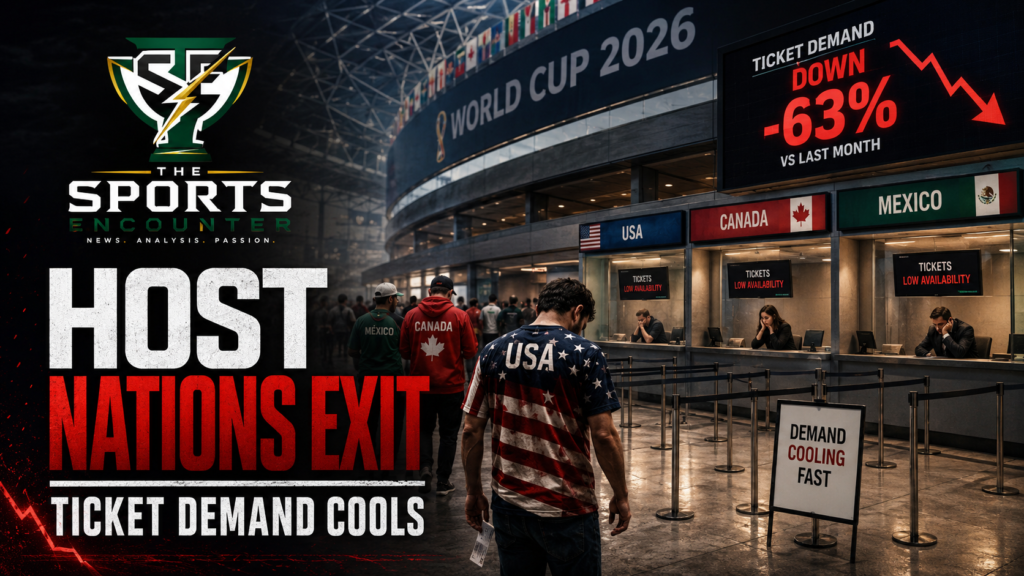
Fans walking away from World Cup 2026 ticket counters after host nations USA, Canada, and Mexico exit the tournament, showing empty ticket booths, falling demand, and The Sports Encounter logo in a dramatic sports news graphic.

Mexico brought one of the strongest football cultures in the tournament. Its supporters filled stadiums, traveled in huge numbers, and helped turn knockout possibilities into national events. Canada offered growing domestic enthusiasm and home-market demand in Toronto and Vancouver. The United States supplied the tournament’s largest collection of venues, sponsors, corporate buyers, and casual spectators.

None of the three reached the quarterfinals.

Canada’s campaign ended against Morocco. Mexico lost a dramatic Round of 16 match to England. The United States followed them out against Belgium.

That sequence removed three layers of demand at once:

  1. Supporters buying tickets to follow their own country
  2. Domestic viewers drawn into the tournament by a home-team run
  3. Speculative buyers expecting host-nation games to retain premium resale value

The disappearance of all three hosts also changed the atmosphere around late-stage ticketing.

Fans of eliminated teams began selling seats. Buyers who had purchased match codes before knowing the participants lost interest. Resellers faced the risk of holding expensive inventory that might become harder to move as kickoff approached.

The tournament still had global appeal, but its late-stage ticket market had lost the national foundation that hosting usually provides.

Mexico’s exit helped pull down the Miami quarterfinal

The decline spread well beyond Los Angeles.

Before England eliminated Mexico, TickPick listed the lowest resale price for the eventual Miami quarterfinal pathway at $3,866. After the Round of 16, the cheapest ticket for England vs Norway fell to $2,049. That represented a decline of roughly 47%.

England and Norway still offered substantial star appeal.

Harry Kane remained one of the world’s leading strikers. Jude Bellingham carried enormous international recognition. Norway had Erling Haaland, whose goals and personality had become central to one of the tournament’s most unexpected runs.

Yet Mexico’s departure removed a host nation and one of football’s most reliable traveling fan bases.

Brazil’s elimination created another gap. A quarterfinal featuring Brazil in Miami would have drawn enormous regional and international interest. Norway’s sporting achievement in eliminating Brazil was historic, but the commercial market judged the confirmed matchup against the most lucrative possibility available earlier in the bracket.

This is one of the central lessons from the price crash.

Knockout tickets were valued according to the dream matchup attached to their bracket position. When the bracket produced a less commercially powerful combination, prices moved toward the value of the actual game.

Colombia’s elimination weakened the Argentina quarterfinal market

The Argentina vs Switzerland quarterfinal experienced a similar correction.

According to AP, the cheapest TickPick price fell from $2,381 to $1,142 after the Round of 16, a decline of approximately 52%.

Lionel Messi remained in the tournament, which shows that Ronaldo’s exit cannot explain the entire market decline.

The other side of the matchup mattered.

Colombia had brought a large, vocal, and mobile fan base across North America. A quarterfinal against Argentina would have created a major South American occasion in Kansas City, complete with regional rivalry, cultural energy, and strong demand from supporters of both nations.

Switzerland advanced instead after a tense goalless match and penalty shootout. Gregor Kobel became the decisive figure as the Swiss goalkeeper helped remove Colombia from the competition.

The Sports Encounter covered Switzerland’s penalty-shootout victory over Colombia and the emotional weight of the result.

Switzerland’s progress was one of the tournament’s strongest underdog stories. Its commercial footprint was still smaller than Colombia’s.

The lower price did not represent a judgment on sporting legitimacy. It reflected the number of people willing to pay four figures to attend that particular matchup.

The ticket supply rose as demand cooled

Falling demand was only half of the equation.

More tickets were entering the market.

Forbes, citing SeatPick, reported that the number of secondary-market listings climbed to 49,415, compared with 28,285 at the beginning of the tournament. Average resale prices across the four quarterfinals reportedly fell 31.5% in one day and 50.4% across three days.

The rise in inventory likely came from several sources:

  • Supporters whose national teams had been eliminated
  • Buyers who had expected different quarterfinal matchups
  • Resellers seeking to exit before prices fell further
  • Travelers canceling costly cross-country plans
  • Corporate or hospitality buyers releasing unused seats
  • Fans who had bought several possible knockout routes

This created a classic market imbalance.

More sellers appeared at the same time that fewer buyers were willing to pay the previous prices. Sellers then lowered their asking prices to avoid being left with worthless tickets after kickoff.

The expanded World Cup geography may have increased the pressure.

Moving between host cities can require long flights, accommodation changes, and additional spending. A supporter who bought a quarterfinal ticket months earlier might accept those costs to watch Ronaldo, Mexico, Brazil, Colombia, or the United States. The calculation changes when the expected team disappears.

Did FIFA’s actual revenue drop sharply?

The wording requires a clear distinction.

The available reports verify a sharp fall in resale prices, secondary-market value, and late-stage ticket revenue potential. They do not provide audited proof that FIFA’s total revenue has fallen sharply across its entire commercial cycle.

FIFA’s revised financial plan projects $13 billion in revenue for the 2023–2026 cycle. The governing body’s official budget shows that broadcasting rights, marketing rights, hospitality, ticket sales, licensing, and other income streams contribute to that total. The 2026 revenue budget alone is listed at approximately $8.9 billion.

Much of the money from originally sold tickets may already have been collected.

When a ticket loses value on TickPick, StubHub, SeatPick, or another marketplace, the decline primarily affects the reseller or ticket holder. It does not automatically reverse FIFA’s original sale.

However, the correction can still pressure FIFA-linked revenue in several areas:

  • Lower transaction values on FIFA’s resale platform
  • Reduced demand for late-release tickets
  • Weaker hospitality sales for less attractive matchups
  • Lower merchandise spending by eliminated fan bases
  • Reduced food, beverage, and venue spending
  • Less demand for premium semifinal and final packages
  • Lower resale commissions if transactions slow or prices fall

Reuters reported that FIFA’s official resale system charges a 15% buyer fee and a 15% seller fee, giving the organization a financial interest in both resale volume and transaction value. FIFA has also advised supporters to use the official FIFA ticketing platform because tickets purchased elsewhere may carry authenticity or transfer risks.

A lower resale market can therefore reduce certain fee opportunities even when the original ticket has already been sold.

The strongest defensible conclusion is that World Cup 2026 suffered a sharp decline in late-stage ticket-market value after its largest commercial attractions were eliminated.

The final impact on FIFA’s full tournament revenue will require official financial reporting.

Dynamic pricing made the correction more dramatic

World Cup 2026 entered the tournament with some of the most controversial ticket prices in football history.

FIFA adopted variable pricing that allowed costs to move with demand, availability, inventory, and the popularity of individual fixtures. Reuters reported that quarterfinal face values ranged from approximately $410 to $1,690, while semifinal prices reached as high as $2,780 before resale premiums.

The system allowed high-profile matches to climb far beyond their original prices.

Portugal vs Croatia became a clear example when Ronaldo and Modrić pushed the cheapest resale listings above $3,000.

The same mechanism worked in reverse after the biggest attractions disappeared.

A market built around maximum demand also becomes vulnerable when the expected demand does not survive the tournament.

Supporter groups had warned about affordability well before the quarterfinals. Football Supporters Europe described the pricing structure as “extortionate” and accused FIFA of betraying traditional fans.

The Sports Encounter also identified ticket pricing and fan access among the World Cup’s biggest organizational challenges before the tournament began.

The quarterfinal crash confirmed the risk.

When prices are pushed high enough, every ticket begins carrying assumptions about the players, countries, and storylines that will eventually reach the venue.

If those assumptions fail, the price becomes difficult to defend.

The World Cup final remains protected by the occasion

The quarterfinal market fell sharply, but the final remained in a different financial category.

AP reported that FIFA released nearly 1,200 Category 2 seats for the July 19 final at $7,380 each. Some Category 1 seats ranged from $19,995 to $32,970, while hospitality packages reached $34,500.

The final retains value regardless of the participants because buyers are purchasing access to the defining event of the tournament.

A quarterfinal depends more heavily on the matchup.

The final offers the trophy presentation, the closing ceremony, global status, and an experience that remains rare even when a buyer has no emotional connection to either finalist.

The identity of the finalists will still move prices.

A team featuring Messi, Mbappé, Kane, Haaland, Yamal, or another global figure could increase demand. An unexpected final may cause some speculative sellers to reduce prices.

The event itself provides a stronger financial floor than any earlier knockout round.

Ronaldo left a commercial measure of his World Cup influence

Ronaldo’s final appearance may be remembered through the tears after Portugal’s elimination, the late goal that ended the run, and the realization that a career stretching across six World Cups had probably reached its final chapter.

The ticket market added another measure of his influence.

Before Portugal went out, buyers valued the possibility of seeing Ronaldo in Los Angeles at several thousand dollars.

After Spain eliminated him, the price attached to that possibility vanished.

The United States’ defeat deepened the correction. Mexico and Canada had already removed the host-country element. Brazil and Colombia took two major traveling audiences with them.

The quarterfinals still contained elite football. They offered strong teams, extraordinary players, and games capable of shaping the tournament’s history.

The market had priced something larger.

It had priced Ronaldo’s farewell, American participation, Mexican passion, Brazilian identity, Colombian support, and the most glamorous version of every possible matchup.

When the tournament produced a different final eight, the commercial premium collapsed.

For some supporters, that created an unexpected opportunity. AP reported that a 65-year-old fan purchased tickets for approximately $1,000 each to attend Spain vs Belgium with his grandson after previously believing the game was unaffordable.

The price remained beyond the reach of many families.

Yet it was far below what sellers had demanded days earlier.

What the crash means for the rest of World Cup 2026

Ticket values will continue moving as the remaining matchups become clear.

The semifinal and final markets will respond to:

  • Which global stars remain
  • Whether Messi reaches another final
  • Whether European heavyweights dominate the bracket
  • How many traveling supporters can reach the host city
  • How much speculative inventory remains unsold
  • Whether sellers become more anxious close to kickoff
  • Whether FIFA releases additional official tickets

Fans considering a purchase should treat the resale market carefully. A falling price can create an opening, but unofficial tickets also carry transfer, fraud, and access risks.

The safest route remains the official ticketing system and FIFA’s published guidance.

The larger commercial lesson is already visible.

FIFA World Cup 2026 ticket prices rose on the strength of possible moments: Ronaldo against America, Mexico in Miami, Brazil in the last eight, Colombia against Argentina, and three hosts carrying the tournament deep into July.

Football removed those possibilities.

The market followed.

The Sports Encounter’s World Cup 2026 coverage focuses on fixtures, team news, match analysis, fan stories, tournament trends, and the biggest talking points from football’s global stage.

Q1. Why did World Cup 2026 ticket prices drop?
World Cup 2026 ticket prices dropped because several high-demand teams and players were eliminated before the quarterfinals. Cristiano Ronaldo and Portugal exited the tournament, while the United States, Mexico, Canada, Brazil, and Colombia also failed to reach the last eight. These exits reduced demand for premium matchups and caused resale prices to fall sharply.

Q2. How much did World Cup 2026 ticket prices fall?
Some World Cup 2026 resale ticket prices fell by more than 50% during the knockout stage. The cheapest resale ticket for Spain vs Belgium dropped from around $3,261 to $1,381, while Argentina vs Switzerland tickets declined from approximately $2,381 to $1,142.

Q3. Did Cristiano Ronaldo’s exit affect World Cup 2026 ticket prices?
Yes. Cristiano Ronaldo’s elimination had a major impact on ticket demand because fans were willing to pay premium prices for the possibility of watching his final World Cup moments. After Portugal’s exit, the commercial value attached to potential Ronaldo appearances disappeared.

Q4. Did FIFA lose money because World Cup 2026 ticket prices crashed?
There is no confirmed evidence that FIFA suffered a major revenue loss because resale prices declined. Falling secondary-market prices mainly affect ticket resellers and holders. FIFA’s projected revenue for the 2023–2026 cycle remains around $13 billion, with the full financial impact requiring official reporting.

Q5. Are World Cup 2026 resale tickets safe to buy?
Fans should use caution when purchasing resale tickets. FIFA recommends using official ticketing channels because unofficial resale platforms may involve risks related to ticket authenticity, transfer restrictions, or invalid access.


Marcos Wetherfield is a Boca Raton-based fitness expert covering WWE, soccer, baseball, NHL, NBA, and major American sports for The Sports Encounter. His work focuses on athletic conditioning, strength, mobility, recovery, injury prevention, performance habits, and the physical demands behind elite competition. Coverage areas: fitness, sports performance, WWE, soccer, baseball, NHL, NBA, athlete conditioning, recovery, and American sports culture.

Breaking News

Buttler and Brook Crush India as England Complete Historic 4-0 Whitewash

Jos Buttler and Harry Brook shared a record 233-run partnership as England defeated India by 56 runs in Southampton to complete a historic 4-0 T20I whitewash.

Jovana Zlatova | The Sports Encounter

Published

on

Buttler and Brook Crush India as England Complete Historic 4-0 Whitewash

India arrived late in Southampton after traffic delayed the team bus. Once the match began, they spent most of the evening struggling to catch up with England again.

Jos Buttler struck a career-best 131 from 64 balls, while Harry Brook finished unbeaten on 95 from 45. Their record 233-run partnership carried England to 257-3, the highest T20I total ever conceded by India.

The visitors replied with 201-8 and lost by 56 runs on Saturday, July 11. England completed their first T20I series whitewash over India, winning the five-match contest 4-0 after rain washed out the opening game.

TL;DR

  • England defeated India by 56 runs in the fifth T20I at the Utilita Bowl.
  • Jos Buttler scored a career-best 131 from 64 balls and earned Player of the Match.
  • Harry Brook remained unbeaten on 95 from 45 deliveries and was named Player of the Series.
  • Buttler and Brook shared a record 233-run second-wicket partnership.
  • England amassed 257-3 and struck 17 sixes during another brutal assault on India’s bowlers.
  • India arrived late after their team bus became stuck in traffic, causing a 30-minute delay.
  • The 4-0 result gave England their first T20I whitewash over India and lifted them to No. 1 in the ICC rankings.

England vs India Fifth T20I Scorecard

DetailInformation
MatchEngland vs India, 5th T20I
DateJuly 11, 2026
VenueUtilita Bowl, Southampton
TossIndia won the toss and elected to field
England257-3 in 20 overs
India201-8 in 20 overs
ResultEngland won by 56 runs
Top England battersJos Buttler 131, Harry Brook 95*
Top India battersIshan Kishan 56, Tilak Varma 53
Top bowlerSam Curran, 3-36
Player of the MatchJos Buttler
Player of the SeriesHarry Brook
Series resultEngland won 4-0
Turning pointButtler and Brook’s 233-run second-wicket stand
What it meansEngland completed their first T20I whitewash over India and rose to No. 1 in the ICC rankings

Traffic Trouble Delays India Before the Match

India’s difficult evening began before the players reached the ground.

The team bus became stuck in heavy traffic on the journey to the Utilita Bowl, forcing officials to delay the scheduled start by 30 minutes. India arrived late, completed a shortened warm-up and then prepared to face an England side chasing a historic series sweep.

Traffic offered context for the delayed start, although it could not explain the scale of India’s performance. The visitors won the toss and had the opportunity to take early control with the ball. Instead, familiar problems involving execution, fielding and tactical discipline returned once Buttler and Brook established themselves.

The unusual disruption added another difficult moment to a tour that had already brought consecutive defeats and growing questions about India’s T20I direction.

Adil Rashid Receives Special Cap Before 150th T20I

England began the evening by recognizing one of the most consistent performers of their modern white-ball era.

Adil Rashid became the first England player to reach 150 men’s T20I appearances. Jos Buttler presented the leg-spinner with a special cap before play, marking a milestone built through years of control, variation and composure in a format that rarely offers bowlers much protection.

Rashid’s achievement added further significance to a match that soon became historic for several other reasons. Fans can follow more international results, milestones and analysis through The Sports Encounter’s dedicated cricket coverage and wider England vs India series archive.

Buttler and Brook Turn Southampton Into a Batting Exhibition

India’s decision to field brought an early reward, but that breakthrough only united the two batters who would decide the match.

Buttler took control through clean striking and intelligent manipulation of the field. Brook matched his senior partner’s aggression, attacking spin and pace without allowing India’s bowlers to settle into a defensive pattern.

Together, they added 233 runs from 103 balls for the second wicket. It was England’s highest partnership for any wicket in T20 internationals and the highest second-wicket stand in men’s T20I history.

Buttler reached his century from 51 deliveries before accelerating again. His 131 included the range that has defined his white-ball career: powerful straight hitting, scoops behind the wicket and calculated attacks against predictable lengths.

Brook finished five runs short of a century, but his unbeaten 95 carried equal importance. England’s captain faced only 45 balls and maintained the pressure whenever India attempted to slow the scoring rate.

The pair struck most of England’s 17 sixes as the innings surged to 257-3. India had already suffered a record 125-run defeat in the third T20I, yet their bowlers found no convincing response to England’s power and precision in Southampton.

India’s Bowling Plans Collapse Again

The margin between the sides extended beyond boundary hitting. England consistently forced India’s bowlers away from their preferred plans.

Full deliveries disappeared straight or over the leg side. Shorter balls sat up for Buttler and Brook, while defensive lines outside off stump offered room to free their arms. Neither pace changes nor spin created sustained control.

India also missed opportunities in the field, continuing a pattern of poor execution that had followed them throughout the series. Against batters of Buttler and Brook’s quality, every dropped chance or loose over carried a heavy cost.

England had already exposed India’s batting limitations while winning the fourth T20I by nine wickets. The final match showed that India’s bowling and fielding required just as much attention.

Abhishek Sharma’s Horror Run Continues

India needed an explosive opening partnership to make a target of 258 remotely achievable. Instead, Abhishek Sharma failed again despite receiving another opportunity at the top of the order.

His early dismissal extended a miserable run with the bat during the tour. India continued to back the opener through repeated failures, hoping his natural attacking game would eventually provide the power-play momentum the side lacked.

That response never arrived in Southampton.

Abhishek’s latest failure placed immediate pressure on the middle order and strengthened questions about how long India can continue offering chances without meaningful returns. His aggressive style remains valuable in theory, but international selection requires production alongside potential.

The series also exposed a technical problem. England’s fast bowlers repeatedly denied him the width and predictable lengths he prefers, forcing him to play under pressure before establishing any rhythm. He found no effective adjustment across the completed matches.

Kishan and Tilak Reach Fifty, but the Chase Never Develops

Ishan Kishan and Tilak Varma entered the match facing criticism after repeated poor performances. Both finally reached half-centuries, but their innings had little influence on the result.

Kishan scored 56 and Tilak made 53. Those contributions improved their personal series returns and prevented another humiliating collapse, yet India never threatened England’s total.

A target of 258 demanded sustained aggression from the opening over. The required rate left no room for a lengthy rebuilding phase or cautious accumulation.

India needed several batters to attack together, even if that approach increased the risk of being bowled out. Kishan and Tilak instead focused on constructing individual innings while the asking rate moved further beyond reach.

Their half-centuries therefore carried limited value within the match situation. The scoreboard appeared more respectable, but the chase had effectively ended long before both batters completed their milestones.

That difference became especially clear during the middle overs. Brook’s side continued attacking wickets, while India appeared increasingly focused on reducing the final margin. Sam Curran took 3-36 and prevented any late acceleration from changing the outcome.

Shivam Dube contributed lower down the order, but England remained firmly in control. India eventually closed on 201-8, a competitive T20I total in isolation and an inadequate response to 257.

The tourists’ problems had surfaced before this series. Their historic 2-0 defeat against Ireland in Belfast exposed similar weaknesses in decision-making, adaptation and batting under pressure.

Harry Brook Named Player of the Series

Buttler’s 131 earned him Player of the Match, while Brook collected the Player of the Series award after leading England with authority and producing decisive innings throughout the contest.

His unbeaten 79 had guided England through the fourth T20I, and the 95 in Southampton completed an outstanding individual campaign. Brook combined calculated aggression with the calmness required from a captain, giving England clarity in both comfortable and difficult situations.

England began the series by recovering from 1-2 to win the second T20I through Jacob Bethell’s unbeaten 76. From that point, their confidence grew with every match.

According to the official ICC rankings update, the whitewash also moved Brook’s team above India as the world’s top-ranked T20I side.

India Face an Uncomfortable Review Before the ODIs

The scoreline leaves India with deeper concerns than one poor night in Southampton. They lost every completed match, suffered their heaviest T20I defeat, surrendered the No. 1 ranking and became the first Indian side to be swept by England in a bilateral T20I series.

Repeated opportunities produced few convincing answers from the top order. Abhishek’s failures continued, while Kishan and Tilak only found runs when the fifth match had moved beyond India’s reach.

Selection decisions now require closer scrutiny. India must decide whether these players need more time, different roles or stronger competition for their places.

The three-match ODI series begins at Edgbaston on Tuesday, July 14. A change of format may bring different personnel and a chance to reset, but the tactical and technical issues exposed during this series will follow India unless they respond quickly.

England leave Southampton with a record partnership, a historic whitewash and the top position in the world rankings. India leave with a scorecard containing two half-centuries and a series result that demands a much broader examination.

Continue Reading

Breaking News

Tanzid’s 94 Saves Bangladesh From a Zimbabwe Series Whitewash

Bangladesh secured a seven-wicket consolation win in Harare as Tanzid Hasan scored 94 and Zimbabwe’s six dropped catches ruined their chance of completing an ODI series sweep.

Hamad Hussain | The Sports Encounter

Published

on

Zimbabwe players celebrate their 2-1 ODI series victory while disappointed Bangladesh players reflect on missed opportunities in Harare.

Zimbabwe had the chance to complete a statement series sweep in Harare, but six dropped catches turned a defendable target into Bangladesh’s easiest batting afternoon of the tour.

The visitors chased 200 with 83 balls remaining, winning the third and final ODI by seven wickets after Tanzid Hasan struck 94 from 101 balls. Soumya Sarkar supported him with 66 as the opening pair punished an experimental Zimbabwe attack that lacked Richard Ngarava, Blessing Muzarabani, and Newman Nyamhuri.

Bangladesh needed this result after losing the one-off Test and the opening two ODIs. The victory could not change the series outcome, but it prevented a clean sweep and gave the batting group some confidence before the three-match T20I series begins on Wednesday, July 15.

TL;DR

  • Bangladesh beat Zimbabwe by seven wickets in the third ODI.
  • Zimbabwe made 199 in 48.1 overs before Bangladesh reached 200 for 3 in 36.1 overs.
  • Tanzid Hasan led the chase with 94 from 101 balls, while Soumya Sarkar scored 66.
  • Wessly Madhevere made 75 and Brad Evans contributed 50 for Zimbabwe.
  • Zimbabwe dropped six catches and rested three important fast-bowling options.
  • The hosts still won the ODI series 2-1, while Bangladesh avoided a tour whitewash.

Zimbabwe vs Bangladesh Third ODI Scorecard

DetailInformation
MatchZimbabwe vs Bangladesh, 3rd ODI
ResultBangladesh won by seven wickets
VenueHarare Sports Club, Harare
DateJuly 11, 2026
Zimbabwe199 all out in 48.1 overs
Bangladesh200/3 in 36.1 overs
Top Zimbabwe BattersWessly Madhevere 75, Brad Evans 50
Top Bangladesh BattersTanzid Hasan 94, Soumya Sarkar 66
Best BowlingShoriful Islam 4/44
Turning PointZimbabwe dropped six catches during Bangladesh’s chase
Series ResultZimbabwe won the three-match ODI series 2-1

Bangladesh’s Bowlers Keep Zimbabwe Below 200

Mehidy Hasan Miraz won his third consecutive toss and again asked Zimbabwe to bat. This time, Bangladesh’s bowlers backed the decision with early wickets and sustained control through the middle overs.

Zimbabwe slipped to 27 for 3 after losing Ben Curran, Brian Bennett, and Craig Ervine. The top-order problems placed immediate pressure on a reshaped batting lineup, particularly after the hosts had rested several players to test their bench strength.

Wessly Madhevere stopped the early slide with a patient 75. His innings gave Zimbabwe a route toward a competitive total, although the scoring rate remained modest on a surface that required careful batting.

At 108 for 5 after 33 overs, the hosts still looked in danger of finishing well below 180. Brad Evans then continued his valuable lower-order form by making 50 from 41 balls. His partnerships with the tail added substance to the innings before Zimbabwe were dismissed for 199 in 48.1 overs.

Shoriful Islam finished with 4 for 44, leading a disciplined Bangladesh attack. His wickets ensured Zimbabwe could not repeat the late acceleration that had helped them seal the ODI series in the second match.

Bangladesh’s performance also offered a better response after the batting collapse that wasted Nahid Rana’s six-wicket haul in Zimbabwe’s remarkable first ODI victory.

Zimbabwe Test Their Bench Ahead of the T20Is

Zimbabwe made three changes after securing an unassailable 2-0 lead. Wellington Masakadza, Tanaka Chivanga, and Ernest Masuku replaced Ngarava, Nyamhuri, and Muzarabani.

The changes gave the management an opportunity to assess its reserve options, but they also removed much of the pace threat that had troubled Bangladesh earlier in the series. Ngarava, Zimbabwe’s new Test and ODI captain, received a workload-management break, leaving Sikandar Raza to lead the side.

Bangladesh made two changes of their own. Left-arm spinner Tanvir Islam replaced Rishad Hossain, while Mohammad Saifuddin came in for Nahid Rana.

Resting Rana made sense before the T20I series. The fast bowler had carried a heavy workload and produced career-best figures of 6 for 21 in the opening ODI. Bangladesh needed to manage him carefully with three more international matches beginning four days later.

Readers can follow the upcoming series and other international matches through The Sports Encounter’s Cricket Hub, alongside its broader sports news and match analysis.

Tanzid and Soumya Punish Zimbabwe’s Missed Chances

A target of 200 still required Bangladesh to handle the new ball properly. Their previous two defeats had shown how quickly manageable chases could become uncomfortable.

Zimbabwe’s fielders removed that pressure.

Tanzid and Soumya received repeated lives as six catches went down across the innings. Some chances carried different levels of difficulty, but several were opportunities an international side would expect to hold. Each miss weakened the bowlers’ confidence and allowed Bangladesh’s opening partnership to grow.

Soumya made 66 before Tanaka Chivanga finally broke the stand. By then, Bangladesh had complete control of the asking rate and enough wickets in hand to finish without panic.

Tanzid attacked the weakened bowling lineup with increasing confidence. He struck 94 from 101 deliveries and appeared set for a century before lifting Ernest Masuku to Brad Evans at long-on with only three runs required.

Masuku then dismissed Towhid Hridoy in the same over, briefly turning a routine finish into an untidy one. Najmul Hossain Shanto remained unbeaten on 17, and a wide from Sikandar Raza completed the chase at 200 for 3 after 36.1 overs.

The comfortable finish contrasted sharply with Bangladesh’s collapse in the second ODI, when the visitors lost their final five wickets for 27 runs. This time, the opening partnership removed almost every meaningful element of risk.

The dropped catches also recalled another costly fielding breakdown covered by The Sports Encounter, when Sri Lanka’s missed chances helped West Indies win a decisive T20I. Fielding errors often look like isolated moments, but six of them can reshape an entire chase.

What the Result Means for Both Teams

Zimbabwe deserved their 2-1 series victory. They defended modest totals in the first two ODIs, handled pressure better, and found match-winning contributions from different players. Ben Curran, Brad Evans, Newman Nyamhuri, and the fast-bowling unit all influenced the series.

Yet the final match exposed the risks involved in changing several frontline bowlers at once. Bench testing remains valuable, particularly after a series has been secured, but the replacement attack needed stronger support from the field.

Bangladesh leave the ODI contest with fewer positives. One comfortable chase cannot erase two avoidable defeats or the innings loss in the preceding Test. However, Tanzid’s innings, Soumya’s contribution, and Shoriful’s four wickets gave the visitors a more stable platform before the format changes.

The ICC’s official international cricket coverage will provide the wider schedule and competition context as both teams move into the T20I leg of the tour.

The T20I Series Offers a Fresh Test

The three-match T20I series starts on Wednesday, July 15, with both teams expected to adjust their personnel and tactics for the shorter format.

Zimbabwe will enter it with confidence from the ODI series, although the final match leaves a clear fielding issue to address. Bangladesh finally have a win on the board, but they must show that their improved batting can survive against a full-strength attack without relying on repeated missed chances.

Harare denied Zimbabwe the clean sweep they wanted. The scoreboard will record a seven-wicket Bangladesh victory, while the six dropped catches explain how firmly the final ODI slipped from the hosts’ control.

5.6 TerraExtra High

Continue Reading

Breaking News

Messi Faces a Fearless Switzerland With Another World Cup Semifinal at Stake

Lionel Messi and Argentina enter their World Cup quarterfinal as favorites, but Switzerland’s discipline, resilience, and historic run make this a far more dangerous contest than expected.

Marcos Wetherfield | The Sports Encounter

Published

on

Argentina’s No. 10 advances with the ball as five Switzerland defenders form a red wall during their World Cup 2026 quarterfinal in Kansas City.

Lionel Messi has spent much of this World Cup rescuing Argentina from uncomfortable situations. Switzerland now have 90 minutes, perhaps more, to discover whether the defending champions can survive another one.

Argentina enter the fourth and final quarterfinal as clear favorites, carrying the weight of the trophy and a 39-year-old captain who has scored eight goals in the tournament. Yet their path through the knockout rounds has exposed defensive problems that Switzerland are capable of exploiting.

Murat Yakin’s side have reached their first World Cup quarterfinal in 72 years through organization, patience, and an ability to remain composed when matches become tense. Their unexpected presence in the last eight already represents one of the tournament’s finest stories. Beating Argentina would turn it into Swiss football history.

TL;DR

  • Argentina face Switzerland in the final World Cup 2026 quarterfinal in Kansas City.
  • Messi has scored eight goals and remains central to Argentina’s title defense.
  • Argentina recovered from 2-0 down to beat Egypt 3-2 in a controversial Round of 16 match.
  • Switzerland eliminated Algeria before beating Colombia 4-3 on penalties after a goalless draw.
  • Swiss top scorer Johan Manzambi will miss the quarterfinal with a knee injury.
  • The winner will face England or Norway in the semifinals.

Argentina vs Switzerland: Key Match Information

DetailInformation
MatchArgentina vs Switzerland
CompetitionFIFA World Cup 2026 quarterfinal
DateSaturday, July 11, 2026
Kickoff8:00 p.m. CDT / 1:00 a.m. UTC on July 12
VenueKansas City Stadium, Kansas City
Argentina player to watchLionel Messi, eight tournament goals
Switzerland player to watchGregor Kobel
Major absenceJohan Manzambi, Switzerland
RefereeJoão Pinheiro, Portugal
Previous World Cup meetingArgentina won 1-0 after extra time in 2014
Semifinal opponentWinner of England vs Norway

Follow the complete tournament bracket, match reports, and analysis through The Sports Encounter’s FIFA World Cup 2026 coverage hub. Official match information is also available through FIFA’s Argentina vs Switzerland match center.

Messi Remains Argentina’s Difference-Maker

Argentina have won all five of their matches, although their knockout performances have carried far more tension than Lionel Scaloni would have wanted.

Messi opened the tournament with a hat trick in a 3-0 victory over Algeria. His influence has continued through every stage, whether scoring, creating chances, taking set pieces, or giving Argentina a calm reference point when control begins to disappear.

The captain scored and assisted during Argentina’s 3-2 extra-time escape against Cabo Verde in the Round of 32. He then endured an extraordinary night against Egypt, missing a penalty before helping drag his team back from two goals down.

Cristian Romero began the comeback in the 79th minute from Messi’s delivery. The captain equalized four minutes later, and Enzo Fernández completed the turnaround in stoppage time.

That performance took Messi to eight goals in this World Cup, level with Kylian Mbappé in the Golden Boot race. Scaloni described him as “a machine” before the quarterfinal and praised the physical preparation that has allowed him to remain decisive at 39.

Argentina’s reliance on Messi remains both a strength and a warning. When the game becomes chaotic, he still finds solutions. However, Switzerland will believe they can trouble a defense that conceded twice against Cabo Verde and twice against Egypt.

The Controversy Argentina Cannot Completely Leave Behind

Argentina’s dramatic victory over Egypt produced serious debate over the officiating.

Egypt had a potential third goal by Mostafa Zico disallowed following a VAR review. Coach Hossam Hassan later suggested that officials wanted Argentina and Messi to remain in the competition. His crossed-arm gesture became another major talking point, as explained in The Sports Encounter’s report on the Egypt coach’s “X” sign.

FIFA referees chief Pierluigi Collina rejected allegations of bias. Argentina defender Lisandro Martínez also defended the tournament’s officials and dismissed the controversy as a media-driven issue.

The debate will follow Argentina into Kansas City, especially after two knockout matches in which the champions looked vulnerable. Their main concern, though, should be the number of chances they have allowed rather than the noise surrounding the decisions.

How Switzerland Reached the Last Eight

Switzerland’s quarterfinal appearance feels surprising because of their long history of falling at the first knockout hurdle. They reached the Round of 16 in 2006, 2014, 2018, and 2022 without advancing.

This team finally broke that barrier.

The Swiss topped Group B after beating Bosnia and Herzegovina 4-1 and host nation Canada 2-1, alongside a 1-1 draw with Qatar. A controlled 2-0 Round of 32 victory over Algeria then carried them into a difficult meeting with Colombia.

Their Round of 16 became a test of concentration. Switzerland and Colombia remained goalless through 120 minutes before Gregor Kobel saved Cucho Hernández’s penalty and Rubén Vargas converted the decisive kick. The shootout victory over Colombia sent the Swiss into their first last-eight appearance since hosting the tournament in 1954.

Yakin must now reorganize his attack without Manzambi. The 20-year-old contributed three goals and two assists before a knee injury ended his tournament. His absence removes Switzerland’s leading scorer and one of their most unpredictable attackers.

Where Switzerland Can Hurt Argentina

Granit Xhaka will carry the tactical responsibility of controlling midfield and preventing Argentina from dictating the tempo around Messi. Denis Zakaria can add physical coverage, while Dan Ndoye, Breel Embolo, and Vargas offer the pace required to attack the spaces behind Argentina’s advancing defenders.

Yakin believes possession will be essential. Switzerland cannot spend the entire match defending near their penalty area because Messi eventually finds openings against compact blocks.

The Swiss should also target transitions. Argentina’s center backs have contributed important goals, but their movement forward can leave space behind the midfield. Egypt and Cabo Verde both showed that direct, confident attacks can unsettle the champions.

Kobel may need another exceptional performance. Switzerland’s structure can restrict Argentina, yet it is unlikely to remove every Messi opportunity.

Who Has the Better Chance of Reaching the Semifinals?

Argentina deserve favoritism because they have more individual quality, greater knockout experience, and the tournament’s most influential player. Their ability to score late also gives them a psychological advantage if the match remains level.

Switzerland’s chance rests on keeping the score close, disrupting Messi’s service, and forcing Argentina into another emotionally demanding contest. A penalty shootout would suit a side arriving with fresh confidence in Kobel.

The Sports Encounter prediction: Argentina have a 68% chance of advancing, with Switzerland at 32%.

A Swiss victory would be historic, but Manzambi’s absence reduces their attacking threat. Argentina should reach the semifinals if they defend with greater discipline and avoid giving Switzerland the transition opportunities that Egypt repeatedly found.

For Messi, the reward would be another World Cup semifinal and two remaining victories between Argentina and consecutive titles. Switzerland stand in the way with a united team, an outstanding goalkeeper, and 72 years of waiting behind them.

The Sports Encounter’s World Cup 2026 coverage focuses on fixtures, team news, match analysis, fan stories, tournament trends, and the biggest talking points from football’s global stage.

Continue Reading

Breaking News