


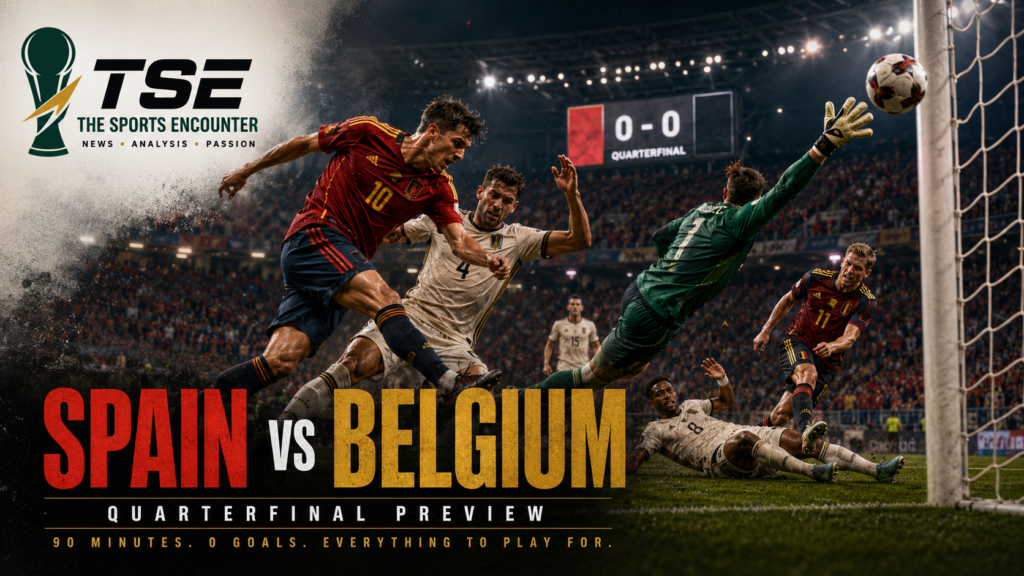
The question around Spain has changed.
Earlier in the FIFA World Cup 2026, it was about whether La Roja had enough edge to survive the knockout pressure. Now, after eliminating Portugal with a stoppage-time winner, the question is sharper: can Spain turn control into a semifinal place against a Belgium side that suddenly looks dangerous again?
This second quarterfinal at Los Angeles Stadium brings two very different forms of momentum. Spain arrive with structure, patience, pressing discipline, and the confidence of a team that has learned how to win tight games. Belgium arrive with release, attacking belief, and the emotional lift of a 4-1 Round of 16 statement against the United States.
For full tournament coverage, follow The Sports Encounter’s FIFA World Cup 2026 hub.
TL;DR
- Spain face Belgium in the FIFA World Cup 2026 quarterfinal at Los Angeles Stadium on July 10.
- Spain reached this stage after beating Portugal 1-0 through a late Mikel Merino goal.
- Belgium stormed past the United States 4-1 in the Round of 16, with Charles De Ketelaere producing a breakout knockout display.
- Spain appear in better overall shape because of their balance, unbeaten rhythm, and defensive control.
- Belgium have momentum too, but their defense must solve the biggest question of the match: how to contain Lamine Yamal.
- The winner moves into the semifinal and stays alive in a tournament where Europe’s heavyweights have begun to separate themselves.
Key Information Box
| Detail | Information |
|---|---|
| Match | Spain vs Belgium |
| Competition | FIFA World Cup 2026 Quarterfinal |
| Venue | Los Angeles Stadium, Inglewood |
| Date | July 10, 2026 |
| Kickoff | 19:00 GMT |
| Referee | Michael Oliver |
| Spain Round of 16 Result | Spain 1-0 Portugal |
| Belgium Round of 16 Result | Belgium 4-1 United States |
| Main Duel | Lamine Yamal vs Belgium defense |
| Head-to-Head | 22 meetings: Spain 12 wins, Belgium 5 wins, 5 draws |
| What It Means | Winner advances to the FIFA World Cup 2026 semifinal |
Spain Arrive With Control, But Also a New Kind of Edge
Spain have carried one of the cleanest tournament profiles into the quarterfinals.
They have not always overwhelmed opponents with chaos or constant goal rushes. Their strength has been more measured: ball control, positional discipline, technical security, and a midfield that can suffocate rhythm before the opposition finds comfort.
The 3-0 win over Austria in the Round of 32 showed Spain’s sharper side. Mikel Oyarzabal scored twice, Pedro Porro added another, and Lamine Yamal stretched Austria’s defensive shape with his movement and timing. That performance, covered in The Sports Encounter’s report on Spain’s commanding Austria win, gave La Roja the attacking authority they needed after earlier questions about whether they could turn possession into punishment.
Then came Portugal.
Spain’s 1-0 Round of 16 win was a different type of proof. They did not need a perfect attacking display. They needed patience, control, nerve, and a late killer moment. Mikel Merino’s stoppage-time winner ended Portugal’s World Cup and likely closed Cristiano Ronaldo’s World Cup story. More importantly for Spain, it confirmed that this team can win a knockout match when the rhythm becomes uncomfortable.
That is why Spain come into this quarterfinal in better overall shape. They have control when the game is open, discipline when the game is tight, and enough bench depth to change the mood late. Their tournament has built layer by layer.
Read more on that emotional knockout night in The Sports Encounter’s report: Spain End Ronaldo’s World Cup Dream With Brutal Late Winner.
Belgium’s Tournament Has Been Messier, But the Belief Is Back
Belgium’s path has been less smooth.
Their group-stage campaign had warning signs. Draws against Egypt and Iran raised questions about tempo, creativity, and whether this version of Belgium still had enough sharpness to go deep. The 5-1 win over New Zealand helped reset the mood, but it did not fully erase the feeling that Belgium were still searching for their best version.
The Round of 16 changed that conversation.
Belgium’s 4-1 win over the United States was their most convincing performance of the tournament. Charles De Ketelaere delivered the kind of display that can change how opponents prepare. His brace gave Belgium a younger attacking reference point beyond the familiar names, while Thibaut Courtois, Kevin De Bruyne, and Romelu Lukaku still give the squad high-level experience around pressure moments.
The win also carried political and emotional noise after the buildup around Folarin Balogun’s availability, which The Sports Encounter covered in its analysis of USA vs Belgium becoming a major World Cup rules debate. Belgium handled that distraction well. Once the match started, they looked sharper, stronger, and far more ruthless than they had earlier in the tournament.
Their 4-1 win also ended the host nation’s run and gave Belgium genuine momentum before facing Spain. The Sports Encounter’s match report on USA’s World Cup dream ending against Belgium remains the key internal reference for that performance.
Which Team Is in Better Shape?
Spain are in better shape overall.
That does not make this match simple. Belgium have the individual quality to hurt any team left in the competition. Courtois can keep them alive. De Bruyne can still find passes that bypass structure. Lukaku can create physical problems late. De Ketelaere now gives Belgium a forward runner with confidence and form.
Still, Spain look more complete.
Their midfield has more control. Their defensive structure has been more reliable. Their wide threat is more consistent. Their unbeaten rhythm under Luis de la Fuente gives them the feel of a team that trusts its own mechanisms rather than waiting for individual rescue acts.
Belgium’s momentum is real, but Spain’s momentum feels more stable.
There is also one selection concern for Belgium. Amadou Onana’s injury removes a major midfield presence, which matters against a Spain side that wants to dominate central zones and force opponents to defend for long spells. Without him, Belgium may need extra defensive discipline from their midfield line and cleaner decision-making when they recover the ball.
Lamine Yamal vs Belgium’s Defense Could Decide the Match
Belgium’s defensive plan begins with Lamine Yamal.
Yamal has already become one of the defining young faces of this World Cup. His threat is not only about dribbling. He changes the geometry of Spain’s attack. When he receives wide, defenders hesitate. When he comes inside, midfielders are forced to decide whether to step out or protect the half-space. That hesitation creates Spain’s rhythm.
Belgium cannot defend him with one player alone.
If the fullback jumps too early, Yamal can slip passes inside or attack the outside shoulder. If Belgium double him too aggressively, Spain can switch play and find space on the far side. If they sit too deep, Spain can keep recycling possession until Rodri and the midfield begin to dictate every angle.
Belgium’s best answer may be controlled aggression. They need to reduce Yamal’s first touch comfort, block his inside passing lanes, and make him defend as much as possible by attacking Spain’s right side when possession turns over.
That is easier to say than to execute.
Yamal’s biggest weapon is calm. He rarely looks rushed. Belgium must avoid the mistake of turning this into a personal duel driven by emotion. The smarter plan is collective: pressure the passer, cover the inside lane, delay the dribble, and avoid cheap fouls near the box.
Spain’s Midfield Control vs Belgium’s Vertical Threat
Spain will likely try to make the match feel slow before making it suddenly fast.
That pattern suits them. Rodri’s presence gives Spain control over second balls and tempo. Pedri, Gavi, Merino, or whichever midfield combination de la Fuente chooses can keep Belgium moving side to side. The aim will be to tire Belgium’s midfield line, pull defenders out of shape, and let Yamal or Nico Williams attack when the space appears.
Belgium will want the opposite.
They need the game to open in moments. Their best chance may come from transitions, quick vertical passes, and early service before Spain’s rest defense settles. De Ketelaere’s confidence after the USA match makes him important here. He can run into gaps, receive between lines, and force Spain’s center backs to make decisions facing their own goal.
De Bruyne’s role could be decisive, even if he is managed carefully. If he gets time to lift his head, Belgium can turn one recovery into a scoring chance. Spain will know that. Cutting off his first forward option may be as important as pressing him directly.
Head-to-Head: Spain Hold the Historical Edge
Spain and Belgium have met 22 times in senior men’s international football.
Spain lead the head-to-head record with 12 wins, while Belgium have won five. Five matches have ended in draws. That history gives Spain the statistical edge, but knockout football rarely follows old records cleanly.
The more relevant pattern is recent competitive identity.
Spain have rebuilt themselves into a cohesive tournament team. Belgium, after years of carrying the “golden generation” label, now look like a side trying to blend old leadership with newer attacking energy. This quarterfinal will test whether Belgium’s reboot has enough substance to survive against one of the most structured teams in the tournament.
Tactical Keys to the Match
| Tactical Area | Spain Need | Belgium Need |
| Wide Play | Isolate Yamal and Williams in advanced zones | Stop first-touch comfort and protect half-spaces |
| Midfield Battle | Control tempo through Rodri and quick passing triangles | Survive without Onana and break pressure cleanly |
| Transitions | Stop De Ketelaere and De Bruyne early | Attack before Spain settle defensively |
| Set Pieces | Avoid needless fouls around the box | Use size and delivery to disrupt Spain’s control |
| Bench Impact | Repeat the late-match influence shown against Portugal | Use Lukaku, De Bruyne, or fresh runners at the right moment |
What Spain Must Avoid
Spain must avoid turning control into comfort.
That has been a familiar danger for possession-heavy teams at World Cups. They can dominate the ball, push the opponent back, and still leave themselves exposed to one transition. Belgium have enough quality to punish that.
La Roja also need patience with purpose. Passing for control is useful only if it moves Belgium’s defensive block. If Spain become too slow, Belgium will settle into a compact shape and wait for counters.
The best version of Spain moves the ball quickly enough to shift the opponent, then accelerates through Yamal, Williams, Oyarzabal, or late midfield runners. That version can make Belgium defend too many zones at once.
What Belgium Must Do to Upset Spain
Belgium need courage, but reckless pressing would be dangerous.
They should pick pressing moments carefully, especially after backward passes or heavy touches. Spain are too comfortable technically to be chased blindly. Belgium must also protect the central spaces in front of their back line because that is where Spain can turn possession into control and control into chances.
Courtois will matter. His experience in Spanish football gives him insight into many of Spain’s players, but this match will still demand concentration for long stretches. Against Spain, goalkeepers can go quiet for 20 minutes and then suddenly face a decisive chance.
Belgium’s attacking players must also be efficient. They may not get many clear openings. When De Ketelaere, Lukaku, or De Bruyne see one, they have to make Spain feel the risk of pushing high.
Prediction: Spain Have the Edge, But Belgium Have the Punch
Spain should enter the FIFA World Cup 2026 quarterfinal as favorites.
They have the stronger tournament body of work, the cleaner tactical identity, and the better balance between control and threat. Their late win over Portugal showed they can carry pressure without panic. Their earlier win over Austria showed they can open up a knockout opponent when the attack clicks.
Belgium, though, are dangerous because they arrive with their best performance behind them. A 4-1 win over the United States gave them belief, goals, and a new attacking headline through De Ketelaere. If they score first, this match could become uncomfortable for Spain very quickly.
Still, the safer read is Spain by a narrow margin.
They look more stable. They have more ways to control the game. And if Lamine Yamal finds enough space against Belgium’s defense, La Roja may have the one player who can tilt a tight quarterfinal before Belgium’s veterans get their chance to rescue it.
For more knockout-stage context, read The Sports Encounter’s Round of 16 preview and the latest Soccer coverage.