Connect with us
Jovana Zlatova | The Sports Encounter

Published

on

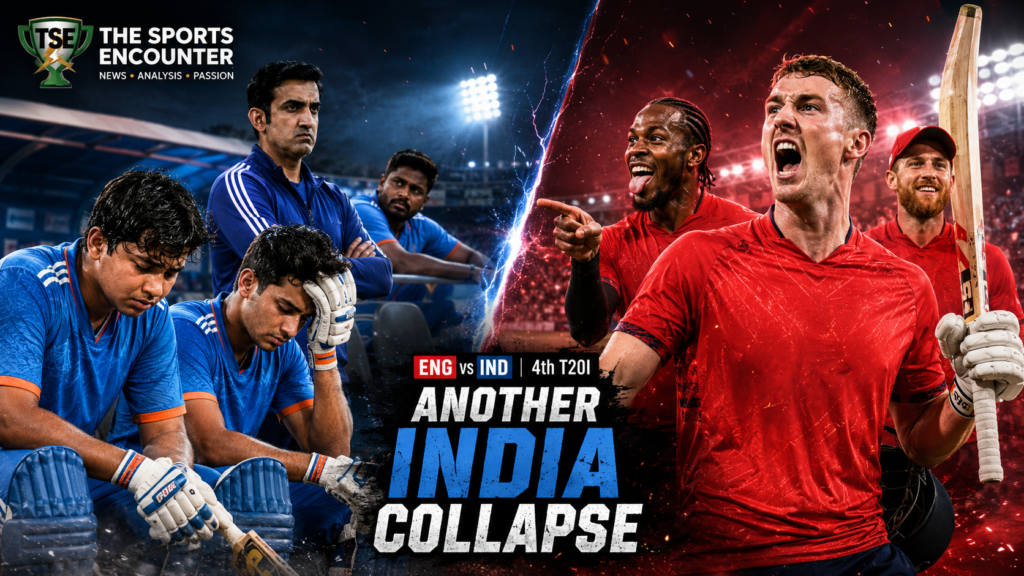
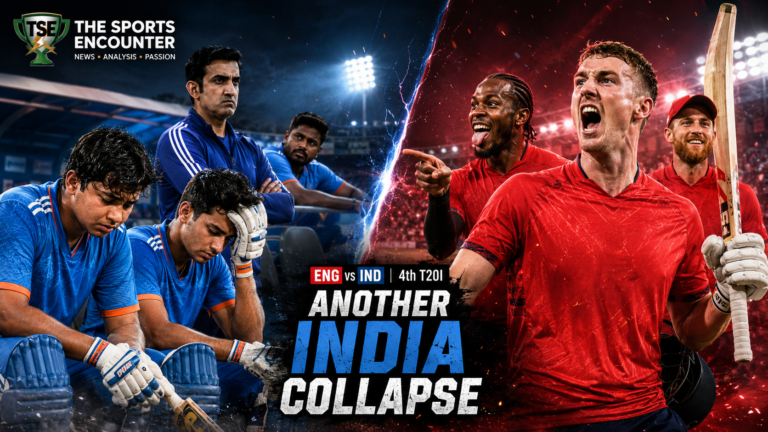
India needed a response. They gave England a record chase instead.

After the 125-run defeat at Trent Bridge had already exposed India’s confused T20I direction, Bristol made the damage feel deeper. India won the toss, chose to bat, reached only 158-7, and then watched England race to 159-1 in just 13.5 overs.

It was England’s fastest successful T20I chase with a target of 150 or more. It also sealed a 3-0 lead in the five-match series, giving England their first T20I series triumph over India in the format and leaving India with back-to-back T20I series defeats for the first time since 2018-19.

Harry Brook, leading England, demolished the Indian attack with an unbeaten 79 off 35 balls. Phil Salt continued his excellent series with another half-century, finishing 59 not out from 42 deliveries. Together, they added an unbeaten 146-run stand after Jos Buttler fell early.

For England, this was control, clarity, and confidence.

For India, it was another difficult night in a series that is quickly becoming a deeper audit of selection, batting maturity, and the team’s ability to handle overseas T20 conditions.

For more cricket coverage and match analysis, follow The Sports Encounter’s Cricket Hub.

England vs India 4th T20I: Match Summary

DetailInformation
MatchEngland vs India, 4th T20I
VenueCounty Ground, Bristol
DateJuly 9, 2026
TossIndia won the toss and chose to bat
India158-7 in 20 overs
England159-1 in 13.5 overs
ResultEngland won by 9 wickets
Series SituationEngland lead 3-0 in the five-match series
Top India BatterShreyas Iyer 80* off 49
Top England BattersHarry Brook 79* off 35, Phil Salt 59* off 42
Best England BowlersJofra Archer 2-20, Josh Tongue 2-36
Major England RecordEngland’s fastest successful chase with a target of 150 or more
India ConcernFirst back-to-back T20I series defeats since 2018-19
Series MilestoneEngland’s first T20I series triumph over India
Turning PointIndia slipped to 48-3 inside seven overs

India’s Batting Fails Again Under Real Pace and Bounce

India’s total was built almost entirely around Shreyas Iyer.

The Indian captain played a fighting unbeaten 80 from 49 balls, striking four fours and five sixes. He gave India some respectability, especially after another weak start left the innings wobbling early. Without him, India’s scorecard would have looked far worse.

The problem was everything around him.

Vaibhav Sooryavanshi made 15 off 10. Abhishek Sharma scored 16 off 14. Ishan Kishan managed only 4. By 6.4 overs, India were 48-3, and the innings had already lost shape.

This was not simply a bad start. It was another reminder that India’s young top order is struggling to adjust when the ball moves, climbs, and forces better shot selection. In Indian conditions, short boundaries and flatter surfaces can sometimes protect loose batting. In England, the margin is smaller. The ball can swing. The bounce can rush batters. The square boundaries can turn hopeful strokes into catching practice.

That is where India looked underprepared again.

The approach from Vaibhav Sooryavanshi will now attract serious debate. He is young, gifted, and fearless, but fearlessness without control can become a liability at international level. India may believe they are investing in the future, but the question is whether this stage has come too early for him.

There is a difference between backing youth and exposing youth before the player has enough tools for hostile conditions.

Sanju Samson Question Returns After Another Top-Order Failure

The continued absence of Sanju Samson will only add more noise around India’s selection calls.

Samson was once again on the bench while India’s top order failed to give the innings any stability. The debate is bigger than one player now. It is about whether India are selecting for reputation, projection, or actual match requirements.

Samson brings experience, international exposure, wicketkeeping depth, and a more developed understanding of tempo. After another top-order failure, India’s decision to keep him out will be questioned by fans and analysts who believe the team needs maturity more than experimentation.

This is not about blaming one young opener or presenting Samson as a magical fix. It is about balance.

India’s T20I lineup currently looks talented, but fragile. Too many players appear to be batting in the same emotional gear. Too many shots look pre-decided. Too many collapses are being explained as part of a transition when they may actually be signs of poor role clarity.

India had already suffered a brutal collapse in the previous match, when England beat them by 125 runs at Trent Bridge. That result was covered in The Sports Encounter’s report on India’s worst T20I defeat by runs. Bristol did not bring the same numerical embarrassment, but it deepened the same cricketing concern.

Archer and Tongue Keep India Under Pressure

England’s bowling was disciplined without needing to be spectacular for all 20 overs.

Jofra Archer set the tone with 2-20 from four overs. He removed Vaibhav Sooryavanshi and later dismissed Washington Sundar, while also contributing to Axar Patel’s run out at the end of India’s innings.

Josh Tongue continued his strong series, taking 2-36. He dismissed Ishan Kishan and Tilak Varma, keeping India from building momentum around Shreyas Iyer.

Will Jacks also played an important holding role with 1-28 from four overs. Sam Curran went wicketless but gave away only 24 from his four overs, helping England squeeze India through the middle and late phases.

India’s 158 looked below par when the innings ended. It looked much smaller once England started batting.

Brook Breaks the Chase Open

England lost Jos Buttler for 8 at 13-1, but that was the only real moment India had.

Harry Brook came in and immediately changed the mood of the chase. His unbeaten 79 from 35 balls included eight fours and four sixes. It was not a captain’s knock in the old cautious sense. It was a captain taking the game away before India could even imagine pressure.

Brook’s hitting exposed India’s lack of control with the ball. Prince Yadav, Axar Patel, Washington Sundar, Shivam Dube, and Prasidh Krishna all struggled to contain England’s scoring rate. India did not build pressure from either end, and once Brook found rhythm, the chase became a procession.

England reached 62-1 in the power play. By the 10th over, the result was almost settled. Brook and Salt did not need risk management. They had enough time, enough wickets, and enough loose bowling to turn the chase into another statement.

This was England’s T20 cricket at its cleanest: aggressive without panic, ruthless without clutter.

Phil Salt Keeps Punishing India

Phil Salt’s 59 not out continued his excellent run in the series.

After scoring 70 in the previous T20I, Salt produced another controlled half-century. He was slightly quieter than Brook in Bristol, but that almost made the partnership more damaging for India. Brook attacked violently. Salt kept the chase moving, punished width, and ensured England never lost tempo.

Salt’s form has become one of the defining stories of the series. He has given England the kind of top-order certainty India currently lack. Where India are searching for the right balance, England look increasingly comfortable with their roles.

The contrast is uncomfortable for India.

Salt knows his job. Brook knows his job. England’s middle order has clarity behind them. India, at the moment, look like a team trying to force a future without enough present-day stability.

What This Defeat Says About India

This defeat should worry India for more than the result.

They were outplayed in skill, execution, and decision-making. Their batting lacked adaptability. Their bowling lacked discipline. Their selection continues to invite difficult questions.

The biggest concern is the repeated pattern. India’s openers are not giving starts. The middle order is repeatedly walking in under pressure. Shreyas Iyer’s 80* was valuable, but one strong innings cannot hide a top-order system that keeps failing.

Overseas T20 cricket demands more than hitting range. It demands judgment. It demands game awareness. It demands batters who can understand when to attack, when to absorb, and when conditions require a different tempo.

India’s young batters are learning those lessons in public. That can be useful in the long term, but it can also damage confidence if the structure around them is poor.

The same concern appeared during India’s recent T20I struggles in Ireland, where The Sports Encounter covered Ireland’s historic clean sweep over India. This is no longer a one-match problem. It is becoming a pattern.

England Look Settled, India Look Exposed

England have turned this series into a clear message about their white-ball direction.

Brook’s captaincy has looked confident. Salt has been in excellent touch. Archer and Tongue have given them power-play bite. Curran, Jacks, and Rashid have offered control, variation, and tactical flexibility.

India, meanwhile, look caught between rebuilding and reacting.

They are backing young players, but without enough protection. They are keeping experienced options on the bench, but without proving the alternatives are ready. They are trying to play modern T20 cricket, but too often it looks like impatient batting rather than high-quality aggression.

The margin carried more than scoreboard damage.

England went 3-0 up in a five-match series, secured their first T20I series triumph over India, and completed their fastest successful chase with a target of 150 or more. For a side that has often been judged against India’s white-ball depth, this was a serious statement.

India’s problem is now impossible to dress up as one bad night. They have lost back-to-back T20I series for the first time since 2018-19, and the pattern is becoming uncomfortable: weak starts, loose shot selection, unstable selection calls, and a young batting group still searching for answers outside familiar home conditions.

Bristol did not simply give England another win.

It gave India another warning.
Sports Writer, Europe. Jovana Zlatova covers European sports for The Sports Encounter, with a focus on major events, match-day atmosphere, athlete stories, fan culture, and the human side of competition across the continent. Her coverage includes tennis, football, international tournaments, European sports culture, and feature-led reporting from the region. Coverage areas: European sports, tennis, football, major events, athlete stories, fan culture.

Breaking News

Two Rebounds Break Belgium Hearts as Spain Reach World Cup Semifinal

Spain scored twice from rebounds as substitute Mikel Merino punished a late goalkeeping error to seal a 2-1 quarterfinal victory over Belgium.

Ruben Santos | The Sports Encounter

Published

on

Belgium Beaten by the Rebound as Spain Reach World Cup Semifinal

Two rebounds, two Spanish goals, and one painful World Cup exit for Belgium.

Fabián Ruiz reacted first when Thibaut Courtois parried Dani Olmo’s shot in the 30th minute. Almost an hour later, substitute Mikel Merino punished Senne Lammens after the replacement goalkeeper spilled Pau Cubarsí’s effort.

The circumstances carried a cruel symmetry for Belgium. Spain scored both goals from rebounds, with two different goalkeepers unable to remove the danger at decisive moments.

Merino’s 88th-minute finish gave Spain a dramatic 2-1 victory at Los Angeles Stadium and sent the reigning European champions into a FIFA World Cup 2026 semifinal against France in Dallas.

Charles De Ketelaere had equalized for Belgium in the 41st minute. His header became the first goal Spain had conceded at this World Cup and ended La Roja’s 650-minute international shutout run.

For results, analysis, and the road to the final, follow The Sports Encounter’s FIFA World Cup 2026 coverage.

Spain vs Belgium Match Facts

DetailInformation
MatchSpain vs Belgium
CompetitionFIFA World Cup 2026 quarterfinal
Final scoreSpain 2-1 Belgium
VenueLos Angeles Stadium, Inglewood
Spain scorersFabián Ruiz 30’, Mikel Merino 88’
Belgium scorerCharles De Ketelaere 41’
Yellow cardsCubarsí 43’, De Bruyne 85’, Laporte 90+4’, Witsel 90+5’
Red cardsNone
RefereeMichael Oliver
Turning pointCourtois’ injury and Lammens’ late spill
Next matchSpain vs France, semifinal

Nothing Separates the Teams Early

The opening phase offered no clear separation between the two European sides.

Spain controlled more of the ball and tried to stretch Belgium through Lamine Yamal, but the Belgian defense held its shape through the first hydration break. Yamal made some progress on the right, using his close control and quick changes of direction to reach promising areas. None of those early moves produced a clear opening.

Belgium accepted Spain’s territorial control and looked for opportunities to attack the spaces left behind. Kevin De Bruyne tried to give the Red Devils composure in possession, while De Ketelaere and Jérémy Doku offered movement around Spain’s back line.

The match needed someone to break its careful rhythm. Ruiz supplied the answer in the 30th minute.

Fabián Ruiz Scores From the First Rebound

Spain’s opening goal came after another sustained attack forced Belgium toward its own net.

Pedro Porro combined with Yamal before delivering a low ball into the penalty area. Olmo struck it first time, forcing Courtois into a low save. The Belgian goalkeeper stopped the initial effort but could not push the ball away from danger.

Ruiz anticipated the rebound, reached it before Belgium’s defenders, and forced the loose ball over the line.

The midfielder’s alertness finally gave Spain a reward for their pressure. Belgium now faced the difficult task of chasing a team that had not conceded throughout the tournament.

Spain continued attacking after taking the lead. Yamal and his teammates put together another series of threatening moves, creating the sense that a second goal could place the quarterfinal beyond Belgium’s reach.

De Ketelaere changed that conversation four minutes before halftime.

De Ketelaere Scores First Goal Against Spain

Belgium equalized in the 41st minute when De Ketelaere met Timothy Castagne’s excellent cross and directed his header beyond Unai Simón.

De Bruyne started the move by finding Castagne at the right moment, while De Ketelaere moved ahead of Cubarsí to reach the delivery. Replays showed that Marc Cucurella had played the Belgian forward onside.

The goal ended Spain’s perfect defensive record at the 2026 World Cup. It also stopped an international shutout streak that had stretched to 650 minutes across the current tournament and previous fixtures.

Cubarsí received the first yellow card of the match in the 43rd minute. The Spanish defender grabbed De Bruyne’s shorts after going to ground while trying to prevent the Belgian captain from escaping.

Both teams entered halftime level at 1-1.

Belgium’s response showed why Spain coach Luis de la Fuente had called the Red Devils his team’s toughest challenge of the tournament. They absorbed pressure, stayed calm after falling behind, and punished Spain’s defense with a sharp transition.

That resilience had already shaped their campaign. Belgium recovered from two goals down to produce a remarkable extra-time comeback against Senegal before overpowering the hosts in a 4-1 Round of 16 win over the United States.

Yamal Creates Openings but Misses His Chances

Yamal remained Spain’s most persistent attacking threat after halftime.

The teenager repeatedly found his way into the penalty area, but several promising opportunities slipped away through a heavy touch, a blocked effort, or an inaccurate finish. Courtois denied him after Cubarsí played him through early in the second half and later saved another driven attempt.

Belgium struggled to stop Yamal from reaching dangerous positions, yet they prevented him from finding the decisive finish. His movement still affected the shape of the match by forcing the Belgian defense deeper and opening space for Spain’s midfielders.

De Bruyne entered referee Michael Oliver’s book in the 85th minute after wrestling Ferran Torres to the ground. The Belgian captain left the field immediately afterward, with Alexis Saelemaekers replacing him.

Extra time appeared increasingly likely. Spain’s substitutes then decided another knockout match.

Courtois Injury Changes Belgium’s Quarterfinal

Courtois suffered a thigh problem during the second half and left the field in the 71st minute. The visibly emotional goalkeeper took his place on the bench with an ice pack strapped to his left thigh.

Lammens entered under immediate pressure as Spain controlled possession and searched for openings around Belgium’s penalty area.

The goalkeeper initially handled several situations without difficulty. However, the match eventually returned to the same detail that had produced Spain’s opening goal: a rebound inside the penalty area.

Merino Punishes the Second Rebound

Cubarsí sent a bouncing shot toward goal in the 88th minute. Lammens failed to secure it, and Merino reacted before anyone else to place the rebound into the net.

The midfielder had replaced Olmo in the 86th minute and required barely two minutes to make the difference.

The finish carried an unmistakable irony for Belgium. Courtois had saved Olmo’s initial shot before Ruiz converted the first rebound. Lammens then stopped neither Cubarsí’s effort nor the danger that followed, allowing Merino to score from another loose ball.

Spain had spent much of the match trying to pass through Belgium’s defensive structure. In the end, alert reactions to two imperfect saves produced both goals.

Merino’s impact repeated the pattern from Spain’s late Round of 16 victory over Portugal, when he also came from the bench and scored the winner.

Four Yellow Cards but No Red Cards

Belgium pushed hard during seven minutes of added time, and the physical temperature rose as Spain protected their lead.

Laporte received Spain’s second yellow card at 90+4. One minute later, Witsel became the fourth and final player booked after arriving late on Rodri with his studs showing. Oliver decided the challenge warranted a yellow card rather than a red.

The verified disciplinary record showed four yellow cards:

  • Pau Cubarsí, Spain, 43rd minute
  • Kevin De Bruyne, Belgium, 85th minute
  • Aymeric Laporte, Spain, 90+4
  • Axel Witsel, Belgium, 90+5

No player received a red card.

Spain Set Up France Semifinal

Hollywood stars Brad Pitt, Javier Bardem, Issa Rae, and Noel Gallagher were among the familiar faces watching from the stands, but Merino owned the closing scene.

Belgium’s campaign ended with the painful knowledge that two rebounds had separated them from a place in extra time. The defeat may also represent the final World Cup appearance for several members of their experienced generation.

Spain advance with growing evidence that their bench can decide close knockout contests. They will now face a French side that defeated Morocco 2-0 in the first World Cup quarterfinal.

France bring Kylian Mbappé and considerable attacking power. Spain carry control, patience, and Merino’s valuable habit of appearing exactly when a difficult match needs someone to settle it.

Official tournament fixtures and disciplinary information are available through FIFA’s World Cup 2026 portal.

Continue Reading

Breaking News

Kane, Haaland and a World Cup Semifinal at Stake in Miami

England meet Norway in a World Cup 2026 quarterfinal loaded with pressure, history, Haaland danger, Kane responsibility, and a major defensive blow for the Three Lions.

Miley Rumer | The Sports Encounter

Published

on

Kane, Haaland and a World Cup Semifinal at Stake in Miami

England survived Mexico. Norway shocked Brazil. Now one of them stands 90 minutes, or maybe more, from a FIFA World Cup semifinal.

That is the pressure waiting in Miami.

England arrive with bigger tournament expectations, deeper squad strength, and a captain who has spent years carrying the emotional weight of a nation. Norway arrive with belief, momentum, Erling Haaland’s goals, Martin Ødegaard’s control, and the kind of fearless energy that can turn a knockout match into a national football moment.

The question is simple enough. Will Harry Kane drag England into another World Cup semifinal, or will Haaland rescue Norway again and give fans another post-match Viking show?

TL;DR

  • England face Norway in a FIFA World Cup 2026 quarterfinal at Hard Rock Stadium in Miami Gardens.
  • England reached the last eight after a wild 3-2 win over Mexico, with Jude Bellingham scoring twice and Harry Kane converting from the spot.
  • Norway stunned Brazil in the Round of 16, with Erling Haaland again becoming the face of their historic run.
  • Jarell Quansah is suspended for two matches after his red card against Mexico, creating a major defensive issue for England.
  • England have the stronger historical head-to-head record, but Norway’s current tournament form makes this far more dangerous than the past suggests.
  • The Kane vs Haaland storyline will dominate, but Declan Rice vs Martin Ødegaard may decide the rhythm of the match.

Key Match Information

DetailInformation
MatchEngland vs Norway
CompetitionFIFA World Cup 2026 Quarterfinal
VenueHard Rock Stadium, Miami Gardens, Florida
DateSaturday, July 11, 2026
Kickoff5pm local time, 10pm BST
Main StorylineHarry Kane’s England against Erling Haaland’s history-chasing Norway
England BlowJarell Quansah suspended for two matches after red card vs Mexico
Key DuelDeclan Rice vs Martin Ødegaard
What It MeansWinner reaches the FIFA World Cup 2026 semifinal

England Reached Miami the Hard Way

England’s Round of 16 win over Mexico had everything a knockout match can throw at a team. Noise, pressure, altitude, VAR, a red card, late Mexican pressure, and the familiar English anxiety that follows this team into every major tournament.

As covered in The Sports Encounter’s report on England’s 3-2 win over Mexico, Jude Bellingham delivered one of his most important England performances with two goals, while Harry Kane’s penalty gave the Three Lions the margin they needed. Jordan Pickford also mattered late, because England were forced into survival mode after Quansah’s dismissal.

That victory showed England’s strength and weakness at the same time.

They have match-winners everywhere. Bellingham can bend a knockout game around his presence. Kane still gives England patience and penalty-box authority. Bukayo Saka’s fitness offers another route to control and width. Declan Rice gives the midfield its engine.

Yet England also showed how quickly they can lose command. After Quansah’s red card in the 54th minute, Mexico turned the match into a chase. England got through it, but Norway will have watched the final half-hour carefully.

A team with Haaland does not need many openings.

Quansah Ban Changes England’s Defensive Picture

Jarell Quansah’s two-match suspension is more than a selection headache. It changes the emotional temperature of England’s back line before facing one of the most dangerous strikers in world football.

The Sports Encounter has already broken down the impact of the ban in England Face Defensive Blow Before Norway Quarterfinal Clash. The issue now is how Thomas Tuchel adjusts without allowing the entire plan to become Haaland-focused.

That is the trap.

Norway are not only Haaland. Ødegaard gives them vision between the lines. Their runners give Haaland second-ball support. Their confidence has grown through each round. If England drop too deep to protect the space behind, Norway can start playing the match at their rhythm. If England hold too high, Haaland will wait for one clean pass into the channel.

Tuchel’s biggest call may be psychological as much as tactical. England must respect Norway’s threat without turning the game into a fear exercise.

Norway Are No Longer a Nice Story

Norway’s run has already moved beyond romance. This is no longer a team enjoying a respectable World Cup appearance. This is a side that has reached its first World Cup quarterfinal and removed Brazil from the tournament.

That matters.

Brazil do not lose World Cup knockout matches without changing the emotional weather around a tournament. Norway’s win gave Haaland a global stage that fits his profile. For years, the conversation around him at international level was simple: could one of the game’s most devastating forwards ever carry Norway deep into a major tournament?

This World Cup has started answering that question.

For readers tracking his wider career and World Cup rise, The Sports Encounter’s feature on Erling Haaland’s records, goals, career, and Norway’s World Cup hope explains why this run feels bigger than one knockout bracket. Haaland has become Norway’s belief system. His goals do not only change scorelines. They change how opponents behave.

England know that better than most because many of their defenders have faced him in domestic football. Familiarity helps, but it does not solve the problem. Haaland is rarely quiet for 90 minutes because he does not need constant involvement. He can disappear, wait, drift off one shoulder, and then turn one mistake into a national celebration.

Head-to-Head: England Own the Past, Norway Want the Present

Historically, England have had the advantage in this fixture. Across 12 previous meetings, England have won seven, Norway have won two, and three have ended in draws.

That record will comfort England supporters, but it should not decide how this match is viewed. Most of that history belongs to different teams, different eras, and different football realities. The England team arriving in Miami carries the burden of expectation. Norway carry the freedom of a side that has already gone further than many expected.

There is another layer too. England and Norway have not built their rivalry through repeated tournament heartbreak. This quarterfinal creates its own weight. Kane and Haaland are both Premier League icons. Rice and Ødegaard know each other from Arsenal’s midfield world. Several English players understand the physical and tactical demands Haaland brings.

The head-to-head record says England have history. The current tournament says Norway have danger.

Kane vs Haaland Is the Poster, Rice vs Ødegaard May Be the Match

The obvious headline is Kane vs Haaland. That is natural. One is England’s captain, penalty-box reference point, and emotional leader. The other is Norway’s goal machine, physical nightmare, and the player who has turned this tournament into a personal statement.

Still, the most important battle may sit deeper.

Declan Rice and Martin Ødegaard know each other’s games intimately. Rice will be asked to protect central spaces, disrupt Ødegaard’s rhythm, and prevent Norway from feeding Haaland with clean early balls. Ødegaard will try to pull England’s midfield shape apart, receive between pressure lines, and create the one pass that makes Haaland alive.

If Rice wins that duel, England can keep the match on their terms. If Ødegaard starts finding time, England’s defenders will spend the evening turning, chasing, and making emergency decisions.

That is where Quansah’s absence could become more painful. Defensive changes rarely hurt only in the back line. They affect timing, distances, pressing cues, and trust.

England Need Control, Not Panic

England’s best path is control. They cannot afford another spell like the one that nearly invited Mexico back into the Round of 16 tie.

Kane will be central to that. His role is no longer only about goals. He drops, links, slows matches down, draws fouls, and gives England a reference point when the game becomes emotional. Against Norway, that maturity could matter as much as his finishing.

Bellingham’s timing from midfield will also be decisive. Norway cannot allow him to arrive freely around the box, especially when Kane pulls defenders out of position. Saka can stretch the pitch, while England’s fullbacks must balance attacking support with the threat of Norway’s transitions.

The real challenge is discipline. England must avoid unnecessary fouls, loose passes in midfield, and emotional defending. Norway will feed on broken moments. A cleared corner, a rushed pass, a midfield turnover, or a second ball can become a Haaland chance very quickly.

Will Norway Bring Another Viking Show?

Norway’s post-match Viking celebrations have become one of the images of their tournament run. They fit the mood of this team: proud, physical, connected, and aware that they are carrying a country through rare football territory.

Another Viking show in Miami would mean something historic. It would mean Norway had beaten Brazil and England in back-to-back knockout matches. It would mean Haaland had pushed his country into a World Cup semifinal. It would also turn Norway from tournament story into tournament force.

England will want no part of that scene.

For the Three Lions, this is a match about maturity. They have survived chaos once. Now they must show they can control danger before it becomes crisis. For Norway, this is the chance to prove Brazil was not the peak of their journey.

Kane carries England’s responsibility. Haaland carries Norway’s dream. Miami gets the collision.

Prediction: England’s Depth vs Norway’s Moment

England have the stronger squad on paper. Their midfield variety, knockout experience, and attacking depth should give them enough tools to manage Norway if they keep the game structured.

Norway, however, have the one thing every favorite fears: a striker who can change a match without warning.

This quarterfinal feels less like a mismatch and more like a test of emotional control. England should have enough to edge it if Kane, Bellingham, and Rice impose themselves early. But if the match stays level deep into the second half, Norway’s belief will grow, the Viking energy will rise, and Haaland will feel the moment moving toward him.

For full official competition coverage, fixtures, and tournament updates, visit the FIFA World Cup 2026 official tournament page.

Continue Reading

Breaking News

Meet the New Most Expensive Player in NHL History

The Anaheim Ducks matched a five-year, $90 million offer sheet to keep Leo Carlsson, making the 21-year-old center the highest-paid player per season in NHL history and reshaping the contract market for young stars.

Marcos Wetherfield | The Sports Encounter

Published

on

Back view of an NHL player standing on the ice as dollar bills rain down around him in a dramatic record-deal themed graphic.

The NHL’s richest annual contract now belongs to a 21-year-old center who has played only three regular seasons.

That sentence alone explains why the Anaheim Ducks’ decision to match the Philadelphia Flyers’ offer sheet is more than a team transaction. It is a league-wide reset.

The player is Leo Carlsson, the Swedish center Anaheim selected No. 2 overall in the 2023 NHL Draft. The deal is a five-year, $90 million contract with an average annual value of $18 million, making Carlsson the highest-paid player in NHL history on a per-season basis. For readers following The Sports Encounter’s wider NHL coverage, this is one of the most aggressive contract moments the league has seen in years.

The Ducks had a choice. They could match the offer sheet and keep their franchise center at a massive price, or they could let him go to Philadelphia and receive four first-round draft picks as compensation. Anaheim chose certainty over draft capital. In doing so, the Ducks kept the player they believe can define their next era.

The Contract That Forced Anaheim’s Hand

Philadelphia’s offer sheet was designed to create pressure.

A five-year term kept the deal short enough to return Carlsson to unrestricted free agency in 2031, while the $18 million annual value placed him above every player in the league on a per-season basis. According to the official NHL report on Carlsson’s offer sheet, the contract was worth $90 million over five years and would have required four first-round picks as compensation if Anaheim did not match.

That structure made the decision uncomfortable. Four first-round picks are not small compensation. In a rebuild, they can shape half a decade of roster construction. But Carlsson is not a normal restricted free agent. He is a young top-line center, a premium position player, and already one of the most important pieces in Anaheim’s rebuild.

For the Ducks, the question was never only about money. It was about identity.

Do you let a franchise center leave because the price is uncomfortable, or do you pay the price because players like this rarely become available?

Anaheim gave its answer.

Why the Ducks Could Not Let Him Walk

Carlsson’s rise explains the match.

Last season, he posted career highs with 29 goals, 38 assists, and 67 points in 70 regular-season games. He also added 11 points in 12 playoff games as Anaheim pushed deeper into the postseason picture. Across his first 201 regular-season games, he has produced 141 points, including 61 goals and 80 assists.

Those numbers matter, but they do not tell the whole story.

At 6-foot-3 and over 200 pounds, Carlsson gives Anaheim size down the middle. He can handle matchups, create offense, and grow into the kind of two-way center who changes how a team is built. Elite centers are hockey’s structural pieces. Wingers can score. Defensemen can tilt the ice. Goalies can steal nights. But a true No. 1 center gives a franchise its spine.

That is why the Ducks’ front office viewed him as non-negotiable.

General manager Pat Verbeek said Anaheim had viewed Carlsson as a franchise player since meeting him before the 2023 draft. Ducks owners Henry and Susan Samueli also made clear that the team had planned its cap space with the ability to keep him. That language matters because it frames the deal as a long-term bet, not a panic reaction.

Philadelphia Lost the Player but Still Changed the Market

The Flyers did not get Carlsson, but they still shook the NHL.

Offer sheets remain rare because they are aggressive by nature. They test another team’s cap structure, force public decisions, and sometimes strain relationships between front offices. Philadelphia knew Anaheim had the right to match. That was the point. The Flyers made the Ducks pay a historic price to keep their own player.

That strategy may not deliver Carlsson to Philadelphia, but it sends a message to the rest of the league. Young restricted free agents now have a new reference point. Agents will look at this deal when negotiating for other emerging stars. General managers will look at their cap tables differently. Teams with unsigned young centers and franchise forwards will know that another club may not wait politely for negotiations to finish.

This is why the contract matters beyond Anaheim. It pushes the restricted free-agent market into a more dangerous place for teams that delay business with cornerstone players.

Highest Paid Does Not Mean Safest Bet

Carlsson is now the NHL’s highest-paid player per season, but that does not mean the deal is risk-free.

Anaheim is paying for what he is and what it believes he will become. At 21, he has already shown top-line production, playoff impact, and franchise-player traits. Still, $18 million per season creates pressure. Every cold stretch will be discussed. Every comparison with other elite centers will follow him. Every playoff failure will make the number louder.

The Ducks are betting that his prime years will justify the price.

That is not an unreasonable bet. Carlsson’s age gives Anaheim upside. This is not a late-career contract for past achievement. It is a front-loaded belief in future value. If he becomes one of the league’s truly elite centers, the deal could age better than it looks today, especially if the salary cap continues to rise.

The risk is that the contract immediately changes the standard by which Carlsson is judged. He is no longer only a promising young center. He is the NHL’s highest-paid player per season.

What This Means for Anaheim’s Rebuild

The Ducks have now made their clearest statement yet about the direction of the franchise.

This team is no longer only collecting prospects and waiting for the future. Anaheim has committed superstar-level money to the player it believes can carry that future. The next step is harder: building a serious contender around him.

That means drafting well, developing young talent, managing cap space, and avoiding the trap of paying too much around one centerpiece. Carlsson can be the foundation, but he cannot be the whole structure.

Anonymous hockey player stands on the ice under arena lights beside the headline “Meet the New Most Expensive Player in the NHL History” in a dramatic NHL-themed graphic.

For context, The Sports Encounter has already tracked several major NHL roster and ownership moves this offseason, including major NHL updates, Pittsburgh’s ownership change, and Florida’s Stanley Cup favorite push after the Brady Tkachuk blockbuster. Carlsson’s contract belongs in that same offseason conversation because it changes competitive planning, not just payroll.

Anaheim now has its center. The challenge is turning that center into a championship timeline.

Why the No-Trade Restriction Matters

Because Anaheim matched the offer sheet, Carlsson cannot be traded for at least one year.

That detail protects the spirit of the offer-sheet system. A team cannot simply match the contract and immediately flip the player elsewhere. The Ducks are now committed to keeping him and absorbing the cap impact, at least in the short term.

That also gives Carlsson stability. He wanted Anaheim to match, and now he gets the security of a massive contract while remaining with the team that drafted him. His comments made that clear. The offer was enormous, but he still wanted to stay a Duck.

For a young player, that matters. Money changes expectations, but comfort and role can shape performance. Carlsson knows Anaheim’s room, market, coaching environment, and organizational direction. Now he has to grow from franchise cornerstone into franchise driver.

Key Facts

DetailInformation
PlayerLeo Carlsson
TeamAnaheim Ducks
Offer Sheet TeamPhiladelphia Flyers
ContractFive years, $90 million
Average Annual Value$18 million
NHL SignificanceHighest-paid player per season in league history
Compensation If Not MatchedFour first-round draft picks
2025-26 Production29 goals, 38 assists, 67 points in 70 games
Career Production141 points in 201 regular-season games
Draft PositionNo. 2 overall in the 2023 NHL Draft

The Bigger Contract Lesson

This deal will not stay isolated.

Every major young player negotiation now has a new ceiling to discuss. Carlsson’s contract gives agents a stronger argument for elite restricted free agents. It also gives aggressive teams a blueprint. If a rival club has a franchise player unsigned and limited cap room, an offer sheet can become a weapon.

That does not mean the NHL will suddenly become an offer-sheet league. Front offices still move carefully. Draft-pick compensation is expensive, and relationships matter. But Philadelphia proved that the tactic can create pressure even when it fails to land the player.

The Flyers forced Anaheim into a historic contract. That alone makes the move successful in a disruptive sense.

FAQs

Who became the highest-paid NHL player per season?

Leo Carlsson became the NHL’s highest-paid player per season after the Anaheim Ducks matched the Philadelphia Flyers’ five-year, $90 million offer sheet.

How much is Leo Carlsson’s new contract worth?

The contract is worth $90 million over five years, with an average annual value of $18 million.

Why did the Ducks match the offer sheet?

Anaheim matched because Carlsson is viewed as a franchise center and one of the core players in the Ducks’ long-term rebuild.

What would the Flyers have paid in compensation?

If Anaheim had not matched, Philadelphia would have owed the Ducks four first-round draft picks.

Can Anaheim trade Leo Carlsson now?

No. Because Anaheim matched the offer sheet, Carlsson cannot be traded for at least one year.

Final Word

The NHL’s richest annual signing is not only about Leo Carlsson getting paid.

It is about a young star becoming the center of a franchise’s future, a rival team forcing a historic decision, and a contract market that now has a new number everyone will remember.

Anaheim kept its player. Philadelphia made its point. Carlsson got the deal of a lifetime and the responsibility that comes with it.

Now the hockey part begins.

For the Ducks, this contract will be judged by more than goals and assists. It will be judged by whether Carlsson becomes the elite center Anaheim believes it just paid for.

Continue Reading

Breaking News