Connect with us

Breaking News

Argentina Escape in Extra Time After Cabo Verde Push Champions to the Brink

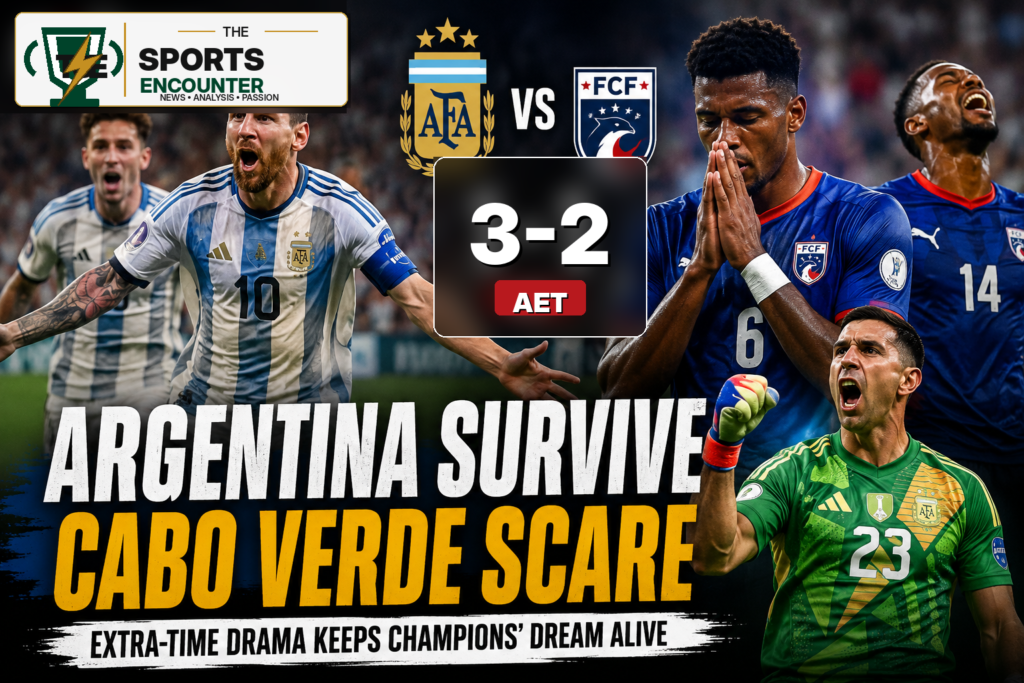
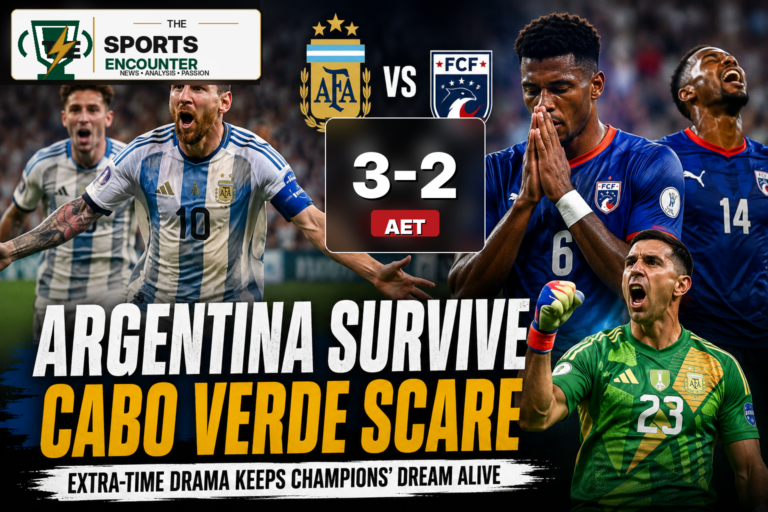
Argentina reached the FIFA World Cup 2026 Round of 16 after a 3-2 extra-time win over Cabo Verde, but the defending champions had to survive one of the tournament’s bravest knockout performances from the debutants.

Miley Rumer | The Sports Encounter

Published

on

Argentina Escape in Extra Time After Cabo Verde Push Champions to the Brink

Argentina walked out of Miami Stadium with their World Cup defense alive, but Cabo Verde made the champions earn every inch of it.

The defending champions beat Cabo Verde 3-2 after extra time in a FIFA World Cup 2026 Round of 32 match that turned into a test of nerve, depth, heat management, and survival instinct. Lionel Messi opened the scoring, Lisandro Martínez restored Argentina’s lead in extra time, and the winner came when Cristian Romero’s header from a Messi corner deflected off Diney Borges and beat Vozinha.

That scoreline sends Argentina into the Round of 16 against Egypt. It also sends Cabo Verde home with something far bigger than sympathy. In their debut World Cup, the Blue Sharks took the champions beyond 90 minutes, equalized twice, defended with courage, attacked with belief, and left the tournament looking like a nation that belongs on this stage.

For more knockout-stage coverage, follow The Sports Encounter’s FIFA World Cup 2026 coverage hub and our latest report on Salah’s Egypt holding their nerve against Australia.

Key Match Information

MatchArgentina vs Cabo Verde
CompetitionFIFA World Cup 2026, Round of 32
VenueMiami Stadium
ResultArgentina 3-2 Cabo Verde after extra time
Argentina goalsLionel Messi 29’, Lisandro Martínez 93’, Diney Borges own goal 111’
Cabo Verde goalsDeroy Duarte 59’, Sidny Lopes Cabral 104’
Next matchArgentina vs Egypt, Round of 16
Yellow cardsKevin Pina, Cabo Verde; Gonzalo Montiel, Argentina
Red cardsNone

Messi Gives Argentina Control, but Not Comfort

Messi’s goal arrived in the 29th minute, and for a while it looked like Argentina had found the kind of early breakthrough that usually breaks underdogs. Lautaro Martínez lifted a clever ball over the Cabo Verde defense, Messi adjusted with that familiar calm, then finished high past Vozinha.

It was his seventh goal of the tournament and another reminder that even at 39, Messi still changes the emotional temperature of a match. Argentina did not need him to dominate every minute. They needed him to locate the one moment that could tilt the game, and he did.

Yet the goal did not settle Argentina in the way Lionel Scaloni would have wanted. The champions controlled spells of possession, but Cabo Verde refused to shrink. Kevin Pina read danger well, the back line stayed compact, and Vozinha gave his team a platform with repeated saves.

Argentina had enough technical quality to move the ball into advanced areas, but their rhythm often slowed near the box. Enzo Fernández and Alexis Mac Allister tried to step higher. Rodrigo De Paul pushed energy into midfield. Still, Cabo Verde kept forcing Argentina into one more pass, one more angle, one more decision.

That mattered. The longer the score stayed 1-0, the more belief moved from Argentina’s side of the pitch to Cabo Verde’s.

Cabo Verde’s Equalizer Changed the Match

Cabo Verde’s equalizer in the 59th minute came from exactly the kind of football that made their debut World Cup special.

Ryan Mendes found space on the right and picked out Deroy Duarte in the box. Duarte controlled, adjusted, and drilled the ball past Emiliano Martínez to make it 1-1. It was not a lucky break. It was a composed team goal, built from patience, movement, and the courage to attack the world champions rather than simply wait for penalties.

That goal changed the match psychologically.

Argentina suddenly had to answer a question they may not have expected from Cabo Verde: could they raise the tempo without losing control? Messi nearly restored the lead soon after, but Vozinha stood tall. Later, the Cabo Verde goalkeeper denied Messi again from a free kick, giving the Blue Sharks more reason to believe.

For Cabo Verde, this was not survival football dressed up as bravery. They defended, yes, but they also passed through pressure, carried the ball forward, and trusted players like Mendes, Duarte, Cabral, and Pina to make decisions under knockout pressure.

Their run to this stage already had historic value after they reached the knockouts in their first World Cup, as covered in The Sports Encounter’s report on Cabo Verde reaching the Round of 32 after holding Saudi Arabia. Against Argentina, they gave that story a sharper edge.

Lisandro Martínez Delivers, Then Cabo Verde Respond Again

Extra time began with Argentina pushing hard, and Lisandro Martínez gave them the lead in the 93rd minute. The defender reacted sharply after a corner and smashed the ball into the roof of the net.

For many teams, that goal against the defending champions would have been the emotional breaking point. Cabo Verde had already chased the game for nearly an hour. Miami’s heat had drained legs. Argentina’s bench had brought more experience into the contest.

Cabo Verde still came back.

Sidny Lopes Cabral produced the moment of their night in the 104th minute, curling a superb strike beyond Emiliano Martínez to make it 2-2. The finish had technique, belief, and timing. It also captured the spirit of Cabo Verde’s tournament. Even when the match appeared to slip away, they found another answer.

At that point, Argentina had to confront the possibility of penalties against a goalkeeper who looked inspired and a team playing with nothing to fear.

Emiliano Martínez Saves Argentina From a Deeper Crisis

Messi and Lisandro Martínez gave Argentina the goals that kept them moving, but Emiliano Martínez gave them the protection that stopped the match from becoming a national trauma.

After Argentina went 3-2 ahead in the second period of extra time, Cabo Verde still pushed. Cabral stood over a dangerous free kick and struck it well. Martínez reacted sharply and made the save. Moments later, he had to come out and close down another late danger as Cabo Verde searched for one last equalizer.

That is where Argentina’s title-winning muscle showed. They did not produce their cleanest performance. They did not dominate with the authority expected from defending champions. But they had enough match-winners in enough moments.

Messi created the decisive corner. Romero attacked it. The deflection off Diney Borges turned it into the winner. Emiliano Martínez then protected the lead when the match could still have turned.

What Argentina Must Fix Before Facing Egypt

Argentina’s next opponent is Egypt, who reached the Round of 16 after a tense penalty shootout win over Australia. That matchup now carries a different feel because Argentina had to spend 120 draining minutes against Cabo Verde.

Scaloni will have concerns.

Argentina allowed Cabo Verde to regain belief after taking the lead. They struggled to finish the match inside 90 minutes. Their attacking play became predictable at times, especially when Messi had to drop into familiar problem-solving zones. The champions also looked stretched late in extra time, which Egypt will study carefully.

Still, knockout football rarely rewards perfection. It rewards survival, decision-making, and players who can carry moments under pressure. Argentina had those players.

Messi scored and assisted the decisive corner. Lisandro Martínez gave the team a defender’s finish when the forwards could not separate the match. Emiliano Martínez made the late saves Argentina needed. Romero attacked the final decisive ball with conviction.

That combination keeps Argentina alive.

Cabo Verde Leave as One of World Cup 2026’s Great Stories

Cabo Verde’s World Cup ends with defeat, but their tournament should not be reduced to heartbreak.

They entered the competition as debutants. They reached the knockout stage. They held their nerve through the group phase. Then they took Argentina, the defending champions, into extra time and equalized twice.

That is not a footnote. That is a football memory.

Their players left the pitch exhausted and devastated, but they also left with proof. Cabo Verde showed structure, discipline, technique, and personality. Vozinha became one of the stories of the match. Duarte and Cabral scored goals that will travel far beyond Miami. Pina and the defense gave Argentina one of their hardest nights of the tournament.

The expanded World Cup has brought debate, but matches like this explain why new football nations need room to breathe on the global stage. Cabo Verde did not arrive as decoration. They arrived ready to compete.

Argentina move on to face Egypt. Cabo Verde go home. But anyone who watched this match will remember how close the debutants came to shaking the champions out of the tournament.

For more tournament context, read The Sports Encounter’s coverage of Mbappé and France sending a World Cup warning and our analysis of Iran’s disallowed goal against Egypt.

The Sports Encounter’s World Cup 2026 coverage focuses on fixtures, team news, match analysis, fan stories, tournament trends, and the biggest talking points from football’s global stage.


Miley Rumer is The Sports Encounter’s U.S. correspondent for American sports coverage, focusing on the NHL, NBA, NFL, MLB, MLS, and major sporting stories across North America. Her coverage tracks the moments that shape games, seasons, rivalries, and fan conversations, with a sharp eye on performance, pressure, team identity, and the human stories behind the scoreboard. Based in St. Clairsville, Ohio, Miley brings a grounded American sports voice to The Sports Encounter’s coverage, helping readers follow the biggest developments from arenas, stadiums, locker rooms, and fan communities across the country.

Breaking News

France vs Morocco Preview: Revenge, Pride, and a Brutal Road to the Semifinal

France and Morocco meet in a high-stakes World Cup 2026 quarterfinal shaped by Mbappé, Hakimi, 2022 memories, tactical pressure, and Morocco’s underdog belief.

Miley Rumer | The Sports Encounter

Published

on

France vs Morocco Preview: Revenge, Pride, and a Brutal Road to the Semifinal

A quarterfinal can sometimes feel like a football match. This one feels like a memory returning with sharper teeth.

France and Morocco meet again at the FIFA World Cup, four years after Les Bleus ended the Atlas Lions’ historic run in the 2022 semifinal. That night in Qatar gave Morocco pride, pain, and a place in football history. This time, the stakes are just as heavy: a semifinal place, a possible revenge story, and another test of whether Morocco’s rise has become a permanent force on the world stage.

France arrive as two-time world champions with Kylian Mbappé still carrying the kind of threat that bends whole defensive systems. Morocco arrive with belief, structure, speed, and Achraf Hakimi, the man who knows Mbappé’s movements better than almost anyone.

The question is simple enough for every fan to understand.

Can Morocco continue their dream run, or will France turn another knockout night into another step toward the final?

For full tournament coverage, follow The Sports Encounter’s FIFA World Cup 2026 hub.

TL;DR: France vs Morocco Quarterfinal Preview

  • France face Morocco in the first FIFA World Cup 2026 quarterfinal at Boston Stadium in Foxborough.
  • The match revives the 2022 semifinal storyline, when France beat Morocco 2-0 in Qatar.
  • Kylian Mbappé remains France’s biggest attacking weapon, but Paraguay showed in the Round of 16 that he can be slowed by compact, disciplined defending.
  • Achraf Hakimi gives Morocco tactical intelligence, recovery speed, set-piece quality, and direct knowledge of Mbappé’s habits.
  • Morocco are no longer a surprise package. Their 3-0 win over Canada showed knockout maturity, patience, and ruthless finishing.
  • The winner moves into the semifinals and takes another major step toward World Cup history.

Key Match Information

DetailInformation
MatchFrance vs Morocco
CompetitionFIFA World Cup 2026 Quarterfinal
Match No.97
VenueBoston Stadium, Foxborough, United States
DateJuly 9, 2026
Kickoff4:00 PM local time / 1:30 AM IST on July 10
Main DuelKylian Mbappé vs Achraf Hakimi
Previous World Cup MeetingFrance beat Morocco 2-0 in the 2022 semifinal
What It MeansWinner reaches the FIFA World Cup 2026 semifinals
Match ContextFrance chase another deep run; Morocco chase another historic underdog statement

Why This Quarterfinal Feels Bigger Than the Bracket

France against Morocco carries more emotion than a normal last-eight match.

It has history. It has migration stories. It has club friendships. It has tactical tension. It has the shadow of 2022, when Morocco became the first African and Arab team to reach a men’s World Cup semifinal, only to run into France at the worst possible time.

France won that semifinal 2-0 through Theo Hernández and Randal Kolo Muani. Morocco had moments, pushed France back, and left the tournament with admiration from the world. Still, admiration does not erase the feeling of an unfinished job.

Now the Atlas Lions get another shot.

The setting has changed. The pressure has changed. Morocco’s status has changed too. In 2022, they were the brave outsider. In 2026, they are a serious knockout team with enough evidence behind them to make France uncomfortable.

The Sports Encounter tracked Morocco’s latest statement in Atlas Lions Roar Again as Ounahi Double Ends Canada’s World Cup Dream, where Azzedine Ounahi’s double and Soufiane Rahimi’s late goal sent the co-hosts out with a 3-0 defeat.

That result mattered because Morocco did not win through emotion alone. They managed the match. They absorbed pressure. They waited. Then they punished Canada with the coldness of a team that understands knockout football.

France’s World Cup So Far: Goals, Control, and One Warning Sign

France have moved through this tournament like a team that understands its own power.

Their attack has carried variety. Mbappé brings the obvious headline threat, but Ousmane Dembélé, Michael Olise, Bradley Barcola, and the supporting runners give Didier Deschamps several ways to stretch opponents. France have already shown they can score freely, hurt teams in transition, and turn half chances into knockout moments.

Earlier in the knockouts, Mbappé gave France a warning shot to the rest of the tournament with two goals against Sweden. That Round of 32 win strengthened the feeling that France had shifted into a more dangerous gear, as covered in Mbappé Leads From the Front as France Crush Sweden and Send a World Cup Warning.

Still, the Round of 16 gave them a useful warning.

Paraguay did not let France run the match on French terms. They sat deep, closed central lanes, defended Mbappé’s favorite spaces, and forced France into a slower, tighter game. Mbappé eventually scored from the penalty spot in the 70th minute, but his open-play influence stayed more limited than it had been earlier in the tournament.

That match, covered in Paraguay Frustrate France, but Mbappé Finds the Knockout Answer, gave Morocco a blueprint worth studying.

France survived because elite teams often find one door even when most of them are locked. Yet Morocco will believe they can make France solve more than one problem.

Morocco’s World Cup So Far: From Belief to Authority

Morocco’s run still carries underdog energy, but their football no longer looks like a fairytale accident.

They have defended with discipline, attacked with timing, and shown enough technical quality to hurt teams that overcommit. Against Canada, they did not start perfectly. The co-hosts brought energy, crowd noise, and early pressure. Morocco stayed calm, adjusted, and then turned the match with a clever set-piece routine involving Hakimi and Ounahi.

That is the sign of a grown-up tournament team.

Before that, Morocco had already survived one of the tournament’s most dramatic knockout nights. Their Round of 32 victory over the Netherlands came after stoppage-time survival and a penalty shootout, as detailed in Morocco Turn Stoppage-Time Survival Into Penalty Shootout Glory.

Morocco’s biggest strength is their emotional control. They can survive rough phases without losing shape. They do not need 65 percent possession to feel comfortable. They can defend low, counter quickly, or step higher when the match asks for it.

This makes them dangerous against France.

France prefer space. Morocco know how to take it away. France want Mbappé running into open grass. Morocco have the fullback who trains his instincts against Mbappé-level pace every week.

That does not make the job easy. It makes the match fascinating.

Mbappé vs Hakimi: Friendship Ends at the Touchline

The headline duel writes itself.

Kylian Mbappé against Achraf Hakimi is not only a superstar winger facing an elite fullback. It is also a contest between two players who understand each other’s rhythm, body shape, acceleration points, and decision habits.

Mbappé’s danger comes in layers.

He can attack the space behind the back line. He can isolate a defender from a standing start. He can receive wide, cut inside, and shoot before the block arrives. He can also drift centrally, draw attention, and create room for runners on the far side.

Hakimi’s job will be more complex than simply “stop Mbappé.”

He must decide when to engage and when to delay. He must avoid diving into tackles. He must communicate constantly with the right-sided center-back and defensive midfielder. He must also choose his attacking moments carefully, because every forward run leaves a recovery question behind him.

That is where Morocco’s game plan becomes crucial.

Hakimi cannot defend Mbappé alone for 90 minutes. Nobody can. Morocco need a collective trap around that side of the pitch.

How Morocco Can Control Mbappé

Paraguay almost kept Mbappé quiet because they denied him comfort.

Morocco can build from that idea, but they have the tools to make it more active.

1. Block the inside lane first

Mbappé becomes most dangerous when he can drive from the left into central shooting areas. Morocco must show him toward the outside more often and protect the channel between fullback and center-back.

That requires the nearest midfielder to slide across early, not after Mbappé has already turned.

2. Do not give him transition space

France love turning defensive recoveries into quick attacks. Morocco’s rest defense must be sharp. When Hakimi goes forward, someone must already be covering the space behind him.

Loose turnovers in midfield could become the match’s most expensive mistake.

3. Make France attack through patience

Paraguay showed that France can become less fluent when they are forced to build slowly against a compact block. Morocco should avoid turning the match into an end-to-end sprint too early.

A slower game suits Morocco. A broken game suits Mbappé.

4. Test Mbappé’s defensive responsibility

Hakimi’s attacking runs can make Mbappé work backward. That matters. The more Mbappé has to track, recover, and think defensively, the fewer clean starting positions he gets for counters.

Morocco should use this idea carefully. Hakimi is a weapon as well as a shield.

5. Avoid emotional fouls near the box

France do not need open-play dominance if Morocco give away cheap free kicks, penalties, or dangerous set-piece positions. Discipline may decide the match as much as bravery.

That is also why referee management matters. The tournament has already produced heated debates around officiating, including The Sports Encounter’s wider look at why World Cup 2026 fans are suddenly obsessed with referees.

Where France Can Hurt Morocco

Morocco’s plan will not only revolve around stopping Mbappé. France have too many weapons for that.

If Morocco overload one side, France can switch quickly. If Hakimi stays deep, Morocco lose one of their best outlets. If Morocco’s midfield drops too low, France can bring Olise into pockets and let Barcola or Dembélé isolate defenders.

Deschamps will also look at set pieces. In knockout football, one corner can undo 40 minutes of perfect structure.

France’s biggest route to control may come through tempo. If they move the ball quickly enough from side to side, Morocco’s defensive block will have to shift constantly. That is when gaps appear. That is when Mbappé stops looking marked and starts looking free.

France also know how to win ugly.

That matters at this stage. They did not sparkle against Paraguay, but they did not panic either. Champions often carry that boring but valuable habit.

The History: France’s Titles, Morocco’s Rise, and 2022’s Unfinished Feeling

France are chasing another semifinal because that is what modern France do. They won the World Cup in 1998 and 2018, reached the final again in 2006 and 2022, and have spent much of the last three decades as one of international football’s great tournament machines.

Morocco’s history reads differently, but its modern chapter has changed football.

Their 2022 semifinal run broke a barrier for African and Arab football. It gave fans from Casablanca to Doha, Paris to Rabat, and across the wider diaspora a tournament memory that felt larger than sport.

That is why this quarterfinal has weight.

France are protecting a standard. Morocco are testing whether their 2022 breakthrough has become a foundation.

This match is also about how football power changes. France still have the deeper squad, bigger knockout pedigree, and most feared individual attacker on the pitch. Morocco have continuity, belief, tactical clarity, and a fan base that can turn any stadium into something close to home.

The emotional edge may belong to Morocco.

The margin for error may still belong to France.

Tactical Battle to Watch: Midfield Second Balls

The Mbappé-Hakimi duel will dominate attention, but the match may turn in midfield.

Morocco need Azzedine Ounahi’s timing, ball-carrying, and composure to break France’s rhythm. If he receives under pressure and escapes the first challenge, Morocco can attack France before their defensive shape settles.

France need to stop those moments early.

If Morocco win second balls and play forward quickly, France’s back line will have to defend running toward its own goal. If France win those same second balls, Morocco could spend long stretches pinned back, defending wave after wave.

That middle-zone fight will decide whether the match becomes Morocco’s controlled underdog script or France’s power game.

Prediction: France Have the Edge, but Morocco Have the Matchup

France should start as favorites. They have more match-winners, more tournament experience, and a forward line that can punish one mistake within seconds.

Still, Morocco have the right profile to trouble them.

They are disciplined enough to reduce space, technical enough to escape pressure, and emotionally strong enough to handle a long knockout fight. Hakimi’s duel with Mbappé gives the match its poster moment, but Morocco’s collective defensive intelligence will matter more than one player’s individual battle.

If France score early, Morocco may have to open up, and that would favor Les Bleus. If Morocco reach halftime level, the pressure could start to shift. The longer the match stays tight, the louder the 2022 revenge story becomes.

France know how to end dreams.

Morocco know how to keep them alive longer than most people expect.

That is why this quarterfinal feels ready to grip the tournament.

What Fans Should Watch

France

Watch how quickly France switch the ball away from Morocco’s pressure. If they move it slowly, Morocco can settle. If they move it fast, Mbappé and France’s wide attackers will find more one-on-one situations.

Morocco

Watch Hakimi’s starting position. If he spends the whole match deep, Morocco may survive but struggle to threaten. If he times his forward runs well, France will have to defend both the player and the space behind him.

The key moment

The first goal may define the match. France with a lead become ruthless. Morocco with a lead become emotionally dangerous and tactically stubborn.

Final Word

France vs Morocco is more than a quarterfinal preview on paper.

It is Mbappé against Hakimi. It is 2022 revisited. It is a two-time champion facing a team that no longer wants to be praised only for bravery. It is a test of whether Morocco’s dream run can stretch deeper into another World Cup, and whether France can keep turning pressure into progress.

The semifinal waits.

So does history.

The Sports Encounter’s World Cup 2026 coverage focuses on fixtures, team news, match analysis, fan stories, tournament trends, and the biggest talking points from football’s global stage.
Continue Reading

Breaking News

Is Bruno Guimarães Joining Arsenal? Here Is Why It Matters

Bruno Guimarães has reportedly told Newcastle United he wants to leave and join Arsenal, turning one of the summer’s biggest midfield rumors into a serious transfer story.

Luke Edelman The Sports Encounter

Published

on

Bruno Guimarães looks back while moving from a black-and-white Newcastle-inspired scene toward a red Arsenal-inspired stadium, with “Bruno to Arsenal?” headline and The Sports Encounter logo.

Bruno Guimarães has reportedly told Newcastle United he wants to leave the club and join Arsenal, turning one of the summer’s biggest midfield rumors into a serious Premier League transfer story.

Newcastle have not publicly commented on the latest development. No transfer has been completed, and Arsenal still need to reach an agreement with Newcastle before any move can happen.

The situation now leaves Newcastle with a major decision over their captain, who remains under contract until 2028 and has been one of the club’s most important players since joining from Lyon in January 2022.

For Arsenal, Guimarães represents the kind of ready-made midfielder who could strengthen a title challenge immediately. For Newcastle, his possible departure would raise questions about ambition, squad planning and the direction of the club’s project.

Key Facts

DetailStatus
PlayerBruno Guimarães
Current clubNewcastle United
Interested clubArsenal
PositionCentral midfielder
Age28
ContractRuns until 2028
Newcastle responseNo public comment on latest claim
Transfer statusNo completed deal
Main issuePlayer intention vs. Newcastle’s leverage

Why This Is a Major Transfer Story

Guimarães is not a squad player looking for minutes.

He is Newcastle’s captain, one of their most influential midfielders and a player closely tied to the club’s rise over recent seasons. His possible move to Arsenal would therefore carry more weight than a standard summer transfer.

The story matters because Arsenal are not chasing potential here. They would be chasing Premier League-proven quality in a position that could define their title push.

That separates this move from many other deals in the market. Chelsea’s long-term Geovany Quenda project is about future upside. Arsenal’s interest in Guimarães is about immediate impact.

Why Arsenal Want Bruno Guimarães

Arsenal need another midfielder who can control difficult matches.

Guimarães offers that profile. He can receive the ball under pressure, break lines, win duels and carry possession through crowded areas. He also brings the aggression and personality Arsenal often need in tight Premier League games.

Mikel Arteta already has Declan Rice for power and defensive range. Martin Ødegaard gives Arsenal creativity and rhythm higher up the pitch. Guimarães would add another layer: a midfielder who can fight, progress the ball and help Arsenal manage high-pressure moments.

That is why this move makes sense from Arsenal’s side.

They are no longer building only for tomorrow. They need players who can improve the team now.

Newcastle Still Hold the Stronger Hand

Arsenal may have an opening, but Newcastle still hold the contract.

Guimarães’ deal runs until 2028, which gives Newcastle control over the negotiation. They do not need to accept a low offer, and they do not need to rush unless the situation becomes too difficult inside the dressing room.

That is the key question now.

Can Newcastle keep a captain who reportedly wants Arsenal? Or would a major offer force them to consider a sale?

Newcastle’s public silence keeps the story open. It also gives the club time to decide how strongly they want to resist Arsenal’s interest.

Why Losing Guimarães Would Hurt Newcastle

Guimarães has become more than a technical midfielder for Newcastle.

He gives the team edge, leadership and emotional identity. Since arriving from Lyon, he has played with the kind of intensity supporters connect with quickly. He demands the ball, competes hard and carries himself like a player who expects Newcastle to challenge bigger clubs.

Bruno Guimarães waves goodbye in a black-and-white Newcastle-style kit inside a smoky stadium tunnel, with “Bruno Bids Adios” headline and The Sports Encounter logo.

That is why a move to Arsenal would hurt.

Selling him would bring financial power, but it would also create a sporting and symbolic gap. Newcastle would need more than a replacement signing. They would need a clear message that the club still intends to move forward, not step back.

For a club trying to establish itself among the Premier League’s strongest sides, losing a captain to a direct domestic rival would test supporter belief.

Why Arsenal Must Move Carefully

Arsenal now need to handle the next stage properly.

A weak offer would not change Newcastle’s position. A messy public chase could harden resistance. The right approach would need to be serious, clear and fast enough to show Guimarães that Arsenal are prepared to back their interest.

This is not the same kind of midfield deal as Manchester United’s reported Andrey Santos move. Santos is a younger player with development upside. Guimarães is a proven Premier League leader entering his prime years.

That difference changes everything.

If Arsenal want him, they need to act like a club chasing a title-ready starter.

What This Means for the Premier League Window

This transfer story could shape the rest of the summer market.

If Arsenal land Guimarães, they would send a clear message to their rivals: they are targeting players who can help them win now. It would also place pressure on Newcastle to respond quickly in midfield.

If Newcastle keep him, they would show strength and protect one of the central figures in their squad.

Either way, this story now belongs near the top of the Premier League transfer agenda.

The Sports Encounter’s soccer transfer coverage has already followed several major summer moves, including Leeds United’s Harry Wilson signing. Guimarães to Arsenal would sit on a different level because of the player’s status, Newcastle’s resistance and Arsenal’s title ambitions.

Verdict: Arsenal Have an Opening, but Newcastle Control the Deal

Bruno Guimarães is not an Arsenal player yet.

That is the most important line in this story.

The move looks serious because the player reportedly wants Arsenal. It remains difficult because Newcastle have the contract, the captaincy, the leverage and no public reason to make the deal easy.

Arsenal now need to decide how far they are willing to go.

Guimarães fits their midfield. He fits their title window. He fits the kind of signing that could turn a strong squad into a stronger one.

Newcastle, meanwhile, must decide whether keeping him is possible, practical and worth the pressure that may now follow.

This is no longer just a rumor.

It is one of the first major transfer tests of the summer.

FAQs

Is Bruno Guimarães joining Arsenal?

Bruno Guimarães has reportedly told Newcastle United he wants to join Arsenal, but no transfer has been completed.

Have Newcastle commented on Bruno Guimarães’ Arsenal links?

Newcastle have not publicly commented on the latest claim.

How long is Bruno Guimarães under contract at Newcastle?

Bruno Guimarães is under contract with Newcastle United until 2028.

Why do Arsenal want Bruno Guimarães?

Arsenal want Guimarães because he offers Premier League experience, midfield control, defensive bite, ball progression and immediate title-race quality.

Why would Newcastle not want to sell Bruno Guimarães?

Newcastle would not want to sell him because he is their captain, one of their most important midfielders and a key symbol of the club’s recent rise.

What would Bruno Guimarães bring to Arsenal?

Guimarães would bring leadership, aggression, ball progression, defensive strength and proven Premier League quality to Arsenal’s midfield.

Continue Reading

Breaking News

Chelsea Bring Geovany Quenda Into Their Long Game Until 2034

Chelsea have completed the arrival of Geovany Quenda from Sporting Lisbon, with the Portuguese winger signing until 2034 after a deal agreed in 2025 allowed him to spend one more season developing in Portugal.

Jovana Zlatova | The Sports Encounter

Published

on

Geovany Quenda walks out of a blue-lit Chelsea stadium tunnel in a Chelsea-style kit, with “Quenda Joins Chelsea” headline and The Sports Encounter logo.

Chelsea have completed the arrival of Geovany Quenda from Sporting Lisbon, turning a transfer agreed more than a year ago into the latest piece of their long-term squad build.

The 19-year-old Portuguese winger has signed until 2034, giving Chelsea one of the most highly rated wide players to come out of Sporting’s development system in recent years. The move was agreed in March 2025, but Quenda stayed in Lisbon for the 2025/26 season before making the switch to Stamford Bridge.

That delay is the part of the story that matters most.

Chelsea did not sign Quenda as a short-term fix. They bought early, let him continue growing in a familiar environment, then brought him into England with another full senior season behind him. In a market where top young attackers become expensive very quickly, this was Chelsea trying to control the timeline before the rest of Europe could reset the price.

It follows the same broader Premier League pattern The Sports Encounter has tracked this summer, from Manchester United’s reported £50m midfield move for Andrey Santos to Leeds United’s decision to sign Harry Wilson on a four-year contract. Clubs are not only buying players. They are buying control, age profile and future flexibility.

Why Quenda Fits Chelsea’s Recruitment Model

Quenda fits Chelsea’s modern recruitment blueprint almost perfectly.

He is young, technically sharp, already battle-tested at senior level and flexible enough to play in more than one wide role. He has been used as a winger and wing-back, which gives Chelsea a player who understands both attacking width and defensive responsibility.

That matters in the Premier League.

Chelsea have collected plenty of young attacking talent in recent years, but Quenda brings a slightly different profile. He can stretch the pitch from the right side, attack defenders in isolated situations and give the team another left-footed option in wide areas. His Sporting education also means he arrives with experience in a demanding environment where young players are expected to mature quickly.

The challenge now is not talent.

The challenge is pathway.

Chelsea must decide whether Quenda is eased into the first team, used as a rotation winger, or given a more structured development plan across domestic cups, league minutes and European fixtures. The contract runs long, but football patience rarely does.

Quenda Leaves Sporting With More Than Potential

Quenda does not arrive as a mystery prospect.

During his two years around Sporting’s senior setup, he built a reputation as one of Portugal’s most exciting young wide players. He helped Sporting through a successful domestic cycle, gained European exposure and earned recognition as one of the standout young players in the Portuguese game.

He also made history at Sporting, becoming the club’s youngest-ever goalscorer and the youngest Portuguese player to score in the Champions League.

Those milestones are not decoration. They tell Chelsea that Quenda has already handled moments that many teenagers never reach. He has played in high-pressure games, carried expectation and produced at a club where academy graduates are judged against a serious tradition.

For Chelsea fans following the club’s wider squad direction through The Sports Encounter’s soccer transfer coverage, this signing should be viewed less as a flashy arrival and more as a long-term bet on attacking evolution.

What Quenda Can Bring to Stamford Bridge

Quenda’s biggest immediate value is width.

Chelsea have often needed players who can hold their position wide, receive under pressure and force defenders to make uncomfortable choices. Quenda can do that. He can stay outside and attack the full-back, or move inside to combine in tighter spaces.

His left foot gives him natural threat when cutting in from the right. His wing-back experience also helps him understand timing, recovery runs and the need to work without the ball.

That makes him more than a highlight-reel winger.

The Premier League will test his physicality and decision-making. English defenders will close space faster than he has often seen in Portugal. He will also need to adjust to Chelsea’s internal competition, where every young attacker is fighting for rhythm and relevance.

But the raw ingredients are clear: pace, courage, technical confidence and a profile Chelsea believe can grow over several seasons.

Why This Transfer Matters Beyond Chelsea

Quenda’s arrival says something about where elite recruitment has gone.

Big clubs are no longer waiting for young players to become obvious. They are moving earlier, accepting risk and building long contracts around future value. Chelsea’s 2034 agreement with Quenda is part of that reality.

Geovany Quenda dribbles the ball at speed in a Chelsea-style blue kit under stadium lights, with “Quenda in Blue” headline and The Sports Encounter logo.

The upside is obvious. If he develops into a first-team regular, Chelsea have secured a major wide talent before his value reaches another level.

The risk is just as clear. Long contracts create expectation. Crowded squads can slow development. Young players need minutes, trust and tactical clarity, not only a long-term deal and a big announcement graphic.

That is where Chelsea must get the next stage right.

Verdict: Chelsea Have Signed the Future, but Now They Must Build the Path

Geovany Quenda’s move to Chelsea is not only a transfer. It is a test of planning.

Chelsea have secured a young winger with serious Portuguese pedigree, senior Sporting experience and a contract that runs deep into the next decade. On paper, it looks like exactly the kind of move modern elite clubs want to make before the market catches up.

But the signing will not be judged by contract length.

It will be judged by development.

Quenda needs minutes, role clarity and patience. Chelsea FC need to make sure he does not become another talented name fighting for space in a crowded attacking group.

If they manage that balance, this could become one of the smarter long-term attacking moves of their current project.

If they do not, Quenda’s talent may become another reminder that buying potential is easier than building it.

FAQs

Has Geovany Quenda joined Chelsea?

Yes. Geovany Quenda has joined Chelsea from Sporting Lisbon and signed a contract running until 2034.

When did Chelsea agree the Geovany Quenda deal?

Chelsea agreed the deal in March 2025, with Quenda staying at Sporting Lisbon for the 2025/26 season before moving to Stamford Bridge.

How much did Chelsea pay for Geovany Quenda?

The deal was agreed for around £40m.

What position does Geovany Quenda play?

Geovany Quenda is mainly a right winger, but he has also played as a wing-back and can operate in wide attacking roles.

Why is Geovany Quenda considered a major talent?

Quenda made senior progress at Sporting Lisbon, became the club’s youngest-ever goalscorer and also became the youngest Portuguese player to score in the Champions League.

Continue Reading

Breaking News