


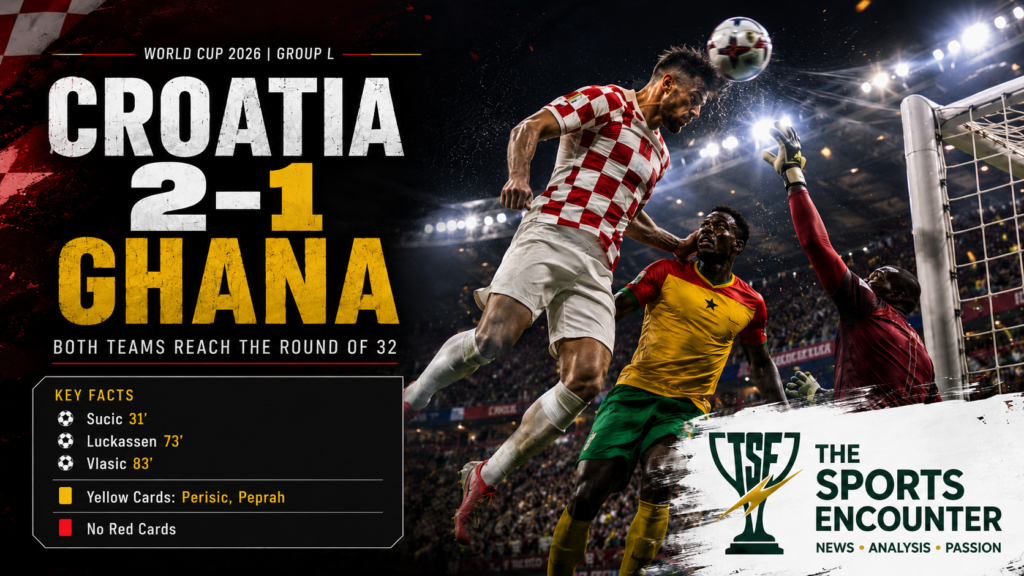
Croatia arrived in Philadelphia with pressure sitting on their shoulders. Ghana arrived with a little more room to breathe, but not enough comfort to switch off. By the end of a tense Group L finale, both teams had their ticket to the FIFA World Cup 2026 Round of 32, though they took very different emotional routes to get there.
Croatia beat Ghana 2-1 at Philadelphia Stadium, turning a dangerous group-stage position into second place behind England. Petar Sucic gave Zlatko Dalic’s side the lead in the first half, Derrick Luckassen pulled Ghana level after a VAR check in the second, and Nikola Vlasic delivered the decisive header in the 83rd minute from Luka Modric’s corner.
For Croatia, this was a rescue mission completed with experience, patience, and one late surge of tournament authority. For Ghana, defeat still came with survival. The Black Stars dropped to third in Group L, but their earlier win over Panama and draw with England proved enough to carry them into the knockouts as one of the best third-placed teams.
That is the strange beauty of this expanded World Cup. A team can lose and still move forward. A veteran side can look fragile one week and dangerous the next. A group-stage finale can feel like an ending for 80 minutes, then suddenly become the start of something bigger.
For full tournament updates, fixtures, and analysis, follow The Sports Encounter’s FIFA World Cup 2026 coverage.
Croatia vs Ghana Key Match Information
| Match | Croatia vs Ghana |
|---|---|
| Competition | FIFA World Cup 2026 |
| Stage | Group L |
| Venue | Philadelphia Stadium |
| Final Score | Croatia 2-1 Ghana |
| Croatia Goals | Petar Sucic 31’, Nikola Vlasic 83’ |
| Ghana Goal | Derrick Luckassen 73’ |
| Yellow Cards | Ivan Perisic, Kojo Peprah |
| Red Cards | None reported |
| Croatia Next Match | Portugal in the Round of 32 |
| Ghana Next Match | Colombia in the Round of 32 |
Croatia Answer the Pressure With Control and Timing
Croatia’s World Cup had needed correction after the opening 4-2 defeat against England. That result left them exposed, especially in transition, and forced them into a tighter emotional space before their second match against Panama.
The 1-0 win over Panama kept them alive, but it did not remove every question. Croatia still needed a stronger performance, not just a result. Against Ghana, they finally found enough of both.
Dalic’s team looked more purposeful from the start. Luka Modric and Mateo Kovacic gave Croatia rhythm in midfield, while Sucic added the forward movement and shooting threat they had lacked at times earlier in the group. Croatia did not overwhelm Ghana with constant chances, but they controlled the game’s direction for long stretches.
The breakthrough came in the 31st minute. Sucic received the ball from Kovacic and struck from distance, driving a low shot through traffic and into the corner. It was the kind of goal Croatia needed from a younger player, especially in a team still shaped emotionally and technically by Modric’s presence.
That balance matters. Croatia cannot ask Modric to carry every phase of every match at 40. They need runners around him. They need midfielders brave enough to shoot. They need forwards and wide players who can turn possession into pressure. Sucic gave them that spark.
Croatia’s earlier defeat against England still offers useful context for how much this team had to repair. Read our full analysis of England’s 4-2 win over Croatia and how Kane and Bellingham shaped that Group L opener.
Ghana Show Spirit, but Their Caution Leaves a Cost
Ghana entered this match in a stronger position than Croatia. Four points from two games had given Carlos Queiroz’s side a path to second place. A draw would have been enough to stay ahead of Croatia and avoid the uncertainty of third-place qualification.
That shaped Ghana’s first-half approach. The Black Stars stayed compact, protected central areas, and tried to manage the match rather than stretch it. The idea made sense on paper. In practice, it invited Croatia to settle into the game.
Ghana had shown against England that they could frustrate a favorite, deny space, and keep danger under control for long periods. That 0-0 draw turned Group L into a final-round fight and gave the Black Stars a real platform. For more background, read how England were held by Ghana as missed chances changed the shape of Group L.
Against Croatia, though, the same defensive discipline lacked enough attacking bite before halftime. Antoine Semenyo offered movement, Jordan Ayew worked to connect play, and Kamaldeen Sulemana gave Ghana pace, but the final-third threat never fully settled.
Queiroz changed the tone after the break. Abdul Fatawu and Kojo Peprah came on at halftime, while Ernest Nuamah and Brandon Thomas-Asante entered later. Ghana pushed higher, played with more urgency, and finally forced Croatia into uncomfortable defensive moments.
The reward arrived in the 73rd minute. Nuamah delivered from a set piece, and Luckassen reacted cleverly inside the box to turn the ball home. The goal initially faced an offside check, but VAR confirmed it. Ghana had equalized, and for a few minutes, second place in Group L was back within reach.
Modric Still Finds the Moment Croatia Need
The match’s decisive passage belonged to Croatia’s old master and one of its trusted finishers.
After Ghana’s equalizer, the momentum could have slipped away from Croatia. Instead, Dalic’s side raised the tempo again. Mario Pasalic forced a strong save from Benjamin Asare, Croatia won a corner, and Modric stepped across to take it.
The delivery was classic Modric: sharp, measured, and placed into a dangerous crowd. Vlasic attacked it and headed Croatia back in front in the 83rd minute.
That goal did more than win a match. It moved Croatia into second place. It protected them from the lottery of third-place qualification. It gave Modric another World Cup moment in what may be his final tournament. It also reminded the field that Croatia remain one of football’s great knockout survivors.
The performance was not perfect. Croatia still allowed Ghana back into the match. They still had spells where possession lacked penetration. But knockout football often rewards teams that know how to suffer without losing structure. Croatia have built an entire modern World Cup identity around that skill.
Ghana Survive, but Colombia Will Test Everything
Ghana’s defeat did not end their campaign. Their four-point total proved enough to take them through as one of the best third-placed teams, giving the Black Stars their first knockout-stage appearance since 2010.
That achievement matters. Ghana have waited a long time to return to this stage. The 2010 quarterfinal run remains one of African football’s most emotional World Cup stories, and this squad now has a chance to write its own chapter.
Still, the Round of 32 will demand more ambition. Colombia will not allow Ghana to sit deep for long periods without punishment. The Black Stars must find a cleaner balance between discipline and attacking confidence. Semenyo’s fitness will also matter after his late injury concern, while Fatawu and Nuamah may have strengthened their case for bigger roles.
Ghana’s tournament so far has shown tactical maturity. Their late win over Panama gave them belief, and their draw against England proved they can control space against elite opposition. The next step is different. They must now create enough danger to win a knockout match.
For wider knockout context, read our breakdown of the World Cup 2026 knockout picture and the Lucky 8 race.
Cards and Discipline
The match did not produce any red cards, but two players went into the referee’s book.
Ivan Perisic received Croatia’s yellow card in the 67th minute for a foul as Ghana began to find more attacking space. Kojo Peprah received Ghana’s yellow card in stoppage time after a late challenge during Croatia’s effort to manage the closing stages.
Neither caution changed the scoreline directly, but both reflected the match’s rising tension after halftime.
What This Result Means for the Round of 32
Croatia now move into a Round of 32 clash with Portugal. That matchup will test their legs, defensive compactness, and ability to manage elite attacking talent. Croatia’s chance depends on slowing the game, keeping midfield control, and turning set pieces into real danger.
Ghana face Colombia in Kansas City. Their path looks different. They will need speed, discipline, and sharper finishing. The Black Stars have already shown they can frustrate strong opponents, but Colombia will force them to defend wide areas, track midfield runners, and respond quickly in transition.
Group L ended with England first, Croatia second, and Ghana third. Panama bowed out, but the group gave the tournament three knockout teams and one clear reminder: survival in World Cup 2026 can come in many forms.
Croatia survived by winning when the pressure demanded it. Ghana survived by making their earlier work count.
Now both must prove they belong beyond the safety net of the group stage.
For more World Cup match reports, tactical stories, and knockout-round updates, visit The Sports Encounter’s football coverage.
The Sports Encounter’s World Cup 2026 coverage focuses on fixtures, team news, match analysis, fan stories, tournament trends, and the biggest talking points from football’s global stage.