


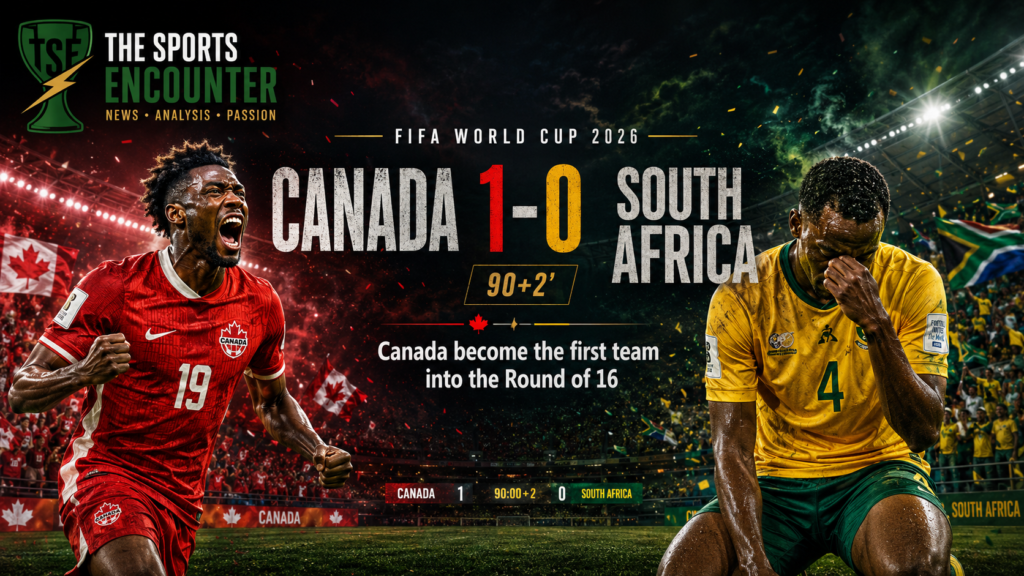
Canada waited until the night had almost run out of space.
For 91 minutes, South Africa dragged the co-hosts into an uncomfortable knockout fight at Los Angeles Stadium. They blocked, chased, cleared, recovered, and forced Canada to keep asking the same question in different ways. Then Stephen Eustáquio found the answer.
His stoppage-time goal gave Canada a 1-0 win over South Africa and made the host nation the first team to qualify for the FIFA World Cup 2026 Round of 16. It was not the smooth, sweeping statement many Canadian fans may have wanted. It was something more useful in knockout football: a hard win earned through pressure, discipline, and refusal to panic.
For full tournament tracking, follow The Sports Encounter’s FIFA World Cup 2026 coverage and our wider World Cup 2026 knockout picture.
Canada vs South Africa Key Match Facts
| Match Detail | Information |
|---|---|
| Match | Canada vs South Africa |
| Competition | FIFA World Cup 2026 |
| Stage | Round of 32 |
| Result | Canada 1-0 South Africa |
| Goal | Stephen Eustáquio, 90+2’ |
| Venue | Los Angeles Stadium, Inglewood |
| Canada status | First team into the Round of 16 |
| Red cards | None reported |
| Yellow card noted | Nathan Saliba, Canada, 54’ |
Canada Needed Nerve Before Quality
Canada controlled more of the match, but control did not quickly become comfort.
Jesse Marsch’s side started with clear attacking intent. Jonathan David looked active between South Africa’s defensive lines. Tajon Buchanan carried threat from wide areas. Tani Oluwaseyi gave Canada movement and physical presence up front. Stephen Eustáquio, back in the midfield, tried to turn possession into rhythm.
The problem was South Africa’s resistance.
Ronwen Williams gave South Africa the calm presence they needed in goal. Aubrey Modiba produced one of the match’s biggest defensive moments with a goal-line clearance from Moise Bombito’s header. Mbekezeli Mbokazi also made a crucial recovery challenge when Canada appeared ready to force the breakthrough.
Canada’s best first-half moments came from set pieces and wide combinations. Derek Cornelius missed a major headed chance from close range, while Bombito thought he had scored before South Africa scrambled the ball away. Canada also appealed for a penalty after Richie Laryea went down under pressure inside the area, but the referee allowed play to continue.
Those moments shaped the mood of the match. Canada looked stronger. South Africa looked stretched. The scoreboard stayed stubborn.
Canada had already lived through a warning in the group stage when Switzerland beat them 2-1 in Vancouver, a result that forced them into this tougher route as Group B runners-up. That earlier scare now feels important in hindsight. Canada entered this knockout match with more urgency, but also with the memory that dominance means little without execution. Read more on that result here: Switzerland Silence Vancouver as Canada Survive World Cup Scare.
South Africa’s Defensive Plan Nearly Worked
South Africa should leave this match disappointed, but not embarrassed.
Hugo Broos’ team understood the assignment. They did not try to turn the match into an open running contest for long spells. Instead, South Africa trusted structure, bodies behind the ball, and quick attacking bursts through players like Oswin Appollis and Thapelo Maseko.
That plan worked for almost the entire night.
South Africa showed more defensive clarity than they had earlier in the tournament. They narrowed central spaces, forced Canada wide, and made the co-hosts work for every clean look. Williams’ goalkeeping and Modiba’s line clearance kept the match level when Canada seemed ready to tilt it permanently.
In possession, South Africa had flashes rather than sustained pressure. Appollis gave them their sharpest attacking energy, cutting inside and forcing Canada’s back line to stay alert. Evidence Makgopa tried to provide an outlet, but South Africa rarely connected the final pass with enough precision.
Their campaign ends with a familiar knockout pain: a team can execute a plan for almost 90 minutes and still lose one moment late.
For South Africa, this World Cup still carried value. They reached a historic knockout stage, restored pride after earlier pressure, and pushed a host nation to the edge. The result hurts because they came so close. The performance deserves respect because they made Canada earn everything.
Alphonso Davies’ Return Changed the Energy
Canada captain Alphonso Davies started on the bench because of his hamstring issue, but his second-half introduction changed the emotional tone of the match.
Davies gave Canada speed, belief, and a visible lift. South Africa had to respect his acceleration immediately, even when he was not directly involved in the final action. His presence stretched the field and helped Canada increase pressure during the late stages.
That mattered because Canada had begun to look like a team fighting the clock as much as the opponent. South Africa’s blocks kept arriving. Williams kept organizing. The match carried the feel of extra time.
Then Eustáquio stepped forward.
His 92nd-minute goal rewarded Canada’s persistence and gave the match the clear finish it had been threatening to deny. It also confirmed Canada’s biggest men’s World Cup moment so far: a first knockout win and a first place in the Round of 16.
Cards and Discipline
The match stayed competitive without losing control.
Nathan Saliba received a yellow card for Canada in the 54th minute after a challenge on Khuliso Mudau. No red cards were reported in this match. That discipline mattered, especially in a game where one reckless foul or second booking could have changed the balance.
South Africa also deserve credit for defending aggressively without turning the match into chaos. Canada, meanwhile, kept pushing without losing structure.
What This Means for Canada
Canada now move into the Round of 16 with belief, pressure, and a growing national story.
The win will not erase all concerns. Canada still need sharper finishing. Their set-piece threat created danger, but several chances went unused before Eustáquio’s late goal. Against stronger opponents, that waste could become costly.
Still, knockout tournaments reward survival first. Style matters less when the bracket starts removing teams. Canada survived a tense night, beat a stubborn opponent, and gave their home World Cup campaign a major emotional lift.
The bigger story is also structural. The expanded 48-team format created a new Round of 32 layer, and Canada became the first team to pass through it into the last 16. For readers still tracking how the new tournament format works, The Sports Encounter’s guide on FIFA World Cup 2026 qualification and format explains why this edition has created fresh paths, pressure points, and bracket drama.
Final Word
Canada did not produce a perfect performance. They produced a grown-up one.
They met a South African team that defended with pride, absorbed pressure, and nearly forced the match into a longer, more nervous night. Canada kept going anyway. They trusted their midfield, leaned on their depth, and found the goal when the margin for action had almost disappeared.
For South Africa, the exit will sting because the plan came so close to working. For Canada, the celebration carries history.
The host nation is alive, the Round of 16 is waiting, and Stephen Eustáquio has written the first major knockout line of Canada’s World Cup 2026 story. Canada will now face the winner of the round of 32 match between Morocco and Netherlands.
The Sports Encounter’s World Cup 2026 coverage focuses on fixtures, team news, match analysis, fan stories, tournament trends, and the biggest talking points from football’s global stage.