


Argentina wanted proof that their World Cup rhythm could survive without Lionel Messi carrying the opening act.
They got it in Dallas.
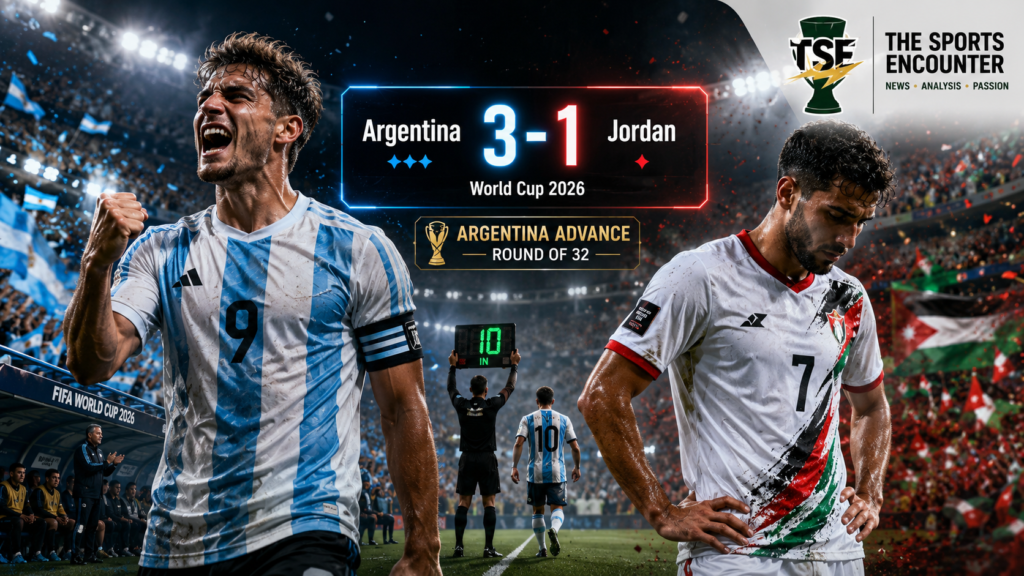
The defending champions beat Jordan 3-1 in their final FIFA World Cup 2026 Group J match, closing the group stage with a perfect record and a useful reminder before the knockout rounds. Messi started on the bench as Lionel Scaloni rotated heavily, but Argentina still controlled long stretches of the match, built a two-goal cushion before halftime, absorbed Jordan’s brief second-half push, and then watched Messi arrive late to finish the job.
For Jordan, the night carried a different meaning. Their first World Cup ended with another defeat, but also with a goal, moments of belief, and a clearer picture of the gap between qualification history and tournament survival.
For full tournament tracking, fixtures, knockout updates, and daily coverage, follow The Sports Encounter’s FIFA World Cup 2026 hub.
Match Summary: Jordan 1-3 Argentina
| Detail | Information |
|---|---|
| Competition | FIFA World Cup 2026 |
| Match | Jordan vs Argentina |
| Venue | Dallas Stadium |
| Final Score | Jordan 1-3 Argentina |
| Argentina Goals | Giovani Lo Celso, Lautaro Martínez, Lionel Messi |
| Jordan Goal | Mousa Al Tamari |
| Red Cards | None reported |
| Yellow Cards | Mohannad Abu Taha, Yazan Al Arab |
| Argentina Next Match | Round of 32 vs Cape Verde |
| Jordan Status | Eliminated from the World Cup |
Argentina Rotate, But the System Stays Sharp
Scaloni made nine changes, and that alone turned this match into more than a routine group-stage closer. Argentina had already secured top spot, so the decision made sense. The risk was rhythm.
Tournament football can punish teams that loosen too much before the knockouts. Argentina avoided that trap by keeping the structure clear. Giovani Lo Celso, Exequiel Palacios, Nico Paz, Lautaro Martínez, and Julián Álvarez gave Argentina enough ball security and movement to stop Jordan from turning the match into a loose, emotional contest.
Lo Celso’s opening goal in the 19th minute set the tone. It was the kind of strike that rewards patience rather than panic, and it helped Argentina settle into the night without needing Messi to solve the first problem.
Lautaro Martínez then doubled the lead from the penalty spot in the 31st minute, giving Argentina a 2-0 halftime cushion that reflected their control. Jordan chased, pressed in patches, and tried to break into the spaces behind Argentina’s rotated back line, but the world champions managed the game with the confidence of a team that understands tournament pacing.
That may matter more than the scoreline.
Argentina’s stars will decide bigger matches later. But the supporting cast showed they can protect the floor. In a 48-team World Cup with an expanded knockout bracket, that matters. Legs, minutes, suspensions, injuries, and short turnarounds can define campaigns. Argentina’s depth now looks like an advantage, not just a luxury.
The Sports Encounter covered Argentina’s earlier statement against Austria in Argentina Advance After Messi Turns Controversial Penalty Miss Into Magic, and this Jordan match offered a different kind of evidence. Argentina can win through Messi. They can also function before he enters the story.
Messi Did Not Start, Then Changed the Ending Anyway
Messi’s absence from the starting lineup shaped the emotional temperature of the match. Argentina fans watched a different version of their team for an hour, one built less around Messi’s gravity and more around collective control.
Then came the familiar turn.
Messi entered in the second half and scored Argentina’s third from a free kick in the 80th minute. The goal gave the match its headline moment, but the more important takeaway came before he arrived. Argentina were already ahead. They had already imposed themselves. Messi did not need to rescue them.
That is the balance Scaloni will want before the Round of 32 against Cape Verde.
Messi still changes games. His presence still shifts defenders, crowds, and momentum. Yet Argentina’s knockout hopes cannot depend on asking a 39-year-old icon to carry every minute. Against Jordan, Scaloni got the useful version of the plan: rest at the start, minutes later, impact at the end.
For broader Messi legacy context, read The Sports Encounter’s feature on the Messi vs Ronaldo GOAT debate.
Jordan Find a Goal, But Not a Way Back
Jordan’s tournament ended with a familiar mix of pride and frustration.
Mousa Al Tamari’s second-half goal gave Jordan their best moment of the night. It was clean, sharp, and deserved for a team that refused to leave quietly. For a debut World Cup side, scoring against Argentina matters. It gives supporters something to hold. It gives the squad a clip that will travel back home with meaning.
Still, the campaign exposed Jordan’s limitations at this level.
They entered the World Cup with emotion, national pride, and the lift of history. But Group J was unforgiving. Austria punished them. Algeria beat them after a pressure-heavy second half. Argentina then showed the difference between participation and elite tournament control.
Jordan struggled to sustain possession under pressure. Their defensive structure cracked too early in matches. Their attacking threat often arrived in flashes rather than phases. Against Argentina, they improved after halftime, especially once Al Tamari entered, but they had already given themselves too much to repair.
The yellow cards for Mohannad Abu Taha and Yazan Al Arab also reflected how often Jordan had to defend reactive moments. There were no reported red cards, which kept the match from turning ugly, but Jordan spent too much of the night chasing Argentina’s movement.
For more on Jordan’s earlier Group J setback, read The Sports Encounter’s Algeria Turn Second-Half Pressure Into World Cup Lifeline Against Jordan.
What Argentina Take Into Cape Verde
Argentina now move into the Round of 32 against Cape Verde, one of the tournament’s strongest underdog stories.
That matchup will ask different questions. Cape Verde have already shown discipline, patience, and emotional resilience. They will not match Argentina player for player, but knockout football rarely works that neatly. One defensive mistake, one set piece, one counterattack, and the favorite can suddenly feel the weight of the bracket.
Argentina should still enter as heavy favorites. They have Messi, Lautaro, Álvarez, midfield depth, defensive experience, and a goalkeeper in Emiliano Martínez who knows how to live inside high-pressure moments. But the Jordan match gave Scaloni useful selection evidence.
Lo Celso looked ready to contribute. Lautaro kept scoring rhythm. The rotated unit handled responsibility. Messi got minutes without starting. That is exactly the kind of group-stage management champions want before the games become unforgiving.
For a simple guide to how the expanded format works, see The Sports Encounter’s explainer: Know All About FIFA World Cup 2026 Qualification Process.
Jordan Leave With Lessons, Not Illusions
Jordan’s World Cup campaign will sting because the results did not match the dream. That is the hard truth.
But debut tournaments often serve as mirrors. They show what a team has built, what still needs work, and how far the next step really is. Jordan learned that World Cup football demands more than courage. It demands repeatable patterns, defensive calm, transition quality, and bench depth that can survive three high-intensity matches.
Their supporters will remember the anthem, the first appearance, the goal against Argentina, and the pride of seeing Jordan on football’s biggest stage. Coaches and decision-makers should remember the details: the spaces conceded, the pressure moments lost, and the need to turn historic qualification into a stronger long-term football project.
Argentina leave Dallas with nine points, a rested Messi, and a knockout match against Cape Verde waiting. Jordan leave with no points, but with a first World Cup experience that can become useful if they treat it honestly.
One team moves forward with the trophy still in sight.
The other goes home with a clearer view of what the world stage really demands.