


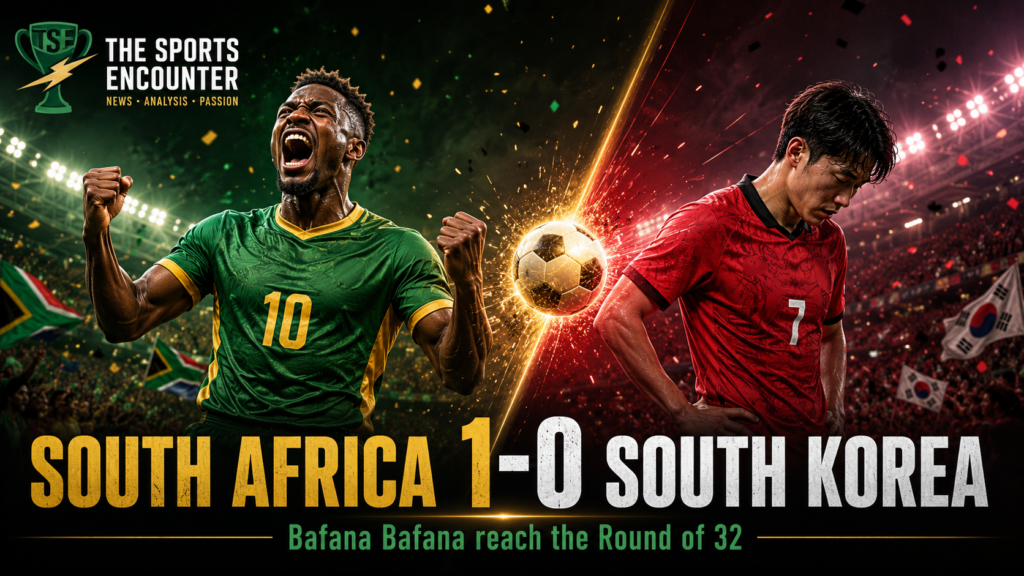
South Africa found the result they needed when the pressure was at its highest.
A 1-0 win over South Korea in their final FIFA World Cup 2026 Group A match sent Bafana Bafana into the knockout rounds for the first time in their history and left South Korea waiting anxiously to learn whether three points will be enough to continue their tournament.
Thapelo Maseko scored the decisive goal in the 63rd minute, finishing clinically inside the box after South Africa had grown into the game and looked increasingly dangerous on the break. It was the kind of moment that changes a national team’s tournament story in one kick.
For readers following our full FIFA World Cup 2026 coverage, this was another reminder that the expanded format has turned final group matches into pressure chambers. South Africa entered the match needing a win to guarantee progress. South Korea needed only a draw to secure second place. That contrast shaped the whole night.
South Korea had more of the ball, more territory, and long spells of control. South Africa had the clearer purpose.
By full-time, purpose had beaten possession.
Final Score
South Africa 1
South Korea 0
Scorer: Thapelo Maseko, 63’
Match Summary
South Korea started with the confidence of a team that knew a draw could be enough. They moved the ball patiently, stretched South Africa across the pitch, and looked to create openings through Lee Kang-in and their wide runners.
The problem was the final pass.
South Korea’s possession rarely became sustained danger. They entered good zones, but South Africa’s defensive shape stayed compact. The center-backs held their line well, the midfield tracked runners, and goalkeeper Ronwen Williams looked assured whenever South Korea forced the issue.
South Africa, meanwhile, played like a team that had learned from the chaos of its earlier group matches. Their campaign had looked fragile after the opening defeat to Mexico and the tense draw covered in our report on how Czechia and South Africa shared the pain as Group A tightened.
This time, they were less emotional, more structured, and more patient.
They accepted that South Korea would dominate the ball, then waited for transition chances.
The winner came in the second half when Maseko found space inside the area and delivered the finish South Africa had been waiting for. It was not only a goal. It was a release.
South Korea pushed late, especially after bringing more attacking energy into the game, but their pressure lacked precision. Crosses were cleared. Corners were defended. Half-chances came and went. South Africa held firm and protected the biggest World Cup result in their history.
South Africa Performance Analysis
This was South Africa’s most mature performance of the group stage.
They did not play with panic, even when South Korea controlled possession. Their back line stayed compact, their midfield protected central spaces, and their attacking players chose the right moments to break forward.
Maseko was the obvious match-winner, but this victory was built on discipline before it was won by finishing. South Africa understood the match situation better. They knew South Korea would leave space behind as the game stretched. They also knew one clean transition could be enough.
That is exactly how it played out.
South Africa’s biggest improvement was emotional control. After losing 2-0 to Mexico in their opener and drawing 1-1 with Czechia, they came into the final match under real pressure. A weaker team could have chased the game too early. South Africa stayed calm, waited for their opening, and then defended the lead with impressive resolve.
Their reward is historic: second place in Group A and a place in the Round of 32.
South Korea Performance Analysis
South Korea will feel this was a match they let slip.
They had the ball for long periods, but their attacking rhythm lacked bite. There were neat passing sequences, intelligent rotations, and moments of promise, yet not enough conviction around the South African penalty area.
That was a sharp contrast with their opening win, when Hwang In-beom led South Korea’s fightback against Czech Republic and gave them early control of their Group A story. Against South Africa, that same authority disappeared when it mattered most.
The bigger concern was chance quality. South Korea had the technical players to control the match, but they did not turn that control into enough clean looks at goal. Their movement became predictable as the game wore on, and South Africa’s defenders were rarely pulled badly out of shape.
Son Heung-min’s introduction added urgency, but it did not fully change the pattern. South Korea needed composure in the final third. Instead, they became rushed as the clock ran down.
This defeat does not officially end their tournament, but it makes their path uncomfortable. They now depend on other third-placed teams across the remaining groups.
Group A Final Picture
Mexico finished top of Group A with a perfect record.
South Africa finished second with four points after one win, one draw, and one defeat.
South Korea finished third with three points, while Czechia ended bottom with one point.
For South Africa, the group stage became a story of recovery. They began with a defeat against Mexico, rescued a draw against Czechia, then beat South Korea when everything was on the line.
For South Korea, the story is far more frustrating. They opened with a 2-1 win over Czechia, lost narrowly to Mexico, then failed to take the point they needed against South Africa.
Who Will South Africa Play in the Knockout Round?
South Africa will play Canada in the Round of 32.
That match gives both teams a rare opportunity. Canada reached the knockouts as Group B runner-up, while South Africa arrived as Group A runner-up. Neither side will treat this as a free hit. Both will see it as a winnable knockout match and a chance to push deeper into the tournament.
Canada’s group-stage route had its own sharp turns. Their campaign began with a historic moment when Cyle Larin rescued Canada’s first World Cup point on home soil. They later survived a final-round scare, as covered in our report on Switzerland silencing Vancouver while Canada still advanced.
South Africa will need the same defensive discipline against Canada, but they may also need more sustained attacking presence. Canada have pace, direct runners, and a stronger goal difference from the group stage. South Africa cannot only defend and wait. They will need to carry threat early enough to keep Canada honest.
Can South Korea Still Reach the Knockout Stage?
South Korea can still qualify, but their chances are no longer in their own hands.
Under the expanded FIFA World Cup format, the top two teams from each group advance automatically, along with the eight best third-placed teams. South Korea finished third in Group A with three points and a -1 goal difference.
For readers still getting used to the expanded tournament structure, our guide to the FIFA World Cup 2026 qualification process explains why third-place teams remain alive even after missing out on the automatic top-two places.
South Korea’s position gives them a chance, but not a guarantee.
Their total is better than some third-placed teams, including Scotland, who finished Group C with three points and a weaker goal difference. However, several other groups still have matches to complete, and South Korea need enough third-placed teams to finish below them.
In simple terms, South Korea need results elsewhere to protect them.
Three points with a -1 goal difference is a nervous total. It can be enough in a 48-team format, but it depends heavily on how the remaining groups finish.
Cards and Discipline
There were no red cards in the match.
The available match trackers recorded yellow cards for South Korea striker Cho Gue-sung and South Africa defender Aubrey Modiba. Cho was booked for a high challenge, while Modiba was also listed as booked during the second half.
South Africa had already dealt with suspension problems earlier in the group stage, so finishing this decisive match without a red card was important for their knockout preparation.
What This Result Means
This was more than a win for South Africa. It was a breakthrough.
South Africa have had World Cup moments before, especially as hosts in 2010, but this result gives them something different: a place in knockout football earned through pressure, discipline, and a decisive final-match performance.
For South Korea, the night was a warning about the limits of possession without punch. They had enough control to manage the game, but not enough final-third quality to protect their tournament position.
South Africa walk into the Round of 32 with belief.
South Korea now wait.
And in World Cup football, waiting is often the hardest part.