


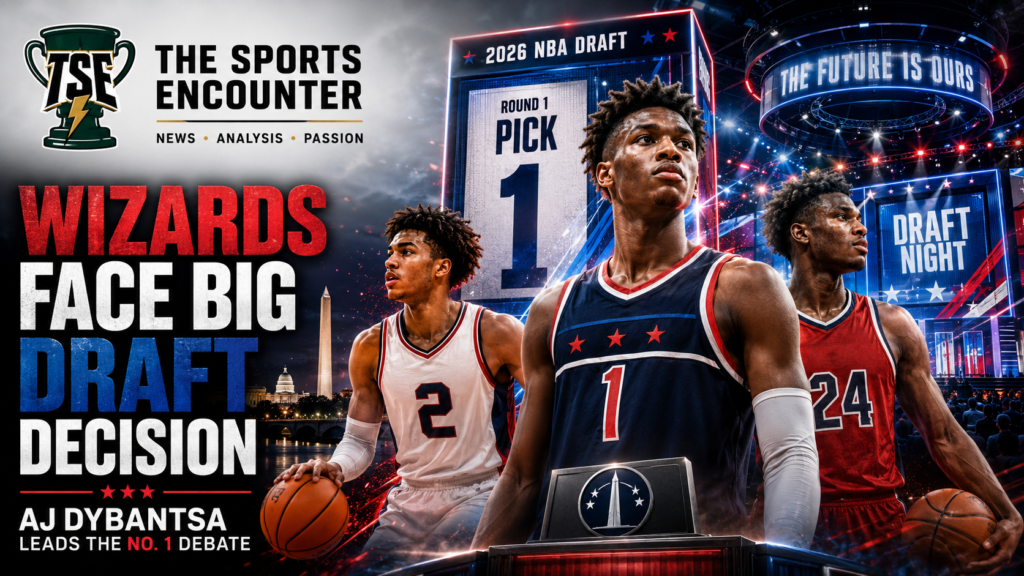
The Washington Wizards have been here before. Sometimes it went badly. Sometimes it changed everything.
In 2001, Washington used the No. 1 overall pick on Kwame Brown, a high-school gamble that became one of the most painful draft memories in franchise history. In 2010, the Wizards took John Wall, and for a while, the franchise had speed, hope, identity, and a true lead guard who made Washington feel relevant again.
Now Washington Wizards are back at No. 1.
This time, the decision sits at the top of a 2026 NBA Draft class that has real star power and enough debate to make Washington’s front office sweat until the final card goes in.
AJ Dybantsa looks like the safest answer. Darryn Peterson may still have the higher offensive ceiling if everything breaks right. Cameron Boozer is the steady, productive, forceful forward who could make the top two teams hesitate. Caleb Wilson, another high-level forward, waits just behind that group.
For readers following The Sports Encounter’s NBA coverage, this draft is not only about one pick. It is about how losing teams rebuild, how front offices measure risk, and how quickly a franchise can move from bad basketball to a real plan.
Washington’s No. 1 Pick Is About More Than Talent
The Washington Wizards need talent. That part is obvious.
But at No. 1, they need something bigger than talent. They need direction.
Washington has spent too much time in the NBA’s vague middle and lower tier, searching for a structure that fans can believe in. The No. 1 pick gives the franchise a rare chance to name its next era.
That is why this decision cannot be treated like a standard draft-board exercise.
The Washington Wizards have to ask harder questions.
Who fits with the current roster? Who can grow with Trae Young after Washington retained him on a four-year deal? Who gives the franchise the clearest identity? Who has the maturity to handle losing early, pressure quickly, and a market that has already lived through one famous No. 1 mistake?
Dybantsa, Peterson, and Boozer all answer those questions differently.
That is what makes this draft night so interesting.
AJ Dybantsa Looks Like the Cleanest No. 1 Answer
AJ Dybantsa has been treated as the likely No. 1 pick for much of the draft cycle, and the logic is not hard to understand.
At 6-foot-9, he brings size, scoring polish, shot creation, transition force, and enough maturity to make scouts comfortable. His freshman season at BYU gave Washington and the rest of the league a full college sample to study. He led the nation in scoring at 25.5 points per game and did it while carrying the kind of offensive burden that usually exposes young players quickly.
Dybantsa did not hide inside a system.
He was the system on many nights.
His offensive game already feels advanced for a teenager. He can attack downhill, finish through contact, get to his mid-range spots, score in transition, draw fouls, and use his size against smaller defenders. He still needs to tighten parts of his handle and become a more consistent shooter, but his baseline is high.
That matters for Washington.
Washington Wizards do not need a mystery box. They need a player who can step into heavy minutes, grow through mistakes, and still give the franchise a clear reason to watch every night.
Dybantsa gives them that.
His comments during the pre-draft process also said plenty about his confidence. After visiting both Washington and Utah, he noted that he did not need to work out for either team because they already knew what he could do.
That can sound bold. In his case, it also sounds accurate.
Why Dybantsa Fits Better Beside Trae Young
The Trae Young factor may be the quiet key to Washington’s decision.
If the Washington Wizards had no established lead guard, Darryn Peterson’s case at No. 1 might feel stronger. Peterson is a dynamic scoring guard with real self-creation upside. But Washington’s decision to keep Young changes the roster math.
Young needs size, wings, finishers, defenders, and players who can punish rotating defenses without needing to own every possession.
Dybantsa makes more sense in that picture.
He can become Washington’s big wing scorer while Young organizes the offense. He can run the floor, attack tilted defenses, and give the Wizards a second front-line creator without forcing the franchise into a two-small-guard identity from day one.
That does not make Peterson a bad fit. It only makes the fit more complicated.
Washington has to decide whether it wants to build around a guard pairing or give Young a bigger, more flexible scoring partner. Given where the league is going, size on the wing remains the safer premium bet.
That is why Dybantsa still feels like the pick.
Darryn Peterson Is the Temptation Washington Wizards Cannot Fully Ignore
Darryn Peterson’s case is not going away quietly.
The Kansas guard has the type of offensive game that makes front offices think twice, even when another prospect looks cleaner on paper. At 6-foot-5, Peterson can score from multiple levels, create off the dribble, pressure defenders, and carry possessions late in the clock.
He averaged 20.2 points in his one college season at Kansas. He also made it clear that he wants to join Danny Manning and Andrew Wiggins as Kansas players taken No. 1 overall.
The confidence is there.
The talent is there.
The questions are there too.
Peterson missed 11 of Kansas’ 35 games and left others early because of physical issues, including cramping. Durability has become the main concern around his draft case. That matters because NBA seasons are not gentle. They are longer, faster, more physical, and much less forgiving than college campaigns.
Peterson has framed last season as adversity he can learn from. That may be true.
Still, Washington Wizards cannot spend the No. 1 pick on hope alone.
If the Wizards believe Peterson’s physical concerns are manageable and his upside is clearly higher than Dybantsa’s, they could surprise the room. But that would be a braver call than simply taking the best wing scorer in the class.
Cameron Boozer Keeps the Top of the Draft Honest
Cameron Boozer is the name that makes this draft more layered.
The Duke forward averaged 22.5 points and 10.2 rebounds last season, giving him one of the strongest production profiles near the top of the board. He is polished, strong, smart, and ready to help a team quickly.
He may not carry the same mystery-ceiling discussion as Peterson or the same wing-scorer appeal as Dybantsa, but Boozer has fewer empty calories in his game.
He produces. He rebounds. He understands positioning. He does not need to be sold through imagination alone.
The Utah angle makes this even more interesting.
Boozer’s father, Carlos Boozer, played for the Jazz and now works in Utah’s front office, with a focus on evaluating draft prospects. That does not mean Utah will take Cameron at No. 2. It does mean the Jazz know the family, the background, and the player closely.
If Washington takes Dybantsa, Utah may face the draft’s most uncomfortable choice: Peterson’s upside or Boozer’s reliability.
That decision could shape the top of the lottery almost as much as Washington’s pick.
The Jazz Are Waiting for Washington’s Signal
The Utah Jazz hold the No. 2 pick, but their real draft begins with Washington.
If the Wizards take Dybantsa, Utah likely has to choose between Peterson and Boozer. If Washington shocks everyone and takes Peterson, the Jazz could have Dybantsa fall into their lap after watching him play down the road at BYU.
That would be a dream scenario for Utah.
Dybantsa’s BYU season gave the Jazz a close look at his game, his local impact, and his ability to carry attention in the state. While teams cannot draft purely for geography, a high-level prospect with local familiarity always adds a layer of appeal.
The Jazz also need a franchise-level answer.
Utah has been collecting pieces and searching for its next true centerpiece. Dybantsa, Peterson, or Boozer could all fit that need in different ways. The board may look simple from the outside, but Utah’s choice could reveal how the franchise views its rebuild.
Do the Jazz want a scoring guard, a polished power forward, or the best available wing if Washington passes?
That is the pressure sitting behind the No. 2 pick.
Caleb Wilson Could Be the First Player After the Big Three
North Carolina forward Caleb Wilson is expected to come off the board near No. 4, with the Memphis Grizzlies and Chicago Bulls sitting just behind Washington and Utah in the top four order.
Wilson averaged 19.8 points and 9.4 rebounds, giving him a strong frontcourt case in a draft that briefly turns guard-heavy after the first few selections.
He may not carry the same headline buzz as Dybantsa, Peterson, or Boozer, but that could work in his favor. Teams often spend so much time debating the top tier that the next player becomes undervalued.
Wilson has enough production and size to become the kind of pick that looks better two years later than it did on draft night.
For Chicago, in particular, this draft matters because the Bulls have four picks. That gives them multiple paths: take a high-upside player early, package assets, or use depth to reset the roster around younger pieces.
The NBA Draft Could Turn Into a Guard Run Quickly
After the top forwards and Peterson, the board gets crowded with guards.
Keaton Wagler of Illinois, Darius Acuff Jr. of Arkansas, Mikel Brown Jr. of Louisville, Kingston Flemings of Houston, and Brayden Burries of Arizona are all part of the group expected to draw lottery and first-round attention.
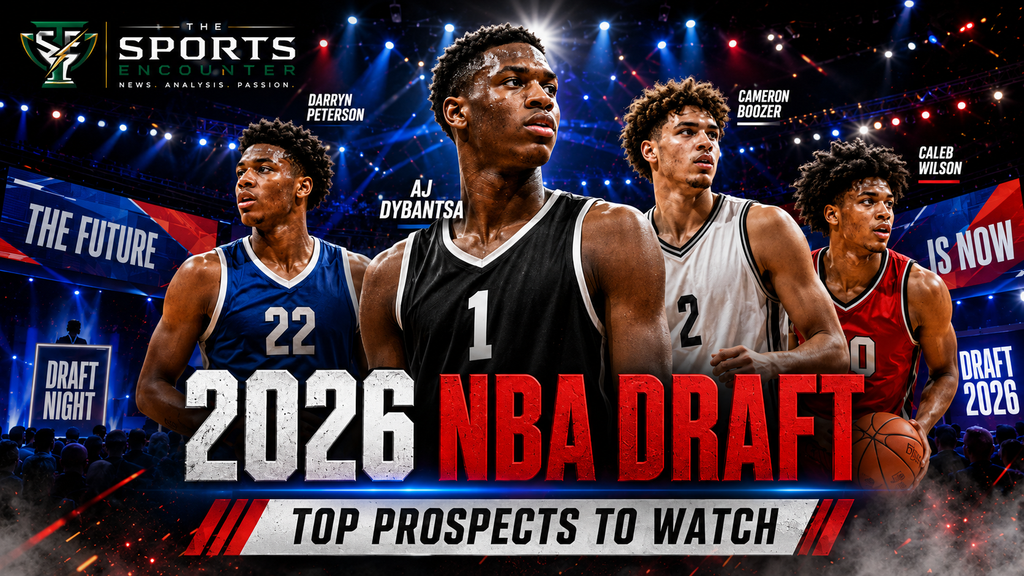
That guard depth makes Peterson’s evaluation even more important.
If a team believes it can find backcourt creation later in the lottery, it may value Dybantsa or Boozer more at the top. If it believes Peterson sits clearly above the rest of the guards, then his injury concerns become easier to tolerate.
This is how draft boards really work.
Teams are not only comparing players in isolation. They are comparing scarcity. Wing creators are hard to find. Big forwards who produce early are hard to find. Lead guards are valuable, but this class has several of them.
That could help Dybantsa at No. 1.
Karim Lopez Gives the Draft Its International Swing
Karim Lopez of Mexico is widely viewed as the top international prospect in this class.
The New Zealand Breakers forward is expected to land around the middle of the first round, giving teams outside the lottery a chance at a long-term developmental swing.
International prospects are often judged through uneven visibility. Some fans know college stars in detail but only see international players through short clips, tournament flashes, and scouting summaries. That can make players like Lopez harder to place publicly, even when teams have done deeper work.
His selection range will say something about how comfortable NBA front offices are with his development curve.
In a draft with a strong domestic top tier, Lopez gives the middle of the first round a different flavor.
The Knicks Enter as Champions, Not Rebuilders
The New York Knicks are in a very different position from Washington.
After winning the 2026 NBA championship, the Knicks enter the draft with the No. 24 pick and second-round selections at No. 31 and No. 55. That gives them useful flexibility without the pressure of needing a savior.
Championship teams draft differently.
They look for rotation fit, cost-controlled depth, defensive role players, shooting, and players who can survive limited minutes without needing developmental oxygen every night.
That is a luxury Washington does not have.
The Washington Wizards need a face. The Knicks need reinforcement.
That gap shows how wide the NBA team-building spectrum can be on draft night. One team is searching for a foundation. Another is trying to protect a title window. For more on the Knicks’ championship context, read The Sports Encounter’s report on New York ending its 53-year title wait.
Why This Draft Matters for the League’s Next Cycle
The 2026 NBA Draft arrives at a fascinating time.
The Knicks just won the title. The Spurs have Victor Wembanyama and another set of picks. The Thunder, Nuggets, Timberwolves, Celtics, Grizzlies, and several other teams are adjusting to a league where youth, cap structure, and star timelines collide quickly.
Washington’s pick could shape the bottom of the Eastern Conference for years.
Utah’s pick could define its rebuild.
Memphis and Chicago could add major young pieces.
San Antonio has four total picks and the luxury of building around an existing superstar. The Bulls also have four selections, which gives them one of the more flexible draft-night setups. The Pacers and Trail Blazers, meanwhile, enter without picks in the 60-player draft.
That variety makes the draft more than a prospect showcase.
It is a map of where teams think they are.
Some are chasing foundations. Some are chasing role players. Some are chasing trade flexibility. Some are trying to avoid expensive mistakes.
Washington sits at the center because No. 1 always does.
Washington Wizards Should Take Dybantsa
There is room for debate, but the best answer still looks like AJ Dybantsa.
He gives Washington size, scoring, star upside, and a cleaner fit beside Trae Young. He offers more positional value than Peterson and more creator upside than Boozer. He also gives the Wizards the clearest public reset after years of uncertainty.
Peterson may become an elite guard. Boozer may become the most reliable top-three player. Draft history is full of uncomfortable surprises.
But Washington has to make the best decision with the evidence available now.
Dybantsa is the strongest balance of floor, ceiling, fit, and franchise need.
That is usually what the No. 1 pick should be.
Final Word: Can Washington Wizards Deal With It?
The Wizards cannot afford to make this pick feel clever for the sake of being clever.
They need clarity.
AJ Dybantsa gives them that. Darryn Peterson gives them temptation. Cameron Boozer gives them pressure. Caleb Wilson and the rest of the class give the lottery depth.
Washington’s NBA draft history will hover over the room because No. 1 picks are never just names on a board. They become chapters in a franchise’s memory.
Kwame Brown became a warning. John Wall became a revival.
Now the Washington Wizards need this pick to become the beginning of something stable.
If they choose Dybantsa, they will be betting on the most complete top prospect in the class. If they choose Peterson, they will be betting on guard brilliance over positional fit and health concerns. If they choose Boozer, they will be betting on production, strength, and immediate reliability.
There is no risk-free choice.
There is, however, a sensible one.
Washington Wizards should take Dybantsa and start building the next version of the franchise around a wing scorer with the size, polish, and confidence to carry the weight.
For more basketball coverage, visit The Sports Encounter’s NBA Hub. You can also read why the champion Knicks opened only fourth in 2026-27 NBA title odds, how Knicks-Spurs ratings showed the NBA still owns the big stage, and why early offseason moves are already reshaping the league’s next season.
The Sports Encounter’s NBA coverage focuses on league news, player movement, franchise strategy, major games, playoff stories, draft developments, and the biggest basketball talking points shaping the sport.
FAQs
Who has the No. 1 pick in the 2026 NBA Draft?
The Washington Wizards hold the No. 1 overall pick in the 2026 NBA Draft.
Who is favored to be the No. 1 pick?
AJ Dybantsa is widely viewed as the leading candidate to go No. 1, though Darryn Peterson and Cameron Boozer remain part of the top-pick discussion.
Why is AJ Dybantsa such a strong No. 1 candidate?
Dybantsa combines size, scoring polish, maturity, and positional value. He led the nation in scoring at BYU and fits well beside Trae Young in Washington.
What are the concerns around Darryn Peterson?
Peterson is a high-upside scoring guard, but his Kansas season included missed games and physical concerns, which have raised questions about durability.
Could Cameron Boozer go No. 2 to Utah?
Yes. If Washington takes Dybantsa, Utah could choose between Peterson and Boozer at No. 2. Boozer’s family connection to the Jazz adds another layer, but the decision will still depend on Utah’s evaluation.