


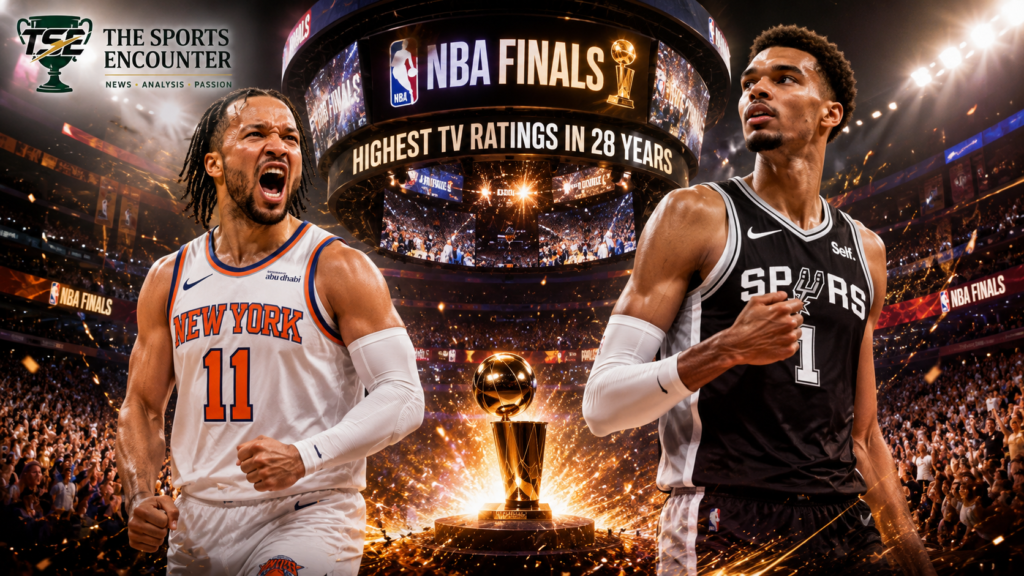
The NBA did not only crown a champion in 2026. It found a reminder of what still happens when the right Finals matchup reaches the right emotional moment.
The New York Knicks’ title win over the San Antonio Spurs became the league’s biggest television success story in nearly three decades. According to Nielsen data cited by Reuters, the Knicks-Spurs NBA Finals averaged 20.6 million viewers, making it the most-watched Finals since Michael Jordan’s Chicago Bulls beat the Utah Jazz in 1998.
That number carries weight on its own. The larger story sits beneath it.
This was a Finals powered by New York’s 53-year title drought, Jalen Brunson’s superstar arrival, Victor Wembanyama’s first championship-stage test, and a national audience ready for a basketball story with clear stakes. The Knicks did not simply beat the Spurs in five games. They turned the series into appointment television, then turned the championship into a merchandise rush that broke Fanatics records.
For a league often measured through highlight clips, social media debates, player movement, and regular-season fatigue, Knicks-Spurs proved something important.
When the NBA gets the right story, fans still show up live.
Knicks-Spurs Gives the NBA Its Biggest Finals Audience Since 1998
The 2026 NBA Finals averaged 20.6 million viewers across the series. Game 5, the Knicks’ 94-90 title-clinching win in San Antonio, averaged 24.5 million viewers on ESPN and ABC. The audience peaked at 33 million as Brunson carried New York through a fourth-quarter comeback and closed the door on the Spurs.
Those figures are huge because they reset the recent conversation around NBA viewership.
Last year’s Finals between the Oklahoma City Thunder and Indiana Pacers went seven games and averaged 10.31 million viewers. Knicks-Spurs nearly doubled that average despite ending in five games. That kind of jump cannot be explained only by the scoreline, the number of games, or the quality of basketball.
This Finals had national gravity.
The Knicks brought New York’s market, history, noise, and frustration. The Spurs brought Wembanyama, a young roster ahead of schedule, and a franchise name connected to championship pedigree. Together, they created a series that reached beyond routine basketball fans.
For more basketball coverage across the league, follow The Sports Encounter’s NBA hub.
Why the 20.6 Million Average Matters
The NBA has spent years navigating a changing media landscape. Younger fans consume games differently. Clips travel faster than broadcasts. Regular-season viewership often faces questions about attention, injuries, scheduling, and player availability.
The Finals remain different.
A strong Finals can still become one of the biggest live sports events in America. Knicks-Spurs showed that live basketball can dominate when casual viewers understand the story before the opening tip.
New York chasing its first title since 1973 was easy to understand. Brunson trying to finish one of the great Knicks postseason runs was easy to follow. Wembanyama trying to bring the Spurs back to the top so early in his career gave neutral viewers another reason to care.
That clarity helped the Finals break through.
Game 5 Became the Perfect Ratings Finish
The Knicks closed the series with a 94-90 win in Game 5, and the game gave television exactly what it needed.
New York trailed by 10 points in the fourth quarter. The Spurs had a home crowd behind them and enough momentum to threaten a Game 6. Knicks fans could feel the title close, but decades of disappointment made the moment feel unstable.
Then Brunson took over.
His 45-point performance gave the Finals its signature individual display. It also gave broadcasters the kind of fourth-quarter drama that pulls casual viewers into the ending. The 33 million viewer peak reflected that tension. People wanted to see whether the Knicks could finally finish the job.
The Sports Encounter covered the full title-clinching moment in our report on how the New York Knicks ended their 53-year NBA title wait.
Brunson Turns a Title Into a National Moment
Every championship run needs a face. Brunson became that face for the 2026 Knicks.
He had already moved beyond the label of All-Star guard. By the end of Game 5, he had become the defining player of a championship that New York fans waited more than half a century to see.
His 45 points mattered because of timing. He scored when the game tightened. He settled the Knicks when possessions became heavy. He gave New York a closer in the exact moment when the city needed one.
That kind of performance travels.
It drives television replays, merchandise sales, social media discussion, and future legacy debates. Fans may forget some details of the series over time. They will remember Brunson taking the ball late in Game 5 and refusing to let the Knicks collapse.
The Merchandise Rush Confirms the Emotional Power of the Title
The ratings surge was only one half of the story.
The other half came from Fanatics, which reported that Knicks championship merchandise set a new first-24-hours sales record for any league champion. The previous record belonged to the Philadelphia Eagles after their Super Bowl LIX victory over the Kansas City Chiefs in 2025.
Fanatics also said Knicks sales doubled the previous top NBA championship seller, the 2020 Los Angeles Lakers. At one point, the company received more than 8,000 orders per minute.
That is not ordinary celebration spending. It is emotional release.
Knicks fans had waited 53 years. For many of them, championship T-shirts and hats were not just souvenirs. They were proof that the wait had finally ended. The longer the drought, the stronger the reaction once the title arrives.
The city is already turning that release into a wider public celebration, which we covered in our story on the New York Knicks championship parade.
Why Knicks Merchandise Hit Record Pace
Championship merchandise works best when it combines three forces: market size, emotional wait, and a central player story.
The Knicks had all three.
New York is one of the strongest sports markets in the world. The title drought stretched back to 1973. Brunson gave fans a player they could attach the moment to. Add a national television audience of more than 20 million per game, and the merchandise rush becomes easier to understand.
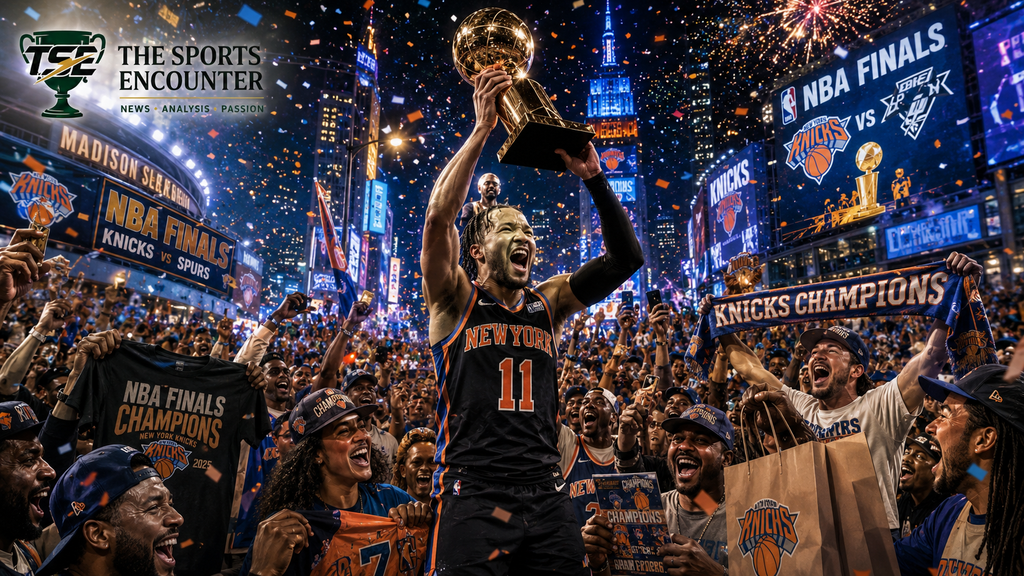
The Knicks did not only win a title. They activated a fan base that had spent decades waiting to spend, celebrate, and finally claim the championship identity again.
Why New York Changed the Temperature of the Finals
The NBA does not need New York to matter every year, but a great Knicks team changes the league’s temperature.
Madison Square Garden carries a different kind of visibility. New York sports talk moves fast. National media attention follows every storyline. Casual fans recognize the Knicks even when they do not follow every playoff team.
This matters for television.
A Knicks Finals appearance gives the NBA a larger cultural frame. Celebrity crowds, city-wide tension, historic frustration, and a massive fan base all become part of the broadcast experience. The games feel bigger because the setting feels bigger.
San Antonio gave the matchup balance. Wembanyama brought future-facing intrigue, while the Spurs’ rise gave the series a second storyline beyond New York’s drought. The result was a Finals with both present emotion and future tension.
The Spurs Lost the Series But Gained National Weight
San Antonio lost in five games, but the Spurs did not disappear from the Finals story.
Wembanyama’s first Finals appearance gave the league a preview of what may come next. He entered the series as one of basketball’s most important young stars, and the matchup against New York placed his development in front of the league’s largest audience in years.
The Spurs had painful moments, especially late in the series. They had also carried earlier scars from Game 4, when New York’s comeback shifted the emotional balance of the Finals. Our analysis of how the Knicks taught the Spurs the cruelest lesson of the NBA Finals showed how much San Antonio still had to learn about closing championship games.
That learning curve now becomes part of the Spurs’ future.
A young team that reaches the Finals often leaves with both pride and regret. San Antonio will feel both. Wembanyama gave the series a long-term story, and the Spurs’ defeat may become a step toward something larger if they return sharper next season.
Wembanyama’s Value Went Beyond the Box Score
Wembanyama did not win the title, but his presence helped make the series feel like a generational crossover.
Brunson represented the finished product: polished, composed, hardened by playoff pressure. Wembanyama represented the future: rare talent, huge ceiling, and a team still learning how to win the final possessions in June.
That contrast helped the Finals.
Fans were watching the Knicks end a historic drought. They were also watching the Spurs discover what championship pressure demands. The series gave the NBA a complete narrative arc.
What This Ratings Boom Means for the NBA
Knicks-Spurs showed that NBA viewership concerns need context.
The league still faces challenges in regular-season attention and fragmented media consumption. Finals ratings, though, depend heavily on matchup clarity, emotional stakes, star power, and market reach. When those pieces align, the audience can still be massive.
This series marked only the third time since 1999 that the NBA Finals averaged at least 20 million viewers. It also produced the highest Finals average since ABC and ESPN began broadcasting the Finals in 2003.
That should matter to the NBA’s partners, sponsors, and future media strategy.
The league does not need every Finals to copy Knicks-Spurs. It does need to keep building stories that casual fans can understand quickly. Star rivalries, city identity, title droughts, young contenders, and legacy moments help turn great basketball into national television.
The Business Lesson Behind Knicks-Spurs
The 2026 Finals delivered a rare sports-business combination.
Television audience soared. Merchandise records fell. A major market reclaimed championship relevance. A star guard became a New York icon. A young Spurs core gained national exposure. The NBA ended its season with a story that felt bigger than the bracket.
That is the league’s ideal outcome.
The Knicks became champions on the court, but they also became the center of a commercial surge. Their title run created value across broadcasts, apparel, ticket demand, sponsorship, future scheduling, and year-round media attention.
This is why teams with historic brands still matter. When they finally win, the reaction can stretch across the entire sports economy.
The Next Question: Can the Knicks Stay on Top?
The ratings boom now creates another storyline.
The Knicks are champions, but the market is already looking ahead. Early 2026-27 title odds do not place New York as the clear favorite, despite the trophy and Brunson’s Finals MVP run. That makes the next chapter even more interesting.
We explored that tension in our analysis of why the champion Knicks are only fourth in the early NBA 2026-27 title odds.
That question will follow New York all summer. Was this the start of a Knicks window, or a perfect storm that peaked at the right time?
The answer will shape next season’s NBA conversation.
Final Verdict
Knicks-Spurs gave the NBA more than a champion.
It gave the league its strongest Finals audience in 28 years, a title-clinching Game 5 that averaged 24.5 million viewers, a 33 million viewer peak, and a record-breaking merchandise rush that showed how much emotional power still lives inside the right sports story.
New York’s 53-year wait gave the series depth. Brunson’s 45-point masterpiece gave it a face. Wembanyama and the Spurs gave it a future. The ratings gave it business weight.
The NBA will take plenty from this Finals, but one lesson stands above the rest.
When basketball has clear stakes, a major emotional hook, and stars who meet the moment, the sport still owns the big stage.