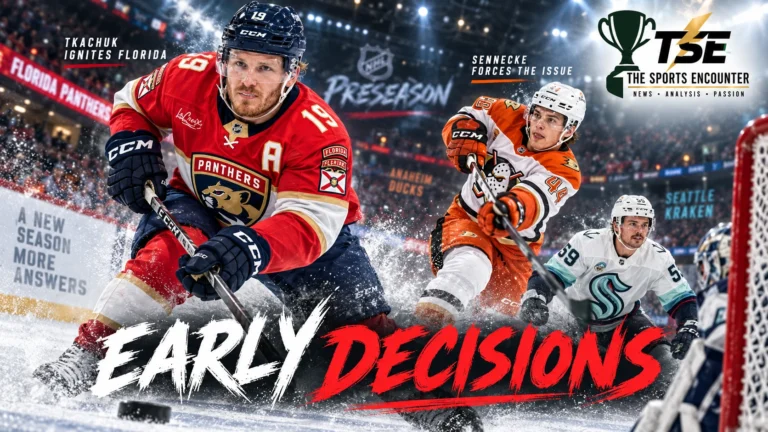
Florida Panthers Jump Back Into Stanley Cup Favorites After Brady Tkachuk Blockbuster
Brady Tkachuk’s move to Florida has changed the Stanley Cup conversation before the offseason has even settled. The Panthers paid a heavy price, but the reward is clear: two Tkachuk brothers, a harder top six, and a championship window that just reopened.
Brady Tkachuk is now a Florida Panther. The Florida Panthers did not ease into the NHL offseason.
They kicked the door open, grabbed one of the league’s most recognizable power forwards, reunited the Tkachuk brothers, and forced oddsmakers to rewrite the Stanley Cup conversation before July even arrived.
Matthew Tkachuk is no longer the only Tkachuk setting the tone in South Florida. And after a season that ended with Florida outside the playoffs, the Panthers are suddenly being priced like a Stanley Cup threat again.
ALSO READ: Rangers Send Adam Edstrom to Predators as Nashville Buys Size and New York Clears a Path
That tells you almost everything about how the league views this trade.
Florida missed the postseason after back-to-back Stanley Cup wins, but the market did not see a declining team. It saw a wounded contender with enough core talent, enough front-office nerve, and now enough edge to get dangerous again.
For readers following The Sports Encounter’s NHL coverage, this is the first major offseason move that truly changes the 2026-27 title picture.
The Trade That Changed Florida’s Summer
The Panthers acquired Brady Tkachuk from the Ottawa Senators in a blockbuster deal that sent a massive draft package the other way.
Ottawa received Florida’s two first-round picks in the 2026 NHL Draft, No. 9 and No. 25 overall, a top-10 protected first-round pick in 2029, and a second-round pick in 2027. Florida had acquired the No. 25 pick earlier from the Seattle Kraken in a separate move involving Mackie Samoskevich.
That is not a casual price.
It is the price a team pays when it believes its championship window is still open and the missing piece is not patience, but force.
Tkachuk brings 213 goals, 250 assists, and 463 points from 572 regular-season games with Ottawa. He also brings the kind of identity that does not need a long scouting report. He plays hard, agitates naturally, scores around traffic, drags teammates into the fight, and makes opponents uncomfortable shift after shift.
Florida already had that personality in Matthew Tkachuk.
Now it has two of them.
Why the Odds Moved So Quickly
Before the Brady Tkachuk trade, BetMGM listed Florida at +1100 to win the 2026-27 Stanley Cup. After the deal, the Panthers moved to +800.
That moved them behind only the defending champion Carolina Hurricanes and the Colorado Avalanche, both listed at +750. Florida also jumped ahead of the Vegas Golden Knights at +900 and pulled clear of the Edmonton Oilers at +1100.
Odds are not predictions. They are market reactions shaped by money, public interest, roster quality, and bookmaker risk.
Still, this movement matters because it shows how quickly Florida’s perception changed.
According to the reported BetMGM numbers, 64% of all bets placed on the next Stanley Cup champion after the trade backed the Panthers. That is not just curiosity. That is a rush of public confidence around a team many fans were not ready to write off anyway.
The Golden Knights remain a major betting liability at BetMGM because they have attracted a large share of money despite a smaller share of total tickets. But Florida now sits in the center of the early title discussion.
That is a strong shift for a team that finished 14th in the Eastern Conference last season.
It also says something about reputation. Florida did not lose its championship aura in one bad year. It only lost its place in the playoffs.
Florida’s Real Bet Is on Identity, Not Just Talent
This move is easy to explain through names.
Brady joins Matthew. The Panthers get tougher. Ottawa gets picks. Odds shorten. Fans react.
The deeper story is about identity.
Florida’s best teams were never built only on skill. They won because they made games feel miserable for opponents. They forechecked hard, lived around the crease, invited contact, and turned long playoff series into emotional stress tests.
Brady Tkachuk fits that model almost too neatly.
He is not a luxury scorer who needs the game styled around him. He is a pressure player. He can live on the wall, work below the goal line, crash the net, take punishment, create rebounds, and force defenders into mistakes.
That matters in a league where playoff hockey still rewards teams that can win ugly minutes.
Florida’s title years proved that talent matters, but so does appetite. The Panthers played with bite. They wore teams down. They turned chaos into a weapon.
Brady Tkachuk gives them more of that.
The Tkachuk Brothers Give Florida a Rare Emotional Edge
There is also the family element, and it is impossible to ignore.
Brady and Matthew Tkachuk have already won together with Team USA, helping the Americans secure Olympic gold earlier this year. Now they will try to turn that chemistry into NHL hardware.
Brother pairings can become overhyped quickly, especially when the story is this easy to sell. But this one has real hockey logic behind it.
Both brothers play with similar emotional wiring. They compete with edge. They draw attention. They are comfortable inside uncomfortable games. They can score, provoke, screen, hit, and shift momentum without needing a perfect possession sequence.
That kind of shared instinct can travel.
It also gives Florida a marketing gift. The Panthers now have one of the most compelling sibling stories in the NHL, and they have it at a time when the league needs strong personalities to carry interest beyond the Stanley Cup Final.
The NHL’s broader momentum is real. The 2026 Stanley Cup Final delivered a strong national ratings story, which we covered in our analysis of how hockey rediscovered its lost mojo. Florida’s move gives the league another ready-made storyline before the next season even begins.
Why Ottawa Had to Accept a Painful Reset
For Ottawa, the trade hurts because Brady Tkachuk was more than a productive forward.
He was the face of the franchise.
The Senators drafted him fourth overall in 2018, handed him the captaincy, and made him one of the emotional pillars of a rebuild that often moved slower than fans wanted. Under Tkachuk, Ottawa reached the playoffs in the last two seasons, but the Senators still have not advanced beyond the first round since 2017.
That context matters.
Ottawa was no longer selling pure hope. It had started to move toward results. Losing Tkachuk now turns the franchise into something harder to read.
The return is significant. Two first-round picks in the current draft, another first-rounder in 2029, and a 2027 second-round pick give Ottawa flexibility. The Senators can draft, package picks for roster help, manage cap space, or reshape the team around a different core.
But picks do not replace presence overnight.
That is the uncomfortable part. Ottawa may have made a rational long-term move, especially if Tkachuk wanted Florida, but the Senators still lost a player who gave their rebuild a clear face.
The franchise now has to prove that the return becomes more than future value on paper.
Florida’s Risk Is Real
The Panthers deserve credit for aggression, but this is not a risk-free deal.
Three first-round picks and a second-round pick is a heavy price for a player with two seasons left on his contract. If Florida wins another Stanley Cup during that window, no one will care about the draft board. If the Panthers fall short, the cost will stay attached to the deal for years.
That is how all-in moves work.
They look brave when the team wins and reckless when the window closes.
Florida is betting that last season was an injury-shaped dip rather than the beginning of decline. The Panthers are also betting that their core can absorb another major personality and turn it into playoff strength rather than noise.
That bet makes sense because Florida has already shown it can manage hard, emotional players. This is not a soft locker room trying to learn playoff bite from scratch. It is a championship group trying to reload its old edge.
Still, the margin is thin.
The Eastern Conference will not wait for Florida to make the chemistry perfect. Carolina just lifted the Cup. Colorado is priced as a major contender. Vegas remains dangerous. Edmonton still has elite firepower. Tampa Bay, Dallas, Montreal, and others will believe they can climb.
Florida has improved its ceiling. It has also raised its pressure.
How Brady Tkachuk Trade Changes the Atlantic Division
The Atlantic Division already had enough tension. This move adds more.

Florida gets heavier. Ottawa loses its captain. Tampa Bay remains part of the early contender group. Montreal continues building toward a stronger position. Toronto always carries expectation. Buffalo, Detroit, and Boston will read this move through their own competitive timelines.
The Panthers have made one thing clear: they are not waiting for the division to come back to them.
They are trying to take it back.
That is why this trade feels bigger than one roster move. It changes the emotional temperature around the Atlantic. Florida has reminded everyone that its front office still thinks like a contender, even after a missed postseason.
Ottawa, meanwhile, has to convince its fans that this is not retreat. That may be the harder sell.
The Stanley Cup Market Has a New Problem Team
Every title race has a team nobody wants to face if it gets healthy, confident, and emotionally locked in.
Florida just became that team again.
The Panthers already knew what deep playoff hockey required. They already knew how to win the Cup. They already had Matthew Tkachuk, Aleksander Barkov, and a hardened culture built through long series and heavy minutes.
Brady Tkachuk does not guarantee anything.
He does make Florida harder to ignore.
That is why oddsmakers moved. That is why bettors reacted. That is why the rest of the East will spend the summer looking at Florida differently.
For background on the standard Florida is chasing again, revisit how Carolina finished the last NHL season in our report on the Hurricanes’ Stanley Cup-clinching win over Vegas. That is the level Florida is trying to return to.
Final Word
The Panthers did not trade for Brady Tkachuk because they wanted a good offseason headline.
They traded for him because they believe their championship window is still alive.
That belief now has a price: three first-round picks, one second-round pick, and the pressure of turning a blockbuster into a banner chase.
Florida’s reward is obvious. Brady and Matthew Tkachuk now share the same NHL sweater. The Panthers have more bite, more personality, and more playoff-style power in their top group. The Stanley Cup odds have already reacted.
Ottawa’s challenge is just as clear. The Senators have assets, but they no longer have the captain who defined their rebuild.
That is why this trade will follow both teams all season.
If Florida wins, it becomes another Bill Zito masterstroke. If Ottawa turns the picks into a stronger long-term core, the Senators can defend a painful decision. If both sides stumble, this deal will age loudly.
For now, the Panthers are back in the Stanley Cup conversation.
And they did not whisper their way into it.
For more hockey stories, follow The Sports Encounter’s NHL Hub. You can also read our Hurricanes vs Golden Knights Game 6 analysis and our feature on Jonathan Toews and the leadership legacy he left in Chicago.
The Sports Encounter’s NHL coverage focuses on match reports, series analysis, player performances, tactical trends, fan impact, and the biggest talking points from hockey’s biggest stage.
FAQs
Who did the Florida Panthers acquire from the Ottawa Senators?
The Panthers acquired forward Brady Tkachuk from the Ottawa Senators in a blockbuster offseason trade.
What did Ottawa receive for Brady Tkachuk?
Ottawa received Florida’s 2026 first-round picks at No. 9 and No. 25 overall, a top-10 protected 2029 first-round pick, and a 2027 second-round pick.
How did the trade affect Florida’s Stanley Cup odds?
Florida’s BetMGM odds moved from +1100 to +800 after the trade, placing the Panthers among the early favorites for the 2026-27 Stanley Cup.
Will Brady Tkachuk play with Matthew Tkachuk in Florida?
Yes. Brady Tkachuk will join his brother Matthew Tkachuk on the Panthers, making them NHL teammates for the first time.
Why is this trade risky for Florida?
The Panthers gave up a major draft package for a player with two seasons left on his contract. The move raises their championship ceiling, but it also adds pressure to win while their core remains in position to contend.
Breaking News
NFL 2026: Seahawks Bet on Trevon Diggs as Jaguars Trade for Daniel Faalele
Seattle is betting on Trevon Diggs’ upside with a one-year deal, while Jacksonville has traded for Daniel Faalele to strengthen an injury-hit offensive line. The two moves show how quickly NFL roster priorities are shifting late in the preseason.
The NFL’s late-summer roster market is starting to look less like cleanup and more like emergency problem-solving.
Seattle is taking a calculated shot on one of the league’s most recognizable ball-hawking cornerbacks. Jacksonville, meanwhile, has moved quickly to reinforce an offensive line hit by injury.
The Seahawks are signing two-time Pro Bowl cornerback Trevon Diggs to a one-year deal after bringing him in for a workout, while the Jaguars are acquiring massive guard Daniel Faalele from the New York Giants for a late-round 2027 draft pick.
The moves solve very different problems.
Seattle is chasing upside in the secondary.
Jacksonville needs playable protection now.
Both transactions also reveal how quickly NFL roster priorities change once training camp starts exposing injuries, depth issues and uncertainty that looked manageable in May.
Fans can follow the broader wave of roster movement through The Sports Encounter’s NFL coverage, where signings, injuries, trades and training-camp developments are tracked throughout the preseason.
NFL Signings and Trades Update: Diggs and Faalele at a Glance
| Player | Position | Move | New Team | Key Context |
|---|---|---|---|---|
| Trevon Diggs | Cornerback | One-year signing | Seattle Seahawks | Former All-Pro and two-time Pro Bowler trying to revive career after injuries |
| Daniel Faalele | Guard | Trade from Giants | Jacksonville Jaguars | Added after Patrick Mekari underwent back surgery |
The NFL’s official 2026 roster tracker provides league-wide context for offseason signings and trades. :contentReference[oaicite:0]{index=0}
Trevon Diggs Is Heading to Seattle on a One-Year Deal
Trevon Diggs is getting another chance to show that the playmaker who once terrorized quarterbacks has not disappeared.
The Seahawks are signing the veteran cornerback to a one-year contract after he worked out for the team on Tuesday, according to reports confirmed Wednesday.
Financial terms were not immediately disclosed.
Seattle’s decision makes sense once Diggs’ career is viewed in full rather than through the injuries that have defined his last three seasons.
At his peak, he was one of the NFL’s most dangerous takeaway specialists.
In 2021, Diggs intercepted 11 passes, led the league in that category, returned two for touchdowns and earned both Pro Bowl and All-Pro recognition.
That season turned him into one of the biggest defensive names in football and eventually helped him secure a five-year, $97 million extension with Dallas in 2023.
The Seahawks are now betting that some portion of that player still exists.
Seattle Is Buying Upside, Not Certainty
This is not the same Trevon Diggs who signed that Cowboys extension.
Injuries changed the trajectory.
He tore his ACL two games into the 2023 season and later missed the final six games of 2024 with another left knee problem.
Right-knee issues disrupted the following campaign as well.
Across the last three seasons, Diggs appeared in only 22 games.
That availability record is why the one-year structure matters.
Seattle does not have to treat him as a long-term cornerstone.
The Seahawks can evaluate the knees, the movement, the tackling and the coverage consistency in real time.
If the old instincts return, they may have found a veteran playmaker at exactly the right moment.
If they do not, the commitment is limited.
Diggs Still Has 20 Career Interceptions
The ball production remains impossible to ignore.
Diggs has recorded 20 interceptions in 67 career regular-season games, including 64 starts.
He also owns 63 passes defended and 242 tackles.
Those numbers explain why Seattle was willing to bring him into the building despite the physical concerns.
Interception production can be volatile, but anticipation, route recognition and confidence around the football are difficult traits to manufacture.
Diggs has already proved he owns them.
Seattle’s Secondary Makes This a Fascinating Fit
The Seahawks are not signing Diggs because they lack defensive ambition.
They are signing him because the defending champions understand how much secondary depth matters over a 17-game season.
Seattle has already spent the offseason reshaping parts of its defensive backfield.
The Sports Encounter previously highlighted the Seahawks’ roster philosophy while examining the NFL’s most underrated 2026 offseason signings, including former Seattle defensive back Coby Bryant’s move to Chicago.
Diggs gives the Seahawks another experienced option inside a cornerback room that cannot assume everyone will remain healthy.
Reports also say Seattle plans to sign former Detroit Lions cornerback Terrion Arnold, although that situation carries separate roster and league-status complications.
The Most Interesting Part of the Diggs Deal Is Familiarity
Seattle is not introducing Diggs to a completely unfamiliar coaching environment.
Secondary coach Karl Scott previously worked with him at Alabama, while Seahawks defensive coordinator Aden Durde spent time with Diggs in Dallas.
That familiarity may shorten the adjustment period.
Coaches already understand the strengths.
They also understand the weaknesses.
That matters with a veteran player trying to rediscover his best football.
A new team does not have to spend weeks learning why certain techniques work for him or where he needs help.
Seattle can begin with a much clearer picture.
TSE Analysis: Diggs Does Not Need to Become 2021 Diggs Again
This signing will be judged incorrectly if the standard becomes 11 interceptions.
Seattle does not need that.
What the Seahawks need is a healthy defensive back who can survive NFL coverage snaps, create occasional takeaways and provide veteran depth when injuries inevitably hit.
Even six or seven competent games at a high level could become valuable over a championship defense’s season.
The larger question is whether Diggs can still move confidently enough after multiple knee problems.
Cornerbacks live on acceleration, recovery speed and trust in their lower body.
Hesitation is expensive.
That makes his physical condition more important than his résumé.
Diggs’ Exit From Dallas Ended an Unusual Chapter
His Cowboys tenure ended with more than injury questions.
Dallas waived Diggs late last season after a period that included concerns over his availability and a widely discussed travel issue following a win over Washington.
Head coach Brian Schottenheimer said at the time that the decision involved multiple factors.
Green Bay then added Diggs late in the season.
He appeared in the regular-season finale and played one snap in the Packers’ wild-card loss to Chicago.
That short Packers stint never became a meaningful reset.
Seattle now provides the real opportunity.
The Sports Encounter recently covered another veteran comeback discussion through Aaron Donald’s workout with the Rams. Diggs’ circumstances are obviously different, but the underlying preseason question is similar: how much of a former star’s peak physical level still remains?
Jacksonville Solves a Different Problem With Daniel Faalele
While Seattle is chasing defensive upside, Jacksonville is reacting directly to injury.
The Jaguars are acquiring Daniel Faalele from the New York Giants in exchange for a late-round pick in the 2027 NFL Draft.
Multiple reports identify the compensation as a sixth-round selection. :contentReference[oaicite:1]{index=1}
The timing is straightforward.
Jacksonville guard Patrick Mekari recently underwent back surgery, creating immediate uncertainty on the offensive line.
Faalele gives the Jaguars something they badly needed.
Experience.
And a lot of size.
Daniel Faalele Is One of the Biggest Players in the NFL
Faalele stands 6-foot-8 and weighs around 370 pounds.
That size made him one of the most physically unusual offensive-line prospects in recent draft history.
The Australian entered the NFL as a fourth-round pick by Baltimore in 2022 after playing college football at Minnesota.
He initially worked as a reserve tackle before moving inside.
The transition eventually turned him into a full-time guard.
Faalele started all 17 regular-season games for Baltimore in 2024 and did it again in 2025.
Across four NFL seasons, he has made 66 regular-season appearances and 35 starts. :contentReference[oaicite:2]{index=2}
Jacksonville Needed a Guard Who Has Actually Played NFL Snaps
That distinction matters.
Training-camp depth can look acceptable until a starter goes down.
Then coaches discover how quickly the talent gap widens between developmental reserves and players who have started meaningful NFL games.
Faalele has lived through full seasons as a starting guard.
He understands blitz pickups, defensive-line games, protection changes and the physical grind of playing every week.
Jacksonville does not need to teach him how an NFL Sunday feels.
The Jaguars need to integrate him into their terminology and determine whether he can stabilize an injury-hit interior.
Patrick Mekari’s Surgery Changed the Equation
The Faalele trade is best understood as an injury response.
Mekari’s back surgery created uncertainty at a position Jacksonville could not afford to leave exposed.
Other offensive linemen have also dealt with availability issues during camp, increasing the pressure on the Jaguars to find help before the regular season begins.
The Sports Encounter recently explored how fast offensive-line depth can become a roster priority when covering San Francisco’s signing of Kion Smith.
The principle applies here on a larger scale.
An offensive line can lose one player and survive.
Multiple injuries can change the entire offense.
Why Jacksonville Could Justify Giving Up a Draft Pick
A sixth-round pick in 2027 sounds like future value.
Jacksonville is buying present certainty.
Late-round picks matter, but they also carry significant developmental uncertainty.
Faalele has already played four NFL seasons.
He has already started 35 games.
The Jaguars know the approximate floor they are acquiring.
For a team trying to protect its quarterback and keep the offense functional, that immediate value can outweigh the possibility of finding a contributor with a future Day 3 selection.
The Giants Had a Different Calculation
New York could afford to move Faalele because its guard depth had evolved.
Veteran Jon Runyan and 2026 first-round pick Francis Mauigoa are positioned as starters.
That pushed Faalele toward a reserve role.
He had only signed with the Giants as a free agent in April after leaving Baltimore.
Instead of carrying a veteran backup who might have struggled to justify his place on the final roster, New York converted him into future draft capital.
That is efficient roster management.
Jacksonville receives a player it needs more.
New York receives an asset for a player it needs less.
Faalele Also Reunites the Debate Around Interior Protection
Guards are becoming more valuable across the NFL.
The rise of dominant interior pass rushers has changed how teams think about protection.
Quarterbacks cannot step up when pressure arrives directly through the A and B gaps.
The Sports Encounter examined that changing market through Peter Skoronski’s record-setting $100 million Titans extension.
Faalele obviously does not operate at Skoronski’s contractual level.
The positional logic still matters.
Teams cannot treat guards as replaceable bodies when interior pressure can ruin an entire passing structure.
What Faalele Must Prove in Jacksonville
Size alone will not secure him a long-term role.
At 370 pounds, Faalele can absorb power and create movement when his technique is clean.
The challenge comes against quicker interior defenders.
Modern defensive tackles attack edges, change direction and force large guards to redirect.
Jacksonville must determine whether Faalele can remain balanced enough in pass protection while still using his mass as an advantage in the run game.
Conditioning Will Matter
August trades create a particular challenge for offensive linemen.
They must learn a new playbook while already deep into training camp.
Terminology changes.
Protection calls change.
Footwork rules can change.
Faalele’s previous starting experience helps, but Jacksonville still faces a race against time if Mekari remains unavailable into the regular season.
Seattle and Jacksonville Are Solving Two Different Types of Risk
| Team | Risk | Response | Potential Reward |
|---|---|---|---|
| Seattle Seahawks | Secondary depth and uncertainty | Sign Trevon Diggs for one year | Possible high-upside veteran ball production |
| Jacksonville Jaguars | Offensive-line injuries | Trade a 2027 sixth-round pick for Daniel Faalele | Experienced guard depth with starting background |
This is the part of NFL roster building that often receives less attention than free agency in March.
Teams enter camp with plans.
Practice begins exposing weaknesses.
Injuries arrive.
Depth charts change.
Suddenly a veteran cornerback or backup guard becomes considerably more valuable than he looked two weeks earlier.
The Sports Encounter’s recent NFL training-camp roundup has already shown how quickly preseason developments can alter roster priorities around the league.
Seattle’s Move Has the Bigger Name, Jacksonville’s May Be More Necessary
Diggs will generate more attention.
That is natural.
He has an All-Pro season, 20 career interceptions and a recognizable name from years in Dallas.
Faalele’s acquisition carries less glamour.
Jacksonville may ultimately need him more.
If Mekari misses meaningful time, the Jaguars require somebody who can handle starting snaps.
Protection failures can derail an offense far faster than most roster weaknesses.
A cornerback signing might create turnovers.
A guard acquisition may prevent the quarterback from being hit before the play develops.
The Deals Fit a Busy NFL August
The Diggs and Faalele moves continue a period of aggressive roster churn across the league.
The Sports Encounter recently covered Stefon Diggs joining Washington amid a wider wave of NFL roster changes, while Deebo Samuel’s return to San Francisco showed how veteran names can suddenly re-enter the market late in the offseason.
Injuries have added another layer of urgency.
The latest NFL injury roundup highlighted how rapidly availability questions are reshaping depth charts before Week 1.
That is why August transactions deserve more attention than the calendar sometimes gives them.
What Happens Next for Trevon Diggs?
The first challenge is physical.
Seattle must determine how Diggs’ knees respond to consecutive practices, live coverage work and preseason preparation.
The second challenge is competitive.
A former Pro Bowler does not automatically receive a starting job because of his résumé.
Diggs has to earn snaps.
If his movement returns, Seattle suddenly owns another cornerback capable of changing games with one read.
If his recovery remains incomplete, he may simply become experienced depth.
What Happens Next for Daniel Faalele?
Jacksonville has less time for experimentation.
The Jaguars need to integrate Faalele quickly and establish whether he can help cover Mekari’s absence.
He brings the physical profile.
He brings starting experience.
The remaining work involves fit.
Can he learn the protections quickly?
Can he handle Jacksonville’s preferred run concepts?
Can he remain effective against faster interior rushers?
Those answers will determine whether this becomes a temporary depth move or something more significant.
TSE Verdict: August Roster Moves Are About Problems, Not Headlines
Seattle and Jacksonville entered Wednesday with different concerns.
The Seahawks saw an opportunity to add a former All-Pro cornerback without making a long-term commitment.
The Jaguars saw an offensive-line problem becoming too dangerous to ignore.
Both reacted.
That is what competent NFL roster management looks like in August.
Teams stop worrying about whether a transaction wins social media and start worrying about whether the roster can survive September.
Diggs could become one of the more interesting comeback stories of the 2026 season.
Faalele could become a far quieter addition whose value shows up every time Jacksonville’s quarterback gets another second in the pocket.
The names are different.
The logic is the same.
Training camp exposed a need, and two teams refused to wait for the regular season to punish them for it.
Frequently Asked Questions
Did the Seahawks sign Trevon Diggs?
Seattle is signing Trevon Diggs to a one-year deal after the veteran cornerback worked out for the Seahawks. Financial terms were not immediately disclosed. :contentReference[oaicite:3]{index=3}
How many interceptions does Trevon Diggs have?
Diggs has recorded 20 interceptions in 67 career regular-season games.
What was Trevon Diggs’ best NFL season?
His best season came in 2021, when he led the NFL with 11 interceptions, returned two for touchdowns and earned Pro Bowl and All-Pro honors.
Why are the Jaguars trading for Daniel Faalele?
Jacksonville needed additional offensive-line depth after guard Patrick Mekari underwent back surgery. Faalele brings 35 career starts and two full seasons of starting experience at guard.
What are the Jaguars giving the Giants for Daniel Faalele?
Reports say Jacksonville is sending New York a 2027 sixth-round draft pick. :contentReference[oaicite:4]{index=4}
How big is Daniel Faalele?
Faalele is listed at 6-foot-8 and approximately 370 pounds. :contentReference[oaicite:5]{index=5}
Where did Daniel Faalele play before the Giants?
Faalele spent his first four NFL seasons with the Baltimore Ravens. He started every regular-season game at guard in both 2024 and 2025 before signing with New York in 2026.
Where can fans follow the latest NFL roster moves?
Fans can follow The Sports Encounter’s NFL section for roster news, signings, trades, injuries and training-camp updates, alongside the official NFL roster tracker.
Breaking News
Premier League 2026: Villa Sign Suzuki and Ruggeri as Arsenal Land Konsa, and Man Utd Close on Baleba
Aston Villa have completed deals for Zion Suzuki and Matteo Ruggeri, Arsenal are moving for Ezri Konsa, and Manchester United are closing in on Carlos Baleba. The latest Premier League transfer activity reveals how several top clubs are reshaping key positions before the window closes.
The Premier League transfer market has suddenly accelerated.
Aston Villa have completed two permanent signings, Arsenal have reached an agreement to take one of Villa’s most important defenders, and Manchester United are pushing toward another major midfield addition from Brighton.
Within the same burst of activity, Zion Suzuki and Matteo Ruggeri have arrived at Villa Park, Ezri Konsa is heading toward Arsenal after the clubs agreed a deal reported at £51 million, and United remain in negotiations over Carlos Baleba.
Viewed separately, they are three significant transfer stories.
Put together, they reveal something more interesting about the Premier League market in August 2026. Leading clubs are no longer simply adding depth before the season settles into its rhythm. They are solving immediate structural problems, and Aston Villa sit at the center of much of the movement.
Here is where each deal stands, why the players are being targeted, and what the moves could change for Aston Villa, Arsenal, Manchester United and Brighton.
Premier League Transfer Tracker: Where the Deals Stand
| Player | From | To | Position | Status |
|---|---|---|---|---|
| Zion Suzuki | Parma | Aston Villa | Goalkeeper | Confirmed |
| Matteo Ruggeri | Atletico Madrid | Aston Villa | Left-back / wing-back | Confirmed |
| Ezri Konsa | Aston Villa | Arsenal | Center-back / right-back | Club agreement reported |
| Carlos Baleba | Brighton | Manchester United | Central midfielder | Advanced negotiations |
The wider context can be followed through the official Premier League website, while the clubs involved continue to communicate completed business through their respective official channels.
Aston Villa Confirm Zion Suzuki and Matteo Ruggeri
Villa have moved decisively at two positions.
Japan international goalkeeper Zion Suzuki arrives from Parma after establishing himself in Serie A, while Italian defender Matteo Ruggeri joins from Atletico Madrid.
Both are permanent signings.
Reuters reported that Suzuki made 59 appearances during two seasons with Parma before the move. The 23-year-old has also accumulated substantial international experience with Japan and arrives at an intriguing moment in Villa’s goalkeeping plans.
Ruggeri, 24, provides Unai Emery with another option on the left side of defense after a season with Atletico that included domestic and Champions League football.
Together, the moves suggest Villa are trying to refresh important areas of the squad with players young enough to develop further but experienced enough to contribute immediately.
Zion Suzuki Could Be Much More Than Goalkeeping Depth
Suzuki is the more strategically interesting of Villa’s two arrivals.
A goalkeeper signing can sometimes be read as straightforward competition.
This one arrives against continuing uncertainty surrounding Emiliano Martinez.
That gives Suzuki’s transfer a longer horizon.
He has already played regularly in Serie A, represented Japan at major international tournaments and attracted attention from several prominent European clubs.
His age is equally important.
At 23, Villa are buying a goalkeeper who could potentially occupy the position for years rather than simply covering it for a season.
Why Suzuki Fits Unai Emery’s Villa
Emery’s goalkeeper has to do more than stop shots.
Villa regularly ask their goalkeeper to participate in possession, remain composed against pressure and help manipulate the opposition press.
Suzuki’s development in Italy should help with the tactical transition, although the Premier League will present a different physical challenge.
Crosses arrive under heavier pressure. Set pieces are intensely contested. Opponents will test his decision-making quickly.
There is also a broader historical dimension.
If Suzuki establishes himself as Villa’s first-choice goalkeeper, he would break relatively unexplored ground for Japanese goalkeepers in the Premier League.
Japanese outfield players have become increasingly familiar across England’s top flight. Goalkeeper remains a very different frontier.
Matteo Ruggeri Gives Villa a Different Weapon on the Left
Ruggeri’s attraction lies in his tactical flexibility.
He can operate as a conventional left-back but has considerable experience playing higher as a wing-back.
That matters for Emery.
Villa’s shape can change considerably depending on possession, opponent and game state. A full-back who understands when to advance and when to become part of the defensive structure gives the manager another way to manipulate that shape.
Ruggeri also arrives with experience from two very different tactical environments.
His development at Atalanta exposed him to an aggressive, highly structured system before his move to Atletico Madrid placed him inside Diego Simeone’s demanding defensive environment.
Those experiences should make the tactical education at Villa less intimidating.
Then Villa’s Window Took Another Turn: Arsenal Move for Ezri Konsa
Villa’s incoming business cannot be understood without looking at the other side of their transfer window.
Ezri Konsa is now set for Arsenal after the clubs reached an agreement reported at £51 million.
Earlier reports described negotiations as advancing. The situation subsequently moved forward, with Arsenal and Villa agreeing terms for the England defender.
For Villa, that means the same transfer cycle that brought Suzuki and Ruggeri into Emery’s squad is also threatening to remove one of his most dependable defensive players.
Konsa has become an established Premier League center-back and offers something particularly valuable to Arsenal: he can also play at right-back.
Why Arsenal Want Ezri Konsa Now
Arsenal’s interest is easy to understand once their defensive situation is considered.
William Saliba and Jurrien Timber have both been dealing with injuries, increasing the need for another defender capable of handling major Premier League and European matches immediately.
Konsa removes much of the adaptation risk associated with signing from abroad.
He already understands the league.
He has played European football.
He is an England international.
He can cover two defensive positions.
For a team pursuing major trophies, those qualities are enormously useful.
Konsa Is More Than Injury Cover
Calling him cover would undersell the transfer.
Arsenal’s schedule requires multiple high-level defenders even when everyone is healthy. Premier League title challenges, European football and domestic cup competitions create too many demanding matches for a defense to depend on a fixed starting four.
Konsa gives Arsenal another defender capable of starting important games without forcing a major tactical compromise.
His ability to move between central defense and right-back also gives the coaching staff more ways to manage injuries, suspensions and workload.
That is why £51 million can make sense despite Arsenal already possessing high-level defenders.
The Bigger Question Is What Konsa’s Exit Does to Aston Villa
This is where Villa’s transfer window becomes fascinating.
Signing Suzuki and Ruggeri strengthens two positions.
Losing Konsa weakens another.
Recruitment cannot therefore be judged by counting arrivals.
The relevant question is whether the final squad is stronger than the one that entered the window.
Konsa has provided reliability, Premier League experience and tactical flexibility. Replacing those qualities may prove harder than replacing his name on a team sheet.
Villa could still respond in the market, and the financial return from a major sale gives them options.
Yet every replacement carries adaptation risk.
Konsa already knew Emery’s system.
A newcomer would have to learn it.
Manchester United Close In on Carlos Baleba
While Villa and Arsenal negotiate directly with each other, Manchester United are attempting to complete another major Premier League-to-Premier League transfer.
United and Brighton are in advanced negotiations over Carlos Baleba.
Reports indicate United have offered around £60 million plus £5 million in add-ons. That proposal has been considered below Brighton’s valuation, but talks have continued with the parties working toward an agreement.
Other reporting has placed United’s bid at approximately £65 million and suggested Brighton are now prepared to negotiate below valuations associated with Baleba during previous transfer discussions.
The important distinction is that, unlike Suzuki and Ruggeri, Baleba has not yet been officially announced as a Manchester United player.
Until the clubs complete the agreement, he remains a Brighton player.
Why Carlos Baleba Has Become Such an Important Manchester United Target
United’s interest is about midfield architecture.
Baleba is 22 and already understands Premier League football. He brings physical power, ball-winning ability and the capacity to carry possession through pressure.
Those qualities become particularly valuable for a team trying to control transitions.
United have spent too many periods in recent seasons with matches becoming stretched through midfield. When possession breaks down, large spaces can appear between the attacking and defensive units.
A midfielder capable of recovering ground, competing physically and moving the ball forward can reduce that vulnerability.
Baleba Would Continue United’s Midfield Reconstruction
Manchester United have already reshaped the midfield this summer.
Youri Tielemans arrived from Aston Villa, while Andrey Santos joined from Chelsea. Kobbie Mainoo remains another major component of the department.
Adding Baleba would create a significantly different midfield group from the one United carried through previous campaigns.
More importantly, it would lower the age profile while giving the coaching staff several different combinations.
Tielemans offers passing and experience.
Santos brings mobility and technical quality.
Mainoo provides composure and progression.
Baleba would add another layer of athleticism and defensive coverage.
Brighton Again Find Themselves Holding a Valuable Premier League Asset
United may want the deal quickly.
Brighton have little reason to make it easy.
The club’s recruitment model has repeatedly placed Brighton in a powerful negotiating position. They identify young players, develop them in the Premier League and sell only when the financial conditions make sense.
Baleba fits that model.
Brighton signed him from Lille in 2023, and his development in England subsequently attracted interest from clubs with considerably greater spending power.
That explains why a £60 million-plus package does not automatically finish the negotiation.
Brighton know the value of Premier League-proven midfielders with Baleba’s age and physical profile.
Aston Villa Sit at the Center of This Transfer Chain
The most interesting connection across these stories is Aston Villa.
Villa have signed Suzuki.
They have signed Ruggeri.
They are selling Konsa to Arsenal.
United have already taken Tielemans from Villa during the same summer.
This is beginning to look less like routine squad maintenance and more like a significant recalibration under Emery.
Villa are changing personnel across the goalkeeper, defense and midfield departments while preparing for another demanding season.
That creates opportunity and risk simultaneously.
Fresh legs and younger players can increase the squad’s ceiling.
Too much turnover can damage established relationships.
What Each Club Is Actually Buying
| Club | Player | Immediate Need | Longer-Term Value |
|---|---|---|---|
| Aston Villa | Zion Suzuki | Goalkeeping competition | Potential long-term No. 1 |
| Aston Villa | Matteo Ruggeri | Left-side defensive depth | Tactical flexibility at full-back/wing-back |
| Arsenal | Ezri Konsa | Defensive reinforcement amid injuries | Premier League-proven multi-position depth |
| Manchester United | Carlos Baleba | Midfield athleticism and ball-winning | Potential cornerstone midfielder at 22 |
TSE Analysis: These Deals Tell Us Where the Premier League Arms Race Has Moved
The most revealing feature of these transfers is the profile of the players involved.
None is being recruited primarily for celebrity value.
Suzuki is 23.
Ruggeri is 24.
Baleba is 22.
Konsa is older at 28, but Arsenal are buying something the younger players cannot offer to the same degree: established Premier League reliability at two defensive positions.
That reflects the increasingly sophisticated way leading Premier League clubs approach recruitment.
The question is rarely simply, “Who is the best player available?”
Clubs increasingly ask which player solves the exact problem inside their squad while retaining resale value, tactical flexibility or both.
Villa’s two additions fit that model.
Baleba fits it for United.
Konsa represents Arsenal choosing certainty over developmental speculation.
Arsenal May Be Making the Safest Signing of the Four
Suzuki could become an outstanding Premier League goalkeeper.
Baleba possesses an extremely attractive midfield profile.
Ruggeri has the tools to fit Emery’s system.
Konsa, however, carries the least mystery.
Arsenal already know he can defend against Premier League forwards.
They know he can operate in high-pressure matches.
They know he can play centrally and on the right.
That certainty has value for a team expected to challenge immediately for major trophies.
A £51 million fee can be debated. The football logic is much harder to question.
Baleba Could Have the Highest Ceiling
If United complete their deal, Baleba may become the player from this group with the greatest potential to transform his new team’s structure.
Midfielders influence almost every phase of a match.
They help teams escape pressure, protect defenders, recover second balls, support attacks and control transitions.
United’s problem has often been that improving one of those areas has exposed another.
A younger, more athletic midfield gives them a chance to change that equation.
Baleba would not solve every problem by himself, and expectations surrounding a transfer of this size would need to remain realistic.
Still, his age gives United something particularly valuable: time.
If the move works, they could be buying several prime seasons rather than a short-term patch.
Suzuki May Become Villa’s Most Important Signing
Goalkeepers are difficult to evaluate through transfer-window excitement.
Their influence usually becomes clearer over months rather than announcement day.
Suzuki therefore may receive less attention than Konsa or Baleba.
His importance to Villa could eventually exceed both Ruggeri’s arrival and several of their other summer moves.
If Martinez eventually leaves and Suzuki becomes Villa’s long-term No. 1, this transfer will represent a genuine generational change in goal.
That makes his development one of Villa’s most interesting stories heading into the new campaign.
What Happens Next?
Villa have already completed their part of the incoming double deal.
The next major step concerns Konsa. With Arsenal and Aston Villa reported to have reached agreement, the remaining formalities include the player’s medical and completion of the transfer process before an official announcement.
Manchester United’s Baleba pursuit remains less advanced.
Negotiations with Brighton are continuing, and the valuation gap still matters. United have made substantial progress, but a transfer should not be described as complete until the clubs finalize terms and the usual medical and contractual formalities are concluded.
For Villa, attention may quickly return to recruitment if Konsa’s departure is finalized.
Emery has gained a goalkeeper and left-sided defender. Losing an established center-back would create another problem requiring an answer.
Premier League Transfer Window Is Entering Its Decisive Phase
The final weeks of a transfer window often produce movement that months of speculation cannot.
Clubs know what their squads still lack.
Players understand where they stand.
Selling clubs know how much time remains to recruit replacements.
That pressure is now visible across these deals.
Villa have acted decisively with Suzuki and Ruggeri while accepting a major offer for Konsa.
Arsenal are moving to protect a title-challenging squad against defensive injuries.
Manchester United are attempting to add one of Brighton’s most valuable young midfielders.
Brighton, as so often happens, are negotiating from a position of strength.
Four clubs. Four different squad problems. Four transfers that reveal far more than the headline fees.
And with the Premier League season moving into focus, the most consequential part of the summer market may only now be beginning.
Breaking News
India Knock Pakistan Out as 49-Goal FIH Hockey World Cup Day Delivers Drama
India’s 5-3 win over Pakistan became the headline result of an extraordinary August 19 at the FIH Hockey World Cup 2026. Across eight men’s and women’s matches, 49 goals were scored as the Netherlands crushed Japan, England overwhelmed Wales, and Australia and France survived with dramatic late equalizers.
August 19 began with Australia trying to save its Women’s Hockey World Cup campaign and ended with Belgium surviving a Malaysian challenge that came much closer to an upset than the final score suggested.
In between, the FIH Hockey World Cup produced one of its busiest and most revealing days yet.
Eight matches across the men’s and women’s tournaments delivered 49 goals. The Netherlands women scored nine of them. England’s men added eight. India and Pakistan revived one of international hockey’s fiercest rivalries with eight more between them. Chile came within 31 seconds of beating Australia, while France waited until the final 39 seconds to deny defending men’s champions Germany victory.
By the end of Wednesday, the picture had also become much clearer. Pool A and Pool B were settled in the women’s competition, while Pools B and D reached their conclusions on the men’s side. Under the 2026 format, the top two teams from each opening pool advance to the Second Stage and remain in championship contention, while the bottom two move into the Classification Stage.
The official FIH Hockey World Cup 2026 tournament center provides the full schedule, standings and match information as the competition moves forward.
For readers following hockey across its different international forms, The Sports Encounter’s hockey coverage hub tracks the sport’s major competitions, players and wider storylines.
FIH Hockey World Cup 2026: August 19 Results
| Competition | Pool | Match | Result | Player of the Match |
|---|---|---|---|---|
| Women | A | Chile vs Australia | 4-4 | Mariah Williams, Australia |
| Women | B | Argentina vs Scotland | Argentina 2-0 | Victoria Miranda, Argentina |
| Women | B | United States vs Germany | Germany 3-1 | Jette Fleschütz, Germany |
| Women | A | Netherlands vs Japan | Netherlands 9-0 | Luna Fokke, Netherlands |
| Men | D | England vs Wales | England 8-2 | Tom Sorsby, England |
| Men | D | Pakistan vs India | India 5-3 | Abhishek, India |
| Men | B | France vs Germany | 1-1 | Michel Struthoff, Germany |
| Men | B | Belgium vs Malaysia | Belgium 5-3 | Tom Boon, Belgium |
Those results were confirmed in the official FIH August 19 tournament review.
Women’s World Cup: Netherlands Turn Pool A Into a Warning
The Netherlands did considerably more than win Pool A.
They made another statement about the gap their best hockey can create.
Japan ran into the full force of the defending champions in Amstelveen and lost 9-0. The Dutch were already five goals clear by halftime before adding four more after the break.
Yibbi Jansen produced the day’s most destructive individual scoring performance.
She scored four.
Marijn Veen and Felice Albers contributed two goals each, while Frederique Matla completed the scoring.
Japan goalkeeper Akio Tanaka still made several excellent saves, which tells its own story about the volume and quality of Dutch pressure.
Yibbi Jansen Gives the Netherlands Another Route to Goal
Scoring four goals in a World Cup match would dominate almost any individual performance discussion.
What makes Jansen’s contribution more concerning for the Netherlands’ rivals is the attack around her.
The Dutch did not rely on a single scorer to manufacture nine goals. Veen and Albers both struck twice. Matla also scored. Japan had to defend threats coming from several areas while Jansen repeatedly punished them.
The result completed a perfect opening phase for the Netherlands and sent them into the Second Stage as Pool A winners.
Australia advanced alongside them in second place.
That second outcome only became secure after a match that nearly went badly wrong for the Hockeyroos.
Chile 4-4 Australia: Thirty-One Seconds Save the Hockeyroos
Australia’s tournament was moving toward a very different conversation when the clock entered its final minute.
Chile led 4-3.
Then Mariah Williams found the loose ball that kept Australia alive.
Her equalizer came with only 31 seconds remaining and completed one of the most dramatic matches of the tournament so far.
Courtney Schonell had initially put Australia ahead just 11 seconds before halftime. Laura Müller equalized early in the third quarter before Abigail Wilson converted a penalty stroke to restore the Hockeyroos’ advantage.
Australia then lost control of both its discipline and the match.
At one stage, the Hockeyroos were reduced to nine players. Chile removed its goalkeeper to create an even larger numerical advantage and Manuela Urroz converted that pressure into a 47th-minute equalizer.
Claire Colwill made it 3-2 to Australia from a penalty corner five minutes later.
Chile responded again.
Florencia Barrios scored her first senior international goal to make it 3-3 before Fernanda Villagran converted a penalty stroke in the 55th minute.
For the first time all afternoon, Chile led.
They were half a minute from a famous victory when Williams reacted fastest inside the circle and made it 4-4.
Why the Draw Mattered More Than the Score Suggests
Australia’s equalizer eventually proved sufficient to send the Hockeyroos through in second place after the Netherlands completed their rout of Japan.
Yet qualification should not disguise the warning.
Australia repeatedly lost leads, suffered costly disciplinary problems and allowed Chile to dictate the final-quarter pressure.
The Hockeyroos survived. The next stage may not be so forgiving.
Argentina 2-0 Scotland: Las Leonas Win Pool B Without Needing Their Best Hockey
Argentina’s 2-0 victory over Scotland carried a different tone.
There was little chaos and no nine-goal explosion.
Las Leonas simply found the moments they needed.
Scotland began positively, but María Granatto punished Argentina’s first significant opening by converting from a penalty corner in the 11th minute.
Argentina increasingly controlled the match during the second quarter without adding another goal.
Lara Casas finally created separation in the 41st minute, scrambling the ball home from close range.
The victory eventually secured first place in Pool B for Argentina.
That is important because World Cups are rarely won by playing at maximum intensity in every pool match. Championship teams learn how to win games that never fully open up.
Argentina did exactly that.
Germany 3-1 USA: Fleschütz Wins the Pool B Qualification Fight
Germany and the United States entered their meeting with considerably more at stake.
Second place in Pool B was effectively on the table.
Germany took it.
Jette Fleschütz opened the scoring from a penalty stroke in the 20th minute. Lisa Nolte doubled Germany’s advantage early in the second half.
The Americans refused to disappear.
Ashley Sessa produced an outstanding individual goal to reduce the deficit and briefly reopen the contest.
Germany’s response was immediate enough to prevent the match from changing direction.
Fleschütz converted another penalty stroke four minutes later to complete her brace and restore the two-goal advantage.
Germany won 3-1 and finished second behind Argentina.
Women’s Pool A and Pool B Winners
| Pool | Winner | Second | What Happened August 19 |
|---|---|---|---|
| A | Netherlands | Australia | Netherlands beat Japan 9-0; Australia drew Chile 4-4 |
| B | Argentina | Germany | Argentina beat Scotland 2-0; Germany beat USA 3-1 |
Men’s World Cup: England Produce the Day’s First Avalanche
Before the Netherlands women scored nine, England’s men had already set the attacking standard.
Wales were beaten 8-2 in a Pool D match that England controlled almost from the opening whistle.
Sam Ward scored after two minutes.
Will Calnan then struck twice in seven minutes, pushing the lead to 3-0 before Wales had found any meaningful control.
Tom Sorsby added the fourth in the 22nd minute.
Zach Wallace made it 5-0 during the third quarter.
England were still not finished.
Three more goals arrived between the 48th and 54th minutes as Wales’ defense finally gave way under sustained pressure.
Goalkeeper Toby Reynolds-Cotterill prevented the score from becoming even more severe with a series of saves.
Gareth Furlong scored twice for Wales in the final three minutes, but those goals could only soften the margin.
England had already made its point.
An 8-2 victory gave them first place in Pool D and reinforced their status as one of the early men’s teams capable of creating goals in clusters.
India 5-3 Pakistan: The Rivalry Delivers, but India’s Start Decides It
The match carrying the greatest emotional weight on Wednesday was never difficult to identify.
India against Pakistan remains one of hockey’s defining rivalries, carrying decades of Olympic history, World Cup memories and regional sporting tension.
The 2026 meeting produced eight goals.
India won 5-3.
The decisive damage came early.
Harmanpreet Singh opened the scoring from a penalty corner. Abhishek doubled the advantage before Harmanpreet struck again to make it 3-0.
Pakistan suddenly faced a problem larger than simply chasing the game. They had to do so against an opponent with enough control to punish the spaces created by that chase.
Pakistan found one response.
Abhishek quickly answered with his second goal, restoring India’s three-goal cushion at 4-1.
Sufyan Khan then hammered home a drag flick for Pakistan to make it 4-2.
Any realistic comeback needed Pakistan to score next.
Instead, Hardik Singh converted a penalty stroke early in the second half and India were 5-2 ahead.
Hannan Shahid scored his second goal during the final quarter, but Pakistan could not complete the recovery.
India held on for a 5-3 victory and second place in Pool D behind England.
Abhishek Earns Player of the Match
Harmanpreet’s penalty-corner work gave India early authority, but Abhishek’s contribution changed the match’s shape.
His first goal stretched the lead. His second arrived after Pakistan had finally found a response.
That second strike mattered particularly because rivalry matches can change emotionally after one goal.
Pakistan had a route back at 3-1.
Abhishek closed it almost immediately.
FIH named him Player of the Match.
France 1-1 Germany: Thirty-Nine Seconds Change the Pool B Finish
Germany were 39 seconds from ending their opening stage with another victory.
France refused to accept it.
Justus Weigand had put the defending champions ahead in the 42nd minute after Thies Prinz’s effort found him positioned in front of goal.
Germany carried that 1-0 lead deep into the final quarter.
France then made the gamble teams increasingly use when a tournament result is slipping away.
The goalkeeper came off.
An extra outfield player went on.
Germany were also reduced to 10 players, creating the opening France needed.
Louis Haertelmeyer finally found it.
With 39 seconds left, his upright reverse-stick finish beat the German defense and rescued a 1-1 draw.
Germany still finished first in Pool B, but France had denied the defending champions a clean ending to the phase.
Belgium 5-3 Malaysia: Tom Boon Scores Four, but Malaysia Refuse to Fold
The final match of August 19 looked comfortable on paper.
World No. 1 Belgium beat Malaysia 5-3.
The match itself was considerably less comfortable.
Tom Boon scored four goals for Belgium, producing the men’s individual performance of the day. Thibeau Stockbroekx supplied Belgium’s other goal.
Malaysia kept creating enough pressure to stop the contest from becoming routine.
Aiman Rozemi scored while making his 200th appearance for Malaysia, giving his milestone night a World Cup goal against one of the tournament favorites.
More importantly, Malaysia had an opportunity to make the finish even more uncomfortable.
A penalty stroke in the closing minutes went unconverted.
Belgium survived and secured a 5-3 victory, confirming second place in Pool B behind Germany.
Tom Boon’s Four Goals Carry More Weight Than the Final Margin
Belgium needed Boon’s finishing because Malaysia kept asking questions.
That makes his four-goal performance more valuable than a similar total accumulated during a one-sided rout.
Belgium’s wider championship credentials will be tested later, but elite tournaments often turn on whether a leading scorer can convert difficult matches into victories.
Boon did that on Wednesday.
Readers interested in how individual scorers shape hockey’s biggest games can also explore The Sports Encounter’s coverage of Finland’s inaugural 3ICE World Cup title, another international hockey tournament where finishing quality became decisive.
Men’s Pool B and Pool D Winners
| Pool | Winner | Second | August 19 Decisive Results |
|---|---|---|---|
| B | Germany | Belgium | Germany drew France 1-1; Belgium beat Malaysia 5-3 |
| D | England | India | England beat Wales 8-2; India beat Pakistan 5-3 |
The Numbers That Defined August 19
| Category | Figure |
|---|---|
| Matches played | 8 |
| Women’s matches | 4 |
| Men’s matches | 4 |
| Total goals | 49 |
| Women’s goals | 24 |
| Men’s goals | 25 |
| Biggest victory | Netherlands 9-0 Japan |
| Highest-scoring men’s match | England 8-2 Wales, 10 goals |
| Highest-scoring women’s matches | Chile 4-4 Australia and Netherlands 9-0 Japan, 8 and 9 goals respectively |
| Leading individual scorers | Yibbi Jansen and Tom Boon, 4 goals each |
| Latest equalizer | Mariah Williams, Australia, 31 seconds remaining |
| Other late equalizer | Louis Haertelmeyer, France, 39 seconds remaining |
Jansen and Boon Owned the Scoreboard, but the Day Was About Pressure
Yibbi Jansen and Tom Boon will understandably dominate the individual headlines.
Both scored four times.
Their performances came in very different circumstances.
Jansen was the central scorer inside a Dutch attack that overwhelmed Japan from multiple directions. Boon supplied four of Belgium’s five goals in a match where Malaysia kept forcing the hosts to find another response.
Elsewhere, the day’s most important contributions were often smaller.
Mariah Williams needed one goal to change Australia’s tournament.
Louis Haertelmeyer needed one touch with 39 seconds remaining to change France’s evening.
Abhishek’s two goals helped India control the emotional momentum of the Pakistan rivalry.
Jette Fleschütz converted two penalty strokes in a match carrying direct qualification consequences.
That variety explains why Wednesday felt significant.
World Cups reveal teams through different types of pressure.
What August 19 Told Us About the Women’s World Cup
The Netherlands remain the clearest statement team from the pools decided on Wednesday.
Nine goals against Japan reinforced the depth of their attack and their ability to turn territorial superiority into scoreboard damage.
Argentina showed something different.
Las Leonas did not need a spectacular performance to beat Scotland. They remained patient, found two goals and won Pool B.
Germany handled a direct qualification contest against the United States with greater efficiency in the circles.
Australia advanced, but the Chile draw exposed problems that stronger Second Stage opponents will study carefully.
The Hockeyroos’ discipline and inability to protect repeated leads could become significant if left unresolved.
What August 19 Told Us About the Men’s World Cup
England may have made the loudest statement.
Eight goals against Wales showed how quickly their attack can turn control into separation.
Germany’s draw with France was less convincing, although the defending champions still won Pool B.
Belgium’s 5-3 victory also came with a warning. Malaysia stayed close enough to make the world No. 1 side work until late in the match.
India’s position is particularly interesting.
The 5-3 victory over Pakistan showed attacking quality and penalty-corner danger, but the three goals conceded also leave defensive questions before the level rises again.
The result itself, however, carries enormous value.
India entered one of world hockey’s most emotionally demanding fixtures and controlled enough of it to advance in second place.
TSE Matchday Awards
| Award | Selection | Reason |
|---|---|---|
| Women’s performance of the day | Netherlands | Nine unanswered goals against Japan |
| Men’s performance of the day | England | Eight goals and complete control against Wales |
| Women’s individual performance | Yibbi Jansen | Four goals against Japan |
| Men’s individual performance | Tom Boon | Four of Belgium’s five goals against Malaysia |
| Most dramatic moment | Mariah Williams | Equalized for Australia with 31 seconds remaining |
| Late escape | France | Haertelmeyer equalized against Germany with 39 seconds left |
| Rivalry performance | Abhishek | Two goals and Player of the Match in India’s 5-3 win over Pakistan |
| Milestone moment | Aiman Rozemi | Scored against Belgium on his 200th Malaysia appearance |
Why the New World Cup Format Makes These Results More Important
The 2026 tournament does not move directly from conventional four-team pools into quarterfinals.
The top two teams from each opening pool move into a Second Stage, where the championship race continues. The bottom two enter the Classification Stage.
That changes the value of early positioning.
Winning a pool does not deliver an immediate knockout ticket, but it tells us which teams have entered the next phase with momentum and which have already exposed weaknesses.
The official FIH fixtures and results page will track the Second Stage and Classification Stage as the tournament develops.
August 19 Was the Day This World Cup Began to Separate Teams
The opening days of a World Cup tell us who has arrived.
Days like August 19 begin telling us who may stay around.
The Netherlands women look every bit like a team prepared to defend their title. Argentina have moved through their opening pool without requiring constant fireworks. Germany’s women survived a direct qualification test, while Australia escaped a result that could have transformed their tournament.
Among the men, England’s eight-goal performance will demand attention. Germany remain alive to another title defense. Belgium have Tom Boon scoring at frightening volume. India survived the pressure of Pakistan and moved forward.
There were also reminders that reputations offer little protection once the ball starts moving.
Chile pushed Australia to the final 31 seconds. France denied Germany with 39 seconds remaining. Malaysia stayed within striking distance of Belgium. Scotland made Argentina work.
For broader hockey analysis, readers can follow The Sports Encounter’s hockey news archive, revisit our Jonathan Toews career retrospective, or explore our analysis of hockey’s highest-paid players.
The sport’s club and international forms are very different, but the same competitive truth keeps appearing. The biggest games reward teams that manage pressure without losing their structure.
On August 19, some teams mastered that pressure.
Others survived it.
And a few discovered exactly how quickly a World Cup can begin slipping away.
Frequently Asked Questions
What were the FIH Hockey World Cup results on August 19, 2026?
In the women’s tournament, Chile drew 4-4 with Australia, Argentina beat Scotland 2-0, Germany beat the United States 3-1 and the Netherlands defeated Japan 9-0. In the men’s tournament, England beat Wales 8-2, India defeated Pakistan 5-3, France drew 1-1 with Germany and Belgium beat Malaysia 5-3.
Who scored four goals at the Hockey World Cup on August 19?
Yibbi Jansen scored four for the Netherlands women against Japan, while Tom Boon scored four for Belgium’s men against Malaysia.
What was the India vs Pakistan Hockey World Cup score?
India defeated Pakistan 5-3 in their men’s Pool D match. Abhishek scored twice and was named Player of the Match.
Who won England vs Wales?
England defeated Wales 8-2 to finish first in men’s Pool D.
What was the Netherlands vs Japan women’s score?
The Netherlands defeated Japan 9-0. Yibbi Jansen scored four goals, while Marijn Veen and Felice Albers scored twice each.
Did Australia qualify after drawing with Chile?
Yes. Australia’s 4-4 draw, combined with the Netherlands’ victory over Japan, left the Hockeyroos second in women’s Pool A and through to the Second Stage.
Who qualified from women’s Pool B?
Argentina finished first and Germany second, sending both teams into the Second Stage.
Who qualified from men’s Pool D?
England won Pool D and India finished second.
Who qualified from men’s Pool B?
Defending champions Germany finished first, with Belgium taking second place.
Where is the 2026 FIH Hockey World Cup being played?
The men’s and women’s competitions are being staged across Belgium and the Netherlands, with matches at the Belfius Hockey Arena and Wagener Hockey Stadium.
Final Verdict: Eight Matches Changed the Shape of Two World Cups
The raw number from August 19 is 49 goals.
The more useful number is eight.
Eight matches gave the tournament a much clearer hierarchy.
The Netherlands women and England men produced the largest victories. Jansen and Boon supplied the individual scoring explosions. Australia and France found equalizers in the final minute. Germany’s women won a direct qualification battle. India handled the pressure of Pakistan.
Yet none of those results finishes the argument about who will become world champion.
They make the next stage more interesting.
The teams moving forward now carry evidence with them. Some have shown overwhelming attacking power. Others have shown resilience. A few have revealed vulnerabilities their next opponents will already be studying.
That is what August 19 ultimately gave the FIH Hockey World Cup.
Less uncertainty about who survived the opening pools, and far more intrigue about what happens when the survivors begin facing each other.
Follow The Sports Encounter for continuing FIH Hockey World Cup 2026 results, match reports, analysis and major stories from the men’s and women’s tournaments.
-
Cricket3 weeks agoIs The Hundred Losing Its Oomph Among English Cricket Fans?
-
Editor's Choice2 weeks agoPremier League 2026–27 Curtain Raiser: Fixtures, Teams, Title Contenders, Transfers and Season Predictions
-
Editor's Choice3 weeks agoUS Open 2026 Curtain-Raiser: Players, Schedule, Title Contenders, New York Storylines and Everything Fans Need to Know