


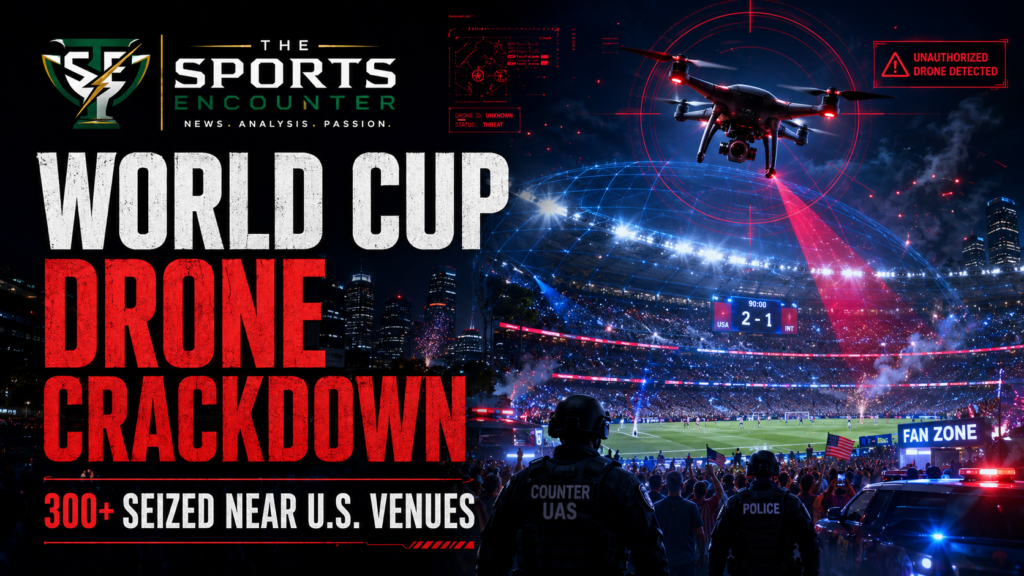
The FIFA World Cup 2026 is being played on grass, watched from packed stands, and celebrated in fan zones across the United States. But one of the tournament’s most serious security battles is happening above everyone’s heads.
U.S. agencies have seized more than 300 drones near World Cup venues since the tournament began on June 11, according to the Transportation Security Administration. The figure shows how quickly unauthorized drone activity has become one of the most visible security pressure points around the tournament.
This is not a small operational headache.
It is a major test of how the United States manages airspace around the biggest football event on earth, where stadiums, fan festivals, team movements, broadcast operations, and public gatherings all create security layers that cannot be treated casually.
For readers following The Sports Encounter’s FIFA World Cup 2026 coverage, this is a reminder that the tournament is not only about fixtures, goals, and group-stage drama. It is also about crowd safety, law enforcement coordination, technology, and the unseen systems that allow millions of fans to enjoy the event without disruption.
More Than 300 Drones Seized Since Opening Day
The TSA said U.S. agencies have seized over 300 drones near FIFA World Cup sites since play began on June 11.
That number matters because it came less than two weeks into the tournament. It also shows that drone restrictions are not only theoretical warnings printed on official websites. Federal agencies are actively enforcing them around stadiums and fan areas.
The FBI’s Miami field office alone said it had issued tickets to 49 drone operators and seized 54 drones in Florida. Other cities have also reported seizures and enforcement activity as World Cup matches continue across U.S. venues.
The most important point is simple: drone operators are still flying into restricted areas despite repeated warnings.
Some may be hobbyists trying to capture crowd shots. Some may be influencers chasing social content. Some may be visitors who do not understand U.S. airspace rules. Law enforcement cannot afford to separate harmless intent from potential risk in real time over a packed stadium.
That is why the response has been firm.
During a tournament of this scale, unauthorized drones are treated as security threats until proven otherwise.
What the No-Drone Rules Actually Say
The Federal Aviation Administration has established temporary flight restrictions over World Cup stadiums, fan events, team base camps, and related sites across the United States.
On match days, all aircraft operations, including drones, are prohibited within a 3-nautical-mile radius of stadiums and up to 3,000 feet above ground level unless specifically authorized by air traffic control.
Fan gatherings have their own restrictions. At those sites, drone operations are generally barred within a 1-nautical-mile radius and up to 1,000 feet above ground level unless authorized.
These restrictions cover far more than the stadium bowl.
They can include surrounding streets, fan zones, parks, official gatherings, training facilities, hotels, and event spaces connected to the tournament. That makes casual drone use especially risky for visitors who assume a flight is legal because they are not directly over the stadium.
The FAA has also warned that drone operators who enter restricted airspace without approval can face fines of up to $100,000, drone confiscation, and federal criminal charges.
That is not a warning to ignore.
Why Drones Are Such a Serious World Cup Concern
Drones have changed event security.
A decade ago, the main stadium-security concerns were crowd movement, ticketing, perimeter checks, traffic, and possible ground-level disruption. Those risks still matter. But drones add a new layer because they can move quickly, approach from unexpected angles, and enter areas that traditional crowd-control systems cannot physically block.
A small drone can create panic if it appears over a crowd.
It can interrupt match operations.
It can interfere with helicopters or law enforcement aircraft.
It can carry cameras into protected areas.
In a worst-case scenario, it can be modified for hostile use.
That is why major events now treat drone defense as a core safety function, not a side issue for aviation regulators.
The World Cup brings together huge crowds, international teams, political visibility, celebrity presence, broadcast value, and global attention. Any disruption would travel instantly across social media and international news platforms.
The United States knows that.
So do the agencies responsible for securing the tournament.
The Hidden Security Network Around Stadiums
The FBI has teams stationed around World Cup stadiums to detect and disable unauthorized drones. Federal law enforcement also has authority to use specialized mitigation tools when drones enter restricted airspace.
That means security is not limited to officers standing outside gates.
It includes airspace monitoring, drone detection systems, enforcement teams, aviation coordination, local police support, federal prosecution capacity, and real-time response plans. The purpose is to spot unauthorized drones quickly, identify the operator where possible, seize equipment, and prevent escalation.
This is the kind of work most fans never see unless something goes wrong.
That is exactly how it should be.
Good tournament security is usually invisible. It keeps matches moving, fans safe, players protected, and venues stable without making the event feel like a security operation first and a football festival second.
The problem with drones is that one careless operator can force that invisible system into public view.
Fans Need to Understand the Risk Before Flying
The World Cup is a dream setting for drone footage.
Stadium lights. National flags. Crowds marching through city streets. Fan zones packed with color. Team buses arriving. Skyline shots. Sunset over match-day venues.
That temptation is exactly why the restrictions matter.
Fans may think they are capturing memories. Agencies may see an aircraft in restricted space near tens of thousands of people. Those two realities can collide quickly.
Drone owners should not assume that distance from the stadium makes a flight legal. They should check FAA temporary flight restrictions, official no-drone zone maps, and local instructions before even unpacking a drone near a World Cup city.
The safest rule for most fans is straightforward.
Do not fly a drone near World Cup stadiums, fan zones, training sites, hotels, public viewing areas, or match-day crowds unless you have official authorization.
A great photo is not worth a seized drone, a federal investigation, or a fine that can reach six figures.
Seattle, Miami, Kansas City and Other Cities Show the Scale of the Issue
The Reuters report highlighted Seattle fan scenes after the United States’ Group D match against Australia, while Florida enforcement numbers showed how active drone monitoring has become in one major host state.
Kansas City has also seen federal enforcement around World Cup events, including drones seized during match-related activity near stadium and fan festival areas. Dallas-area reporting has described dozens of drone seizures around World Cup sites in North Texas.
The pattern is clear.
This is not one city’s problem.
It is a national tournament-security issue across host markets.
That makes the World Cup a stress test for future major events in the United States, including later knockout matches, the final stages of the tournament, and other global sports events that will bring similar airspace risks.
The U.S. security response now will likely shape how future events handle drone restrictions, detection, penalties, and public messaging.
FIFA World Cup 2026 Is Testing More Than Football Infrastructure
FIFA World Cup 2026 has always been a massive logistical project.
It is spread across three countries, multiple time zones, major cities, border systems, transport networks, fan zones, and stadium environments. The U.S. portion alone requires coordination between federal agencies, local governments, police departments, aviation authorities, venue operators, and tournament organizers.
The drone issue shows how modern sports infrastructure now extends above the venue.
Stadium security no longer ends at turnstiles. Match-day planning now includes airspace, digital monitoring, emergency communications, counter-drone technology, and public compliance.
That adds a new layer to how fans should understand the tournament.
When we cover match results, tactical trends, and group-stage turning points, we are seeing the public face of the World Cup. Behind that, another tournament is being managed by agencies trying to make sure the event stays safe.
That hidden effort deserves attention because it protects the experience fans came to enjoy.
Why This Matters as the FIFA World Cup 2026 Knockout Rounds Approach
The risk will not disappear as the tournament moves forward.
In fact, it may grow.
Knockout matches bring bigger stakes, more emotion, more international attention, and heavier crowds. Fan gatherings become louder. Team hotels attract more attention. Stadium approaches become more congested. More casual visitors may arrive as the tournament builds toward its final weeks.
That means drone enforcement will likely remain aggressive.
Authorities will not want a preventable incident to define a match, a city, or the tournament. The message to fans is already clear, but the number of seizures suggests it still needs repeating.
World Cup venues and fan zones are no-drone environments unless official authorization has been granted.
That applies whether the operator is a tourist, content creator, local resident, journalist, hobby pilot, or commercial user without proper clearance.
The Bigger Lesson for Fans and Content Creators
The World Cup has become a content factory.
Every fan has a phone. Every celebration becomes a clip. Every match-day street becomes a possible viral moment. Drones sit naturally inside that culture because they promise cinematic footage without much effort.
But major events are not open-air content sets.
They are controlled security environments.
That distinction matters. A creator may be thinking about angles and engagement. Law enforcement is thinking about crowd safety, airspace control, and threat prevention.
The gap between those two mindsets is where many violations happen.
For content creators covering the World Cup, the better approach is to work within permitted media zones, official event guidelines, public street-level coverage, and authorized footage. The tournament already provides more than enough visual energy without risking federal penalties.
Football gives you emotion at ground level.
You do not need a drone to find the story.
Final Word
The seizure of more than 300 drones near FIFA World Cup venues is one of the clearest signs that tournament security has entered a new era.
The World Cup is still about football. It is still about goals, flags, songs, nerves, and national pride. But modern mega-events now require a level of airspace control that previous generations of fans never had to think about.
U.S. agencies are treating drone violations seriously because the stakes are serious.
A drone near a stadium is not just a gadget in the sky. It is an unknown aircraft entering restricted space above a major international event. That is enough to trigger enforcement, seizure, fines, and possible criminal consequences.
Fans should take the warning seriously.
Enjoy the matches. Record the streets. Capture the atmosphere from where it is safe and legal. Let the official broadcast teams and authorized operators handle the aerial views.
The tournament has enough drama on the pitch.
It does not need avoidable trouble in the sky.
For more tournament coverage, visit The Sports Encounter’s FIFA World Cup 2026 Hub. You can also read our guide on how FIFA World Cup 2026 qualification works, our analysis of Spain’s statement win over Saudi Arabia, and our report on Jonathan David’s hat-trick for Canada.
The Sports Encounter’s World Cup 2026 coverage focuses on fixtures, team news, match analysis, fan stories, tournament trends, and the biggest talking points from football’s global stage.
FAQs
How many drones have been seized near FIFA World Cup 2026 venues?
U.S. agencies have seized more than 300 drones near FIFA World Cup venues since the tournament began on June 11.
Are drones banned near World Cup stadiums?
Yes. On match days, unauthorized drone operations are prohibited within a 3-nautical-mile radius and up to 3,000 feet above ground level around World Cup stadiums.
Are drones also banned near fan zones?
Yes. Drone operations are generally prohibited within a 1-nautical-mile radius and up to 1,000 feet above ground level at designated World Cup fan-event locations unless authorized.
What penalties can drone operators face?
Unauthorized operators can face fines of up to $100,000, drone confiscation, and possible federal criminal charges.
Why are drones considered a major security risk at the World Cup?
Drones can disrupt airspace, interfere with match operations, create crowd panic, record protected areas, or pose more serious security threats. That is why authorities are enforcing strict no-drone zones.