


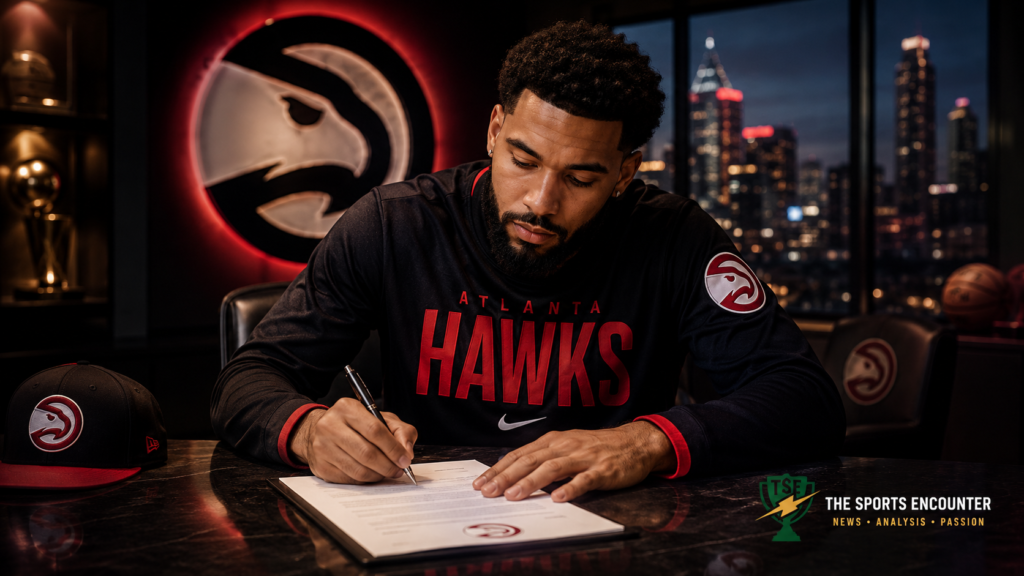
The Oklahoma City Thunder trading Aaron Wiggins to the Atlanta Hawks feels strange at first glance.
A 27-year-old guard. A proven rotation player. A career 38 percent three-point shooter. A trusted regular-season piece. A player who averaged 9.4 points, 3.1 rebounds, and 1.7 assists last season while starting 21 games.
So why would a championship-level team send him away for two second-round picks?
The answer sits at the intersection of money, depth, timing, draft flexibility, and the brutal reality of roster building in the modern NBA.
Oklahoma City did not give Wiggins away because he could not play. The Thunder moved him because their roster has reached the stage where useful players can become expensive luxuries. For Atlanta, that same player becomes a low-cost rotation upgrade. That is why this deal makes sense for both sides, even if it looks cold from the outside.
According to multiple reports, the Thunder are sending Wiggins to the Hawks for Atlanta’s 2030 second-round pick and the least favorable of Atlanta’s or the Los Angeles Lakers’ 2032 second-round pick. On paper, that return looks light. In practical NBA terms, the real return is not only the picks. It is the money saved, the roster spot opened, and the flexibility gained before the draft.
The Trade Was Really About Oklahoma City’s Luxury Tax Problem
The biggest number in this deal is not Wiggins’ scoring average. It is Oklahoma City’s projected luxury tax bill.
ESPN reported that the Thunder entered the offseason with a projected luxury tax penalty of $213 million. Trading Wiggins reduces that figure to around $152 million. That is a saving of more than $60 million.
That number changes the entire conversation.
Wiggins is due $9.2 million next season, with three years remaining on his contract. In a normal cap situation, that salary is reasonable for a rotation guard. For a team buried deep into the tax, however, every dollar becomes multiplied. The real cost of keeping him was far higher than his base salary.
This is the kind of move championship teams often hate making but eventually must make. Winning creates value across the roster. Role players get paid. Young stars become more expensive. Extension decisions pile up. Draft picks need roster space. Suddenly, the front office is no longer asking, “Can this player help us?” It is asking, “Can we justify this player’s total cost compared with his role?”
For Wiggins, the answer became difficult.
Oklahoma City’s front office has built one of the deepest teams in basketball. That depth gave the Thunder protection during injuries and flexibility across the regular season. It also created a squeeze. Wiggins was good enough to help, but not central enough to be untouchable.
That is how a useful player becomes movable.
Aaron Wiggins’ Playoff Role Told the Real Story
The regular-season version of Wiggins had clear value. He played 65 games, started 21, and gave the Thunder dependable minutes. Across his five-year career in Oklahoma City, he averaged 8.7 points, 3.2 rebounds, and 1.4 assists over 339 games. He also started 100 regular-season games, which tells you he was more than a back-of-the-bench option.
The playoffs changed the equation.
Last season, Wiggins averaged only 1.5 points in 5.8 minutes over 13 playoff games. When rotations tightened, his role almost disappeared. That matters more than regular-season production when a contender evaluates its future.
Playoff basketball is unforgiving. Coaches shorten the bench. Matchups become targeted. Every defensive possession is hunted. Every offensive weakness gets magnified. A player can help win games in January and still become hard to use in May.
Oklahoma City had already seen that shift.
The Thunder had enough guards, wings, creators, and defenders to survive without giving Wiggins a major postseason role. Jared McCain, acquired from the Philadelphia 76ers during the season, reportedly moved ahead of him in the playoff rotation and projects to hold a bigger bench role next season.
That point is important. Wiggins was not pushed out by one bad stretch. He was squeezed out by Oklahoma City’s own success in building a deep, young, flexible roster.
The Thunder did not need to ask whether Wiggins was an NBA player. They needed to ask whether he was one of their eight or nine most important playoff players. By the end of the postseason, the answer looked clear.
For more basketball coverage across the league, follow The Sports Encounter’s NBA Hub.
The Thunder Also Needed Draft Flexibility
Oklahoma City holds the No. 12 and No. 17 picks in the upcoming NBA Draft. That detail makes the Wiggins trade even more logical.
Two first-round picks mean two guaranteed rookie contracts unless the Thunder move one of them or package both to trade up. Either way, roster space matters. Payroll planning matters. Development minutes matter.
A contender with too many young players can run into a different kind of problem. There are only so many rotation minutes, only so many developmental reps, and only so many roster spots. Oklahoma City has spent years collecting assets. Now the front office has to keep converting those assets into a sustainable roster.
That is harder than it sounds.
The Thunder cannot carry every useful player forever. They must constantly decide which players fit the next version of the team. Wiggins helped this version. But with two first-round picks, a deep guard rotation, and a giant tax bill, Oklahoma City had to create room somewhere.
Trading him before the draft gives the Thunder more options.
They can keep both picks and add younger, cheaper players. They can consolidate the picks and move higher. They can use the open roster spot to balance positions. They can also reduce future financial pressure before bigger contract decisions arrive.
This is how smart front offices stay ahead of the tax instead of reacting too late. It is also why Oklahoma City’s current move should be read beside the wider league picture, including the early NBA 2026-27 title odds debate, where roster depth, payroll pressure, and championship windows already shape next season’s expectations.
Draft Capital Is Not Only About Selecting Players
The two second-round picks Oklahoma City received may look distant, but draft capital has a different meaning for a team like the Thunder.
Future picks can become trade sweeteners. They can help move money. They can be used in draft-night swaps. They can support larger consolidation deals. Oklahoma City has spent years treating picks as flexible currency, and this deal follows that same logic.
Why Atlanta Wanted Aaron Wiggins?
From Atlanta’s side, this is a very different deal.
The Hawks are not taking on a mystery player. They are adding a 27-year-old guard with playoff experience, a reliable regular-season track record, and a career three-point percentage of 38 percent. That is valuable in today’s NBA.

Atlanta also had a practical path to absorb him. Reports noted that the Hawks had an $11 million trade exception created from the Luke Kennard deal with the Lakers in February. Wiggins’ $9.2 million salary fits neatly into that structure.
That makes this a clean acquisition.
The Hawks give up two future second-round picks, both years away, and receive a player who can help now. Wiggins can defend, space the floor, attack closeouts, and play without needing the ball. Those are exactly the kind of skills teams want around primary creators.
Atlanta also reportedly re-signed CJ McCollum, adding another veteran guard presence. With Wiggins arriving, the Hawks are clearly trying to make the roster deeper, more stable, and more playoff-ready.
This is not a superstar move. It is a winning-margin move.
Teams do not build strong seasons only through stars. They need the sixth, seventh, eighth, and ninth players to make sense. Wiggins gives Atlanta another credible rotation option without requiring a major trade package.
For the Hawks, this is the opposite of Oklahoma City’s problem. The Thunder had too many playable guards for the cost. Atlanta saw one available at the right price.
Aaron Wiggins Transfer: Why the Return Looks Small but Still Makes Sense
Fans often judge trades by name value. That is understandable. Aaron Wiggins was a familiar Thunder player and a respected role piece. Two second-round picks in 2030 and 2032 do not feel exciting.
But Oklahoma City’s real priority was not headline value.
The Thunder wanted tax relief, a roster spot, and future flexibility. They also avoided taking salary back. In that context, the return becomes easier to understand.
This is the modern NBA’s cold math.
A player can be worth more to another team than to his current team. Wiggins may be more useful to Atlanta than he was going to be in Oklahoma City next season. That difference creates the trade.
Oklahoma City’s front office also values future draft assets. Even second-round picks can become trade chips, stash opportunities, or sweeteners in larger deals. The Thunder have repeatedly treated draft capital as a flexible currency, not just a way to select players.
Still, this deal will feel emotional for Thunder fans who remember Aaron Wiggins’ journey. Oklahoma City selected him in the second round of the 2021 NBA Draft out of Maryland. He developed inside the organization, became a useful contributor, and played a part in the team’s rise.
That is why the move feels less like a basketball rejection and more like a roster-stage decision.
The Thunder are no longer rebuilding. They are managing a contender.
That phase is less romantic.
Oklahoma City’s Depth Made This Possible
The Thunder could make this trade because they had already built enough depth to survive it.
That is the central point.
A weaker team probably keeps Aaron Wiggins. A thinner contender probably cannot afford to lose him. Oklahoma City can, because its guard and wing rotation has become one of the league’s strongest development pipelines.
The Thunder’s rise has been built on player growth, draft accumulation, and intelligent roster balance. Shai Gilgeous-Alexander gives them star power. The supporting cast gives them range, pace, defense, and youth. Their playoff run showed how many players can step into different roles.
That depth is a strength, but it creates difficult choices.
When Wiggins was averaging 12.0 points in the 2024-25 regular season, he looked like a strong long-term bench piece. One year later, with his playoff role shrinking and the tax bill rising, the same player became expendable.
That does not mean he declined beyond usefulness. It means the Thunder’s roster context changed.
The NBA punishes teams that hold onto every good story too long. Oklahoma City appears determined to avoid that trap.
The Thunder’s Western Conference run also showed how quickly their championship window has evolved. For more context on their playoff position and Finals path, read Knicks Await NBA Finals Opponent as Thunder-Spurs Lock Horns in Game 6.
Playoff Windows Can Turn Fast
Oklahoma City already understands how quickly the league can move from celebration to recalibration. The postseason does not leave much room for sentiment, and the Finals picture around the league showed that clearly. The Knicks’ title run, covered in New York Knicks Finish NBA Finals Rout in 5 Games, End 53-Year Title Wait, proved how fast one team’s breakthrough can reshape the league conversation.
What This Means for Wiggins
For Wiggins, Atlanta could be a strong landing spot.
He leaves a crowded team and joins a franchise that should have more room for his skill set. He can compete for rotation minutes, provide shooting, and offer steady two-way play. At 27, he is not a developmental gamble. He is entering his prime as a role player.
The Hawks are likely not asking him to become a star. They need him to be solid, reliable, and efficient. That is exactly the profile he has shown across his career.
A larger role could also restore some of the value that got lost during Oklahoma City’s playoff rotation squeeze. If he plays regular minutes, shoots near his career average from three, and defends well enough to stay on the floor, Atlanta will feel it acquired him cheaply.
This is why the Hawks’ side of the deal deserves credit.
They took advantage of another team’s financial pressure and added a useful player without sacrificing a major asset.
The Bigger NBA Lesson Behind the Deal
This trade also shows where the NBA is heading.
Championship teams cannot only think about talent. They have to think about contract timing, tax bands, second-apron pressure, rookie-scale value, and whether a player’s role survives deep into the playoffs.
Wiggins is a good player. That is exactly what makes the deal interesting. Oklahoma City did not move a non-factor. It moved a useful piece because the math of contention made the decision attractive.
That is the same league environment that helped make this year’s Finals so important commercially and competitively. As Knicks-Spurs Ratings Boom Shows Why the NBA Still Owns the Big Stage explained, the NBA still has massive audience power when the story is clear. Front offices know that, and they are building rosters for moments that survive the brightest stage.
Final Verdict: OKC Did Not Give Wiggins Away, It Bought Flexibility
The phrase “give away” makes the trade sound careless. It was probably the opposite.
Oklahoma City made a calculated decision. The Thunder looked at Wiggins’ salary, playoff role, roster depth, tax burden, draft position, and future flexibility. Then they chose the cleaner path.
It may hurt emotionally. It may even help Atlanta immediately. But for OKC, the move fits the reality of a contender entering its expensive phase.
The Thunder saved more than $60 million in projected tax penalties, opened a roster spot before the draft, collected two future second-round picks, and moved a player whose postseason role had shrunk. That is not a glamorous return. It is a strategic one.
Atlanta, meanwhile, got a capable rotation guard at a modest acquisition cost.
Both teams solved different problems.
The Hawks needed depth.
The Thunder needed flexibility.
Aaron Wiggins was simply the player caught between those two needs of the two very different NBA franchises.
FAQs
Why did the Thunder trade Aaron Wiggins?
The Thunder traded Aaron Wiggins mainly to reduce their projected luxury tax bill, open a roster spot, and create flexibility before the NBA Draft. His playoff role had also become much smaller.
What did Oklahoma City get for Aaron Wiggins?
Oklahoma City reportedly received Atlanta’s 2030 second-round pick and the least favorable of Atlanta’s or the Los Angeles Lakers’ 2032 second-round pick.
How much money did the Thunder save by trading Wiggins?
Reports said the trade reduced Oklahoma City’s projected luxury tax penalty from $213 million to around $152 million, saving more than $60 million.
Is Aaron Wiggins a good pickup for the Hawks?
Yes. Wiggins gives Atlanta a proven rotation guard with playoff experience, career 38 percent three-point shooting, and the ability to play useful minutes without needing a high-usage role.
Did Wiggins lose his role in Oklahoma City?
His regular-season role was still useful, but his playoff role shrank sharply. He averaged only 1.5 points and 5.8 minutes in 13 playoff games last season.