


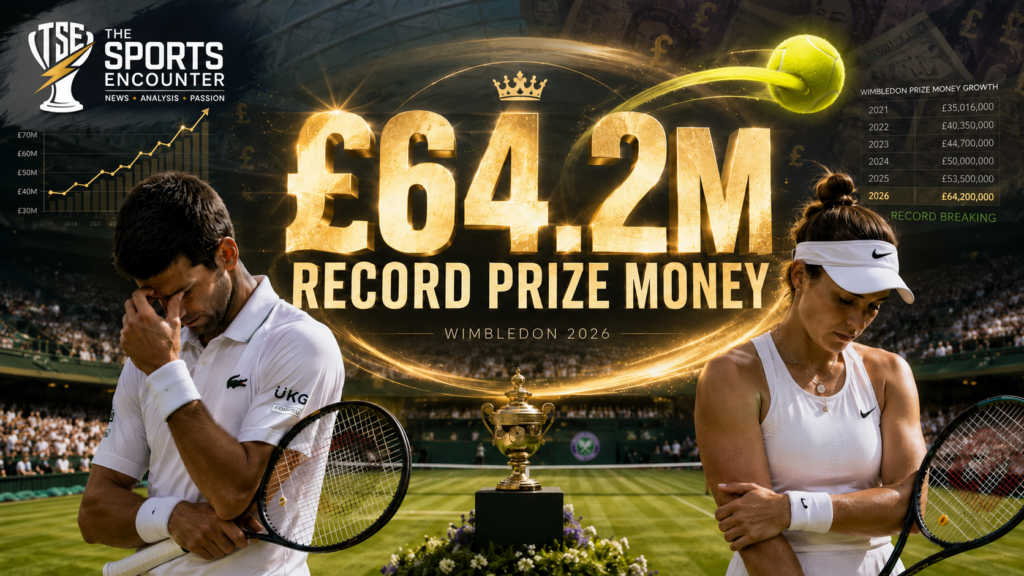
Wimbledon has answered the player pay debate with its biggest prize-money rise in history, but the dispute around Grand Slam revenue sharing has not gone away.
The All England Club has announced a record £64.2 million prize-money fund for Wimbledon 2026, a 20% increase from 2025. The men’s and women’s singles champions will each receive £3.6 million, while first-round singles players will earn £80,000. Qualifying prize money has also gone up by 25%, taking that fund beyond £6 million.
For the full tournament backdrop, key dates, player storylines, and grass-court power shift, read our Wimbledon 2026 curtain raiser.
On paper, this is a major move. In tennis politics, it is only part of the answer.
The increase gives Wimbledon a strong headline before the Championships begin, but it also lands during one of the most serious conversations in modern tennis: how much of Grand Slam revenue should go back to the players who create the show?
Here is the Complete Wimbledon 2026 dates and schedule
Wimbledon 2026 Prize Money Reaches £64.2 Million
The headline number is impossible to ignore.
A £64.2 million prize pot is a record for Wimbledon and represents a £10.7 million rise from last year’s tournament. Wimbledon’s official announcement framed the increase as part of a broader commitment to players, facilities, services, the grass-court season, and tennis development. The All England Club also said it has invested nearly £1 billion into prize money, event facilities, services, and tennis support since COVID.
For the players on the court, the numbers are clear.
The singles champions will earn £3.6 million each. First-round singles players will receive £80,000. The qualifying competition also gets a notable uplift, which matters because lower-ranked players often operate with tighter financial margins than established stars.
That detail should not be overlooked. A Grand Slam’s health does not depend only on champions holding trophies. It also depends on the players fighting through qualifying, early rounds, travel costs, coaching expenses, and an unforgiving calendar.
Why Players Still Want More
The issue is not whether £64.2 million is a large prize fund. It is. The issue is whether players believe the distribution matches the money Grand Slams generate.
Top ATP and WTA events are understood to return around 22% of revenue to players, while Grand Slams are estimated to return closer to 15%. That gap has become the center of the current dispute.
Players have been pushing for a higher share of Grand Slam revenue, with reports saying their target is a model that moves closer to 22% by 2030. Some players had reportedly sought a Wimbledon prize fund around £70 million to £71 million, which would have aligned more closely with their revenue-share demands.
That is why the latest increase can be both historic and insufficient at the same time.
For Wimbledon, a 20% increase is a major financial step. For players, the question remains whether it reflects a fair share of the business they help power.
The All England Club’s Position
Wimbledon’s leadership has defended its approach by pointing to the tournament’s operating model.
The All England Club is not positioned as a standard commercial sports league. Chair Debbie Jevans has stressed the tournament’s not-for-profit structure and its wider investment responsibilities, including facilities, services, the grass-court season, and support for British tennis. Reuters reported that Wimbledon reinvests surplus into the sport, including a major contribution to the Lawn Tennis Association last year.
This is where the dispute becomes more complicated than a simple “players want more money” argument.
Grand Slam organizers argue they fund an entire tennis ecosystem. Players argue that the sport’s biggest events rely heavily on their labor, visibility, risk, and star power, so the revenue share should reflect that more clearly.
Both positions have logic. Both also have pressure points.
If Wimbledon gives too much away, it may argue that development funding, facilities, and tournament investment suffer. If it gives too little, players may feel they are being asked to carry the entertainment value without getting a fair enough stake in the upside.
Why the Timing Matters
Wimbledon’s announcement comes after rising player frustration across the Grand Slam calendar.
Reuters reported in May that players accused Grand Slams of ignoring their concerns as tensions rose around prize money, revenue sharing, and representation. The French Open also faced pressure after its prize-money increase failed to calm player dissatisfaction.
That wider context matters because Wimbledon is not operating in isolation.
ALSO READ: When Paris Welcomed Two New French Open Champions
The biggest names in tennis now understand their collective leverage better than before. They play individual matches, but in business terms, they are starting to sound more like a group asking for formal recognition in how the biggest tournaments divide revenue.
That shift could shape Grand Slam politics for years.
Prize Money Is Only Part of the Story
Wimbledon has also introduced or expanded other player-facing changes.
Reuters reported that the tournament will introduce video review technology in 2026, allowing players to challenge certain judgment calls made by the chair umpire, including situations such as double bounces or whether the ball touched a player’s racket or body. This sits alongside live Electronic Line Calling, which Wimbledon introduced earlier.
The All England Club has also highlighted improved facilities and services as part of its broader player support.
That matters because modern tennis players are not only asking about prize money. They are also asking about scheduling, welfare, rest, transparency, and communication. Prize money gets the headline, but the bigger issue is whether the sport’s biggest events treat players as partners rather than visiting performers.
What This Means for Wimbledon 2026
For fans, the immediate takeaway is simple: Wimbledon 2026 will offer record prize money and some of the richest rewards in the sport.
For players, the announcement may feel like progress without closure.
The £64.2 million prize fund shows that Wimbledon has moved. The continuing dispute shows that players want a more formal and transparent revenue-sharing framework, not only periodic increases when pressure builds.
That tension could hang over the Championships, especially if leading players continue to speak publicly about fairness, revenue, and representation. Wimbledon still has prestige few tournaments can match. But prestige alone no longer settles business questions in elite sport.
The grass will still be immaculate. Centre Court will still feel like Centre Court. The champions will still lift one of tennis’s most iconic trophies.
But behind the clean whites and polished traditions, tennis is changing. Wimbledon 2026 prize money has reached record territory. The bigger question now is whether the sport can find a revenue model that satisfies both the institutions that built the Grand Slams and the players who keep them alive.